Small Logos, Big Meaning:
 Hot on the Trail of Credible Certification
         Green Roundtable Webinar 12.1.10
    Mark T. Petruzzi, VP of Certification & Strategic Relations


        Green Seal Background
• 501 (c)(3) science-based non-profit
• Beginning 22nd year
• Environmental mission with exclusive focus on
  products, services, purchasing, operations
• Encompass multiple product & service categories
• Utilize a multiple criteria / life-cycle approach
• No financial interest in certified products/services
  or in any manufacturer or company

                                                                  2
Why is Credible Certification Important?
• Rise of Greenwashing and environmental claims: “green” = $
• Reluctance to trust manufacturers claims – they want to sell
  products
• Single attributes sometimes “apples to oranges” (non-toxic vs. low
  VOC – what about performance?)
• Manufacturers are not required to provide full disclosure, even if
  available hard to interpret
• Reduce the effort needed for identifying, selecting and purchasing
  environmentally responsible products and services
• Distinguish brand from competitors
• Obtain business from purchasers at all levels looking (or mandated)
  to procure green products & service
• Validated by recognized third-party
                                                                    3


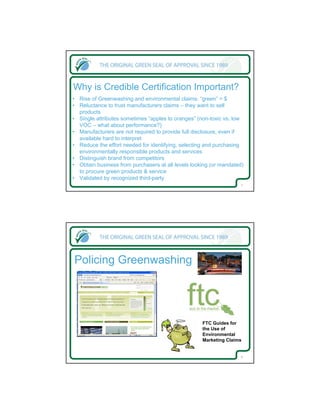
Policing Greenwashing


                                                    FTC Guides for
                                                    the Use of
                                                    Environmental
                                                    Marketing Claims


                                                                    4
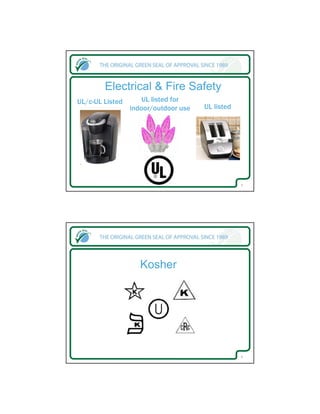
Electrical & Fire Safety
UL/c-UL Listed      UL listed for
                 indoor/outdoor use   UL listed


                                                  5


                    Kosher


                                                  6
Public Health/Food Safety


                            7


     Used Vehicles


                            8
Water Filters/Treatment


                          9


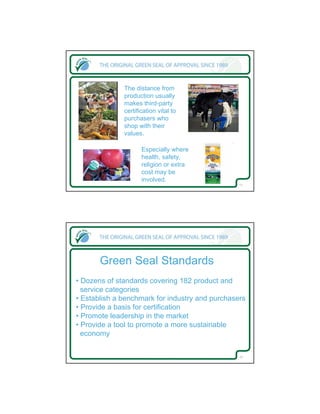
     Diamonds


                          10
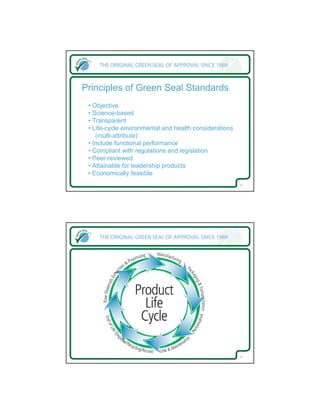
The distance from
              production usually
              makes third-party
              certification vital to
              purchasers who
              shop with their
              values.

                     Especially where
                     health, safety,
                     religion or extra
                     cost may be
                     involved.
                                                 11


       Green Seal Standards
• Dozens of standards covering 182 product and
  service categories
• Establish a benchmark for industry and purchasers
• Provide a basis for certification
• Promote leadership in the market
• Provide a tool to promote a more sustainable
  economy


                                                 12
Principles of Green Seal Standards
 • Objective
 • Science-based
 • Transparent
 • Life-cycle environmental and health considerations
    (multi-attribute)
 • Include functional performance
 • Compliant with regulations and legislation
 • Peer-reviewed
 • Attainable for leadership products
 • Economically feasible
                                                        13


                                                        14
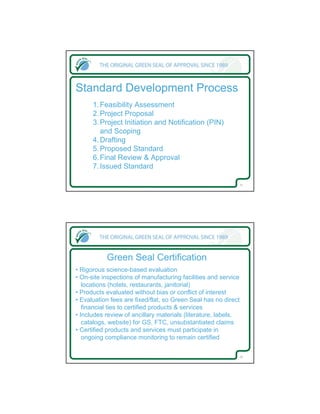
Standard Development Process
      1. Feasibility Assessment
      2. Project Proposal
      3. Project Initiation and Notification (PIN)
         and Scoping
      4. Drafting
      5. Proposed Standard
      6. Final Review & Approval
      7. Issued Standard

                                                            15


           Green Seal Certification
• Rigorous science-based evaluation
• On-site inspections of manufacturing facilities and service
   locations (hotels, restaurants, janitorial)
• Products evaluated without bias or conflict of interest
• Evaluation fees are fixed/flat, so Green Seal has no direct
   financial ties to certified products & services
• Includes review of ancillary materials (literature, labels,
   catalogs, website) for GS, FTC, unsubstantiated claims
• Certified products and services must participate in
   ongoing compliance monitoring to remain certified

                                                            16
Guidelines for Type I “Seal of Approval” Ecolabels
• ISO 14020 Environmental labels and declarations – General
  principles
• ISO 14024 Type I Environmental labelling – Principles and
  procedures
• Global Ecolabelling Network (GEN) membership (Green Seal
  is the US member )
• ANSI-accredited standards developing organization
• EPA criteria for third-party certifiers
• Consumers Union criteria for “What Makes a Good Ecolabel”
• FTC Guides for the Use of Environmental Marketing Claims


                                                              17


  The Global Ecolabelling Network (GEN)
     founded 1994, currently 26 member programs


                                                              18
Commonalities Among Guidelines
• Voluntary participation        • Criteria based on product
• Run by organizations without       life-cycle
conflicts of interest            • Open access to licensees of
• Standards process involves     all sizes, all countries
stakeholders & the public        • Authority to inspect manuf.
• Criteria, assumptions,         facility or service location
methods & data used are          • Criteria that encourage
open & transparent (i.e.,        products & services that are
publicly available, easily       significantly less damaging to
accessed & understandable)       the environment (leadership)
• Legally protected mark         • Periodic review of criteria,
                                 considering technology &
                                 marketplace
                                                                  19


             FTC Green Guides
 Federal Trade Commission
 16 CFR Part 260
 Guides for the Use of Environmental Marketing Claims

 First issued in 1992, revised in 1996 and 1998.

 Proposed revisions posted in the Federal Register in
 October with comments due by December 10, 2010.

 http://www.ftc.gov/green

                                                                  20
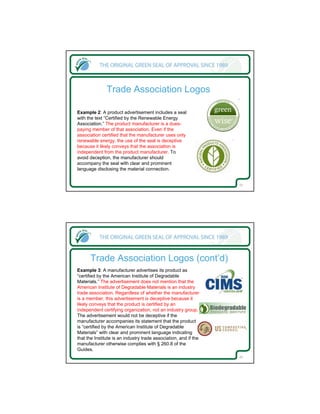
Logos/Seals Considered Endorsements
16 CFR Part 255 - Guides Concerning the Use of Endorsements &
Testimonials in Advertising

Must disclose “material connections”
“When there exists a connection between the endorser and the seller of
the advertised product that might materially affect the weight or credibility
of the endorsement (i.e., the connection is not reasonably expected by
the audience), such connection must be fully disclosed.”
               OAKLAND, Calif., (March 1, 2010) - The Green Works® natural
               cleaners brand today announced that it is giving $645,000 to Sierra
       *       Club® to support the organization's ongoing conservation efforts.
               The donation, based on 2009 calendar year sales, raises the Green
               Works® brand's two-year contribution total to more than $1.1
               million.
               *Sierra Club logo is used with permission, which does not constitute
               sponsorship or endorsement of any company or product.
                                                                                      21


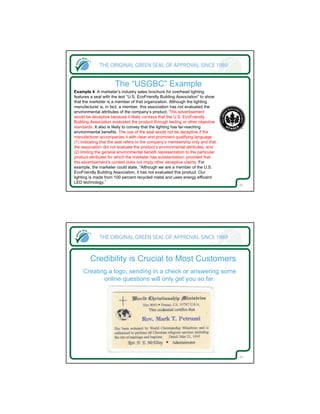
   Logos Created by Manufacturers
Example 1: An advertisement for paint features a
“GreenLogo” seal and the statement “GreenLogo for
Environmental Excellence.” This advertisement likely
conveys that: (1) the GreenLogo seal is awarded by an
independent, third-party certifier with expertise in
evaluating the environmental attributes of paint; and (2)
the product has far-reaching environmental benefits. If
the paint manufacturer placed the GreenLogo seal in its
advertisement, and no independent, third-party certifier
evaluated the paint, the claim would be deceptive. The
claim would not be deceptive if the marketer
accompanied the seal with clear and prominent
language: (1) indicating that the marketer itself created
the GreenLogo seal; and (2) limiting the general
environmental benefit representation to the particular
product attributes for which the marketer has
substantiation, provided that the advertisement’s context
does not imply other deceptive claims.
                                                                                      22
Trade Association Logos

Example 2: A product advertisement includes a seal
with the text “Certified by the Renewable Energy
Association.” The product manufacturer is a dues-
paying member of that association. Even if the
association certified that the manufacturer uses only
renewable energy, the use of the seal is deceptive
because it likely conveys that the association is
independent from the product manufacturer. To
avoid deception, the manufacturer should
accompany the seal with clear and prominent
language disclosing the material connection.


                                                                  23


      Trade Association Logos (cont’d)
Example 3: A manufacturer advertises its product as
“certified by the American Institute of Degradable
Materials.” The advertisement does not mention that the
American Institute of Degradable Materials is an industry
trade association. Regardless of whether the manufacturer
is a member, this advertisement is deceptive because it
likely conveys that the product is certified by an
independent certifying organization, not an industry group.
The advertisement would not be deceptive if the
manufacturer accompanies its statement that the product
is “certified by the American Institute of Degradable
Materials” with clear and prominent language indicating
that the Institute is an industry trade association, and if the
manufacturer otherwise complies with § 260.8 of the
Guides.
                                                                  24
The “USGBC” Example
Example 4: A marketer’s industry sales brochure for overhead lighting
features a seal with the text “U.S. EcoFriendly Building Association” to show
that the marketer is a member of that organization. Although the lighting
manufacturer is, in fact, a member, this association has not evaluated the
environmental attributes of the company’s product. This advertisement
would be deceptive because it likely conveys that the U.S. EcoFriendly
Building Association evaluated the product through testing or other objective
standards. It also is likely to convey that the lighting has far-reaching
environmental benefits. The use of the seal would not be deceptive if the
manufacturer accompanies it with clear and prominent qualifying language:
(1) indicating that the seal refers to the company’s membership only and that
the association did not evaluate the product’s environmental attributes, and
(2) limiting the general environmental benefit representation to the particular
product attributes for which the marketer has substantiation, provided that
the advertisement’s context does not imply other deceptive claims. For
example, the marketer could state, “Although we are a member of the U.S.
EcoFriendly Building Association, it has not evaluated this product. Our
lighting is made from 100 percent recycled metal and uses energy efficient
LED technology.”
                                                                                  25


        Credibility is Crucial to Most Customers
     Creating a logo, sending in a check or answering some
            online questions will only get you so far.


                                                                                  26
Contact Information
Green Seal, Inc.
1001 Connecticut Ave, NW
Suite 827
Washington, DC 20036-5525
Tel: (336) 956-2211
Email: mpetruzzi@greenseal.org
Website: www.greenseal.org

          Thank You!!


                                 27

Lifecycle Assessment and Green Seal Certification

  • 1.
    Small Logos, BigMeaning: Hot on the Trail of Credible Certification Green Roundtable Webinar 12.1.10 Mark T. Petruzzi, VP of Certification & Strategic Relations Green Seal Background • 501 (c)(3) science-based non-profit • Beginning 22nd year • Environmental mission with exclusive focus on products, services, purchasing, operations • Encompass multiple product & service categories • Utilize a multiple criteria / life-cycle approach • No financial interest in certified products/services or in any manufacturer or company 2
  • 2.
    Why is CredibleCertification Important? • Rise of Greenwashing and environmental claims: “green” = $ • Reluctance to trust manufacturers claims – they want to sell products • Single attributes sometimes “apples to oranges” (non-toxic vs. low VOC – what about performance?) • Manufacturers are not required to provide full disclosure, even if available hard to interpret • Reduce the effort needed for identifying, selecting and purchasing environmentally responsible products and services • Distinguish brand from competitors • Obtain business from purchasers at all levels looking (or mandated) to procure green products & service • Validated by recognized third-party 3 Policing Greenwashing FTC Guides for the Use of Environmental Marketing Claims 4
  • 3.
    Electrical & FireSafety UL/c-UL Listed UL listed for indoor/outdoor use UL listed 5 Kosher 6
  • 4.
    Public Health/Food Safety 7 Used Vehicles 8
  • 5.
  • 6.
    The distance from production usually makes third-party certification vital to purchasers who shop with their values. Especially where health, safety, religion or extra cost may be involved. 11 Green Seal Standards • Dozens of standards covering 182 product and service categories • Establish a benchmark for industry and purchasers • Provide a basis for certification • Promote leadership in the market • Provide a tool to promote a more sustainable economy 12
  • 7.
    Principles of GreenSeal Standards • Objective • Science-based • Transparent • Life-cycle environmental and health considerations (multi-attribute) • Include functional performance • Compliant with regulations and legislation • Peer-reviewed • Attainable for leadership products • Economically feasible 13 14
  • 8.
    Standard Development Process 1. Feasibility Assessment 2. Project Proposal 3. Project Initiation and Notification (PIN) and Scoping 4. Drafting 5. Proposed Standard 6. Final Review & Approval 7. Issued Standard 15 Green Seal Certification • Rigorous science-based evaluation • On-site inspections of manufacturing facilities and service locations (hotels, restaurants, janitorial) • Products evaluated without bias or conflict of interest • Evaluation fees are fixed/flat, so Green Seal has no direct financial ties to certified products & services • Includes review of ancillary materials (literature, labels, catalogs, website) for GS, FTC, unsubstantiated claims • Certified products and services must participate in ongoing compliance monitoring to remain certified 16
  • 9.
    Guidelines for TypeI “Seal of Approval” Ecolabels • ISO 14020 Environmental labels and declarations – General principles • ISO 14024 Type I Environmental labelling – Principles and procedures • Global Ecolabelling Network (GEN) membership (Green Seal is the US member ) • ANSI-accredited standards developing organization • EPA criteria for third-party certifiers • Consumers Union criteria for “What Makes a Good Ecolabel” • FTC Guides for the Use of Environmental Marketing Claims 17 The Global Ecolabelling Network (GEN) founded 1994, currently 26 member programs 18
  • 10.
    Commonalities Among Guidelines •Voluntary participation • Criteria based on product • Run by organizations without life-cycle conflicts of interest • Open access to licensees of • Standards process involves all sizes, all countries stakeholders & the public • Authority to inspect manuf. • Criteria, assumptions, facility or service location methods & data used are • Criteria that encourage open & transparent (i.e., products & services that are publicly available, easily significantly less damaging to accessed & understandable) the environment (leadership) • Legally protected mark • Periodic review of criteria, considering technology & marketplace 19 FTC Green Guides Federal Trade Commission 16 CFR Part 260 Guides for the Use of Environmental Marketing Claims First issued in 1992, revised in 1996 and 1998. Proposed revisions posted in the Federal Register in October with comments due by December 10, 2010. http://www.ftc.gov/green 20
  • 11.
    Logos/Seals Considered Endorsements 16CFR Part 255 - Guides Concerning the Use of Endorsements & Testimonials in Advertising Must disclose “material connections” “When there exists a connection between the endorser and the seller of the advertised product that might materially affect the weight or credibility of the endorsement (i.e., the connection is not reasonably expected by the audience), such connection must be fully disclosed.” OAKLAND, Calif., (March 1, 2010) - The Green Works® natural cleaners brand today announced that it is giving $645,000 to Sierra * Club® to support the organization's ongoing conservation efforts. The donation, based on 2009 calendar year sales, raises the Green Works® brand's two-year contribution total to more than $1.1 million. *Sierra Club logo is used with permission, which does not constitute sponsorship or endorsement of any company or product. 21 Logos Created by Manufacturers Example 1: An advertisement for paint features a “GreenLogo” seal and the statement “GreenLogo for Environmental Excellence.” This advertisement likely conveys that: (1) the GreenLogo seal is awarded by an independent, third-party certifier with expertise in evaluating the environmental attributes of paint; and (2) the product has far-reaching environmental benefits. If the paint manufacturer placed the GreenLogo seal in its advertisement, and no independent, third-party certifier evaluated the paint, the claim would be deceptive. The claim would not be deceptive if the marketer accompanied the seal with clear and prominent language: (1) indicating that the marketer itself created the GreenLogo seal; and (2) limiting the general environmental benefit representation to the particular product attributes for which the marketer has substantiation, provided that the advertisement’s context does not imply other deceptive claims. 22
  • 12.
    Trade Association Logos Example2: A product advertisement includes a seal with the text “Certified by the Renewable Energy Association.” The product manufacturer is a dues- paying member of that association. Even if the association certified that the manufacturer uses only renewable energy, the use of the seal is deceptive because it likely conveys that the association is independent from the product manufacturer. To avoid deception, the manufacturer should accompany the seal with clear and prominent language disclosing the material connection. 23 Trade Association Logos (cont’d) Example 3: A manufacturer advertises its product as “certified by the American Institute of Degradable Materials.” The advertisement does not mention that the American Institute of Degradable Materials is an industry trade association. Regardless of whether the manufacturer is a member, this advertisement is deceptive because it likely conveys that the product is certified by an independent certifying organization, not an industry group. The advertisement would not be deceptive if the manufacturer accompanies its statement that the product is “certified by the American Institute of Degradable Materials” with clear and prominent language indicating that the Institute is an industry trade association, and if the manufacturer otherwise complies with § 260.8 of the Guides. 24
  • 13.
    The “USGBC” Example Example4: A marketer’s industry sales brochure for overhead lighting features a seal with the text “U.S. EcoFriendly Building Association” to show that the marketer is a member of that organization. Although the lighting manufacturer is, in fact, a member, this association has not evaluated the environmental attributes of the company’s product. This advertisement would be deceptive because it likely conveys that the U.S. EcoFriendly Building Association evaluated the product through testing or other objective standards. It also is likely to convey that the lighting has far-reaching environmental benefits. The use of the seal would not be deceptive if the manufacturer accompanies it with clear and prominent qualifying language: (1) indicating that the seal refers to the company’s membership only and that the association did not evaluate the product’s environmental attributes, and (2) limiting the general environmental benefit representation to the particular product attributes for which the marketer has substantiation, provided that the advertisement’s context does not imply other deceptive claims. For example, the marketer could state, “Although we are a member of the U.S. EcoFriendly Building Association, it has not evaluated this product. Our lighting is made from 100 percent recycled metal and uses energy efficient LED technology.” 25 Credibility is Crucial to Most Customers Creating a logo, sending in a check or answering some online questions will only get you so far. 26
  • 14.
    Contact Information Green Seal,Inc. 1001 Connecticut Ave, NW Suite 827 Washington, DC 20036-5525 Tel: (336) 956-2211 Email: mpetruzzi@greenseal.org Website: www.greenseal.org Thank You!! 27