800k Opene,
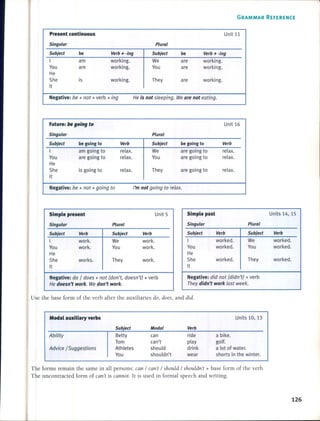
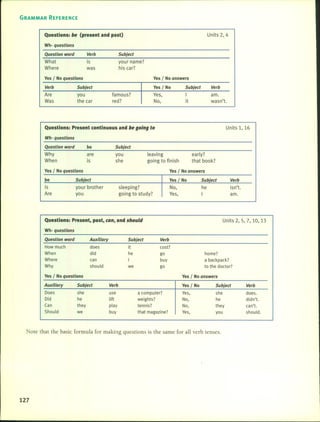
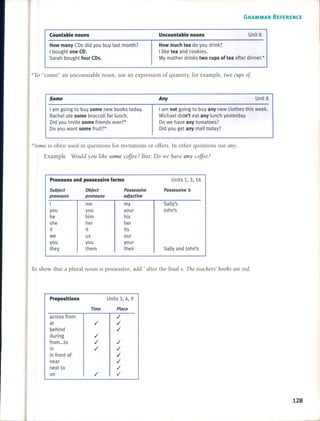
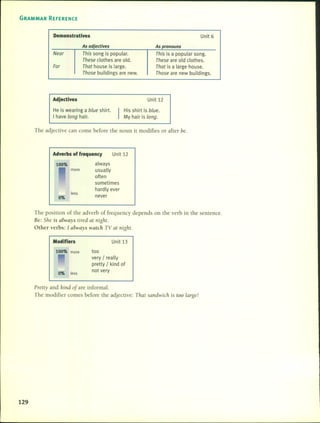
Therese Naber · Angela Blackwell
with Michelle Johnstone
OXFORD
UNIVERSITY PRESS
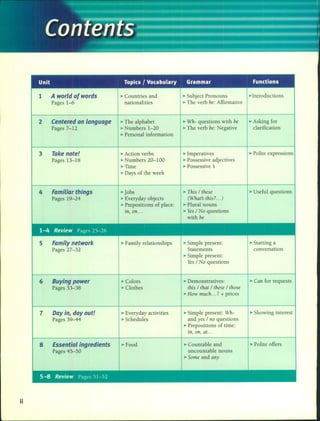
Unit Topics I Vocabulary Grammar Functions
1 A world of words ~ Countries and ~ Subject Pronouns ~1ntroductions
Pages 1-6 nationalities ~ The verb be: Affirmative
2 Centered on language ~ The alphabet ~ Wh- questions with be ~ Asking for
Pages 7-12 ~ Numbers 1-20 ~ The verb be: Negative clarifica tion
~ Personal information
3 Take note! ~ Action verbs ~ 1mperatives ~ Polite expressions
Pages 13-18 ~ Numbers 20-100 ~ Possessive adjectives
~Time ~ Possessive s
~ Days of the week
4 Familiar things ~Jobs ~ This / these ~ Useful questions
Pages 19-24 ~ Everyday objects (Whats this? .. )
~ Prepositions of place: ~ Plural nouns
in, on... ~ Yes / No questions
with be
1-4 Re vie w Pages 25-26
5 Family network ~ Family relationships ~ Simple present: ~ Starting a
Pages 27-32 Statements conversation
~ Simple present:
Yes / No questions
6 Buying power ~ Colors ~ Demonstratives: ~ Can for requests
Pages 33-38 ~ Clothes this / that / these / tltose
~ How rnuch ... ? + prices
7 Doy in, doy out! ~ Everyday activities ~ Simple present: Wh- ~ Showing interest
Pages 39-44 ~ Schedules and yes / no questions
~ Prepositions of time:
in, on, at ...
8 Essential ingredients ~ Food ~ Countable and ~ Polite offers
Pages 45-50 uncountable nouns
~ Sorne and any
5-8 Re vie w Pagcs 51-52
ii
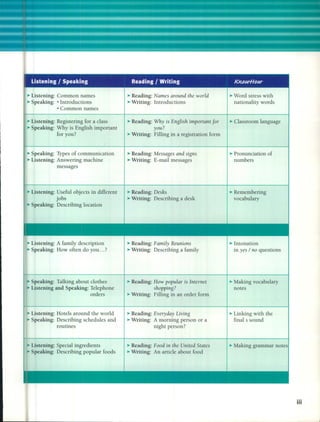
Listening I Speaking Reading I Writing KnowHour
~ Listening: Common names
~ Speaking: • Introductions
• Common names
~ Listening: Registering for a class
~ Speaking: Why is English important
for you?
~ Speaking: Types of communication
~ Listening: Answering machine
messages
~ Listening: UsefuI objects in different
jobs
~ Speaking: Describing location
~ Reading: Names around the world
~ Writing: Introductions
~ Reading: Why is English important Jor
you?
~ Writing: Filling in a registration form
~ Reading: Messages and signs
~ Writing: E-mail messages
~ Reading: Deshs
~ Writing: Describing a desk
~ Word stress with
nationality words
~ Classroom language
~ Pronunciation of
numbers
~ Remembering
vocabulary
~ Listening: A family description
~ Speaking: How often do you ... ?
~ Speaking: Talking about clothes
~ Listening and Speaking: Telephone
orders
~ Listening: Hotels around the world
~ Speaking: Describing schedules and
routines
Listening: Special ingredients
Speaking: Describing popular foods
~ Reading: Family Reunions
~ Writing: Describing a family
~ Reading: How popular is Internet
shopping?
~ Writing: Filling in an order form
~ Reading: Evelyday Living
~ Writing: A morning person or a
night person?
~ Reading: Food in the United States
~ Writing: An article about food
~ Intonation
in yes / no questions
~ Making vocabulary
notes
~ Linking with the
final s sound
~ Making grammar notes
¡¡¡
Unit Topics I Vocabulary Grammar Functions
9 In the neighborhood ~ Places ~ There is / are ~ Asking and
Pages 53-58 ~ Prepositions of place: answering
next to, infmnt oI .. questions about
places
10 Fun and games ~ Spons, games, ancl ~ Can / can't (ability) ~ Offering help
Pages 59-64 abilities ~ Conjunctions: and,
but,or
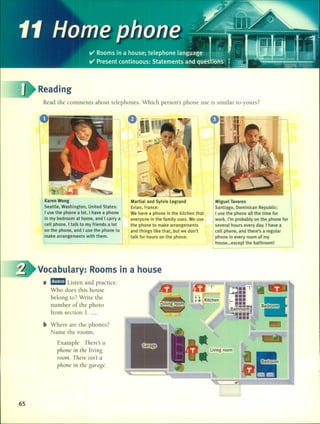
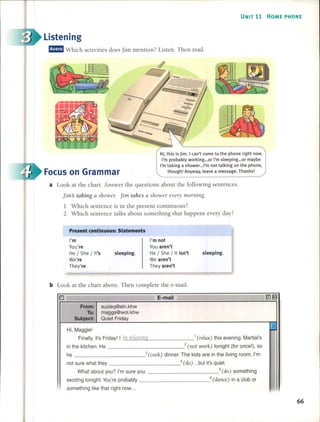
11 Home phone ~ Rooms in a house ~ Present continuous: ~ Telephone
Pages 65-70 ~ Telephone language Statements language -
~ Present continuous: calling and
W11- and yes / no answering the
questions phone
12 Hotand cold ~ Months and seasons ~ Adjectives ~ Small talk
Pages 71-76 ~Weather ~ Adverbs of frequency
9-12 Review Pages 77-78
13 Take care of yourself ~ Pans of the body ~ Should / shouldn't ~ Giving advice
Pages 79-84 ~ Ailments and remedies (advice and suggestions)
~ Modifiers: too, ve,y ...
14 It was fantastic! ~ Adjectives and nouns ~ Simple past: be ~ Responding to
Pages 85-90 ~ Simple past: Regular information
and irregular verbs
15 Extraordinary Uves ~ Life events ~ Simple past: Negative ~ Expressing
Pages 91-96 ~ Years statements degrees of
~ Simple past: Questions certainty
16 Let's celebra te! ~ Festivals and ~ Future: be going to + verb ~ Invitations -
Pages 97-102 celebrations ~ Subject-object pronouns inviting,
~ Ordinal numbers accepting,
and refusing
13-16 Review Pages 103-104
iv
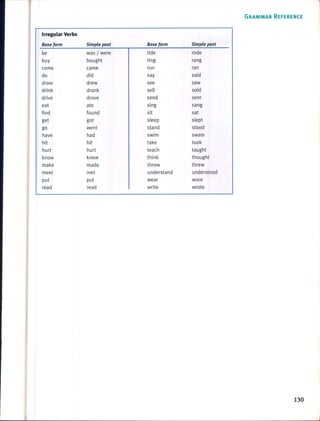
Keep on talking! Pages 105-115 Vocabulary Reference Pages 116-124 Grammar Reference Pages 125-130
Listening I Speaking Reading I Writing KMU!H()W-
~ Listcning: Dcscription of a
neighborhood
~ Spcaking: Dcsigning an ideal
neighborhood
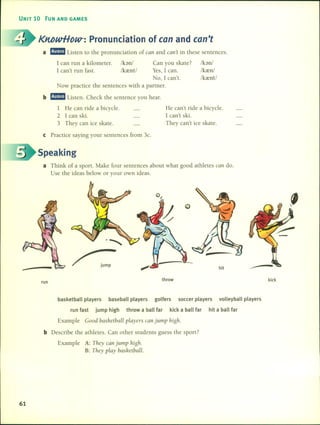
~ Spcaking: What can athletes do?
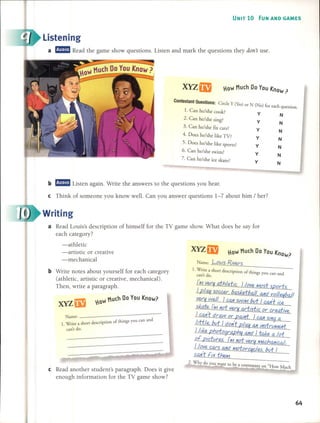
~ Listcning: A game show
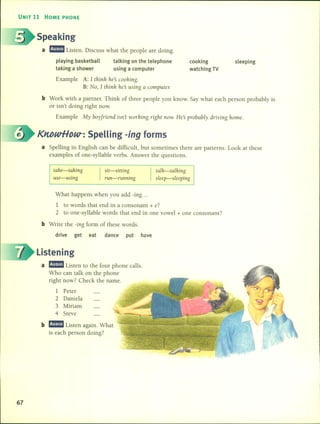
~ Spcaking: • What are people doing?
• Describing pictures
~ Listcning: Who can talk on
the phonc?
~ Listcning: • Weathcr in January
• Song - "Blue Skies"
~ Spcaking: How do your clothcs and
activities change by scason?
~ Reading: • Posteard
• New Urbanism
~ Writing: An advertising brochure
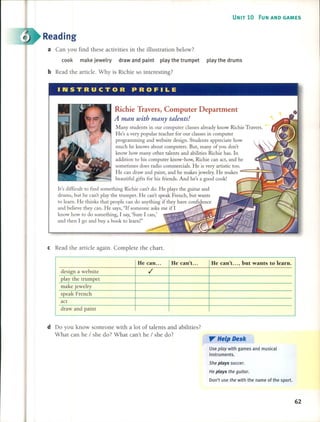
~ Reading: • Instructor Profile
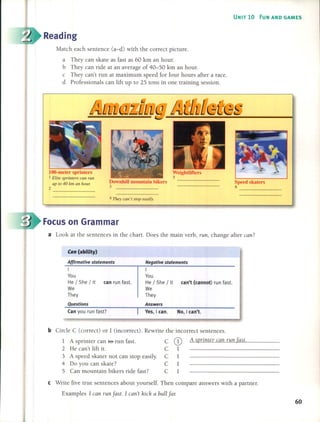
• Amazing Athletes
~ Writing: Describing abiities
~ Rcading: Home PIlOnes
~ Reading and Writing: The Message
- A IV script
~ Rcading: Traveling to Mars?
~ Writing: Life and seasons
~ Listening tips
~ Pronunciation of
can and can't
~ Spelling -ing forms
~ Sentcnce stress
~ Listcning: Computer Dos and Don'ts
~ Speaking: Giving advice
~ Listcning: Who did the letters
belong to?
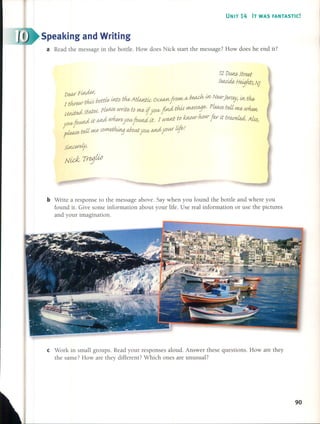
~ Spcaking: Where did you find the
bottle?
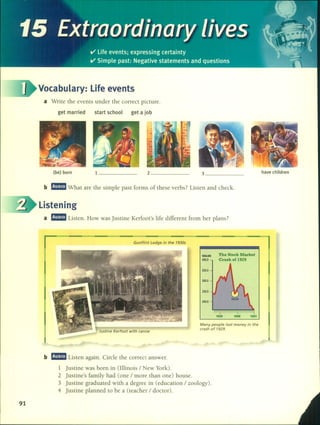
~ Listcning: Justine Kerfoot's ife story
~ Speaking: Important dates and events
in your ife
~ Speaking: Describing festivals in
your country
Listcning: • Birthday presents
• Song - "Cclebration"
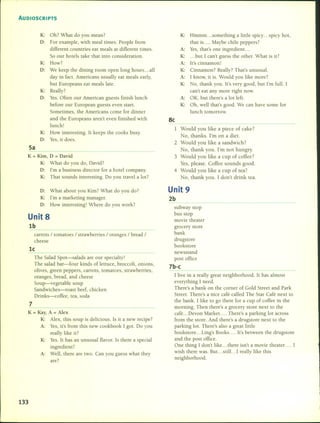
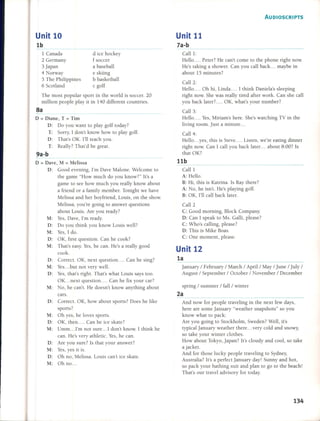
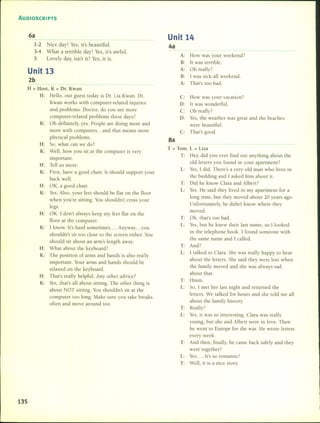
udioscripts Pages 131-138
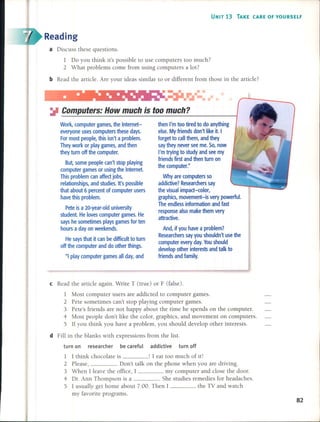
~ Reading: Computas:
How mueh is too mueh?
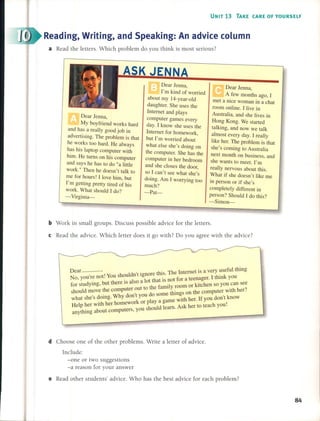
~ Reading and Writing: Ash jenna-an
advice column
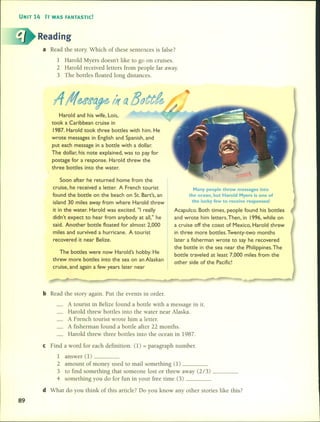
~ Reading: A Message in a Bottle
~ Writing: A letter
~ Reading: A True Pioneer
~ Writing: A famous person
~ Rcading: • Voiees in the street
• Festivals Around the World
~ Writing: Describing a festival
Acknowledgments Pages 138-139
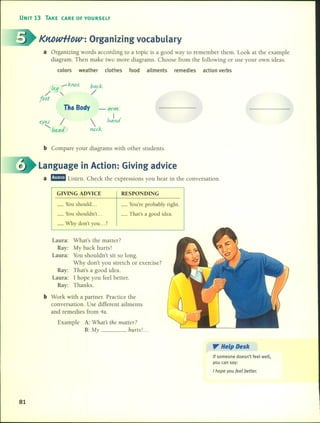
~ Organizing vocabulary
~ Pronunciation of
-ed endings
~ Reading tips
~ Pronunciation of
ordinal numbers
v
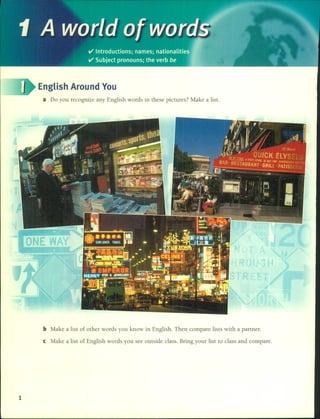
English Around You
a Do you recognize any English words in these pictures? Make a listo
b Make a list of other words you know in English. Then compare lists with a partner.
e Make a list of English words you see outside class. Bring your list to class and compare.
1
UNIT 1 A WORLD OF WORDS
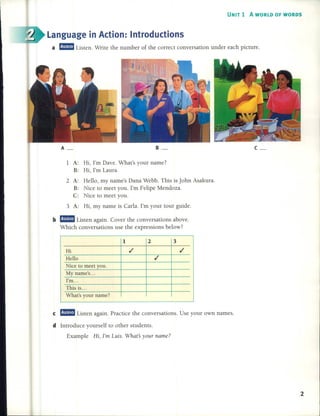
a a!mm Listen. Write the number of the correct conversation under each picture.
Language in Action: Introductions
2
c_B_
y
1 2 3
Hi .1 .1
Heno .1
Nice to meet you.
My name's ...
I'm...
This is...
What's our name?
A_
e a!mm Listen again. Practice the conversations. Use your own names.
1 A: Hi, I'm Dave. What's your name?
B: Hi, I'm Laura.
2 A: HelIo, my name's Dana Webb. This is John Asakura.
B: Nice to meet you. I'm Felipe Mendoza.
C: Nice to meet you.
3 A: Hi, my name is Carla. I'm your tour guide.
b a!mm Listen again. Cover the conversations aboye.
Which conversations use the expressions below?
d Introduce yourse1f to other students.
Example Hi, I'm Luis. Whats your name?
UNIT 1 A WORLD OF WORDS
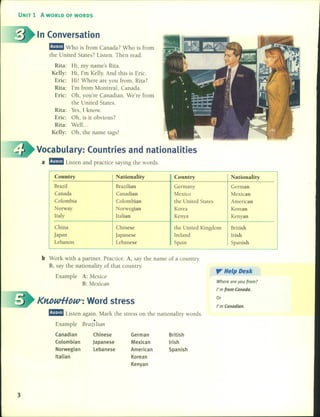
In Conversation
l!J!mI Who is [ram Cana da ? Who is [ram
the United States? Listen. Then read.
Rita: Hi, my name's Rita.
Kelly: Hi, I'm Kelly. And this is Eric.
Eric: Hi! Where are you [ram, Rita?
Rita: I'm [ram Montreal, Canada.
Eric: Oh, you're Canadian. We're [rom
the United States.
Rita: Yes, I know.
Eric: Oh, is it obvious?
Rita: Well ...
Kelly: Oh, the name tags!
Vocabulary: Countries and nationalities
a l!J!mI Listen and practice saying the words.
Country Nationality Country Nationality
Brazil Brazilian Germany German
Canada Canadian Mexico Mcxican
Colombia Colombian the United States American
Norway Norwegian Korea Korean
Italy Italían Kenya Kenyan
China Chinese the United Kingdom British
Japan Japanese lreland Irish
Lebanon Lebancse spain spanish
b Work with a partner. Practice. A, say the name o[ a country.
B, say the nationality o[ that country.
Example A: Mexico
B: Mexican
KwwHoW': Word stress
l!J!mI Listen again. Mark the stress on the nationality words .
•Example Brazi lian
". Help Desk
Where are you {rom?
/' m from Canada.
Or
/' m Canadian.
3
Canadian
Colombian
Norwegian
Italian
Chinese
Japanese
Lebanese
German
Mexican
American
Korean
Kenyan
British
Irish
Spanish
UNIT 1 A WORLD OF WORDS
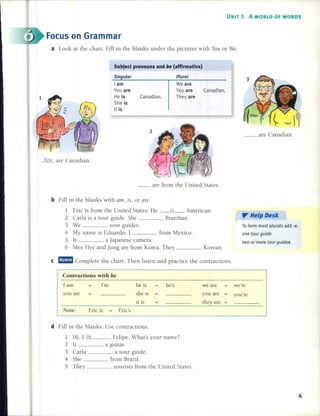
Focus on Grarnrnar
a Look at the chart. Fill in the blanks under the pictures with YOH or We.
Subject pronouns and be (affirmative)
__ are Canadian.
Plural
We are
You are Canadian.
Theyare
Singular
I am
You are
He is Canadian.
Sheis
It is
YOll are Canadian.
__ are from the United States.
b Fill in the blanks with am, is, or are.
1 Eric is from the United States. He is American.
2 Carla is a tour guide. She Brazilian.
3 We tour guides.
4 My name is Eduardo. 1 from Mexico.
5 It a Japanese camera.
6 Mee Hye and Jung are from Korea. They Korean.
". He'p Desk
lo form most plurals add -s.
one tour guide
two or more tour guides
e rmmm Complete the chart. Then listen and practice the contractions.
Contractions with be
Note: Eric is
1 am
you are
I'm he is he's we are we're
she is you are you're
it is theyare
Eric's
d Fill in the blanks. Use contractions.
1 Hi, 1_'n_l Felipe. What's your name?
2 lt a guitar.
3 Carla a tour guide.
4 She from Brazil.
5 They tourists from the United States.
4
UNIT 1 A WORLD OF WORDS
Speaking
a Choose the name of a famous persono Use that name and introduce "yourself" to
other students.
Example A: Hi, I'm ....
B: Hi, .... I'm .... I'mfrom ....
Where are you from?
A: I'm from ....
b Work with a partner. Try lO remember names and places from 7a.
Talk about the other students. Use He's / She's / They're ...
Writing
a Complete the conversations with the expressions below.
Helio. My name's Greg Soto.
Anna.
1 Hi, I'm Paul.
Hi, Paul. I'm Louise.
2 This is Lisa Coopero
Nice to meet you, Lisa. I'm Dan.
Hi, Paul. I'm Louise.
3 What's your na me ?
4 Hello. My name's Isabel Silva.
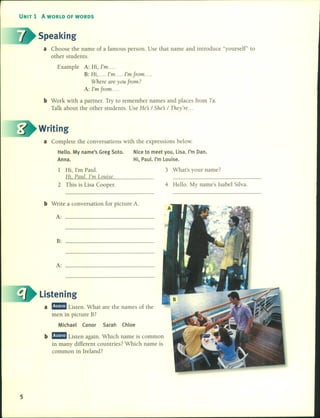
b Write a conversation for picture A.
A:
B:
A:
Listening
a ma:!mI Listen. What are the names of the
men in picture B?
Michael Conor Sarah Chloe
b ma:!mI Listen again. Which name is common
in many different countries? Which name is
common in Ireland?
5
UNIT 1 A WORLD OF WORDS
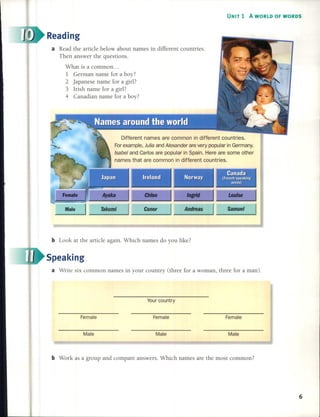
Different names are common in different countries.
For example, Julia and Alexander are very popular in Germany.
Isabel and Carlos are popular in Spain. Here are some other
names that are common in different countries.
Louise
Samuel
Ingrld
Andreas
Chloe
Conor
Ireland~
TakumiMale
a Read the artide below about names in different countries.
Then answer the questions.
What is a common ...
1 German name for a boy?
2 japanese name for a girl?
3 Irish name for a girl?
4 Canadian name for a boy?
Reading
b Look at the artide again. Which names do you like?
Speaking
a Write six common names in your country (three for a woman, three for aman).
Your country
Female Female Female
Male Male Male
b Work as a group and compare answers. Which names are the most common?
6
, °1'): a delire" (.. 'al 18 done
Ilenetic e n enlline"r'
"En.gl/sh' ~eel1JJg. "'11•.
E B
!hal is SPok:n{J9
in
l.rJ/noun 1 rrn
rllaJn !he U •u J Ih
'Peak Bnd in sorne n1led Stat
fi/JeJ'erJEj¡¡¡llsh?ol've O!her C0llntr
• rs. o }fOtodo been 1earn(. I
E"Slliah (PI You Say " nll
11, 1lraJ¡!he Perro "(.
. PeoPIe 01
. rCOnne
b mam Listen. Practice saying the numbers.
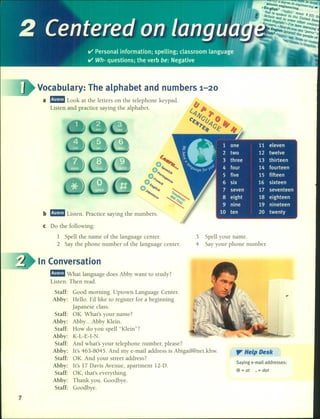
Vocabulary: The alphabet and numbers 1-20
a mam Look at the letters on the telephone keypad.
Listen and practice saying the alphabet.
e Do the following:
1 Spell the name of the language center.
2 Say the phone number of the language center.
3 Spell your name.
4 Say your phone number.
7
In Conversation
mmmI What language does Abby want to study?
Listen. Then read.
Staff: Good morning. Uptown Language Center.
Abby: Hello. l'd like to register for a beginning
japanese class.
Staff: OK. What's your name?
Abby: Abby ... Abby Klein.
Staff: How do you spell "Klein"?
Abby: K-L-E-I-N.
Staff: And what's your telephone number, please?
Abby: lt's 463-8045. And my e-mail address is Abigail@net.khw.
Staff: OK. And your street address?
Abby: lt's 17 Davis Avenue, apartment l2-D.
Staff: OK, that's everything.
Abby: Thank you. Goodbye.
Staff: Goodbye.
,.... Help Desk
Saving e-mail addresses:
@ = at • = dot
UNIT 2 CENTERED ON LANGUAGE
Wh- questions (information questions) with be
8
Plural
What are your names?
Where are you from?
Where are Abby and Brad from?
Where are the Spanish c1asses?
a Abigail@net.khw
b intermediate
c Klein
d 463-8045
e 17 Davis Avenue
What is your namc?
____ apartment
____ name
____ Ianguage c1ass
____ address
Note: Contractions
What is ~ What's Where is ~ Where's
What are / Where are ~ no contraction
Singular
What is your name?
Where are you from?
Where is Abby from?
Where is the beginning Spanish c1ass?
1
2
3
4
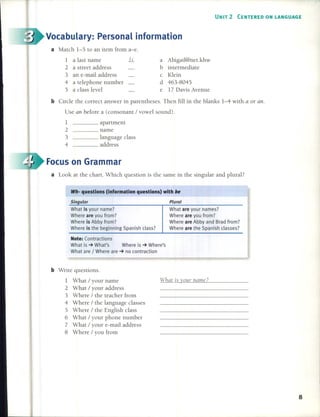
b Write questions.
1 What / your name
2 What / your address
3 Where / the teacher [rom
4 Where / the language c1asses
5 Where / the English c1ass
6 What / your phone number
7 What / your e-mail address
8 Where / you [ram
b Circ1e the correct answer in parentheses. Then fill in the blanks 1-4 with a or ano
Use an befare a (consonant / vowe1 sound).
a Look at the chart. Which question is the same in the singular and plural?
a Match 1-5 to an item [ram a-e.
1 a last name k
2 a street address
3 an e-mail address
4 a telephone number
5 a c1ass level
Focus on Grarnrnar
Vocabulary: Personal inforrnation
UNIT 2 CENTERED ON LANGUAGE
language in Action: Asking for clarification
a ,.. Listen and practice.
A: What's your last name?
B: Klein.
A: How do you spell "Klein"?
B: K-L-E-I-N.
A: Can you repeat that, please?
B: Yes, it's K-L-E-I-N.
• How da yau spell ... ?
• Can yau repeat that?
b Work with a partner. Practice the conversation with your own names.
listening
,.. Listen and complete the formo
Register Here
For
spanish Classes
Registration form: Uptown Language Center
@net.khw
Engl¡'sh French joponese Portuguese SponishLanguage:
B .' Intermediate AdvancedLevel: egmnmg B
E-mail:
Name: Brad 1 _
Address: 2____ Monroe Street
Apartment 3__ -----
Telephone: 4 _
e Find three words from Unit l. Ask your partner How do you spell. .. ?
Example A: How do you spell "]apanese"?
B: ]-A-P-A-N-E-S-E.
Registration form: Uptown Language CenterA
Name:
Writing and Speaking
a Work with a partner. Ask your partner
questions from 4b on page 8. Complete
form B. Then change roles.
b Look at your partner's formo Is the
information about you correct?
Address:
Telephone:
E-mail:
Language: English French japanese Portuguese Spanish
Level: Beginning Intermedia te Advanced
9
UNIT 2 CENTERED ON LANGUAGE
In Conversation
mmmI 15 Brad in the correct class? Listen. Ihen read.
Brad: Excuse me.
Teacher: Yes?
Brad: What class is this? 15 it beginning Spanish?
Teacher: No, this isn't beginning Spanish. Ihis is
advanced Spanish.
Brad: Oh, good!
Teacher: Good?
Brad: Yes, I'm glad this isn't my class. 1 don't
understand anything!
Focus on Grarnrnar
a Look at the chart. Find two examples of the negative in the conversation aboye.
The verb be: Negative (full forms and contractions)
I am not
You are not
He / She / It is not
We are not
You are not
I'm not
You aren't (you're not)
He / She / It isn't (He / She / It's not) in my c1ass.
We aren't (We're not)
They aren't (They're not)
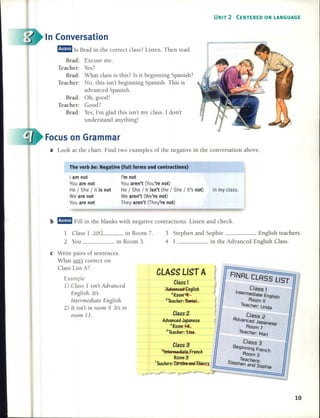
b mmmI Fill in the blanks with negative contractions. Listen and check.
1 Class 1_i_sn_'t in Room 7.
2 You in Room 3.
3 Stephen and Sophie English teachers.
4 in the Advanced English Class.
CLASS LIST A
10
FINRL CLRSS lIST
C1ass I
Intermed/ate E
R ng/lsh
oom 11
TeaCher: linda
C1ass 2
Rdvanced Ja
panese
Room 7
Teacher: Mari
C1ass 3
8eglnnlng French
Room 3
5 Teachers'
tephen and 50Phle
_.J
Class~- -__ L _
-6.f"t~iat£.F':e"ch -
11. Room3----.
-. 7Teachers: tIroIirltelld-T-hiera.
e Write pairs of sentences.
What isn't correct on
Class List A?
Example
1) Class 1 isn't Advanced
English. It's
Intermediate English.
2) It isn't in room 9. It's in
room 11.
UNIT 2 CENTERED ON LANGUAGE
Speaking
Work with a partner. A, write three or four sentences about yourself. Make one senlence falseo
B, find the false sentence and correct it.
Example A: My phone nUll1ber is 682-1045.
B: Your p}lOne nwnber isn't 682-1045.
Its 682-1099.
KnbwHoU/: Classroom language
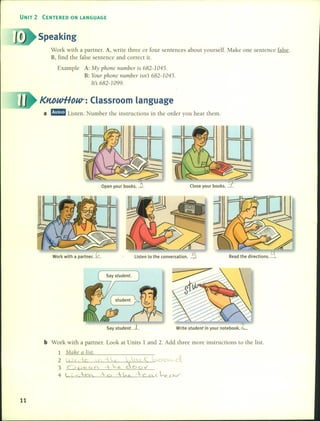
a mrmm Listen. Number the instructions in the order you hear them.
Open your books . ..?L
Work with a partner. ~ Listen to the conversation. -5- Read the directions. ~
Say student. -L Write student in your notebook.L
b Work with a partner. Look al Units 1 and 2. Add three more instructions to the list.
1 Mahe a list.
2 ( ) f 1e '{ - n y...;> o (
3 O f?e. 0.( =,-~ doov
4 <. ; So -et +0 --w -----e Q. e ~O'-v
11
UNIT 2 CENTERED ON LANGUAGE
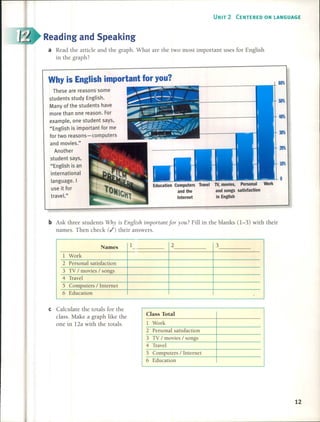
Reading and Speaking
a Read the artide and the graph. What are the two most important uses for English
in the graph?
Why is English important for yOU? 60%
These are reasons sorne
students study English.
Many of the students have
more than one reason. For
example, one student says,
"English is important for me
for two reasons-computers
and movies."
Another
student says,
"English is an
international
language. I
use it for
travel."
Education Computers Travel
and the
Internet
TV,movies, Personal
and songs satisfaction
in English
400/,
30%
10%
o
b Ask three students Why is English important for you? Fill in the blanks (1-3) with their
names. Then check (v') their answers.
Names
1 Work
2 Personal satisfaction
3 TV / movies / songs
4 Travel
5 Computers / Internet
6 Education
e Calcula te the tatals far the
dass. Make ~ graph like the
ane in 12a with the tatals.
1 2
Class Total
1 Work
2 Personal satisfaction
3 TV / movies / songs
4 Travel
5 Computers / Internet
6 Education
3
12
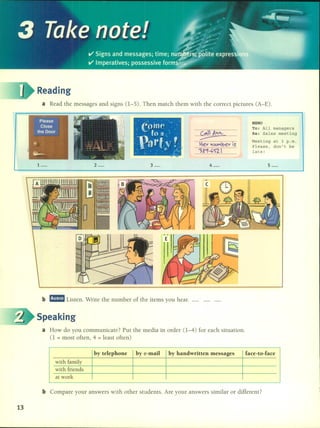
Reading
a Read the messages and signs 0-5). Then match them with the correct pictures (A-E).
~.
---¡:¡ev V.""(b ev IS
>8'1-GS'2.
MEMO
To: All managers
Re: Sales meeting
Meeting at 3 p.m.
Please, don't be
late!
1_ 2_ 3_ 4_ 5-
b m!mm Listen. Write the number of the items you hear.
13
Speaking
a How do you communicate? Put the media in order 0-4) for each situation.
(1 = most often, 4 = least often)
by telephone by e-mail by handwritten messages Cace-to-Cace
with family
with friends
at work
b Compare your answers with other students. Are your answers similar or different?
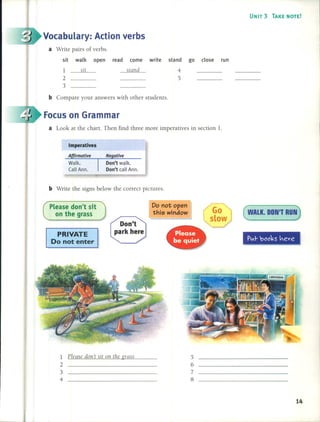
UNIT 3 TAKE NOTE!
( WALK. DDN'T RUN)~
~
5
6
7
8
go c10se run
Do not open
this window
sit walk open read come write stand
1 sit stand 4
2 5
3
1 PIcase don't sil on the grass
2
3
4
PRIVATE
Do not enter
Imperatives
PLeasedon't sit
on the grass
b Write the signs below the correct pictures.
b Compare your answers with other students.
a Look at the chart. Then find three more imperatives in section 1.
a Write pairs of verbs.
Focus on Grammar
Vocabulary: Action verbs
14
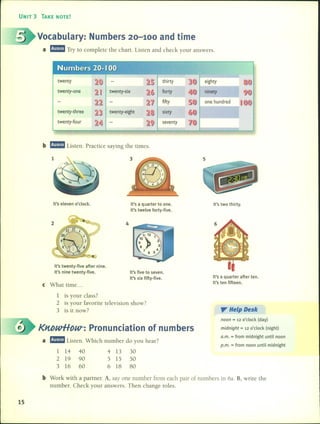
UNIT 3 TAKE NOTE!
Vocabulary: Numbers 20-100 and time
a mmm1 Try to complete the chart. Listen and check your answers.
thirty eighty
twenty-one forty ninety
fifty one hundred
twenty-three sixty
twenty-four seventy
b mmm1 Listen. Practice saying the times.
It's eleven o'dock. It's a quarter to one.
It's twelve forty-five.
It's two thirty.
It's twenty-five after nine.
It's nine twenty-five.
e What time ...
4
It's five to seven.
It's six fifty-five. It's a quarter after ten.
It's ten fifteen.
1 is your class?
2 is your favorite television show?
3 is it now? y HelpDesk
KnbwHDW-: Pronunciation of numbers
a mmm1Listen. Which number do you hear?
1 14 40 4 13 30
2 19 90 5 15 50
3 16 60 6 18 80
noon = 12 o'dock (day)
midnight = 12 o'dock (night)
a.m. = from midnight until noon
p.m. = from noon until midnight
b Work with a partner. A, say one number [ram each pair of numbers in 6a. B, write the
number. Check your answers. Then change roles.
15
UNIT 3 TAKE NOTE!
e Practice the conversation. Use these times.
1 6:00 2 3:20 3 4:45 4 (the time now) • I'm sorry.
• Please
• You're welcome.
• Excuse me.
• Thank you
POUTE EXPRESSIONS
¡Excuse me.
What time is it, _2 7
_3 • l don't know.
Person 1:
Person 2:
Person 3: It's 5 o'clock.
Person 1: _4 _
Person 3: _5 _
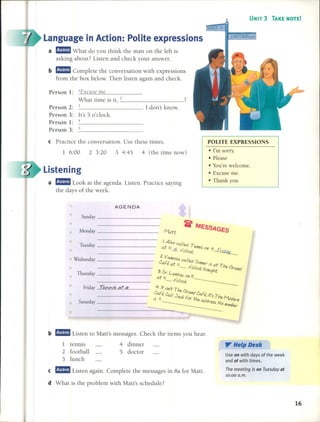
a m!mI Look at the agenda. Listen. Practice saying
the days of the week.
Language in Action: Polite expressions
a m!mI What do you think the man on the left is
asking about? Listen and check your answer.
b m!mI Complete the conversation with expressions
fram the box below. Then listen again and check.
Listening
AGENDA
Sunday _
Monday _ Matt,
Tuesday _ 1.4/ex cal/,
at b) L1 ,ec!.TelflftSOlf a)JriAA"
-= oc/ocJ;. ~
z, V~eSSacal/, ,
Caf'éat e) ee;.DtlflfertSat Th
- oc/oc/: ta 'ht e Gr~d
3. Dr L 1ft:} .
at e)' ~dau OlfdJ _
- oc/ocJ;.
4. Jt tSIf'tTh
Caf'é.CaI/ J~Gr~d Caf'é,rf's Th Ivt
ts ~ f'or the add. e , 'lOderlf
Saturday ~~IfU~óer
Thursday _
Wednesday _
b m!mI Listen to Matt's messages. Check the items you hear.
4 dinner
5 doctor
1 tennis
2 football
3 lunch
e m!mI Listen again. Complete the messages in 8a for Matt.
". Help Desk
Use on with days of the week
and al with times.
The meeting is on Tuesdayal
10:00 a.m.
d What is the problem with Matt's schedule?
16
UNIT 3 TAKE NOTE!
Focus on Grarnrnar
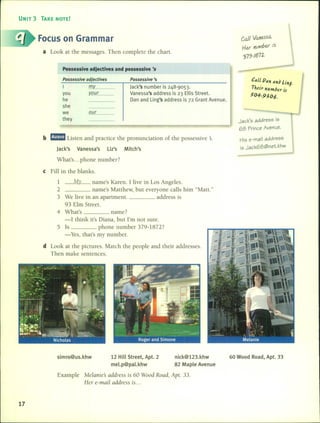
a Look at the messages. Then complete the chart.
Possessive adjectives and possessive '5
Cal} Vane.ssQ..
Her nvlVlber is
?J79-IB7~.
b mama Listen and practice the pronunciation of the possessive s.
Jack's Vanessa's Liz's Mitch's
Possess;ve adject;ves
I m
you ~_ou_r _
he
she
we _o_ur _
they
Possess;ve 's
jack's number is 248-9053.
Vanessa's address is 23 Ellis Street.
Dan and Ling's address is 72 Grant Avenue.
Ca/~Pan an~ linJ.
Thetr number zJ
50+_~j06.
Jack's address is
68 f'rince Avenue.
His e-mail address
is Jack68@net.khw
What's ... phone number7
e Fill in the blanks.
1 My name's Karen. 1 live in Los Angeles.
2 name's Matthew, but everyone calls him "Matt."
3 We live in an apartment. address is
93 Elm Street.
4 What's name7
-1think it's Diana, but I'm not sure.
5 15 phone number 379-18727
- Yes, that's my number.
d Look at the pictures. Match the people and their addresses.
Then make sentences.
simro@us.khw 12 HiIl Street, Apt. 2
mel.p@pal.khw
nick@123.khw
82 Maple Avenue
60 Wood Road, Apt. 33
Example Melanies address is 60 Wood Road, Apt. 33.
Her e-mail address is ...
17
b Work in pairs. Write an e-mail to your partner. Use the information on the calendar (or
your own ideas).
e Exchange messages. Answer your partner's e-mail.
o
The
o'clock.
[]
UNIT 3 TAKE NOTE!
D-
I, E-mail
From: -08
To:
Subject:
r=
h
I
I
I
....!
..•.
l-
•...,.,...
~
From: matthew@net.khw
To: Vanessa@pdq.khw
Subject: Re: Dinner
Hi Vanessa,
OK. The Modern Café at 7 o'clock.
1'm never late!
Matt
Hi Vanessa,
Great! Thank you. See you at
Grand Café on Thursday at 7
Matt
From: matthew@net.khw
To: Vanessa@pdq.khw
Subject: Re: Dinner
dinner
The
Sunday
Saturday
PMtlt at F p.m. at ?lefut,~~.
friday
Ú'bf at 9!M*¡ t4 amuai ~.
Writing: E-mail messages
a Read the e-mail messages. Number them in the correct order.
Hi Matt, d f'
. n't The Gran Ca e.
l'ro sorry. 1t lS Thursday at 7.
1t's The Modern Café.
Don't be late. OK? []
vaness
a
__ ---------------
From: Vanessa@pdq.khW
To: matthew@net.khw
Subject: R:e~:D=in~n~er ----
From: Vanessa@pdq.khw
To: matthew@net.khw
Subject: Dinner
Hi Matt,
Meet me at The Grand Café for
on Thursday at 7 o'clock. OK?
address is 50 Summit Street .
Vanessa .
18
4 e. -,- the
'~,-=
raml lar Ings .~.~>o .. ~~
el' Everyday objects; jobs /'f~ifi(~'
-~e.~ ••.••. ""
el' This / these; plur~l nouns; yes / no questions ~it~-be '
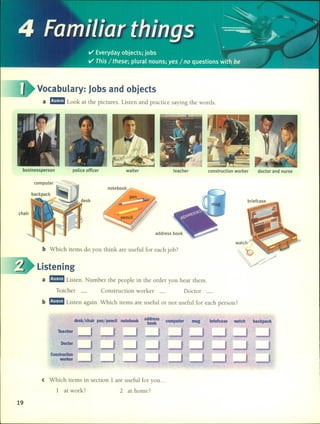
Vocabulary: Jobs and objects
a ~ Look at the pictures. Listen and practice saying the words.
businessperson poice officer waiter teacher construction worker doctor and nurse
b Which items do you think are useful for each job?
address book
listening
a ~ Listen. Number the people in the order you hear them.
Teacher _ Construction worker _ Doctor _
b ~ Listen again. Which items are useful or not useful for each person?
desk/chair pen/pencil notebook . a~~~eks computer mug . briefcase . watch backpack
Teacher
Doctor
Constructlon
worker
'.
e Which items in section 1 are useful for you ...
1 at work? 2 at home?
19
UNIT 4 FAMILIAR THINGS
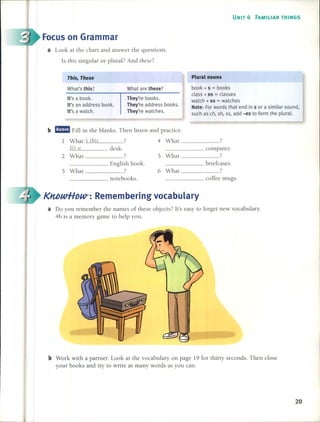
Focus on Grammar
a Look at the chan and answer the questions.
ls this singular or plural? And these?
This, These
What's this?
It's a book.
It's an address book.
It's a wateh.
What are these?
They're books.
They're address books.
They're watehes.
Plural nouns
book + s = books
class + es = classes
wateh + es = watehes
Note: Forwords that end in s or a similar sound,
sueh as eh, sh, ss, add -es to form the plural.
b riE Fill in the blanks. Then listen and practice.
1 What ~ this ? 4 What 7
It~ a desk. computer.
2 What ? 5 What -------?
______ English book. briefcases.
3 What 7 6 What .7
______ notebooks. coffee mugs.
KltbwHDW-: Remembering vocabulary
a Do you relnember the names of these objects? lt's easy to forget new vocabulary.
4b is a memory game to help you.
b Work with a partner. Look at the vocabulary on page 19 for thiny seconds. Then close
your books and try to write as many words as you can.
20
UNIT 4 FAMILIAR THINGS
Language in Action: Useful questions
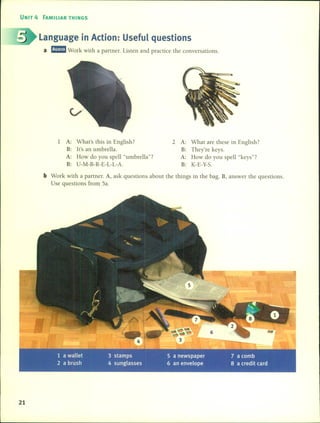
a rJ!I!ID Work with a partner. listen and practice the conversations.
1 A: What's this in English?
B: It's an umbrella.
A: How do you spell "umbrella"?
B: U-M-B-R-E-L-L-A.
2 A: What are these in English?
B: They're keys.
A: How do you spell "keys"?
B: K-E-Y-S.
b Work with a partner. A, ask questions about the things in the bago B, answer the questions.
Use questions [rom Sa.
21
UNIT 4 FAMILIAR THINGS
In Conversation
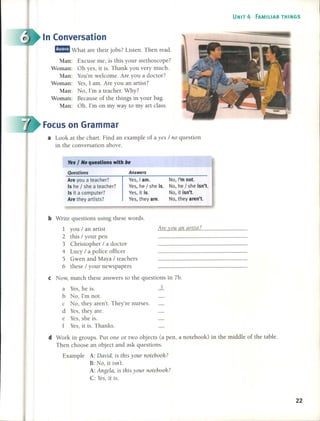
fJ!JII What are their jobs? Listen. Then read.
Man: Excuse me, is this your stethoscope?
Woman: Oh yes, it is. Thank you very mucho
Man: You're welcome. Are you a doctor?
Woman: Yes, 1 amo Are you an artist?
Man: No, l'm a teacher. Why?
Woman: Because of the things in your bago
Man: Oh. l'm on my way to my art class.
Focus on Grarnrnar
a Look at the chart. Find an example of a yes / 110 question
in the conversation aboye.
Yes I No questions with be
Questions
Are you a teacher?
15 he I she a teacher?
15 it a computer?
Are they artists?
Answers
Ves, I amo
Ves, he / she ¡s.
Ves, it ¡s.
Ves, they are.
No, I'm not.
No, he / she ¡sn't.
No, it ¡sn't.
No, they aren't.
A re vou al1 artist?
b Write questions using these words.
1 you / an artist
2 this / your pen
3 Christopher / a doctor
4 Lucy / a police officer
5 Gwen and Maya / teachers
6 these / your newspapers
e Now, match these answers to the questions in 7b.
a Yes, he is. 2..
b No, l'm noto
c No, they aren't. They're nurses.
d Yes, they are.
e Yes, she is.
f Yes, it is. Thanks.
d Work in groups. Put one or two objects Capen, a notebook) in the middle of the tableo
Then choose an object and ask questions.
Example A: David, is this your l1otebooh?
B: No, it iSI1't.
A: Al1gela, is this your 110tebooh?
C: Yes, it is.
22
UNIT 4 FAMILIAR THINGS
Vocabulary: Location
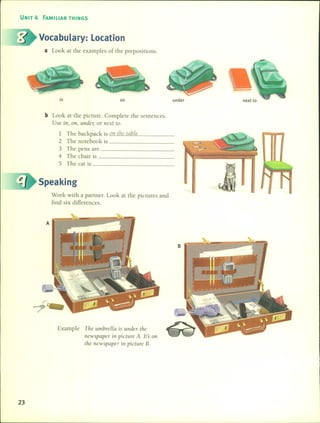
a Look at the examples of the prepositions.
in on under
b Look at the picture. Complete the sentences.
Use in, on, undel; or next to.
1 The backpack is _o_l1_t_ilc_I(_lb_l_e _
2 The notebook is _
3 The pens are _
4 The chair is _
5 The cat is _
Speaking
Work with a partner. Look at the pictures and
find six differences.
Example Tile umbrella is Llnder lilc
newspaper in picture A. lts 011
tile ncwspaper in picture B.
23
UNIT 4 FAMILIAR THINGS
Reading
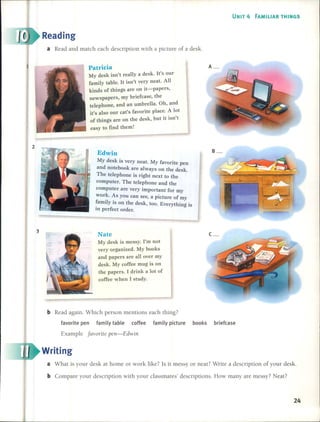
a Read and match each description with a picture of a desk.
Patricia
My desk isn't real1ya desk. It's our
family tableoIt isn't very neat. Al1
kinds of things are on it-papers,
newspapers, my briefcase, the
telephone, and an umbrel1a. Oh, and
it's also our cat's favorite place. A lot
of things are on the desk, but it isn't
easy to find them!
A_
2
3
Edwin
My desk is very neat. My favorite pen
and notebook are always on the desk.
The telephone is right next to the
computer. The telephone and the
computer are very important for my
work. As you can see, a picture of my
~amilyis on the desk, too. Everything is
1ll perfect order.
Nate
My desk is messy. Pm not
very organized. My books
and papers are al1over my
desk. My coffee mug is on
the papers. 1drink a lot of
coffee when 1 study.
B_
c_
bRead again. Which person mentions each thing?
favorite pen family table coffee family picture books briefcase
Example favorite pen-Edwin
Writing
a What is your des k at home or work like? Is it messy or neat? Write a description of your desk.
b Compare your description with your classmates' descriptions. How many are messy? Neat?
24
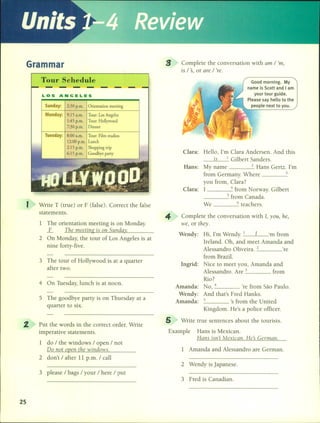
Grarnrnar Complete the conversation with am / 'm,
is / S, or are / 're.
I
2.
25
Tour Schedule
LOS ANGELES
Sunday: 2:30 p.m. Orientation meeting
Monday: 9: 15 a.m. Tour: Los Angeles
1:45 p.m. Tour: Hollywood
7:30 p.m. Dinner
Tuesday: 8:00 a.m. Tour: Film studios
12:00 p.m. Lunch
2: 15 p.m. Shopping trip
6: 15 p.m. Goodbye party
Write T (true) or F (false). Correct the false
statements.
1 The orientation meeting is on Monday.
E. The meeting is on Sunday.
2 On Monday, the tour of Los Angeles is at
nine forty-five.
3 The tour of Hollywood is at a quarter
after two.
4 On Tuesday, lunch is at noon.
5 The goodbye party is on Thursday at a
quarter to six.
Put the words in the correct order. Write
imperative statements.
1 do / the windows / open / not
Do not open the windows.
2 don't / after 11 p.m. / call
3 please / bags / your / here / put
Good morning. My
name is 5cott and I am
your tour guide.
Please say helio to the
people next to you.
Clara: HelIo, I'm Clara Andersen. And this
is 1 Gilbert Sanders.
Hans: My name 2 Hans Gertz. I'm
from Germany. Where 3
you from, Clara?
Clara: 1 4 from Norway. Gilbert
____ 5 from Canada.
We 6 teachers.
4 Complete the conversation with 1,you, he,
we, or they.
Wendy: Hi, I'm Wendy. 1 'm from
Ireland. Oh, and meet Amanda and
Alessandro Oliveira. 2 're
from Brazil.
Ingrid: Nice to meet you, Amanda and
Alessandro. Are 3 from
Rio?
Amanda: No, 4 're from Sao Paulo.
Wendy: And that's Fred Hanks.
Amanda: 5 's from the United
Kingdom. He's a police officer.
5 Write true sentences about the tourists.
Example Hans is Mexican.
Hans isn't Mexican. Hes Gennan.
1 Amanda and Alessandro are German.
2 Wendy is japanese.
3 Fred is Canadian.
UNITS 1-4 REVIEW
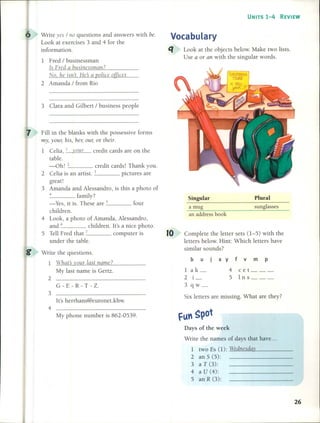
Vocabulary
q Look at the objects below. Make two lists.
Use a or an with the singular words.
Complete the letter sets (1-5) with the
letters below. Hint: Which letters have
similar sounds?
b u x y f v m p
1 ak_ 4 cet ___
2 i_ 5 lns ___
3 qw_
Plural
sunglasses
Singular
a mug
an address book
3 Clara and Gilbert / business people
1 Fred / businessman
15 Fred a businessman?
No, he iSIl't. Hes a poliee o,(fieCl:
2 Amanda / from Rio
Write yes / no questions and answers with be.
Look at exercises 3 and 4 for the
information.
Write the questions.
1 What's your last llame?
My last name is Gertz.
2
G - E - R - T - Z.
7 Fill in the blanks with the possessive forms
my, yow; his, /1CI; our, or their.
1 Celia, 1 your credit cards are on the
tableo
-Oh! 2 credit cards! Thank you.
2 Celia is an artist. 3 pictures are
great!
3 Amanda and Alessandro, is this a photo of
4 family?
- Yes, it is. These are 5 four
children.
4 Look, a photo of Amanda, Alessandro,
and 6 children. lt's a nice photo.
5 Tell Fred that 7 computer is 10
under the tableo
3
1t's herrhans@euronet.khw.
Six letters are missing. What are they?
4
My phone number is 862-0539.
Days of the week
Write the names of days that have ...
1 two Es (1): -.:...Vi'-"e=dll:..:..:e=s=da"-'y'--_
2 an S (5):
3 a T (3):
4 a U (4):
5 an R (3):
26
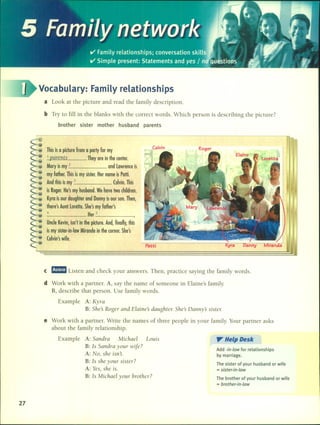
Vocabulary: Family relationships
a Look at the picture and read the family description.
b Try to fill in the blanks with the correct words. Which person is describing the picture?
brother sister mother husband parents
This is O picture from O porty for my
1 parents . They are in the center.
Mory is my 2 ond Lowrence is
my fother. This is my sister. Her nome is Potti.
And this is my 3 (olvin. This
is Roger. He's my husbond. We hove two children.
Kyro is our doughter ond Donny is our son. Then,
there's Aunt Loretlo. She's my fother's
4 • Her _5 _
Uncle Kevin, isn't in the picture. And, finolly, this
is my sister-in-Iow Mirando in the comer. She's
(olvin's wife.
e mE Listen and check your answers. Then, practice saying the family words.
d Work with a partner. A, say the na me of someone in Elaine's family.
B, describe that persono Use family words.
Example A: Kyra
B: She's Roge,. clI1dElainc's daughte,: She's Danny's siste,:
".. He'p Desk
Add -in-/aw for relationships
by marriage.
The sister of your husband or wife
= sister-in-/aw
The brother of your husband or wife
= brother-in-/aw
e Work with a partner. Write the names of three people in your family. Your partner asks
about the family relationship.
Example A: Sandra Mic11Qel Louis
B: Is Sandra you,. wife?
A: No, she isn't.
B: Is she your sister?
A: Yes, she ¡s.
B: Is Mic11Qelyour brothcr?
27
UNIT 5 FAMILY NETWORK
Reading
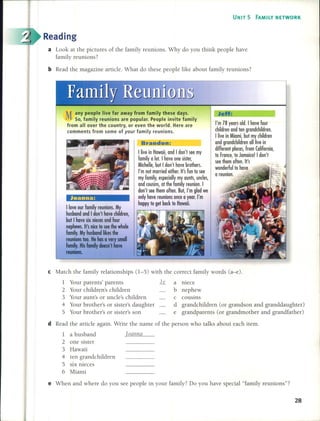
a Look at the pictures of the family reunions. Why do you think people have
family reunions?
bRead the magazine artide. What do these people like about family reunions?
M any people live far away from family these days.
So, family reunions are popular. People invite family
from al! over the country, or even the world. Here are
comments from some of your family reunions.
Joanna:
Ilove our fomily reunions. My
husbond ond 1don'l hove children,
bull hove six nieces ond four
nephews. Il's nice lo see Ihe whole
fomily. My husbond likes Ihe
reunions loo. He hos o very smoll
fomily. His fomily doesn'l hove
reunions.
Brandon:
llive in Howoii, ond I don'l see my
fomily o 101. I hove one sisler,
Michelle, bull don'l hove brolhers.
I'm nol morried eilher. Il's fun lo see
my fomily, especiolly my ounls, undes,
ond cousins, ollhe fomily reunion. 1
don'l see Ihem often. Bul, I'm glod we
only hove reunions once o yeor. I'm
hoppy lo gel bock lo Howoii.
JeH:
I'm 78 yeors old. I hove four
children ond len grondchildren.
llive in Miomi, bul my children
ond grondchildren olllive in
differenl ploces, from Colifornio,
lo Fronce, lo Jomoico! I don'l
see Ihem often. It's
wonderfullo hove
o reunion.
e Match the family relationships (1-5) with the correct family words (a-e).
1 Your parents' parents li a niece
2 Your children's children b nephew
3 Your aunt's or unde's children c cousins
4 Your brother's or sister's daughter d grandchildren (or grandson and granddaughter)
5 Your brother's or sister's son e grandparents (or grandmother and grandfather)
d Read the artide again. Write the name of the person who talks about each item.
1 a husband
2 one sister
3 Hawaii
4 ten grandchildren
5 six nieces
6 Miami
'oatllla
e When and where do you see people in your family? Do you have special "family reunions"?
28
UNIT 5 FAMILY NETWORK
Focus on Grarnrnar
a Look at the chart. Answer the questions.
1 When do you add -s lO the verb?
2 When do you use doesn't?
Simple present: Statements
Af{irmative Negative
I live I don't live
You live You don't live
He / She lives in Miarni. He / She doesn't live in Miarni.
We live We don't live
They live They don't live
Note: The spelling changes with he / she / it for sorne verbs.
have ....) has
go .....:!. goes
He has a sister.
She goes to work.
b Circle the correct formo
He lives in Canada.
".. Help Desk
In the simple present,
remember to add -s to
verbs with he / she / it in
affirmative statements.
1 MolIy (have / has) one brother.
2 Her brother (live / lives) in Canada.
3 Kate and Peter (have / has) two children.
4 Nick's wife (have / has) a lot of cousins.
5 Their children (live / lives) in a different city.
6 We (don't / doesn't) live in New York.
7 Timmy doesn't (have / has) a brother.
e Complete the paragraph with the correct forms of
live or havc.
My name is Patrick. 1 1 live in Monterrey, in
Mexico. My parents 2 in Monterrey, too.
l'm not married. 1 3 one brother and one
sister. They 4 (nor) in Monterrey. My
brother's name is Arturo and he 5 in
Mexico City. He is married, but he _6 _
(not) children. My sister's name is Victoria. She's
married and she 7 two daughters. She
8 (not) a son. She and her family live in
DalIas, Texas.
d Write sentences about your family. Try to use aH the words below.
is / ¡sn't have / has Uve / lives don't / doesn't
Examples 1 live in Osa}w. 1 havc one sister and two brothers. My sister's name is Ma}ú}w.
She lives in Yohohama. She isn't married. Shc has ...
Read another student's sentences. Are alI the verbs formed correctly?
29
UNIT 5 FAMILY NETWORK
In (onversation
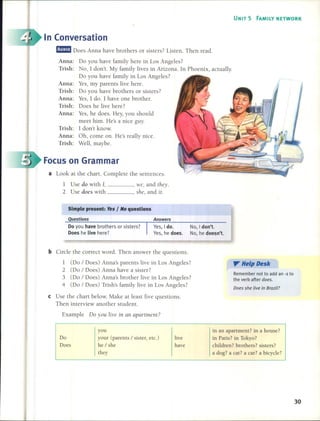
mrmm Does Anna have brothers or sisters? Listen. Then read.
Anna: Do you have family here in Los Angeles?
Trish: No, 1 don't. My family lives in Arizona. In Phoenix, actually.
Do you have family in Los Angeles?
Anna: Yes, my parents live here.
Trish: Do you have brothers or sisters?
Anna: Yes, 1 do. 1 have one brother.
Trish: Does he live here?
Anna: Yes, he does. Hey, you should
meet him. He's a nice guy.
Trish: 1 don't know.
Anna: Oh, come on. He's really nice.
Trish: Well, maybe.
Focuson Grarnrnar
a Look at the chart. Complete the sentences.
1 Use do with 1, , we, and they.
2 Use does with , she, and it.
Simple present: Yes I No questions
Questions
Do you have brothers or sisters?
Does he live here?
Answers
Yes, Ido.
Yes, he does.
No, I don't.
No, he doesn't.
b Circle the correct word. Then answer the questions.
1 (Do / Does) Anna's parents live in Los Angeles?
2 (Do / Does) Anna have a sister?
3 (Do / Does) Anna's brother live in Los Angeles?
4 (Do / Does) Trish's family live in Los Angeles?
e Use the chart below. Make al least five questions.
Then interview another student.
Example Do you live in all apartment?
". He'p Desk
Remember not to add an -s to
the verb after does.
Does she Uve in Brazi/?
Do
Does
you
your (parents / sister, etc.)
he / she
they
live
have
in an apartment? in a house?
in Paris? in Tokyo?
children? brothers? sisters?
a dog? a cat? a car? a bicycle?
30
UNIT 5 FAMILV NETWORK
KMwHDW-: Intonation in yes / no questions
a m:!mm Listen to these questions. Notice how the voice goes up at the end of
yes / no questions.
1 Do you live in Tokyo rj
2 Do you live in an apartment?.-!
3 Does your sister have children?.-!
b Now practice the questions.
Listening
San F?ancisco
t:San Diego'
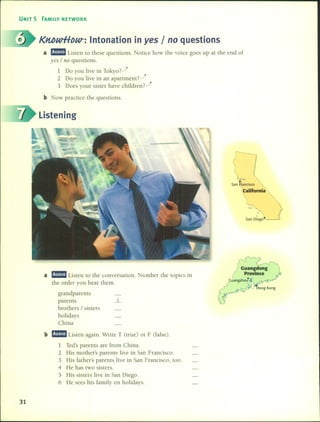
a m:!mm Listen to the conversation. Number the topics in
the order you hear them.
grandparents
parents _1
brathers / sisters
holidays
China
b m:!mm Listen again. Write T (tme) or F (false).
1 Ted's parents are fram China.
2 His mother's parents live in San Francisco.
3 His father's parents live in San Francisco, too.
4 He has two sisters.
5 His sisters live in San Diego.
6 He sees his family on holidays.
31
3 celebrate a family occasion?
4 visit family in another city?
32
If someone asks you a question in
a social situation, try to say more
than Yes or No. Give sorne
additional information. Then you
can say What about you?
".. Help Desk
Work in groups and discuss the questions. Use the words on the list.
every day once a week every weekend once a month
How often do you ...
1 talk to family on the phone?
2 have lunch or dinner with family?
b Write a similar text ahout another student's fam ily. Use the information from your discussion
in section 9.
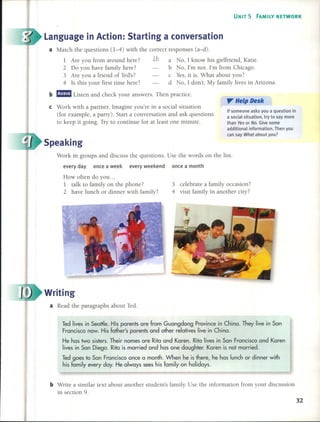
a Read the paragraphs about Ted.
Ted lives in Seattle. His parents are from Guangdong Province in China. They live in San
Francisco now. His father's parents and other relatives live in China.
He has two sisters. Their names are Rita and Karen. Rita lives in San Francisco and Karen
lives in San Diego. Rita is married and has one daughter. Karen is not married.
Ted goes to San Francisco once a month. when he is there, he has lunch or dinner with
his family every day. He always sees his family on holidays.
UNIT 5 FAMILY NETWORK
e Work with a partner. Imagine you're in a social situation
(for example, a party). Start a conversation and ask questions
to keep it going. Try to continue for at least one minute.
a Match the questions (1-4) with the correct responses (a-d).
1 Are you from around here? 1.lz. a NO,I know his girlfriend, Katie.
2 Do you have family here? b No, I'm not. I'm from Chicago.
3 Are you a friend of Ted's? c Yes, it is. What about you?
4 Is this your first time here? d No, 1 don't. My family lives in Arizona.
b rmmm Listen and check your answers. Then practice.
Writing
Speaking
Language in Action: Starting a conversation
Speaking
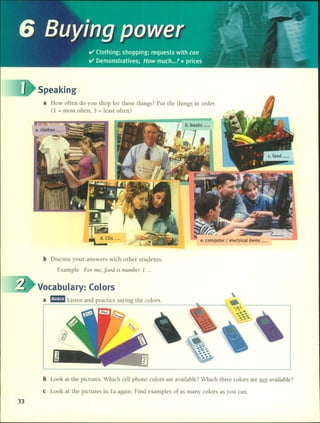
a How often do you shop for these things? Put the things in order.
(l = most often, 5 = least often)
b Discuss your answers with other students.
Example Far me, faad is number 1...
Vocabulary: Colors
a l!mI Listen and practice saying the colors.
33
b Look at the pictures. Which ceH phone colors are available? Which three colors are not available?
e Look at the pictures in la again. Find examples of as many colors as you can.
UNIT 6 BUYING POWER
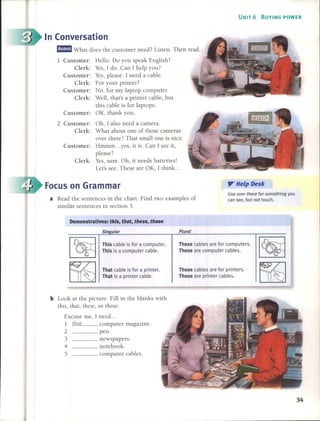
fjEJ What does the customer need? listen. Then read.
a Read the sentences in the chart. Find two examples of
similar sentences in section 3.
Use over there for something you
can see, but not touch.
". He'p Desk
1 Customer: Hello. Do you speak English?
Clerk: Yes, 1 do. Can 1 help you?
Customer: Yes, please. 1 need a cable.
Clerk: For your printer?
Customer: No, for my laptop computer.
Clerk: Well, that's a printer cable, but
this cable is for laptops.
Customer: OK, thank you.
2 Customer: Oh, 1 also need a camera.
Clerk: What about one of those cameras
over there? That small one is nice.
Customer: Hmmm ... yes, it is. Can 1 see it,
please?
Clerk: Yes, sure. Oh, it needs batteries!
Let's see. These are OK, 1 think ...
Focus on Grarnrnar
In Conversation
Demonstratives: th/s, that, these, those
Sin ular Plural
This cable is for a computer.
This is a computer cable.
That cable is for a printer.
That is a printer cable.
These cables are for computers.
These are computer cables.
Those cables are for printers.
Those are printer cables.
computer magazine.
____ peno
____ newspapers.
____ notebook.
____ computer cables.
1 that
2
3
4
5
b Look at the picture. Fill in the blanks with
this, that, these, or those.
Excuse me, 1 need ...
34
UNIT 6 BUYING POWER
Vocabulary: Clothes
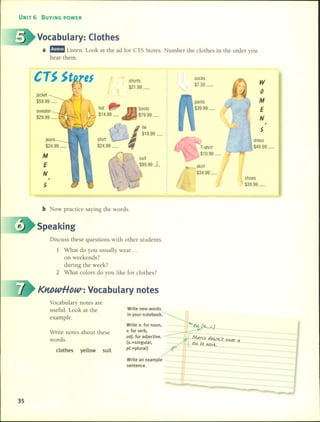
a m!mm Listen. Look at the ad for CTS Stores. Number the clothes in the order you
hear them.
, shorts
socks
WI
$7.50_
$21.99_
Ojacket .......
$59.99_ .... M
sweater ...... E
$29.99_ N
tíe
$
$19.99_
jeans ......... shirt dress
$24.99_ $24.99_ $49.99_
M
E skírt
N $34.99_
$
b Now practice saying the words.
Speaking
Discuss these questions with other students.
1 What do you usually wear. ..
on weekends?
during the week?
2 What co10rs do you like for clothes?
KnbwHow-: Vocabulary notes
Vocabu1ary notes are
useful. Look at the
examp1e.
Write notes about these
words.
clothes yellow suit
Write new words
in your notebook.
Write n. for noun,
v. for verb,
adj. for adjective.
(s.=singular,
pl.=plural)
Write an example
sentence.
---
---
35
UNIT 6 BUYING POWER
Focuson Grammar
In (onversation
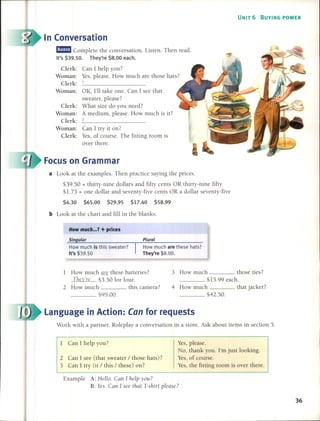
Can 1 try it on?
Yes, of course. The fitting room is
over there.
Clerk:
Woman:
Clerk:
Woman:
Clerk:
tE Complete the conversation. Listen. Then read.
It's $39.50. They're $8.00 each.
Clerk: Can 1 help you?
Woman: Yes, please. How much are those hats?
Clerk: _1 _
Woman: OK, l'll take one. Can 1see that
sweater, please?
What size do you need?
A medium, please. How much is it?
2
a Look at the examples. Then practice saying the prices.
$39.50 = thirty-nine dollars and fifty cents OR thiny-nine fifty
$1. 75 = one dollar and seventy-five cents OR a dollar seventy-five
$4.30 $65.00 $29.95 $17.40 $58.99
b Look at the chan and filI in the blanks.
How much ... ? + prices
Sin ular
How much is this sweater?
It's $39.50
Plural
How much are these hats?
They're $8.00.
Work with a panner. Roleplay a conversation in a store. Ask about items in section 5.
Language in Action: Can for requests
1 How much are these batteries?
They're $3.50 for four.
2 How much this camera?
___ $95.00.
1 Can 1 help you?
2 Can 1 see (that sweater / those hats)?
3 Can 1 try (it / this / these) on?
3 How much those ties?
___ $15.99 each.
4 How much . that jacket?
___ $42.50.
Yes, please.
No, thank you. l'm just Iooking.
Yes, of course.
Yes, the fitting room is over there.
Example A: Helio. Can 1 help you?
B: Yeso Can 1 see that T-shirt please?
36
UNIT 6 BUYING POWER
Reading
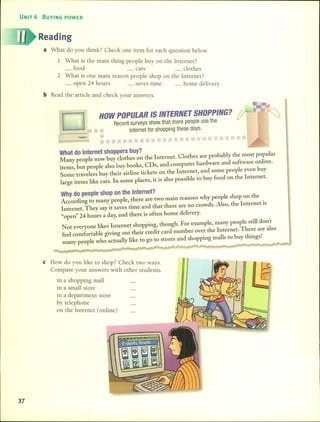
a What do you think? Check one item for each question below.
1 What is the main thing people buy on the Internet?
_ food. _ cars _ dothes
2 What 15 one main rrason people shop on the Internet?
_ open 24 hours _ saves time h d l'_ ome e lvery
bRead the artide and check your answers.
HOW POPULAR 15 INTERNET 5HOPPING?
Recent surveys show that more people use the
Internet for shopping these days.
--
What do Internet shoppers huy?
Many people now huy c10thes on the Internet. Clothes are prohahly the rnost popular
items, hut people also huy hooks, CDs, and cornputer hardware and software online.
Sorne trave1ers huy their airline tickets on the Internet, and sorne people even huy
large iterns like cars. In sorne places, it is also possible to huy food on the Internet.
Why do people shop on the Internet?
According to rnany people, there are two rnain reasons why people shop on the
Internet. They say it saves time and that there are no crowds. Also, the Internet is
"open" 24 hours a day, and there is often horne delivery.
Not everyone likes Internet shopping, though. For exarnple, rnany people still don't
fee1cornfortahle giving out their credit card nurnher over the Internet. There are also
rnany people who actually like to go to stores and shopping rnalls to huy things!
e How do you like to shop? Check two ways.
Compare your answers with other students.
in a shopping mall
in a small store
in a department store
by telephone
on the Internet (online)
37
UNIT 6 BUYING POWER
Writing, Listening, and Speaking
a rJ!I!Ia Look at order form A and listen to
the conversation. Which two things are
wrong on the order form?
e-a T-Shirts
11 Pronto
A
Shop online WWW.tshirts.pronto.khw
Order toll free 1-800-555-0000
Customer service 1-800-555-0001
Fax 1-800-555-0002
B
Item Number Description Color Size Quantity Price
M13/1.34 Men's í-shú-/; blaLJ< L / .f/g.95
TOTAL .f/g.95
Name iT"-II1es Prado
Address /4¿,¿, (Ales-tsLáe DrtÍle
,.( .
City t"-I1t State fL Zip Code 034¿,¿,
Phone(day) /1.3-555-01./9
Phone (evening) /1.3 - 555 - ¿'¿,44
E-mail addressn.1 a.
-------------
METHOD OF PAYMENT
O Check [X]Credit Card
Credit Card Number 1/11./314/51 ¿,I7/ g 19/0 1/11./515/5/5/
Expiration Date _/_/_ (month) / ~ (year)
Signature
--------------
Men's
MT3567
•
Women's
WT3567
"
T-Shirts
--- Pronto =--=--=--_-_-_------
Men's
MB1234
Description Color Size Quantity Price
Item Number
TOTAL
METHOD OF PAYMENT
O Check O Credit Card
Credit Card Number  1 1 I I I I I I I I I I I I 1 I
Expiration Date __ (month) 1 __ (year)
Signature
Name
Address
City State -- Zip Code
Phone (day)
Phone (evening)
E-mail address
available in sizes S, M, and L
S = small M = medium l = large
b Work with a partner. A, choose
something from the ad above. B,
take A's order and complete order
form B. Then reverse roles.
Use fuI questions:
Can 1 take your order?
What's your name?
What's your address?
What's your phone number?
What's your credit card number?
"
T-Shirts
Pronto
Shop online www,tshirts.pronto.khw
Order toll free 1-800-555-0000
Customer service 1-800-555-0001
Fax 1-800-555-0002
38
Vocabulary: Everyday activities
a r.-Listen and practice these expressions.
get up start work eat lunch finish work have dinner go to bed
b What time do you do these things?
In Conversation
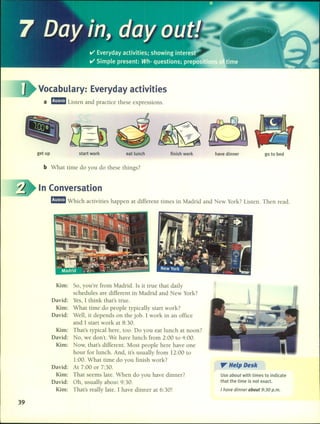
r.-Which activities happen at different times in Madrid and New York? Listen. Then read.
39
Kim: So, you're fram Madrid. 15 it true that daily
schedules are different in Madrid and New York?
David: Yes, 1 think that's true.
Kim: What time do people typically start work?
David: Well, it depends on the jobo 1work in an office
and 1 start work at 8:30.
Kim: That's typical here, too. Do you eat lunch at noon?
David: No, we don't. We have lunch fram 2:00 to 4:00.
Kim: Now, that's different. Most people here have one
hour for lunch. And, it's usually fram 12:00 to
1:00. What time do you finish work?
David: At 7:00 or 7:30.
Kim: That seems late. When do you have dinner?
David: Oh, usually about 9:30.
Kim: That's really late. 1 have dinner at 6:30!
". Help Desk
Use about with times to indicate
that the time is not exacto
I have dinner about 9:30 p.m.
UNIT 7 DAY IN, DAY OUT!
Focus on Grarnrnar
a Compare the yes / no questions and the Wh- questions. Find two examples of Wh- questions in
the conversation on page 39.
Simple present: Wh- and yes I no questions
Questions
Do you Uve in Spain?
Where do you Uve?
Does he start work at 8:30 a.m.?
When does he start work?
Answers
Ves, I do. No, I don't.
In Spain.
Ves, he does. No, he doesn't.
At 8:30 a.m.
b Malch the questions (1-5) and answers (a-e).
1 What does David do? 1.Q
2 Where does Kim live?
3 Where does he work?
4 What time does he start work?
5 When do people in Spain have dinner?
e Put the words in order lO make questions.
Example get up / you / do / when
When do you get L!p?
1 you / do / what / do
2 do / live / where / you
3 start / time / what / you / do / work
4 lunch / you / have / do / when
5 do / work / what / you / time / finish
6 dinner / when / have / do / you
a In New York.
b At 8:30 a.m.
c Late, after 8:00 p.m.
d He's a business director.
e In an office.
d Work with a partner. Ask and answer the questions in 3c.
Example A: What do you do?
B: 1 worh in a restaurant. l'm a waitel:
". Help Desk
What do you do?
means What is your job?
40
UNIT 7 DAY IN, DAY OUT!
Listening
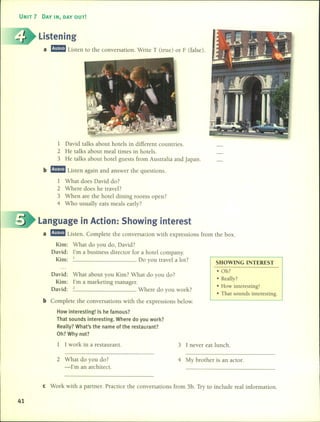
a mmListen to the conversation. Write T (true) or F (false).
SHOWING INTEREST
1 David talks about hotels in different countries.
2 He talks about meal times in hote1s.
3 He talks about hotel guests fram Australia and Japan.
b mmListen again and answer the questions.
1 What do es David do?
2 Where does he travel?
3 When are the hotel dining raoms open?
4 Who usually eats meals early?
Language in Action: Showing interest
a mmListen. Complete the conversation with expressions fram the box.
Kim: What do you do, David?
David: l'm a business director for a hotel company.
Kim: 1 Do you travel a lot?
David: What about you Kim? What do you do?
Kim: l'm a marketing manager.
David: 2 Where do you work?
b Complete the conversations with the expressions below.
How interesting! 15 he famous?
That sounds interesting. Where do you work?
Really? What's the name of the restaurant?
Oh? Why not?
• Oh?
• Really?
• How interesting!
• That sounds interesting.
1 1 work in a restaurant.
2 What do you do?
-l'm an architect.
3 1 never eat lunch.
4 My brother is an actor.
e Work with a partner. Practice the conversations fram 5b. Try to include real information.
41
UNIT 7 DAV IN, DAV OUT!
Reading
a Can you put the words and phrases into the appropriate category?
a hospital
pick up a package
an editor
deliver a baby
patients
deliver a package
write an article
interview
Doctor Journalist Package courier
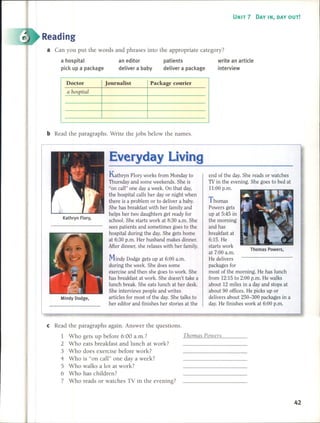
a hospital
bRead the paragraphs. Write the jobs below the names.
Thomas Powers,
end of the day. She reads or watches
TV in the evening. She goes to bed at
11:00 p.m.
Thomas
Powers gets
up at 5:45 in
the morning
and has
breakfast at
6:15. He
starts work
at 7:00 a.m.
He delivers
packages for
most of the morning. He has lunch
from 12:15 to 2:00 p.m. He walks
about 12 miles in a day and stops at
about 90 offices. He picks up or
delivers about 250-300 package s in a
day. He finishes work at 6:00 p.m.
Kathryn Flory works from Monday to
Thursday and sorne weekends. She is
"on caH" one day a week. On that day,
the hospital caHs her day or night when
there is a problem or to deliver a baby.
She has breakfast with her family and
helps her two daughters get ready for
school. She starts work at 8:30 a.m. She
sees patients and sometimes goes to the
hospital during the day. She gets home
at 6:30 p.m. Her husband makes dinner.
After dinner, she relaxes with her family.
Mindy Dodge gets up at 6:00 a.m.
during the week. She does sorne
exercise and then she goes to work. She
has breakfast at work. She doesn't take a
lunch break. She eats lunch at her desk.
She interviews people and writes
articles for most of the day. She talks to
her editor and finishes her stories at the
Kathryn Hory,
Mindy Dodge,
cRead the paragraphs again. Answer the questions.
1 Who gets up before 6:00 a.m.? ThomQs Powers
2 Who eats breakfast and lunch at work?
3 Who does exercise before work?
4 Who is "on caH" one day a week?
5 Who walks a lot at work?
6 Who has children?
7 Who reads or watches TV in the evening?
42
UNIT 7 DAY IN, DAY OUT!
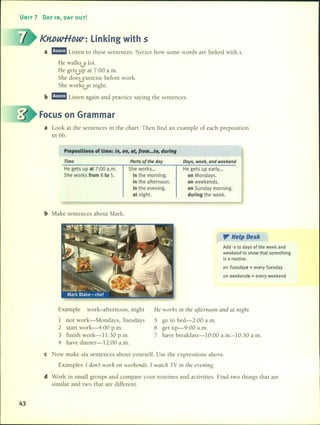
KntJwHDW-: Linking with S
a rJ!mm Listen to these sentences. Notice how sorne words are linked with s.
He walks a lot......"
He gets....."upat 7:00 a.m.
She does exercise before work......"
She work~at night.
b rJ!mm Listen again and practice saying the sentences.
Focus on Grarnrnar
a Look at the sentences in the chart. Then find an example of each preposition
in 6b.
Prepositions of time: In, on, at, trom ...to, during
Time
He gets up at 7:00 a.m.
She works from 8 to 5.
b Make sentences about Mark.
Parts of the doy
She works ...
in the morning.
in the afternoon.
in the evening.
at night.
Days, week, and weekend
He gets up early...
on Mondays.
on weekends.
on Sunday morning.
during the week.
". He'p Desk
Add -s to days of the week and
weekend to show that something
is a routine.
on Tuesdays = every Tuesday
on weekends = every weekend
Example work-afternoon, night
1 not work-Mondays, Tuesdays
2 start work-4:00 p.m.
3 finish work-ll:30 p.m.
4 have dinner-12:00 a.m.
He worhs in the aftenlOon and at night.
5 go to bed-2:00 a.m.
6 get up-9:00 a.m.
7 have breakfast-1O:00 a.m.-l0:30 a.m.
e Now make six sentences about yourself. Use the expressions aboye.
Examples 1don't worh on weehends. 1 watch TV in thc evening.
d Work in small groups and compare your routines and activities. Find two things that are
similar and two that are different.
43
UNIT 7 DAY IN, DAY OUT!
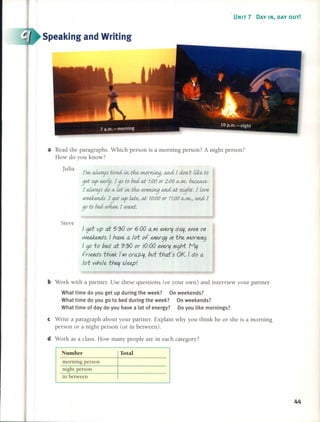
Speaking and Writing
[~aiw-ayf tired irv t:h.h uwrrWtjJ tJJ1.L£ [ do/1/'t ti1b to
3d ~ earty. [30 to bed al; 1:00or 2:00 IV./11/. b~~
1aiw-ayfdo IV wt irv t:h.h ~ tJJ1.L£ al; nijhr. 1w~
weeIwuú. [3d ~Úú~ al; 10:000r 11:00IV./11/'J tJJ1.L£[
30 to bed ~ [ WtU1i:.
a Read the paragraphs. Which person is a morning person? A night person?
How do you know?
Julia
Steve
} ge.t up af 5'.'30 or 6,.00 a.M. ever~ da~1even on
weekends. } have a /of of energ~ in fhe Morning.
} go fo bed af 9'.'30 or /0,.00 ever~ night. M~
friends fhink J'Mcra~, buf fhaFs OK. } do a
/of whtle fhe~ s/eep!
b Work with a partner. Use these questions (or your own) and interview your partner.
What time do you get up during the week? On weekends?
What time do you go to bed during the week? On weekends?
What time of day do you have a lot of energy? Do you Iike mornings?
e Write a paragraph about your partner. ExpIain why you think he or she is a morning
person or a night person (or in between).
d Work as a class. How many peopIe are in each category?
Number Total
morning person
night person
in between
44
Colfee
Soda
Tea
Vege!able
soup
Sandwich meats
Chicken
Roas! beef
The Salad Spot
SANDWICHES SOUP af the day/DRINKSSALAD BAR
Green
Peppers
Lettuce
Olives
Onions
Broccoli
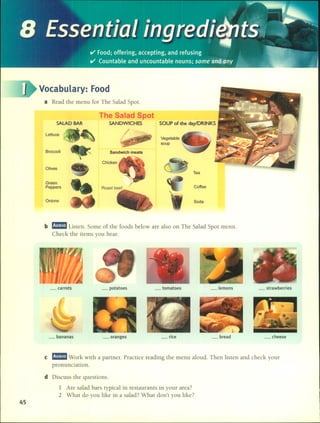
a Read the rnenu for The Salad Spot.
Vocabulary: Food
b fiE Listen. Sorne of the foods below are also on The Salad Spot rnenu.
Check the iterns you hear.
_ carrots _ potatoes _tomatoes _lemons _ strawberries
_bananas _oranges _rice _ bread _cheese
e fiE Work with a partner. Practice reading the rnenu aloud. Then listen and check your
pronunciation.
45
d Discuss the questions.
1 Are salad bars typical in restaurants in your area?
2 What do you like in a salad? What don't you like?
It is possible to "count"
uncountable nouns.
I drink caffee. (uncountable)
I drink two cups of caffee every
marning. (You can count cups.)
". He'p Desk
dressí~
Uncountable nouns
Rob wants soup after his salad.
He likes soup.
3 1 calo .. every day.
4 1 drink ... every day.
úU.J1.ttitbLe I1Olo(l1J &htLOlo(l1ttitbLe l10WtJ
C'l SC'lMJwíc.it/SC'lMJwíc.kes soup
C'l tOl1lLúltO/t0Wt0toes iettuc.e..
C'lf"l olíve../olíves broaolí
Countoble nouns
Rob wants a sandwich.
He likes sandwiches.
1 1 like ....
2 1 don't like ....
UNIT 8 ESSENTIAL INGREDIENTS
46
Countable and uncountable nouns
Examples 1 liJ~cpotatoes and tomatocs. 1don't liJ~cchccsc. 1 cat a sandwich cvcry day.
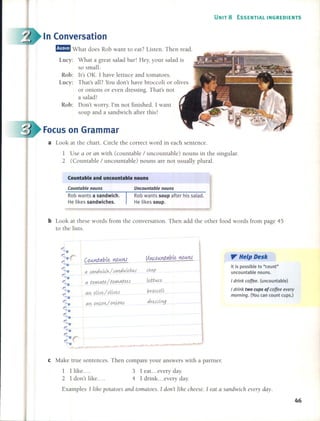
m!Jm What does Rob want to eat? Listen. Then read.
Lucy: What a great salad bar! Hey, your salad is
so small.
Rob: It's OK. 1 have lettuce and tomatoes.
Lucy: That's all? You don't have braccoli or olives
or onions or even dressing. That's not
a salad!
Rob: Don't worry. I'm not finished. 1want
soup and a sandwich after this!
b Look at these words fram the conversation. Then add the other food words fram page 45
to the lists.
a Look at the chart. Circle the correct word in each sentence.
1 Use a or an with (countable / uncountable) nouns in the singular.
2 (Countable / uncountable) nouns are not usually plural.
e Make true sentences. Then compare your answers with a partner.
In Conversation
Focus on Grarnrnar
UNIT 8 ESSENTIAL INGREDIENTS
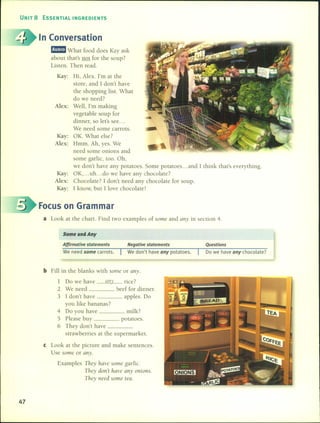
In Conversation
,.. What food does Kay ask
about that's not for the soup?
Listen. Then read.
Kay: Hi, Alex. I'm at the
store, and 1 don't have
the shopping list. What
do we need?
Alex: Well, I'm making
vegetable soup for
dinner, so let's see ...
We need some carrots.
Kay: OK. What else?
Alex: Hmm. Ah, yes. We
need some onions and
some garlic, too. Oh,
we don't ha ve any potatoes. Some pota toes ... and 1 think that's everything.
Kay: OK, ... uh ... do we have any chocolate?
Alex: Chocolate? 1 don't need any chocolate for soup.
Kay: 1 know, but 1 love chocolate!
Focus on Grarnrnar
a Look at the chart. Find two examples of saine and any in section 4.
SomeandAny
Affirmative statements
We need some carrots.
Negative statements
We don't have any pota toes.
Questions
Do we have any chocolate?
47
b Fill in the blanks with saine or any.
1 Do we have an)' rice?
2 We need beef for dinner.
3 1 don't have apples. Do
you like bananas?
4 Do you have milk?
5 Please buy potatoes.
6 They don't have _
strawberries at the supermarket.
e Look at the picture and make sentences.
Use saine or any.
Examples They have saine garUe.
They dan't have any ania/ls.
They /leed saine tea.
UNIT 8 ESSENTIAL INGREDIENTS
KltbwHow-: Grarnrnar notes
a It's helpful to make your own notes about new grammar. Look at this example.
fish / seafood
People usually give a reason or
explanation when they refuse an offer.
'don't drink tea. / "m on a dieto
".. Help Desk
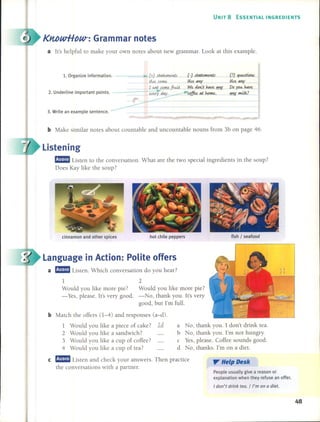
hot chile peppers
(-!)--rt&lte-me.!1ts__ (::)_st<ft~ __ {?)_q~l1.L
(Me-jome., Use-~<t~ u.rc._<ttty:__
Le-&ltJome.Jr!t¡t_IX,,-'(o!t't_MVc.~1)o_yoI(.JU!l"c._
e-Ve-rrA'&lY. ~ffu-_"C/y¡t't1.e.__ ~¥I'liLk2_
2
Would you like more pie?
-No, thank you. It's very
good, but 1'm full.
cinnamon and other spices
1
Would you like more pie?
- Yes, please. It's very good.
1. Organize information.
2. Underline important points.
fJ!JII Listen lO the conversation. What are the two special ingredients in the soup?
Does Kay like the soup?
b Match the offers (1-4) and responses (a-d).
1 Would you like a piece of cake? 1.d a No, thank you. 1 don't drink tea.
2 Would you like a sandwich? b No, thank you. 1'm not hungry.
3 Would you like a cup of coffee? c Yes, please. Coffee sounds good.
4 Would you like a cup of tea? d No, thanks. 1'm on a diet.
e fJ!JII Listen and check your answers. Then practice
the conversations with a partner.
a fJ!JII Listen. Which conversation do you hear?
b Make similar notes about countable and uncountable nouns from 3b on page 46.
3. Write an example sentence.
Language in Action: Polite offers
Listening
48
UNIT 8 ESSENTIAL INGREDIENTS
Reading
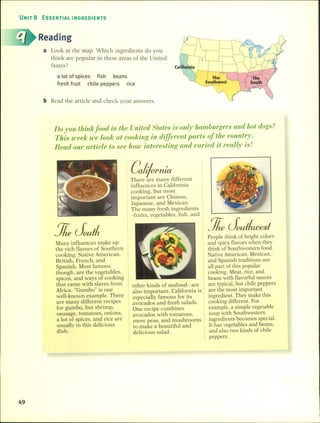
a Look at the map. Which ingredients do you
think are popular in these areas of the United
States?
a lot of spices fish beans
fresh fruit chile peppers rice
bRead the artide and check your answers.
Do yo" Illink lood in tlle Ullit(~dSta le.,;i,,;01l(Y /Ullllb"rgers aml/lOt dogs?
Tlli.,; w(~ek we look at cooking i" dillernll part,"! 01t/U' cOIllltr:r.
J1ead our article lo ."1('(' /IOW illler(~."!ti"gllIul varü.d il r(~al(y is!
People think of bright colors
and spicy flavors when they
think of Southwestern food.
Native American, Mexican,
and Spanish traditions are
aH part of this popular
cooking. Meat, rice, and
beans with flavorful sauces
are typical, but chile peppers
are the most important
ingredient. They make this
cooking different. For
example, a simple vegetable
soup with Southwestern
ingredients becomes special.
It has vegeta bIes and beans,
and also two kinds of chile
peppers.
:!le cfoulhwesl
other kinds of seafood- are I
also important. California is I
especially famous for its
avocados and fresh salads.
Qne recipe combines 1
avocados with tomatoes, I
snow peas, and mushrooms
to make a beautiful and
delicious salad.
I California
There are many different
influences in California
cooking, but most
important are Chinese,
Japanese, and Mexican.
The many fresh ingredients
-fruits, vegetables, fish, and I
Many influences make up
the rich flavors of Southern
cooking: Native American,
British, French, and
Spanish. Most famous
though, are the vegetables,
spices, and ways of cooking
that came with slaves from
Africa. "Gumbo" is one
well-known example. There
are many different recipes
for gumbo, but shrimp,
sausage, tomatoes, onions,
a lot of spices, and rice are
usually in this delicious
dish.
49
UNIT 8 ESSENTIAL INGREDIENTS
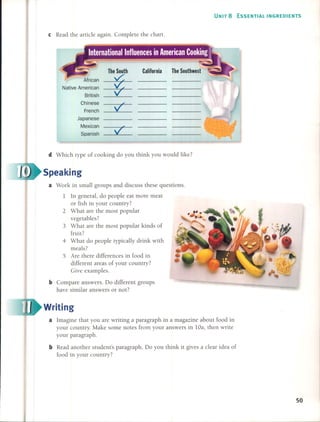
cRead the anide again. Complete the chart.
African
Native American
British
Chinese
French
Japanese
Mexican
Spanish v
California The Southwest
d Which type of cooking do you think you would like?
Speaking
a Work in small groups and discuss these questions.
1 In general, do people eat more meat
or fish in your country?
2 What are the most popular
vegetables?
3 What are the most popular kinds of
fruit?
4 What do people typically drink with
meals?
5 Are there differences in food in
different areas of your country?
Give examples.
b Compare answers. Do clifferent groups
have similar answers or not?
Writing
a Imagine that you are writing a paragraph in a magazine about food in
your country. Make sorne notes from your answers in lOa, then write
your paragraph.
bRead another stuclent's paragraph. Do you think it gives a dear idea of
food in your country?
50
Units -8
1 What 7
Takeshi Sato is a businessman.
2 7
He ancl his wife live in Tokyo.
3 7
They come to New York in October.
4 ?
She (Kumiko) usuaHy eats breakfast
at 7:30.
3 1 get up at _
4 For lunch 1 eat _
Complete the sentences with true information
about yourself.
1 I'm a _
2 1 work (study) at _
5 On Saturday afternoons, 1 _
2. Complete the paragraph with the correct
prepositions.
in on at from to
Jason goes to Japanese c1ass 1 mI
Monday. He works 2 night, so he
goes to c1ass 3 the morning. His
c1ass is 4 9:00 5 10:30.
He doesn't work Ó weekends, so
he is not tired 7 Monclay
mornings.
3 Write the questions for these answers. The
words in bold are the answers.
4
1 Does Jason work during the day?
No, he _do_e_s_n'_t_
He worlls al night.
2 Jason single?
No,he _
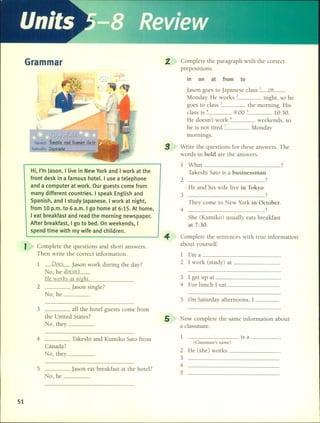
Hi, I'm Jason. I live in New York and I work at the
front desk in a famous hotel. I use a telephone
and a computer at work. Our guests come from
many different countries. I speak English and
Spanish, and I study Japanese. I work at night,
from 10 p.m. to 6 a.m. I go home at 6:15. At home,
I eat breakfast and read the morning newspaper.
After breakfast, I go to bed. On weekends, I
spend time with my wife and children.
Grarnrnar
I Complete the questions and short answers.
Then write the correct information.
3 aH the hotel guests come fram
the United States?
No, they _
5 Now complete the same information about
a c1assmate.
5 Jason eat breakfast at the hotel?
No,he _
2 He (she) works _
3
4
5
4 ____ Takeshi and Kumiko Sato fram
Canada?
No, they _
1 ________ is a _
(Classmate's name)
51
Vocabulary
g Underline the different word in each group.
Then wrile the topie of each group in the
space.
clothes family colors food
ía.J<eshJ;and KuMÚ<D Sa.~
0C!pCtlltSe
8(,9z / 6esshp) ÍDKVD
3459-(,48/
{KSa. ~ (ál web .Khw
UNITS 5-8 REVIEW
Read lhe registration formo Write the
questions Jason asked Mr. and Mrs. Sato.
1 What~ vour llame?
2
3
4
5
A riddle is a funny or "trick" question. Can
you answer this riddle?
Don has a photograph of someone. His
friend asks, "Who is it?" Don says, "That
man's father is my father's son." (Don has
no brothers.)
Who is in the photograph?
Can you find the answer? If not, arrange
these letters into two words. ONOSSND
Name(s):
Nationality:
Address:
Telephone:
E-mail:
fun ~pot
Recycling Center ~
q
: red orange sweater white
____ : cable soup rice sandwich
____ : boots shirl actor T-shirt
____ : niece cousin bieycle father
1 c%rs
2
3
4
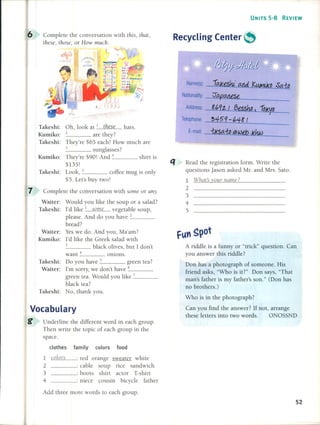
Complete the conversation with this, that,
these, those, or How mucho
Complete the conversation with some or any.
Waiter: Would you like the soup or a salad?
Takeshi: I'd like 1 some vegetable soup,
please. And do you have _2 _
bread?
Waiter: Ves we do. And you, Ma'am?
Kumiko: I'd like the Greek salad with
3 black olives, bul 1 don't
want -+ onions.
Takeshi: Do you have 5 green tea?
Waiter: I'm sorry, we don't have _6 _
green tea. Would you like _7 _
black tea?
Takeshi: No, thank you.
Takeshi: Oh, look at 1 these hals.
Kumiko: 2 are lhey?
Takeshi: They're $65 each! How much are
3 sunglasses?
Kumiko: They're $90! And -+ shirt is
$135!
Takeshi: Look, 5 coffee mug is only
$5. Lel's buy lwO!
7
6
Add three more words to each group.
52
UNIT 9 IN THE NEIGHBORHOOD
In Conversation
r.-What are they looking for? How are they going to get there? Listen. Then read.
JiU: So, where's the Convention Center?
Luc: I'm not quite sure. l think it's near the harbor.
JiU: Do we have a map?
Luc: l have this drawing .... It's not exactly a map.
JiU: Let's see ... it looks like the Convention Center is on
Central Avenue, next to the National Theater.
Luc: Yes, that looks right. OK, let's go. There's a
subway stop across the street.
JiU: Let's take a taxi. lt's faster.
Luc: Good idea! Then we don't need the map.
Focus on Grarnrnar
a Look at the chart. Find four examples of the prepositions in the
conversation aboye.
Prepositions of place
Onext
to in tron~of onear
-~)across from
on the I
comer of I
". He'p Desk
on Central Avenue.
on the corner of Central Avenue and Park Street.
near / next to / across from / in front of / behind
the theater.
between the theater and the museum.
acmss FOIl1
It'sWhere's (the convention center)?
1 The Convention Center is
the harbor.
2 The National Theater is _
Central Avenue Blake Boulevard.
3 The Harbor Hotel is the
Convention Center.
4 The Convention Center is the Harbor
Hotel the National Theater. --
5 There's a parking lot the
Convention Center.
b Fill in the blanks with the correct prepositions.
e Work with a partner. Make five questions about places in
your town or city. Then ask other stuclents your questions.
Example A: Whercs the Rivcrvicw Shopping Ccntcr?
B: Its on Grand Avcnuc, ncxt to the ...
Be careful:
It's neor the museum.
(Not: /t.!.s-neor.tothe-museum.)
BUT
It's next to the museum.
55
UNIT 9 IN THE NEIGHBORHOOD
KltbwHow-: Listen ing ti ps
1
b Look at the suggestions below. Then do the listening
activity in section 7.
1 Think about the topie before you listen.
2 Listen for the general idea first.
3 Don't worry if you don't understand every word.
Use key words to help you understand.
4 Listen more than once.
a Before you listen, discuss the two maps.
Example TI1e Star Café is between the
banll and Devon MQI'I~et.
b mmmJ Listen and answer the questions.
1 How does Tim feel about the
neighborhood?
2 Which places does he talk about?
e mmmJ Listen again. Which map is described?
a Think about listening to an English tape or CD in
class. How do you feel about it?
I like it. It's OK. It's difficult.
Listening
Language in Action: Places
a Practice the conversation.
A: Excuse me. 15 there a grocery store
near here?
B: Yes, there is. Devon Market. It's on
Gold Street, next to the café.
A: OK, thank you.
B: You're welcome.
ASKING ABOUT PLACES
Excuse me, is there a grocery store near here?
ANSWERING
Yes, there is. {t's...
No, there isn't.
I'm sorry, { don't know.
b Work with a partner. A, you are a tourist. Ask about a place. B, describe the location.
56
UNIT 9 IN THE NEIGHBORHOOD
Reading
a
---•• •••••••••• • •
••••••
bRead the artide. Which town plan do the "new urbanists" "}use.
•
These are some of the
principIes of New Urbanism:
• There is a clear eenter to the
neighborhood.This is often a
square or a plaza.
• Most houses or apartments
are within a five-minute walk
of the eenter.
• There are different kinds of
houses and apartments, with
varying priees.
• There is a variety of sto res and
offiees in the neighborhood .
• l1'spossible for ehildren to
walk to the elementary sehool.
• There are narrow streets with
trees along them.This slows
traffle and makes it better for
people who walk or ride
bieycles.
••••
possible lO walk almost anywhere.
Their ideas are called New
Urbanismo There are now
300-500 New Urbanism projects
planned or being built in the
United States. One
example is Vermillion,
a new neighborhood in
Huntersville, North
Carolina.
••
eurrently, many people live in
suburbs, large residential
areas oUlside major cities. In these
areas slOres, schools, and work
places are often far away from
people's homes.
These communities
sometimes have no
center. Cars are a
necessity. Parents
drive their children
lO school, and they
drive lO the slOres.
People don't walk
very mucho They don't see or talk
lO their neighbors on the street.
Now sorne lOwn planners and
architects are designing small,
integrated lOWDS,where it's
New Urbanism
There's a new approach to town and city
planning in the United States these days.
L
•
I
I•
I•
I
•
I•
I
I
I
r._._._._._._._._._._._._._._._._.
e Check the sentences that describe communities based on New U b .r amsm.
_ 1 You orten see people riding bikes or walking
2 Children go to school by car or bus. .
3 PeopIe don't usually walk to work.
4 There's a central area with stores and other public places.
5 All the houses are the same.
6 You don't need a car all the time.
57
UNIT 9 IN THE NEIGHBORHOOD
Speaking
a Discuss these questions.
1 Where do you walk in your community? To school? To the supermarket? To work?
2 Where do you drive or go by bus or other transportation?
3 Do you know the people in your neighborhood?
4 What do you think of the New Urbanism principies?
b Work with a partner. Design an "ideal neighborhood." Choose eight locations and place
them on the map below. Use these ideas (or your own):
bank
newsstand
museum
post office
movie theater
drugstore
café
school
hospital
restaurant
grocery store
bookstore
e Describe your neighborhood to another pairo
Writing
a Imagine a brachure advertising houses in your
"ideal neighborhood." Use your plan fram lOb
and write a paragraph describing the area.
bRead about other students' neighborhoods.
Which do you like best? Why?
A NicePlace
• UVe!This is a ver)'speeial
neighborhood
~
JI has everything you need.
There's a bank and a pOSI office.
There's a grocery slore ...
58
~
10 Funand games~~:.~__.,''
ti' Sports, games, and abilities • 
-----, ti' Can / can't (ability); conjunctions~.~==~ ",__ ~_
/00
00
00
I

Vocabulary: Sports
a Work with a partner. Do lhe quiz.
Basketball
u
S
Take OUT quiz and find out!
Which sport do you think is the most popular in eaeh eountry?
1. Canada a. baseball
2. Germany b. basketball
3. Japan c.go~
4. Norway d. ice hockey
5. The Philippines e. skiing
6. Scotland f. soccer
}
~j
I I
Golf :
Baseball
• e •
'l" . e.e
J!j
..,.
(
I
What is the most popular sport in the world?
a. golf b. soccer c. baseball
Ice Hockey
b mmmI Listen and check your answers.
e Discuss lhe queslions.
1 Which sports are popular or nol popular where you live?
2 Which sports do you like or nol like?
Examples Soccer is ve/y populQ/: [ce hoáey isn't popular
[ lihe soccer and bashetball. [ don't lihe golf.
[ don't lihe any sports!
59
UNIT 10 FUN AND GAMES
Reading
Match each sentence (a-d) with the correct picture.
a They can skate as fast as 60 km an hour.
b They can ride at an average of 40-50 km an hour.
e They can't run at maximum speed for four hours after a race.
d Professionals can lift up to 25 tons in one training session.
lOO-meter sprinters
I E/ite sprinters can run
U/1 ro 40 km an houT.
2
Downhill mountain bikers
3
4 They can 't stop easi/y.
Weightlifters
5
Speed skaters
6
Focus on Grarnrnar
a Look at the sentences in the chart. Does the main verb, run, change after can?
Can (abllity)
Af{irmative statements
I
You
He / She / It can run fast.
We
They
Negative statements
I
You
He / She / It can't (cannot) run fast.
We
They
Questions
Can you run fast?
Answers
Yes, lean. No, I can't.
b Circle C (correct) or 1 (incorrect). Rewrite the incorrect sentences.
1 A sprinter can ffi- run fast. C CD A sprinter can run [ast.
2 He can't lift it. C 1
3 A speed skater not can stop easily. C 1
4 Do you can skate? C 1
5 Can mountain bikers ride fast? C 1
e Write five true sentences about yourself. Then compare answers with a partner.
Examples 1 can run fast. 1 can't kick a ball far.
60
UNIT 10 FUN AND GAMES
KntJwHoW': Pronunciation of can and can't
a r.-Listen to the pronunciation of can and can't in these sentences.
/bn/
/kren/
/krent/
/bn/
/krent/
1 can run a kilo meter.
1 can't run fast.
Can you skate?
Yes, 1 can.
No, 1 can't.
Now practice the sentences with a partner.
b r.-Listen. Check the sentence you hear.
1 He can ride a bicycle.
2 1 can ski.
3 They can ice skate.
He can't ride a bicycle.
1 can't ski.
They can't ice skate.
e Practice saying your sentences from 3c.
Speaking
a Think of a sport. Make four sentences about what good athletes can do.
Use the ideas below or your own ideas.
hit
run throw kick
basketball players baseball players golfers soccer players volleyball players
run fast jump high throwa ball far kick a ball far hit a ball far
Example Good basketball players can jump high.
b Describe the athletes. Can other students guess the sport?
Example A: They can jwnp high.
B: They play basketball.
61
UNIT 10 FUN ANO GAMES
Reading
a Can you find these activities in the illustration below?
cook make jewelry draw and paint play the trumpet play the drums
bRead the artide. Why is Richie so interesting?
INSTRUCTOR PROFILE
Richie Travers, Computer Department
Aman with many talents!
Many students in our computer classes already know Richie Travers.
He's a very popular teacher for our classes in computer
programming and website designo Students appreciate how
much he knows about computers. But, many of you don't
know how many other talents and abilities Richie has. In
addition to his computer know-how, Richie can act, and he
sometimes does radio commercials. He is very artistic too.
He can draw and paint, and he makes jewelry. He makes
beautiful gifts for his friends. And he's a good cook!
It's difficult to find something Richie can't do. He plays the guitar and
drums, but he can't play the trumpet. He can't speak French, but wants
to learn. He thinks that people can do anything if they have confidence
and believe they can. He says, "If someone asks me if 1
know how to do something, 1 say, 'Sure 1 can,'
and then 1 go and buy a book to learn!"
cRead the artide again. Complete the chart.
He can ... He can't. .. He can't. .., but wants to learn.
design a website ,/
play the trumpet
make jewelry
speak French
act
draw and paint
d Do you know someone with a lot of talents and abilities?
What can he / she do? What can't he / she do?
,,- Help Desk
Use play with games and musical
instruments.
She plays soccer.
He plays the guitar.
Don't use the with the name of the sport.
62
UNIT 10 FUN ANO GAMES
Focus on Grarnrnar
a Look at the chart. Complete the sentences.
1 Use ----ºL for alternatives.
2 Use __ for contrasting ideas.
3 Use __ for similar or related ideas.
Conjunctions: and, but, ar
I can draw and paint.
He acts, but he can't sing.
She wants to learn how to play the guitar or the drums.
Note: He can't sing or dance. = He can't sing, and he can't dance.
b Fill in the blanks.
1 1like sports, but 1don't like basketball.
2 1 love music. 1 can play the guitar the piano.
3 What do you want to play now, volleyball tennis?
4 1 don't have many hobbies, 1 like photography.
5 Can you study japanese Spanish
at the same time?
6 1 can't paint draw.
7 1 can't ride a bike, 1 would like to learn.
Language in Action: Offering help
a mmm1Listen. Complete the conversation with the
expressions Diane and Tim use.
REFUSING
Thanks, but 1don't
have time.
No, thanks.
ACCEPTING
OK!
Thanks!
That'd be great.
OFFERING
1can teach you.
1can show you.
rn teach you.
rn show you.
Diane: Do you want to play golf today?
Tim: Sorry, 1 don't know how to play golf.
Diane: That's OK. _1 •
Tim: Really? _2 _
b Work with a partner. Practice the conversation.
Use different activities and expressions.
Find something that your partner can teach you!
". Help Desk
I don' t know how to is similar
to I can' t.
I don' t know how to is better in
the conversation between Diane
and Tim. It means that Tim never
learned to play golf.
63
UNIT 10 FUN ANO GAMES
Listening
a mmmJ Read the game show questions. Listen and mark the questions they don't use.
,""ow t1uch Do You KnoIN ?
Contestant Questions: Circle y (Yes)or N (N ) ch'
O IOreac questIon.
1. Can he/she cook? y N
2. Can he/she sing? y N
3. Can he/she fix cars? y N
4. Does he/she like TV? y N
5. Does he/she like SPOrts? y N
6. Can he/she swim? y N
7. Can he/she ice skate? y N
b mmmJ Listen again. Write the answers to the questions you hear.
e Think of someone you know well. Can you answer questions 1-7 about him / her?
Writing
XYZ iD ,""ow t1uch Do You Kno ,
IN.
Name: Lou/s R/vers
l. Wr~tea shorr description of things you can d
Qnt~ m
J'mverv ath/et/c. J /ove 1l10stsports.
J p/av soccer. bask.etball, Md vo//evbal/
verv we/I. J can SWIMb..Jo J 't.I VL can Ice
sk.at~.J 111not verv arl/st/c or creat/ve.
J cMt draw or pa/nt. J CM s/ng a
!tft/e. bvf J don't p/av M /nstrull1ent
J It/ee phot ographv Md J tak.e a /ot .
of p/etures. J'mnot verv ll1echM/cal¿
J /o;e cars Md 1l10torcvc/es, but J
CMt ft'x thell1.
2. Why'd . b
o you want to e a COntestant on "How Much
ovJ ~uc.h 00 You KnoIN?
-artistie or ereative
-meehanical
Name: _----------~-
l. Write a short description of things you can and
can't do.
b Write notes about yourself for eaeh eategory
(athletic, artistie or ereative, meehanical).
Then, write a paragraph.
cRead another student's paragraph. Does it give
enough information for the TV game show?
a Read Louis's deseription of himself for the TV game show. What does he say for
eaeh eategory?
-athletie
64
Reading
Read the comments about telephones. Vhich person's phone use is similar to yours?
Karen Wong
Seattle, Washington, United States:
I use the phone a loto I have a phone
in my bedroom at home, and I carry a
cel! phone. I talk to my friends a lot
on the phone, and I use the phone to
make arrangements with them.
Martial and Sylvie Legrand
Evian, France:
We have a phone in the kitchen that
everyone in the family uses. We use
the phone to make arrangements
and things like that, but we don't
talk for hours on the phone.
Miguel lavares
Santiago, Dominican Republic:
I use the phone al! the time for
work. I'm probably on the phone for
several hours every day. I have a
cel! phone, and there's a regular
phone in every room of my
house ...except the bathroom!
Vocabulary: Rooms in a house
a m!mI Listen and practice.
Who do es this house
belong to? Write the
number of the photo
from section l. _
65
b Where are the phones?
Name the rooms.
Example There~ a
phone in the living
room. Therc isn't a
phone in the garage.
•
UNIT 11 HOME PHONE
Listening
m!IID Which activities do es jim mention? Listen. Then read.
a Look at the chart. Answer the questions about the following sentences.
jim's taldng a showel: jim talles a shower evel)' m01l1ing.
1 Which sentence is in the present continuous?
2 Which sentence talks about something that happens every day?
Focus on Grarnrnar
Present continuous: Statements
Hi, this is jim. I can't come to the phone right now.
I'm probably working ...or I'm sleeping ...or maybe
I'm taking a shower ...I'm not talking on the phone,
though! Anyway, leave a message. Thanks!
I'm
You're
He / She / It's
We're
They're
sleeping.
I'm not
You aren't
He / She / It isn't
We aren't
Theyaren't
sleeping.
b Look at the chart aboye. Then complete the e-mail.
From:
To:
Subject:
suzieq@eln.khw
maggs@wol.khw
Quiet Friday
Hi, Maggie!
Finally, it's Friday! l' .c:.n-'-.l.:....>re'-"lc""lX"-'.i'-"ngi'>- 1 (relax) this evening. Martial's
in the kitchen. He 2 (not work) tonight (for once!), so
he 3 (cook) dinner. The kids are in the living room. I'm
not sure what they 4 (do) ... but ¡t's quiet.
What about you? I'm sure you 5(do) something
exciting tonight. You're probably 6(dance) in a club or
something like that right now ...
16
ñ
I
I
!
66
UNIT 11 HOME PHONE
Speaking
a llJIlJ Listen. Discuss what the people are doing.
playing basketball
taking a shower
talking on the telephone
using a computer
cooking
watchingTV
sleeping
Example A: I think he's cooking.
B: No, I think he's using a computo:
b Work with a partner. Think of three people you know. Say what each person probably is
or isn't doing right now.
Example My boyfriend isn't working right now. He's probably driving home.
KntJwHDUt': Spelling -ing forms
a Spelling in English can be difficult, but sometimes there are patterns. Look at these
examples of one-sylIable verbs. Answer the questions.
take-taking
use-using I
sit-sitting.
run-nmnll1g I
talk-talking
sleep-sleeping
What happens when you add -ing ...
1 to words that end in a consonant + e?
2 to one-sylIable words that end in one vowel + one consonant?
b Write the -ing form of these words.
drive get eat dance put have
Listening
a llJIlJ Listen to the fom phone calIs.
Who can talk on the phone
right now? Check the name.
1 Peter
2 Daniela
3 Miriam
4 Steve
b IlJIlJ'Listen again. What
is each person doing?
67
UNIT 11 HOME PHONE
In Conversation
m!l!mJ Does Mark know what his neighbor is doing? Listen. Then read.
Timothy: What is your neighbor doing?
Mark: 1 don't know.
Timothy: 15 he moving furniture
or something?
Mark: Maybe. I'm not sure.
Timothy: Does it bother you?
Mark: Not really. He do es it
a loto
Patricia: Hey, 1 hope he isn't
getting ready for a party.
Mark: Why?
Patricia: Because we aren't invited!
Focus on Grarnrnar
a Look at the chart. Find examples of Wh- and yes / no questions in section 8.
Present contlnuous: Questlons
Questions
What are they doing?
Are they moving furniture?
What's she doing?
15 she moving furniture?
Answers
They're moving furniture.
Yes, they are. No, they aren't.
She's moving furniture.
Yes, she is. No, she ¡sn't.
b Match the questions (1-6) and answers (a-f).
I What are you doing? k a They're playing basketball.
2 15 she talking on the phone? b No, I'm listening to the radio.
3 Where is Marta sleeping? c I'm cooking dinner.
4 What's he reading? d No, she isn't.
5 What are they doing? e A magazine.
6 Are you watching TV? f In her bedroom.
e m!l!mJ Listen and check your answers. Then practice asking the questions.
d Write questions.
I What/he/do
2 she / watch / TV
3 they / eat / dinner
4 Where / they / sit
5 he / talk / on the telephone
6 she / use / the computer
Whats he doing?
Is she watching TV?
68
UNIT 11 HOME PHONE
Speaking
a Work with a partner. A, look at picture 1 for one minute. Then cover the picture. B, ask
questions about the picture. Use the questions below and add your own ideas.
1
d. 7
What's the man / woman omg.
,;
earing7
What's the man / woman w .
Are the women in the living room?
Are the women sitting or standing?
b Now change roles. B, look at picture 2 for one minute. A, ask questions about the picture.
Language in Action: Telephone language
a Try to complete the conversations with expressions from the chart.
CALLER
This is (name).
Is (name) there?
Can 1 speak to (name), picase?
PERSON ANSWERING
Helio.
Yes,he / she is. OR No, he / she isn't.
Who's calling, piease?
Just a minute.
One moment, piease.
CALL 1
A: HelIo.
B: Hi, this is Katrina. 1 15
Ray ?
A: No, 2 . He's playing golf.
B: OK, 1'11 call back latero
CALL 2
C: Good morning, Block Company.
o: _3 _
Ms. Galli, please?
<=: 4 ?
O: This is Mike Boas.
e _5 _
69
b mD:!m1 Now listen and check your answers.
e Work with a partner. Practice the conversations. Use your own names (and different
activities if the person isn't there).
UNIT 11 HOME PHONE
Reading and Writing
. Wh t do you think it is about?a Look at the pictures. Descnbe the scene. a
Claire:
Peter:
Claire:
Peter:
(reaching for the phone) Hello.
Hi, Claire, it 's me. (voice coming from
the phone)
Oh...(pausing), hi o 1s this Phil?
No, it's Peter. Claire, listen, 1 have
something really important to tel1 you.
OK. What is it? (turning down the radio)
1 don't want to tell you on the phone.
We need to meet. (sounding nervous)
OK, it sounds serious. Where do you want
to meet?
Let's meet at the café by your house in
ten minutes.
1'm eating dinner right now. How about in
half an hour?
Claire, this is important. Please come
now! (sounding angry)
OK, OK. 1'm coming. 1'11 be there in
fifteen minutes.
SCRIPT: THE MESSAGE
Scene 1: There is a table in the middle of a
kitchen. Claire is sitting alone at the tableo
She is eating dinner and looks relaxed. She is
wearing jeans and a sweater. The radio is
playing in the background. The phone is ringing.
Peter is off on the side of the stage. He's
talking on his cell phone.
Claire:
Peter:
Claire:
Peter:
Claire:
Peter:
Claire:
bRead the script for
Scene l. Where is the
meeting? When is it?
e Work with a partner. Read
the scene aloud. What do
you think Peter wants to
tell Claire? Make a list of
possible ideas.
d Work with a partnero Write
Scene 20 Describe the scene
and write the dialogo Use
these questions to help
you.
What are Peter and
Claire doing?
What does Peter tell
Claire?
How does Claire
respond?
What do they do next?
e Exchange scenes with
another pair and read
them. How similar or
different are your scenes?
70
Vocabulary: Months and seasons
a ammJ Listen. Practice saying the months and seasons.
Dates in the chart represent the first and last days of the season in each section.
b Which months are part of which seasons where you live?
Example june, july, and August are winter months
where 1 live.
Listening
a ammJ Listen. Number the pictures below in the order you
hear them.
b Choose the picture that best shows the weather where
you live now.
...•...
I 'H
I
11 ~t 're 'lO
fI.~ ~. t> ft
~ I ,~ • +t ~~ 1t
n •
Australia_ Sweden_ Japan_
71
UNIT 12 HOT AND COLD
Vocabulary: Weather nouns and adjectives
Read the sentences and complete the chart.
It's cold and snowy in Stockholm today.
It's cloudy and cool in Tokyo.
It's sunny and hot in Sydney.
You can use rain and snow
as verbs.
It's raining.
It snows a lot in the winter.
". He'p Desk
Adjective (nonn + y)Nonn
sun
rain rainy Tuesday, November 20
snow
Vancouver
Seattle
San Diego
warm
cool
cold
hot
sun
rain
I! snow
••••••• clouds
•••~
~.;.111
fog
wind
Anchorage
San Francisco
°F oC
100-= r40
~ ~30
SO"ª ~
~ ~20
GO"ª ª".; ~10
40
1to
20] f.10
01 t.20
Temperatures are in Fahrenheit.
It's a sunny day in Sydney.
Rome is a warm city in summer.
Today is a cold day.
foggy
windy
Adjectives
It's sunny in Sydney.
It's warm in Rome.
It's cold today.
cloud
fog
wind
3 It's a cloudy in Paris this morning.
4 lt's a day snowy in Toranta.
e Look at the map and the key. Ask and answer questions
about the weather in the different cities.
Example A: What's the weather like in Ancharage?
B: It's snawy.
d Talk about the weather in your area taday.
b Correct the grammar mistakes in these sentences. (More
than one answer may be possible.)
1 It's~ot day in Mexico City.
It's a haL day in Mexico City.
2 15 cool in London today.
a Look at the chart. Answer the question.
Does the adjective come before or after the noun
(for example, day)?
Focus on Grarnrnar
72
UNIT 12 HOT AND COLD
KntJwHoW': Sentence stress
a m!J!ID Listen to these three sentences.
1 ¡t's a beautiful day.
2 lt's cloudy and foggy in London.
3 lt's sunny but cold today.
Which kinds of words have the most stress? Circle the correct answer.
a the verb be b words like and, but c nouns and adjectives
b m!J!ID Practice saying these sentences with the appropriate stress.
1 lt's a rainy day.
2 lt's cold and rainy in Seattle.
3 It's sunny and warm today.
Language in Action: Small talk
a m!J!ID Put the words into the correct categories. Then listen and
complete the conversations.
". Help Desk
People often use the weather
as a topic of informal social
conversation (Usmall talk").
horrible
lovely
nice wonderful awful
beautiful terrible
POSlTIVE I NEGATIVE
horrible
I Nice day!
Yes, it's _2 _
What a 3
Yes, ¡t's 4
day! _5 day, isn't it?
Yes, it is.
b Work with a partner. Practice the conversations. Use words for the weather in
your area today.
73
UNIT 12 HOT AND COLD
Reading
a Discuss these sentences about the weather on Marso What do you think?
Write T (true) or F (false) o
1 There are no seasonso
2 The weather can change very quickly.
3 It gets very cold.
4 It rains a lot.
bRead the artide. Were your ideas correct?
are usualIy very windy and dusty. There are often
dust storms. Dust clouds can be hundreds of miles
long and storms sometimes Iast for days.
Winters are very cold and cloudy. In the south,
WÍnter lasts for 183 days. O°F (-lS°C) is a typicaI high
temperature in the daytime. At night, temperatures
are sometimes extremely low. Once scientists
recorded a temperature of-200°F (-129°C).
On the positive
side, you don't usuaIly
need an umbrella on
Mars. It's often cloudy,
but it hardly ever mins.
So, youll need a lot of
warm clothes for your
trip to Mars, but not a
raincoat
Have a good trip!
TRAVELING TO MARS?
HereJs what you need to know!
A vacation on Mars?
Does it sound
impossible? Sorne peopIe
don't think so. They
believe that one day itwill
" be possibIe. Just in case,
here is sorne weather
information to help you
prepare for that ultimate
Sur/aee o/Marso trip.
Mars has different seasons like Earth, but they
are not equaI and are often extreme. Temperatures
can change by 40° (22°C) in a few minutes.
Surnmers Iast 178 Earth days in the north and
154 Earth days in the south. In the surnmer,
temperatures can reach 60°F (15°C) during the day,
but can fall to -90°F (-68°C)the same night Summers
cRead the artide again and complete the charlo
Seasons on Mars
NUMBER OF DAYS TEMPERATURE TYPICAL WEATHER
Summer 178 days (north)
days (south)
Winter
d Some people think that there is life on Mars and that it's possible for humans to travel
to Mars. What do you think?
Ves, definitely. Possibly. Probably noto No, definitely noto
Examples Yes, deJinitely. 1 thilll~ there is lije on Mars ...
No, deJinitely not. 1 don't think there is lije 011 Mars ...
74
UNIT 12 HOT ANO COLO
Focus on Grarnrnar
a The sentences in the chart show the usual position of some frequency adverbs.
1 Does the adverb come befare or after the verb be?
2 What about other verbs?
100%
Adverbs of frequency
With be
It is hardly ever rainy on Mars.
Temperatures are sometimes very low.
With other verbs
It hardly ever rains on Mars.
Temperatures sometimes go very low.
0%
always
usually
often
sometimes
hardlyever
never
b Put the adverb in the correct place in the sentences below.
1 Summers are very windy. Cusually)
2 There are dust storms. Coften)
3 Storms last for days. Csometimes)
4 The weather is very extreme. Calways)
e Put adverbs in these sentences to make true sentences about where you live.
Then compare answers with a partner.
Example It's usually hot in Rio de janeiro in Februmy.
1 lt's hot in February.
2 It rains a lot in the summer.
3 It's cool in the falI.
4 It snows in the winter.
5 It's very cold in May.
Speaking
Work in small groups. How do your activities and clothes change at different times
of the year? Use these verbs.
wear go eat drink do work
Examples 1 often go to the beach on weehends in the summer. .
1 usually wear a hat in the winter.
1sometimes worh more in September and OctobeJ:
75
UNIT 12 HOT AND COLD
) qo to the beae::h011week.end~!.it the _.
sUll1l11er:) usuaJly 12la~ volle~baJl E:!!1__
5WIM.)11Auqust, ) dOI1'tWOrK.) qo _
to the beach for the whole 1I1011th.)--¡ - ----------- -
I
r-::
1-
f-=
f
!-=---t y'suaJ/~ wear shorts and a T-shirt il1
~ the SUll1l11er'(l1of a:t workJJ. )fs oft!!:.I1_.
~y-.!-it the &JI lit Barcelol1tb) d!?l1'i __
~-4- Itke_that. )11the wlitter, Lff't~11 qo _
1-- sk.úitq with f riends lit the 1I10Ul1tatits.
---I+-And ) usuaJ/~Jak.e a sk.i vacatiol1 with_
_ -+t- 111~faJ'vJi!~lit Decell1ber. )j!!'l~g;~Cf!-(,__
_t 50) pla~ soccer aJI ~ear(
a Use your ideas from section 9. Write
a paragraph about your life at
different times of the year.
bRead another student's paragraph.
How similar or different are your
habits during the year?
t
••Antonio,
Writing
76
Bluebirds
Singing a _4 •
Nothing but bluebirds
AH day long
Never saw the sun shining so bright
Never saw things going so _5 _
Noticing the days hurrying by _
When you're in lave, my how they fiy!
Blue days,
AH of them gane _
Nothing but blue skies
From now 6
------.
Blue Skies
by Irving Berlin
I was blue, just as blue as I could be;
Ev'ry day was a cIoudy day for _1 _
Then good luck carne a-knocking at my 2
Skies were gray, but they're not gray anym-or-e----
BIue skies
Smiling at me
Nothing but blue skies
0013
------
a Can you fill in the missing words
to the song? Use the words below.
right see song on me door
b I!I!ID Now listen and check.
d This classic American song was
written in 1926. Why do you
think it's still popular today?
Now explain the two uses of the
word blue in the songo
5 Blue days, AH of them gone.
e I!I!ID This song uses colors and
the weather to describe being
happy or sad. Listen again. Write
happy or sad in the blanks.
1 1 was blue. _
2 Ev'ry day was a cloudy day
forme. _
3 Skies were gray. _
4 Blue skies smiling at me.
Listening: Song
Grammar
The Chicago Skyline
Hi ~ol',
Here J "'1', il Chic",~o. ~y Iew
jo'b is ~re"'l; 'b•.••t ,'", very 'bv.sy.
J ~o,,'t h",ve "' •.••eh H1o'eto
relDX.The we",ther is
terrible! It's ",lw",ys wil~y,
"'I~ to~",y it's Slowi~. 1 Ii<e
"'Y Iew "'p"'""""elt. It's '" '"
~oo~ lei~h'borhoO~1"'I~
there's '" 'bv.sstop ",cross the
street. I ",iss yo•.•••
Leve,
""iri"'lM
J"'let Pctts
~ Oce"'l '5tve,
""i"'lMi, F1ori~",
s: So, tell me about your new apartment.
How many bedrooms are there?
M: Well, there are two bedrooms.
S: 1 1s t11ere a dining room?
M: NO,2 , but
3 a large living room.
S: It sounds niee. -+ a lot
of stores nearby?
M: Yes, 5 , and
6
two or three cafés
on my street.
S: 7
a subway stop in
the neighborhood?
M: NO,8 . 1 take the bus
to work.
77
I
2.
Circle the eorreet answer.
1 janet Potts lives in _
a) Chicago b) Boston @Míami
2 janet is Miriam's .
a) eousin b) mother e) daughter
3 Miriam relaxes.
a) usually b) never e) hardly ever
4 It is in Chieago.
a) cloudy and rainy
b) windy and snowy
e) rainy and foggy
Complete the eonversation between Seott
and Miriam. Use there ís / iSIl't, there are, 1s
there ... ?, or Are there ..?
Circle the eorreet answer. Simple present or
present eontinuous?
K: Hello, Miriam. This is Karen, Seott's
wife.
M: Oh. Hello, Karen.
K: l(Are you eating / Do you eat) dinner?
M: No, I'm not. 1 2(relax / 'm relaxing) in
front of the TV
K: Oh, good. 1 3(eall / 'm ealling) about
dinner on Friday. Are you free?
M: Yes, 1 amo 1 hardly ever -+(go/ am going)
out on Friday nights.
K: Great. We usually 5(eat / are eating)
about 7:00. So come around
6:00 or 6:30.
UNITS 9-12 REVIEW
Write sentences with always, usual/y, often,
sometimes, hardly ever, or nevero Use each
word once.
(0% = never; 100% = always)
1 Which endings are contractions?
2 Which is possessive?
tenchik
egaargebalsalb
cocers
sports rooms
de tasking tharmoob
gutusA
Fuyarebr
Recycling Center ~
7 Complete with -s, -'s, or N. (N = nothing).
Note: The -:s can be a contraction of is or
a possessive.
Scott and Karen Martin live ~ in
Chicago. Scott ~ Miriam __ 3 boss.
He __ 4 a computer programmer, and he
work __ 5 with the new people in the
office. He love __ 6 his jobo Scott and
Karen often invite __ 7 friends home for
dinner. Karen love __ 8 to cook, and she
like __ 9 to meet new people.
Miriam __ 1_0 eating dinner with them
tonight.
Look at the :s endings in the paragraph
above.
tennssawd
places months
nakb lb<':.) enJu
dgruserto
Vocabulary
6 Put the letters in order to make words. Then
add more words to each set.
Scott
Miami
1 cold / 10%
It is hardly ever cold in Miami.
2 rains / 60% / in September
Look at the chart. Write sentences,
questions, and answers with can.
.1 = yes; X = no.
Examples
Miriam can program a computer.
Scott can't dance.
Can Karen and Scott play golf?
Miriam Karen
dance .1 ,/
play the guitar X X
play golf X ,/
program a computer ,/ X
cook X ,/
3 sunny / 100% / in the spring
Chicago
4 snows / 0% / in July
5 foggy / 40% / in the morning
Can you solve this puzzle?
What is always coming but never arrives?
Hint: moworrot
6 windy / 80% / in the faH
78
--1
..,-..~"";.
~''f;jI 
13. Takecare ofyourselfl/ ..
ti' Compute,language; parts ofthe body;ailments and ,emedi!s.,f(. .1I
V' Should /shouldn't; modifiers i/ ~I
Vocabulary: Parts of the body
l!I!mJ Listen. Practice saying the parts of the body.
head
eye
ear
neck
shoulder
back
arm
hand
knee
leg
foot
• Use a good chair.
.----------
.----------
2
• -----3-----
• Don't sit too close to the screen.
• -----4-----
• Don't sit too long. Take breaks .
". He'p Desk
You usually use
possessive adjectives (for
example. my or your) with
parts of the body.
Re/ax your hands.
15 this different in your
language?
79
Listening
a Look at the poster aboye. Find a pan of
the picture that relates to each of these
phrases.
1 cross your legs
2 keep your feet fiat on the fioor
3 keep your hands and arms relaxed
4 sit an arm's length away
b l!I!mJ Listen. Then complete the pos ter
with the phrases from 2a.
UNIT 13 TAKE (ARE OF YOURSELF
Focuson Grammar
a Look at the chart. Then make sentences with should or shouldn't. Use the pos ter on page 79.
Example Your chair SllOUld support your baá. You shouldn't cross your legs.
Should I shouldn't (advice I suggestlons)
Af{irmative statements
I
You
He / She should sit up straighí.
We
They
Negative statements
I
You
He / She shouldn't sit in that chair.
We
They
Questions
Should I take a break now?
What should Ido?
Answers
Ves, you should. No, you shouldn't.
You should sit up straighí.
b Complete the sentences. Use an expression below and should or sllOuldn't.
sit up straight take a break sit too c10se to the screen cross her legs use a good chair
1 They look tired.
2 She has abad knee!
3 Oh, my back!
4 This chair isn't very comfortable.
S My eyes are tired.
They should take a break
She _
You _
You _
You _
Vocabulary: Ailments and remedies
a l!J!m1 Listen. Practice saying the ailments (row 1) and remedies (row 2).
  1/,/
;~#L~~'" ~4lJ -
~~
I have a cold. I have a headache. I have a I'm stressed out. My back hurts.
stomachache.
~/:~I~ IJ)..-f. I =
I ~~, --IF
!~?¡~~
¡ti'1rI ~{í,(:;2 I
take sorne aspirin drink hot liquids try to relax more go to bed early exercise see a doctor
and stay warm
b Which remedies are good for each ailment? Compare answers with a partner.
(Different answers are possible.)
Example A: 1 have a caldo
B: You should see a docto,:
80
UNIT 13 TAKE (ARE OF YOURSELF
eyes /
" hutd
KMwHow-: Organizing vocabulary
a Organizing words according to a topic is a good way to remember them. Look at the example
diagram. Then make two more diagrams. Choose fram the following or use your own ideas.
colors weather clothes food ailments remedies action verbs
l - kJILU be;rc.k
/ej" /
foot
The Body - e;rrm
 tulll'td
Vl.Uk
b Compare your diagrams with other students.
Language in Action: Giving advice
a mD!ID Listen. Check the expressions you hear in the conversation.
GIVING ADVICE
_ You should ...
_ You shouldn't. ..
_ Why don't you ... ?
RESPONDING
_ You're probably right.
_ That's a good idea.
Laura: What's the matter?
Ray: My back hurts!
Laura: You shouldn't sit so long.
Why don't you stretch or exercise?
Ray: That's a good idea.
Laura: 1 hope you fee! better.
Ray: Thanks.
b Work with a partner. Practice the
conversation. Use different ailments
and remedies fram 4a.
Example A: WJ1Qts thc matter?
B: My hurts! ...
". He'p Desk
If someone doesn't feel well,
you can say:
I hope you feel better.
81
UNIT 13 TAKE (ARE OF YOURSELF
Reading
a Discuss these questions.
1 Do you think it's possible to use computers too much?
2 What problems come from using computers a lot?
bRead the anicle. Are your ideas similar to or different from those in the anicle?
then l'm too tired to do anything
else. Myfriends don't like it. 1
forget to call them, and they
say they never see me. So, now
I'm trying to study and see my
friends first and then turn on
the computer."
Why are computers so
addictive? Researchers say
the visual impact-color,
graphics, movement-is very powerful.
The endless information and fast
response also make them very
attractive.
And, ifyou have a problem?
Researchers say you shouldn't use the
computer every day. Youshould
develop other interests and talk to
friends and family.
Work, computer games, the Internet-
everyone uses computers these days.
For most people, this isn't a problem.
They work or play games, and then
they turn off the computer.
But, sorne people can't stop playing
computer games or using the Internet.
This problem can affect jobs,
relationships, and studies. It's possible
that about 6 percent of computer users
have this problem.
Pete is a 20-year-old university
student. He loves computer games. He
says he sometimes plays games for ten
hours a day on weekends.
He says that it can be difficultto turn
off the computer and do other things.
"1play computer games all day, and
~ Computers: How much is too much?
cRead the anicle again. Write T (true) or F (false).
1 Most computer users are addicted to computer games.
2 Pete sometimes can't stop playing computer games.
3 Pete's friends are not happy about the time he spends on the computer.
4 Most people don't like the color, graphics, and movement on computers.
5 If you think you have a problem, you should develop other interests.
d Fill in the blanks with expressions from the list.
turn on researcher be careful addictive turn off
1 I think chocolate is ! I eat too much of it!
2 Please, o Don't talk on the phone when you are driving.
3 When I leave the office, I my computer and close the door.
4 Dr. Ann Thompson is a . She studies remedies for headaches.
5 I usually get home about 7:00. Then I the TV and watch
my favorite programs.
82
UNIT 13 TAKE (ARE OF YOURSELF
In Conversation
m!I!IiJ What's the problem with the table?
Listen. Then read.
Pete: Hey! Jerry! Don't put that computer
on that table!
jerry: Huh? Why not? What's the problem?
Pete: The table's too small.
jerry: Yes, you're right. This monitor is
pretty big. How about this desk? Can
1put it here?
Pete: Sure. That's fine. Thanks.
Focus on Grammar
a Look at the chart. Answer the questions.
1 Which word means "more than is good in the situation"? (too or very)
2 Can you put these sentences in order? (Least = 1)
The table is kind of small. _
The table is very small. _
The table isn't very small. _
Modifiers
I'm
You're
He's / She's / It's
We're
They're
too
very / really
pretty / kind of
not very
tired.
big.
relaxed.
small.
". Help Desk
The modifiers pretty and
kind of are more informal
than the others.
b Circle the correct words.
1 You should wear a light jacket. lt's (really / kind 00 cold today.
2 lt's (too / not very) hot to play tennis. Let's go swimming.
3 Nina is (really / not very) relaxed. She's always stressed out.
4 1 am (very / too) tired, but let's go to the party anyway. 1 can sleep tomorrow.
e Complete the chart for you. Write sentences. Then compare answers with a partner.
Example 1 usually go to bed ve1Y late. 1'm Ilot ve1y tired today.
m general .
too very / really pretty / kind of Jlot very
1 How late do you usually
go to bed? (ti )
2 How early do you get up?
3 How tired are you today?
4 How stressed out are you
today?
S How relaxed are you
..,
83
UNIT 13 TAKE (ARE OF YOURSELF
Reading, Writing, and Speaking: An advice column
a Read the letters. Which problem do you think is most serious?
ASK JENNA
Dear lenna,
My boyfriend works hard
and has a really good job in
advertising. The problem is that
he works too hard. He always
has his Japtop computer with
him. He turns on his computer
and says he has to do "a little
work." Then he doesn 't talk to
me for hours! I love him, but
I'm getting pretty tired of his
work. What should Ido?
-Virginia-
Dear lenna,
I'm kind of worried
about my 14-year-old
daughter. She uses the
Internet and plays
computer games every
day. I know she uses the
Internet for homework,
but I'm worried about
what else she's doing on
the computer. She has the
computer in her bedroom
and she closes the door,
so I can't see what she's
doing. Am I worrying too
much?
-Pat-
Dear lenna,
A few months ago, I
met a nice woman in a chat
room online. I live in
Australia, and she lives in
Hong Kong. We started
talking, and now we talk
almost every day. I really
like her. The problem is that
she's coming to Australia
next month on business, and
she wants to meet. I'm
really nervous about this.
What if she doesn't like me
in person or if she's
completely different in
person? Should I do this?
-Simon-
b Work in small groups. Diseuss possible adviee for the letters.
ith the advice:>cRead the adviee. Which letter does it go with? Do you agree w .
tl.S a very useful thing
h. The Interne
Dear , , shouldn't ignore t IS. na er 1think you
No, you're noto You .s also a lot that is not for a tee . ghe.n so you can see
for studying, but there ~ter out to the family room or ~lt~omputer with her?
should m,ove ~he C~Py don't you do some thin~s °hnt ~f you don't know
hat she s domg. 1 a game wlth ero ,
w .th her homework or P ay Ask her to teach you.
Help her Wl you should learn.
h. about computers,anyt mg
d Choose one of the other problems. Write a letter of advice.
Inelude:
-one or two suggestions
-a reason for your answer
e Read other students' advice. Who has the best adviee for eaeh problem?
84
In (onversation
m!mID Listen. Then read. Match the conversations (1-3) lO the photographs (A-C).
Vocabulary: Adjectives and nouns
a Look at the conversations again. Which words are used to describe these nouns?
1 weather
2 person / people
3 music
bad 4 food
5 trip
b Cross out the word which isn't usually used with each noun.
1 nice terrible impoftaflt weather
2 bus y long famous person
3 delicious good busy food
4 small beautiful terrible day
5 loud good big music
6 exciting delicious fantastic trip
e Use adjectives to describe these things.
the weather today last Saturday your best friend your last trip
85
UNIT 14 IT WAS FANTASTIC!
Focuson Grammar
Look at the chart. Then complete the conversation below.
Simple past: be
Statements
I was (wasn't)
Vou were (weren't)
He / She / It was (wasn't) busy.
We were (weren't)
They were (weren't)
work?
Questions and answers
Were you busy?
Ves, I was. No, 1wasn't.
Was she busy?
Ves, she was. No, she wasn't.
How were your c1asses?
They were very interesting.
Note: wasn't = was not weren't = were not
B: lt 2 terrible! First, 1 3 late
and my boss 4 (not) happy. Then,
the usual cook 5 (not) there.
She 6 sick, so there 7 a
different cook. He 8 (not) very good
and people 9 (not) happy with the
food. There 10 a lot of people and it
11 very busy aH day. There
12 (not) even time for a break.
A: How 1 was
Language in Action: Responding
to information
a mam Listen. Complete the conversations with the expressions below.
Oh really? That's good. That's too bad.
1 was sick aH weekend.
2
A: How was your weekend?
B: lt was terrible.
A: 1
B:
A:
C: How was your vacation?
D: lt was wonderful.
C: _3 _
D: Yes, the weather was great and the beaches
were beautiful.
C: _4 _
b Practice the conversations with a partner. Use the ideas below or your own ideas.
your day work school classes yesterday last weekend last week
86
UNIT 14 IT WAS FANTASTIC!
In Conversation
a!JII What did Liza find in the apartment? Listen. Then read.
Tom: You look tired.
Liza: 1 amo 1just moved into a new
apartment.
Tom: Oh really?
Liza: Yes, yesterday 1 deaned, painted,
and decorated all day.
Tom: It sounds like a lot of work.
Liza: Yes, it was, but sorne friends carne
over and helped me.
Tom: That's good.
Liza: We found something a little
strange, though.
Tom: Really? What?
Liza: We found sorne really old letters in the back of
a doset. 1 read one. They're love letters to someone named Clara.
Tom: How interesting!
Liza: 1 know. I'd like to return the letters, though. They're important to someone.
Focus on Grarnrnar
a Look at the chart. How do you form the simple past of regular verbs?
Simple past: Affirmative statements
Regular verbs
I moved in
She c1eanedthe apartment
They painted
yesterday.
last night.
al! day.
Irregular verbs
I came over
We found some letters
You read the letters
last weekend.
on Saturday.
this morning.
b a!JII List the present and past forms of the verbs. Listen and check your answers.
wrote threw took knew went met said read
found want had say find know write put
go meet put read have wanted take throw
e Fill in the blanks with the past of come, want, be, move, meet, help, worl?, and have.
¡-Ii!
I 1 wanted to ~endyou my new addre~~. I 2 in la~t weekend. My brotha
and ~ome friend~ 3 me move. It 4 a lot of work! We 5 _
all day and then I 6 a Iittle party in the evening. My neighbor~ 7 _
~o I B them. They're really nice.
87
KwwHDW-: Pronunciation of
-ed endings
a aam Listen. Which simple past verb has an
extra syllable?
1 1 worked. 1 worked on Saturday.
2 1 cleaned. 1 cleaned on Saturday.
3 1 painted. 1 painted on Saturday.
b aam Look at this explanation: The -ed ending
is pronounced / Id / after / t / or / d 1.
Now listen. Then practice reading the text aloud
to a partner.
listening
a aam Listen. Did Liza find the person the letters
belonged to?
b aam Listen again. Write T
(true) or F (false).
1 The old man knew
Clara and Albert.
2 The old man knew
where they moved.
3 Liza used the phone
book to find the
fam ily.
4 Liza talked to Albert.
5 Liza returned the
letters.
6 Albert was in Europe
when he wrote the
letters.
e Did you (or someone you
know) ever find something
unusual? What was it?
What happened?
UNIT 14 IT WAS FANTASTIC!
0 rvi,A",y, I wov~eJ. i t-v.e
L.,oe~L I ce",eJ. ",1 J."'Yo"'p",n-"", 0"0
"Ív.e I w",t-cv.eJ. íJ - 1eeJ.eJ.
'" ;)ve"'~!
0 S",t-v.v,A",y, I r",it-eJ. ",J.
J.ecov",t-eJ. ",1 ,A",y. 1~iisv.eJ.
",t- c¡ r.lM•
88
UNIT 14 IT WAS FANTASTIC!
Reading
a Read the story. Which 01' these sentences is false?
1 Harold Myers doesn't like to go on cmises.
2 Harold received letters from people far away.
3 The bottles floated long distan ces.
Harold and his wife, Lois,
took a Caribbean cruise in
1987. Harold took three bottles with him. He
wrote messages in English and Spanish, and
put each message in a bottle with a dollar.
The dollar, his note explained, was to pay for
postage for a response. Harold threw the
three bottles into the water.
Soon after he returned home from the
cruise, he received a letter. A French tourist
found the bottle on the beach on StoBart's, an
island 30 miles away from where Harold threw
it in the water. Harold was excited. "1really
didn't expect to hear from anybody at all," he
said. Another bottle f10ated for almost 2,000
miles and survived a hurricane. A tourist
recovered it near Belize.
The bottles were now Harold's hobby. He
threw more bottles into the sea on an Alaskan
cruise, and again a few years later near
Many people throw messages into
the ocean, but Harold Myers is one of
the lucky few to receive responsesl
Acapulco. Both times, people found his bottles
and wrote him letters. Then, in 1996, while on
a cruise off the coast of Mexico, Harold threw
in three more bottles. Twenty-two months
later a fisherman wrote to say he recovered
the bottle in the sea near the Philippines. The
bottle traveled at least 7,000 miles from the
other side of the Pacific!
bRead the story again. Put the events in order.
A tourist in Belize found a botde with a message in it.
Harold threw bottles into the water near Alaska.
A French tourist wrote him a letter.
A fisherman found a botde al'ter 22 months.
Harold threw three bottles into the ocean in 1987.
e Find a word for each definition. (l) = paragraph number.
1 answer (1) _
2 amounl 01' money used to mail something (1) _
3 to find something that someone lost or threw away (2/3) _
4 something you do for fun in your free time (3) _
d What do you think 01' this artide? Do you know any other stories like this?
89
~I
UNIT 14 IT WAS FANTASTIC!
Speaking and Writing
a Read the rnessage in the botde. How does Nick start the rnessage? How does he end it?
12DUIfh ftred
fwik Heijhts; Ni
De<if Fi;ulP¡ ,
d. : r bot:t/b Útto tfu, Atúud-ic- OcettJ1J fvOIM/ tV b~ lJ1/ NWJjers~ Uvtfu,
1Wew-r;t'W) J' , !ea£
united ftatM. p/eJU~writ~ to me, if yoU/jútd tItM ?UMsa:J&'P ~ teU me, ~
yoU/jound iJ;a,tr.dwIur~ yoU/jotAJUiiJ;. 1 (,{ltU1.É ~o~ur Mur lar it trweúd. AúoJ
pieM~teit ~ so~ MOutyoU/ a;ui your 0/&.
fiJicer~
Nidv TrejM
b Write a response to the rnessage aboye. Say when you found the botde and where you
found it. Give sorne inforrnation about your life. Use real inforrnation or use the pictures
and your irnagination.
e Work in srnall groups. Read your responses aloud. Answer these questions. How are they
the sarne? How are they different? Which ones are unusual?
90
Vocabulary: Life events
a Write the events under the correct picture.
get married start school get a job
(be) born 1 _ 2 _ 3 _ have children
b rJ!IIJ What are the simple past forms of these verbs? Listen and check.
Listening
a rJ!IIJ Listen. How was justine Kerfoot's life different fram her plans?
Gunflint Lodge in the 1930s
Many people lost money in the
crash of 1929.
Justine Kerfoot with canoe
VALUE
400.0
350.0
300.0
250.0
200.0
The Stock Market
Crash ol 1929
91
b rJ!IIJ Listen again. Circle the correct answer.
1 justine was born in (Illinois / New York).
2 justine's family had (one / more than one) house.
3 justine graduated with a degree in (education / zoology).
4 justine planned to be a (teacher / doctor).
UNIT 15 EXTRAORDINARV UVES
Focus on Grarnrnar
a Look at the grammar chart and circle the correct word in the sentence below.
Use the (past / base) form of the main verb after didn't.
have a lot of money.
stay in 11Iinois.
become a doctor.
didn'l (did not)
Simple pasl: Negalive slalemenls
I
You
He / She
We
They
b Make negative sentences to correct the statements.
1 Justine's family had three houses before the stock market crash.
Justine'sfamily didn't have three /w!lses befare the stae/? marl?et crasll
2 The stock market crashed in 1930.
3 Her family had a 10t of money after the stock market crash.
4 Justine stayed in Chicago.
5 She became a doctor.
e Work with a partner. Which of these things didn't you do yesterday? Tell your partner.
1900 1907 1993 2001 2050
b mmmJ Say these years. Then listen and check.
1904 1910 1980 1995 2000 2005 2031
Examp1e 1 didn't llave a big brea/lfast.
a mmmJ Listen and practice.
get up early
playa game
y Help Desk
Use in with the year and the month.
but on with the exact date and the
month.
A/ex was born in 1981.
A/ex was born in january.
A/ex was born on january 3, 1981.
visit an old friend
read a book
have a Iight lunch
talk on the phone
go to the movies
have a big breakfast
watch TV
get up late
eat dinner
Vocabulary: Years
92
UNIT 15 EXTRAORDINARY LIVES
Reading
a Look at the pictures and the tide. Then read the artide. Why was justine a
"tme pioneer"?
ustine was a 21-year-old
city girl when she moved
to her family's small
fishing camp, called
Gunflint Lodge, in the
wilderness of Northern
~innesota. She and her family
IIved there after they lost thei;
money and their other homes in
the Depression.
The lodge didn't have running
water or eIectricity when they
arrived. ]ustine learned how to
hunt and fish from the Native
Americans who lived in the area.
In the winter, she traveIed by
dogsled for days or even a week
at a time.
She got married in 1934. She
and her husband, Bill Kerfoot,
had three children. They worked
very hard ro make the lodge a
successful business. Mter a fire in
1953, ]ustine and Bill rebuilt the
lodge in only a few months.
]ustine made most of the new
furniture herself. Ir was sometimes
difficult, but ]ustine and Bill
made the lodge a Success.
In her later years, ]ustine drove
across Mrica and traveIed to the
Amazon and Antarctica. She
continued to hunt, fish, canoe,
and ride dogsleds when she was
over 80 years old. She wrote
three books about her life.
Her Jife definiteIy didn't turn
out as planned, but it was an
amazing life.
bRead again. Write T (true) or F (false).
1 justine and her family went to Gunf1int Lodge for a vacation.
2 There were no electric Jights at Gunf1int Lodge when they arrived.
3 justine didn't know how to hunt or fish when she arrived.
4 justine and Bill had two sons and two daughters.
5 It took a long time to rebuild the lodge after the fire.
6 justine didn't do adventurous things when she was old.
e What do you think? What was unusual about justine's Jife? Talk about someone
you know who has (or had) an unusual Jife.
93
UNIT 15 EXTRAORDINARY UVES
K1tbwHow-: Read ing ti ps
a Look at these suggestions.
1 Look at the pictures. Think about the topic before you read.
2 First, read the whole text quickly.
3 Don't focus on every word. Use key words to help you understand the main
ideas.
4 Read the text more than once.
b Look back at section 5. How did you apply suggestions 1-4 as you read?
In Conversation
/
Famous people.
First question: Where
was Albert Einstein born,
Germany or Switzerland?
Hmm, let me think. lt's
probably Germany. Yes,
Germany.
Yes, that's right. He was born
there in 1879. Next: Did
he win a Nobel Prize for
his work?
Oh, that's easy. Yes, he did.
YesoNext question: Did he
have children?
Umm ... 1'm not sure. 1 know
he was married .... 1'11say "Yes."
Yes, he had children. Now, a bonus
question for five extra points.
OK.
How many sons did he have?
1 don't know. Hmm. 1'm guessing ... four?
No, sorry. He had two sonso
Phil:
Phil:
Phil:
Susie:
Susie:
Phil:
Susie:
Phil:
Susie:
Susic:
m:!mm Who is Susie asking about? Listen. Then read.
Susic:
94
UNIT 15 EXTRAORDINARY UVES
Focus on Grarnrnar
a Look at the chart. Find examples 01' questions and answers in the conversation in section 7.
Simple past: Questions
Questions
Did he win a Nobel Prize?
When did he win it?
Did he have children?
How many children did he have?
Answers
Ves, he did.
In 1921.
Ves, he did.
Two.
No, he didn't.
No, he didn't.
b Prepare questions for an interview about a real person from another generation. (Think
about people you know 01' in your family or community.)
Examples When was(name) born? Did (he / she) go to high se/tool?
1 When / born?
2 Where / born?
3 go / university (or high school)?
4 When / graduate?
5 get married? (H yes, ask When ... ?)
6 have children? (H yes, ask How many ... ?)
7 get a job? (When? / Where?)
e Work with a partner. Use your questions from 8b. A, ask about your partner's
persono B, answer A's questions. Then change roles.
Language in Action: Degrees of certainty
a mD!ID Listen to the conversation in section 7 again. Focus on Phil. Which expressions does
he use?
DEGREES OF CERTAINIT
• l'm sure .
• 1know .
• 1think. ..
• l'm not sure.
• 1don't know.
100%
0%
very certain
not certain
b Work with a partner. Write four questions about famous people or current events. A, ask a
question. B, answer the question. Use an expression from the listo
Example A: Where was Pablo Picasso born?
B: Hmm. I'm not sure. 1 thinll he was born in Spain. Or was it France?
95
UNIT 15 EXTRAORDINARY L1VES
Writing
a Read the paragraph about a famous persono Who was this person?
he was born in Albania on August 27,
1910. The whole world knew her for her
work with the poor. She entered the order of
the Sisters of Our Lady of Loreto at the age
of 18 and taught in Calcutta. In 1946, she
started her work with dying people and
opened an orphanage. In 1950, she
started a charity to help very poor people.
She received the Nobel Peace Prize in 1979.
She died in 1997.
b Think of a famous persono Write
a paragraph about the
person's life, but don't
write the name. Look at
the pictures on this
page for ideas or use
your own ideas.
cRead your paragraph to
other students. Can they
guess who the person is?
Speaking
Work in small groups. Write six important years in
your life. Ask and answer questions with the people
in the group.
Example A's list: 1983, 1994, ...
B: Were yau ban¡ in 1983?
A: Na, 1 wasn't.
C: Did yau start schaal in 1983?
A: Yes, 1did.
D: Where did yau ga ta schaal?
96
a Match the words (1-4) and definitions (a-d).
Vocabulary: Celebrations
1 birthday
2 wedding anniversary
3 graduation
4 wedding
a the ceremony when you get married
b the day that you were born
c the same day that you got married
d the ceremony when you finish school or university
b Make a list of things you do for each celebration. Use the ideas below. Then compare
lists with other students.
Example birthday: have a party, give al1d get presel1ts
97
have a party
take pictures
have a special meal
get together with family or friends
send a card
give and get presents
wear special clothes
have a special ceremony
go out to a restaurant
dance
UNIT 16 lET'S CELEBRATE!
Reading
a Read the artide. What are these people going to celebrate?
Voicesin the street ...
Everyane has different things ta eelebrate every doy.
We asked twa peaple, "What are you going to ee/ebrate soan?"
Adam Rafitz, 22
San Diego, California
My new job! 1 finally got ajob
in journalism, and I'm really
happy. 1 start next week, so
I'm going to eelebrate this
weekend. My girlfriend's going
to take me out for dinner at
my favorite restaurant.
Keesha Peters, 39
Boston, Massachusetts
My husband and 1 are going
to eelebrate our 16th wedding
anniversary next week.
We're going to take a trip to
eelebrate, but 1 don't know
where we're going. My
husband wants to surprise me!
b What other events do you celebra te?
Focus on Grarnrnar
a Look at the chart and cirde the correct ending for this sentence.
Use be going to for (future plans / something happening now.)
Now find three more examples of be going to in section 2.
Future: be go/ng to + verb
Statements
I'm (I'm not)
You're (You aren't)
He / She / It's
(He / She / It isn't)
We're (We aren't)
They're (They aren't)
going to be on time.
Questions ond onswers
Are you going to eelebrate?
Yes, I amo No, I'm nol.
Is he going to eelebrate?
Yes, he is. No, he isn'l.
What are they going to eelebrate?
Their wedding anniversary.
b Fill in the missing word in each sentence.
to are is going
owe
1 We /going to celebra te this weekend.
2 Graciela going to get presents.
3 When is Frank to start his new job?
4 My friends are going have a party.
e Talk about things you're going to do and things you're not going lO do ...
this evening tomorrow next weekend
Example I'm not going to watcl1 TV this evening. I'm going to...
98
UNIT 16 LET'S CELEBRATE!
In Conversation
mmmJ Who is going to buy a CD for Sam? Listen. Then read.
Amy: Hey, Ben! Sam's birthday is next week. What are
you going to give him?
Ben: 1 don't know. Do you have any ideas?
Amy: Well, he likes music. What about a CD?
Ben: That's a good idea.
Amy: The new Kayahs CD would be good.
Ben: Great. Now 1 know what to buyo
Amy: Hey, wait! What am 1 going to give him?
Focus on Grarnrnar
a Look at the examples and complete the chart.
What are yau gaing ta give Sam? -+ What are yau gaing ta give him?
He lihes the Kayahs. -+ He ¡ihes them.
1'm gaing ta buy t}¡eCD. -+ 1'm gaing ta buy it.
Subject-object pronouns
I
You
me
you
She
He
It
her We
You
They
us
you
b Fill in the blanks with objcct pronouns.
1 Jan is making a birthday cake for Lori. 4 Do you know Liz and Mike?
Can you help }¡i/ll ? -No, 1 don't know _
-Yeso 15 he making now? 5 We're planning a party. Do you
2 Rosa called. Please call want lO help ?
3 1 need a present. Can you help 7 -Sure, I'll help _
Listening
a mmmJ Listen to Amy and Jamie talk about Sam's birthday. Number the items in the arder
you hear them.
r;/FT CER
rlF/CATE
CSV ~oo.r~
STOF?£S r",~
a tennis racket and sorne balls a CD
a gift certificate a book
b mmmJ Listen again. What do they decide to buy? Who is the present going to be from?
e What kinds of things do you like to receive as presents?
99
UNIT 16 lET'S CELEBRATE!
Vocabulary: Ordinal numbers
Look at the chart. Which ordinal numbers dOIl't end in -th?
eleventh sixteenth 1 Ih twenty-first
second twelfth seventeenth 17th twenty-second
third thirteenth eighteenth 1 th
fourth fourteenth nineteenth 19th thirtieth
fifth 5th tenth fifteenth twentieth 20th thirty-first
Language in Action: Invitations
a rJ!mm Listen. Which day are Sergio and Lisa going to go to the music festival?
Sergio: Would you like to go to the music festival?
Lisa: I'd love to. When is it?
Sergio: It's on Friday, June 15th.
Lisa: l'm sorry, 1 have plans on the 15th.
Sergio: Well, it's also on Saturday, the 16th.
Do you want to go then?
Lisa: Yes, that'd be great.
KMwHow-: Pronunciation
a rJ!mm Listen. Practice saying the ordinal numbers.
b Say the date: today / tomorrow / yesterday.
". Help Desk
Write days like this:
june 15, 2005 Or 6/15/05
You say dates like this:
june {ifteenth (or the (ifteenth of
june), two thousand {ive.
INVITING
Would you like lO ... ?
Do you want lO ... ?
ACCEPTING
OK.
I'd love to.
Yes, that'd be great.
REFUSING
I'm sorry. 1can't.
I'd like to, but 1 have plans.
b Work with a partner. Invite your partner to one of these events. Use expressions fram
the chart above.
Fest Ital Spring
100
UNIT 16 LET'S CELEBRATE!
Reading
a Read the artide. Match the pictures to the festivals.
Lft,S Fa,Ila,8
Las Fallas is a festival in Valencia, Spain, to celebrate spring and the feast
of San José. Artists make giant figures of paper, wood, and paint and then
bum them in the festival. The figures are huge (sorne are almost five
stories talll), and they usually represent a famous personality or fantasy
figure. On March 19th, the streets of Valencia are filled with fire and noise.
Vft,Sa,II..~ Pa,II..ch.ft,m.i.
In January or February, Hindus in many parts of India celebrate the
coming of spring with the festival of Vasant Panchami, the birthday of the
goddess of leaming, wisdom, and fine arts. Young children are encouraged
to write the letters of the alphabet for the first time. People wear yellow
c1othes, make special rice, and fly kites.
Mia,:pporo T-.LIci ~a,~8""'J.
In February, in Sapporo, Japan, artists and ice sculptors make very large
ice sculptures. These include models of animals, such as whales. There are
also models of famous buildings like the Egyptian pyramids and the Great
Wall of China. Visitors can even walk around in sorne of these sculptures.
Tourists come from around the world to see the ice kingdom and take part
in special games and activities.
b Read the artide again. Complete the chart.
When?
Why?
What do they do?
Las Fallas
Valencia, Spain
MoV'cl-.
t-o ce1e:l •.",t-e sr •.i,,~",,,.A
t-I-Ie -Pe",st- o-P'5",,, José
Vasant Panchami
India
Snow Festival
Sapporo, japan
to make something
very big
something you hear
to watch
101
e Find these words in the text aboye. Then choose the correct definition.
(l) = paragraph number.
1 bum (l) a to destroy something with fire b
2 huge (l) a very small ~
3 noise (l) a something you see
4 tal?e part in (3) a to participa te in b
d Which festival would you like to go to? Do you know of any other interesting
or unusual festivals? Oiscuss.
UNIT 16 LET'S CELEBRATE!
Speaking and Writing
a Work in smal! groups. Think of three different festivals in your country.
Discuss them and complete the chart.
When?
Why?
What do you do?
b Choose one celebration. Use your notes and write a paragraph about it.
cRead another student's description of the same celebration.
How similar or different are your descriptions?
Listening: Song
a Try to put these lyrics in the correct place in the songo
And forever we'lI be free
'Ti! the music fades away
It's gonna be a perfect day
Peace and love is what we dream of
b rJ!mm Now listen to the song and check.
e What is the singer celebrating? What other songs do you
associate with celebrations?
".. Help Desk
People often use gonna for
going to in informal situations.
especially songs.
102
Grarnrnar
Montreal
)llcing in the Street~
Montreal is a Canadian city famous for its summer festivals.
For eleven days every July, more than a million Montrealers
and visitors enjoy the music and fun of the Montreal
International Jazz Festival. The first festival, in the summer
of 1979, only eelebrated jazz music. But today you can hear
many types of music from all over the world. Last year there
were three hundred free shows, and people daneed in the
streets from noon to midnight every day.
00
I Write the answers.
1 Where is Montreal?
Complete the conversation with ¡s, should,
do, wl1cn, or can.
at the Festival?
Ves, you should spend at least three days here.
There's a lot to see and do.
Complete these FAQs (Frequently Asked
Questions) about the Montreal jazz Festival.
Use should.
_ Montreal FAQs
Hello?
Hi Pierre, it's Katy. How are you?
I'm great. So, 1 when are you going
to come to Montreal?
We're going to take the bus on Friday
morning. 2 we stay at your
place?
Sure. _3 Pat going to come, too?
Yes, she is. _4 we bring sorne
food?
No, that's OK. _5 you want me
to meet you at the bus?
That would be really nice. See you on
Friday. Bye.
MONTREAL FAQs
Should we make hotel reservations?
Ves, the hotels are very crowded at this time.
---------- a lot of warm clothes?
No, Montreal is usually pretty warm in the summer.
Just bring a sweater or a jacket.
__________ more than one day
Pierre:
Pierre:
Katy:
Katy:
Pierre:
Katy:
Pierre:
Katy:
4
3 When was the first festival?
2 How many people go to the festival?
4 How many free shows were there last
year?
Complete the conversation. Fill in the blanks
with be going to + verbo
Joe: 1 Are vou going to go (yo u / go) to
Newport this year?
Pat: No, I'm not. 1 _2 _
(go) to the Montreal Jazz Festival with my
sister Katy.
Joe: That's a pretty big festival. You should
reserve a hotel room soon.
Pat: Oh, we don't need a hotel room.
We 3 (stay) with
my sister's friend, Pierre.
Joe: When 4 (you /
buy) the tickets?
Pat: We don't need tickets.
We 5 (see) the free
shows.
2.
103
UNITS 13-16 REVIEW
6 Complete the letter with the correct object
pronoun: you, him, hel; US, them, or it.
Dear joe,
Liz and 1 went to the Montreal jazz
Festival last week. We loved _1 _it ,
Katy and Pat were there, too. We met
2 at the B.E. King concert. He is a
great guitarist. We're going to see
3 again in New York next month.
Do you want to come with 4 ? Do
you think Alicia would like to go too?
Let's ask _5 _
1 hope we see 6 soon.
Best,
Kenny
July 10
We arrive~ at the festival.
U waS very exciting.
5 Subway Stop S
4 Food Stand FS
3 Information Center a
Look at this map of a jazz festival site. Write
sentences with 011,in jrol1t oj, betweel1, 011the
comer oj, l1ext to, or across jrom.
1 jazz Stage 1
rhe lazz Stage is 011Gral1d Avel1ue.
2 Music Store CD
Recycling Center ~
July 13
July 12
July 11
We
It
We
We
We
We
Read Pat's notes for her journal. Then write
the en tries in her journal. Use the past tense.
5
Vocabulary
7 List adjectives that can go with each noun.
Compare answers.
busy fantastic long delicious
small beautiful terrible important
loud good big
exciting bad nice
6 Souvenir Store •
Use aH the letters. Write four celebration
words.
weather
a person
food
a day
music
a trip
bad, nice, terrible, good
nice
aaaaabddddeegghiii
nnnnorrrrsttuvwyy
Example b ir ...
104
Keep m
UNIT
1-2 Make a class directory Name
Street Address
1 Complete the first section of the address book with
City
Telephone (home)
your information. Telephone (work)
E-mail
2 lnterview two people in your class. Write the
Name
information in your book. Street Address
Example A: Whats yaur name?
City
Telephone (home)
B: Danny Chang Telephone (work)
A: Whats yaur telephane Ilumber? E-mail
B: Its.. . Name
Street Address
3 Share the information with the class. Crea te a class City
directory. Telephone (home)
Telephone (work)
E-mail
UNIT
g Find the conversations
1 Work with a partner. Make two conversations with the sentences below. Then compare answers
with another pairo Are they the same 7
Here is the beginning of each conversation.
1
A: What time is the movie 7
B: Its at 2:30.
2
C: Where is the japanese class7
D: _
105
Oh, no, we're late. lt's 3 o'clock noV.
lt's in Room 3.
Yes, you're right. lt's 2 o'clock.
But the students are in Room 5.
Look at this schedule. ls this a 3 or a 57
les al 2:30.
No, it isn't. Your watch is wrong.
It's a 5.
2 Cover the conversations and try to
remember them. Practice with your
partner.
3 Make similar conversations. Use different
times, places, and events.
!3eg¡'Y>.h/j",gJPlpPlhM~
AdvPlhCed 5pPlY>.,,<;h
Room TIme
5'p.M.
7p.M.
7:30 10:00
KEEP ON TALKING!
NIT
4 Objeet eharts: 5tudent A
(For B's part of this aetivity, go to page 109.)
1 Work with a partner. A, look at the box diagram.
Follow these instruetions:
a Write the teaeher's name under the
newspaper in Box F.
b Draw a eomputer on the table in Box C.
2 Work with B. Tell B about the things in your
boxes. Give instruetions.
Example Write tite ward sunglasses in Bax A.
3 Listen to B. Write and draw B's items in your
squares. Ask questions if neeessary.
Examples Can yau repeat that? Haw da yau spell. .. ?
B
NIT
5 Who's who?
1 Work with a partner. Read the sentenees in the box below. Look at the Falon Family Tree.
Then fill in the blanks with the missing names.
Example A: Hmm. Anna Itas ane granddaugltter. 1think that her name is Alisan.
B: Yes, that's right. Alisan has ane brothel: His name is...
Alison is Anna's granddaughter.
Paul has one sister. Her name is Alison.
Ted is Paul's father.
Naney is Ted's wife.
loan and Naney are sisters.
jaek is Conor's son.
Anna is jaek's mother.
Edith is Paul's aunt.
jaek and Edith have one son. His name is Carl.
Anna
Grandmother Grandfather
Son-in-Iaw
I
T Daughter
I
Daughter
Jack
Son T Daughter-in-Iaw
Granddaughter Grandson Grandson
2 Compare your answers with another pair.
106
KEEP ON TALKING!
UNIT
6 Find someone who...
1 Ask other students. Try to find one person for each item. Write the person's
name in the space.
Example Da yau wear a suit ta warl??
a wears a suit to work
b likes to wear hats
c has a green pen
d wants to buy a computer
e buys a newspaper every day
f reads fashion magazines
g likes black clothes
h likes bright colors for clothes
has a red or purple shirt
j has a pair of yellow socks
k loves to wear jeans
1 likes to shop for clothes
2 Discuss the results with the class.
UNIT
7 What do you do in the evening?
1 Look at the chart. Which three activities are most popular?
107
2 Work with a small group. Talk about
evening activities. Ask each person for
three different activities. Add more
activities as necessary. For example, do
some people work or study in the
evening?
Example A: Tell me three things yau
da in the evening.
B: Well, 1 have a class twa
evenings eve,y weel? And
then 1 li1?eta be with my
fami/y.
3 Work with the class. Create a chart for
the whole group with statistics about
evening activities.
Visit friends or family
Watch videos at home
Listen to music
Spend time on the
computer
7%
11%
11%
15%
U IT
KEEP ON TALKING!
The food trip
Play the game ami talk about food.
1 Play in groups. Use one marker for each person and one die.
2 Roll the die and move that number of spaces on the board.
3 When you land on a square with a question or an instruction, answer the question or
follow the instruction.
4 If your response is correct, move ahead two spaces. If it is incorrect, move back one.
(The group decides if your response is correct or not. If you disagree, ask the teacher.)
5 The person who reaches END first wins the game.
108
BA
ExampIe Draw two coffee mugs in Box B.
3 Listen to A. Write and draw A's items in your
squares. Ask questions if necessary.
ExampIes Can you repeat that? How do you spell. .. ?
(For A's part of this activity, go to page 106.)
1 Work with a partner. B, Iook at the box diagram.
Follow these instructions:
a Write the word umbrella under the umbrella e
in Box D.
b Draw a notebook next to the pens in Box E.
2 Work with A. Tell A about the things in your boxes.
Give instructions.
KEEP ON TALKING!
UNIT
4 Objeet eharts: 5tudent B
UNIT
q Our town: 5tudent A
A
(For B's part of this activity, go to page lll.)
1 A, five pIaces are missing on your map. Ask B for the Iocation of these pIaces and write
them on your map.
school shoe sto re bookstore newsstand bus stop
ExampIe A: Wheres the bookstore?
B: Its on Main Street, next to the bank.
. I
!" t '
t.k. ~ .
2 Compare maps with your partner. Are the maps the same?
109
KEEP ON TALKING!
U IT
An extreme sport: 5tudent A
(For B's part of this activity, go to page 113.)
1 Read these four sentences from an artide
about a sporting event called a triathlon. Your
partner has four sentences from the same
artide. The sentences are not in logical order.
The total time for the raee is about eight
hours for men and nine hours for women.
The raee usually starts early, at
about 6:30 a.m.
6
7
8
9
The sports are swimming, cycling, and running.
In race number two, they get on their bikes and ride 112 miles!
2 Work with your partner. Read your sentences. listen to your partner's sentences. Put the
sentences in logical arder.
Here is the first sentence:
1 What is a triathlon?
2
3
4
5
U IT
11 What am I doing?
1 Fill in the blanks in the sentence with a) a room in the house and b) an activity. Use the present
continuous. Oon't show your sentence to other students.
I'm in the .,and I'm _
Example I'm in the hitchen, and I'm eating pizza.
2 Work in groups. The other people in your group
guess where you are and what you are doing.
They can ask only ten yes / no questions.
Example A: Are you in the living room?
B: No, I'1» not.
e: Are you in the Idtchen?
B: Yes, 1 am.
O: Are you coohing?
B: No, I'm not ....
110
KEEP ON TALKING!
UNIT
12 A communication crossword: 5tudent A
(For B'spart of this activity, go to page 114.) ACROSS
•O
1 Work with a partner. A, you have the O
dowl1 words in this crossword puzzle.
w
N
Your partner has the across words. Help
!your partner guess the down words.
Don't say the words. Give clucs.
Examples of clues: Numbcr 4 dowl1
is a mOl1th. It's before Octobe1:
(Answer: SEPTEMBER)
2 Change roles. Listen to your partner's
clues for the across words. Complete
your puzzle.
3 Check your answers with your partner.
UNIT
q Our town: 5tudent B
(For P.spart of this activity, go to page 109.)
B
1 B, five places are missing on your map. Ask A for the location of these places and put
them on your map.
bank museum post office subway stop café
Example B: Wheres the café?
A: It's 011 Rivcr Street, l1ext to tlle groce1Y store.
2 Compare maps with your partner. Are the maps the same?
111
KEEP ON TALKING!
Good advice
Play the game and give good advice.
1 Play in groups. Use one marker for each person and one die.
2 Roll the die and move that number of spaces around the cirele.
3 When you land on a square with a problem, make a sentence with should, shouldn't, or
dOIl't and some advice.
4 If your advice is appropriate, move ahead one space. If not, move back two spaces.
(The group decides if the advice is appropriate. If you disagree, ask the teacher.)
5 The first person to get to the END square wins the game.
Aclassmate
can't understand
the teacher.
A co-worker has
a very important
meeting at
3:00 p.m.
A friend works
for 12 hours
every day.
A friend plays
computer
games
every night.
Aclassmate
says,
"I'mecld."
Your daughter or
son talks on the
phone for hours
every night.
A co-worker says
he/she is very
stressed out.
Your son is
studying for a test.
The person next to you
on an airplane has a
backache.
A child is at a
birthday party.
There's a lot of
food on the
table.
The teacher is
sitting very c10se
to the computer
screen.
A classmate is stressed
out about a test.
112
I
6
7
8
9
KEEP ON TALKING!
UNIT
lO An extreme sport: 5tudent B
(For A's part of this activity, go to page 110.)
1 Read these four sentences fram an artide
about a sporting event called a triathlon. Your
partner has four sentences fram the same
artide. The sentences are not in logical order.
In race number three, they run 26.2 miles.
In race number one, the athletes swim
2.4 miles.
In the afternoon after the race, the athletes usually sleep!
A triathlon is a race with three different sports.
2 Work with your partner. Read your sentences. Listen to your partner's sentences. Put the
sen ten ces in logical order.
Here is the first sentence:
1 What is a lriathlon?
2
3
4
5
UNIT
14 Write your own story
1 Complete this story with your own ideas. Use your imagination.
A Wonderful Vacation.
---- __ 1 went to with
(When?) (Where?)
______ . We went to and
(Who?) (Where?)
- ..The weather was ..We
(Did what?) (Describe)
met . We didn't and 1
(Who?) (What?)
was ..We carne home _
(Describe) (When?)
Example Lasl year 1 wfnl to Paris with
myfriend Use. We went ro the Louvre and saw ...
2 Practice telling the story to your partner. Add
details to make it more interesting.
3 Listen to your partner's story. Use expressions to show your interest.
Examples Oh, really? Wow! That's intcresting!
4 Work with a new partner. Listen to your partner's story and then tell your story again.
113
KEEP ON TALKING!
U IT
A communication crossword: 5tudent B
(For A's part of this aetivity, go to page lll.)
1 Work with a partner. B, you have the
across words in this erossword puzzle.
Your partner has the down words. Help
your partner guess the aeross words.
Don't say the words. Give clues.
Examples of clues: Number 5 across is
a fruit. It is red.
(Answer: APPLE)
2 Change roles. Listen to your partner's
clues for the down words. Complete your
puzzle.
3 Cheek your answers with your partner.
5 Numbers in your life
o
o
W
N
1
1 Write down five numbers that were
important in your life at sorne time in the past. Use different kinds of numbers
(for example, telephone numbers or years). Write only the numbers. Don't write
explanations.
2 Work in small groups. Dietate your number
list to the other people in your group.
3 Ask and answer questions about the
numbers on your lists.
Example A: Why is the number
438-7920 important for
you?
B: Well, that was my telephone
number in Santiago, Chile.
C: Really! When did you live in
Santiago?
B: 1lived there in ...
114
KEEP ON TALKING!
UNIT
16 Practice your English
1 Work with a partner. Write three ideas for practicing English outside lhe classroom.
1 We're going lo _
2
3
2 Compare your ideas wilh another pair.
3 Make a liSl with ideas fram the whole class. Discuss the ideas. Which are lhe most practical?
v Ea
115
This section brings together key words and expressions fram each unit.
Use Word for Word to note down other important words that you want to
remember.
n.-noun
v. - verb
adj. - adjective
prono- pronoun
adv. - adverb
prep. - preposition
dem. - demonstrative
posS. - possessive
Countries (n.) Nationalities (adj.)
Brazil Brazilian
Canada Canadian
China Chinese
Colombia Colombian
Germany German
Ireland Irish
Italy Italian
japan japanese
Months (n.) Numbers (n.)
january zera (oh)
February one
March two
April three
May four
june five
july six
August seven
september eight
October nine
November ten
December eleven
twelve
Days (n.) thirteen
sunday fourteen
Monday fifteen
Tuesday sixteen
Wednesday seventeen
Thursday eighteen
Friday nineteen
saturday twenty
Countries (n.)
Kenya
Korea
Lebanon
Mexico
Norway
spain
the United Kingdom
the United States
twenty-one
twenty-two
twenty-three
twenty-four
twenty-five
twenty-six
twenty-seven
twenty-eight
twenty-nine
thirty
forty
fifty
sixty
seventy
eighty
ninety
one hundred
Nationalities (adj.)
Kenyan
Korean
Lebanese
Mexican
Norwegian
spanish
British
American
Ordinal Numbers (adj.)
first
second
third
fourth
fifth
sixth
seventh
eighth
ninth
tenth
eleventh
twelfth
thirteenth
fourteenth
fifteenth
sixteenth
seventeenth
eighteenth
nineteenth
twentieth
twenty-first
twenty-second
thirtieth
thirty-first
116
VOCABULARY REFERENCE
Unit 1: A world of words
be (v.)
boy (n.)
camera (n.)
common (adj.)
country (n.)
different (adj.)
from (prep.)
girl (n.)
guitar (n.)
he (pron.)
I (pron.)
introduction (n.)
it (pron.)
know (v.)
man (n.)
na me (n.)
name tag (n.)
nationality (n.)
obvious (adj.)
popular (adj.)
she (pron.)
they (pron.)
tour guide (n.)
tourist (n.)
we (pron.)
woman (n.)
world (n.)
you (pron.)
Expressions
Hello.
Hi.
My name's ...
Nice to meet you.
This is...
What's your name?
Where are you from?
Word for Word
--
Unit 2: Centered on language
117
address (n.)
advanced (adj.)
alphabet (n.)
apartment (n.)
beginning (adj.)
book (n.)
class (n.)
close (v.)
computer (n.)
conversation (n.)
direction (n.)
education (n.)
e-mail address (n.)
form (n.)
important (adj.)
intermedia te (adj.)
the Internet (n.)
language (n.)
language class (n.)
last na me (n.)
level (n.)
list (n.)
listen (v.)
make (v.)
movies (n.)
not (adv.)
notebook (n.)
number (n.)
open (v.)
partner (n.)
read (v.)
reason (n.)
register (v.)
room (n.)
say (v.)
song (n.)
spell (v:)
student (n.)
study (v.)
teacher (n.)
telephone number (n.)
travel (n.)
understand (v.)
what (adv.)
where (adv.)
why (adv.)
work (n., v.)
write (v.)
Expressions
Can you repeat
that?
How do you
spell. .. ?
Word for Word
--,
nit 3: Take note!
a.m.
at (prep.)
call (v.)
come (v.)
day (11.)
dinner (11.)
door (11.)
face-lO-face (adv.)
family (n.)
football (n.)
friend (n.)
go (v.)
grass (11.)
handwritten
message (11.)
here (adv.)
late (adj.)
lunch (11.)
meeting (11.)
message (n.)
nit 4: Familiar things
midnight (n.)
noon (11.)
now (adv.)
on (prep.)
p.m.
party (11.)
put (v.)
quiet (adj.)
run (v.)
sign (n.)
sit (v.)
stand (v.)
tennis (n.)
time (11.)
walk (v.)
week (n.)
Expressions
Excuse me.
I'm sorry.
Please
Thank you
You're welcome.
VOCABULARY REFERENCE
Word ftr Word
address book (n.)
artist (11.)
backpack (n.)
briefcase (n.)
brush (n.)
businessperson (n.)
cat (n.)
chair (11.)
(coffee) mug (n.)
comb (n.)
construction
worker (n.)
credil card (n.)
desk (n.)
doctor (n.)
envelope (n.)
favorite (adj.)
home (n.)
in (prep.)
job (n.)
keys (n.)
messy (adj.)
neat (adj.)
newspaper (n.)
next to (prep.)
nurse (11.)
object (11.)
on (prep.)
organized (adj.)
pen (n.)
pencil (11.)
picture (n.)
police officer (n.)
stamp (n.)
stethoscope (11.)
sunglasses (n.)
table (n.)
thing (n.)
this / these (dem. adj. /
pron.)
umbrella (11.)
under (prep.)
useful (adj.)
waiter / wailress (11.)
wallet (11.)
watch (n.)
Word ftr Word
118
VOCABULARY REFERENCE
Unit 5: Family network
aunt (n.) guy (n.) sister-in-law (n.)
bicycle (n.) happy (adj.) small (adj.)
brother (n.) have (v.) son (n.)
brother-in-law (n.) holiday (n.) uncle (n.)
car (n.) house (n.) weekend (n.)
children (n.) husband (n.) wife (n.)
cousin (n.) live (v.)
daughter (n.) married (adj.) Expressions
do (v.) meet (v.) Are you from
Wordftr Word
dog (n.) month (n.) around here?
every (adj.) mother (n.) Come on.
family reunion (n.) nephew (n.)
father (n.) nice (adj.)
fun (adj.) niece (n.)
glad (adj.) often (adv.)
grandchildren (n.) once (n.)
granddaughter (n.) parents (n.)
grandfather (n.) place (n.)
grandmother (n.) relationship (n.)
grandparents (n.) see (v.) _-.
grandson (n.) sister (n.)
Unit 6: Buying power
batteries (n.) help (v.) shopping mall (n.) Can 1see ... ?
black (adj.) home delivery (n.) shorts (n.) Can 1 take your
blue (adj.) item (n.) size (n.) order?
boots (n.) jacket (n.) skirt (n.) Can 1 try it on?
buy (v.) jeans (11.) socks (n.) How much ... ?
cable (n.) laptop computer (n.) software (n.) l'm just looking.
cell phone (n.) magazine (n.) speak (v.) over there
CD (n.) medium (adj.) store (n.)
cent (n.) need (v.) suit (n.)
clothes (n.) online (adv.) sweater (n.)
•color (n.) orange (adj.) that / those (deln. Wordftr Word
crowd (n.) order (v., n.) adj. /
department store (n.) pants (n.) pron.)
dollar (n.) printer (n.) tie (n.)
dress (n.) purple (adj.) T-shirt (n.)
electrical (adj.) red (adj.) wear (v.)
fitting room (n.) save (v.) white (adj.)
food (n.) shirt (n.) yellow (adj.)
gray (adj.) shoes (n.)
green (adj.) shop (v.) Expressions
hat (n.) shopping (n.) Can 1help you?
- --
119
nit 7: Day in, day out!
VOCABULARY REFERENCE
about (prcp.)
actor (n.)
architect (n.)
artide (n.)
baby (n.)
breakfast (n.)
business director (n.)
chef (n.)
crazy (adj.)
daily schedule (n.)
deliver (v.)
during (prcp.)
early (adv.)
eat (v.)
editor (n.)
energy (n.)
evening (n.)
exercise (n.)
famous (adj.)
finish (v.)
from ...to (prcp.)
hospital (n.)
hotel (n.)
hotel guest (n.)
interview (v.)
journalist (n.)
late (adv.)
lunch break (n.)
meal time (n.)
mile (n.)
morning (n.)
night (n.)
office (n.)
package courier (n.)
patient (n.)
pick up (v.)
relax (v.)
restaurant (n.)
start (v.)
tired (adj.)
typical (adj.)
usually (adv.)
when (adv.)
Expressions
deliver a baby
deliver a package
get up
go to bed
How interesting.
on call
pick up a package
Really?
That sounds
interesting.
watch TV
What do you
do?
What time do
you ... ?
Word ftr Word
nit 8: Essential ingredients
any (adj.)
apple (n.)
avocado (n.)
banana (n.)
beans (n.)
beef (n.)
bread (n.)
broccoli (n.)
cake (n.)
carrot (n.)
cheese (n.)
chicken (n.)
chile pepper (n.)
chocolate (n.)
cooking (n.)
cup (n.)
delicious (adj.)
dressing (n.)
drink (n., v.)
fish (n.)
fiavor (n.)
fresh (adj.)
fmit (n.)
garlic (n.)
green pepper (n.)
gumbo (n.)
hamburger (n.)
hot dog (n.)
hungry (adj.)
infiuence (n.)
ingredient (n.)
lemon (n.)
lettuce (n.)
meat (n.)
menu (n.)
milk (n.)
olive (n.)
onion (n.)
orange (n.)
pie (n.)
piece (n.)
potato (n.)
recipe (n.)
rice (n.)
roast beef (n.)
salad (n.)
salad bar (n.)
sandwich (n.)
sausage (n.)
seafood (n.)
shopping list (n.)
shrimp (n.)
soda (n.)
sorne (adj.)
soup (n.)
spices (n.)
spicy (adj.)
strawberries (n.)
tea (n.)
tomato (n.)
vegetable (n.)
want (v.)
Expressions
I'm not hungry.
I'm full.
I'm on a dieto
Would you like ... ?
Word ftr Word
120
VOCABULARY REFERENCE
Unit 9: In the neighborhood
acrass (fram) (prep.)
area (n.)
bank (n.)
beautiful (adj.)
behind (prep.)
between (prep.)
bookstore (n.)
bus stop (n.)
café (n.)
center (n.)
central (adj.)
city (n.)
community (n.)
convention center (n.)
difficult (adj.)
drugstore (n.)
gracery store (n.)
harbor (n.)
ideal (adj.)
in frant of (prep.)
integrated (adj.)
interesting (adj.)
like (v.)
liule (adj.)
map (n.)
movie theater (n.)
museum (n.)
near (prep.)
neighbor (n.)
neighborhood (n.)
newsstand (n.)
noisy (adj.)
on the comer of (prep.)
parking lot (n.)
post office (n.)
quiet (adj.)
school (n.)
street (n.)
suburb (n.)
subway stop (n.)
theater (n.)
think (v.)
town (n.)
traffic (n.)
variety (n.)
video store (n.)
Word ftr Word
Unit 10: Fun and games
121
ability (n.)
act (v.)
and (conj.)
artistic (adj.)
athletic (adj.)
baseball (n.)
basketball (n.)
but (conj.)
can (v.)
computer
programming (n.)
creative (adj.)
cook (v., n.)
dance (v.)
downhill mountain
biker (n.)
draw (v.)
drums (n.)
far (adv.)
fast (adv.)
fix (v.)
golf (n.)
high (adv.)
hit (v.)
hockey (n.)
ice skate (v.)
jewelry (n.)
jump (v.)
kick (v.)
lift (v.)
mechanical (adj.)
motorcycle (n.)
or (con}.)
paint (v.)
photography (n.)
piano (n.)
play (v.)
player (n.)
ride (v.)
sing (v.)
skate (v.)
ski (v.)
skiing (n.)
soccer (n.)
speed skater (n.)
sport (n.)
sprinter (n.)
swim (v.)
talent (n.)
thraw (v.)
trumpet (n.)
volleyball (n.)
website design (n.)
weightlifter (n.)
Expressions
1 can teaeh / show
you.
1 don't know how
to ...
1'11teach / show
you.
No, thanks.
That'd be great.
Word ftr Word
nit 11: Home phone
VOCABULARY REFERENCE
arrangements (n.)
bathroom (n.)
bedroom (n.)
boyfriend (n.)
carry (v.)
dining room (n.)
drive (v.)
furniture (n.)
garage (n.)
get (v.)
invited (adj.)
kitchen (n.)
living room (n.)
move (v.)
radio (n.)
ring (v.)
script (n.)
shower (n.)
sleep (v.)
take (v.)
use (v.)
work (v.)
Expressions
Can 1speak lO ... ,
please?
I'l1 caH back later.
15... there?
Just a minute.
One moment, please.
take a shower
talk on the phone
This is...
Who's caHing, please?
Word for Word
nit 12: Hot and cold
always (adv.)
awful (adj.)
beach (n.)
cloud (n.)
cloudy (adj.)
cold (adj.)
cool (adj.)
definitely (adv.)
dust storm (n.)
extreme (adj.)
faH (n.)
fog (n.)
foggy (adj.)
hardly ever (adv.)
horrible (adj.)
hot (adj.)
long (adj.)
lovely (adj.)
low (adj.)
Mars (n.)
mountain (n.)
never (adv.)
north (n.)
often (adv.)
possibly (adv.)
probably (adv.)
rain (n., v.)
rainy (adj.)
season (n.)
smaH talk (n.)
snow (n., v.)
snowy (adj.)
sometimes (adv.)
south (n.)
spring (n.)
summer (n.)
sun (n.)
sunny (adj.)
temperature (n.)
terrible (adj.)
vacation (n.)
warm (adj.)
weather (n.)
wind (n.)
windy (adj.)
winter (n.)
wonderful (adj.)
Expressions
What a terrible day!
What's the weather
like?
Lovely day, isn't it? Word for Word
122
VOCABULARY REFERENCE
Unit 13: Take care of yourself
addictive (adj.)
advice (n.)
ailment (n.)
arm (n.)
aspirin (n.)
back (n.)
big (adj.)
body (n.)
careful (adj.)
cold (n.)
comfortable (adj.)
cross (v.)
ear (n.)
eye (n.)
flat (adj.)
floor (n.)
foot / feet (n.)
hand (n.)
head (n.)
headache (n.)
hot liquids (n.)
hurt (v.)
ignore (v.)
kind of (adv.)
knee (n.)
leg (n.)
neck (n.)
not very (adv.)
pretty (adv.)
problem (n.)
really (adv.)
re!axed (adj.)
remedy (n.)
researcher (n.)
screen (n.)
should / shouldn't (v.)
shoulder (n.)
stomachache (n.)
straigh( (adj.)
stressed out (adj.)
stretch (v.)
support (v.)
tired (adj.)
too (adv.)
try (v.)
turn off (v.)
turn on (v.)
very (adv.)
visual impact (n.)
worried (adj.)
Expressions
go to bed early
1hope you fee!
better.
see a doctor
stay warm
take a break
That's a good
idea.
What's (he
matter?
Why don't you ... ?
You're probably right.
W()rd ftr W()rd
Unit 14: It was fantastic!
123
all (adj.)
answer (n.)
bad (adj.)
boss (n.)
bottle (n.)
busy (adj.)
dean (v.)
doset (n.)
coast (n.)
cruise (n.)
decorate (v.)
distance (n.)
exciting (adj.)
fantastic (adj.)
find (v.)
fisherman (n.)
float (v.)
fun (adj.)
help (v.)
hobby (n.)
last (adj.)
letter (n.)
lucky (adj.)
ocean (n.)
phone book (n.)
postage (n.)
recover (v.)
response (n.)
return (v.)
sea (n.)
sick (adj.)
strange (adj.)
(rip (n.)
yesterday (n.)
Expressions
Dear. ..
Oh really?
Sincere!y, ...
That's good.
That's too bad.
W()rd ftr W()rd
U it 15: Extraordinary lives
VOCABULARV REFERENCE
adventurous (adj.)
be born (v.)
certain (adj.)
charity (n.)
college (n.)
die (v.)
electricity (11.)
fish (v.)
graduate (v.)
hunt (v.)
lodge (11.)
plan (v.)
poor (adj.)
quickly (adv.)
rebuild (v.)
stock market crash (n.)
success (11.)
successful (adj.)
sure (adj.)
teach (v.)
text (n.)
turn out (v.)
university (n.)
Expressions
get a job
get married
have children
1 don't know.
1 think ...
I'm (not) sure ...
start school
'Wordjor 'Word
nit 16: Let's eelebrate!
anniversary (11.)
birthday (11.)
birthday cake (n.)
building (n.)
burn (v.)
card (11.)
celebra te (v.)
celebration (n.)
ceremony (11.)
date (11.)
feast (11.)
festival (11.)
figure (11.)
fire (11.)
future (11.)
get together (v.)
gift certificate (n.)
girlfriend (11.)
graduation (11.)
huge (adj.)
ice sculpture (11.)
music (n.)
next (adj.)
noise (11.)
ordinal numbers (11.)
participa te (v.)
picture (n.)
plan (11.)
present (n.)
send (v.)
special (adj.)
surprise (v.)
take part in (v.)
tennis racket (11.)
tomorrow (n.)
wedding (11.)
Expressions
Do you want to ... ?
give / get presents
have a party
l'ellove too
I'm sorry. 1 can't.
send a card
Would you like to ... ?
'Wordjor 'Word
124
This section summarizes the main grammar points presented in this book.
Simple present: be Unit 1 Contractions: be (present)
Affirmative Affirmative
Subject be Subject be I'm he's
I am a tourist. We are from Italy.
you're she's
You are a student. You are students.
we're it's
He
they're
She is from Italy. They are tourists. Negative
It I'm not
Negative he /she isn't or he /she's not
Subject be + not Subject be + not
it isn't or it's not
I am not a student. We are not tourists.
you aren't or you're not
You are not a tourist. You are not students.
we aren't or we're not
He
they aren't or they're not
She is not from Korea. They are not from Italy.
It
Simple past: be Unit 6
Affirmative
Subject be Subjed be
I was late. We were happy.
You were at work. You were at home.
He
She was busy. They were famous.
It
Negative
Subject be + not Subjed be + not
I was not late. We were not at home.
You were not at home. You were not busy.
He
She was not happy. They were not late.
It
There is I are
Contractions: be (past)
Affirmative
There are no contractions for
the affirmative forms of be in
the pasto
Negative
I wasn't
he /she / it wasn't
you weren't
we weren't
they weren't
Unit 5
Singular
There is
There isn't
Questions
15 there
Are there
a pen on the tableo
a pen on the tableo
a pen on the table?
pens on the table?
Plural
There are
There aren't
Answers
Ves, there ¡s.
Ves, there are.
three pens on the table.
any pens on the tableo
No, there isn't.
No, there aren't.
Contractions: There is is usualIy contracted to Therc's in speaking.
125
Use the base form of the verb after the auxiliaries do,
Negative: do / does + not (don't, doesn't) + verb
He doesn't work. We don't work.
Simple present
Singular Plural
Subject Verb Subject Verb
I work. We work.
You work. You work.
He
She works. They work.
It
Negative: be + not + verb + ing
GRAMMAR REFERENCE
Unit 11
ral
ect be Verb + -ing
are working.
are working.
are working.
pingo We are not eating.
Unit 16
I
ect be goingto Verb
are going to relax.
are going to relax.
are going to relax.
to re/ax.
t 5 Simple past Units 14, 15
Singular Plural
Subject Verb Subject Verb
I worked. We worked.
You worked. You worked.
He
She worked. They worked.
It
Negative: did not (didn't) + verb
They didn't work /ast week.
does, and did.
Units lO, 13
I Verb
ride a bike.
play golf.
Id drink a lot of water.
Idn't wear shorts in the winter.
Uní
They
Plu
Subj
We
You
Plura
Subj
We
You
They
Moda
can
can't
shou
shou
He is not s/ee
I'm not going
relax.
Verb
relax.
relax.
Subject
Betty
Tom
Athletes
You
working.
Verb + -ing
working.
working.
be
am
are
is going to
be going to
am going to
are going to
is
Present continuous
Advice /Suggestions
Singular
Subject
I
You
He
She
It
Modal auxiliary verbs
Future: be golng fo
Abi/ity
Singular
Subject
I
You
He
She
It
Negative: be + not + going to
The forms remain the same in aH persons: can / can't / should / shouldn't + base form of the verbo
The uncontracted form of can't is cannot. lt is used in formal speech and writing.
126
GRAMMAR REFERENCE
Questlons: be (present and past) Units 2, 4
Wh- questions
Question word
What
Where
Ves I No questions
Verb
is
was
Subject
your name?
his car?
Ves I No answers
Verb
Are
Was
Subject
you
the car
famous?
red?
Ves I No
Yes,
No,
Subject
1
it
Verb
amo
wasn't.
Questlons: Present contlnuous and be going fo Units 1,16
Wh- questions
Question word
Why
When
be
are
is
Subject
you
she
leaving
going to finish
early?
that book?
Ves I No questions Ves I No answers
be
15
Are
Subject
your brother
you
sleeping?
going to study?
Ves I No
No,
Yes,
Subject
he
I
Verb
isn't.
amo
Questions: Present, past, can, and should
Wh- questions
Units 2, 5, 7, 10, 13
Question word
How much
When
Where
Why
Ves I No questions
Auxiliary
does
did
can
should
Subject
it
he
I
we
Verb
cost?
go
buy
go
home?
a backpack?
to the doctor?
Ves I No answers
Auxiliary
Does
Did
Can
Should
Subject
she
he
they
we
Verb
use
Iift
play
buy
Ves I No Subject Verb
a computer? Yes, she does.
weights? No, he didn't.
tennis? No, they can't.
that magazine? Yes, you should.
Note that the basic formula for making questions is the same for aH verb tenses.
127
Counlable nouns Uncounlable nouns
GRAMMAR REFERENCE
Unit 8
How rnany (Os did you buy last month?
I bought one CD.
Sarah bought four CDs.
How rnuch tea do you drink?
Ilike tea and cookies.
My mother drinks two cups of tea after dinner. *
*To "count" an uncountable noun, use an expression of quantity, for example, two cups of.
Some Any Unit 8
I am going to buy sorne new books today.
Rachel ate sorne broccoli for lunch.
Oid you invite sorne friends over?*
Do you want sorne fruit?*
I am not going to buy any new clothes this week.
Michael didn't eat any lunch yesterday.
Do we have any tomatoes?
Oid you get any mail today?
*Some is often used in questions for invitations or offers. In other questions use any.
Example Would you lihe some coffee? But: Do we llave any coffee?
Pronouns and possessive forms
Subject Object Possessive
pronouns pronouns adjective
I me my
you you your
he him his
she her her
it it its
we us our
you you your
they them their
Units 1, 3, 16
Possessive ~
Sally's
John's
Sally and John's
To show that a plural noun is possessive, add ' after the final s. Tlle teachers' boohs are red.
Preposilions Units 3, 4, 9
Time Place
across from ./
at ./ ./
behind ./
during ./
from ...to ./ ./
in ./ ./
in front of ./
near ,/
next to ./
on ./ ./
128
GRAMMAR REFERENCE
Demonstratives Unit 6
Near
Far
As adjectives
This song is popular.
These clothes are old.
That house is large.
Those buildings are new.
As pronouns
This is a popular songo
These are old clothes.
That is a large house.
Those are new buildings.
Adjectives
He is wearing a blue shirt.
I have long hair.
Unit 12
I
His shirt is blue.
My hair is long.
The adjective can come before the noun it modifies or after be.
Adverbs of frequency Unit 12
100%
0%
more
less
always
usua.lly
ofien
sometimes
hardlyever
never
The position of the adverb of frequency depends on the verb in the sentence.
Be: She is always tired at night.
Other verbs: 1always watch TV at night.
Modifiers
100% more
0% less
Unit 13
too
very / really
pretty / kind of
not very
Pretty and hind oJ are informal.
The modifier comes before the adjective: That sandwich is too large!
129
GRAMMAR REFERENCE
Irregular Verbs
8oseform Simple post 8oseform Simple post
be was / were ride rode
buy bought ring rang
come carne run ran
do did say said
draw drew see saw
drink drank seU sold
drive drove send sent
eat ate sing sang
find found sit sat
get got sleep slept
go went stand stood
have had swim swam
hit hit take too k
hurt hurt teach taught
know knew think thought
make made throw threw
meet met understand understood
put put wear wore
read read write wrote
130
Audio ilJrs
This section provides audioscripts where a reference and extra support for recorded activities
may be helpful.
131
Unit 1
9a-b
C = Chloe, MI = Michael #1, M2 = Michael #2
C: Hi, my name's Chloe and this is Michael.
MI: Hi, what's your name?
M2: My name's Michael too.
MI: Well, that's easy! Nice to meet you.
M2: Nice to meet you too.
C: Michael's a really common name, isn't it?
M2: Ves, it is. 1 think it's common in a lot of
different countries. But Chloe isn't really a
common name in the United States, is it?
C: No, it isn't. It's an Irish name. So, 1 think it's
common in Ircland.
M2: Hmm, that's interesting.
Unit 2
6
S = Staf~ B = Brad
S: OK, Brad, what's your last name?
B: Schultz.
s: How do you spell "Schultz"?
B: S-C-H-U-L- T-Z
S: What's your address?
B: 14 Momoe Street, apartment 4.
S: OK, that's 4 Momoe Street, apartment 14.
B: No, it's 14 Momoe Street, apartment 4.
S: OK. And, what's your phone number?
B: My phone number is 543-2197.
S: And, your e-mail address?
B: Brad 123@net.khw
S: Can you repeat that?
B: BradI23@net.khw
S: And, finally, what language class ... ?
B: Spanish.
S: Beginning ... intermediate ... advanced?
B: Oh, beginning. 1don't know any Spanish.
S: OK, beginning Spanish ...
11
Say sludcllt. / Write sludclll in your notebook. /Open
your books. / Read the directions. / Listen to the
conversation. / Work with a partner. / Close your
books.
Unit 3
lb
Sam, the office meeting is at 3 p.m. in conference
room A.
Mary, please come to our party. It's on Friday.
Jason, call Ann. Her number is 389-6521.
7a-b
1: Excuse me. What time is it, picase?
2: l'm sorry. I don't know.
3: lt's 5 o'clock.
1: Thank you.
3: You're welcome.
8b-c
1 Thursday, 10 a.m.
Hi Matt. lt's Alex. Meet me for tennis
tomorrow-on Friday-at 4 o'clock as usual.
OK? Bye.
2 Thursday, 1:30 p.m.
Hi Matt. lt's Vanessa. Meet me at The Grand
Café at 7 o'clock for dinner tonight. ... That's 7
o'clock.
3 Thursday, 2:15 p.m.
Matt, this is Dr. Landau's office. Your
appointment is tomorrow .... That's Friday, at 4
o'clock. Goodbye.
4 Thursday, 2:30 p.m.
Matt, it's Vanessa again. I'm sorry, it isn't The
Grand Café for dinner tonight. ... lt's The
Modern Café. Call Jack for the address. His
number is 248-9053 .... That's 248-9053. Bye.
1I
Unit 4
2a-b
T = Teacher, o = Doctor, C = Construction Worker
T: I'm a teacher, so a lot of these things are useful
in my jobo A desk and a chair of
course ... notebooks, pens and pencils-a lot of
pens and pencils!-they're usefu. A computer
is useful for me ... and for my students. Ves, all
of these things are useful. ..well, no, not a
briefcase ... 1 use a backpack. And my watch is
important, too.
O: Let's see .... These aren't the main things for my
jobo I'm a doctor. But, a desk, chair, and
computer are all useful for me. Pens and
pencils are usefu. Oh yes, and a briefcase is
very useful for all my papers.
C: Well, a lot of these things aren't useful ... a
desk, a chair, a computer. No, they aren't
useful for a construction worker like me. Of
these things, a pen, pencil, and notebook are
usefu. Oh, and, a coffee mugo I love coffee!
Unit 5
le
This is a picture from a party for my parents. They are
in the center. Mary is my mother, and Lawrence is my
father. This is my sister. Her name is Patti. And this is
my brolher Calvin. This is Roger. He's my husband.
We have lwo children. Kyra is our daughler, anel
Oanny is our son. Then there's Aunl Lorelta. She's my
father's sister. Her husband, Unde Kevin, isn'l in the
picture. And, finally, this is my sisler-in-Iaw Miranda
in lhe comer. She's Calvin's wife.
parenls / children / mOlher / father / son / daughter /
sister / brother / aunl / unde / husband / wife
7a-b
W = Woman, T = Ted
W: So, Tecl, are you from arouncl here?
T: No, I'm not. I'm from San Francisco. My
parents live lhere. They're originally from
Guangdong Province in China, bUl they live in
San Francisco now.
W: Oh, really. Do you still have family in China?
T: Ves, I clo. My mother's parents live in San
Francisco. But, my other grandparents-my
father's parenls-live in China. Some aUnls,
undes, ancl cousins live there too. But I don't
know them al al. lt's very expensive lo travel
to China.
V: Ves, l'm sure il is. Do you have brothers or
sisters?
AUDIOSCRIPTS
T: 1 have two sisters. 1 don't have brothers.
W: Do they live in San Francisco?
T: One sister does. Her name's Rita. My other
sister, Karen, lives in San Diego.
W: Do you see your family often?
T: Not really. Now lhat 1 live in Seattle, 1 only go
to San Francisco about once a month. But,
when l'm there, 1see my family every day. We
have lunch or dinner together. And holidays
are important. We always get together on
holidays. But, that's enough aboul me. What
about you? Do you have family here?
Unit 6
2a
black / white / green / blue / red / orange / ye!low /
purple / gray
5a
Suil / dress / skirt / shorts / shoes / tie / hat / boots /
socks / jeans / jacket"! pants / sweater / T-shirt / shirt
12a
W = Woman, P = Mr. Prado
W: OK, Mr. Prado, can I take your order?
P: Ves, item number MB1234, please.
W: OK, that's MB1234, a men's T-shirt.
P: Ves, one of those. Size medium in red, please.
W: OK, one red T-shirt, size medium.
P: Ves.
W: OK, that's $18.95. What's your credit card
number?
Unit 7
la
I get up al 7 a.m.
I start work at 8:30.
I eat lunch at 2:00 p.m.
I finish work at 7:00 or 7:30 p.m.
I have dinner at 9:30 p.m.
I go to bed al 11:30 p.m.
4a-b
K = Kim, O = David
K: What do you do, David?
O: l'm a business director for a hotel company.
K: That sounds interesting. Do you trave! a lot?
O: Yeso1 visit hote!s in different places. Asia, Latin
America, and the United States mainly.
K: Hmm. Are hotels differenl around the world?
O: Well, the big hotels are pretty similar.
Nowadays they work hard to satisfy
inlemational guests, people from all differenl
countries.
132
AUDIOSCRIPTS
K: Oh? What do you mean?
D: For example, with meal times. People from
different countries eat meals at different times.
So our hotels take that into consideration.
K: How?
D: We keep the dining room open long hours ... all
day in fact. Americans usually eat meals early,
but Europeans eat meals late.
K: Really?
D: YesoOften our American guests finish lunch
before our European guests even start.
Sorne times, the Americans come for dinner
and the Europeans aren't even finished with
lunch!
K: How interesting. It keeps the cooks busy.
D: Yes, it does.
5a
K = Kim, D = David
K: What do you do, David?
D: I'm a business director for a hotel company.
K: That sounds interesting. Do you travel a lot?
D: What about you Kim? What do you do?
K: I'm a marketing manager.
D: How interesting! Where do you work?
Unit 8
lb
carrots / toma toes / strawberries / oranges / bread /
che ese
le
The Salad Spot-salads are our specialty!
The salad bar-four kinds of lettuce, broccoli, onions,
olives, green peppers, carrots, toma toes, strawberries,
oranges, bread, and che ese
Soup-vegetable soup
Sandwiches-roast beef, chicken
Drinks-coffee, tea, soda
7
K = Kay, A = Alex
K: Alex, this soup is delicious. Is it a new recipe?
A: Yes, it's from this new cookbook 1gOl. Do you
really like it?
K: YesoIt has an unusual flavor. 15there a special
ingredient?
A: Well, there are two. Can you guess what they
are?
133
K: Hmmm something a little spicy ... spicy hot,
that is Maybe chile peppers?
A: Yes, that's one ingredient. ..
K: ... but 1 can't guess the other. What is it?
A: It's cinnamon!
K: Cinnamon? Really? That's unusua!.
A: 1 know, it is. Would you like more?
K: No, thank you. It's very good, but I'm fuI!. 1
can't eat any more right now.
A: OK, but there's a lot left.
K: Oh, well that's good. We can have sorne for
lunch tomorrow.
Se
1 Would you like a piece of cake?
No, thanks. I'm on a dieto
2 Would you like a sandwich?
No, thank you. I'm not hungry.
3 Would you like a cup of coffee?
Yes, please. Coffee sounds good.
4 Would you like a cup of tea?
No, thank you. 1 don't drink tea.
Unit 9
2b
subway stop
bus stop
movie theater
grocery store
bank
drugstore
bookstore
newsstand
post office
7b-e
1live in a really great neighborhood. It has almost
everything 1 need.
There's a bank on the comer of Gold Street and Park
Street. There's a nice café called The Star Café next to
the bank. 1 like to go there for a cup of coffee in the
morning. Then there's a grocery store next to the
café ... Devon Market. ... There's a parking lot across
from the store. And there's a drugstore next to the
parking lot. There's al50 a great little
bookstore ... Ling's Books .... It's between the drugstore
and the post office.
One thing 1don't like ... there isn't a movie theater. ... 1
wish there was. But. ..stil!. .. 1 really like this
neighborhood.
The most popular sport in the world is soccer. 20
million people play it in 140 different countries.
8a
D = Diane, T = Tim
D: Do you want to play golf today?
T: Sorry, 1don't know how to play golf.
D: That's OK. 1'11teach you.
T: Really? That'd be great.
9a-b
D = Dave, M = Melissa
D: Good evening, 1'm Dave Malone. Welcome to
the game "How much do you know?" It's a
game to see how much you really know about
a friend or a family member. Tonight we have
Melissa and her boyfriend, Louis, on the show.
Melissa, you're going to answer questions
about Louis. Are you ready?
M: Yes, Dave, 1'm ready.
D: Do you think you know Louis wel?
M: Yes, 1 do.
D: OK, first question. Can he cook?
M: That's easy. Yes, he can. He's a really good
cook.
D: Correct. OK, next question .... Can he sing?
M: Yes... but not very well.
D: Yes, that's right. That's what Louis says too.
OK ... next question .... Can he fix your car?
M: No, he can't. He doesn't know anything about
cars.
D: Correct. OK, how about sports? Does he like
sports?
M: Oh yes, he loves sports.
D: OK, then .... Can he ice skate?
M: Umm .. .I'm not sure ... 1 don't know. 1 think he
can. He's very athletic. Yes, he can.
D: Are you sure? 15that your answer?
M: Yes, yes it is.
D: Oh no, Melissa. Louis can't ice skate.
M: Oh no ...
Unit 10
1b
1 Canada
2 Germany
3 japan
4 Norway
5 The Philippines
6Scotland
d ice hockey
f soccer
a baseball
e skiing
b basketball
e golf
AUDIOSCRIPTS
Unit 11
7a-b
Call 1:
Helio .... Peter? He can't come to the phone right now.
He's taking a shower. Can you call back. .. maybe in
about 15 minutes?
Call 2:
Helio .... Oh hi, Linda .... 1 think Daniela's sleeping
right now. She was really tired after work. Can she call
you back later? ... OK, what's your number?
Call 3:
Helio .... Yes, Miriam's here. She's watching TV in the
living room. Just a minute ...
Call 4:
Helio ... yes, this is Steve .... Listen, we're eating dinner
right now. Can 1 call you back later ... about 8:00? 15
that OK?
11b
Call 1
A: Helio.
B: Hi, this is Katrina. 15Ray there?
A: No, he isn't. He's playing golf.
B: OK, 1'11call back later.
Call 2
C: Good morning, Block Company.
D: Can 1speak to Ms. Galli, please?
C: Who's calling, please?
D: This is Mike Boas.
C: One moment, please.
Unit 12
1a
january / February / March / April / May / june / july /
August / September / October / November / December
spring / summer / fall / winter
2a
And now for people traveling in the next few days,
here are sorne january "weather snapshots" so you
know what to pack:
Are you going to Stockholm, Sweden? Well, it's
typicaljanuary weather there ... very cold and snowy,
so take your winter clothes.
How about Tokyo, japan? It's cloudy and cool, so take
a jacket.
And for those lucky people traveling to Sydney,
Australia? It's a perfect january day! Sunny and hot,
so pack your bathing suit and plan to go to the beach!
That's our travel advisory for today.
134
AUDIOSCRIPTS
Unit 13
2b
6a
1-2
3-4
5
Nice day! Yes, it's beautiful.
What a terrible day! Yes, it's awful.
Lovely day, isn't it? Yes, it is.
Unit 14
4a
A: How was your weekend?
B: [t was terrible.
A: Oh really?
B: [was sick all weekend.
A: That's too bad.
H = Host, K = Dr. Kwan
H: Helio, our guest today is Dr. Lia Kwan. Dr.
Kwan works with computer-related injuries
and problems. Doctor, do you see more
computer-related problems these days?
K: Oh definitely, yeso People are doing more and
more with computers ... and that means more
physical problems.
H: So, what can we do?
K: Well, how you sit at the computer is very
important.
H: Tell us more.
K: First, have a gooel chair. It shoulel support your
back welI.
H: OK, a good chair.
K: YesoAIso, your feet shoulel be flat on the floor
when you're sitting. You shouldn't cross your
legs.
H: OK. 1 don't always keep my feet flat on the
floor at the computer.
K: I know. [t's harel sometimes .... Anyway ... you
shouleln't sit too cIose to the screen either. You
should sit abouL an arm's length away.
H: What about the keyboard?
K: The position of arms anel hands is also really
important. Your arms and hanels shoulel be
relaxed on the keyboard.
H: That's really helpfuI. Any other aelvice?
K: Yes, that's all about sitting. The oLher thing is
about NOT sitting. You shouldn't sit at the
compuLer too long. Make sure you take breaks
often and move around too.
135
C: How was your vacation?
D: ILwas wonderful.
C: Oh really?
D: Yes, the weather was greaL and the beaches
were beautiful.
C: That's good.
8a
T = Tom, L = Liza
T: Hey, did you ever find out anything abouL the
old letters you found in your apartment?
L: Yes, [ elidoThere's a very old man who lives in
the building and 1 asked him about ilo
T: Did he know Clara ami Albert?
L: YesoHe saiel Lhey lived in my apartmenL for a
long time, but they moved about 20 years ago.
Unfortunately, he didn'L know where they
moved.
T: Oh, that's too bad.
L: Yes, but he knew their last name, so [ looked
in the telephone book. 1 founel someone with
the same name anel [ called.
T: And?
L: 1 talkeel to Clara. 5he was really happy to hear
about the letters. 5he said they were lost when
the family moved and she was always sad
about thalo
T: Hmm.
L: So, 1 met her last night and returned Lhe
letters. We talked for hours and she told me all
about the family history.
T: Really?
L: Yes, it was so interesting. Clara was really
young, bULshe and Albert were in love. Then
he went to Europe for the war. He wrote letters
every week.
T: . And then, finall y, he came back safely and they
were together?
L: Yes.... [t's so romantic!
T: Well, it is a nice story.
Unit 15
lb
was born / started school / got a job / got married /
had children
2a-b
Justine Kerfoot was born in a suburb of Chicago,
IlIinois in 1906. Her family had two beautiful houses
and a comfortable Jife in Illinois. Justine planned to
sta y in Chicago and get a good education. She
graduated fmm college with a degree in zoology, and
she planned to go to medical school to become a
doclor. Her fUlure seemed very certain. BUl then the
stock market crashed in 1929. The Great Oepression
carne, and suddenly her family didn't have a lot of
money. Justine's Jife changed dramatically. She didn'l
slay in Chicago and she didn't beco me a doctor. She
didn't Jive her Jife as planned.
Unit 16
6a-b
A = Amy, J = Jamie
A: Hi, Jamie. We're talking about what to give
Sam for his birthday. 00 you have any ideas?
j: Well, l'm not sure. I was thinking about a CO.
A: Not a good idea. Ben's going to give him a CO.
j: OK, well that's OUl then. Hmm ... let's see, what
else does he Jike? Hey, what about something
for lennis. He plays a lot of tennis, right?
A: No, not anymore. He stopped because he hurt
his armo
j: Oh .... Well, a book then. A book is always a
good present.
A: He doesn't Jike reading very mucho
j: Wow, he's difficult to buy a present for, isn't
he?
A: Yes, he is.
J: Well, what are you going to get him, Amy?
A: 1 don't know. l'm trying to lhink of something
too.
J: Hey, I have an idea. Whal aboul a gifl
certificate? Then he can buy whatever he
wants.
A: That is a good idea .... But, wait a minute. I
still don't have anything to give him.
j: Oon't worry .... It can be fmm bOlh of uso
A: OK. Great!
AUDIOSCRIPTS
136
KMwHow- NOTES
137
Text Acknowledgments
The publishers are grateJullo the individuals and institulions /lamed
bclolV Jor pennission to i/le/ude their materials in this booll.
p. 6: Names based on statistical information 1995-1999.
p. 57: Vermillion used by permission of Nate Bowman. New Urbanism
PrincipIes used by permission of Andres Duany of Duany Plater-
Zyberk.
p. 59: "#1 Sport Worldwide." Factmonster.com. ~2000 Learning
NetlVork. http://www.factmonster.com/ipka/A0769918.html (October
19, 2001).
p. 76: Lyric of "Blue Skies" by lrving Berlin.
Copyright ~ 1926, 1927 by lrving Berlin
Copyright Renewed lnternational Copyright Secured
AlI Rights Reserved Reprinted by Permission
KlWwffow- NOTES
p. 89: "Winds and tides toss up retiree's messages on distant shores"
by BilJ Murphy. Sandia Lab NelVs, june 4, 1999.
p. 93: justine Kerroot and Gunnint Lodge used by permission of
jennifer Walsh of Gunnint Lodge.
p. 102: "Celebrate Our Love"
Music &: Iyrics by Eelke Kalberg ("Kalmani") and Sebastiaan Molijn
("Pronti")
~2000 by Kalberg Publishing and Molijn Publishing
138
Prinling (last digit): 10987
Printed in Hong Kong.
Aeknowledgments
OXFORD
VNIVERSITY f'RESS
198 Madison Avenue
New York, NY 10016 USA
Greal C1arendon Slreet
Oxford OX2 6DP England
Oxford New 10rk
Auekland Bangkok Buenos Aires Cape TOlVn Clmllwi
Dar es Salaam Delhi //ong Kong ¡sranbul Karachi Kol/wla
Kuala LUlnpur Madrid Mclbounlc Maieo Cily Mumlwi Nairobi
S<loPaulo Shanglwi 7ili¡>ri Tokyo Toronlo
OXFORD is a frademark of Oxford Universily Press.
ISBN 0-19-463667-X
Copyright @ 2003 Oxford Universily Press
Library of Congr~ss Cataloging-in-Publiealion Data
Naber, Therese.
English knowhow. Studem book opener / Therese Naber, Angela llIackwell'; wilh
Michelle Johnstone.
p. cm.
ISBN 0-19-453667-X (pbk.)
1. English language- Textbooks for foreign speakers. 1. Title: English knowhow ,Iudcnl
book opener. 11.Tille: Sludent boa k opener. 111.Blackwell, Angela Glover. IV.Johnstone,
Miehelle. V. Tille.
PEI128.N24 2003
428.2'4-<lc21
2003042021
'ft 4 ~ "3 "5
 1
, 'JE~'~~o 1
~J: on phone);
straphanger)
ll/usrrations: Silke Baehmann/lllusl eb p. 56 (maps); Nick BackeslAmeriean Artists
Rep. Ine. pgs. 35 (advertisement), 38 (advertisement), 51 (check-in), 52 (gift shop), 59
(athletes), 67 (women), 79 (interview), 86 (eouplc/lhoughl bubble), 115 (magazines.
computer scrcen, man, note, video store); Barbara Bastian pp. 13 (inviLation, rncssagf.
memo), 25 (schedule), 28 (family reunions), 49 (U.s. food), 58 (advertisement), 62
(inslruetor profile), 71 (seasons), 79 (Do/Oon't), 91 (background, stock market crash), 93
(a lrue pioneer), 100 (invitalions), 103 (Montreal, FAQs); Keilh Batehellor pp. 2
(businesspeople. lOur, picnic), 16 (people), 48 (women), 63 (people), 73 (joggers. rainy
day, businesspeop!e), 81 (people), 86 (two couples); Kenneth Balelman pp. 34 (cables), 53
(mal' key), 57 (maps, New Urbanism), 59 (quiz), 60 (amazing alhletes), 72 (map), 8-1
(advice columns), 98 (interviews), 104 (map); Annie Bissell pp. 16 (agenda, messages). 38
(order forms), 51 (form), 52 (form), 64 (queslionnaire, forms), 105 (address book, limes),
107 (bar graph), 114 (numbers); John Clarke pp. 4 (people), 80 (ailmentslremedies);
lyndall Culbertson pp. 7 (broehure, background), 14 (signs), 15 (chart), 17 (notes),:l5
(ad layoul), 38 (ad layout). 55 (boxes). 71 (TV sel), 76 (song), 77 (posteard), 81 (mind
maps),89 (message in a bOllle), 90 (note). 100 (chart, ¡nvitations), 102 (song), 106 & 109
(box wilh illustrations), 111 & 114 (erossword puzzle); Jim DeLaptne pp. 15 (clocks), 23
(briefcases),27 (nolebook), 39 (everyday activities). 66 (answering maehine and message).
106 (family tree); BiII Dodge p. 23 (cal); Chuck Gillies 1'1'.3 (people), 22 (people), 34
(shopping seenes), 46 (salad bar), 87 (woman), 88 (women); John GurneylBernslein &
Andriulli Ine. pp. 24 (desks), 26 (objeets), 70 (clapperboard); Robert Hynes pp. 14 (bLke
riding. Iibrary). 25 (tour guide), 77 (women). 91 (life events). 107 (people), 110 (people);
Daniel KirkIBernslein & Andriulli Ine. pp. 19 (objeets), 23 (baekpacks. table. ehair). 33
(colors, eell phones), 99 (objeets); Uldis Klavins pp. 109 & III (map); Karen Minot pp. 9
(regislration forms), 18 (e-mails), 19 (ehart), 37 (article). 46 (nolepage), 53 (posteard.L. 66
(e-mai), 76 (notepad), 82 (eompulers). 87 (letler), 88 (notepad); Roger Motzkus pp. 9
(people), 10 (people), 30 (people), 36 (people), 55 (people. map), 68 (people), 85 (people
talking), 94 (people); Eric Mueller p. 62 (objeels): Ortelius Design Ine. pp. 31 (map), 49
(map), 58 (map); Roh Sehuster pp. 6 (names, ehart), 10 (class Iists). 18 (notepad). 42
(everyday living), 50 (ehart), 65 (noor plan), 74 (Mars), 96 (profile), 104 (notes); Miehael
Stepanek p. 61 (alhletes); Don Stewart pp. 64 (game show), 83 (men); Studio LiddelV
American Artists Rep. Ine. 1'1'.45 (menu), 47 (pantry), 108 & 112 (game. dice); William
Waitzman pp. II (students), 13 (people), 20 (man), 37 (people), 56 (people). 66 (Jim)
Commissioncd 1'/lOrogra¡>"s: Arnold Kalz Photography pp. 17 (man. woman), 21 (durne
bag), 45 (salad bar), 47 (supermarkel), 48 (spiees); Lyndall Culbcrtson/Oxford University
Press pp. 7 (header, keypad), 13 (door sign. crosswalk signal. header). 71 (header); Mar)'
Martin p. 42 (Kalbryn Flory); Kalhryn L. O'Dell/Oxrord University Press p. 62 (Riehie
Travers); Jodi Waxman/Oxford University Press p. 58 (streel)
TlJe ¡>ublis"ers lVould like 10 rhank Ihe fol/olVing for Ihei,' ¡>fnnission 10 ,e¡>roduce ¡>hologra¡>hs:
Agpix p. 101 (Vasant Panchami); Ping AmranandlSuperStock p. I (Hong Kong);
AWeSlTllck/Agpix p. 113 (cyeling); Linda Holt AyrisslGeny hnages 1', 45 (potatoes); David
BalVlndex Stock p. 90 (Crele); MilVako Ball/lnternational Stock p. 45 (carrols); Scon T.
Baxter/PhotoDise p. 97 (anniversarY);John Ilechtold Sludio/lnternational Slock p. 76
(man); Walter BibikolV/lndex Slock p. 71 (Japan); Christopher BisselVTaxi p. B
(shopping); Mark Bolsler/lnlernalional Stock p. 7 (man); Werner BokelberglGwy Images
p. 42 (journalist); Brian Bowman p. 57 (Vennillion: house, Sfreel, building); Kcith
Brofsky/PhotoDisc p. 85 (lVoman at work); Thomas BrummettlPholoDise p. 97 (header);
David Buffinglon/PhotoDisc p. 79 (headn); C Squared StudiosIPhotoDise p. 49 (soup);
Peter Cadc/Gen)' Images p. 102 (couple on beach); Sean Campbell/lnternational Slock
1'_19 (doctor/nurse); Color Day Produelion/Genr Images p. 33 (CDs): Comslock p. 71
(spring); Corbis p. I (newsstand); James Ddvisllmernanonal Slock pp. 6 (family), 19
(businessperson); Donna Day/PhoLODisc p. 99 (people); Maria De K()f(Vlnternational Stock
p. 24 (businessperson); Tonr Demin/lnternalional Stock p. 85 (rafting); SteJlhcn Derr/Geny
Images p. 33 (hooks); Prisma Diallndex Stock p. 32 (family/snow); Digital Vision/Gen)'
Imagrs 1'.50 (food);Jeffrey Dunn/lndex Stock p. 24 (lVoman); Kennelh Ehlersl
International Stock p. 71 (lVinter, Swcden); ElektrVision AG/lndex Stock pp. 85 (header),
91 (header); Erewire 1'.53 (header); Eycwire Collection/Geny Images 1'.60 (mounlain
biker); Eyewire ColleclionlPhotoDise p. 45 (oranges); GalalSuperSloek p. I (Paris);
GJashcen Graphicsllndex Stock p. 54 (town); Tom and Michele Grimm/lnternational Stock
1'.41 (oulside hotel); Charles Gupton Pholographr/Corbis p. 33 (compuler); Tim
Heneghan /Index Stock p. 90 (Alaska); David Hiller/PhoLoDisc p. 19 (police officer); HolI)'
Hilzmen/lndex Stock p. 49 (gumbo); Waller HodgeslCorbis p. 24 (stlldent); Marty Honigl
PhotoDisc p. 45 (stralVberries); MilCh HrdlickaIPholoDisc p. 45 (rice); ImagelOOlRoyally-
Frec/Corbis Stock Market pp. 31 (couple), 33 (clolhes); ImageSlale 1'1'.71 ([all). 84
(woman); Index Stock pp. 25 (Hollywood), 48 (chiles, seafood). 60 (wcightlirler);
InLernational Slock p. 28 (familr on right); International Stock Photo. lld.llnternalional
Slock p. 45 (cheese); Shawn JohnstonlFair Street New Media p. 53 (strceL); Shizuo
Kambayashi (Al' staff)/Assoeiated Press p. 101 (Sapporo Yuki Matsuri); Miehael Keller/
Index Slock p. 65 (Freneh woman); Richard KolkerlTaxi p. 13 (header); Dennis Lanc/
lndex Slock p. 75 (park); Peter LlIlgonc Inc./International SLock p. 19 (waiter); John
L'lVrencc/lnternational Stock p. 39 (Madrid); David leeslFPG p. 85 (panr); Rran McVay/
Geny Images 1'.21 (keyring); Ryan Mc'arlPhotoDisc pp. 5 (two adults). 39 (airpon,
header); Steve Mason/PhotoDisc p. 5 (four adulls); Maslerfile p. 77 (Chicago); Rob
Melnychuk/PholoDisc p. 19 (construction worker); Randy MonLoyalSandia Lab News p. 89
(Harold Myers); Marrinr Mouehy/Genr Images p. 44 (morning); Slcphen B. Myersl
International Stock p. 45 (lomaloes); Nasa.eom p. 74 (Mars. dust clouds); Mark
Newman/lnternalional Stock p. 71 (AusLralia); O'Brien/lnternalional Slock p. 12 (marquee);
Orion/lnternalional SLock p. 71 (summer); Scnn ParncIFoodPix p. 41 (inside hote!); Kevin
Peterson/PhotoDise p. 106 (woman); pholoDise pp. 1 (header). 17 (couple), 27 (header).
33 (food), 45 (header). 59 (hcader), 60 (sprinter), 65 (header), 98 (man), 106 (man);
Phyllis PieardillnLernational Slock p. 65 (Asia n woman); Joe Poli IIio/GettY Images p. 29
(man); Peler PoulideslGeny lmages p. 42 (courier); Patriek Ramsey/lnternalional Slock
p. 65 (man); Reulers NewMedia Inc.lCorbis Stock Market p. 110 (swimming); Don
Romero Photography/lnternalional Stock p. 97 (graduation); Frank Sileman/lndex Stock
p. 75 (reading); Ariel Skelley/Corbis p. 27 (family); Don SmeLzer/Stone p. 32
(family/cards); Joseph Sohm/ChromoSohm Ine.lCorbis p. 12 (airport); Phillip SpearslGeny
Images p. 65 (header); Bill Stanton/lnternalional Stock p. 39 (New York); Stockbyte p. 21
(umbrella); Johnny StockshooLer/lnlernational Stock p. 54 (eitr); Superstoek p. 28
(families on left and in middle); Svoboda Stock/lnternational Slock pp. 45 (lemons.
bananas, bread), 49 (salad); TabIc Mesa Produclions!David L./Index Slock p. 75 (biking);
Jay Thomasllnternational Stock p. 19 (leaeher); Mike Timo/Geny Images p. 44 (nighl);
Don Tremain/PholoDise p. 97 (wedding); Rudi Von BrieVlndcx Stock p. 98 (woman); Karl
WeatherlylPholoDisc p. 60 (speed skalers); Ken Weingartllnternalional Stock p. 69 (eello);
Charles Westerman/lnternational Stock p. 43 (chef); Ltrry Williamsl Corbis Stock Market
1'.82 (man); Russell Willison/lnternaLional Sloek p. 69 (eouple on coueh); Mr. John T.
Wongllndex Stock p. 103 (musician); webshots p. 78 (Chicago); Yellow Dog Productionsl
Geny Images p. 97 (binhday)
S¡>eciallltalllls lo: Cathy Dodge p. 42 (journalist); KaLhrrn Flory p. 42 (doclor); Cily Cafe
Cofree Bar 1'.45 (salad bar); Gristede's #99 NYC p. 47 (supermarkel); Richard Hussan p.
62 ("can do" man); Peter Cockrort p. 71 (weaLherman); the Tourist Office of Spain in New
York p. 101 (Las Fallas); Lhe Kerfoot familr pp. 91 (Justine Kerfoot. Gunnint lodge), 93
(dogsled. canoeing. lishing)
Thc Clullwrs and pt{blishas cxlt'nd thanllS lo lhe Jollowillg Euglish lan,guage TCQching
proJcssionals and inslílUlioPls Jor lIl{'jr iPlvahwblc S((Pp0r! and fn'dbadl during lhe dl'Vclopmcllt
of Ihis se,;es: Gill Adams (Brazil); Virgilio Almcida and staff (Brazi!); Barbara Bangle
(Mexico); Vera Berk (Brazil); J"mes Boyd (Japan); Bonnie Brown de Masis (Cosla Rica);
Janaina Cardoso and starf (Brazi!); Hector Castillo (Mexico); Dr. Robin Chapman (Japan);
Ana Isahel Delgado (Brazil); Nora Diaz (Mexico); Maria d" Gra,a Duarre and slaff (Brazi!);
Stephen Edmunds (Mexico); Israel Escalante (Mexico); Raquel Farias ami staff (Brazil);
Verónica Galván (Mexico); Saul Sanlos Garcia (Mexico); Carmen Gehrke amI slaff (Brazi);
Arlele Wurschig Gon,alves and staff (Brazil); Kimberley Humphries (MexicoJ; Miehelle
Johnslone (Canada); Jean-Pierre louvrier (Brazi); Shan-jen Amy lu (Taiwan); Mar)' Meyer
(Paraguay); Dulce Montes de Oca (Mexico); Harold Murillo (Colombia); Connie Reyes
(Mexieo); Carmen Oliveira and slaff (Brazil); Thelma Félix Olivcim (Brazil); Eliane Cunha
Peixolo and staff (Brazil); Verónica Olguin (Mexico); Claudia Olake (Mexico); Nicola
SarJcanL (Korea); Débora Schisler and slaff (Brazil); Lilian Munhoz Soares and staff (Brazi);
Sharon Springer (Cosla Rica); Silvia Thalaeker and stafr (Brazi); Kris Vicca (Taiwan);
Daniel Zara le (Mexico).
Centro Cullural Brasil-Estados Unidos, Santos; Centro de Línguas Estrangciras Mackenzic,
Sao Paulo; ENEP Acat!;;n. Edo. de México; English Forever. S"lv"dor: EscoJa Técnica
Estatlual Fernando Prestes, Sorocaba; GrecnSystcm, Bclo Horizonte; Instituto Cultural
Brasil Norte-Americano, Porto Alegre; MAl, licio Horizonte; Plus!, Brasília; Quatrum. Porto
Alegre; SENAC Río; Seven. Sao Paulo; Talkative. Sao Paulo; Universidad Autónoma de
México; Universidad AUlónoma del ESlado de México; Universidade Católica de Brasilia;
Universidad La Salle, León, GuanajualO; Universidad Latino Americano, Mexico Cily:
Universidad Nacional Autónoma de México
14833
-11' ~!VI
• 11( 2
KNOWHOW OPENER STB OXFORD

KNOWHOW OPENER STB OXFORD

  • 3.
    800k Opene, Therese Naber· Angela Blackwell with Michelle Johnstone OXFORD UNIVERSITY PRESS
  • 4.
    Unit Topics IVocabulary Grammar Functions 1 A world of words ~ Countries and ~ Subject Pronouns ~1ntroductions Pages 1-6 nationalities ~ The verb be: Affirmative 2 Centered on language ~ The alphabet ~ Wh- questions with be ~ Asking for Pages 7-12 ~ Numbers 1-20 ~ The verb be: Negative clarifica tion ~ Personal information 3 Take note! ~ Action verbs ~ 1mperatives ~ Polite expressions Pages 13-18 ~ Numbers 20-100 ~ Possessive adjectives ~Time ~ Possessive s ~ Days of the week 4 Familiar things ~Jobs ~ This / these ~ Useful questions Pages 19-24 ~ Everyday objects (Whats this? .. ) ~ Prepositions of place: ~ Plural nouns in, on... ~ Yes / No questions with be 1-4 Re vie w Pages 25-26 5 Family network ~ Family relationships ~ Simple present: ~ Starting a Pages 27-32 Statements conversation ~ Simple present: Yes / No questions 6 Buying power ~ Colors ~ Demonstratives: ~ Can for requests Pages 33-38 ~ Clothes this / that / these / tltose ~ How rnuch ... ? + prices 7 Doy in, doy out! ~ Everyday activities ~ Simple present: Wh- ~ Showing interest Pages 39-44 ~ Schedules and yes / no questions ~ Prepositions of time: in, on, at ... 8 Essential ingredients ~ Food ~ Countable and ~ Polite offers Pages 45-50 uncountable nouns ~ Sorne and any 5-8 Re vie w Pagcs 51-52 ii
  • 5.
    Listening I SpeakingReading I Writing KnowHour ~ Listening: Common names ~ Speaking: • Introductions • Common names ~ Listening: Registering for a class ~ Speaking: Why is English important for you? ~ Speaking: Types of communication ~ Listening: Answering machine messages ~ Listening: UsefuI objects in different jobs ~ Speaking: Describing location ~ Reading: Names around the world ~ Writing: Introductions ~ Reading: Why is English important Jor you? ~ Writing: Filling in a registration form ~ Reading: Messages and signs ~ Writing: E-mail messages ~ Reading: Deshs ~ Writing: Describing a desk ~ Word stress with nationality words ~ Classroom language ~ Pronunciation of numbers ~ Remembering vocabulary ~ Listening: A family description ~ Speaking: How often do you ... ? ~ Speaking: Talking about clothes ~ Listening and Speaking: Telephone orders ~ Listening: Hotels around the world ~ Speaking: Describing schedules and routines Listening: Special ingredients Speaking: Describing popular foods ~ Reading: Family Reunions ~ Writing: Describing a family ~ Reading: How popular is Internet shopping? ~ Writing: Filling in an order form ~ Reading: Evelyday Living ~ Writing: A morning person or a night person? ~ Reading: Food in the United States ~ Writing: An article about food ~ Intonation in yes / no questions ~ Making vocabulary notes ~ Linking with the final s sound ~ Making grammar notes ¡¡¡
  • 6.
    Unit Topics IVocabulary Grammar Functions 9 In the neighborhood ~ Places ~ There is / are ~ Asking and Pages 53-58 ~ Prepositions of place: answering next to, infmnt oI .. questions about places 10 Fun and games ~ Spons, games, ancl ~ Can / can't (ability) ~ Offering help Pages 59-64 abilities ~ Conjunctions: and, but,or 11 Home phone ~ Rooms in a house ~ Present continuous: ~ Telephone Pages 65-70 ~ Telephone language Statements language - ~ Present continuous: calling and W11- and yes / no answering the questions phone 12 Hotand cold ~ Months and seasons ~ Adjectives ~ Small talk Pages 71-76 ~Weather ~ Adverbs of frequency 9-12 Review Pages 77-78 13 Take care of yourself ~ Pans of the body ~ Should / shouldn't ~ Giving advice Pages 79-84 ~ Ailments and remedies (advice and suggestions) ~ Modifiers: too, ve,y ... 14 It was fantastic! ~ Adjectives and nouns ~ Simple past: be ~ Responding to Pages 85-90 ~ Simple past: Regular information and irregular verbs 15 Extraordinary Uves ~ Life events ~ Simple past: Negative ~ Expressing Pages 91-96 ~ Years statements degrees of ~ Simple past: Questions certainty 16 Let's celebra te! ~ Festivals and ~ Future: be going to + verb ~ Invitations - Pages 97-102 celebrations ~ Subject-object pronouns inviting, ~ Ordinal numbers accepting, and refusing 13-16 Review Pages 103-104 iv Keep on talking! Pages 105-115 Vocabulary Reference Pages 116-124 Grammar Reference Pages 125-130
  • 7.
    Listening I SpeakingReading I Writing KMU!H()W- ~ Listcning: Dcscription of a neighborhood ~ Spcaking: Dcsigning an ideal neighborhood ~ Spcaking: What can athletes do? ~ Listcning: A game show ~ Spcaking: • What are people doing? • Describing pictures ~ Listcning: Who can talk on the phonc? ~ Listcning: • Weathcr in January • Song - "Blue Skies" ~ Spcaking: How do your clothcs and activities change by scason? ~ Reading: • Posteard • New Urbanism ~ Writing: An advertising brochure ~ Reading: • Instructor Profile • Amazing Athletes ~ Writing: Describing abiities ~ Rcading: Home PIlOnes ~ Reading and Writing: The Message - A IV script ~ Rcading: Traveling to Mars? ~ Writing: Life and seasons ~ Listening tips ~ Pronunciation of can and can't ~ Spelling -ing forms ~ Sentcnce stress ~ Listcning: Computer Dos and Don'ts ~ Speaking: Giving advice ~ Listcning: Who did the letters belong to? ~ Spcaking: Where did you find the bottle? ~ Listcning: Justine Kerfoot's ife story ~ Speaking: Important dates and events in your ife ~ Speaking: Describing festivals in your country Listcning: • Birthday presents • Song - "Cclebration" udioscripts Pages 131-138 ~ Reading: Computas: How mueh is too mueh? ~ Reading and Writing: Ash jenna-an advice column ~ Reading: A Message in a Bottle ~ Writing: A letter ~ Reading: A True Pioneer ~ Writing: A famous person ~ Rcading: • Voiees in the street • Festivals Around the World ~ Writing: Describing a festival Acknowledgments Pages 138-139 ~ Organizing vocabulary ~ Pronunciation of -ed endings ~ Reading tips ~ Pronunciation of ordinal numbers v
  • 8.
    English Around You aDo you recognize any English words in these pictures? Make a listo b Make a list of other words you know in English. Then compare lists with a partner. e Make a list of English words you see outside class. Bring your list to class and compare. 1
  • 9.
    UNIT 1 AWORLD OF WORDS a a!mm Listen. Write the number of the correct conversation under each picture. Language in Action: Introductions 2 c_B_ y 1 2 3 Hi .1 .1 Heno .1 Nice to meet you. My name's ... I'm... This is... What's our name? A_ e a!mm Listen again. Practice the conversations. Use your own names. 1 A: Hi, I'm Dave. What's your name? B: Hi, I'm Laura. 2 A: HelIo, my name's Dana Webb. This is John Asakura. B: Nice to meet you. I'm Felipe Mendoza. C: Nice to meet you. 3 A: Hi, my name is Carla. I'm your tour guide. b a!mm Listen again. Cover the conversations aboye. Which conversations use the expressions below? d Introduce yourse1f to other students. Example Hi, I'm Luis. Whats your name?
  • 10.
    UNIT 1 AWORLD OF WORDS In Conversation l!J!mI Who is [ram Cana da ? Who is [ram the United States? Listen. Then read. Rita: Hi, my name's Rita. Kelly: Hi, I'm Kelly. And this is Eric. Eric: Hi! Where are you [ram, Rita? Rita: I'm [ram Montreal, Canada. Eric: Oh, you're Canadian. We're [rom the United States. Rita: Yes, I know. Eric: Oh, is it obvious? Rita: Well ... Kelly: Oh, the name tags! Vocabulary: Countries and nationalities a l!J!mI Listen and practice saying the words. Country Nationality Country Nationality Brazil Brazilian Germany German Canada Canadian Mexico Mcxican Colombia Colombian the United States American Norway Norwegian Korea Korean Italy Italían Kenya Kenyan China Chinese the United Kingdom British Japan Japanese lreland Irish Lebanon Lebancse spain spanish b Work with a partner. Practice. A, say the name o[ a country. B, say the nationality o[ that country. Example A: Mexico B: Mexican KwwHoW': Word stress l!J!mI Listen again. Mark the stress on the nationality words . •Example Brazi lian ". Help Desk Where are you {rom? /' m from Canada. Or /' m Canadian. 3 Canadian Colombian Norwegian Italian Chinese Japanese Lebanese German Mexican American Korean Kenyan British Irish Spanish
  • 11.
    UNIT 1 AWORLD OF WORDS Focus on Grarnrnar a Look at the chart. Fill in the blanks under the pictures with YOH or We. Subject pronouns and be (affirmative) __ are Canadian. Plural We are You are Canadian. Theyare Singular I am You are He is Canadian. Sheis It is YOll are Canadian. __ are from the United States. b Fill in the blanks with am, is, or are. 1 Eric is from the United States. He is American. 2 Carla is a tour guide. She Brazilian. 3 We tour guides. 4 My name is Eduardo. 1 from Mexico. 5 It a Japanese camera. 6 Mee Hye and Jung are from Korea. They Korean. ". He'p Desk lo form most plurals add -s. one tour guide two or more tour guides e rmmm Complete the chart. Then listen and practice the contractions. Contractions with be Note: Eric is 1 am you are I'm he is he's we are we're she is you are you're it is theyare Eric's d Fill in the blanks. Use contractions. 1 Hi, 1_'n_l Felipe. What's your name? 2 lt a guitar. 3 Carla a tour guide. 4 She from Brazil. 5 They tourists from the United States. 4
  • 12.
    UNIT 1 AWORLD OF WORDS Speaking a Choose the name of a famous persono Use that name and introduce "yourself" to other students. Example A: Hi, I'm .... B: Hi, .... I'm .... I'mfrom .... Where are you from? A: I'm from .... b Work with a partner. Try lO remember names and places from 7a. Talk about the other students. Use He's / She's / They're ... Writing a Complete the conversations with the expressions below. Helio. My name's Greg Soto. Anna. 1 Hi, I'm Paul. Hi, Paul. I'm Louise. 2 This is Lisa Coopero Nice to meet you, Lisa. I'm Dan. Hi, Paul. I'm Louise. 3 What's your na me ? 4 Hello. My name's Isabel Silva. b Write a conversation for picture A. A: B: A: Listening a ma:!mI Listen. What are the names of the men in picture B? Michael Conor Sarah Chloe b ma:!mI Listen again. Which name is common in many different countries? Which name is common in Ireland? 5
  • 13.
    UNIT 1 AWORLD OF WORDS Different names are common in different countries. For example, Julia and Alexander are very popular in Germany. Isabel and Carlos are popular in Spain. Here are some other names that are common in different countries. Louise Samuel Ingrld Andreas Chloe Conor Ireland~ TakumiMale a Read the artide below about names in different countries. Then answer the questions. What is a common ... 1 German name for a boy? 2 japanese name for a girl? 3 Irish name for a girl? 4 Canadian name for a boy? Reading b Look at the artide again. Which names do you like? Speaking a Write six common names in your country (three for a woman, three for aman). Your country Female Female Female Male Male Male b Work as a group and compare answers. Which names are the most common? 6
  • 14.
    , °1'): adelire" (.. 'al 18 done Ilenetic e n enlline"r' "En.gl/sh' ~eel1JJg. "'11•. E B !hal is SPok:n{J9 in l.rJ/noun 1 rrn rllaJn !he U •u J Ih 'Peak Bnd in sorne n1led Stat fi/JeJ'erJEj¡¡¡llsh?ol've O!her C0llntr • rs. o }fOtodo been 1earn(. I E"Slliah (PI You Say " nll 11, 1lraJ¡!he Perro "(. . PeoPIe 01 . rCOnne b mam Listen. Practice saying the numbers. Vocabulary: The alphabet and numbers 1-20 a mam Look at the letters on the telephone keypad. Listen and practice saying the alphabet. e Do the following: 1 Spell the name of the language center. 2 Say the phone number of the language center. 3 Spell your name. 4 Say your phone number. 7 In Conversation mmmI What language does Abby want to study? Listen. Then read. Staff: Good morning. Uptown Language Center. Abby: Hello. l'd like to register for a beginning japanese class. Staff: OK. What's your name? Abby: Abby ... Abby Klein. Staff: How do you spell "Klein"? Abby: K-L-E-I-N. Staff: And what's your telephone number, please? Abby: lt's 463-8045. And my e-mail address is Abigail@net.khw. Staff: OK. And your street address? Abby: lt's 17 Davis Avenue, apartment l2-D. Staff: OK, that's everything. Abby: Thank you. Goodbye. Staff: Goodbye. ,.... Help Desk Saving e-mail addresses: @ = at • = dot
  • 15.
    UNIT 2 CENTEREDON LANGUAGE Wh- questions (information questions) with be 8 Plural What are your names? Where are you from? Where are Abby and Brad from? Where are the Spanish c1asses? a Abigail@net.khw b intermediate c Klein d 463-8045 e 17 Davis Avenue What is your namc? ____ apartment ____ name ____ Ianguage c1ass ____ address Note: Contractions What is ~ What's Where is ~ Where's What are / Where are ~ no contraction Singular What is your name? Where are you from? Where is Abby from? Where is the beginning Spanish c1ass? 1 2 3 4 b Write questions. 1 What / your name 2 What / your address 3 Where / the teacher [rom 4 Where / the language c1asses 5 Where / the English c1ass 6 What / your phone number 7 What / your e-mail address 8 Where / you [ram b Circ1e the correct answer in parentheses. Then fill in the blanks 1-4 with a or ano Use an befare a (consonant / vowe1 sound). a Look at the chart. Which question is the same in the singular and plural? a Match 1-5 to an item [ram a-e. 1 a last name k 2 a street address 3 an e-mail address 4 a telephone number 5 a c1ass level Focus on Grarnrnar Vocabulary: Personal inforrnation
  • 16.
    UNIT 2 CENTEREDON LANGUAGE language in Action: Asking for clarification a ,.. Listen and practice. A: What's your last name? B: Klein. A: How do you spell "Klein"? B: K-L-E-I-N. A: Can you repeat that, please? B: Yes, it's K-L-E-I-N. • How da yau spell ... ? • Can yau repeat that? b Work with a partner. Practice the conversation with your own names. listening ,.. Listen and complete the formo Register Here For spanish Classes Registration form: Uptown Language Center @net.khw Engl¡'sh French joponese Portuguese SponishLanguage: B .' Intermediate AdvancedLevel: egmnmg B E-mail: Name: Brad 1 _ Address: 2____ Monroe Street Apartment 3__ ----- Telephone: 4 _ e Find three words from Unit l. Ask your partner How do you spell. .. ? Example A: How do you spell "]apanese"? B: ]-A-P-A-N-E-S-E. Registration form: Uptown Language CenterA Name: Writing and Speaking a Work with a partner. Ask your partner questions from 4b on page 8. Complete form B. Then change roles. b Look at your partner's formo Is the information about you correct? Address: Telephone: E-mail: Language: English French japanese Portuguese Spanish Level: Beginning Intermedia te Advanced 9
  • 17.
    UNIT 2 CENTEREDON LANGUAGE In Conversation mmmI 15 Brad in the correct class? Listen. Ihen read. Brad: Excuse me. Teacher: Yes? Brad: What class is this? 15 it beginning Spanish? Teacher: No, this isn't beginning Spanish. Ihis is advanced Spanish. Brad: Oh, good! Teacher: Good? Brad: Yes, I'm glad this isn't my class. 1 don't understand anything! Focus on Grarnrnar a Look at the chart. Find two examples of the negative in the conversation aboye. The verb be: Negative (full forms and contractions) I am not You are not He / She / It is not We are not You are not I'm not You aren't (you're not) He / She / It isn't (He / She / It's not) in my c1ass. We aren't (We're not) They aren't (They're not) b mmmI Fill in the blanks with negative contractions. Listen and check. 1 Class 1_i_sn_'t in Room 7. 2 You in Room 3. 3 Stephen and Sophie English teachers. 4 in the Advanced English Class. CLASS LIST A 10 FINRL CLRSS lIST C1ass I Intermed/ate E R ng/lsh oom 11 TeaCher: linda C1ass 2 Rdvanced Ja panese Room 7 Teacher: Mari C1ass 3 8eglnnlng French Room 3 5 Teachers' tephen and 50Phle _.J Class~- -__ L _ -6.f"t~iat£.F':e"ch - 11. Room3----. -. 7Teachers: tIroIirltelld-T-hiera. e Write pairs of sentences. What isn't correct on Class List A? Example 1) Class 1 isn't Advanced English. It's Intermediate English. 2) It isn't in room 9. It's in room 11.
  • 18.
    UNIT 2 CENTEREDON LANGUAGE Speaking Work with a partner. A, write three or four sentences about yourself. Make one senlence falseo B, find the false sentence and correct it. Example A: My phone nUll1ber is 682-1045. B: Your p}lOne nwnber isn't 682-1045. Its 682-1099. KnbwHoU/: Classroom language a mrmm Listen. Number the instructions in the order you hear them. Open your books . ..?L Work with a partner. ~ Listen to the conversation. -5- Read the directions. ~ Say student. -L Write student in your notebook.L b Work with a partner. Look al Units 1 and 2. Add three more instructions to the list. 1 Mahe a list. 2 ( ) f 1e '{ - n y...;> o ( 3 O f?e. 0.( =,-~ doov 4 <. ; So -et +0 --w -----e Q. e ~O'-v 11
  • 19.
    UNIT 2 CENTEREDON LANGUAGE Reading and Speaking a Read the artide and the graph. What are the two most important uses for English in the graph? Why is English important for yOU? 60% These are reasons sorne students study English. Many of the students have more than one reason. For example, one student says, "English is important for me for two reasons-computers and movies." Another student says, "English is an international language. I use it for travel." Education Computers Travel and the Internet TV,movies, Personal and songs satisfaction in English 400/, 30% 10% o b Ask three students Why is English important for you? Fill in the blanks (1-3) with their names. Then check (v') their answers. Names 1 Work 2 Personal satisfaction 3 TV / movies / songs 4 Travel 5 Computers / Internet 6 Education e Calcula te the tatals far the dass. Make ~ graph like the ane in 12a with the tatals. 1 2 Class Total 1 Work 2 Personal satisfaction 3 TV / movies / songs 4 Travel 5 Computers / Internet 6 Education 3 12
  • 20.
    Reading a Read themessages and signs 0-5). Then match them with the correct pictures (A-E). ~. ---¡:¡ev V.""(b ev IS >8'1-GS'2. MEMO To: All managers Re: Sales meeting Meeting at 3 p.m. Please, don't be late! 1_ 2_ 3_ 4_ 5- b m!mm Listen. Write the number of the items you hear. 13 Speaking a How do you communicate? Put the media in order 0-4) for each situation. (1 = most often, 4 = least often) by telephone by e-mail by handwritten messages Cace-to-Cace with family with friends at work b Compare your answers with other students. Are your answers similar or different?
  • 21.
    UNIT 3 TAKENOTE! ( WALK. DDN'T RUN)~ ~ 5 6 7 8 go c10se run Do not open this window sit walk open read come write stand 1 sit stand 4 2 5 3 1 PIcase don't sil on the grass 2 3 4 PRIVATE Do not enter Imperatives PLeasedon't sit on the grass b Write the signs below the correct pictures. b Compare your answers with other students. a Look at the chart. Then find three more imperatives in section 1. a Write pairs of verbs. Focus on Grammar Vocabulary: Action verbs 14
  • 22.
    UNIT 3 TAKENOTE! Vocabulary: Numbers 20-100 and time a mmm1 Try to complete the chart. Listen and check your answers. thirty eighty twenty-one forty ninety fifty one hundred twenty-three sixty twenty-four seventy b mmm1 Listen. Practice saying the times. It's eleven o'dock. It's a quarter to one. It's twelve forty-five. It's two thirty. It's twenty-five after nine. It's nine twenty-five. e What time ... 4 It's five to seven. It's six fifty-five. It's a quarter after ten. It's ten fifteen. 1 is your class? 2 is your favorite television show? 3 is it now? y HelpDesk KnbwHDW-: Pronunciation of numbers a mmm1Listen. Which number do you hear? 1 14 40 4 13 30 2 19 90 5 15 50 3 16 60 6 18 80 noon = 12 o'dock (day) midnight = 12 o'dock (night) a.m. = from midnight until noon p.m. = from noon until midnight b Work with a partner. A, say one number [ram each pair of numbers in 6a. B, write the number. Check your answers. Then change roles. 15
  • 23.
    UNIT 3 TAKENOTE! e Practice the conversation. Use these times. 1 6:00 2 3:20 3 4:45 4 (the time now) • I'm sorry. • Please • You're welcome. • Excuse me. • Thank you POUTE EXPRESSIONS ¡Excuse me. What time is it, _2 7 _3 • l don't know. Person 1: Person 2: Person 3: It's 5 o'clock. Person 1: _4 _ Person 3: _5 _ a m!mI Look at the agenda. Listen. Practice saying the days of the week. Language in Action: Polite expressions a m!mI What do you think the man on the left is asking about? Listen and check your answer. b m!mI Complete the conversation with expressions fram the box below. Then listen again and check. Listening AGENDA Sunday _ Monday _ Matt, Tuesday _ 1.4/ex cal/, at b) L1 ,ec!.TelflftSOlf a)JriAA" -= oc/ocJ;. ~ z, V~eSSacal/, , Caf'éat e) ee;.DtlflfertSat Th - oc/oc/: ta 'ht e Gr~d 3. Dr L 1ft:} . at e)' ~dau OlfdJ _ - oc/ocJ;. 4. Jt tSIf'tTh Caf'é.CaI/ J~Gr~d Caf'é,rf's Th Ivt ts ~ f'or the add. e , 'lOderlf Saturday ~~IfU~óer Thursday _ Wednesday _ b m!mI Listen to Matt's messages. Check the items you hear. 4 dinner 5 doctor 1 tennis 2 football 3 lunch e m!mI Listen again. Complete the messages in 8a for Matt. ". Help Desk Use on with days of the week and al with times. The meeting is on Tuesdayal 10:00 a.m. d What is the problem with Matt's schedule? 16
  • 24.
    UNIT 3 TAKENOTE! Focus on Grarnrnar a Look at the messages. Then complete the chart. Possessive adjectives and possessive '5 Cal} Vane.ssQ.. Her nvlVlber is ?J79-IB7~. b mama Listen and practice the pronunciation of the possessive s. Jack's Vanessa's Liz's Mitch's Possess;ve adject;ves I m you ~_ou_r _ he she we _o_ur _ they Possess;ve 's jack's number is 248-9053. Vanessa's address is 23 Ellis Street. Dan and Ling's address is 72 Grant Avenue. Ca/~Pan an~ linJ. Thetr number zJ 50+_~j06. Jack's address is 68 f'rince Avenue. His e-mail address is Jack68@net.khw What's ... phone number7 e Fill in the blanks. 1 My name's Karen. 1 live in Los Angeles. 2 name's Matthew, but everyone calls him "Matt." 3 We live in an apartment. address is 93 Elm Street. 4 What's name7 -1think it's Diana, but I'm not sure. 5 15 phone number 379-18727 - Yes, that's my number. d Look at the pictures. Match the people and their addresses. Then make sentences. simro@us.khw 12 HiIl Street, Apt. 2 mel.p@pal.khw nick@123.khw 82 Maple Avenue 60 Wood Road, Apt. 33 Example Melanies address is 60 Wood Road, Apt. 33. Her e-mail address is ... 17
  • 25.
    b Work inpairs. Write an e-mail to your partner. Use the information on the calendar (or your own ideas). e Exchange messages. Answer your partner's e-mail. o The o'clock. [] UNIT 3 TAKE NOTE! D- I, E-mail From: -08 To: Subject: r= h I I I ....! ..•. l- •...,.,... ~ From: matthew@net.khw To: Vanessa@pdq.khw Subject: Re: Dinner Hi Vanessa, OK. The Modern Café at 7 o'clock. 1'm never late! Matt Hi Vanessa, Great! Thank you. See you at Grand Café on Thursday at 7 Matt From: matthew@net.khw To: Vanessa@pdq.khw Subject: Re: Dinner dinner The Sunday Saturday PMtlt at F p.m. at ?lefut,~~. friday Ú'bf at 9!M*¡ t4 amuai ~. Writing: E-mail messages a Read the e-mail messages. Number them in the correct order. Hi Matt, d f' . n't The Gran Ca e. l'ro sorry. 1t lS Thursday at 7. 1t's The Modern Café. Don't be late. OK? [] vaness a __ --------------- From: Vanessa@pdq.khW To: matthew@net.khw Subject: R:e~:D=in~n~er ---- From: Vanessa@pdq.khw To: matthew@net.khw Subject: Dinner Hi Matt, Meet me at The Grand Café for on Thursday at 7 o'clock. OK? address is 50 Summit Street . Vanessa . 18
  • 26.
    4 e. -,-the '~,-= raml lar Ings .~.~>o .. ~~ el' Everyday objects; jobs /'f~ifi(~' -~e.~ ••.••. "" el' This / these; plur~l nouns; yes / no questions ~it~-be ' Vocabulary: Jobs and objects a ~ Look at the pictures. Listen and practice saying the words. businessperson poice officer waiter teacher construction worker doctor and nurse b Which items do you think are useful for each job? address book listening a ~ Listen. Number the people in the order you hear them. Teacher _ Construction worker _ Doctor _ b ~ Listen again. Which items are useful or not useful for each person? desk/chair pen/pencil notebook . a~~~eks computer mug . briefcase . watch backpack Teacher Doctor Constructlon worker '. e Which items in section 1 are useful for you ... 1 at work? 2 at home? 19
  • 27.
    UNIT 4 FAMILIARTHINGS Focus on Grammar a Look at the chan and answer the questions. ls this singular or plural? And these? This, These What's this? It's a book. It's an address book. It's a wateh. What are these? They're books. They're address books. They're watehes. Plural nouns book + s = books class + es = classes wateh + es = watehes Note: Forwords that end in s or a similar sound, sueh as eh, sh, ss, add -es to form the plural. b riE Fill in the blanks. Then listen and practice. 1 What ~ this ? 4 What 7 It~ a desk. computer. 2 What ? 5 What -------? ______ English book. briefcases. 3 What 7 6 What .7 ______ notebooks. coffee mugs. KltbwHDW-: Remembering vocabulary a Do you relnember the names of these objects? lt's easy to forget new vocabulary. 4b is a memory game to help you. b Work with a partner. Look at the vocabulary on page 19 for thiny seconds. Then close your books and try to write as many words as you can. 20
  • 28.
    UNIT 4 FAMILIARTHINGS Language in Action: Useful questions a rJ!I!ID Work with a partner. listen and practice the conversations. 1 A: What's this in English? B: It's an umbrella. A: How do you spell "umbrella"? B: U-M-B-R-E-L-L-A. 2 A: What are these in English? B: They're keys. A: How do you spell "keys"? B: K-E-Y-S. b Work with a partner. A, ask questions about the things in the bago B, answer the questions. Use questions [rom Sa. 21
  • 29.
    UNIT 4 FAMILIARTHINGS In Conversation fJ!JII What are their jobs? Listen. Then read. Man: Excuse me, is this your stethoscope? Woman: Oh yes, it is. Thank you very mucho Man: You're welcome. Are you a doctor? Woman: Yes, 1 amo Are you an artist? Man: No, l'm a teacher. Why? Woman: Because of the things in your bago Man: Oh. l'm on my way to my art class. Focus on Grarnrnar a Look at the chart. Find an example of a yes / 110 question in the conversation aboye. Yes I No questions with be Questions Are you a teacher? 15 he I she a teacher? 15 it a computer? Are they artists? Answers Ves, I amo Ves, he / she ¡s. Ves, it ¡s. Ves, they are. No, I'm not. No, he / she ¡sn't. No, it ¡sn't. No, they aren't. A re vou al1 artist? b Write questions using these words. 1 you / an artist 2 this / your pen 3 Christopher / a doctor 4 Lucy / a police officer 5 Gwen and Maya / teachers 6 these / your newspapers e Now, match these answers to the questions in 7b. a Yes, he is. 2.. b No, l'm noto c No, they aren't. They're nurses. d Yes, they are. e Yes, she is. f Yes, it is. Thanks. d Work in groups. Put one or two objects Capen, a notebook) in the middle of the tableo Then choose an object and ask questions. Example A: David, is this your l1otebooh? B: No, it iSI1't. A: Al1gela, is this your 110tebooh? C: Yes, it is. 22
  • 30.
    UNIT 4 FAMILIARTHINGS Vocabulary: Location a Look at the examples of the prepositions. in on under b Look at the picture. Complete the sentences. Use in, on, undel; or next to. 1 The backpack is _o_l1_t_ilc_I(_lb_l_e _ 2 The notebook is _ 3 The pens are _ 4 The chair is _ 5 The cat is _ Speaking Work with a partner. Look at the pictures and find six differences. Example Tile umbrella is Llnder lilc newspaper in picture A. lts 011 tile ncwspaper in picture B. 23
  • 31.
    UNIT 4 FAMILIARTHINGS Reading a Read and match each description with a picture of a desk. Patricia My desk isn't real1ya desk. It's our family tableoIt isn't very neat. Al1 kinds of things are on it-papers, newspapers, my briefcase, the telephone, and an umbrel1a. Oh, and it's also our cat's favorite place. A lot of things are on the desk, but it isn't easy to find them! A_ 2 3 Edwin My desk is very neat. My favorite pen and notebook are always on the desk. The telephone is right next to the computer. The telephone and the computer are very important for my work. As you can see, a picture of my ~amilyis on the desk, too. Everything is 1ll perfect order. Nate My desk is messy. Pm not very organized. My books and papers are al1over my desk. My coffee mug is on the papers. 1drink a lot of coffee when 1 study. B_ c_ bRead again. Which person mentions each thing? favorite pen family table coffee family picture books briefcase Example favorite pen-Edwin Writing a What is your des k at home or work like? Is it messy or neat? Write a description of your desk. b Compare your description with your classmates' descriptions. How many are messy? Neat? 24
  • 32.
    Grarnrnar Complete theconversation with am / 'm, is / S, or are / 're. I 2. 25 Tour Schedule LOS ANGELES Sunday: 2:30 p.m. Orientation meeting Monday: 9: 15 a.m. Tour: Los Angeles 1:45 p.m. Tour: Hollywood 7:30 p.m. Dinner Tuesday: 8:00 a.m. Tour: Film studios 12:00 p.m. Lunch 2: 15 p.m. Shopping trip 6: 15 p.m. Goodbye party Write T (true) or F (false). Correct the false statements. 1 The orientation meeting is on Monday. E. The meeting is on Sunday. 2 On Monday, the tour of Los Angeles is at nine forty-five. 3 The tour of Hollywood is at a quarter after two. 4 On Tuesday, lunch is at noon. 5 The goodbye party is on Thursday at a quarter to six. Put the words in the correct order. Write imperative statements. 1 do / the windows / open / not Do not open the windows. 2 don't / after 11 p.m. / call 3 please / bags / your / here / put Good morning. My name is 5cott and I am your tour guide. Please say helio to the people next to you. Clara: HelIo, I'm Clara Andersen. And this is 1 Gilbert Sanders. Hans: My name 2 Hans Gertz. I'm from Germany. Where 3 you from, Clara? Clara: 1 4 from Norway. Gilbert ____ 5 from Canada. We 6 teachers. 4 Complete the conversation with 1,you, he, we, or they. Wendy: Hi, I'm Wendy. 1 'm from Ireland. Oh, and meet Amanda and Alessandro Oliveira. 2 're from Brazil. Ingrid: Nice to meet you, Amanda and Alessandro. Are 3 from Rio? Amanda: No, 4 're from Sao Paulo. Wendy: And that's Fred Hanks. Amanda: 5 's from the United Kingdom. He's a police officer. 5 Write true sentences about the tourists. Example Hans is Mexican. Hans isn't Mexican. Hes Gennan. 1 Amanda and Alessandro are German. 2 Wendy is japanese. 3 Fred is Canadian.
  • 33.
    UNITS 1-4 REVIEW Vocabulary qLook at the objects below. Make two lists. Use a or an with the singular words. Complete the letter sets (1-5) with the letters below. Hint: Which letters have similar sounds? b u x y f v m p 1 ak_ 4 cet ___ 2 i_ 5 lns ___ 3 qw_ Plural sunglasses Singular a mug an address book 3 Clara and Gilbert / business people 1 Fred / businessman 15 Fred a businessman? No, he iSIl't. Hes a poliee o,(fieCl: 2 Amanda / from Rio Write yes / no questions and answers with be. Look at exercises 3 and 4 for the information. Write the questions. 1 What's your last llame? My last name is Gertz. 2 G - E - R - T - Z. 7 Fill in the blanks with the possessive forms my, yow; his, /1CI; our, or their. 1 Celia, 1 your credit cards are on the tableo -Oh! 2 credit cards! Thank you. 2 Celia is an artist. 3 pictures are great! 3 Amanda and Alessandro, is this a photo of 4 family? - Yes, it is. These are 5 four children. 4 Look, a photo of Amanda, Alessandro, and 6 children. lt's a nice photo. 5 Tell Fred that 7 computer is 10 under the tableo 3 1t's herrhans@euronet.khw. Six letters are missing. What are they? 4 My phone number is 862-0539. Days of the week Write the names of days that have ... 1 two Es (1): -.:...Vi'-"e=dll:..:..:e=s=da"-'y'--_ 2 an S (5): 3 a T (3): 4 a U (4): 5 an R (3): 26
  • 34.
    Vocabulary: Family relationships aLook at the picture and read the family description. b Try to fill in the blanks with the correct words. Which person is describing the picture? brother sister mother husband parents This is O picture from O porty for my 1 parents . They are in the center. Mory is my 2 ond Lowrence is my fother. This is my sister. Her nome is Potti. And this is my 3 (olvin. This is Roger. He's my husbond. We hove two children. Kyro is our doughter ond Donny is our son. Then, there's Aunt Loretlo. She's my fother's 4 • Her _5 _ Uncle Kevin, isn't in the picture. And, finolly, this is my sister-in-Iow Mirando in the comer. She's (olvin's wife. e mE Listen and check your answers. Then, practice saying the family words. d Work with a partner. A, say the na me of someone in Elaine's family. B, describe that persono Use family words. Example A: Kyra B: She's Roge,. clI1dElainc's daughte,: She's Danny's siste,: ".. He'p Desk Add -in-/aw for relationships by marriage. The sister of your husband or wife = sister-in-/aw The brother of your husband or wife = brother-in-/aw e Work with a partner. Write the names of three people in your family. Your partner asks about the family relationship. Example A: Sandra Mic11Qel Louis B: Is Sandra you,. wife? A: No, she isn't. B: Is she your sister? A: Yes, she ¡s. B: Is Mic11Qelyour brothcr? 27
  • 35.
    UNIT 5 FAMILYNETWORK Reading a Look at the pictures of the family reunions. Why do you think people have family reunions? bRead the magazine artide. What do these people like about family reunions? M any people live far away from family these days. So, family reunions are popular. People invite family from al! over the country, or even the world. Here are comments from some of your family reunions. Joanna: Ilove our fomily reunions. My husbond ond 1don'l hove children, bull hove six nieces ond four nephews. Il's nice lo see Ihe whole fomily. My husbond likes Ihe reunions loo. He hos o very smoll fomily. His fomily doesn'l hove reunions. Brandon: llive in Howoii, ond I don'l see my fomily o 101. I hove one sisler, Michelle, bull don'l hove brolhers. I'm nol morried eilher. Il's fun lo see my fomily, especiolly my ounls, undes, ond cousins, ollhe fomily reunion. 1 don'l see Ihem often. Bul, I'm glod we only hove reunions once o yeor. I'm hoppy lo gel bock lo Howoii. JeH: I'm 78 yeors old. I hove four children ond len grondchildren. llive in Miomi, bul my children ond grondchildren olllive in differenl ploces, from Colifornio, lo Fronce, lo Jomoico! I don'l see Ihem often. It's wonderfullo hove o reunion. e Match the family relationships (1-5) with the correct family words (a-e). 1 Your parents' parents li a niece 2 Your children's children b nephew 3 Your aunt's or unde's children c cousins 4 Your brother's or sister's daughter d grandchildren (or grandson and granddaughter) 5 Your brother's or sister's son e grandparents (or grandmother and grandfather) d Read the artide again. Write the name of the person who talks about each item. 1 a husband 2 one sister 3 Hawaii 4 ten grandchildren 5 six nieces 6 Miami 'oatllla e When and where do you see people in your family? Do you have special "family reunions"? 28
  • 36.
    UNIT 5 FAMILYNETWORK Focus on Grarnrnar a Look at the chart. Answer the questions. 1 When do you add -s lO the verb? 2 When do you use doesn't? Simple present: Statements Af{irmative Negative I live I don't live You live You don't live He / She lives in Miarni. He / She doesn't live in Miarni. We live We don't live They live They don't live Note: The spelling changes with he / she / it for sorne verbs. have ....) has go .....:!. goes He has a sister. She goes to work. b Circle the correct formo He lives in Canada. ".. Help Desk In the simple present, remember to add -s to verbs with he / she / it in affirmative statements. 1 MolIy (have / has) one brother. 2 Her brother (live / lives) in Canada. 3 Kate and Peter (have / has) two children. 4 Nick's wife (have / has) a lot of cousins. 5 Their children (live / lives) in a different city. 6 We (don't / doesn't) live in New York. 7 Timmy doesn't (have / has) a brother. e Complete the paragraph with the correct forms of live or havc. My name is Patrick. 1 1 live in Monterrey, in Mexico. My parents 2 in Monterrey, too. l'm not married. 1 3 one brother and one sister. They 4 (nor) in Monterrey. My brother's name is Arturo and he 5 in Mexico City. He is married, but he _6 _ (not) children. My sister's name is Victoria. She's married and she 7 two daughters. She 8 (not) a son. She and her family live in DalIas, Texas. d Write sentences about your family. Try to use aH the words below. is / ¡sn't have / has Uve / lives don't / doesn't Examples 1 live in Osa}w. 1 havc one sister and two brothers. My sister's name is Ma}ú}w. She lives in Yohohama. She isn't married. Shc has ... Read another student's sentences. Are alI the verbs formed correctly? 29
  • 37.
    UNIT 5 FAMILYNETWORK In (onversation mrmm Does Anna have brothers or sisters? Listen. Then read. Anna: Do you have family here in Los Angeles? Trish: No, 1 don't. My family lives in Arizona. In Phoenix, actually. Do you have family in Los Angeles? Anna: Yes, my parents live here. Trish: Do you have brothers or sisters? Anna: Yes, 1 do. 1 have one brother. Trish: Does he live here? Anna: Yes, he does. Hey, you should meet him. He's a nice guy. Trish: 1 don't know. Anna: Oh, come on. He's really nice. Trish: Well, maybe. Focuson Grarnrnar a Look at the chart. Complete the sentences. 1 Use do with 1, , we, and they. 2 Use does with , she, and it. Simple present: Yes I No questions Questions Do you have brothers or sisters? Does he live here? Answers Yes, Ido. Yes, he does. No, I don't. No, he doesn't. b Circle the correct word. Then answer the questions. 1 (Do / Does) Anna's parents live in Los Angeles? 2 (Do / Does) Anna have a sister? 3 (Do / Does) Anna's brother live in Los Angeles? 4 (Do / Does) Trish's family live in Los Angeles? e Use the chart below. Make al least five questions. Then interview another student. Example Do you live in all apartment? ". He'p Desk Remember not to add an -s to the verb after does. Does she Uve in Brazi/? Do Does you your (parents / sister, etc.) he / she they live have in an apartment? in a house? in Paris? in Tokyo? children? brothers? sisters? a dog? a cat? a car? a bicycle? 30
  • 38.
    UNIT 5 FAMILVNETWORK KMwHDW-: Intonation in yes / no questions a m:!mm Listen to these questions. Notice how the voice goes up at the end of yes / no questions. 1 Do you live in Tokyo rj 2 Do you live in an apartment?.-! 3 Does your sister have children?.-! b Now practice the questions. Listening San F?ancisco t:San Diego' a m:!mm Listen to the conversation. Number the topics in the order you hear them. grandparents parents _1 brathers / sisters holidays China b m:!mm Listen again. Write T (tme) or F (false). 1 Ted's parents are fram China. 2 His mother's parents live in San Francisco. 3 His father's parents live in San Francisco, too. 4 He has two sisters. 5 His sisters live in San Diego. 6 He sees his family on holidays. 31
  • 39.
    3 celebrate afamily occasion? 4 visit family in another city? 32 If someone asks you a question in a social situation, try to say more than Yes or No. Give sorne additional information. Then you can say What about you? ".. Help Desk Work in groups and discuss the questions. Use the words on the list. every day once a week every weekend once a month How often do you ... 1 talk to family on the phone? 2 have lunch or dinner with family? b Write a similar text ahout another student's fam ily. Use the information from your discussion in section 9. a Read the paragraphs about Ted. Ted lives in Seattle. His parents are from Guangdong Province in China. They live in San Francisco now. His father's parents and other relatives live in China. He has two sisters. Their names are Rita and Karen. Rita lives in San Francisco and Karen lives in San Diego. Rita is married and has one daughter. Karen is not married. Ted goes to San Francisco once a month. when he is there, he has lunch or dinner with his family every day. He always sees his family on holidays. UNIT 5 FAMILY NETWORK e Work with a partner. Imagine you're in a social situation (for example, a party). Start a conversation and ask questions to keep it going. Try to continue for at least one minute. a Match the questions (1-4) with the correct responses (a-d). 1 Are you from around here? 1.lz. a NO,I know his girlfriend, Katie. 2 Do you have family here? b No, I'm not. I'm from Chicago. 3 Are you a friend of Ted's? c Yes, it is. What about you? 4 Is this your first time here? d No, 1 don't. My family lives in Arizona. b rmmm Listen and check your answers. Then practice. Writing Speaking Language in Action: Starting a conversation
  • 40.
    Speaking a How oftendo you shop for these things? Put the things in order. (l = most often, 5 = least often) b Discuss your answers with other students. Example Far me, faad is number 1... Vocabulary: Colors a l!mI Listen and practice saying the colors. 33 b Look at the pictures. Which ceH phone colors are available? Which three colors are not available? e Look at the pictures in la again. Find examples of as many colors as you can.
  • 41.
    UNIT 6 BUYINGPOWER fjEJ What does the customer need? listen. Then read. a Read the sentences in the chart. Find two examples of similar sentences in section 3. Use over there for something you can see, but not touch. ". He'p Desk 1 Customer: Hello. Do you speak English? Clerk: Yes, 1 do. Can 1 help you? Customer: Yes, please. 1 need a cable. Clerk: For your printer? Customer: No, for my laptop computer. Clerk: Well, that's a printer cable, but this cable is for laptops. Customer: OK, thank you. 2 Customer: Oh, 1 also need a camera. Clerk: What about one of those cameras over there? That small one is nice. Customer: Hmmm ... yes, it is. Can 1 see it, please? Clerk: Yes, sure. Oh, it needs batteries! Let's see. These are OK, 1 think ... Focus on Grarnrnar In Conversation Demonstratives: th/s, that, these, those Sin ular Plural This cable is for a computer. This is a computer cable. That cable is for a printer. That is a printer cable. These cables are for computers. These are computer cables. Those cables are for printers. Those are printer cables. computer magazine. ____ peno ____ newspapers. ____ notebook. ____ computer cables. 1 that 2 3 4 5 b Look at the picture. Fill in the blanks with this, that, these, or those. Excuse me, 1 need ... 34
  • 42.
    UNIT 6 BUYINGPOWER Vocabulary: Clothes a m!mm Listen. Look at the ad for CTS Stores. Number the clothes in the order you hear them. , shorts socks WI $7.50_ $21.99_ Ojacket ....... $59.99_ .... M sweater ...... E $29.99_ N tíe $ $19.99_ jeans ......... shirt dress $24.99_ $24.99_ $49.99_ M E skírt N $34.99_ $ b Now practice saying the words. Speaking Discuss these questions with other students. 1 What do you usually wear. .. on weekends? during the week? 2 What co10rs do you like for clothes? KnbwHow-: Vocabulary notes Vocabu1ary notes are useful. Look at the examp1e. Write notes about these words. clothes yellow suit Write new words in your notebook. Write n. for noun, v. for verb, adj. for adjective. (s.=singular, pl.=plural) Write an example sentence. --- --- 35
  • 43.
    UNIT 6 BUYINGPOWER Focuson Grammar In (onversation Can 1 try it on? Yes, of course. The fitting room is over there. Clerk: Woman: Clerk: Woman: Clerk: tE Complete the conversation. Listen. Then read. It's $39.50. They're $8.00 each. Clerk: Can 1 help you? Woman: Yes, please. How much are those hats? Clerk: _1 _ Woman: OK, l'll take one. Can 1see that sweater, please? What size do you need? A medium, please. How much is it? 2 a Look at the examples. Then practice saying the prices. $39.50 = thirty-nine dollars and fifty cents OR thiny-nine fifty $1. 75 = one dollar and seventy-five cents OR a dollar seventy-five $4.30 $65.00 $29.95 $17.40 $58.99 b Look at the chan and filI in the blanks. How much ... ? + prices Sin ular How much is this sweater? It's $39.50 Plural How much are these hats? They're $8.00. Work with a panner. Roleplay a conversation in a store. Ask about items in section 5. Language in Action: Can for requests 1 How much are these batteries? They're $3.50 for four. 2 How much this camera? ___ $95.00. 1 Can 1 help you? 2 Can 1 see (that sweater / those hats)? 3 Can 1 try (it / this / these) on? 3 How much those ties? ___ $15.99 each. 4 How much . that jacket? ___ $42.50. Yes, please. No, thank you. l'm just Iooking. Yes, of course. Yes, the fitting room is over there. Example A: Helio. Can 1 help you? B: Yeso Can 1 see that T-shirt please? 36
  • 44.
    UNIT 6 BUYINGPOWER Reading a What do you think? Check one item for each question below. 1 What is the main thing people buy on the Internet? _ food. _ cars _ dothes 2 What 15 one main rrason people shop on the Internet? _ open 24 hours _ saves time h d l'_ ome e lvery bRead the artide and check your answers. HOW POPULAR 15 INTERNET 5HOPPING? Recent surveys show that more people use the Internet for shopping these days. -- What do Internet shoppers huy? Many people now huy c10thes on the Internet. Clothes are prohahly the rnost popular items, hut people also huy hooks, CDs, and cornputer hardware and software online. Sorne trave1ers huy their airline tickets on the Internet, and sorne people even huy large iterns like cars. In sorne places, it is also possible to huy food on the Internet. Why do people shop on the Internet? According to rnany people, there are two rnain reasons why people shop on the Internet. They say it saves time and that there are no crowds. Also, the Internet is "open" 24 hours a day, and there is often horne delivery. Not everyone likes Internet shopping, though. For exarnple, rnany people still don't fee1cornfortahle giving out their credit card nurnher over the Internet. There are also rnany people who actually like to go to stores and shopping rnalls to huy things! e How do you like to shop? Check two ways. Compare your answers with other students. in a shopping mall in a small store in a department store by telephone on the Internet (online) 37
  • 45.
    UNIT 6 BUYINGPOWER Writing, Listening, and Speaking a rJ!I!Ia Look at order form A and listen to the conversation. Which two things are wrong on the order form? e-a T-Shirts 11 Pronto A Shop online WWW.tshirts.pronto.khw Order toll free 1-800-555-0000 Customer service 1-800-555-0001 Fax 1-800-555-0002 B Item Number Description Color Size Quantity Price M13/1.34 Men's í-shú-/; blaLJ< L / .f/g.95 TOTAL .f/g.95 Name iT"-II1es Prado Address /4¿,¿, (Ales-tsLáe DrtÍle ,.( . City t"-I1t State fL Zip Code 034¿,¿, Phone(day) /1.3-555-01./9 Phone (evening) /1.3 - 555 - ¿'¿,44 E-mail addressn.1 a. ------------- METHOD OF PAYMENT O Check [X]Credit Card Credit Card Number 1/11./314/51 ¿,I7/ g 19/0 1/11./515/5/5/ Expiration Date _/_/_ (month) / ~ (year) Signature -------------- Men's MT3567 • Women's WT3567 " T-Shirts --- Pronto =--=--=--_-_-_------ Men's MB1234 Description Color Size Quantity Price Item Number TOTAL METHOD OF PAYMENT O Check O Credit Card Credit Card Number 1 1 I I I I I I I I I I I I 1 I Expiration Date __ (month) 1 __ (year) Signature Name Address City State -- Zip Code Phone (day) Phone (evening) E-mail address available in sizes S, M, and L S = small M = medium l = large b Work with a partner. A, choose something from the ad above. B, take A's order and complete order form B. Then reverse roles. Use fuI questions: Can 1 take your order? What's your name? What's your address? What's your phone number? What's your credit card number? " T-Shirts Pronto Shop online www,tshirts.pronto.khw Order toll free 1-800-555-0000 Customer service 1-800-555-0001 Fax 1-800-555-0002 38
  • 46.
    Vocabulary: Everyday activities ar.-Listen and practice these expressions. get up start work eat lunch finish work have dinner go to bed b What time do you do these things? In Conversation r.-Which activities happen at different times in Madrid and New York? Listen. Then read. 39 Kim: So, you're fram Madrid. 15 it true that daily schedules are different in Madrid and New York? David: Yes, 1 think that's true. Kim: What time do people typically start work? David: Well, it depends on the jobo 1work in an office and 1 start work at 8:30. Kim: That's typical here, too. Do you eat lunch at noon? David: No, we don't. We have lunch fram 2:00 to 4:00. Kim: Now, that's different. Most people here have one hour for lunch. And, it's usually fram 12:00 to 1:00. What time do you finish work? David: At 7:00 or 7:30. Kim: That seems late. When do you have dinner? David: Oh, usually about 9:30. Kim: That's really late. 1 have dinner at 6:30! ". Help Desk Use about with times to indicate that the time is not exacto I have dinner about 9:30 p.m.
  • 47.
    UNIT 7 DAYIN, DAY OUT! Focus on Grarnrnar a Compare the yes / no questions and the Wh- questions. Find two examples of Wh- questions in the conversation on page 39. Simple present: Wh- and yes I no questions Questions Do you Uve in Spain? Where do you Uve? Does he start work at 8:30 a.m.? When does he start work? Answers Ves, I do. No, I don't. In Spain. Ves, he does. No, he doesn't. At 8:30 a.m. b Malch the questions (1-5) and answers (a-e). 1 What does David do? 1.Q 2 Where does Kim live? 3 Where does he work? 4 What time does he start work? 5 When do people in Spain have dinner? e Put the words in order lO make questions. Example get up / you / do / when When do you get L!p? 1 you / do / what / do 2 do / live / where / you 3 start / time / what / you / do / work 4 lunch / you / have / do / when 5 do / work / what / you / time / finish 6 dinner / when / have / do / you a In New York. b At 8:30 a.m. c Late, after 8:00 p.m. d He's a business director. e In an office. d Work with a partner. Ask and answer the questions in 3c. Example A: What do you do? B: 1 worh in a restaurant. l'm a waitel: ". Help Desk What do you do? means What is your job? 40
  • 48.
    UNIT 7 DAYIN, DAY OUT! Listening a mmListen to the conversation. Write T (true) or F (false). SHOWING INTEREST 1 David talks about hotels in different countries. 2 He talks about meal times in hote1s. 3 He talks about hotel guests fram Australia and Japan. b mmListen again and answer the questions. 1 What do es David do? 2 Where does he travel? 3 When are the hotel dining raoms open? 4 Who usually eats meals early? Language in Action: Showing interest a mmListen. Complete the conversation with expressions fram the box. Kim: What do you do, David? David: l'm a business director for a hotel company. Kim: 1 Do you travel a lot? David: What about you Kim? What do you do? Kim: l'm a marketing manager. David: 2 Where do you work? b Complete the conversations with the expressions below. How interesting! 15 he famous? That sounds interesting. Where do you work? Really? What's the name of the restaurant? Oh? Why not? • Oh? • Really? • How interesting! • That sounds interesting. 1 1 work in a restaurant. 2 What do you do? -l'm an architect. 3 1 never eat lunch. 4 My brother is an actor. e Work with a partner. Practice the conversations fram 5b. Try to include real information. 41
  • 49.
    UNIT 7 DAVIN, DAV OUT! Reading a Can you put the words and phrases into the appropriate category? a hospital pick up a package an editor deliver a baby patients deliver a package write an article interview Doctor Journalist Package courier a hospital bRead the paragraphs. Write the jobs below the names. Thomas Powers, end of the day. She reads or watches TV in the evening. She goes to bed at 11:00 p.m. Thomas Powers gets up at 5:45 in the morning and has breakfast at 6:15. He starts work at 7:00 a.m. He delivers packages for most of the morning. He has lunch from 12:15 to 2:00 p.m. He walks about 12 miles in a day and stops at about 90 offices. He picks up or delivers about 250-300 package s in a day. He finishes work at 6:00 p.m. Kathryn Flory works from Monday to Thursday and sorne weekends. She is "on caH" one day a week. On that day, the hospital caHs her day or night when there is a problem or to deliver a baby. She has breakfast with her family and helps her two daughters get ready for school. She starts work at 8:30 a.m. She sees patients and sometimes goes to the hospital during the day. She gets home at 6:30 p.m. Her husband makes dinner. After dinner, she relaxes with her family. Mindy Dodge gets up at 6:00 a.m. during the week. She does sorne exercise and then she goes to work. She has breakfast at work. She doesn't take a lunch break. She eats lunch at her desk. She interviews people and writes articles for most of the day. She talks to her editor and finishes her stories at the Kathryn Hory, Mindy Dodge, cRead the paragraphs again. Answer the questions. 1 Who gets up before 6:00 a.m.? ThomQs Powers 2 Who eats breakfast and lunch at work? 3 Who does exercise before work? 4 Who is "on caH" one day a week? 5 Who walks a lot at work? 6 Who has children? 7 Who reads or watches TV in the evening? 42
  • 50.
    UNIT 7 DAYIN, DAY OUT! KntJwHDW-: Linking with S a rJ!mm Listen to these sentences. Notice how sorne words are linked with s. He walks a lot......" He gets....."upat 7:00 a.m. She does exercise before work......" She work~at night. b rJ!mm Listen again and practice saying the sentences. Focus on Grarnrnar a Look at the sentences in the chart. Then find an example of each preposition in 6b. Prepositions of time: In, on, at, trom ...to, during Time He gets up at 7:00 a.m. She works from 8 to 5. b Make sentences about Mark. Parts of the doy She works ... in the morning. in the afternoon. in the evening. at night. Days, week, and weekend He gets up early... on Mondays. on weekends. on Sunday morning. during the week. ". He'p Desk Add -s to days of the week and weekend to show that something is a routine. on Tuesdays = every Tuesday on weekends = every weekend Example work-afternoon, night 1 not work-Mondays, Tuesdays 2 start work-4:00 p.m. 3 finish work-ll:30 p.m. 4 have dinner-12:00 a.m. He worhs in the aftenlOon and at night. 5 go to bed-2:00 a.m. 6 get up-9:00 a.m. 7 have breakfast-1O:00 a.m.-l0:30 a.m. e Now make six sentences about yourself. Use the expressions aboye. Examples 1don't worh on weehends. 1 watch TV in thc evening. d Work in small groups and compare your routines and activities. Find two things that are similar and two that are different. 43
  • 51.
    UNIT 7 DAYIN, DAY OUT! Speaking and Writing [~aiw-ayf tired irv t:h.h uwrrWtjJ tJJ1.L£ [ do/1/'t ti1b to 3d ~ earty. [30 to bed al; 1:00or 2:00 IV./11/. b~~ 1aiw-ayfdo IV wt irv t:h.h ~ tJJ1.L£ al; nijhr. 1w~ weeIwuú. [3d ~Úú~ al; 10:000r 11:00IV./11/'J tJJ1.L£[ 30 to bed ~ [ WtU1i:. a Read the paragraphs. Which person is a morning person? A night person? How do you know? Julia Steve } ge.t up af 5'.'30 or 6,.00 a.M. ever~ da~1even on weekends. } have a /of of energ~ in fhe Morning. } go fo bed af 9'.'30 or /0,.00 ever~ night. M~ friends fhink J'Mcra~, buf fhaFs OK. } do a /of whtle fhe~ s/eep! b Work with a partner. Use these questions (or your own) and interview your partner. What time do you get up during the week? On weekends? What time do you go to bed during the week? On weekends? What time of day do you have a lot of energy? Do you Iike mornings? e Write a paragraph about your partner. ExpIain why you think he or she is a morning person or a night person (or in between). d Work as a class. How many peopIe are in each category? Number Total morning person night person in between 44
  • 52.
    Colfee Soda Tea Vege!able soup Sandwich meats Chicken Roas! beef TheSalad Spot SANDWICHES SOUP af the day/DRINKSSALAD BAR Green Peppers Lettuce Olives Onions Broccoli a Read the rnenu for The Salad Spot. Vocabulary: Food b fiE Listen. Sorne of the foods below are also on The Salad Spot rnenu. Check the iterns you hear. _ carrots _ potatoes _tomatoes _lemons _ strawberries _bananas _oranges _rice _ bread _cheese e fiE Work with a partner. Practice reading the rnenu aloud. Then listen and check your pronunciation. 45 d Discuss the questions. 1 Are salad bars typical in restaurants in your area? 2 What do you like in a salad? What don't you like?
  • 53.
    It is possibleto "count" uncountable nouns. I drink caffee. (uncountable) I drink two cups of caffee every marning. (You can count cups.) ". He'p Desk dressí~ Uncountable nouns Rob wants soup after his salad. He likes soup. 3 1 calo .. every day. 4 1 drink ... every day. úU.J1.ttitbLe I1Olo(l1J &htLOlo(l1ttitbLe l10WtJ C'l SC'lMJwíc.it/SC'lMJwíc.kes soup C'l tOl1lLúltO/t0Wt0toes iettuc.e.. C'lf"l olíve../olíves broaolí Countoble nouns Rob wants a sandwich. He likes sandwiches. 1 1 like .... 2 1 don't like .... UNIT 8 ESSENTIAL INGREDIENTS 46 Countable and uncountable nouns Examples 1 liJ~cpotatoes and tomatocs. 1don't liJ~cchccsc. 1 cat a sandwich cvcry day. m!Jm What does Rob want to eat? Listen. Then read. Lucy: What a great salad bar! Hey, your salad is so small. Rob: It's OK. 1 have lettuce and tomatoes. Lucy: That's all? You don't have braccoli or olives or onions or even dressing. That's not a salad! Rob: Don't worry. I'm not finished. 1want soup and a sandwich after this! b Look at these words fram the conversation. Then add the other food words fram page 45 to the lists. a Look at the chart. Circle the correct word in each sentence. 1 Use a or an with (countable / uncountable) nouns in the singular. 2 (Countable / uncountable) nouns are not usually plural. e Make true sentences. Then compare your answers with a partner. In Conversation Focus on Grarnrnar
  • 54.
    UNIT 8 ESSENTIALINGREDIENTS In Conversation ,.. What food does Kay ask about that's not for the soup? Listen. Then read. Kay: Hi, Alex. I'm at the store, and 1 don't have the shopping list. What do we need? Alex: Well, I'm making vegetable soup for dinner, so let's see ... We need some carrots. Kay: OK. What else? Alex: Hmm. Ah, yes. We need some onions and some garlic, too. Oh, we don't ha ve any potatoes. Some pota toes ... and 1 think that's everything. Kay: OK, ... uh ... do we have any chocolate? Alex: Chocolate? 1 don't need any chocolate for soup. Kay: 1 know, but 1 love chocolate! Focus on Grarnrnar a Look at the chart. Find two examples of saine and any in section 4. SomeandAny Affirmative statements We need some carrots. Negative statements We don't have any pota toes. Questions Do we have any chocolate? 47 b Fill in the blanks with saine or any. 1 Do we have an)' rice? 2 We need beef for dinner. 3 1 don't have apples. Do you like bananas? 4 Do you have milk? 5 Please buy potatoes. 6 They don't have _ strawberries at the supermarket. e Look at the picture and make sentences. Use saine or any. Examples They have saine garUe. They dan't have any ania/ls. They /leed saine tea.
  • 55.
    UNIT 8 ESSENTIALINGREDIENTS KltbwHow-: Grarnrnar notes a It's helpful to make your own notes about new grammar. Look at this example. fish / seafood People usually give a reason or explanation when they refuse an offer. 'don't drink tea. / "m on a dieto ".. Help Desk hot chile peppers (-!)--rt&lte-me.!1ts__ (::)_st<ft~ __ {?)_q~l1.L (Me-jome., Use-~<t~ u.rc._<ttty:__ Le-&ltJome.Jr!t¡t_IX,,-'(o!t't_MVc.~1)o_yoI(.JU!l"c._ e-Ve-rrA'&lY. ~ffu-_"C/y¡t't1.e.__ ~¥I'liLk2_ 2 Would you like more pie? -No, thank you. It's very good, but 1'm full. cinnamon and other spices 1 Would you like more pie? - Yes, please. It's very good. 1. Organize information. 2. Underline important points. fJ!JII Listen lO the conversation. What are the two special ingredients in the soup? Does Kay like the soup? b Match the offers (1-4) and responses (a-d). 1 Would you like a piece of cake? 1.d a No, thank you. 1 don't drink tea. 2 Would you like a sandwich? b No, thank you. 1'm not hungry. 3 Would you like a cup of coffee? c Yes, please. Coffee sounds good. 4 Would you like a cup of tea? d No, thanks. 1'm on a diet. e fJ!JII Listen and check your answers. Then practice the conversations with a partner. a fJ!JII Listen. Which conversation do you hear? b Make similar notes about countable and uncountable nouns from 3b on page 46. 3. Write an example sentence. Language in Action: Polite offers Listening 48
  • 56.
    UNIT 8 ESSENTIALINGREDIENTS Reading a Look at the map. Which ingredients do you think are popular in these areas of the United States? a lot of spices fish beans fresh fruit chile peppers rice bRead the artide and check your answers. Do yo" Illink lood in tlle Ullit(~dSta le.,;i,,;01l(Y /Ullllb"rgers aml/lOt dogs? Tlli.,; w(~ek we look at cooking i" dillernll part,"! 01t/U' cOIllltr:r. J1ead our article lo ."1('(' /IOW illler(~."!ti"gllIul varü.d il r(~al(y is! People think of bright colors and spicy flavors when they think of Southwestern food. Native American, Mexican, and Spanish traditions are aH part of this popular cooking. Meat, rice, and beans with flavorful sauces are typical, but chile peppers are the most important ingredient. They make this cooking different. For example, a simple vegetable soup with Southwestern ingredients becomes special. It has vegeta bIes and beans, and also two kinds of chile peppers. :!le cfoulhwesl other kinds of seafood- are I also important. California is I especially famous for its avocados and fresh salads. Qne recipe combines 1 avocados with tomatoes, I snow peas, and mushrooms to make a beautiful and delicious salad. I California There are many different influences in California cooking, but most important are Chinese, Japanese, and Mexican. The many fresh ingredients -fruits, vegetables, fish, and I Many influences make up the rich flavors of Southern cooking: Native American, British, French, and Spanish. Most famous though, are the vegetables, spices, and ways of cooking that came with slaves from Africa. "Gumbo" is one well-known example. There are many different recipes for gumbo, but shrimp, sausage, tomatoes, onions, a lot of spices, and rice are usually in this delicious dish. 49
  • 57.
    UNIT 8 ESSENTIALINGREDIENTS cRead the anide again. Complete the chart. African Native American British Chinese French Japanese Mexican Spanish v California The Southwest d Which type of cooking do you think you would like? Speaking a Work in small groups and discuss these questions. 1 In general, do people eat more meat or fish in your country? 2 What are the most popular vegetables? 3 What are the most popular kinds of fruit? 4 What do people typically drink with meals? 5 Are there differences in food in different areas of your country? Give examples. b Compare answers. Do clifferent groups have similar answers or not? Writing a Imagine that you are writing a paragraph in a magazine about food in your country. Make sorne notes from your answers in lOa, then write your paragraph. bRead another stuclent's paragraph. Do you think it gives a dear idea of food in your country? 50
  • 58.
    Units -8 1 What7 Takeshi Sato is a businessman. 2 7 He ancl his wife live in Tokyo. 3 7 They come to New York in October. 4 ? She (Kumiko) usuaHy eats breakfast at 7:30. 3 1 get up at _ 4 For lunch 1 eat _ Complete the sentences with true information about yourself. 1 I'm a _ 2 1 work (study) at _ 5 On Saturday afternoons, 1 _ 2. Complete the paragraph with the correct prepositions. in on at from to Jason goes to Japanese c1ass 1 mI Monday. He works 2 night, so he goes to c1ass 3 the morning. His c1ass is 4 9:00 5 10:30. He doesn't work Ó weekends, so he is not tired 7 Monclay mornings. 3 Write the questions for these answers. The words in bold are the answers. 4 1 Does Jason work during the day? No, he _do_e_s_n'_t_ He worlls al night. 2 Jason single? No,he _ Hi, I'm Jason. I live in New York and I work at the front desk in a famous hotel. I use a telephone and a computer at work. Our guests come from many different countries. I speak English and Spanish, and I study Japanese. I work at night, from 10 p.m. to 6 a.m. I go home at 6:15. At home, I eat breakfast and read the morning newspaper. After breakfast, I go to bed. On weekends, I spend time with my wife and children. Grarnrnar I Complete the questions and short answers. Then write the correct information. 3 aH the hotel guests come fram the United States? No, they _ 5 Now complete the same information about a c1assmate. 5 Jason eat breakfast at the hotel? No,he _ 2 He (she) works _ 3 4 5 4 ____ Takeshi and Kumiko Sato fram Canada? No, they _ 1 ________ is a _ (Classmate's name) 51
  • 59.
    Vocabulary g Underline thedifferent word in each group. Then wrile the topie of each group in the space. clothes family colors food ía.J<eshJ;and KuMÚ<D Sa.~ 0C!pCtlltSe 8(,9z / 6esshp) ÍDKVD 3459-(,48/ {KSa. ~ (ál web .Khw UNITS 5-8 REVIEW Read lhe registration formo Write the questions Jason asked Mr. and Mrs. Sato. 1 What~ vour llame? 2 3 4 5 A riddle is a funny or "trick" question. Can you answer this riddle? Don has a photograph of someone. His friend asks, "Who is it?" Don says, "That man's father is my father's son." (Don has no brothers.) Who is in the photograph? Can you find the answer? If not, arrange these letters into two words. ONOSSND Name(s): Nationality: Address: Telephone: E-mail: fun ~pot Recycling Center ~ q : red orange sweater white ____ : cable soup rice sandwich ____ : boots shirl actor T-shirt ____ : niece cousin bieycle father 1 c%rs 2 3 4 Complete the conversation with this, that, these, those, or How mucho Complete the conversation with some or any. Waiter: Would you like the soup or a salad? Takeshi: I'd like 1 some vegetable soup, please. And do you have _2 _ bread? Waiter: Ves we do. And you, Ma'am? Kumiko: I'd like the Greek salad with 3 black olives, bul 1 don't want -+ onions. Takeshi: Do you have 5 green tea? Waiter: I'm sorry, we don't have _6 _ green tea. Would you like _7 _ black tea? Takeshi: No, thank you. Takeshi: Oh, look at 1 these hals. Kumiko: 2 are lhey? Takeshi: They're $65 each! How much are 3 sunglasses? Kumiko: They're $90! And -+ shirt is $135! Takeshi: Look, 5 coffee mug is only $5. Lel's buy lwO! 7 6 Add three more words to each group. 52
  • 60.
    UNIT 9 INTHE NEIGHBORHOOD In Conversation r.-What are they looking for? How are they going to get there? Listen. Then read. JiU: So, where's the Convention Center? Luc: I'm not quite sure. l think it's near the harbor. JiU: Do we have a map? Luc: l have this drawing .... It's not exactly a map. JiU: Let's see ... it looks like the Convention Center is on Central Avenue, next to the National Theater. Luc: Yes, that looks right. OK, let's go. There's a subway stop across the street. JiU: Let's take a taxi. lt's faster. Luc: Good idea! Then we don't need the map. Focus on Grarnrnar a Look at the chart. Find four examples of the prepositions in the conversation aboye. Prepositions of place Onext to in tron~of onear -~)across from on the I comer of I ". He'p Desk on Central Avenue. on the corner of Central Avenue and Park Street. near / next to / across from / in front of / behind the theater. between the theater and the museum. acmss FOIl1 It'sWhere's (the convention center)? 1 The Convention Center is the harbor. 2 The National Theater is _ Central Avenue Blake Boulevard. 3 The Harbor Hotel is the Convention Center. 4 The Convention Center is the Harbor Hotel the National Theater. -- 5 There's a parking lot the Convention Center. b Fill in the blanks with the correct prepositions. e Work with a partner. Make five questions about places in your town or city. Then ask other stuclents your questions. Example A: Whercs the Rivcrvicw Shopping Ccntcr? B: Its on Grand Avcnuc, ncxt to the ... Be careful: It's neor the museum. (Not: /t.!.s-neor.tothe-museum.) BUT It's next to the museum. 55
  • 61.
    UNIT 9 INTHE NEIGHBORHOOD KltbwHow-: Listen ing ti ps 1 b Look at the suggestions below. Then do the listening activity in section 7. 1 Think about the topie before you listen. 2 Listen for the general idea first. 3 Don't worry if you don't understand every word. Use key words to help you understand. 4 Listen more than once. a Before you listen, discuss the two maps. Example TI1e Star Café is between the banll and Devon MQI'I~et. b mmmJ Listen and answer the questions. 1 How does Tim feel about the neighborhood? 2 Which places does he talk about? e mmmJ Listen again. Which map is described? a Think about listening to an English tape or CD in class. How do you feel about it? I like it. It's OK. It's difficult. Listening Language in Action: Places a Practice the conversation. A: Excuse me. 15 there a grocery store near here? B: Yes, there is. Devon Market. It's on Gold Street, next to the café. A: OK, thank you. B: You're welcome. ASKING ABOUT PLACES Excuse me, is there a grocery store near here? ANSWERING Yes, there is. {t's... No, there isn't. I'm sorry, { don't know. b Work with a partner. A, you are a tourist. Ask about a place. B, describe the location. 56
  • 62.
    UNIT 9 INTHE NEIGHBORHOOD Reading a ---•• •••••••••• • • •••••• bRead the artide. Which town plan do the "new urbanists" "}use. • These are some of the principIes of New Urbanism: • There is a clear eenter to the neighborhood.This is often a square or a plaza. • Most houses or apartments are within a five-minute walk of the eenter. • There are different kinds of houses and apartments, with varying priees. • There is a variety of sto res and offiees in the neighborhood . • l1'spossible for ehildren to walk to the elementary sehool. • There are narrow streets with trees along them.This slows traffle and makes it better for people who walk or ride bieycles. •••• possible lO walk almost anywhere. Their ideas are called New Urbanismo There are now 300-500 New Urbanism projects planned or being built in the United States. One example is Vermillion, a new neighborhood in Huntersville, North Carolina. •• eurrently, many people live in suburbs, large residential areas oUlside major cities. In these areas slOres, schools, and work places are often far away from people's homes. These communities sometimes have no center. Cars are a necessity. Parents drive their children lO school, and they drive lO the slOres. People don't walk very mucho They don't see or talk lO their neighbors on the street. Now sorne lOwn planners and architects are designing small, integrated lOWDS,where it's New Urbanism There's a new approach to town and city planning in the United States these days. L • I I• I• I • I• I I I r._._._._._._._._._._._._._._._._. e Check the sentences that describe communities based on New U b .r amsm. _ 1 You orten see people riding bikes or walking 2 Children go to school by car or bus. . 3 PeopIe don't usually walk to work. 4 There's a central area with stores and other public places. 5 All the houses are the same. 6 You don't need a car all the time. 57
  • 63.
    UNIT 9 INTHE NEIGHBORHOOD Speaking a Discuss these questions. 1 Where do you walk in your community? To school? To the supermarket? To work? 2 Where do you drive or go by bus or other transportation? 3 Do you know the people in your neighborhood? 4 What do you think of the New Urbanism principies? b Work with a partner. Design an "ideal neighborhood." Choose eight locations and place them on the map below. Use these ideas (or your own): bank newsstand museum post office movie theater drugstore café school hospital restaurant grocery store bookstore e Describe your neighborhood to another pairo Writing a Imagine a brachure advertising houses in your "ideal neighborhood." Use your plan fram lOb and write a paragraph describing the area. bRead about other students' neighborhoods. Which do you like best? Why? A NicePlace • UVe!This is a ver)'speeial neighborhood ~ JI has everything you need. There's a bank and a pOSI office. There's a grocery slore ... 58
  • 64.
    ~ 10 Funand games~~:.~__.,'' ti'Sports, games, and abilities • -----, ti' Can / can't (ability); conjunctions~.~==~ ",__ ~_ /00 00 00 I Vocabulary: Sports a Work with a partner. Do lhe quiz. Basketball u S Take OUT quiz and find out! Which sport do you think is the most popular in eaeh eountry? 1. Canada a. baseball 2. Germany b. basketball 3. Japan c.go~ 4. Norway d. ice hockey 5. The Philippines e. skiing 6. Scotland f. soccer } ~j I I Golf : Baseball • e • 'l" . e.e J!j ..,. ( I What is the most popular sport in the world? a. golf b. soccer c. baseball Ice Hockey b mmmI Listen and check your answers. e Discuss lhe queslions. 1 Which sports are popular or nol popular where you live? 2 Which sports do you like or nol like? Examples Soccer is ve/y populQ/: [ce hoáey isn't popular [ lihe soccer and bashetball. [ don't lihe golf. [ don't lihe any sports! 59
  • 65.
    UNIT 10 FUNAND GAMES Reading Match each sentence (a-d) with the correct picture. a They can skate as fast as 60 km an hour. b They can ride at an average of 40-50 km an hour. e They can't run at maximum speed for four hours after a race. d Professionals can lift up to 25 tons in one training session. lOO-meter sprinters I E/ite sprinters can run U/1 ro 40 km an houT. 2 Downhill mountain bikers 3 4 They can 't stop easi/y. Weightlifters 5 Speed skaters 6 Focus on Grarnrnar a Look at the sentences in the chart. Does the main verb, run, change after can? Can (abllity) Af{irmative statements I You He / She / It can run fast. We They Negative statements I You He / She / It can't (cannot) run fast. We They Questions Can you run fast? Answers Yes, lean. No, I can't. b Circle C (correct) or 1 (incorrect). Rewrite the incorrect sentences. 1 A sprinter can ffi- run fast. C CD A sprinter can run [ast. 2 He can't lift it. C 1 3 A speed skater not can stop easily. C 1 4 Do you can skate? C 1 5 Can mountain bikers ride fast? C 1 e Write five true sentences about yourself. Then compare answers with a partner. Examples 1 can run fast. 1 can't kick a ball far. 60
  • 66.
    UNIT 10 FUNAND GAMES KntJwHoW': Pronunciation of can and can't a r.-Listen to the pronunciation of can and can't in these sentences. /bn/ /kren/ /krent/ /bn/ /krent/ 1 can run a kilo meter. 1 can't run fast. Can you skate? Yes, 1 can. No, 1 can't. Now practice the sentences with a partner. b r.-Listen. Check the sentence you hear. 1 He can ride a bicycle. 2 1 can ski. 3 They can ice skate. He can't ride a bicycle. 1 can't ski. They can't ice skate. e Practice saying your sentences from 3c. Speaking a Think of a sport. Make four sentences about what good athletes can do. Use the ideas below or your own ideas. hit run throw kick basketball players baseball players golfers soccer players volleyball players run fast jump high throwa ball far kick a ball far hit a ball far Example Good basketball players can jump high. b Describe the athletes. Can other students guess the sport? Example A: They can jwnp high. B: They play basketball. 61
  • 67.
    UNIT 10 FUNANO GAMES Reading a Can you find these activities in the illustration below? cook make jewelry draw and paint play the trumpet play the drums bRead the artide. Why is Richie so interesting? INSTRUCTOR PROFILE Richie Travers, Computer Department Aman with many talents! Many students in our computer classes already know Richie Travers. He's a very popular teacher for our classes in computer programming and website designo Students appreciate how much he knows about computers. But, many of you don't know how many other talents and abilities Richie has. In addition to his computer know-how, Richie can act, and he sometimes does radio commercials. He is very artistic too. He can draw and paint, and he makes jewelry. He makes beautiful gifts for his friends. And he's a good cook! It's difficult to find something Richie can't do. He plays the guitar and drums, but he can't play the trumpet. He can't speak French, but wants to learn. He thinks that people can do anything if they have confidence and believe they can. He says, "If someone asks me if 1 know how to do something, 1 say, 'Sure 1 can,' and then 1 go and buy a book to learn!" cRead the artide again. Complete the chart. He can ... He can't. .. He can't. .., but wants to learn. design a website ,/ play the trumpet make jewelry speak French act draw and paint d Do you know someone with a lot of talents and abilities? What can he / she do? What can't he / she do? ,,- Help Desk Use play with games and musical instruments. She plays soccer. He plays the guitar. Don't use the with the name of the sport. 62
  • 68.
    UNIT 10 FUNANO GAMES Focus on Grarnrnar a Look at the chart. Complete the sentences. 1 Use ----ºL for alternatives. 2 Use __ for contrasting ideas. 3 Use __ for similar or related ideas. Conjunctions: and, but, ar I can draw and paint. He acts, but he can't sing. She wants to learn how to play the guitar or the drums. Note: He can't sing or dance. = He can't sing, and he can't dance. b Fill in the blanks. 1 1like sports, but 1don't like basketball. 2 1 love music. 1 can play the guitar the piano. 3 What do you want to play now, volleyball tennis? 4 1 don't have many hobbies, 1 like photography. 5 Can you study japanese Spanish at the same time? 6 1 can't paint draw. 7 1 can't ride a bike, 1 would like to learn. Language in Action: Offering help a mmm1Listen. Complete the conversation with the expressions Diane and Tim use. REFUSING Thanks, but 1don't have time. No, thanks. ACCEPTING OK! Thanks! That'd be great. OFFERING 1can teach you. 1can show you. rn teach you. rn show you. Diane: Do you want to play golf today? Tim: Sorry, 1 don't know how to play golf. Diane: That's OK. _1 • Tim: Really? _2 _ b Work with a partner. Practice the conversation. Use different activities and expressions. Find something that your partner can teach you! ". Help Desk I don' t know how to is similar to I can' t. I don' t know how to is better in the conversation between Diane and Tim. It means that Tim never learned to play golf. 63
  • 69.
    UNIT 10 FUNANO GAMES Listening a mmmJ Read the game show questions. Listen and mark the questions they don't use. ,""ow t1uch Do You KnoIN ? Contestant Questions: Circle y (Yes)or N (N ) ch' O IOreac questIon. 1. Can he/she cook? y N 2. Can he/she sing? y N 3. Can he/she fix cars? y N 4. Does he/she like TV? y N 5. Does he/she like SPOrts? y N 6. Can he/she swim? y N 7. Can he/she ice skate? y N b mmmJ Listen again. Write the answers to the questions you hear. e Think of someone you know well. Can you answer questions 1-7 about him / her? Writing XYZ iD ,""ow t1uch Do You Kno , IN. Name: Lou/s R/vers l. Wr~tea shorr description of things you can d Qnt~ m J'mverv ath/et/c. J /ove 1l10stsports. J p/av soccer. bask.etball, Md vo//evbal/ verv we/I. J can SWIMb..Jo J 't.I VL can Ice sk.at~.J 111not verv arl/st/c or creat/ve. J cMt draw or pa/nt. J CM s/ng a !tft/e. bvf J don't p/av M /nstrull1ent J It/ee phot ographv Md J tak.e a /ot . of p/etures. J'mnot verv ll1echM/cal¿ J /o;e cars Md 1l10torcvc/es, but J CMt ft'x thell1. 2. Why'd . b o you want to e a COntestant on "How Much ovJ ~uc.h 00 You KnoIN? -artistie or ereative -meehanical Name: _----------~- l. Write a short description of things you can and can't do. b Write notes about yourself for eaeh eategory (athletic, artistie or ereative, meehanical). Then, write a paragraph. cRead another student's paragraph. Does it give enough information for the TV game show? a Read Louis's deseription of himself for the TV game show. What does he say for eaeh eategory? -athletie 64
  • 70.
    Reading Read the commentsabout telephones. Vhich person's phone use is similar to yours? Karen Wong Seattle, Washington, United States: I use the phone a loto I have a phone in my bedroom at home, and I carry a cel! phone. I talk to my friends a lot on the phone, and I use the phone to make arrangements with them. Martial and Sylvie Legrand Evian, France: We have a phone in the kitchen that everyone in the family uses. We use the phone to make arrangements and things like that, but we don't talk for hours on the phone. Miguel lavares Santiago, Dominican Republic: I use the phone al! the time for work. I'm probably on the phone for several hours every day. I have a cel! phone, and there's a regular phone in every room of my house ...except the bathroom! Vocabulary: Rooms in a house a m!mI Listen and practice. Who do es this house belong to? Write the number of the photo from section l. _ 65 b Where are the phones? Name the rooms. Example There~ a phone in the living room. Therc isn't a phone in the garage. •
  • 71.
    UNIT 11 HOMEPHONE Listening m!IID Which activities do es jim mention? Listen. Then read. a Look at the chart. Answer the questions about the following sentences. jim's taldng a showel: jim talles a shower evel)' m01l1ing. 1 Which sentence is in the present continuous? 2 Which sentence talks about something that happens every day? Focus on Grarnrnar Present continuous: Statements Hi, this is jim. I can't come to the phone right now. I'm probably working ...or I'm sleeping ...or maybe I'm taking a shower ...I'm not talking on the phone, though! Anyway, leave a message. Thanks! I'm You're He / She / It's We're They're sleeping. I'm not You aren't He / She / It isn't We aren't Theyaren't sleeping. b Look at the chart aboye. Then complete the e-mail. From: To: Subject: suzieq@eln.khw maggs@wol.khw Quiet Friday Hi, Maggie! Finally, it's Friday! l' .c:.n-'-.l.:....>re'-"lc""lX"-'.i'-"ngi'>- 1 (relax) this evening. Martial's in the kitchen. He 2 (not work) tonight (for once!), so he 3 (cook) dinner. The kids are in the living room. I'm not sure what they 4 (do) ... but ¡t's quiet. What about you? I'm sure you 5(do) something exciting tonight. You're probably 6(dance) in a club or something like that right now ... 16 ñ I I ! 66
  • 72.
    UNIT 11 HOMEPHONE Speaking a llJIlJ Listen. Discuss what the people are doing. playing basketball taking a shower talking on the telephone using a computer cooking watchingTV sleeping Example A: I think he's cooking. B: No, I think he's using a computo: b Work with a partner. Think of three people you know. Say what each person probably is or isn't doing right now. Example My boyfriend isn't working right now. He's probably driving home. KntJwHDUt': Spelling -ing forms a Spelling in English can be difficult, but sometimes there are patterns. Look at these examples of one-sylIable verbs. Answer the questions. take-taking use-using I sit-sitting. run-nmnll1g I talk-talking sleep-sleeping What happens when you add -ing ... 1 to words that end in a consonant + e? 2 to one-sylIable words that end in one vowel + one consonant? b Write the -ing form of these words. drive get eat dance put have Listening a llJIlJ Listen to the fom phone calIs. Who can talk on the phone right now? Check the name. 1 Peter 2 Daniela 3 Miriam 4 Steve b IlJIlJ'Listen again. What is each person doing? 67
  • 73.
    UNIT 11 HOMEPHONE In Conversation m!l!mJ Does Mark know what his neighbor is doing? Listen. Then read. Timothy: What is your neighbor doing? Mark: 1 don't know. Timothy: 15 he moving furniture or something? Mark: Maybe. I'm not sure. Timothy: Does it bother you? Mark: Not really. He do es it a loto Patricia: Hey, 1 hope he isn't getting ready for a party. Mark: Why? Patricia: Because we aren't invited! Focus on Grarnrnar a Look at the chart. Find examples of Wh- and yes / no questions in section 8. Present contlnuous: Questlons Questions What are they doing? Are they moving furniture? What's she doing? 15 she moving furniture? Answers They're moving furniture. Yes, they are. No, they aren't. She's moving furniture. Yes, she is. No, she ¡sn't. b Match the questions (1-6) and answers (a-f). I What are you doing? k a They're playing basketball. 2 15 she talking on the phone? b No, I'm listening to the radio. 3 Where is Marta sleeping? c I'm cooking dinner. 4 What's he reading? d No, she isn't. 5 What are they doing? e A magazine. 6 Are you watching TV? f In her bedroom. e m!l!mJ Listen and check your answers. Then practice asking the questions. d Write questions. I What/he/do 2 she / watch / TV 3 they / eat / dinner 4 Where / they / sit 5 he / talk / on the telephone 6 she / use / the computer Whats he doing? Is she watching TV? 68
  • 74.
    UNIT 11 HOMEPHONE Speaking a Work with a partner. A, look at picture 1 for one minute. Then cover the picture. B, ask questions about the picture. Use the questions below and add your own ideas. 1 d. 7 What's the man / woman omg. ,; earing7 What's the man / woman w . Are the women in the living room? Are the women sitting or standing? b Now change roles. B, look at picture 2 for one minute. A, ask questions about the picture. Language in Action: Telephone language a Try to complete the conversations with expressions from the chart. CALLER This is (name). Is (name) there? Can 1 speak to (name), picase? PERSON ANSWERING Helio. Yes,he / she is. OR No, he / she isn't. Who's calling, piease? Just a minute. One moment, piease. CALL 1 A: HelIo. B: Hi, this is Katrina. 1 15 Ray ? A: No, 2 . He's playing golf. B: OK, 1'11 call back latero CALL 2 C: Good morning, Block Company. o: _3 _ Ms. Galli, please? <=: 4 ? O: This is Mike Boas. e _5 _ 69 b mD:!m1 Now listen and check your answers. e Work with a partner. Practice the conversations. Use your own names (and different activities if the person isn't there).
  • 75.
    UNIT 11 HOMEPHONE Reading and Writing . Wh t do you think it is about?a Look at the pictures. Descnbe the scene. a Claire: Peter: Claire: Peter: (reaching for the phone) Hello. Hi, Claire, it 's me. (voice coming from the phone) Oh...(pausing), hi o 1s this Phil? No, it's Peter. Claire, listen, 1 have something really important to tel1 you. OK. What is it? (turning down the radio) 1 don't want to tell you on the phone. We need to meet. (sounding nervous) OK, it sounds serious. Where do you want to meet? Let's meet at the café by your house in ten minutes. 1'm eating dinner right now. How about in half an hour? Claire, this is important. Please come now! (sounding angry) OK, OK. 1'm coming. 1'11 be there in fifteen minutes. SCRIPT: THE MESSAGE Scene 1: There is a table in the middle of a kitchen. Claire is sitting alone at the tableo She is eating dinner and looks relaxed. She is wearing jeans and a sweater. The radio is playing in the background. The phone is ringing. Peter is off on the side of the stage. He's talking on his cell phone. Claire: Peter: Claire: Peter: Claire: Peter: Claire: bRead the script for Scene l. Where is the meeting? When is it? e Work with a partner. Read the scene aloud. What do you think Peter wants to tell Claire? Make a list of possible ideas. d Work with a partnero Write Scene 20 Describe the scene and write the dialogo Use these questions to help you. What are Peter and Claire doing? What does Peter tell Claire? How does Claire respond? What do they do next? e Exchange scenes with another pair and read them. How similar or different are your scenes? 70
  • 76.
    Vocabulary: Months andseasons a ammJ Listen. Practice saying the months and seasons. Dates in the chart represent the first and last days of the season in each section. b Which months are part of which seasons where you live? Example june, july, and August are winter months where 1 live. Listening a ammJ Listen. Number the pictures below in the order you hear them. b Choose the picture that best shows the weather where you live now. ...•... I 'H I 11 ~t 're 'lO fI.~ ~. t> ft ~ I ,~ • +t ~~ 1t n • Australia_ Sweden_ Japan_ 71
  • 77.
    UNIT 12 HOTAND COLD Vocabulary: Weather nouns and adjectives Read the sentences and complete the chart. It's cold and snowy in Stockholm today. It's cloudy and cool in Tokyo. It's sunny and hot in Sydney. You can use rain and snow as verbs. It's raining. It snows a lot in the winter. ". He'p Desk Adjective (nonn + y)Nonn sun rain rainy Tuesday, November 20 snow Vancouver Seattle San Diego warm cool cold hot sun rain I! snow ••••••• clouds •••~ ~.;.111 fog wind Anchorage San Francisco °F oC 100-= r40 ~ ~30 SO"ª ~ ~ ~20 GO"ª ª".; ~10 40 1to 20] f.10 01 t.20 Temperatures are in Fahrenheit. It's a sunny day in Sydney. Rome is a warm city in summer. Today is a cold day. foggy windy Adjectives It's sunny in Sydney. It's warm in Rome. It's cold today. cloud fog wind 3 It's a cloudy in Paris this morning. 4 lt's a day snowy in Toranta. e Look at the map and the key. Ask and answer questions about the weather in the different cities. Example A: What's the weather like in Ancharage? B: It's snawy. d Talk about the weather in your area taday. b Correct the grammar mistakes in these sentences. (More than one answer may be possible.) 1 It's~ot day in Mexico City. It's a haL day in Mexico City. 2 15 cool in London today. a Look at the chart. Answer the question. Does the adjective come before or after the noun (for example, day)? Focus on Grarnrnar 72
  • 78.
    UNIT 12 HOTAND COLD KntJwHoW': Sentence stress a m!J!ID Listen to these three sentences. 1 ¡t's a beautiful day. 2 lt's cloudy and foggy in London. 3 lt's sunny but cold today. Which kinds of words have the most stress? Circle the correct answer. a the verb be b words like and, but c nouns and adjectives b m!J!ID Practice saying these sentences with the appropriate stress. 1 lt's a rainy day. 2 lt's cold and rainy in Seattle. 3 It's sunny and warm today. Language in Action: Small talk a m!J!ID Put the words into the correct categories. Then listen and complete the conversations. ". Help Desk People often use the weather as a topic of informal social conversation (Usmall talk"). horrible lovely nice wonderful awful beautiful terrible POSlTIVE I NEGATIVE horrible I Nice day! Yes, it's _2 _ What a 3 Yes, ¡t's 4 day! _5 day, isn't it? Yes, it is. b Work with a partner. Practice the conversations. Use words for the weather in your area today. 73
  • 79.
    UNIT 12 HOTAND COLD Reading a Discuss these sentences about the weather on Marso What do you think? Write T (true) or F (false) o 1 There are no seasonso 2 The weather can change very quickly. 3 It gets very cold. 4 It rains a lot. bRead the artide. Were your ideas correct? are usualIy very windy and dusty. There are often dust storms. Dust clouds can be hundreds of miles long and storms sometimes Iast for days. Winters are very cold and cloudy. In the south, WÍnter lasts for 183 days. O°F (-lS°C) is a typicaI high temperature in the daytime. At night, temperatures are sometimes extremely low. Once scientists recorded a temperature of-200°F (-129°C). On the positive side, you don't usuaIly need an umbrella on Mars. It's often cloudy, but it hardly ever mins. So, youll need a lot of warm clothes for your trip to Mars, but not a raincoat Have a good trip! TRAVELING TO MARS? HereJs what you need to know! A vacation on Mars? Does it sound impossible? Sorne peopIe don't think so. They believe that one day itwill " be possibIe. Just in case, here is sorne weather information to help you prepare for that ultimate Sur/aee o/Marso trip. Mars has different seasons like Earth, but they are not equaI and are often extreme. Temperatures can change by 40° (22°C) in a few minutes. Surnmers Iast 178 Earth days in the north and 154 Earth days in the south. In the surnmer, temperatures can reach 60°F (15°C) during the day, but can fall to -90°F (-68°C)the same night Summers cRead the artide again and complete the charlo Seasons on Mars NUMBER OF DAYS TEMPERATURE TYPICAL WEATHER Summer 178 days (north) days (south) Winter d Some people think that there is life on Mars and that it's possible for humans to travel to Mars. What do you think? Ves, definitely. Possibly. Probably noto No, definitely noto Examples Yes, deJinitely. 1 thilll~ there is lije on Mars ... No, deJinitely not. 1 don't think there is lije 011 Mars ... 74
  • 80.
    UNIT 12 HOTANO COLO Focus on Grarnrnar a The sentences in the chart show the usual position of some frequency adverbs. 1 Does the adverb come befare or after the verb be? 2 What about other verbs? 100% Adverbs of frequency With be It is hardly ever rainy on Mars. Temperatures are sometimes very low. With other verbs It hardly ever rains on Mars. Temperatures sometimes go very low. 0% always usually often sometimes hardlyever never b Put the adverb in the correct place in the sentences below. 1 Summers are very windy. Cusually) 2 There are dust storms. Coften) 3 Storms last for days. Csometimes) 4 The weather is very extreme. Calways) e Put adverbs in these sentences to make true sentences about where you live. Then compare answers with a partner. Example It's usually hot in Rio de janeiro in Februmy. 1 lt's hot in February. 2 It rains a lot in the summer. 3 It's cool in the falI. 4 It snows in the winter. 5 It's very cold in May. Speaking Work in small groups. How do your activities and clothes change at different times of the year? Use these verbs. wear go eat drink do work Examples 1 often go to the beach on weehends in the summer. . 1 usually wear a hat in the winter. 1sometimes worh more in September and OctobeJ: 75
  • 81.
    UNIT 12 HOTAND COLD ) qo to the beae::h011week.end~!.it the _. sUll1l11er:) usuaJly 12la~ volle~baJl E:!!1__ 5WIM.)11Auqust, ) dOI1'tWOrK.) qo _ to the beach for the whole 1I1011th.)--¡ - ----------- - I r-:: 1- f-= f !-=---t y'suaJ/~ wear shorts and a T-shirt il1 ~ the SUll1l11er'(l1of a:t workJJ. )fs oft!!:.I1_. ~y-.!-it the &JI lit Barcelol1tb) d!?l1'i __ ~-4- Itke_that. )11the wlitter, Lff't~11 qo _ 1-- sk.úitq with f riends lit the 1I10Ul1tatits. ---I+-And ) usuaJ/~Jak.e a sk.i vacatiol1 with_ _ -+t- 111~faJ'vJi!~lit Decell1ber. )j!!'l~g;~Cf!-(,__ _t 50) pla~ soccer aJI ~ear( a Use your ideas from section 9. Write a paragraph about your life at different times of the year. bRead another student's paragraph. How similar or different are your habits during the year? t ••Antonio, Writing 76 Bluebirds Singing a _4 • Nothing but bluebirds AH day long Never saw the sun shining so bright Never saw things going so _5 _ Noticing the days hurrying by _ When you're in lave, my how they fiy! Blue days, AH of them gane _ Nothing but blue skies From now 6 ------. Blue Skies by Irving Berlin I was blue, just as blue as I could be; Ev'ry day was a cIoudy day for _1 _ Then good luck carne a-knocking at my 2 Skies were gray, but they're not gray anym-or-e---- BIue skies Smiling at me Nothing but blue skies 0013 ------ a Can you fill in the missing words to the song? Use the words below. right see song on me door b I!I!ID Now listen and check. d This classic American song was written in 1926. Why do you think it's still popular today? Now explain the two uses of the word blue in the songo 5 Blue days, AH of them gone. e I!I!ID This song uses colors and the weather to describe being happy or sad. Listen again. Write happy or sad in the blanks. 1 1 was blue. _ 2 Ev'ry day was a cloudy day forme. _ 3 Skies were gray. _ 4 Blue skies smiling at me. Listening: Song
  • 82.
    Grammar The Chicago Skyline Hi~ol', Here J "'1', il Chic",~o. ~y Iew jo'b is ~re"'l; 'b•.••t ,'", very 'bv.sy. J ~o,,'t h",ve "' •.••eh H1o'eto relDX.The we",ther is terrible! It's ",lw",ys wil~y, "'I~ to~",y it's Slowi~. 1 Ii<e "'Y Iew "'p"'""""elt. It's '" '" ~oo~ lei~h'borhoO~1"'I~ there's '" 'bv.sstop ",cross the street. I ",iss yo•.••• Leve, ""iri"'lM J"'let Pctts ~ Oce"'l '5tve, ""i"'lMi, F1ori~", s: So, tell me about your new apartment. How many bedrooms are there? M: Well, there are two bedrooms. S: 1 1s t11ere a dining room? M: NO,2 , but 3 a large living room. S: It sounds niee. -+ a lot of stores nearby? M: Yes, 5 , and 6 two or three cafés on my street. S: 7 a subway stop in the neighborhood? M: NO,8 . 1 take the bus to work. 77 I 2. Circle the eorreet answer. 1 janet Potts lives in _ a) Chicago b) Boston @Míami 2 janet is Miriam's . a) eousin b) mother e) daughter 3 Miriam relaxes. a) usually b) never e) hardly ever 4 It is in Chieago. a) cloudy and rainy b) windy and snowy e) rainy and foggy Complete the eonversation between Seott and Miriam. Use there ís / iSIl't, there are, 1s there ... ?, or Are there ..? Circle the eorreet answer. Simple present or present eontinuous? K: Hello, Miriam. This is Karen, Seott's wife. M: Oh. Hello, Karen. K: l(Are you eating / Do you eat) dinner? M: No, I'm not. 1 2(relax / 'm relaxing) in front of the TV K: Oh, good. 1 3(eall / 'm ealling) about dinner on Friday. Are you free? M: Yes, 1 amo 1 hardly ever -+(go/ am going) out on Friday nights. K: Great. We usually 5(eat / are eating) about 7:00. So come around 6:00 or 6:30.
  • 83.
    UNITS 9-12 REVIEW Writesentences with always, usual/y, often, sometimes, hardly ever, or nevero Use each word once. (0% = never; 100% = always) 1 Which endings are contractions? 2 Which is possessive? tenchik egaargebalsalb cocers sports rooms de tasking tharmoob gutusA Fuyarebr Recycling Center ~ 7 Complete with -s, -'s, or N. (N = nothing). Note: The -:s can be a contraction of is or a possessive. Scott and Karen Martin live ~ in Chicago. Scott ~ Miriam __ 3 boss. He __ 4 a computer programmer, and he work __ 5 with the new people in the office. He love __ 6 his jobo Scott and Karen often invite __ 7 friends home for dinner. Karen love __ 8 to cook, and she like __ 9 to meet new people. Miriam __ 1_0 eating dinner with them tonight. Look at the :s endings in the paragraph above. tennssawd places months nakb lb<':.) enJu dgruserto Vocabulary 6 Put the letters in order to make words. Then add more words to each set. Scott Miami 1 cold / 10% It is hardly ever cold in Miami. 2 rains / 60% / in September Look at the chart. Write sentences, questions, and answers with can. .1 = yes; X = no. Examples Miriam can program a computer. Scott can't dance. Can Karen and Scott play golf? Miriam Karen dance .1 ,/ play the guitar X X play golf X ,/ program a computer ,/ X cook X ,/ 3 sunny / 100% / in the spring Chicago 4 snows / 0% / in July 5 foggy / 40% / in the morning Can you solve this puzzle? What is always coming but never arrives? Hint: moworrot 6 windy / 80% / in the faH 78
  • 84.
    --1 ..,-..~"";. ~''f;jI 13. Takecareofyourselfl/ .. ti' Compute,language; parts ofthe body;ailments and ,emedi!s.,f(. .1I V' Should /shouldn't; modifiers i/ ~I Vocabulary: Parts of the body l!I!mJ Listen. Practice saying the parts of the body. head eye ear neck shoulder back arm hand knee leg foot • Use a good chair. .---------- .---------- 2 • -----3----- • Don't sit too close to the screen. • -----4----- • Don't sit too long. Take breaks . ". He'p Desk You usually use possessive adjectives (for example. my or your) with parts of the body. Re/ax your hands. 15 this different in your language? 79 Listening a Look at the poster aboye. Find a pan of the picture that relates to each of these phrases. 1 cross your legs 2 keep your feet fiat on the fioor 3 keep your hands and arms relaxed 4 sit an arm's length away b l!I!mJ Listen. Then complete the pos ter with the phrases from 2a.
  • 85.
    UNIT 13 TAKE(ARE OF YOURSELF Focuson Grammar a Look at the chart. Then make sentences with should or shouldn't. Use the pos ter on page 79. Example Your chair SllOUld support your baá. You shouldn't cross your legs. Should I shouldn't (advice I suggestlons) Af{irmative statements I You He / She should sit up straighí. We They Negative statements I You He / She shouldn't sit in that chair. We They Questions Should I take a break now? What should Ido? Answers Ves, you should. No, you shouldn't. You should sit up straighí. b Complete the sentences. Use an expression below and should or sllOuldn't. sit up straight take a break sit too c10se to the screen cross her legs use a good chair 1 They look tired. 2 She has abad knee! 3 Oh, my back! 4 This chair isn't very comfortable. S My eyes are tired. They should take a break She _ You _ You _ You _ Vocabulary: Ailments and remedies a l!J!m1 Listen. Practice saying the ailments (row 1) and remedies (row 2). 1/,/ ;~#L~~'" ~4lJ - ~~ I have a cold. I have a headache. I have a I'm stressed out. My back hurts. stomachache. ~/:~I~ IJ)..-f. I = I ~~, --IF !~?¡~~ ¡ti'1rI ~{í,(:;2 I take sorne aspirin drink hot liquids try to relax more go to bed early exercise see a doctor and stay warm b Which remedies are good for each ailment? Compare answers with a partner. (Different answers are possible.) Example A: 1 have a caldo B: You should see a docto,: 80
  • 86.
    UNIT 13 TAKE(ARE OF YOURSELF eyes / " hutd KMwHow-: Organizing vocabulary a Organizing words according to a topic is a good way to remember them. Look at the example diagram. Then make two more diagrams. Choose fram the following or use your own ideas. colors weather clothes food ailments remedies action verbs l - kJILU be;rc.k /ej" / foot The Body - e;rrm tulll'td Vl.Uk b Compare your diagrams with other students. Language in Action: Giving advice a mD!ID Listen. Check the expressions you hear in the conversation. GIVING ADVICE _ You should ... _ You shouldn't. .. _ Why don't you ... ? RESPONDING _ You're probably right. _ That's a good idea. Laura: What's the matter? Ray: My back hurts! Laura: You shouldn't sit so long. Why don't you stretch or exercise? Ray: That's a good idea. Laura: 1 hope you fee! better. Ray: Thanks. b Work with a partner. Practice the conversation. Use different ailments and remedies fram 4a. Example A: WJ1Qts thc matter? B: My hurts! ... ". He'p Desk If someone doesn't feel well, you can say: I hope you feel better. 81
  • 87.
    UNIT 13 TAKE(ARE OF YOURSELF Reading a Discuss these questions. 1 Do you think it's possible to use computers too much? 2 What problems come from using computers a lot? bRead the anicle. Are your ideas similar to or different from those in the anicle? then l'm too tired to do anything else. Myfriends don't like it. 1 forget to call them, and they say they never see me. So, now I'm trying to study and see my friends first and then turn on the computer." Why are computers so addictive? Researchers say the visual impact-color, graphics, movement-is very powerful. The endless information and fast response also make them very attractive. And, ifyou have a problem? Researchers say you shouldn't use the computer every day. Youshould develop other interests and talk to friends and family. Work, computer games, the Internet- everyone uses computers these days. For most people, this isn't a problem. They work or play games, and then they turn off the computer. But, sorne people can't stop playing computer games or using the Internet. This problem can affect jobs, relationships, and studies. It's possible that about 6 percent of computer users have this problem. Pete is a 20-year-old university student. He loves computer games. He says he sometimes plays games for ten hours a day on weekends. He says that it can be difficultto turn off the computer and do other things. "1play computer games all day, and ~ Computers: How much is too much? cRead the anicle again. Write T (true) or F (false). 1 Most computer users are addicted to computer games. 2 Pete sometimes can't stop playing computer games. 3 Pete's friends are not happy about the time he spends on the computer. 4 Most people don't like the color, graphics, and movement on computers. 5 If you think you have a problem, you should develop other interests. d Fill in the blanks with expressions from the list. turn on researcher be careful addictive turn off 1 I think chocolate is ! I eat too much of it! 2 Please, o Don't talk on the phone when you are driving. 3 When I leave the office, I my computer and close the door. 4 Dr. Ann Thompson is a . She studies remedies for headaches. 5 I usually get home about 7:00. Then I the TV and watch my favorite programs. 82
  • 88.
    UNIT 13 TAKE(ARE OF YOURSELF In Conversation m!I!IiJ What's the problem with the table? Listen. Then read. Pete: Hey! Jerry! Don't put that computer on that table! jerry: Huh? Why not? What's the problem? Pete: The table's too small. jerry: Yes, you're right. This monitor is pretty big. How about this desk? Can 1put it here? Pete: Sure. That's fine. Thanks. Focus on Grammar a Look at the chart. Answer the questions. 1 Which word means "more than is good in the situation"? (too or very) 2 Can you put these sentences in order? (Least = 1) The table is kind of small. _ The table is very small. _ The table isn't very small. _ Modifiers I'm You're He's / She's / It's We're They're too very / really pretty / kind of not very tired. big. relaxed. small. ". Help Desk The modifiers pretty and kind of are more informal than the others. b Circle the correct words. 1 You should wear a light jacket. lt's (really / kind 00 cold today. 2 lt's (too / not very) hot to play tennis. Let's go swimming. 3 Nina is (really / not very) relaxed. She's always stressed out. 4 1 am (very / too) tired, but let's go to the party anyway. 1 can sleep tomorrow. e Complete the chart for you. Write sentences. Then compare answers with a partner. Example 1 usually go to bed ve1Y late. 1'm Ilot ve1y tired today. m general . too very / really pretty / kind of Jlot very 1 How late do you usually go to bed? (ti ) 2 How early do you get up? 3 How tired are you today? 4 How stressed out are you today? S How relaxed are you .., 83
  • 89.
    UNIT 13 TAKE(ARE OF YOURSELF Reading, Writing, and Speaking: An advice column a Read the letters. Which problem do you think is most serious? ASK JENNA Dear lenna, My boyfriend works hard and has a really good job in advertising. The problem is that he works too hard. He always has his Japtop computer with him. He turns on his computer and says he has to do "a little work." Then he doesn 't talk to me for hours! I love him, but I'm getting pretty tired of his work. What should Ido? -Virginia- Dear lenna, I'm kind of worried about my 14-year-old daughter. She uses the Internet and plays computer games every day. I know she uses the Internet for homework, but I'm worried about what else she's doing on the computer. She has the computer in her bedroom and she closes the door, so I can't see what she's doing. Am I worrying too much? -Pat- Dear lenna, A few months ago, I met a nice woman in a chat room online. I live in Australia, and she lives in Hong Kong. We started talking, and now we talk almost every day. I really like her. The problem is that she's coming to Australia next month on business, and she wants to meet. I'm really nervous about this. What if she doesn't like me in person or if she's completely different in person? Should I do this? -Simon- b Work in small groups. Diseuss possible adviee for the letters. ith the advice:>cRead the adviee. Which letter does it go with? Do you agree w . tl.S a very useful thing h. The Interne Dear , , shouldn't ignore t IS. na er 1think you No, you're noto You .s also a lot that is not for a tee . ghe.n so you can see for studying, but there ~ter out to the family room or ~lt~omputer with her? should m,ove ~he C~Py don't you do some thin~s °hnt ~f you don't know hat she s domg. 1 a game wlth ero , w .th her homework or P ay Ask her to teach you. Help her Wl you should learn. h. about computers,anyt mg d Choose one of the other problems. Write a letter of advice. Inelude: -one or two suggestions -a reason for your answer e Read other students' advice. Who has the best adviee for eaeh problem? 84
  • 90.
    In (onversation m!mID Listen.Then read. Match the conversations (1-3) lO the photographs (A-C). Vocabulary: Adjectives and nouns a Look at the conversations again. Which words are used to describe these nouns? 1 weather 2 person / people 3 music bad 4 food 5 trip b Cross out the word which isn't usually used with each noun. 1 nice terrible impoftaflt weather 2 bus y long famous person 3 delicious good busy food 4 small beautiful terrible day 5 loud good big music 6 exciting delicious fantastic trip e Use adjectives to describe these things. the weather today last Saturday your best friend your last trip 85
  • 91.
    UNIT 14 ITWAS FANTASTIC! Focuson Grammar Look at the chart. Then complete the conversation below. Simple past: be Statements I was (wasn't) Vou were (weren't) He / She / It was (wasn't) busy. We were (weren't) They were (weren't) work? Questions and answers Were you busy? Ves, I was. No, 1wasn't. Was she busy? Ves, she was. No, she wasn't. How were your c1asses? They were very interesting. Note: wasn't = was not weren't = were not B: lt 2 terrible! First, 1 3 late and my boss 4 (not) happy. Then, the usual cook 5 (not) there. She 6 sick, so there 7 a different cook. He 8 (not) very good and people 9 (not) happy with the food. There 10 a lot of people and it 11 very busy aH day. There 12 (not) even time for a break. A: How 1 was Language in Action: Responding to information a mam Listen. Complete the conversations with the expressions below. Oh really? That's good. That's too bad. 1 was sick aH weekend. 2 A: How was your weekend? B: lt was terrible. A: 1 B: A: C: How was your vacation? D: lt was wonderful. C: _3 _ D: Yes, the weather was great and the beaches were beautiful. C: _4 _ b Practice the conversations with a partner. Use the ideas below or your own ideas. your day work school classes yesterday last weekend last week 86
  • 92.
    UNIT 14 ITWAS FANTASTIC! In Conversation a!JII What did Liza find in the apartment? Listen. Then read. Tom: You look tired. Liza: 1 amo 1just moved into a new apartment. Tom: Oh really? Liza: Yes, yesterday 1 deaned, painted, and decorated all day. Tom: It sounds like a lot of work. Liza: Yes, it was, but sorne friends carne over and helped me. Tom: That's good. Liza: We found something a little strange, though. Tom: Really? What? Liza: We found sorne really old letters in the back of a doset. 1 read one. They're love letters to someone named Clara. Tom: How interesting! Liza: 1 know. I'd like to return the letters, though. They're important to someone. Focus on Grarnrnar a Look at the chart. How do you form the simple past of regular verbs? Simple past: Affirmative statements Regular verbs I moved in She c1eanedthe apartment They painted yesterday. last night. al! day. Irregular verbs I came over We found some letters You read the letters last weekend. on Saturday. this morning. b a!JII List the present and past forms of the verbs. Listen and check your answers. wrote threw took knew went met said read found want had say find know write put go meet put read have wanted take throw e Fill in the blanks with the past of come, want, be, move, meet, help, worl?, and have. ¡-Ii! I 1 wanted to ~endyou my new addre~~. I 2 in la~t weekend. My brotha and ~ome friend~ 3 me move. It 4 a lot of work! We 5 _ all day and then I 6 a Iittle party in the evening. My neighbor~ 7 _ ~o I B them. They're really nice. 87
  • 93.
    KwwHDW-: Pronunciation of -edendings a aam Listen. Which simple past verb has an extra syllable? 1 1 worked. 1 worked on Saturday. 2 1 cleaned. 1 cleaned on Saturday. 3 1 painted. 1 painted on Saturday. b aam Look at this explanation: The -ed ending is pronounced / Id / after / t / or / d 1. Now listen. Then practice reading the text aloud to a partner. listening a aam Listen. Did Liza find the person the letters belonged to? b aam Listen again. Write T (true) or F (false). 1 The old man knew Clara and Albert. 2 The old man knew where they moved. 3 Liza used the phone book to find the fam ily. 4 Liza talked to Albert. 5 Liza returned the letters. 6 Albert was in Europe when he wrote the letters. e Did you (or someone you know) ever find something unusual? What was it? What happened? UNIT 14 IT WAS FANTASTIC! 0 rvi,A",y, I wov~eJ. i t-v.e L.,oe~L I ce",eJ. ",1 J."'Yo"'p",n-"", 0"0 "Ív.e I w",t-cv.eJ. íJ - 1eeJ.eJ. '" ;)ve"'~! 0 S",t-v.v,A",y, I r",it-eJ. ",J. J.ecov",t-eJ. ",1 ,A",y. 1~iisv.eJ. ",t- c¡ r.lM• 88
  • 94.
    UNIT 14 ITWAS FANTASTIC! Reading a Read the story. Which 01' these sentences is false? 1 Harold Myers doesn't like to go on cmises. 2 Harold received letters from people far away. 3 The bottles floated long distan ces. Harold and his wife, Lois, took a Caribbean cruise in 1987. Harold took three bottles with him. He wrote messages in English and Spanish, and put each message in a bottle with a dollar. The dollar, his note explained, was to pay for postage for a response. Harold threw the three bottles into the water. Soon after he returned home from the cruise, he received a letter. A French tourist found the bottle on the beach on StoBart's, an island 30 miles away from where Harold threw it in the water. Harold was excited. "1really didn't expect to hear from anybody at all," he said. Another bottle f10ated for almost 2,000 miles and survived a hurricane. A tourist recovered it near Belize. The bottles were now Harold's hobby. He threw more bottles into the sea on an Alaskan cruise, and again a few years later near Many people throw messages into the ocean, but Harold Myers is one of the lucky few to receive responsesl Acapulco. Both times, people found his bottles and wrote him letters. Then, in 1996, while on a cruise off the coast of Mexico, Harold threw in three more bottles. Twenty-two months later a fisherman wrote to say he recovered the bottle in the sea near the Philippines. The bottle traveled at least 7,000 miles from the other side of the Pacific! bRead the story again. Put the events in order. A tourist in Belize found a botde with a message in it. Harold threw bottles into the water near Alaska. A French tourist wrote him a letter. A fisherman found a botde al'ter 22 months. Harold threw three bottles into the ocean in 1987. e Find a word for each definition. (l) = paragraph number. 1 answer (1) _ 2 amounl 01' money used to mail something (1) _ 3 to find something that someone lost or threw away (2/3) _ 4 something you do for fun in your free time (3) _ d What do you think 01' this artide? Do you know any other stories like this? 89
  • 95.
    ~I UNIT 14 ITWAS FANTASTIC! Speaking and Writing a Read the rnessage in the botde. How does Nick start the rnessage? How does he end it? 12DUIfh ftred fwik Heijhts; Ni De<if Fi;ulP¡ , d. : r bot:t/b Útto tfu, Atúud-ic- OcettJ1J fvOIM/ tV b~ lJ1/ NWJjers~ Uvtfu, 1Wew-r;t'W) J' , !ea£ united ftatM. p/eJU~writ~ to me, if yoU/jútd tItM ?UMsa:J&'P ~ teU me, ~ yoU/jound iJ;a,tr.dwIur~ yoU/jotAJUiiJ;. 1 (,{ltU1.É ~o~ur Mur lar it trweúd. AúoJ pieM~teit ~ so~ MOutyoU/ a;ui your 0/&. fiJicer~ Nidv TrejM b Write a response to the rnessage aboye. Say when you found the botde and where you found it. Give sorne inforrnation about your life. Use real inforrnation or use the pictures and your irnagination. e Work in srnall groups. Read your responses aloud. Answer these questions. How are they the sarne? How are they different? Which ones are unusual? 90
  • 96.
    Vocabulary: Life events aWrite the events under the correct picture. get married start school get a job (be) born 1 _ 2 _ 3 _ have children b rJ!IIJ What are the simple past forms of these verbs? Listen and check. Listening a rJ!IIJ Listen. How was justine Kerfoot's life different fram her plans? Gunflint Lodge in the 1930s Many people lost money in the crash of 1929. Justine Kerfoot with canoe VALUE 400.0 350.0 300.0 250.0 200.0 The Stock Market Crash ol 1929 91 b rJ!IIJ Listen again. Circle the correct answer. 1 justine was born in (Illinois / New York). 2 justine's family had (one / more than one) house. 3 justine graduated with a degree in (education / zoology). 4 justine planned to be a (teacher / doctor).
  • 97.
    UNIT 15 EXTRAORDINARVUVES Focus on Grarnrnar a Look at the grammar chart and circle the correct word in the sentence below. Use the (past / base) form of the main verb after didn't. have a lot of money. stay in 11Iinois. become a doctor. didn'l (did not) Simple pasl: Negalive slalemenls I You He / She We They b Make negative sentences to correct the statements. 1 Justine's family had three houses before the stock market crash. Justine'sfamily didn't have three /w!lses befare the stae/? marl?et crasll 2 The stock market crashed in 1930. 3 Her family had a 10t of money after the stock market crash. 4 Justine stayed in Chicago. 5 She became a doctor. e Work with a partner. Which of these things didn't you do yesterday? Tell your partner. 1900 1907 1993 2001 2050 b mmmJ Say these years. Then listen and check. 1904 1910 1980 1995 2000 2005 2031 Examp1e 1 didn't llave a big brea/lfast. a mmmJ Listen and practice. get up early playa game y Help Desk Use in with the year and the month. but on with the exact date and the month. A/ex was born in 1981. A/ex was born in january. A/ex was born on january 3, 1981. visit an old friend read a book have a Iight lunch talk on the phone go to the movies have a big breakfast watch TV get up late eat dinner Vocabulary: Years 92
  • 98.
    UNIT 15 EXTRAORDINARYLIVES Reading a Look at the pictures and the tide. Then read the artide. Why was justine a "tme pioneer"? ustine was a 21-year-old city girl when she moved to her family's small fishing camp, called Gunflint Lodge, in the wilderness of Northern ~innesota. She and her family IIved there after they lost thei; money and their other homes in the Depression. The lodge didn't have running water or eIectricity when they arrived. ]ustine learned how to hunt and fish from the Native Americans who lived in the area. In the winter, she traveIed by dogsled for days or even a week at a time. She got married in 1934. She and her husband, Bill Kerfoot, had three children. They worked very hard ro make the lodge a successful business. Mter a fire in 1953, ]ustine and Bill rebuilt the lodge in only a few months. ]ustine made most of the new furniture herself. Ir was sometimes difficult, but ]ustine and Bill made the lodge a Success. In her later years, ]ustine drove across Mrica and traveIed to the Amazon and Antarctica. She continued to hunt, fish, canoe, and ride dogsleds when she was over 80 years old. She wrote three books about her life. Her Jife definiteIy didn't turn out as planned, but it was an amazing life. bRead again. Write T (true) or F (false). 1 justine and her family went to Gunf1int Lodge for a vacation. 2 There were no electric Jights at Gunf1int Lodge when they arrived. 3 justine didn't know how to hunt or fish when she arrived. 4 justine and Bill had two sons and two daughters. 5 It took a long time to rebuild the lodge after the fire. 6 justine didn't do adventurous things when she was old. e What do you think? What was unusual about justine's Jife? Talk about someone you know who has (or had) an unusual Jife. 93
  • 99.
    UNIT 15 EXTRAORDINARYUVES K1tbwHow-: Read ing ti ps a Look at these suggestions. 1 Look at the pictures. Think about the topic before you read. 2 First, read the whole text quickly. 3 Don't focus on every word. Use key words to help you understand the main ideas. 4 Read the text more than once. b Look back at section 5. How did you apply suggestions 1-4 as you read? In Conversation / Famous people. First question: Where was Albert Einstein born, Germany or Switzerland? Hmm, let me think. lt's probably Germany. Yes, Germany. Yes, that's right. He was born there in 1879. Next: Did he win a Nobel Prize for his work? Oh, that's easy. Yes, he did. YesoNext question: Did he have children? Umm ... 1'm not sure. 1 know he was married .... 1'11say "Yes." Yes, he had children. Now, a bonus question for five extra points. OK. How many sons did he have? 1 don't know. Hmm. 1'm guessing ... four? No, sorry. He had two sonso Phil: Phil: Phil: Susie: Susie: Phil: Susie: Phil: Susie: Susic: m:!mm Who is Susie asking about? Listen. Then read. Susic: 94
  • 100.
    UNIT 15 EXTRAORDINARYUVES Focus on Grarnrnar a Look at the chart. Find examples 01' questions and answers in the conversation in section 7. Simple past: Questions Questions Did he win a Nobel Prize? When did he win it? Did he have children? How many children did he have? Answers Ves, he did. In 1921. Ves, he did. Two. No, he didn't. No, he didn't. b Prepare questions for an interview about a real person from another generation. (Think about people you know 01' in your family or community.) Examples When was(name) born? Did (he / she) go to high se/tool? 1 When / born? 2 Where / born? 3 go / university (or high school)? 4 When / graduate? 5 get married? (H yes, ask When ... ?) 6 have children? (H yes, ask How many ... ?) 7 get a job? (When? / Where?) e Work with a partner. Use your questions from 8b. A, ask about your partner's persono B, answer A's questions. Then change roles. Language in Action: Degrees of certainty a mD!ID Listen to the conversation in section 7 again. Focus on Phil. Which expressions does he use? DEGREES OF CERTAINIT • l'm sure . • 1know . • 1think. .. • l'm not sure. • 1don't know. 100% 0% very certain not certain b Work with a partner. Write four questions about famous people or current events. A, ask a question. B, answer the question. Use an expression from the listo Example A: Where was Pablo Picasso born? B: Hmm. I'm not sure. 1 thinll he was born in Spain. Or was it France? 95
  • 101.
    UNIT 15 EXTRAORDINARYL1VES Writing a Read the paragraph about a famous persono Who was this person? he was born in Albania on August 27, 1910. The whole world knew her for her work with the poor. She entered the order of the Sisters of Our Lady of Loreto at the age of 18 and taught in Calcutta. In 1946, she started her work with dying people and opened an orphanage. In 1950, she started a charity to help very poor people. She received the Nobel Peace Prize in 1979. She died in 1997. b Think of a famous persono Write a paragraph about the person's life, but don't write the name. Look at the pictures on this page for ideas or use your own ideas. cRead your paragraph to other students. Can they guess who the person is? Speaking Work in small groups. Write six important years in your life. Ask and answer questions with the people in the group. Example A's list: 1983, 1994, ... B: Were yau ban¡ in 1983? A: Na, 1 wasn't. C: Did yau start schaal in 1983? A: Yes, 1did. D: Where did yau ga ta schaal? 96
  • 102.
    a Match thewords (1-4) and definitions (a-d). Vocabulary: Celebrations 1 birthday 2 wedding anniversary 3 graduation 4 wedding a the ceremony when you get married b the day that you were born c the same day that you got married d the ceremony when you finish school or university b Make a list of things you do for each celebration. Use the ideas below. Then compare lists with other students. Example birthday: have a party, give al1d get presel1ts 97 have a party take pictures have a special meal get together with family or friends send a card give and get presents wear special clothes have a special ceremony go out to a restaurant dance
  • 103.
    UNIT 16 lET'SCELEBRATE! Reading a Read the artide. What are these people going to celebrate? Voicesin the street ... Everyane has different things ta eelebrate every doy. We asked twa peaple, "What are you going to ee/ebrate soan?" Adam Rafitz, 22 San Diego, California My new job! 1 finally got ajob in journalism, and I'm really happy. 1 start next week, so I'm going to eelebrate this weekend. My girlfriend's going to take me out for dinner at my favorite restaurant. Keesha Peters, 39 Boston, Massachusetts My husband and 1 are going to eelebrate our 16th wedding anniversary next week. We're going to take a trip to eelebrate, but 1 don't know where we're going. My husband wants to surprise me! b What other events do you celebra te? Focus on Grarnrnar a Look at the chart and cirde the correct ending for this sentence. Use be going to for (future plans / something happening now.) Now find three more examples of be going to in section 2. Future: be go/ng to + verb Statements I'm (I'm not) You're (You aren't) He / She / It's (He / She / It isn't) We're (We aren't) They're (They aren't) going to be on time. Questions ond onswers Are you going to eelebrate? Yes, I amo No, I'm nol. Is he going to eelebrate? Yes, he is. No, he isn'l. What are they going to eelebrate? Their wedding anniversary. b Fill in the missing word in each sentence. to are is going owe 1 We /going to celebra te this weekend. 2 Graciela going to get presents. 3 When is Frank to start his new job? 4 My friends are going have a party. e Talk about things you're going to do and things you're not going lO do ... this evening tomorrow next weekend Example I'm not going to watcl1 TV this evening. I'm going to... 98
  • 104.
    UNIT 16 LET'SCELEBRATE! In Conversation mmmJ Who is going to buy a CD for Sam? Listen. Then read. Amy: Hey, Ben! Sam's birthday is next week. What are you going to give him? Ben: 1 don't know. Do you have any ideas? Amy: Well, he likes music. What about a CD? Ben: That's a good idea. Amy: The new Kayahs CD would be good. Ben: Great. Now 1 know what to buyo Amy: Hey, wait! What am 1 going to give him? Focus on Grarnrnar a Look at the examples and complete the chart. What are yau gaing ta give Sam? -+ What are yau gaing ta give him? He lihes the Kayahs. -+ He ¡ihes them. 1'm gaing ta buy t}¡eCD. -+ 1'm gaing ta buy it. Subject-object pronouns I You me you She He It her We You They us you b Fill in the blanks with objcct pronouns. 1 Jan is making a birthday cake for Lori. 4 Do you know Liz and Mike? Can you help }¡i/ll ? -No, 1 don't know _ -Yeso 15 he making now? 5 We're planning a party. Do you 2 Rosa called. Please call want lO help ? 3 1 need a present. Can you help 7 -Sure, I'll help _ Listening a mmmJ Listen to Amy and Jamie talk about Sam's birthday. Number the items in the arder you hear them. r;/FT CER rlF/CATE CSV ~oo.r~ STOF?£S r",~ a tennis racket and sorne balls a CD a gift certificate a book b mmmJ Listen again. What do they decide to buy? Who is the present going to be from? e What kinds of things do you like to receive as presents? 99
  • 105.
    UNIT 16 lET'SCELEBRATE! Vocabulary: Ordinal numbers Look at the chart. Which ordinal numbers dOIl't end in -th? eleventh sixteenth 1 Ih twenty-first second twelfth seventeenth 17th twenty-second third thirteenth eighteenth 1 th fourth fourteenth nineteenth 19th thirtieth fifth 5th tenth fifteenth twentieth 20th thirty-first Language in Action: Invitations a rJ!mm Listen. Which day are Sergio and Lisa going to go to the music festival? Sergio: Would you like to go to the music festival? Lisa: I'd love to. When is it? Sergio: It's on Friday, June 15th. Lisa: l'm sorry, 1 have plans on the 15th. Sergio: Well, it's also on Saturday, the 16th. Do you want to go then? Lisa: Yes, that'd be great. KMwHow-: Pronunciation a rJ!mm Listen. Practice saying the ordinal numbers. b Say the date: today / tomorrow / yesterday. ". Help Desk Write days like this: june 15, 2005 Or 6/15/05 You say dates like this: june {ifteenth (or the (ifteenth of june), two thousand {ive. INVITING Would you like lO ... ? Do you want lO ... ? ACCEPTING OK. I'd love to. Yes, that'd be great. REFUSING I'm sorry. 1can't. I'd like to, but 1 have plans. b Work with a partner. Invite your partner to one of these events. Use expressions fram the chart above. Fest Ital Spring 100
  • 106.
    UNIT 16 LET'SCELEBRATE! Reading a Read the artide. Match the pictures to the festivals. Lft,S Fa,Ila,8 Las Fallas is a festival in Valencia, Spain, to celebrate spring and the feast of San José. Artists make giant figures of paper, wood, and paint and then bum them in the festival. The figures are huge (sorne are almost five stories talll), and they usually represent a famous personality or fantasy figure. On March 19th, the streets of Valencia are filled with fire and noise. Vft,Sa,II..~ Pa,II..ch.ft,m.i. In January or February, Hindus in many parts of India celebrate the coming of spring with the festival of Vasant Panchami, the birthday of the goddess of leaming, wisdom, and fine arts. Young children are encouraged to write the letters of the alphabet for the first time. People wear yellow c1othes, make special rice, and fly kites. Mia,:pporo T-.LIci ~a,~8""'J. In February, in Sapporo, Japan, artists and ice sculptors make very large ice sculptures. These include models of animals, such as whales. There are also models of famous buildings like the Egyptian pyramids and the Great Wall of China. Visitors can even walk around in sorne of these sculptures. Tourists come from around the world to see the ice kingdom and take part in special games and activities. b Read the artide again. Complete the chart. When? Why? What do they do? Las Fallas Valencia, Spain MoV'cl-. t-o ce1e:l •.",t-e sr •.i,,~",,,.A t-I-Ie -Pe",st- o-P'5",,, José Vasant Panchami India Snow Festival Sapporo, japan to make something very big something you hear to watch 101 e Find these words in the text aboye. Then choose the correct definition. (l) = paragraph number. 1 bum (l) a to destroy something with fire b 2 huge (l) a very small ~ 3 noise (l) a something you see 4 tal?e part in (3) a to participa te in b d Which festival would you like to go to? Do you know of any other interesting or unusual festivals? Oiscuss.
  • 107.
    UNIT 16 LET'SCELEBRATE! Speaking and Writing a Work in smal! groups. Think of three different festivals in your country. Discuss them and complete the chart. When? Why? What do you do? b Choose one celebration. Use your notes and write a paragraph about it. cRead another student's description of the same celebration. How similar or different are your descriptions? Listening: Song a Try to put these lyrics in the correct place in the songo And forever we'lI be free 'Ti! the music fades away It's gonna be a perfect day Peace and love is what we dream of b rJ!mm Now listen to the song and check. e What is the singer celebrating? What other songs do you associate with celebrations? ".. Help Desk People often use gonna for going to in informal situations. especially songs. 102
  • 108.
    Grarnrnar Montreal )llcing in theStreet~ Montreal is a Canadian city famous for its summer festivals. For eleven days every July, more than a million Montrealers and visitors enjoy the music and fun of the Montreal International Jazz Festival. The first festival, in the summer of 1979, only eelebrated jazz music. But today you can hear many types of music from all over the world. Last year there were three hundred free shows, and people daneed in the streets from noon to midnight every day. 00 I Write the answers. 1 Where is Montreal? Complete the conversation with ¡s, should, do, wl1cn, or can. at the Festival? Ves, you should spend at least three days here. There's a lot to see and do. Complete these FAQs (Frequently Asked Questions) about the Montreal jazz Festival. Use should. _ Montreal FAQs Hello? Hi Pierre, it's Katy. How are you? I'm great. So, 1 when are you going to come to Montreal? We're going to take the bus on Friday morning. 2 we stay at your place? Sure. _3 Pat going to come, too? Yes, she is. _4 we bring sorne food? No, that's OK. _5 you want me to meet you at the bus? That would be really nice. See you on Friday. Bye. MONTREAL FAQs Should we make hotel reservations? Ves, the hotels are very crowded at this time. ---------- a lot of warm clothes? No, Montreal is usually pretty warm in the summer. Just bring a sweater or a jacket. __________ more than one day Pierre: Pierre: Katy: Katy: Pierre: Katy: Pierre: Katy: 4 3 When was the first festival? 2 How many people go to the festival? 4 How many free shows were there last year? Complete the conversation. Fill in the blanks with be going to + verbo Joe: 1 Are vou going to go (yo u / go) to Newport this year? Pat: No, I'm not. 1 _2 _ (go) to the Montreal Jazz Festival with my sister Katy. Joe: That's a pretty big festival. You should reserve a hotel room soon. Pat: Oh, we don't need a hotel room. We 3 (stay) with my sister's friend, Pierre. Joe: When 4 (you / buy) the tickets? Pat: We don't need tickets. We 5 (see) the free shows. 2. 103
  • 109.
    UNITS 13-16 REVIEW 6Complete the letter with the correct object pronoun: you, him, hel; US, them, or it. Dear joe, Liz and 1 went to the Montreal jazz Festival last week. We loved _1 _it , Katy and Pat were there, too. We met 2 at the B.E. King concert. He is a great guitarist. We're going to see 3 again in New York next month. Do you want to come with 4 ? Do you think Alicia would like to go too? Let's ask _5 _ 1 hope we see 6 soon. Best, Kenny July 10 We arrive~ at the festival. U waS very exciting. 5 Subway Stop S 4 Food Stand FS 3 Information Center a Look at this map of a jazz festival site. Write sentences with 011,in jrol1t oj, betweel1, 011the comer oj, l1ext to, or across jrom. 1 jazz Stage 1 rhe lazz Stage is 011Gral1d Avel1ue. 2 Music Store CD Recycling Center ~ July 13 July 12 July 11 We It We We We We Read Pat's notes for her journal. Then write the en tries in her journal. Use the past tense. 5 Vocabulary 7 List adjectives that can go with each noun. Compare answers. busy fantastic long delicious small beautiful terrible important loud good big exciting bad nice 6 Souvenir Store • Use aH the letters. Write four celebration words. weather a person food a day music a trip bad, nice, terrible, good nice aaaaabddddeegghiii nnnnorrrrsttuvwyy Example b ir ... 104
  • 110.
    Keep m UNIT 1-2 Makea class directory Name Street Address 1 Complete the first section of the address book with City Telephone (home) your information. Telephone (work) E-mail 2 lnterview two people in your class. Write the Name information in your book. Street Address Example A: Whats yaur name? City Telephone (home) B: Danny Chang Telephone (work) A: Whats yaur telephane Ilumber? E-mail B: Its.. . Name Street Address 3 Share the information with the class. Crea te a class City directory. Telephone (home) Telephone (work) E-mail UNIT g Find the conversations 1 Work with a partner. Make two conversations with the sentences below. Then compare answers with another pairo Are they the same 7 Here is the beginning of each conversation. 1 A: What time is the movie 7 B: Its at 2:30. 2 C: Where is the japanese class7 D: _ 105 Oh, no, we're late. lt's 3 o'clock noV. lt's in Room 3. Yes, you're right. lt's 2 o'clock. But the students are in Room 5. Look at this schedule. ls this a 3 or a 57 les al 2:30. No, it isn't. Your watch is wrong. It's a 5. 2 Cover the conversations and try to remember them. Practice with your partner. 3 Make similar conversations. Use different times, places, and events. !3eg¡'Y>.h/j",gJPlpPlhM~ AdvPlhCed 5pPlY>.,,<;h Room TIme 5'p.M. 7p.M. 7:30 10:00
  • 111.
    KEEP ON TALKING! NIT 4Objeet eharts: 5tudent A (For B's part of this aetivity, go to page 109.) 1 Work with a partner. A, look at the box diagram. Follow these instruetions: a Write the teaeher's name under the newspaper in Box F. b Draw a eomputer on the table in Box C. 2 Work with B. Tell B about the things in your boxes. Give instruetions. Example Write tite ward sunglasses in Bax A. 3 Listen to B. Write and draw B's items in your squares. Ask questions if neeessary. Examples Can yau repeat that? Haw da yau spell. .. ? B NIT 5 Who's who? 1 Work with a partner. Read the sentenees in the box below. Look at the Falon Family Tree. Then fill in the blanks with the missing names. Example A: Hmm. Anna Itas ane granddaugltter. 1think that her name is Alisan. B: Yes, that's right. Alisan has ane brothel: His name is... Alison is Anna's granddaughter. Paul has one sister. Her name is Alison. Ted is Paul's father. Naney is Ted's wife. loan and Naney are sisters. jaek is Conor's son. Anna is jaek's mother. Edith is Paul's aunt. jaek and Edith have one son. His name is Carl. Anna Grandmother Grandfather Son-in-Iaw I T Daughter I Daughter Jack Son T Daughter-in-Iaw Granddaughter Grandson Grandson 2 Compare your answers with another pair. 106
  • 112.
    KEEP ON TALKING! UNIT 6Find someone who... 1 Ask other students. Try to find one person for each item. Write the person's name in the space. Example Da yau wear a suit ta warl?? a wears a suit to work b likes to wear hats c has a green pen d wants to buy a computer e buys a newspaper every day f reads fashion magazines g likes black clothes h likes bright colors for clothes has a red or purple shirt j has a pair of yellow socks k loves to wear jeans 1 likes to shop for clothes 2 Discuss the results with the class. UNIT 7 What do you do in the evening? 1 Look at the chart. Which three activities are most popular? 107 2 Work with a small group. Talk about evening activities. Ask each person for three different activities. Add more activities as necessary. For example, do some people work or study in the evening? Example A: Tell me three things yau da in the evening. B: Well, 1 have a class twa evenings eve,y weel? And then 1 li1?eta be with my fami/y. 3 Work with the class. Create a chart for the whole group with statistics about evening activities. Visit friends or family Watch videos at home Listen to music Spend time on the computer 7% 11% 11% 15%
  • 113.
    U IT KEEP ONTALKING! The food trip Play the game ami talk about food. 1 Play in groups. Use one marker for each person and one die. 2 Roll the die and move that number of spaces on the board. 3 When you land on a square with a question or an instruction, answer the question or follow the instruction. 4 If your response is correct, move ahead two spaces. If it is incorrect, move back one. (The group decides if your response is correct or not. If you disagree, ask the teacher.) 5 The person who reaches END first wins the game. 108
  • 114.
    BA ExampIe Draw twocoffee mugs in Box B. 3 Listen to A. Write and draw A's items in your squares. Ask questions if necessary. ExampIes Can you repeat that? How do you spell. .. ? (For A's part of this activity, go to page 106.) 1 Work with a partner. B, Iook at the box diagram. Follow these instructions: a Write the word umbrella under the umbrella e in Box D. b Draw a notebook next to the pens in Box E. 2 Work with A. Tell A about the things in your boxes. Give instructions. KEEP ON TALKING! UNIT 4 Objeet eharts: 5tudent B UNIT q Our town: 5tudent A A (For B's part of this activity, go to page lll.) 1 A, five pIaces are missing on your map. Ask B for the Iocation of these pIaces and write them on your map. school shoe sto re bookstore newsstand bus stop ExampIe A: Wheres the bookstore? B: Its on Main Street, next to the bank. . I !" t ' t.k. ~ . 2 Compare maps with your partner. Are the maps the same? 109
  • 115.
    KEEP ON TALKING! UIT An extreme sport: 5tudent A (For B's part of this activity, go to page 113.) 1 Read these four sentences from an artide about a sporting event called a triathlon. Your partner has four sentences from the same artide. The sentences are not in logical order. The total time for the raee is about eight hours for men and nine hours for women. The raee usually starts early, at about 6:30 a.m. 6 7 8 9 The sports are swimming, cycling, and running. In race number two, they get on their bikes and ride 112 miles! 2 Work with your partner. Read your sentences. listen to your partner's sentences. Put the sentences in logical arder. Here is the first sentence: 1 What is a triathlon? 2 3 4 5 U IT 11 What am I doing? 1 Fill in the blanks in the sentence with a) a room in the house and b) an activity. Use the present continuous. Oon't show your sentence to other students. I'm in the .,and I'm _ Example I'm in the hitchen, and I'm eating pizza. 2 Work in groups. The other people in your group guess where you are and what you are doing. They can ask only ten yes / no questions. Example A: Are you in the living room? B: No, I'1» not. e: Are you in the Idtchen? B: Yes, 1 am. O: Are you coohing? B: No, I'm not .... 110
  • 116.
    KEEP ON TALKING! UNIT 12A communication crossword: 5tudent A (For B'spart of this activity, go to page 114.) ACROSS •O 1 Work with a partner. A, you have the O dowl1 words in this crossword puzzle. w N Your partner has the across words. Help !your partner guess the down words. Don't say the words. Give clucs. Examples of clues: Numbcr 4 dowl1 is a mOl1th. It's before Octobe1: (Answer: SEPTEMBER) 2 Change roles. Listen to your partner's clues for the across words. Complete your puzzle. 3 Check your answers with your partner. UNIT q Our town: 5tudent B (For P.spart of this activity, go to page 109.) B 1 B, five places are missing on your map. Ask A for the location of these places and put them on your map. bank museum post office subway stop café Example B: Wheres the café? A: It's 011 Rivcr Street, l1ext to tlle groce1Y store. 2 Compare maps with your partner. Are the maps the same? 111
  • 117.
    KEEP ON TALKING! Goodadvice Play the game and give good advice. 1 Play in groups. Use one marker for each person and one die. 2 Roll the die and move that number of spaces around the cirele. 3 When you land on a square with a problem, make a sentence with should, shouldn't, or dOIl't and some advice. 4 If your advice is appropriate, move ahead one space. If not, move back two spaces. (The group decides if the advice is appropriate. If you disagree, ask the teacher.) 5 The first person to get to the END square wins the game. Aclassmate can't understand the teacher. A co-worker has a very important meeting at 3:00 p.m. A friend works for 12 hours every day. A friend plays computer games every night. Aclassmate says, "I'mecld." Your daughter or son talks on the phone for hours every night. A co-worker says he/she is very stressed out. Your son is studying for a test. The person next to you on an airplane has a backache. A child is at a birthday party. There's a lot of food on the table. The teacher is sitting very c10se to the computer screen. A classmate is stressed out about a test. 112 I
  • 118.
    6 7 8 9 KEEP ON TALKING! UNIT lOAn extreme sport: 5tudent B (For A's part of this activity, go to page 110.) 1 Read these four sentences fram an artide about a sporting event called a triathlon. Your partner has four sentences fram the same artide. The sentences are not in logical order. In race number three, they run 26.2 miles. In race number one, the athletes swim 2.4 miles. In the afternoon after the race, the athletes usually sleep! A triathlon is a race with three different sports. 2 Work with your partner. Read your sentences. Listen to your partner's sentences. Put the sen ten ces in logical order. Here is the first sentence: 1 What is a lriathlon? 2 3 4 5 UNIT 14 Write your own story 1 Complete this story with your own ideas. Use your imagination. A Wonderful Vacation. ---- __ 1 went to with (When?) (Where?) ______ . We went to and (Who?) (Where?) - ..The weather was ..We (Did what?) (Describe) met . We didn't and 1 (Who?) (What?) was ..We carne home _ (Describe) (When?) Example Lasl year 1 wfnl to Paris with myfriend Use. We went ro the Louvre and saw ... 2 Practice telling the story to your partner. Add details to make it more interesting. 3 Listen to your partner's story. Use expressions to show your interest. Examples Oh, really? Wow! That's intcresting! 4 Work with a new partner. Listen to your partner's story and then tell your story again. 113
  • 119.
    KEEP ON TALKING! UIT A communication crossword: 5tudent B (For A's part of this aetivity, go to page lll.) 1 Work with a partner. B, you have the across words in this erossword puzzle. Your partner has the down words. Help your partner guess the aeross words. Don't say the words. Give clues. Examples of clues: Number 5 across is a fruit. It is red. (Answer: APPLE) 2 Change roles. Listen to your partner's clues for the down words. Complete your puzzle. 3 Cheek your answers with your partner. 5 Numbers in your life o o W N 1 1 Write down five numbers that were important in your life at sorne time in the past. Use different kinds of numbers (for example, telephone numbers or years). Write only the numbers. Don't write explanations. 2 Work in small groups. Dietate your number list to the other people in your group. 3 Ask and answer questions about the numbers on your lists. Example A: Why is the number 438-7920 important for you? B: Well, that was my telephone number in Santiago, Chile. C: Really! When did you live in Santiago? B: 1lived there in ... 114
  • 120.
    KEEP ON TALKING! UNIT 16Practice your English 1 Work with a partner. Write three ideas for practicing English outside lhe classroom. 1 We're going lo _ 2 3 2 Compare your ideas wilh another pair. 3 Make a liSl with ideas fram the whole class. Discuss the ideas. Which are lhe most practical? v Ea 115
  • 121.
    This section bringstogether key words and expressions fram each unit. Use Word for Word to note down other important words that you want to remember. n.-noun v. - verb adj. - adjective prono- pronoun adv. - adverb prep. - preposition dem. - demonstrative posS. - possessive Countries (n.) Nationalities (adj.) Brazil Brazilian Canada Canadian China Chinese Colombia Colombian Germany German Ireland Irish Italy Italian japan japanese Months (n.) Numbers (n.) january zera (oh) February one March two April three May four june five july six August seven september eight October nine November ten December eleven twelve Days (n.) thirteen sunday fourteen Monday fifteen Tuesday sixteen Wednesday seventeen Thursday eighteen Friday nineteen saturday twenty Countries (n.) Kenya Korea Lebanon Mexico Norway spain the United Kingdom the United States twenty-one twenty-two twenty-three twenty-four twenty-five twenty-six twenty-seven twenty-eight twenty-nine thirty forty fifty sixty seventy eighty ninety one hundred Nationalities (adj.) Kenyan Korean Lebanese Mexican Norwegian spanish British American Ordinal Numbers (adj.) first second third fourth fifth sixth seventh eighth ninth tenth eleventh twelfth thirteenth fourteenth fifteenth sixteenth seventeenth eighteenth nineteenth twentieth twenty-first twenty-second thirtieth thirty-first 116
  • 122.
    VOCABULARY REFERENCE Unit 1:A world of words be (v.) boy (n.) camera (n.) common (adj.) country (n.) different (adj.) from (prep.) girl (n.) guitar (n.) he (pron.) I (pron.) introduction (n.) it (pron.) know (v.) man (n.) na me (n.) name tag (n.) nationality (n.) obvious (adj.) popular (adj.) she (pron.) they (pron.) tour guide (n.) tourist (n.) we (pron.) woman (n.) world (n.) you (pron.) Expressions Hello. Hi. My name's ... Nice to meet you. This is... What's your name? Where are you from? Word for Word -- Unit 2: Centered on language 117 address (n.) advanced (adj.) alphabet (n.) apartment (n.) beginning (adj.) book (n.) class (n.) close (v.) computer (n.) conversation (n.) direction (n.) education (n.) e-mail address (n.) form (n.) important (adj.) intermedia te (adj.) the Internet (n.) language (n.) language class (n.) last na me (n.) level (n.) list (n.) listen (v.) make (v.) movies (n.) not (adv.) notebook (n.) number (n.) open (v.) partner (n.) read (v.) reason (n.) register (v.) room (n.) say (v.) song (n.) spell (v:) student (n.) study (v.) teacher (n.) telephone number (n.) travel (n.) understand (v.) what (adv.) where (adv.) why (adv.) work (n., v.) write (v.) Expressions Can you repeat that? How do you spell. .. ? Word for Word --,
  • 123.
    nit 3: Takenote! a.m. at (prep.) call (v.) come (v.) day (11.) dinner (11.) door (11.) face-lO-face (adv.) family (n.) football (n.) friend (n.) go (v.) grass (11.) handwritten message (11.) here (adv.) late (adj.) lunch (11.) meeting (11.) message (n.) nit 4: Familiar things midnight (n.) noon (11.) now (adv.) on (prep.) p.m. party (11.) put (v.) quiet (adj.) run (v.) sign (n.) sit (v.) stand (v.) tennis (n.) time (11.) walk (v.) week (n.) Expressions Excuse me. I'm sorry. Please Thank you You're welcome. VOCABULARY REFERENCE Word ftr Word address book (n.) artist (11.) backpack (n.) briefcase (n.) brush (n.) businessperson (n.) cat (n.) chair (11.) (coffee) mug (n.) comb (n.) construction worker (n.) credil card (n.) desk (n.) doctor (n.) envelope (n.) favorite (adj.) home (n.) in (prep.) job (n.) keys (n.) messy (adj.) neat (adj.) newspaper (n.) next to (prep.) nurse (11.) object (11.) on (prep.) organized (adj.) pen (n.) pencil (11.) picture (n.) police officer (n.) stamp (n.) stethoscope (11.) sunglasses (n.) table (n.) thing (n.) this / these (dem. adj. / pron.) umbrella (11.) under (prep.) useful (adj.) waiter / wailress (11.) wallet (11.) watch (n.) Word ftr Word 118
  • 124.
    VOCABULARY REFERENCE Unit 5:Family network aunt (n.) guy (n.) sister-in-law (n.) bicycle (n.) happy (adj.) small (adj.) brother (n.) have (v.) son (n.) brother-in-law (n.) holiday (n.) uncle (n.) car (n.) house (n.) weekend (n.) children (n.) husband (n.) wife (n.) cousin (n.) live (v.) daughter (n.) married (adj.) Expressions do (v.) meet (v.) Are you from Wordftr Word dog (n.) month (n.) around here? every (adj.) mother (n.) Come on. family reunion (n.) nephew (n.) father (n.) nice (adj.) fun (adj.) niece (n.) glad (adj.) often (adv.) grandchildren (n.) once (n.) granddaughter (n.) parents (n.) grandfather (n.) place (n.) grandmother (n.) relationship (n.) grandparents (n.) see (v.) _-. grandson (n.) sister (n.) Unit 6: Buying power batteries (n.) help (v.) shopping mall (n.) Can 1see ... ? black (adj.) home delivery (n.) shorts (n.) Can 1 take your blue (adj.) item (n.) size (n.) order? boots (n.) jacket (n.) skirt (n.) Can 1 try it on? buy (v.) jeans (11.) socks (n.) How much ... ? cable (n.) laptop computer (n.) software (n.) l'm just looking. cell phone (n.) magazine (n.) speak (v.) over there CD (n.) medium (adj.) store (n.) cent (n.) need (v.) suit (n.) clothes (n.) online (adv.) sweater (n.) •color (n.) orange (adj.) that / those (deln. Wordftr Word crowd (n.) order (v., n.) adj. / department store (n.) pants (n.) pron.) dollar (n.) printer (n.) tie (n.) dress (n.) purple (adj.) T-shirt (n.) electrical (adj.) red (adj.) wear (v.) fitting room (n.) save (v.) white (adj.) food (n.) shirt (n.) yellow (adj.) gray (adj.) shoes (n.) green (adj.) shop (v.) Expressions hat (n.) shopping (n.) Can 1help you? - -- 119
  • 125.
    nit 7: Dayin, day out! VOCABULARY REFERENCE about (prcp.) actor (n.) architect (n.) artide (n.) baby (n.) breakfast (n.) business director (n.) chef (n.) crazy (adj.) daily schedule (n.) deliver (v.) during (prcp.) early (adv.) eat (v.) editor (n.) energy (n.) evening (n.) exercise (n.) famous (adj.) finish (v.) from ...to (prcp.) hospital (n.) hotel (n.) hotel guest (n.) interview (v.) journalist (n.) late (adv.) lunch break (n.) meal time (n.) mile (n.) morning (n.) night (n.) office (n.) package courier (n.) patient (n.) pick up (v.) relax (v.) restaurant (n.) start (v.) tired (adj.) typical (adj.) usually (adv.) when (adv.) Expressions deliver a baby deliver a package get up go to bed How interesting. on call pick up a package Really? That sounds interesting. watch TV What do you do? What time do you ... ? Word ftr Word nit 8: Essential ingredients any (adj.) apple (n.) avocado (n.) banana (n.) beans (n.) beef (n.) bread (n.) broccoli (n.) cake (n.) carrot (n.) cheese (n.) chicken (n.) chile pepper (n.) chocolate (n.) cooking (n.) cup (n.) delicious (adj.) dressing (n.) drink (n., v.) fish (n.) fiavor (n.) fresh (adj.) fmit (n.) garlic (n.) green pepper (n.) gumbo (n.) hamburger (n.) hot dog (n.) hungry (adj.) infiuence (n.) ingredient (n.) lemon (n.) lettuce (n.) meat (n.) menu (n.) milk (n.) olive (n.) onion (n.) orange (n.) pie (n.) piece (n.) potato (n.) recipe (n.) rice (n.) roast beef (n.) salad (n.) salad bar (n.) sandwich (n.) sausage (n.) seafood (n.) shopping list (n.) shrimp (n.) soda (n.) sorne (adj.) soup (n.) spices (n.) spicy (adj.) strawberries (n.) tea (n.) tomato (n.) vegetable (n.) want (v.) Expressions I'm not hungry. I'm full. I'm on a dieto Would you like ... ? Word ftr Word 120
  • 126.
    VOCABULARY REFERENCE Unit 9:In the neighborhood acrass (fram) (prep.) area (n.) bank (n.) beautiful (adj.) behind (prep.) between (prep.) bookstore (n.) bus stop (n.) café (n.) center (n.) central (adj.) city (n.) community (n.) convention center (n.) difficult (adj.) drugstore (n.) gracery store (n.) harbor (n.) ideal (adj.) in frant of (prep.) integrated (adj.) interesting (adj.) like (v.) liule (adj.) map (n.) movie theater (n.) museum (n.) near (prep.) neighbor (n.) neighborhood (n.) newsstand (n.) noisy (adj.) on the comer of (prep.) parking lot (n.) post office (n.) quiet (adj.) school (n.) street (n.) suburb (n.) subway stop (n.) theater (n.) think (v.) town (n.) traffic (n.) variety (n.) video store (n.) Word ftr Word Unit 10: Fun and games 121 ability (n.) act (v.) and (conj.) artistic (adj.) athletic (adj.) baseball (n.) basketball (n.) but (conj.) can (v.) computer programming (n.) creative (adj.) cook (v., n.) dance (v.) downhill mountain biker (n.) draw (v.) drums (n.) far (adv.) fast (adv.) fix (v.) golf (n.) high (adv.) hit (v.) hockey (n.) ice skate (v.) jewelry (n.) jump (v.) kick (v.) lift (v.) mechanical (adj.) motorcycle (n.) or (con}.) paint (v.) photography (n.) piano (n.) play (v.) player (n.) ride (v.) sing (v.) skate (v.) ski (v.) skiing (n.) soccer (n.) speed skater (n.) sport (n.) sprinter (n.) swim (v.) talent (n.) thraw (v.) trumpet (n.) volleyball (n.) website design (n.) weightlifter (n.) Expressions 1 can teaeh / show you. 1 don't know how to ... 1'11teach / show you. No, thanks. That'd be great. Word ftr Word
  • 127.
    nit 11: Homephone VOCABULARY REFERENCE arrangements (n.) bathroom (n.) bedroom (n.) boyfriend (n.) carry (v.) dining room (n.) drive (v.) furniture (n.) garage (n.) get (v.) invited (adj.) kitchen (n.) living room (n.) move (v.) radio (n.) ring (v.) script (n.) shower (n.) sleep (v.) take (v.) use (v.) work (v.) Expressions Can 1speak lO ... , please? I'l1 caH back later. 15... there? Just a minute. One moment, please. take a shower talk on the phone This is... Who's caHing, please? Word for Word nit 12: Hot and cold always (adv.) awful (adj.) beach (n.) cloud (n.) cloudy (adj.) cold (adj.) cool (adj.) definitely (adv.) dust storm (n.) extreme (adj.) faH (n.) fog (n.) foggy (adj.) hardly ever (adv.) horrible (adj.) hot (adj.) long (adj.) lovely (adj.) low (adj.) Mars (n.) mountain (n.) never (adv.) north (n.) often (adv.) possibly (adv.) probably (adv.) rain (n., v.) rainy (adj.) season (n.) smaH talk (n.) snow (n., v.) snowy (adj.) sometimes (adv.) south (n.) spring (n.) summer (n.) sun (n.) sunny (adj.) temperature (n.) terrible (adj.) vacation (n.) warm (adj.) weather (n.) wind (n.) windy (adj.) winter (n.) wonderful (adj.) Expressions What a terrible day! What's the weather like? Lovely day, isn't it? Word for Word 122
  • 128.
    VOCABULARY REFERENCE Unit 13:Take care of yourself addictive (adj.) advice (n.) ailment (n.) arm (n.) aspirin (n.) back (n.) big (adj.) body (n.) careful (adj.) cold (n.) comfortable (adj.) cross (v.) ear (n.) eye (n.) flat (adj.) floor (n.) foot / feet (n.) hand (n.) head (n.) headache (n.) hot liquids (n.) hurt (v.) ignore (v.) kind of (adv.) knee (n.) leg (n.) neck (n.) not very (adv.) pretty (adv.) problem (n.) really (adv.) re!axed (adj.) remedy (n.) researcher (n.) screen (n.) should / shouldn't (v.) shoulder (n.) stomachache (n.) straigh( (adj.) stressed out (adj.) stretch (v.) support (v.) tired (adj.) too (adv.) try (v.) turn off (v.) turn on (v.) very (adv.) visual impact (n.) worried (adj.) Expressions go to bed early 1hope you fee! better. see a doctor stay warm take a break That's a good idea. What's (he matter? Why don't you ... ? You're probably right. W()rd ftr W()rd Unit 14: It was fantastic! 123 all (adj.) answer (n.) bad (adj.) boss (n.) bottle (n.) busy (adj.) dean (v.) doset (n.) coast (n.) cruise (n.) decorate (v.) distance (n.) exciting (adj.) fantastic (adj.) find (v.) fisherman (n.) float (v.) fun (adj.) help (v.) hobby (n.) last (adj.) letter (n.) lucky (adj.) ocean (n.) phone book (n.) postage (n.) recover (v.) response (n.) return (v.) sea (n.) sick (adj.) strange (adj.) (rip (n.) yesterday (n.) Expressions Dear. .. Oh really? Sincere!y, ... That's good. That's too bad. W()rd ftr W()rd
  • 129.
    U it 15:Extraordinary lives VOCABULARV REFERENCE adventurous (adj.) be born (v.) certain (adj.) charity (n.) college (n.) die (v.) electricity (11.) fish (v.) graduate (v.) hunt (v.) lodge (11.) plan (v.) poor (adj.) quickly (adv.) rebuild (v.) stock market crash (n.) success (11.) successful (adj.) sure (adj.) teach (v.) text (n.) turn out (v.) university (n.) Expressions get a job get married have children 1 don't know. 1 think ... I'm (not) sure ... start school 'Wordjor 'Word nit 16: Let's eelebrate! anniversary (11.) birthday (11.) birthday cake (n.) building (n.) burn (v.) card (11.) celebra te (v.) celebration (n.) ceremony (11.) date (11.) feast (11.) festival (11.) figure (11.) fire (11.) future (11.) get together (v.) gift certificate (n.) girlfriend (11.) graduation (11.) huge (adj.) ice sculpture (11.) music (n.) next (adj.) noise (11.) ordinal numbers (11.) participa te (v.) picture (n.) plan (11.) present (n.) send (v.) special (adj.) surprise (v.) take part in (v.) tennis racket (11.) tomorrow (n.) wedding (11.) Expressions Do you want to ... ? give / get presents have a party l'ellove too I'm sorry. 1 can't. send a card Would you like to ... ? 'Wordjor 'Word 124
  • 130.
    This section summarizesthe main grammar points presented in this book. Simple present: be Unit 1 Contractions: be (present) Affirmative Affirmative Subject be Subject be I'm he's I am a tourist. We are from Italy. you're she's You are a student. You are students. we're it's He they're She is from Italy. They are tourists. Negative It I'm not Negative he /she isn't or he /she's not Subject be + not Subject be + not it isn't or it's not I am not a student. We are not tourists. you aren't or you're not You are not a tourist. You are not students. we aren't or we're not He they aren't or they're not She is not from Korea. They are not from Italy. It Simple past: be Unit 6 Affirmative Subject be Subjed be I was late. We were happy. You were at work. You were at home. He She was busy. They were famous. It Negative Subject be + not Subjed be + not I was not late. We were not at home. You were not at home. You were not busy. He She was not happy. They were not late. It There is I are Contractions: be (past) Affirmative There are no contractions for the affirmative forms of be in the pasto Negative I wasn't he /she / it wasn't you weren't we weren't they weren't Unit 5 Singular There is There isn't Questions 15 there Are there a pen on the tableo a pen on the tableo a pen on the table? pens on the table? Plural There are There aren't Answers Ves, there ¡s. Ves, there are. three pens on the table. any pens on the tableo No, there isn't. No, there aren't. Contractions: There is is usualIy contracted to Therc's in speaking. 125
  • 131.
    Use the baseform of the verb after the auxiliaries do, Negative: do / does + not (don't, doesn't) + verb He doesn't work. We don't work. Simple present Singular Plural Subject Verb Subject Verb I work. We work. You work. You work. He She works. They work. It Negative: be + not + verb + ing GRAMMAR REFERENCE Unit 11 ral ect be Verb + -ing are working. are working. are working. pingo We are not eating. Unit 16 I ect be goingto Verb are going to relax. are going to relax. are going to relax. to re/ax. t 5 Simple past Units 14, 15 Singular Plural Subject Verb Subject Verb I worked. We worked. You worked. You worked. He She worked. They worked. It Negative: did not (didn't) + verb They didn't work /ast week. does, and did. Units lO, 13 I Verb ride a bike. play golf. Id drink a lot of water. Idn't wear shorts in the winter. Uní They Plu Subj We You Plura Subj We You They Moda can can't shou shou He is not s/ee I'm not going relax. Verb relax. relax. Subject Betty Tom Athletes You working. Verb + -ing working. working. be am are is going to be going to am going to are going to is Present continuous Advice /Suggestions Singular Subject I You He She It Modal auxiliary verbs Future: be golng fo Abi/ity Singular Subject I You He She It Negative: be + not + going to The forms remain the same in aH persons: can / can't / should / shouldn't + base form of the verbo The uncontracted form of can't is cannot. lt is used in formal speech and writing. 126
  • 132.
    GRAMMAR REFERENCE Questlons: be(present and past) Units 2, 4 Wh- questions Question word What Where Ves I No questions Verb is was Subject your name? his car? Ves I No answers Verb Are Was Subject you the car famous? red? Ves I No Yes, No, Subject 1 it Verb amo wasn't. Questlons: Present contlnuous and be going fo Units 1,16 Wh- questions Question word Why When be are is Subject you she leaving going to finish early? that book? Ves I No questions Ves I No answers be 15 Are Subject your brother you sleeping? going to study? Ves I No No, Yes, Subject he I Verb isn't. amo Questions: Present, past, can, and should Wh- questions Units 2, 5, 7, 10, 13 Question word How much When Where Why Ves I No questions Auxiliary does did can should Subject it he I we Verb cost? go buy go home? a backpack? to the doctor? Ves I No answers Auxiliary Does Did Can Should Subject she he they we Verb use Iift play buy Ves I No Subject Verb a computer? Yes, she does. weights? No, he didn't. tennis? No, they can't. that magazine? Yes, you should. Note that the basic formula for making questions is the same for aH verb tenses. 127
  • 133.
    Counlable nouns Uncounlablenouns GRAMMAR REFERENCE Unit 8 How rnany (Os did you buy last month? I bought one CD. Sarah bought four CDs. How rnuch tea do you drink? Ilike tea and cookies. My mother drinks two cups of tea after dinner. * *To "count" an uncountable noun, use an expression of quantity, for example, two cups of. Some Any Unit 8 I am going to buy sorne new books today. Rachel ate sorne broccoli for lunch. Oid you invite sorne friends over?* Do you want sorne fruit?* I am not going to buy any new clothes this week. Michael didn't eat any lunch yesterday. Do we have any tomatoes? Oid you get any mail today? *Some is often used in questions for invitations or offers. In other questions use any. Example Would you lihe some coffee? But: Do we llave any coffee? Pronouns and possessive forms Subject Object Possessive pronouns pronouns adjective I me my you you your he him his she her her it it its we us our you you your they them their Units 1, 3, 16 Possessive ~ Sally's John's Sally and John's To show that a plural noun is possessive, add ' after the final s. Tlle teachers' boohs are red. Preposilions Units 3, 4, 9 Time Place across from ./ at ./ ./ behind ./ during ./ from ...to ./ ./ in ./ ./ in front of ./ near ,/ next to ./ on ./ ./ 128
  • 134.
    GRAMMAR REFERENCE Demonstratives Unit6 Near Far As adjectives This song is popular. These clothes are old. That house is large. Those buildings are new. As pronouns This is a popular songo These are old clothes. That is a large house. Those are new buildings. Adjectives He is wearing a blue shirt. I have long hair. Unit 12 I His shirt is blue. My hair is long. The adjective can come before the noun it modifies or after be. Adverbs of frequency Unit 12 100% 0% more less always usua.lly ofien sometimes hardlyever never The position of the adverb of frequency depends on the verb in the sentence. Be: She is always tired at night. Other verbs: 1always watch TV at night. Modifiers 100% more 0% less Unit 13 too very / really pretty / kind of not very Pretty and hind oJ are informal. The modifier comes before the adjective: That sandwich is too large! 129
  • 135.
    GRAMMAR REFERENCE Irregular Verbs 8oseformSimple post 8oseform Simple post be was / were ride rode buy bought ring rang come carne run ran do did say said draw drew see saw drink drank seU sold drive drove send sent eat ate sing sang find found sit sat get got sleep slept go went stand stood have had swim swam hit hit take too k hurt hurt teach taught know knew think thought make made throw threw meet met understand understood put put wear wore read read write wrote 130
  • 136.
    Audio ilJrs This sectionprovides audioscripts where a reference and extra support for recorded activities may be helpful. 131 Unit 1 9a-b C = Chloe, MI = Michael #1, M2 = Michael #2 C: Hi, my name's Chloe and this is Michael. MI: Hi, what's your name? M2: My name's Michael too. MI: Well, that's easy! Nice to meet you. M2: Nice to meet you too. C: Michael's a really common name, isn't it? M2: Ves, it is. 1 think it's common in a lot of different countries. But Chloe isn't really a common name in the United States, is it? C: No, it isn't. It's an Irish name. So, 1 think it's common in Ircland. M2: Hmm, that's interesting. Unit 2 6 S = Staf~ B = Brad S: OK, Brad, what's your last name? B: Schultz. s: How do you spell "Schultz"? B: S-C-H-U-L- T-Z S: What's your address? B: 14 Momoe Street, apartment 4. S: OK, that's 4 Momoe Street, apartment 14. B: No, it's 14 Momoe Street, apartment 4. S: OK. And, what's your phone number? B: My phone number is 543-2197. S: And, your e-mail address? B: Brad 123@net.khw S: Can you repeat that? B: BradI23@net.khw S: And, finally, what language class ... ? B: Spanish. S: Beginning ... intermediate ... advanced? B: Oh, beginning. 1don't know any Spanish. S: OK, beginning Spanish ... 11 Say sludcllt. / Write sludclll in your notebook. /Open your books. / Read the directions. / Listen to the conversation. / Work with a partner. / Close your books. Unit 3 lb Sam, the office meeting is at 3 p.m. in conference room A. Mary, please come to our party. It's on Friday. Jason, call Ann. Her number is 389-6521. 7a-b 1: Excuse me. What time is it, picase? 2: l'm sorry. I don't know. 3: lt's 5 o'clock. 1: Thank you. 3: You're welcome. 8b-c 1 Thursday, 10 a.m. Hi Matt. lt's Alex. Meet me for tennis tomorrow-on Friday-at 4 o'clock as usual. OK? Bye. 2 Thursday, 1:30 p.m. Hi Matt. lt's Vanessa. Meet me at The Grand Café at 7 o'clock for dinner tonight. ... That's 7 o'clock. 3 Thursday, 2:15 p.m. Matt, this is Dr. Landau's office. Your appointment is tomorrow .... That's Friday, at 4 o'clock. Goodbye. 4 Thursday, 2:30 p.m. Matt, it's Vanessa again. I'm sorry, it isn't The Grand Café for dinner tonight. ... lt's The Modern Café. Call Jack for the address. His number is 248-9053 .... That's 248-9053. Bye.
  • 137.
    1I Unit 4 2a-b T =Teacher, o = Doctor, C = Construction Worker T: I'm a teacher, so a lot of these things are useful in my jobo A desk and a chair of course ... notebooks, pens and pencils-a lot of pens and pencils!-they're usefu. A computer is useful for me ... and for my students. Ves, all of these things are useful. ..well, no, not a briefcase ... 1 use a backpack. And my watch is important, too. O: Let's see .... These aren't the main things for my jobo I'm a doctor. But, a desk, chair, and computer are all useful for me. Pens and pencils are usefu. Oh yes, and a briefcase is very useful for all my papers. C: Well, a lot of these things aren't useful ... a desk, a chair, a computer. No, they aren't useful for a construction worker like me. Of these things, a pen, pencil, and notebook are usefu. Oh, and, a coffee mugo I love coffee! Unit 5 le This is a picture from a party for my parents. They are in the center. Mary is my mother, and Lawrence is my father. This is my sister. Her name is Patti. And this is my brolher Calvin. This is Roger. He's my husband. We have lwo children. Kyra is our daughler, anel Oanny is our son. Then there's Aunl Lorelta. She's my father's sister. Her husband, Unde Kevin, isn'l in the picture. And, finally, this is my sisler-in-Iaw Miranda in lhe comer. She's Calvin's wife. parenls / children / mOlher / father / son / daughter / sister / brother / aunl / unde / husband / wife 7a-b W = Woman, T = Ted W: So, Tecl, are you from arouncl here? T: No, I'm not. I'm from San Francisco. My parents live lhere. They're originally from Guangdong Province in China, bUl they live in San Francisco now. W: Oh, really. Do you still have family in China? T: Ves, I clo. My mother's parents live in San Francisco. But, my other grandparents-my father's parenls-live in China. Some aUnls, undes, ancl cousins live there too. But I don't know them al al. lt's very expensive lo travel to China. V: Ves, l'm sure il is. Do you have brothers or sisters? AUDIOSCRIPTS T: 1 have two sisters. 1 don't have brothers. W: Do they live in San Francisco? T: One sister does. Her name's Rita. My other sister, Karen, lives in San Diego. W: Do you see your family often? T: Not really. Now lhat 1 live in Seattle, 1 only go to San Francisco about once a month. But, when l'm there, 1see my family every day. We have lunch or dinner together. And holidays are important. We always get together on holidays. But, that's enough aboul me. What about you? Do you have family here? Unit 6 2a black / white / green / blue / red / orange / ye!low / purple / gray 5a Suil / dress / skirt / shorts / shoes / tie / hat / boots / socks / jeans / jacket"! pants / sweater / T-shirt / shirt 12a W = Woman, P = Mr. Prado W: OK, Mr. Prado, can I take your order? P: Ves, item number MB1234, please. W: OK, that's MB1234, a men's T-shirt. P: Ves, one of those. Size medium in red, please. W: OK, one red T-shirt, size medium. P: Ves. W: OK, that's $18.95. What's your credit card number? Unit 7 la I get up al 7 a.m. I start work at 8:30. I eat lunch at 2:00 p.m. I finish work at 7:00 or 7:30 p.m. I have dinner at 9:30 p.m. I go to bed al 11:30 p.m. 4a-b K = Kim, O = David K: What do you do, David? O: l'm a business director for a hotel company. K: That sounds interesting. Do you trave! a lot? O: Yeso1 visit hote!s in different places. Asia, Latin America, and the United States mainly. K: Hmm. Are hotels differenl around the world? O: Well, the big hotels are pretty similar. Nowadays they work hard to satisfy inlemational guests, people from all differenl countries. 132
  • 138.
    AUDIOSCRIPTS K: Oh? Whatdo you mean? D: For example, with meal times. People from different countries eat meals at different times. So our hotels take that into consideration. K: How? D: We keep the dining room open long hours ... all day in fact. Americans usually eat meals early, but Europeans eat meals late. K: Really? D: YesoOften our American guests finish lunch before our European guests even start. Sorne times, the Americans come for dinner and the Europeans aren't even finished with lunch! K: How interesting. It keeps the cooks busy. D: Yes, it does. 5a K = Kim, D = David K: What do you do, David? D: I'm a business director for a hotel company. K: That sounds interesting. Do you travel a lot? D: What about you Kim? What do you do? K: I'm a marketing manager. D: How interesting! Where do you work? Unit 8 lb carrots / toma toes / strawberries / oranges / bread / che ese le The Salad Spot-salads are our specialty! The salad bar-four kinds of lettuce, broccoli, onions, olives, green peppers, carrots, toma toes, strawberries, oranges, bread, and che ese Soup-vegetable soup Sandwiches-roast beef, chicken Drinks-coffee, tea, soda 7 K = Kay, A = Alex K: Alex, this soup is delicious. Is it a new recipe? A: Yes, it's from this new cookbook 1gOl. Do you really like it? K: YesoIt has an unusual flavor. 15there a special ingredient? A: Well, there are two. Can you guess what they are? 133 K: Hmmm something a little spicy ... spicy hot, that is Maybe chile peppers? A: Yes, that's one ingredient. .. K: ... but 1 can't guess the other. What is it? A: It's cinnamon! K: Cinnamon? Really? That's unusua!. A: 1 know, it is. Would you like more? K: No, thank you. It's very good, but I'm fuI!. 1 can't eat any more right now. A: OK, but there's a lot left. K: Oh, well that's good. We can have sorne for lunch tomorrow. Se 1 Would you like a piece of cake? No, thanks. I'm on a dieto 2 Would you like a sandwich? No, thank you. I'm not hungry. 3 Would you like a cup of coffee? Yes, please. Coffee sounds good. 4 Would you like a cup of tea? No, thank you. 1 don't drink tea. Unit 9 2b subway stop bus stop movie theater grocery store bank drugstore bookstore newsstand post office 7b-e 1live in a really great neighborhood. It has almost everything 1 need. There's a bank on the comer of Gold Street and Park Street. There's a nice café called The Star Café next to the bank. 1 like to go there for a cup of coffee in the morning. Then there's a grocery store next to the café ... Devon Market. ... There's a parking lot across from the store. And there's a drugstore next to the parking lot. There's al50 a great little bookstore ... Ling's Books .... It's between the drugstore and the post office. One thing 1don't like ... there isn't a movie theater. ... 1 wish there was. But. ..stil!. .. 1 really like this neighborhood.
  • 139.
    The most popularsport in the world is soccer. 20 million people play it in 140 different countries. 8a D = Diane, T = Tim D: Do you want to play golf today? T: Sorry, 1don't know how to play golf. D: That's OK. 1'11teach you. T: Really? That'd be great. 9a-b D = Dave, M = Melissa D: Good evening, 1'm Dave Malone. Welcome to the game "How much do you know?" It's a game to see how much you really know about a friend or a family member. Tonight we have Melissa and her boyfriend, Louis, on the show. Melissa, you're going to answer questions about Louis. Are you ready? M: Yes, Dave, 1'm ready. D: Do you think you know Louis wel? M: Yes, 1 do. D: OK, first question. Can he cook? M: That's easy. Yes, he can. He's a really good cook. D: Correct. OK, next question .... Can he sing? M: Yes... but not very well. D: Yes, that's right. That's what Louis says too. OK ... next question .... Can he fix your car? M: No, he can't. He doesn't know anything about cars. D: Correct. OK, how about sports? Does he like sports? M: Oh yes, he loves sports. D: OK, then .... Can he ice skate? M: Umm .. .I'm not sure ... 1 don't know. 1 think he can. He's very athletic. Yes, he can. D: Are you sure? 15that your answer? M: Yes, yes it is. D: Oh no, Melissa. Louis can't ice skate. M: Oh no ... Unit 10 1b 1 Canada 2 Germany 3 japan 4 Norway 5 The Philippines 6Scotland d ice hockey f soccer a baseball e skiing b basketball e golf AUDIOSCRIPTS Unit 11 7a-b Call 1: Helio .... Peter? He can't come to the phone right now. He's taking a shower. Can you call back. .. maybe in about 15 minutes? Call 2: Helio .... Oh hi, Linda .... 1 think Daniela's sleeping right now. She was really tired after work. Can she call you back later? ... OK, what's your number? Call 3: Helio .... Yes, Miriam's here. She's watching TV in the living room. Just a minute ... Call 4: Helio ... yes, this is Steve .... Listen, we're eating dinner right now. Can 1 call you back later ... about 8:00? 15 that OK? 11b Call 1 A: Helio. B: Hi, this is Katrina. 15Ray there? A: No, he isn't. He's playing golf. B: OK, 1'11call back later. Call 2 C: Good morning, Block Company. D: Can 1speak to Ms. Galli, please? C: Who's calling, please? D: This is Mike Boas. C: One moment, please. Unit 12 1a january / February / March / April / May / june / july / August / September / October / November / December spring / summer / fall / winter 2a And now for people traveling in the next few days, here are sorne january "weather snapshots" so you know what to pack: Are you going to Stockholm, Sweden? Well, it's typicaljanuary weather there ... very cold and snowy, so take your winter clothes. How about Tokyo, japan? It's cloudy and cool, so take a jacket. And for those lucky people traveling to Sydney, Australia? It's a perfect january day! Sunny and hot, so pack your bathing suit and plan to go to the beach! That's our travel advisory for today. 134
  • 140.
    AUDIOSCRIPTS Unit 13 2b 6a 1-2 3-4 5 Nice day!Yes, it's beautiful. What a terrible day! Yes, it's awful. Lovely day, isn't it? Yes, it is. Unit 14 4a A: How was your weekend? B: [t was terrible. A: Oh really? B: [was sick all weekend. A: That's too bad. H = Host, K = Dr. Kwan H: Helio, our guest today is Dr. Lia Kwan. Dr. Kwan works with computer-related injuries and problems. Doctor, do you see more computer-related problems these days? K: Oh definitely, yeso People are doing more and more with computers ... and that means more physical problems. H: So, what can we do? K: Well, how you sit at the computer is very important. H: Tell us more. K: First, have a gooel chair. It shoulel support your back welI. H: OK, a good chair. K: YesoAIso, your feet shoulel be flat on the floor when you're sitting. You shouldn't cross your legs. H: OK. 1 don't always keep my feet flat on the floor at the computer. K: I know. [t's harel sometimes .... Anyway ... you shouleln't sit too cIose to the screen either. You should sit abouL an arm's length away. H: What about the keyboard? K: The position of arms anel hands is also really important. Your arms and hanels shoulel be relaxed on the keyboard. H: That's really helpfuI. Any other aelvice? K: Yes, that's all about sitting. The oLher thing is about NOT sitting. You shouldn't sit at the compuLer too long. Make sure you take breaks often and move around too. 135 C: How was your vacation? D: ILwas wonderful. C: Oh really? D: Yes, the weather was greaL and the beaches were beautiful. C: That's good. 8a T = Tom, L = Liza T: Hey, did you ever find out anything abouL the old letters you found in your apartment? L: Yes, [ elidoThere's a very old man who lives in the building and 1 asked him about ilo T: Did he know Clara ami Albert? L: YesoHe saiel Lhey lived in my apartmenL for a long time, but they moved about 20 years ago. Unfortunately, he didn'L know where they moved. T: Oh, that's too bad. L: Yes, but he knew their last name, so [ looked in the telephone book. 1 founel someone with the same name anel [ called. T: And? L: 1 talkeel to Clara. 5he was really happy to hear about the letters. 5he said they were lost when the family moved and she was always sad about thalo T: Hmm. L: So, 1 met her last night and returned Lhe letters. We talked for hours and she told me all about the family history. T: Really? L: Yes, it was so interesting. Clara was really young, bULshe and Albert were in love. Then he went to Europe for the war. He wrote letters every week. T: . And then, finall y, he came back safely and they were together? L: Yes.... [t's so romantic! T: Well, it is a nice story.
  • 141.
    Unit 15 lb was born/ started school / got a job / got married / had children 2a-b Justine Kerfoot was born in a suburb of Chicago, IlIinois in 1906. Her family had two beautiful houses and a comfortable Jife in Illinois. Justine planned to sta y in Chicago and get a good education. She graduated fmm college with a degree in zoology, and she planned to go to medical school to become a doclor. Her fUlure seemed very certain. BUl then the stock market crashed in 1929. The Great Oepression carne, and suddenly her family didn't have a lot of money. Justine's Jife changed dramatically. She didn'l slay in Chicago and she didn't beco me a doctor. She didn't Jive her Jife as planned. Unit 16 6a-b A = Amy, J = Jamie A: Hi, Jamie. We're talking about what to give Sam for his birthday. 00 you have any ideas? j: Well, l'm not sure. I was thinking about a CO. A: Not a good idea. Ben's going to give him a CO. j: OK, well that's OUl then. Hmm ... let's see, what else does he Jike? Hey, what about something for lennis. He plays a lot of tennis, right? A: No, not anymore. He stopped because he hurt his armo j: Oh .... Well, a book then. A book is always a good present. A: He doesn't Jike reading very mucho j: Wow, he's difficult to buy a present for, isn't he? A: Yes, he is. J: Well, what are you going to get him, Amy? A: 1 don't know. l'm trying to lhink of something too. J: Hey, I have an idea. Whal aboul a gifl certificate? Then he can buy whatever he wants. A: That is a good idea .... But, wait a minute. I still don't have anything to give him. j: Oon't worry .... It can be fmm bOlh of uso A: OK. Great! AUDIOSCRIPTS 136
  • 142.
  • 143.
    Text Acknowledgments The publishersare grateJullo the individuals and institulions /lamed bclolV Jor pennission to i/le/ude their materials in this booll. p. 6: Names based on statistical information 1995-1999. p. 57: Vermillion used by permission of Nate Bowman. New Urbanism PrincipIes used by permission of Andres Duany of Duany Plater- Zyberk. p. 59: "#1 Sport Worldwide." Factmonster.com. ~2000 Learning NetlVork. http://www.factmonster.com/ipka/A0769918.html (October 19, 2001). p. 76: Lyric of "Blue Skies" by lrving Berlin. Copyright ~ 1926, 1927 by lrving Berlin Copyright Renewed lnternational Copyright Secured AlI Rights Reserved Reprinted by Permission KlWwffow- NOTES p. 89: "Winds and tides toss up retiree's messages on distant shores" by BilJ Murphy. Sandia Lab NelVs, june 4, 1999. p. 93: justine Kerroot and Gunnint Lodge used by permission of jennifer Walsh of Gunnint Lodge. p. 102: "Celebrate Our Love" Music &: Iyrics by Eelke Kalberg ("Kalmani") and Sebastiaan Molijn ("Pronti") ~2000 by Kalberg Publishing and Molijn Publishing 138
  • 144.
    Prinling (last digit):10987 Printed in Hong Kong. Aeknowledgments OXFORD VNIVERSITY f'RESS 198 Madison Avenue New York, NY 10016 USA Greal C1arendon Slreet Oxford OX2 6DP England Oxford New 10rk Auekland Bangkok Buenos Aires Cape TOlVn Clmllwi Dar es Salaam Delhi //ong Kong ¡sranbul Karachi Kol/wla Kuala LUlnpur Madrid Mclbounlc Maieo Cily Mumlwi Nairobi S<loPaulo Shanglwi 7ili¡>ri Tokyo Toronlo OXFORD is a frademark of Oxford Universily Press. ISBN 0-19-463667-X Copyright @ 2003 Oxford Universily Press Library of Congr~ss Cataloging-in-Publiealion Data Naber, Therese. English knowhow. Studem book opener / Therese Naber, Angela llIackwell'; wilh Michelle Johnstone. p. cm. ISBN 0-19-453667-X (pbk.) 1. English language- Textbooks for foreign speakers. 1. Title: English knowhow ,Iudcnl book opener. 11.Tille: Sludent boa k opener. 111.Blackwell, Angela Glover. IV.Johnstone, Miehelle. V. Tille. PEI128.N24 2003 428.2'4-<lc21 2003042021 'ft 4 ~ "3 "5 1 , 'JE~'~~o 1 ~J: on phone); straphanger) ll/usrrations: Silke Baehmann/lllusl eb p. 56 (maps); Nick BackeslAmeriean Artists Rep. Ine. pgs. 35 (advertisement), 38 (advertisement), 51 (check-in), 52 (gift shop), 59 (athletes), 67 (women), 79 (interview), 86 (eouplc/lhoughl bubble), 115 (magazines. computer scrcen, man, note, video store); Barbara Bastian pp. 13 (inviLation, rncssagf. memo), 25 (schedule), 28 (family reunions), 49 (U.s. food), 58 (advertisement), 62 (inslruetor profile), 71 (seasons), 79 (Do/Oon't), 91 (background, stock market crash), 93 (a lrue pioneer), 100 (invitalions), 103 (Montreal, FAQs); Keilh Batehellor pp. 2 (businesspeople. lOur, picnic), 16 (people), 48 (women), 63 (people), 73 (joggers. rainy day, businesspeop!e), 81 (people), 86 (two couples); Kenneth Balelman pp. 34 (cables), 53 (mal' key), 57 (maps, New Urbanism), 59 (quiz), 60 (amazing alhletes), 72 (map), 8-1 (advice columns), 98 (interviews), 104 (map); Annie Bissell pp. 16 (agenda, messages). 38 (order forms), 51 (form), 52 (form), 64 (queslionnaire, forms), 105 (address book, limes), 107 (bar graph), 114 (numbers); John Clarke pp. 4 (people), 80 (ailmentslremedies); lyndall Culbertson pp. 7 (broehure, background), 14 (signs), 15 (chart), 17 (notes),:l5 (ad layoul), 38 (ad layout). 55 (boxes). 71 (TV sel), 76 (song), 77 (posteard), 81 (mind maps),89 (message in a bOllle), 90 (note). 100 (chart, ¡nvitations), 102 (song), 106 & 109 (box wilh illustrations), 111 & 114 (erossword puzzle); Jim DeLaptne pp. 15 (clocks), 23 (briefcases),27 (nolebook), 39 (everyday activities). 66 (answering maehine and message). 106 (family tree); BiII Dodge p. 23 (cal); Chuck Gillies 1'1'.3 (people), 22 (people), 34 (shopping seenes), 46 (salad bar), 87 (woman), 88 (women); John GurneylBernslein & Andriulli Ine. pp. 24 (desks), 26 (objeets), 70 (clapperboard); Robert Hynes pp. 14 (bLke riding. Iibrary). 25 (tour guide), 77 (women). 91 (life events). 107 (people), 110 (people); Daniel KirkIBernslein & Andriulli Ine. pp. 19 (objeets), 23 (baekpacks. table. ehair). 33 (colors, eell phones), 99 (objeets); Uldis Klavins pp. 109 & III (map); Karen Minot pp. 9 (regislration forms), 18 (e-mails), 19 (ehart), 37 (article). 46 (nolepage), 53 (posteard.L. 66 (e-mai), 76 (notepad), 82 (eompulers). 87 (letler), 88 (notepad); Roger Motzkus pp. 9 (people), 10 (people), 30 (people), 36 (people), 55 (people. map), 68 (people), 85 (people talking), 94 (people); Eric Mueller p. 62 (objeels): Ortelius Design Ine. pp. 31 (map), 49 (map), 58 (map); Roh Sehuster pp. 6 (names, ehart), 10 (class Iists). 18 (notepad). 42 (everyday living), 50 (ehart), 65 (noor plan), 74 (Mars), 96 (profile), 104 (notes); Miehael Stepanek p. 61 (alhletes); Don Stewart pp. 64 (game show), 83 (men); Studio LiddelV American Artists Rep. Ine. 1'1'.45 (menu), 47 (pantry), 108 & 112 (game. dice); William Waitzman pp. II (students), 13 (people), 20 (man), 37 (people), 56 (people). 66 (Jim) Commissioncd 1'/lOrogra¡>"s: Arnold Kalz Photography pp. 17 (man. woman), 21 (durne bag), 45 (salad bar), 47 (supermarkel), 48 (spiees); Lyndall Culbcrtson/Oxford University Press pp. 7 (header, keypad), 13 (door sign. crosswalk signal. header). 71 (header); Mar)' Martin p. 42 (Kalbryn Flory); Kalhryn L. O'Dell/Oxrord University Press p. 62 (Riehie Travers); Jodi Waxman/Oxford University Press p. 58 (streel) TlJe ¡>ublis"ers lVould like 10 rhank Ihe fol/olVing for Ihei,' ¡>fnnission 10 ,e¡>roduce ¡>hologra¡>hs: Agpix p. 101 (Vasant Panchami); Ping AmranandlSuperStock p. I (Hong Kong); AWeSlTllck/Agpix p. 113 (cyeling); Linda Holt AyrisslGeny hnages 1', 45 (potatoes); David BalVlndex Stock p. 90 (Crele); MilVako Ball/lnternational Stock p. 45 (carrols); Scon T. Baxter/PhotoDise p. 97 (anniversarY);John Ilechtold Sludio/lnternational Slock p. 76 (man); Walter BibikolV/lndex Slock p. 71 (Japan); Christopher BisselVTaxi p. B (shopping); Mark Bolsler/lnlernalional Stock p. 7 (man); Werner BokelberglGwy Images p. 42 (journalist); Brian Bowman p. 57 (Vennillion: house, Sfreel, building); Kcith Brofsky/PhotoDisc p. 85 (lVoman at work); Thomas BrummettlPholoDise p. 97 (header); David Buffinglon/PhotoDisc p. 79 (headn); C Squared StudiosIPhotoDise p. 49 (soup); Peter Cadc/Gen)' Images p. 102 (couple on beach); Sean Campbell/lnternational Slock 1'_19 (doctor/nurse); Color Day Produelion/Genr Images p. 33 (CDs): Comslock p. 71 (spring); Corbis p. I (newsstand); James Ddvisllmernanonal Slock pp. 6 (family), 19 (businessperson); Donna Day/PhoLODisc p. 99 (people); Maria De K()f(Vlnternational Stock p. 24 (businessperson); Tonr Demin/lnternalional Stock p. 85 (rafting); SteJlhcn Derr/Geny Images p. 33 (hooks); Prisma Diallndex Stock p. 32 (family/snow); Digital Vision/Gen)' Imagrs 1'.50 (food);Jeffrey Dunn/lndex Stock p. 24 (lVoman); Kennelh Ehlersl International Stock p. 71 (lVinter, Swcden); ElektrVision AG/lndex Stock pp. 85 (header), 91 (header); Erewire 1'.53 (header); Eycwire Collection/Geny Images 1'.60 (mounlain biker); Eyewire ColleclionlPhotoDise p. 45 (oranges); GalalSuperSloek p. I (Paris); GJashcen Graphicsllndex Stock p. 54 (town); Tom and Michele Grimm/lnternational Stock 1'.41 (oulside hotel); Charles Gupton Pholographr/Corbis p. 33 (compuler); Tim Heneghan /Index Stock p. 90 (Alaska); David Hiller/PhoLoDisc p. 19 (police officer); HolI)' Hilzmen/lndex Stock p. 49 (gumbo); Waller HodgeslCorbis p. 24 (stlldent); Marty Honigl PhotoDisc p. 45 (stralVberries); MilCh HrdlickaIPholoDisc p. 45 (rice); ImagelOOlRoyally- Frec/Corbis Stock Market pp. 31 (couple), 33 (clolhes); ImageSlale 1'1'.71 ([all). 84 (woman); Index Stock pp. 25 (Hollywood), 48 (chiles, seafood). 60 (wcightlirler); InLernational Slock p. 28 (familr on right); International Stock Photo. lld.llnternalional Slock p. 45 (cheese); Shawn JohnstonlFair Street New Media p. 53 (strceL); Shizuo Kambayashi (Al' staff)/Assoeiated Press p. 101 (Sapporo Yuki Matsuri); Miehael Keller/ Index Slock p. 65 (Freneh woman); Richard KolkerlTaxi p. 13 (header); Dennis Lanc/ lndex Slock p. 75 (park); Peter LlIlgonc Inc./International SLock p. 19 (waiter); John L'lVrencc/lnternational Stock p. 39 (Madrid); David leeslFPG p. 85 (panr); Rran McVay/ Geny Images 1'.21 (keyring); Ryan Mc'arlPhotoDisc pp. 5 (two adults). 39 (airpon, header); Steve Mason/PhotoDisc p. 5 (four adulls); Maslerfile p. 77 (Chicago); Rob Melnychuk/PholoDisc p. 19 (construction worker); Randy MonLoyalSandia Lab News p. 89 (Harold Myers); Marrinr Mouehy/Genr Images p. 44 (morning); Slcphen B. Myersl International Stock p. 45 (lomaloes); Nasa.eom p. 74 (Mars. dust clouds); Mark Newman/lnternalional Stock p. 71 (AusLralia); O'Brien/lnternalional Slock p. 12 (marquee); Orion/lnternalional SLock p. 71 (summer); Scnn ParncIFoodPix p. 41 (inside hote!); Kevin Peterson/PhotoDise p. 106 (woman); pholoDise pp. 1 (header). 17 (couple), 27 (header). 33 (food), 45 (header). 59 (hcader), 60 (sprinter), 65 (header), 98 (man), 106 (man); Phyllis PieardillnLernational Slock p. 65 (Asia n woman); Joe Poli IIio/GettY Images p. 29 (man); Peler PoulideslGeny lmages p. 42 (courier); Patriek Ramsey/lnternalional Slock p. 65 (man); Reulers NewMedia Inc.lCorbis Stock Market p. 110 (swimming); Don Romero Photography/lnternalional Stock p. 97 (graduation); Frank Sileman/lndex Stock p. 75 (reading); Ariel Skelley/Corbis p. 27 (family); Don SmeLzer/Stone p. 32 (family/cards); Joseph Sohm/ChromoSohm Ine.lCorbis p. 12 (airport); Phillip SpearslGeny Images p. 65 (header); Bill Stanton/lnternalional Stock p. 39 (New York); Stockbyte p. 21 (umbrella); Johnny StockshooLer/lnlernational Stock p. 54 (eitr); Superstoek p. 28 (families on left and in middle); Svoboda Stock/lnternational Slock pp. 45 (lemons. bananas, bread), 49 (salad); TabIc Mesa Produclions!David L./Index Slock p. 75 (biking); Jay Thomasllnternational Stock p. 19 (leaeher); Mike Timo/Geny Images p. 44 (nighl); Don Tremain/PholoDise p. 97 (wedding); Rudi Von BrieVlndcx Stock p. 98 (woman); Karl WeatherlylPholoDisc p. 60 (speed skalers); Ken Weingartllnternalional Stock p. 69 (eello); Charles Westerman/lnternational Stock p. 43 (chef); Ltrry Williamsl Corbis Stock Market 1'.82 (man); Russell Willison/lnternaLional Sloek p. 69 (eouple on coueh); Mr. John T. Wongllndex Stock p. 103 (musician); webshots p. 78 (Chicago); Yellow Dog Productionsl Geny Images p. 97 (binhday) S¡>eciallltalllls lo: Cathy Dodge p. 42 (journalist); KaLhrrn Flory p. 42 (doclor); Cily Cafe Cofree Bar 1'.45 (salad bar); Gristede's #99 NYC p. 47 (supermarkel); Richard Hussan p. 62 ("can do" man); Peter Cockrort p. 71 (weaLherman); the Tourist Office of Spain in New York p. 101 (Las Fallas); Lhe Kerfoot familr pp. 91 (Justine Kerfoot. Gunnint lodge), 93 (dogsled. canoeing. lishing) Thc Clullwrs and pt{blishas cxlt'nd thanllS lo lhe Jollowillg Euglish lan,guage TCQching proJcssionals and inslílUlioPls Jor lIl{'jr iPlvahwblc S((Pp0r! and fn'dbadl during lhe dl'Vclopmcllt of Ihis se,;es: Gill Adams (Brazil); Virgilio Almcida and staff (Brazi!); Barbara Bangle (Mexico); Vera Berk (Brazil); J"mes Boyd (Japan); Bonnie Brown de Masis (Cosla Rica); Janaina Cardoso and starf (Brazi!); Hector Castillo (Mexico); Dr. Robin Chapman (Japan); Ana Isahel Delgado (Brazil); Nora Diaz (Mexico); Maria d" Gra,a Duarre and slaff (Brazi!); Stephen Edmunds (Mexico); Israel Escalante (Mexico); Raquel Farias ami staff (Brazil); Verónica Galván (Mexico); Saul Sanlos Garcia (Mexico); Carmen Gehrke amI slaff (Brazi); Arlele Wurschig Gon,alves and staff (Brazil); Kimberley Humphries (MexicoJ; Miehelle Johnslone (Canada); Jean-Pierre louvrier (Brazi); Shan-jen Amy lu (Taiwan); Mar)' Meyer (Paraguay); Dulce Montes de Oca (Mexico); Harold Murillo (Colombia); Connie Reyes (Mexieo); Carmen Oliveira and slaff (Brazil); Thelma Félix Olivcim (Brazil); Eliane Cunha Peixolo and staff (Brazil); Verónica Olguin (Mexico); Claudia Olake (Mexico); Nicola SarJcanL (Korea); Débora Schisler and slaff (Brazil); Lilian Munhoz Soares and staff (Brazi); Sharon Springer (Cosla Rica); Silvia Thalaeker and stafr (Brazi); Kris Vicca (Taiwan); Daniel Zara le (Mexico). Centro Cullural Brasil-Estados Unidos, Santos; Centro de Línguas Estrangciras Mackenzic, Sao Paulo; ENEP Acat!;;n. Edo. de México; English Forever. S"lv"dor: EscoJa Técnica Estatlual Fernando Prestes, Sorocaba; GrecnSystcm, Bclo Horizonte; Instituto Cultural Brasil Norte-Americano, Porto Alegre; MAl, licio Horizonte; Plus!, Brasília; Quatrum. Porto Alegre; SENAC Río; Seven. Sao Paulo; Talkative. Sao Paulo; Universidad Autónoma de México; Universidad AUlónoma del ESlado de México; Universidade Católica de Brasilia; Universidad La Salle, León, GuanajualO; Universidad Latino Americano, Mexico Cily: Universidad Nacional Autónoma de México
  • 145.