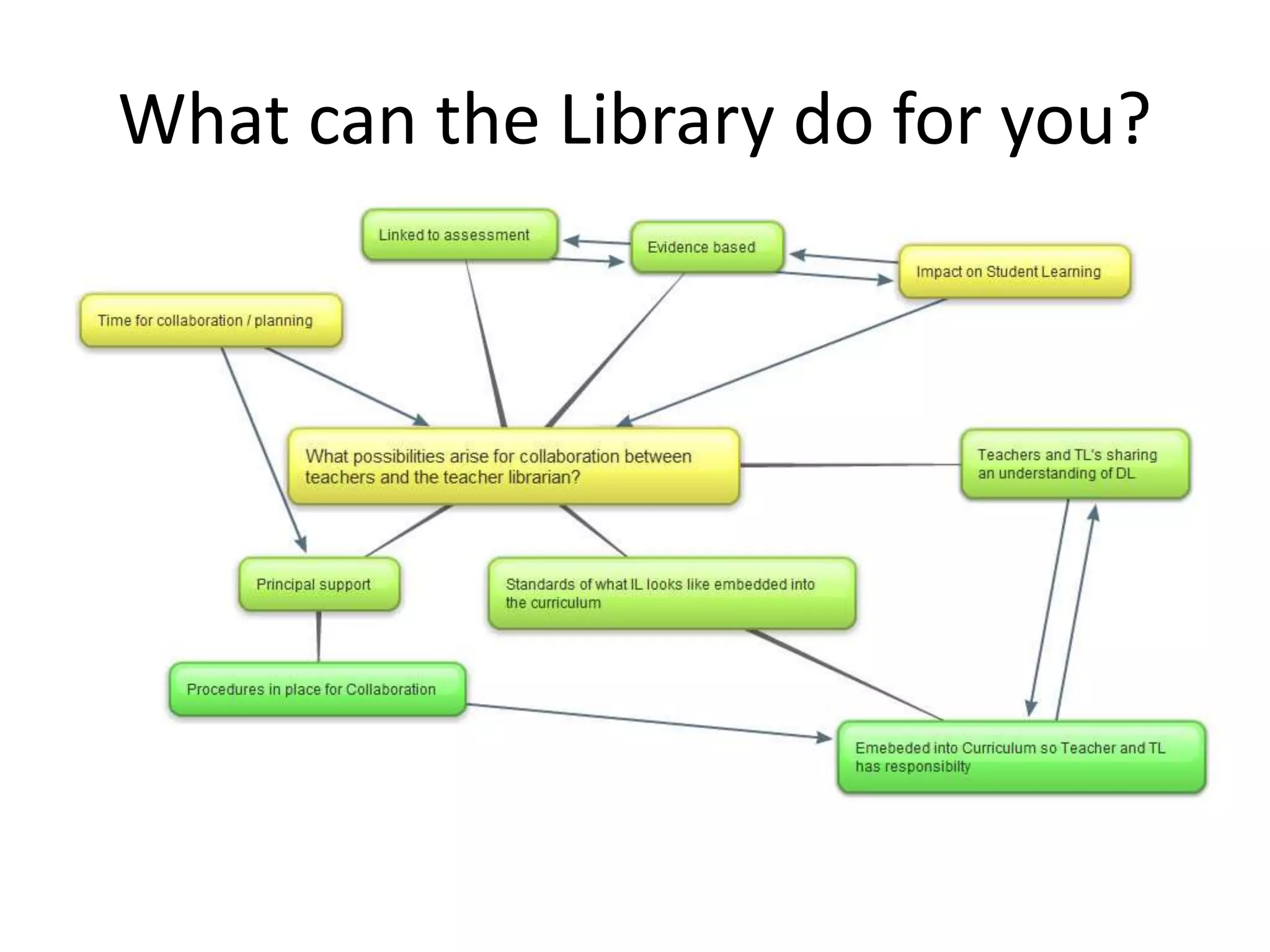
What can the Library do for you? 
http://donnalibrarian.edublogs.org/files/2013/0 
5/New-Mind-Map_2ca9734e-149zmy7.jpg
What do you expect from the 
Library? 
Library feedback….
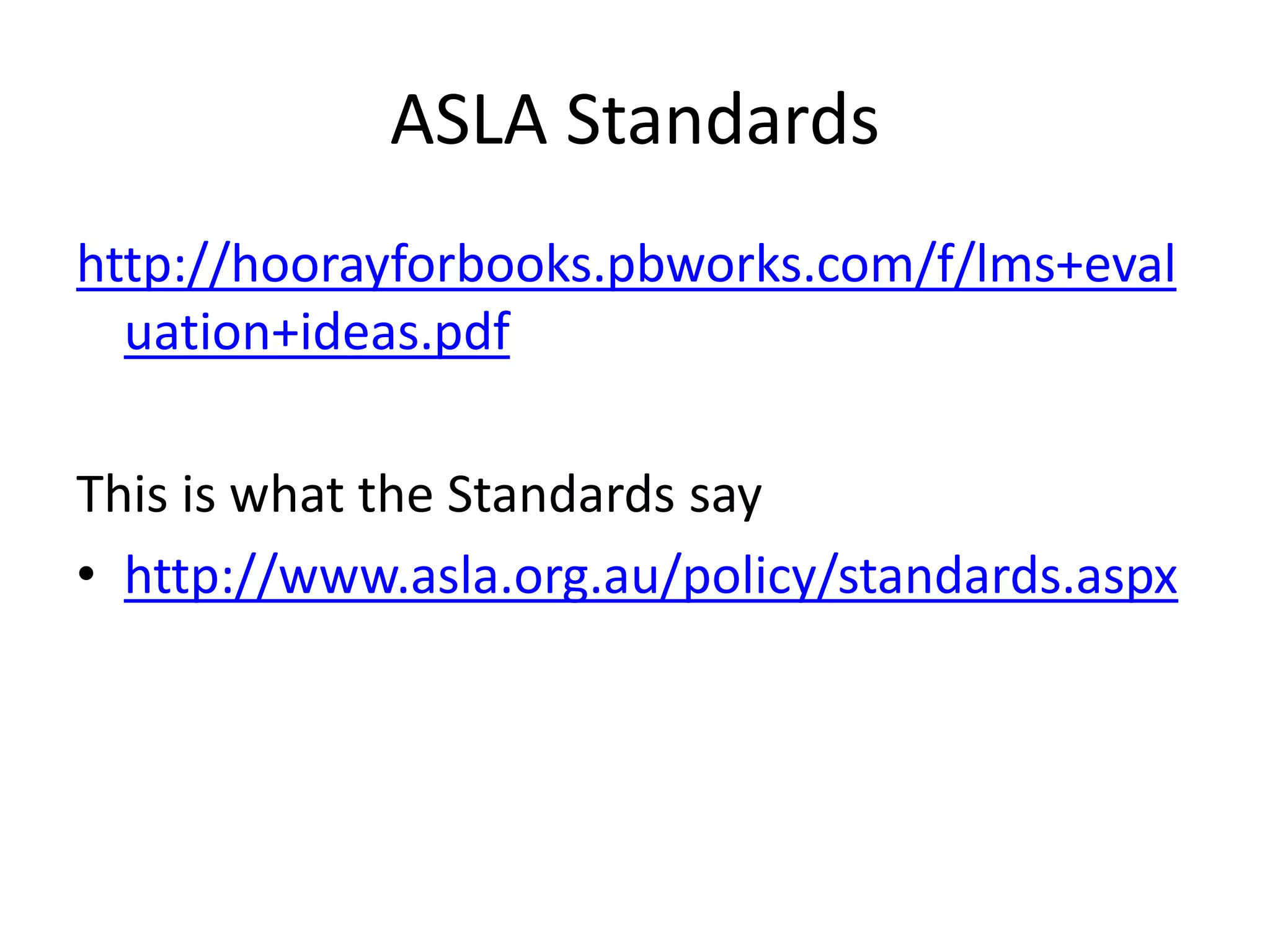
ASLA Standards 
http://hoorayforbooks.pbworks.com/f/lms+eval 
uation+ideas.pdf 
This is what the Standards say 
• http://www.asla.org.au/policy/standards.aspx
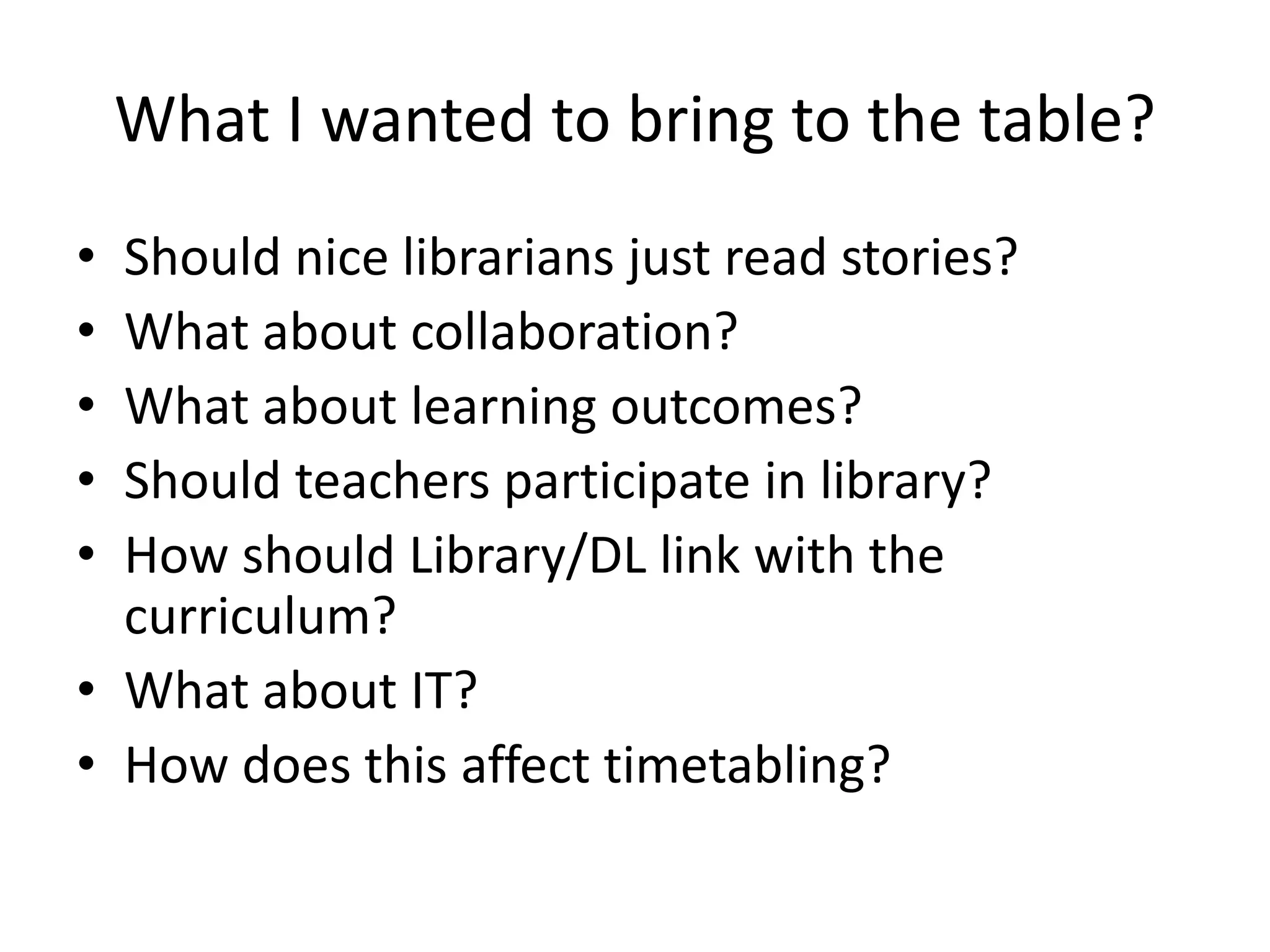
What I wanted to bring to the table? 
• Should nice librarians just read stories? 
• What about collaboration? 
• What about learning outcomes? 
• Should teachers participate in library? 
• How should Library/DL link with the 
curriculum? 
• What about IT? 
• How does this affect timetabling?
• Information Literacy is not just defined as 
Literacy skills but as a set of skills a person 
needs to read, write, and to develop the 
capacities to understand, absorb, assimilate, 
and digest the images being transmitted 
electronically with the added capacity to 
communicate these images electrographically 
(Ross Tweed & Bailey as cited by Langford, 
1994, p. 26).
What does this mean? 
http://www.youtube.com/watch?fea 
ture=player_embedded&v=Wn0_H-kvxkU
What is transliteracy? 
• If the transliteracy means to access a variety 
of media simultaneously, it seems to me that 
transliteracy also relates to how people use 
these skills to cope in their daily lives. These 
skills could be different for many people due 
to different nationalities, socio economic 
backgrounds, interests, occupations, ages, 
interests and needs.
• Why Digital Fluency? 
Sipling says there are three main forms of 
assessment: diagnostic, formative and 
summative. (Stripling, 2007) 
It seems the education community generally agrees that 
information literacy links to life- long learning and this is a 
good thing. The real challenges seem not the information 
process itself but how we adapt with technology and how 
our needs are met real life situations (Eisenberg, 2008, p. 
41).
So what can a Librarian do? 
• Highly Effective School Librarians Cultivate 21st 
Learners. 
http://www.youtube.com/watch?feature=player 
_embedded&v=2MuGDMlbSso.
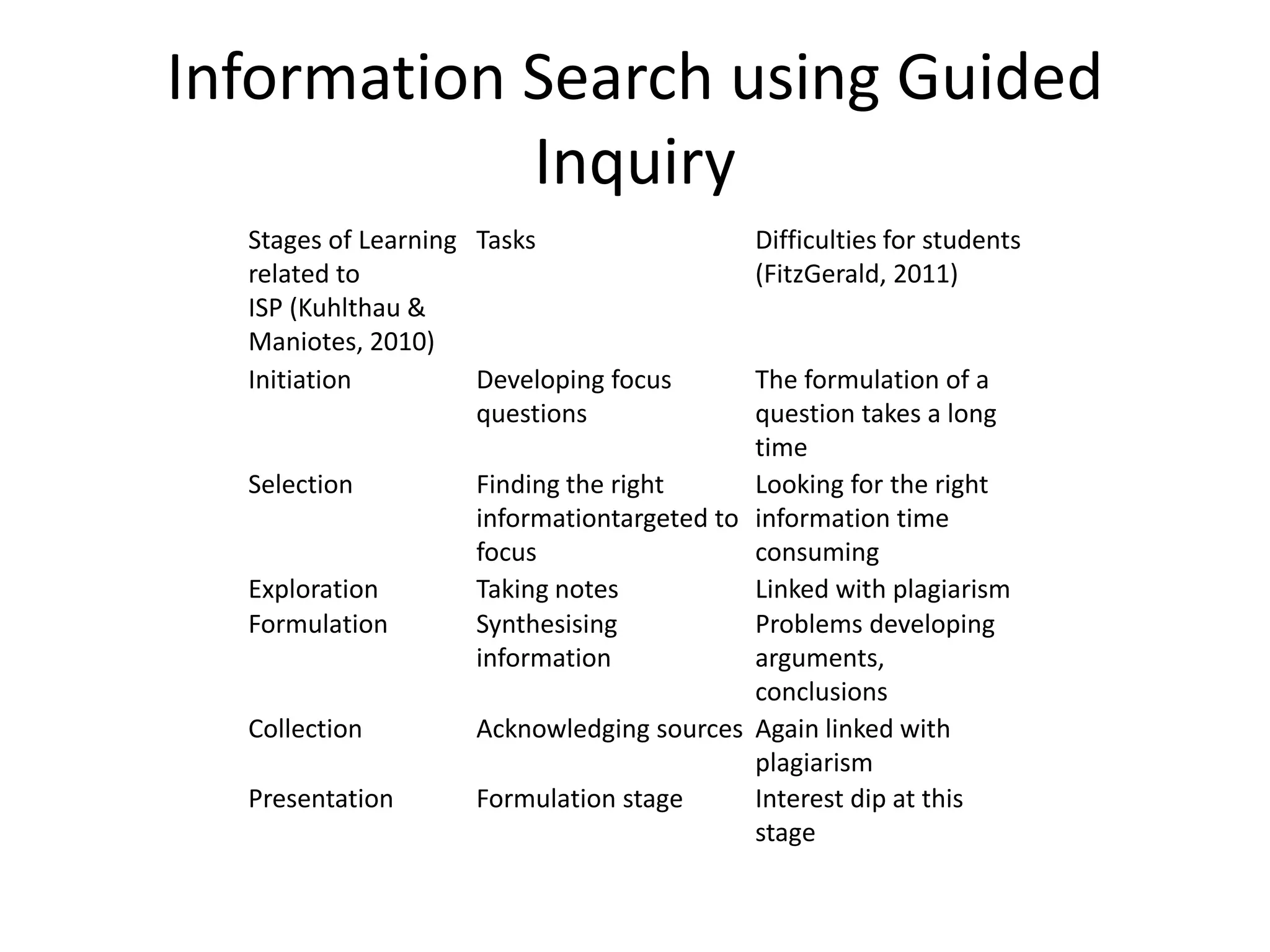
Information Search using Guided 
Inquiry 
Stages of Learning 
related to 
ISP (Kuhlthau & 
Maniotes, 2010) 
Tasks Difficulties for students 
(FitzGerald, 2011) 
Initiation Developing focus 
questions 
The formulation of a 
question takes a long 
time 
Selection Finding the right 
informationtargeted to 
focus 
Looking for the right 
information time 
consuming 
Exploration Taking notes Linked with plagiarism 
Formulation Synthesising 
information 
Problems developing 
arguments, 
conclusions 
Collection Acknowledging sources Again linked with 
plagiarism 
Presentation Formulation stage Interest dip at this 
stage
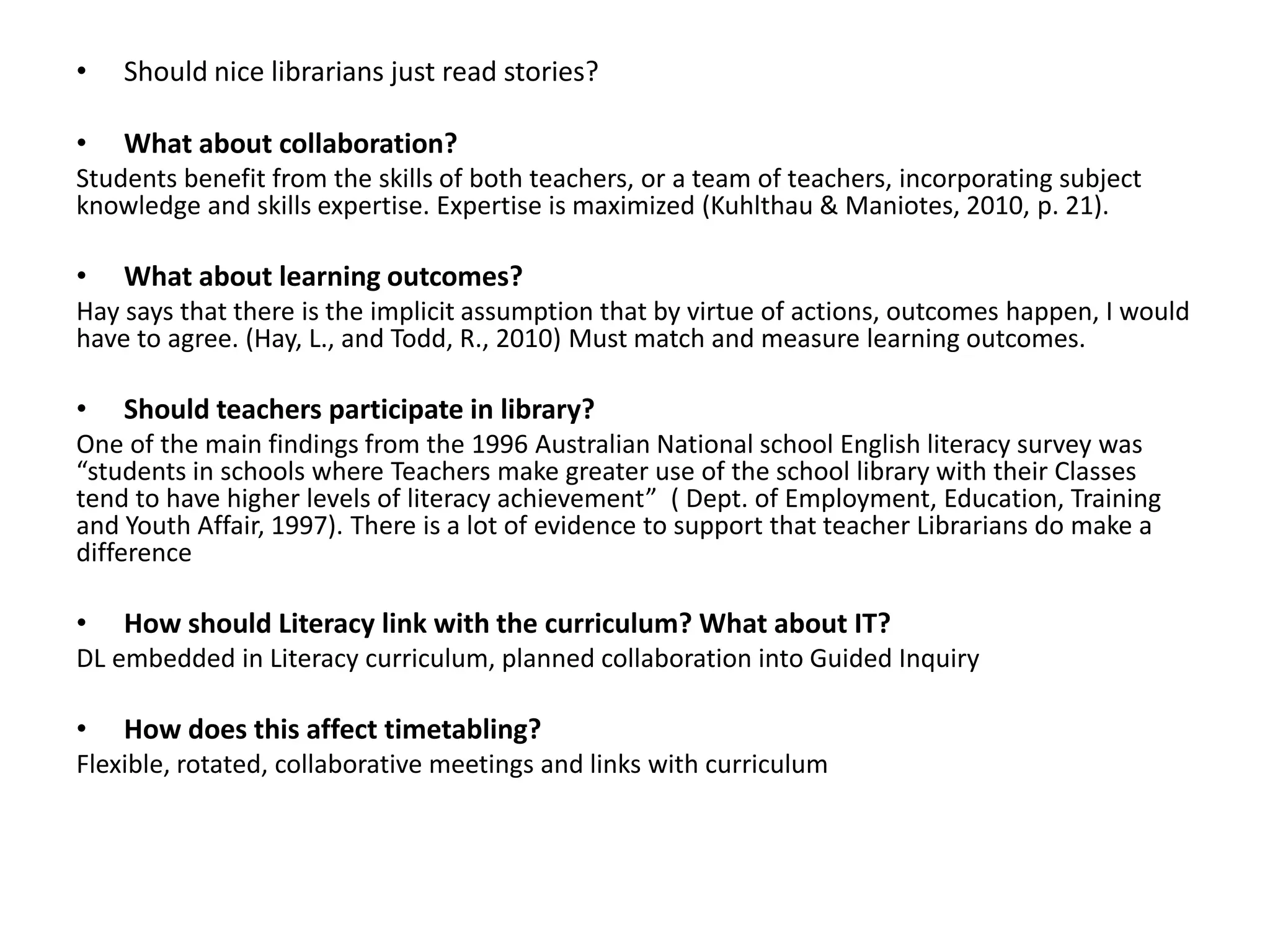
• Should nice librarians just read stories? 
• What about collaboration? 
Students benefit from the skills of both teachers, or a team of teachers, incorporating subject 
knowledge and skills expertise. Expertise is maximized (Kuhlthau & Maniotes, 2010, p. 21). 
• What about learning outcomes? 
Hay says that there is the implicit assumption that by virtue of actions, outcomes happen, I would 
have to agree. (Hay, L., and Todd, R., 2010) Must match and measure learning outcomes. 
• Should teachers participate in library? 
One of the main findings from the 1996 Australian National school English literacy survey was 
“students in schools where Teachers make greater use of the school library with their Classes 
tend to have higher levels of literacy achievement” ( Dept. of Employment, Education, Training 
and Youth Affair, 1997). There is a lot of evidence to support that teacher Librarians do make a 
difference 
• How should Literacy link with the curriculum? What about IT? 
DL embedded in Literacy curriculum, planned collaboration into Guided Inquiry 
• How does this affect timetabling? 
Flexible, rotated, collaborative meetings and links with curriculum
THE END 
http://donnalibrarian.edublogs.org

Library talk to mlt

  • 1.
    What can theLibrary do for you? http://donnalibrarian.edublogs.org/files/2013/0 5/New-Mind-Map_2ca9734e-149zmy7.jpg
  • 2.
    What do youexpect from the Library? Library feedback….
  • 3.
    ASLA Standards http://hoorayforbooks.pbworks.com/f/lms+eval uation+ideas.pdf This is what the Standards say • http://www.asla.org.au/policy/standards.aspx
  • 4.
    What I wantedto bring to the table? • Should nice librarians just read stories? • What about collaboration? • What about learning outcomes? • Should teachers participate in library? • How should Library/DL link with the curriculum? • What about IT? • How does this affect timetabling?
  • 5.
    • Information Literacyis not just defined as Literacy skills but as a set of skills a person needs to read, write, and to develop the capacities to understand, absorb, assimilate, and digest the images being transmitted electronically with the added capacity to communicate these images electrographically (Ross Tweed & Bailey as cited by Langford, 1994, p. 26).
  • 6.
    What does thismean? http://www.youtube.com/watch?fea ture=player_embedded&v=Wn0_H-kvxkU
  • 7.
    What is transliteracy? • If the transliteracy means to access a variety of media simultaneously, it seems to me that transliteracy also relates to how people use these skills to cope in their daily lives. These skills could be different for many people due to different nationalities, socio economic backgrounds, interests, occupations, ages, interests and needs.
  • 8.
    • Why DigitalFluency? Sipling says there are three main forms of assessment: diagnostic, formative and summative. (Stripling, 2007) It seems the education community generally agrees that information literacy links to life- long learning and this is a good thing. The real challenges seem not the information process itself but how we adapt with technology and how our needs are met real life situations (Eisenberg, 2008, p. 41).
  • 9.
    So what cana Librarian do? • Highly Effective School Librarians Cultivate 21st Learners. http://www.youtube.com/watch?feature=player _embedded&v=2MuGDMlbSso.
  • 10.
    Information Search usingGuided Inquiry Stages of Learning related to ISP (Kuhlthau & Maniotes, 2010) Tasks Difficulties for students (FitzGerald, 2011) Initiation Developing focus questions The formulation of a question takes a long time Selection Finding the right informationtargeted to focus Looking for the right information time consuming Exploration Taking notes Linked with plagiarism Formulation Synthesising information Problems developing arguments, conclusions Collection Acknowledging sources Again linked with plagiarism Presentation Formulation stage Interest dip at this stage
  • 11.
    • Should nicelibrarians just read stories? • What about collaboration? Students benefit from the skills of both teachers, or a team of teachers, incorporating subject knowledge and skills expertise. Expertise is maximized (Kuhlthau & Maniotes, 2010, p. 21). • What about learning outcomes? Hay says that there is the implicit assumption that by virtue of actions, outcomes happen, I would have to agree. (Hay, L., and Todd, R., 2010) Must match and measure learning outcomes. • Should teachers participate in library? One of the main findings from the 1996 Australian National school English literacy survey was “students in schools where Teachers make greater use of the school library with their Classes tend to have higher levels of literacy achievement” ( Dept. of Employment, Education, Training and Youth Affair, 1997). There is a lot of evidence to support that teacher Librarians do make a difference • How should Literacy link with the curriculum? What about IT? DL embedded in Literacy curriculum, planned collaboration into Guided Inquiry • How does this affect timetabling? Flexible, rotated, collaborative meetings and links with curriculum
  • 12.