Synopsis 
Project 
On 
Library system management 
Submitted by submitted to 
Name-Sonal anchal Mrs.Prerna ajmani 
Rollno- 05917702013
ACKNOWLEDGEMENT 
The satisfaction that accompanies that the successful 
completion of any task would be incomplete without the 
mention of people whose ceaseless cooperation made it 
possible, whose constant guidance and encouragement 
crown all efforts with success. 
I am grateful to my project guide Mrs.prerna ajmani for 
the guidance, inspiration and constructive suggestions 
that helpful us in the preparation of this project.
Table of Contents 
1. Synopsis 
2. Feasibility Study 
3. Data Tables 
4. Data Flow Diagrams 
5. Entity Relationship Diagram 
6. Screen Shots Of Form 
7. Future Scope 
8. Conclusion
Online Library Management System 
1. Introduction:- 
1.1 Purpose:- 
The purpose of this application are as follows : 
 The software is for automation of library.  
 It provides following facilities to  
Operator : 
 Can enter details related to a particular book.  
 Can provide membership to members.  
Admin : 
 Can read and write information about 
 any member.  
 Can update, create, delete the record of 
membership as per requirement and implementation 
plants.  
6
2.) Scope : 
The different areas where we can use this application 
are : 
 Any education institute can make use of it for 
providing information about author, content of the 
 available books.  
 It can be used in offices and modifications can be 
easily done according to requirements.  
3.) Technology Used : 
Front End : Servlets, HTML, Java script. 
Back End : MS Access, Apache Tomcat server. 
4.) Assumptions 
 This application is used to convert the manual 
application to the online application.  
  Customized data will be used in this application.  
 User does not have right to enter information 
about books.  
7
5.) Overview : 
Project is related to library management which provides 
reading services to its members. Any person can become a 
member of the library by filling a prescribed form. 
They can get the book issued, so that they cab take home 
and return them. 
6.) Functionality : 
 Online membership.  
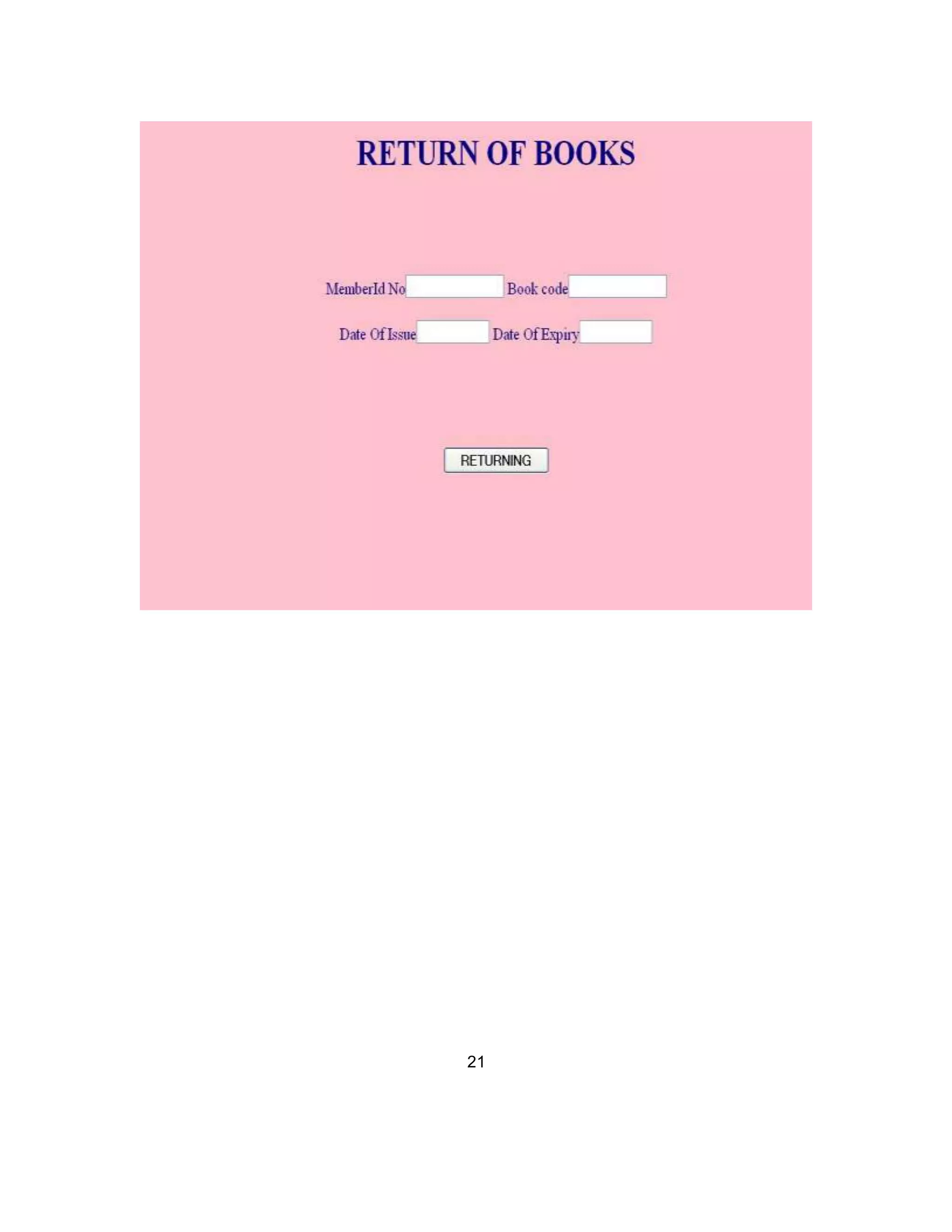
 Keeps the track of issues and submission of books .  
8
Feasibility Study 
In feasibility study phase we had undergone through 
various steps which are describe as under : 
1. Identify the origin of the information at different level. 
2. Identify the expectation of user from computerized 
system. 
3. Analyze the draw back of existing system 
(manual) system. 
WORKING OF PRESENT MANUAL SYSTEM 
The staffs of library are involved in the following tasks. 
1. Membership process : person have to fill membership 
form and they are provided with member id. 
9
DRAWBACKS OF PRESENT SYSTEM 
Some of the problems being faced in manual system are 
as follows: 
1. Fast report generation is not possible. 
2. Tracing a book is difficult. 
3. Information about issue/return of the books are 
not properly maintained. 
4. No central database can be created as information 
is not available in database. 
PROPOSED SYSTEM 
There will be three major components : 
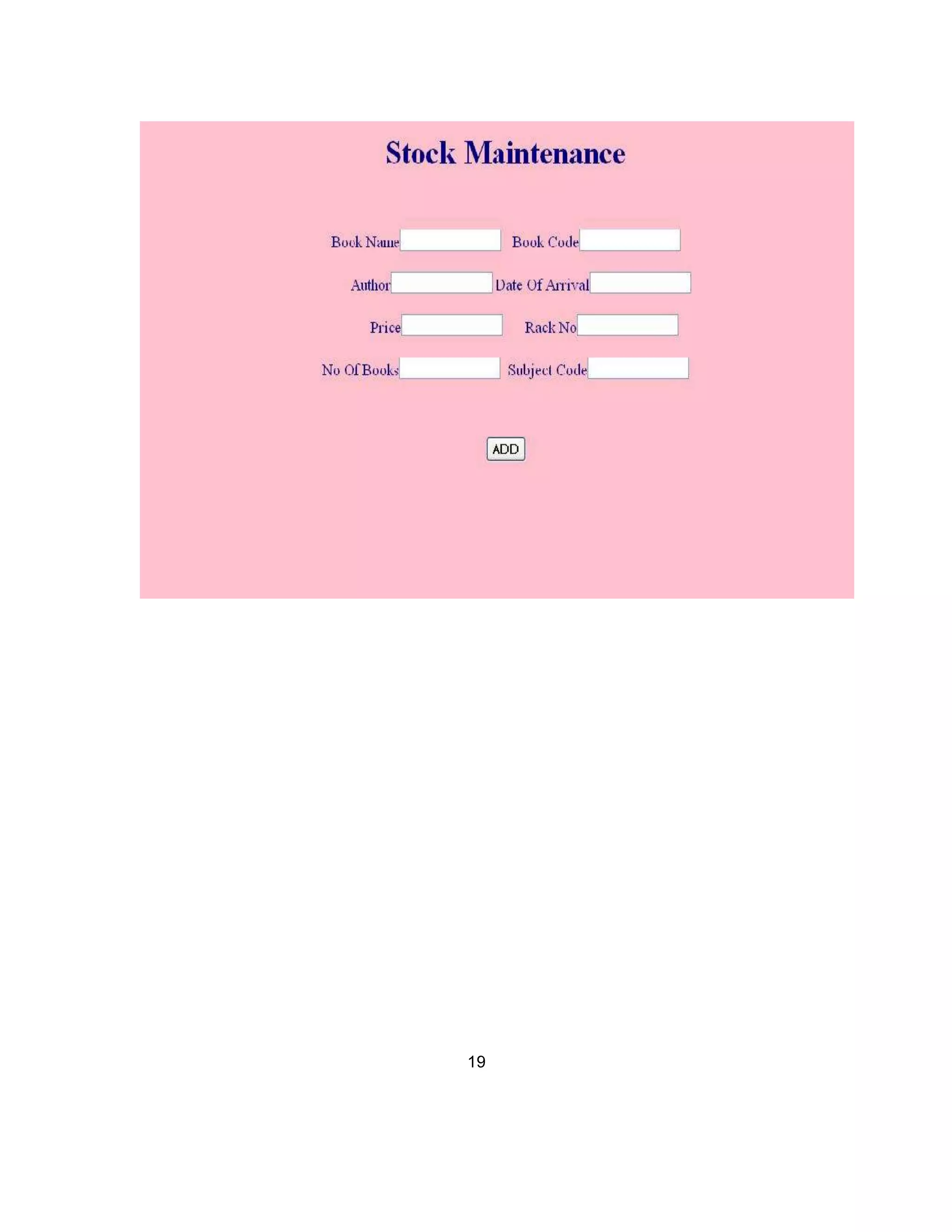
1. Stock maintenance. 
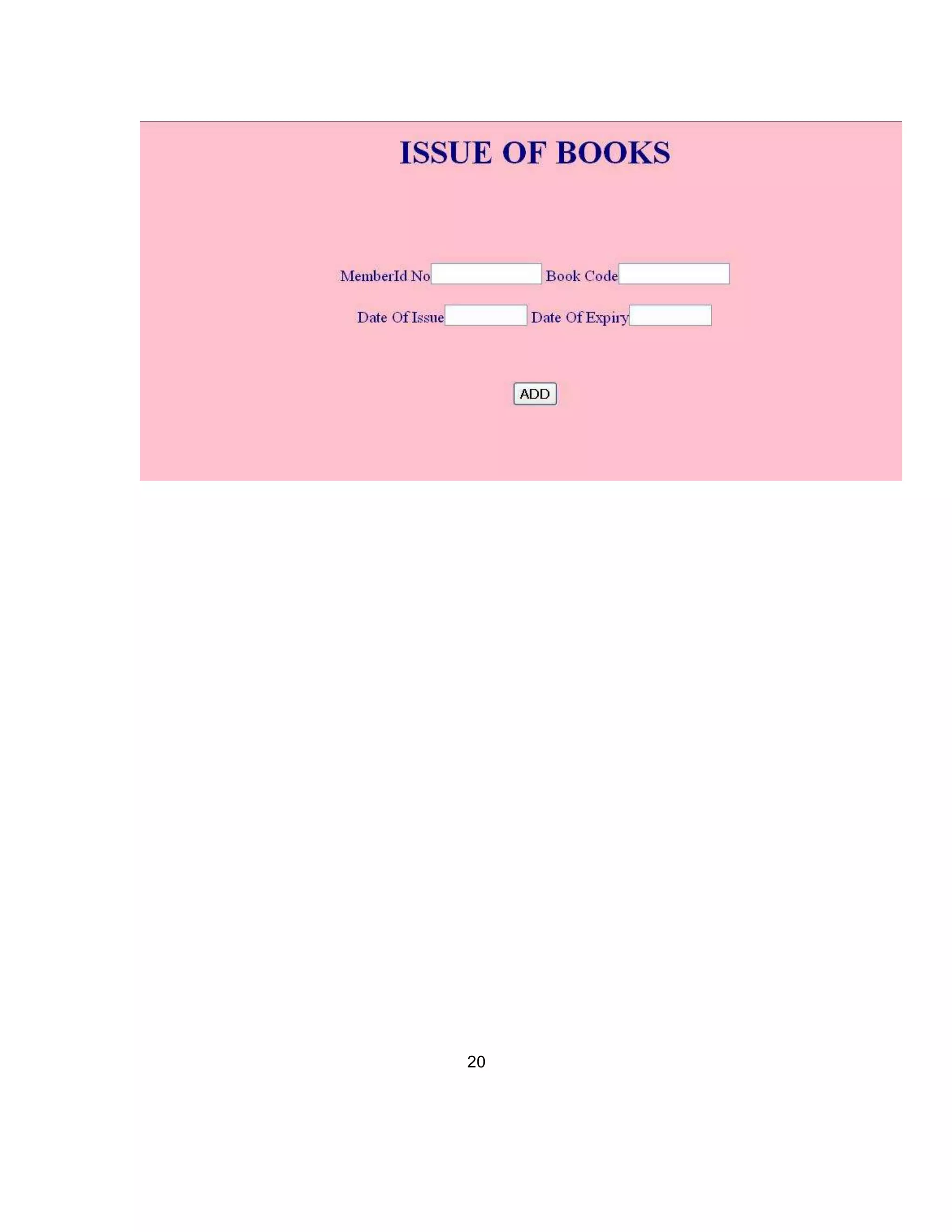
2. Transaction entry. 
3. Reports. 
Proposed system provides with following solutions : 
1. It provides "better and efficient" service to members. 
2. Reduce the workload of employee. 
3. Faster retrieval of information about the desired book. 
4. Provide facility for proper monitoring reduce paper 
work and provide data security. 
5. All details will be available on a click. 
10
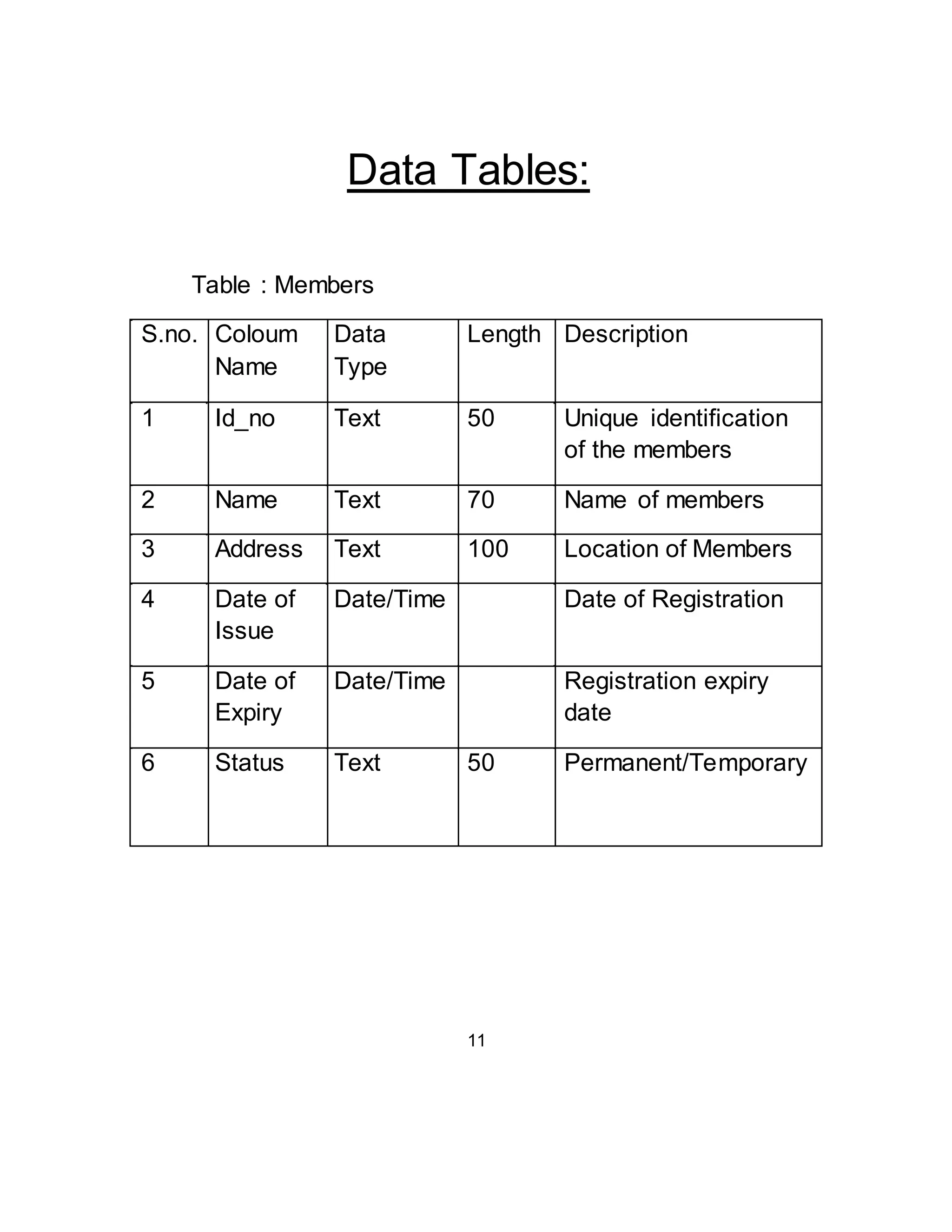
Data Tables: 
Table : Members 
S.no. Coloum Data Length Description 
Name Type 
1 Id_no Text 50 Unique identification 
of the members 
2 Name Text 70 Name of members 
3 Address Text 100 Location of Members 
4 Date of Date/Time Date of Registration 
Issue 
5 Date of Date/Time Registration expiry 
Expiry date 
6 Status Text 50 Permanent/Temporary 
11
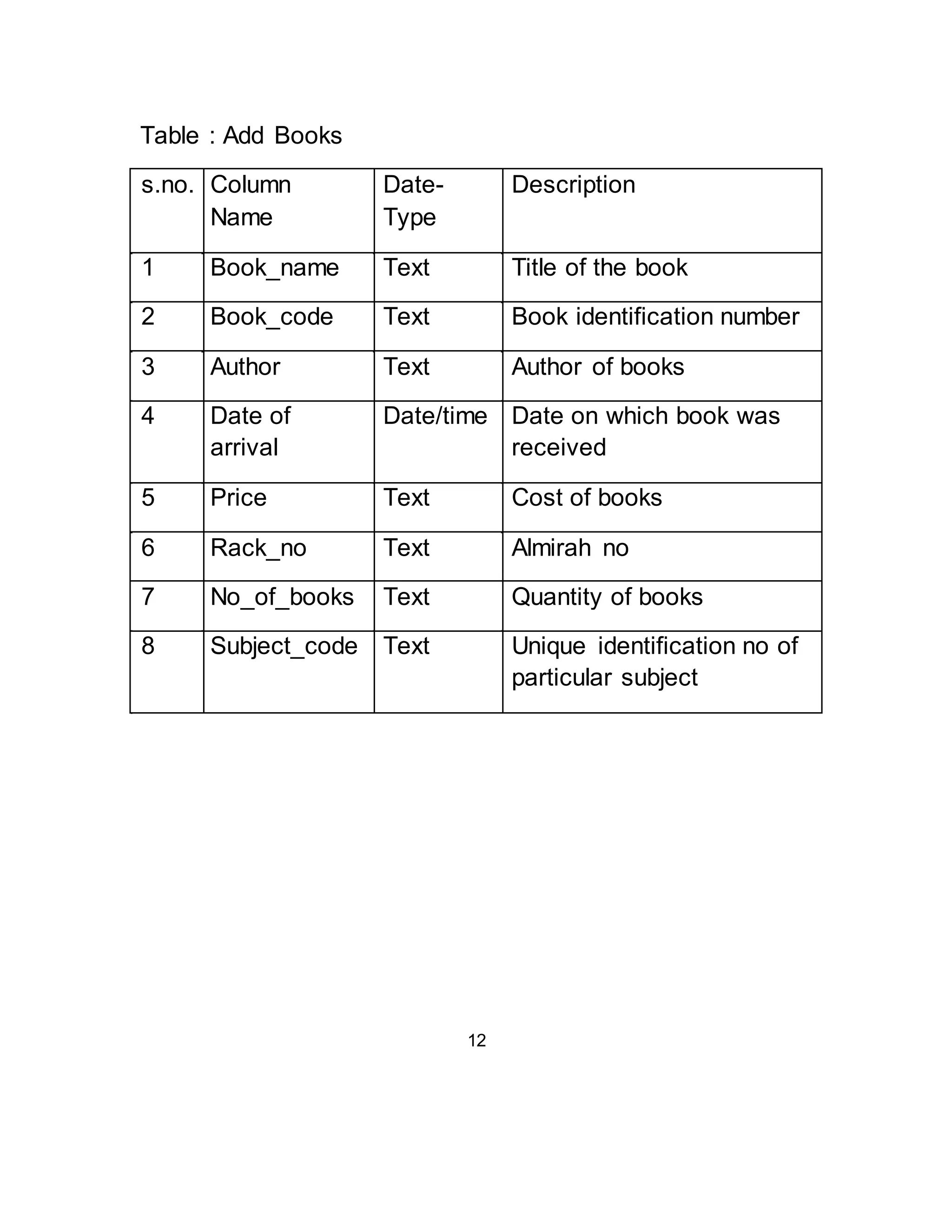
Table : Add Books 
s.no. Column Date- Description 
Name Type 
1 Book_name Text Title of the book 
2 Book_code Text Book identification number 
3 Author Text Author of books 
4 Date of Date/time Date on which book was 
arrival received 
5 Price Text Cost of books 
6 Rack_no Text Almirah no 
7 No_of_books Text Quantity of books 
8 Subject_code Text Unique identification no of 
particular subject 
12
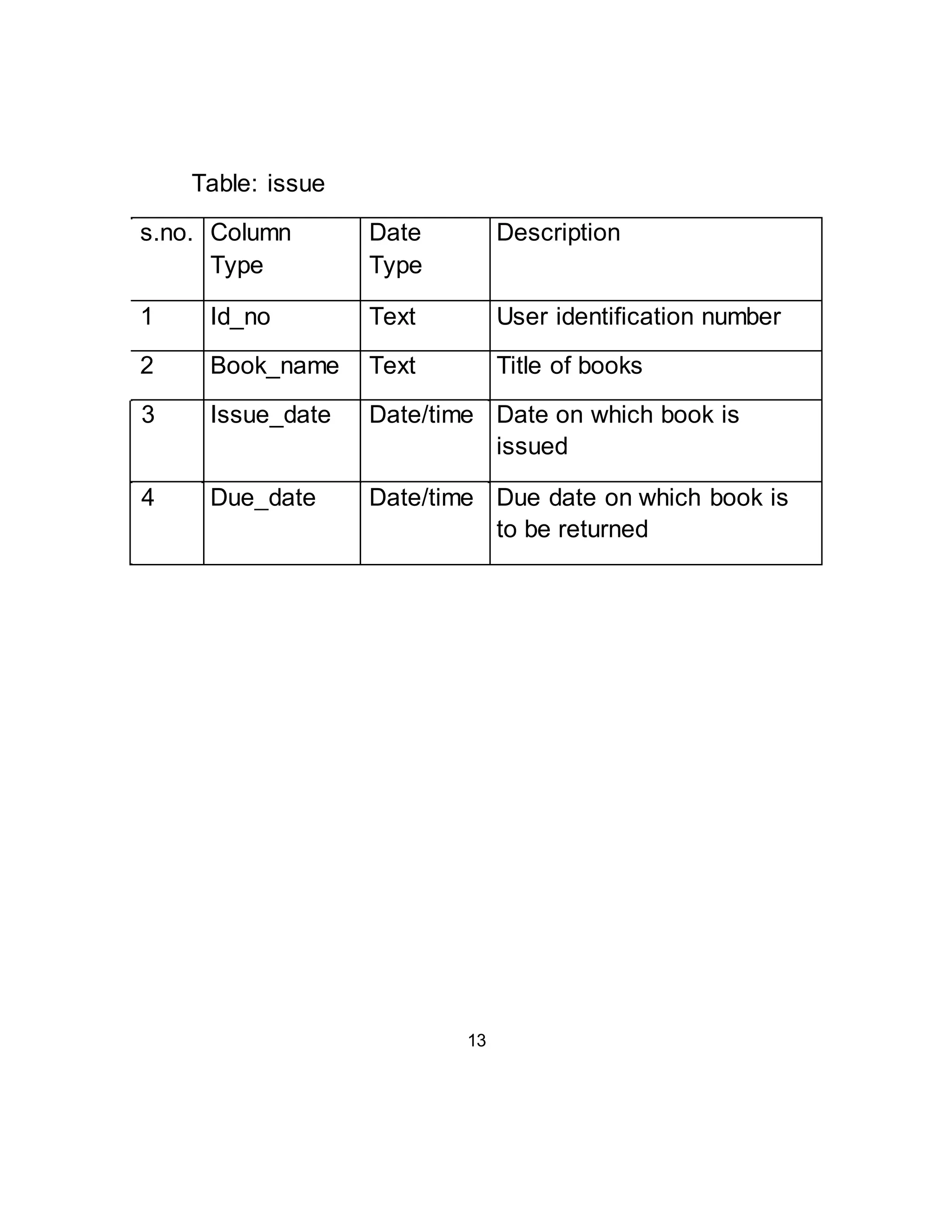
Table: issue 
s.no. Column Date Description 
Type Type 
1 Id_no Text User identification number 
2 Book_name Text Title of books 
3 Issue_date Date/time Date on which book is 
issued 
4 Due_date Date/time Due date on which book is 
to be returned 
13
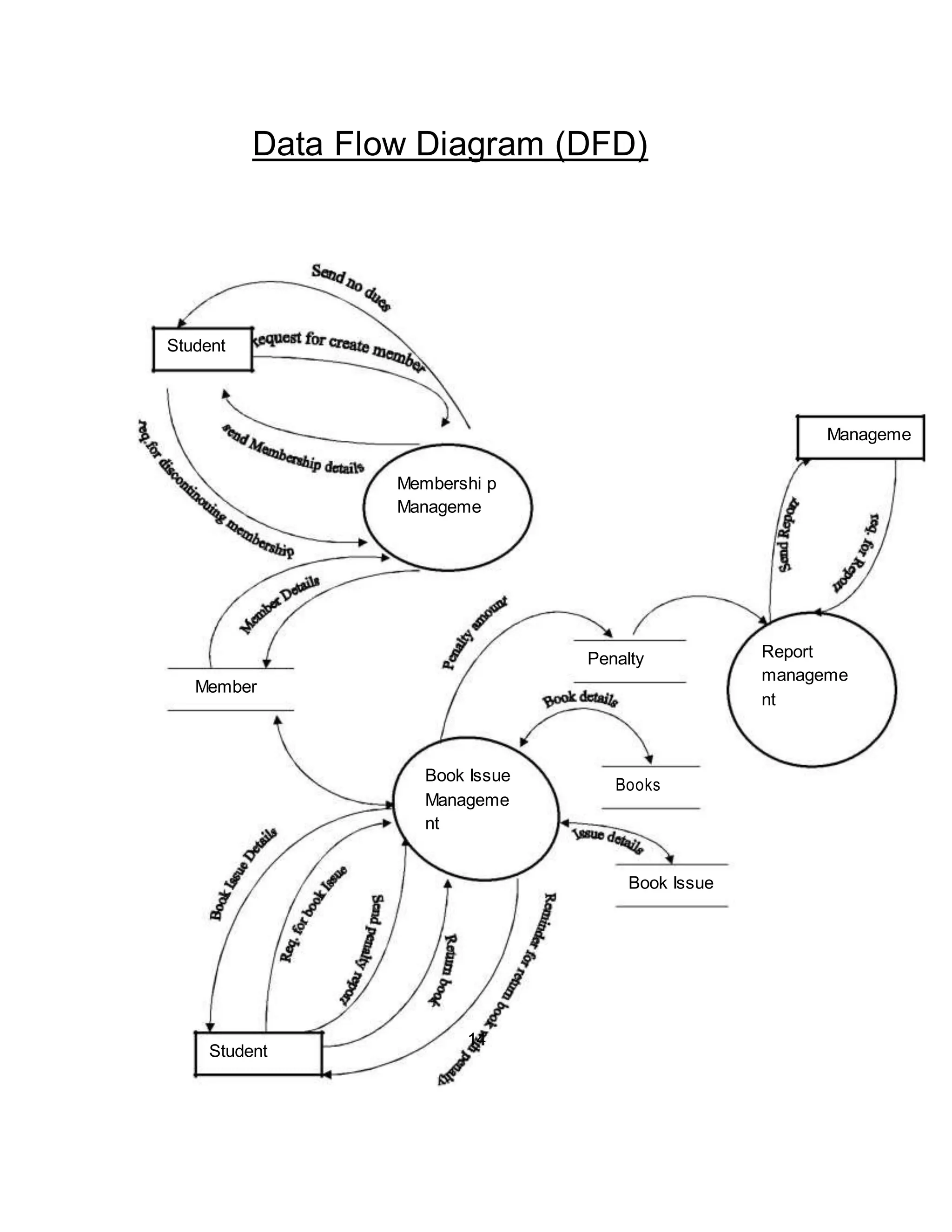
Data Flow Diagram (DFD) 
Student 
Manageme 
Membershi p 
Manageme 
Penalty Report 
Member 
manageme 
nt 
Book Issue 
Books 
Manageme 
nt 
Student 
Book Issue 
14
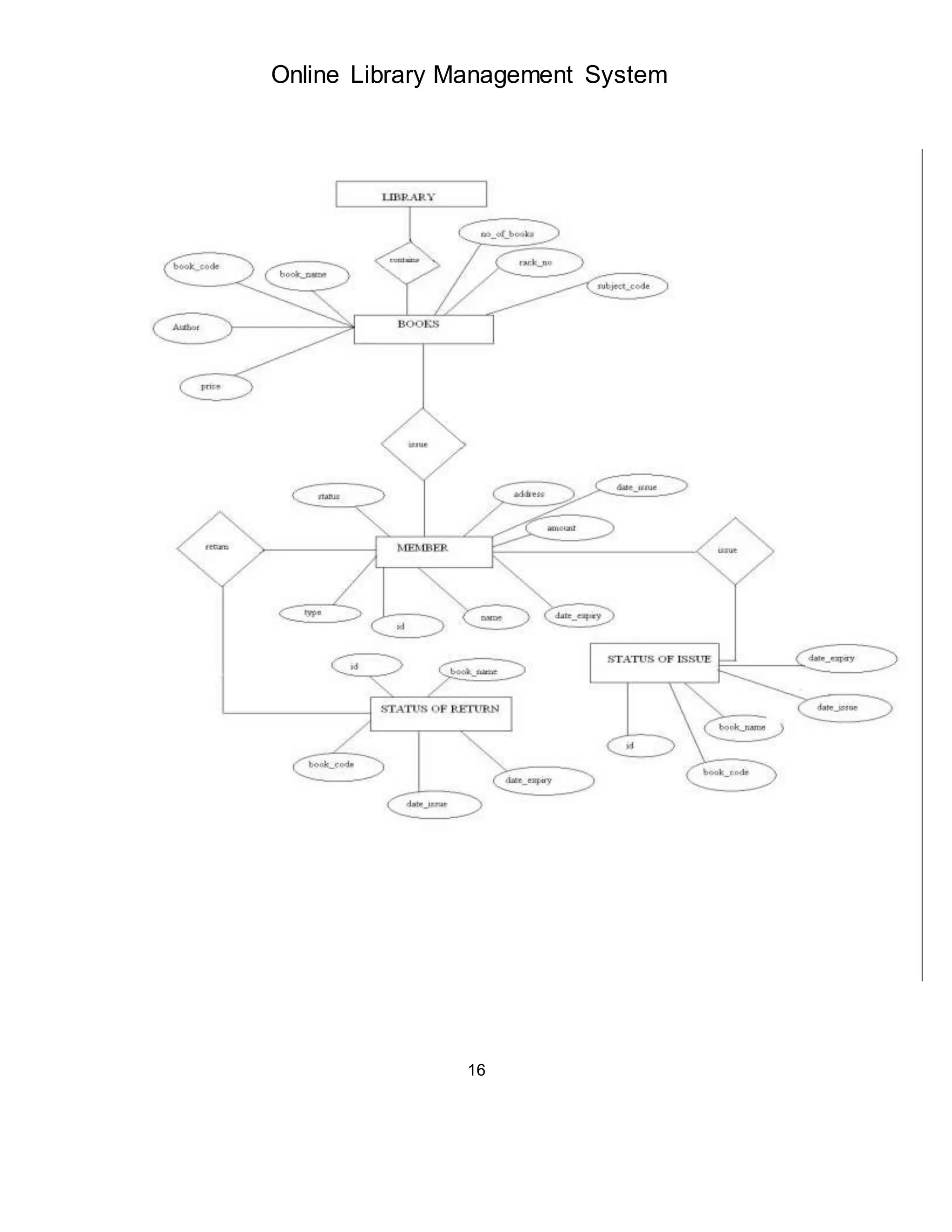
E-R DIGRAM 
It is clear that the physical objects from the previous section 
– the member, books, library – correspond to entities in the 
Entity-Relationship model, and the operations to be done on 
those entities – holds, checkouts, and so on – correspond 
to relationships. However, a good design will minimize 
redundancy and attempt to store all the required information 
in as small a space as possible. 
15
Online Library Management System 
16
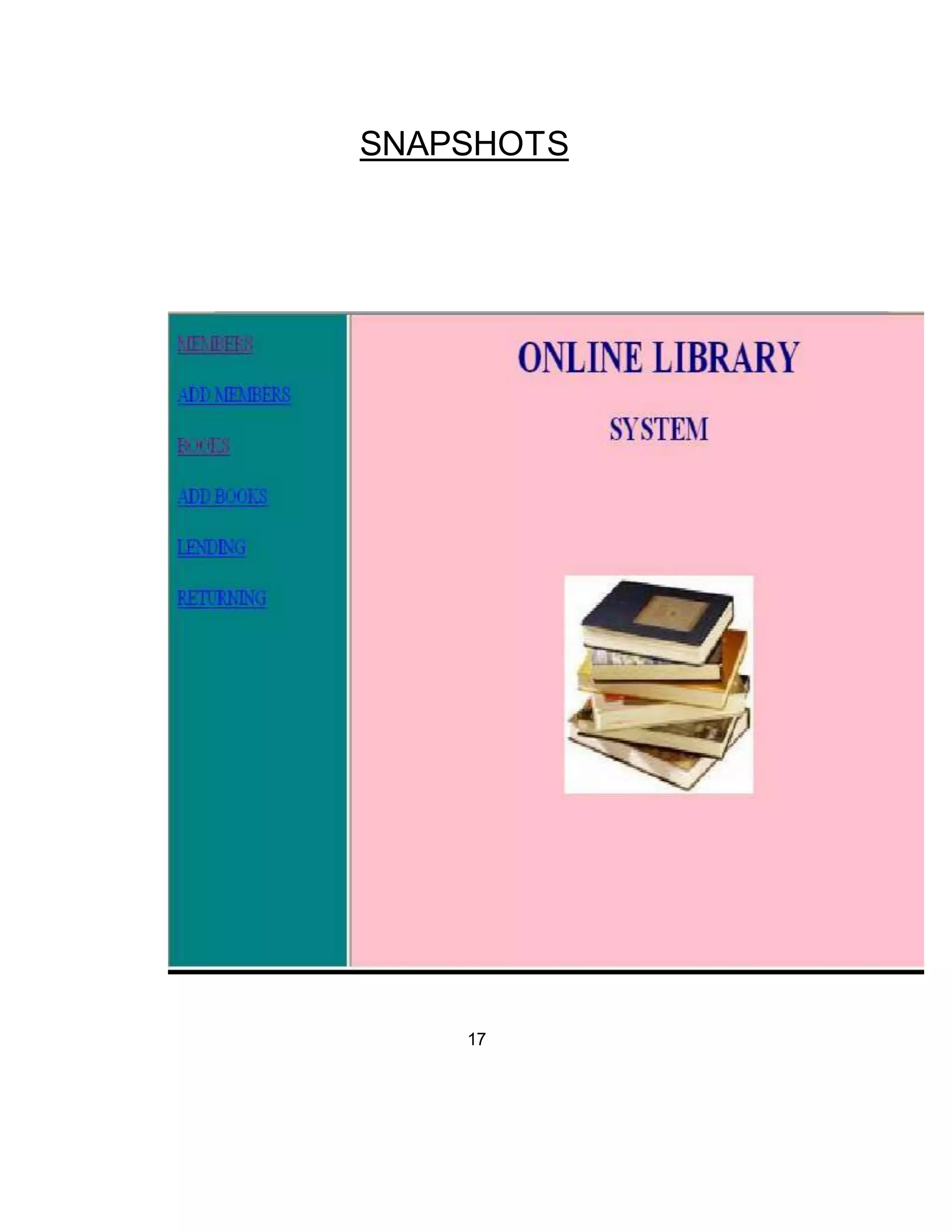
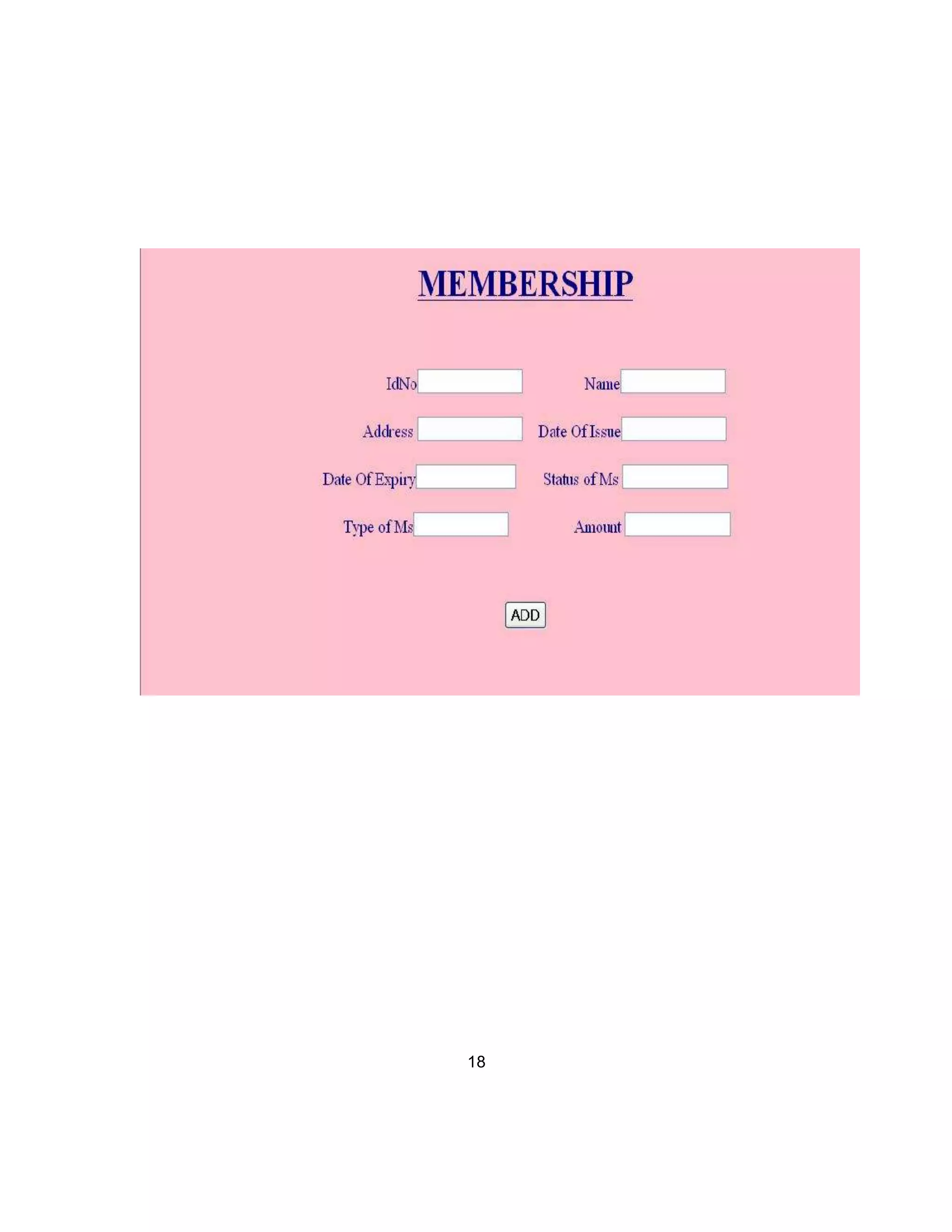
SNAPSHOTS 
17
18
19
20
21
Future Scope 
FUTURE SCOPE OF APPLICATION : 
This application can be easily implemented under various situations. 
We can add new features as and when we require. Reusability is 
possible as and when require in this application. There is flexibility 
in all the modules. 
SOFTWARE SCOPE: 
 Extensibility: This software is extendable in ways that its original 
developers may not expect. The following principles enhances 
extensibility like hide data structure, avoid traversing multiple 
links or methods, avoid case statements on object type and 
distinguish public and private operations.  
 
 Reusability: Reusability is possible as and when require in this 
application. We can update it next version. Reusable software 
reduces design, coding and testing cost by amortizing effort 
over several designs. Reducing the amount of code also 
simplifies understanding, which increases the likelihood that 
the code is correct. We follow up both types of reusability: 
Sharing of newly written code within a project and reuse of 
previously written code on new projects.  
22
 Understandability: A method is understandable if someone other 
than the creator of the method can understand the code (as 
well as the creator after a time lapse). We use the method, 
which small and coherent helps to accomplish this.  
 
 
 
 Cost-effectiveness: Its cost is under the budget and make within 
given time period. It is desirable to aim for a system with a 
minimum cost subject to the condition that it must satisfy the 
entire requirement.  
Scope of this document is to put down the requirements, clearly 
identifying the information needed by the user, the source of the 
information and outputs expected from the system. 
23
Conclusion 
From a proper analysis of positive points and constraints on 
the component, it can be safely concluded that the product is 
a highly efficient GUI based component. This application is 
working properly and meeting to all user requirements. This 
component can be easily plugged in many other systems. 
24
Bibliography 
Books: 
 Beginning Java Objects: From Concepts to Code -by Jacquie 
 Barker)  
  Introduction to Java Programming (NIIIT publication)  
 The Complete Reference Java(McGrawhill; Herbert Schildth- 
reprint 2008)  
 Introduction to MS-Access(Aptech)  
Web Sites: 
 www.apache.org  
 
 www.wikipedia.com  
25

library management

  • 1.
    Synopsis Project On Library system management Submitted by submitted to Name-Sonal anchal Mrs.Prerna ajmani Rollno- 05917702013
  • 2.
    ACKNOWLEDGEMENT The satisfactionthat accompanies that the successful completion of any task would be incomplete without the mention of people whose ceaseless cooperation made it possible, whose constant guidance and encouragement crown all efforts with success. I am grateful to my project guide Mrs.prerna ajmani for the guidance, inspiration and constructive suggestions that helpful us in the preparation of this project.
  • 3.
    Table of Contents 1. Synopsis 2. Feasibility Study 3. Data Tables 4. Data Flow Diagrams 5. Entity Relationship Diagram 6. Screen Shots Of Form 7. Future Scope 8. Conclusion
  • 4.
    Online Library ManagementSystem 1. Introduction:- 1.1 Purpose:- The purpose of this application are as follows :  The software is for automation of library.   It provides following facilities to  Operator :  Can enter details related to a particular book.   Can provide membership to members.  Admin :  Can read and write information about  any member.   Can update, create, delete the record of membership as per requirement and implementation plants.  6
  • 5.
    2.) Scope : The different areas where we can use this application are :  Any education institute can make use of it for providing information about author, content of the  available books.   It can be used in offices and modifications can be easily done according to requirements.  3.) Technology Used : Front End : Servlets, HTML, Java script. Back End : MS Access, Apache Tomcat server. 4.) Assumptions  This application is used to convert the manual application to the online application.    Customized data will be used in this application.   User does not have right to enter information about books.  7
  • 6.
    5.) Overview : Project is related to library management which provides reading services to its members. Any person can become a member of the library by filling a prescribed form. They can get the book issued, so that they cab take home and return them. 6.) Functionality :  Online membership.   Keeps the track of issues and submission of books .  8
  • 7.
    Feasibility Study Infeasibility study phase we had undergone through various steps which are describe as under : 1. Identify the origin of the information at different level. 2. Identify the expectation of user from computerized system. 3. Analyze the draw back of existing system (manual) system. WORKING OF PRESENT MANUAL SYSTEM The staffs of library are involved in the following tasks. 1. Membership process : person have to fill membership form and they are provided with member id. 9
  • 8.
    DRAWBACKS OF PRESENTSYSTEM Some of the problems being faced in manual system are as follows: 1. Fast report generation is not possible. 2. Tracing a book is difficult. 3. Information about issue/return of the books are not properly maintained. 4. No central database can be created as information is not available in database. PROPOSED SYSTEM There will be three major components : 1. Stock maintenance. 2. Transaction entry. 3. Reports. Proposed system provides with following solutions : 1. It provides "better and efficient" service to members. 2. Reduce the workload of employee. 3. Faster retrieval of information about the desired book. 4. Provide facility for proper monitoring reduce paper work and provide data security. 5. All details will be available on a click. 10
  • 9.
    Data Tables: Table: Members S.no. Coloum Data Length Description Name Type 1 Id_no Text 50 Unique identification of the members 2 Name Text 70 Name of members 3 Address Text 100 Location of Members 4 Date of Date/Time Date of Registration Issue 5 Date of Date/Time Registration expiry Expiry date 6 Status Text 50 Permanent/Temporary 11
  • 10.
    Table : AddBooks s.no. Column Date- Description Name Type 1 Book_name Text Title of the book 2 Book_code Text Book identification number 3 Author Text Author of books 4 Date of Date/time Date on which book was arrival received 5 Price Text Cost of books 6 Rack_no Text Almirah no 7 No_of_books Text Quantity of books 8 Subject_code Text Unique identification no of particular subject 12
  • 11.
    Table: issue s.no.Column Date Description Type Type 1 Id_no Text User identification number 2 Book_name Text Title of books 3 Issue_date Date/time Date on which book is issued 4 Due_date Date/time Due date on which book is to be returned 13
  • 12.
    Data Flow Diagram(DFD) Student Manageme Membershi p Manageme Penalty Report Member manageme nt Book Issue Books Manageme nt Student Book Issue 14
  • 13.
    E-R DIGRAM Itis clear that the physical objects from the previous section – the member, books, library – correspond to entities in the Entity-Relationship model, and the operations to be done on those entities – holds, checkouts, and so on – correspond to relationships. However, a good design will minimize redundancy and attempt to store all the required information in as small a space as possible. 15
  • 14.
  • 15.
  • 16.
  • 17.
  • 18.
  • 19.
  • 20.
    Future Scope FUTURESCOPE OF APPLICATION : This application can be easily implemented under various situations. We can add new features as and when we require. Reusability is possible as and when require in this application. There is flexibility in all the modules. SOFTWARE SCOPE:  Extensibility: This software is extendable in ways that its original developers may not expect. The following principles enhances extensibility like hide data structure, avoid traversing multiple links or methods, avoid case statements on object type and distinguish public and private operations.    Reusability: Reusability is possible as and when require in this application. We can update it next version. Reusable software reduces design, coding and testing cost by amortizing effort over several designs. Reducing the amount of code also simplifies understanding, which increases the likelihood that the code is correct. We follow up both types of reusability: Sharing of newly written code within a project and reuse of previously written code on new projects.  22
  • 21.
     Understandability: Amethod is understandable if someone other than the creator of the method can understand the code (as well as the creator after a time lapse). We use the method, which small and coherent helps to accomplish this.      Cost-effectiveness: Its cost is under the budget and make within given time period. It is desirable to aim for a system with a minimum cost subject to the condition that it must satisfy the entire requirement.  Scope of this document is to put down the requirements, clearly identifying the information needed by the user, the source of the information and outputs expected from the system. 23
  • 22.
    Conclusion From aproper analysis of positive points and constraints on the component, it can be safely concluded that the product is a highly efficient GUI based component. This application is working properly and meeting to all user requirements. This component can be easily plugged in many other systems. 24
  • 23.
    Bibliography Books: Beginning Java Objects: From Concepts to Code -by Jacquie  Barker)    Introduction to Java Programming (NIIIT publication)   The Complete Reference Java(McGrawhill; Herbert Schildth- reprint 2008)   Introduction to MS-Access(Aptech)  Web Sites:  www.apache.org    www.wikipedia.com  25