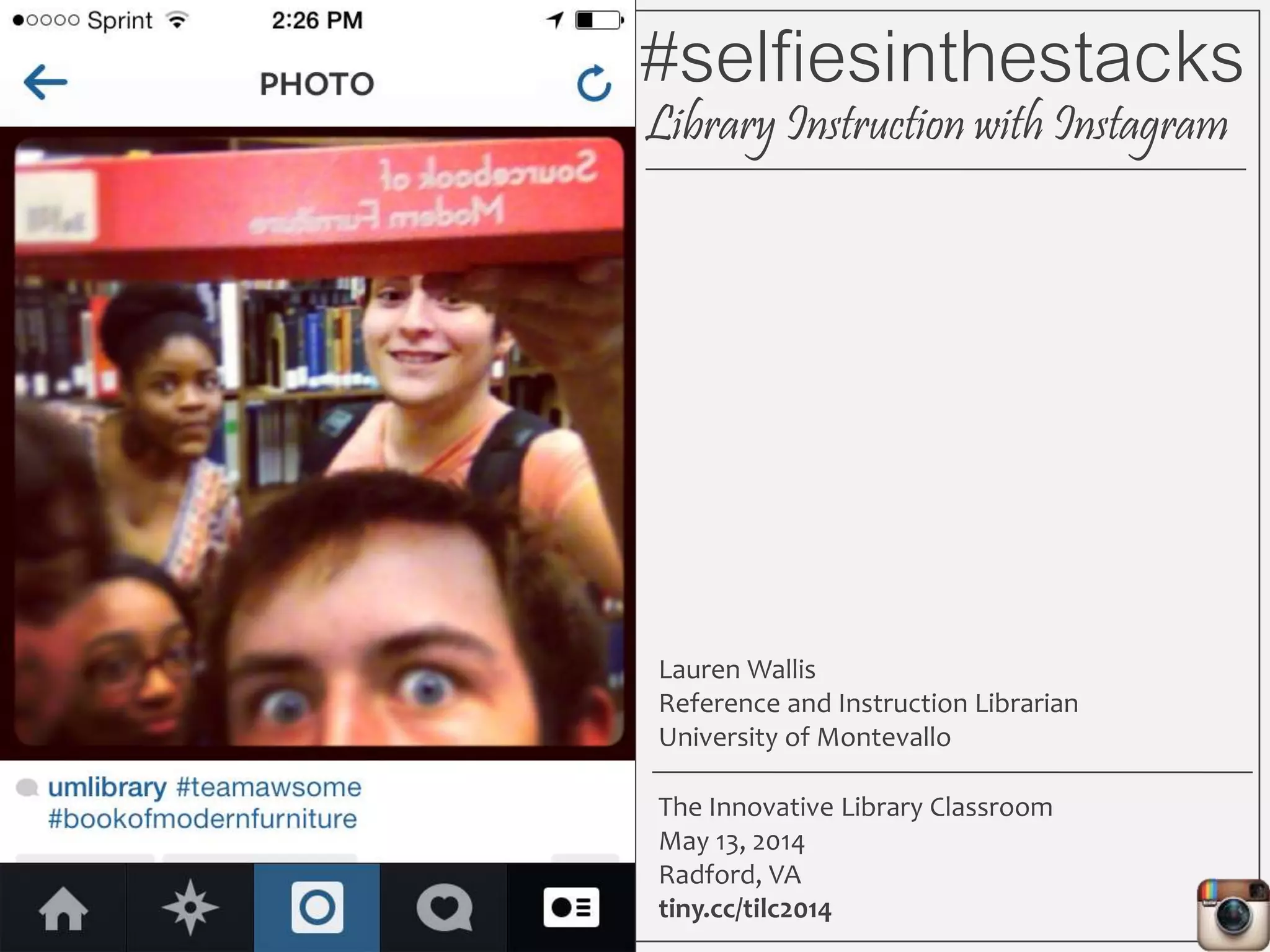
#selfiesinthestacks
Lauren Wallis
Reference and Instruction Librarian
University of Montevallo
The Innovative Library Classroom
May 13, 2014
Radford, VA
tiny.cc/tilc2014
Library Instruction with Instagram
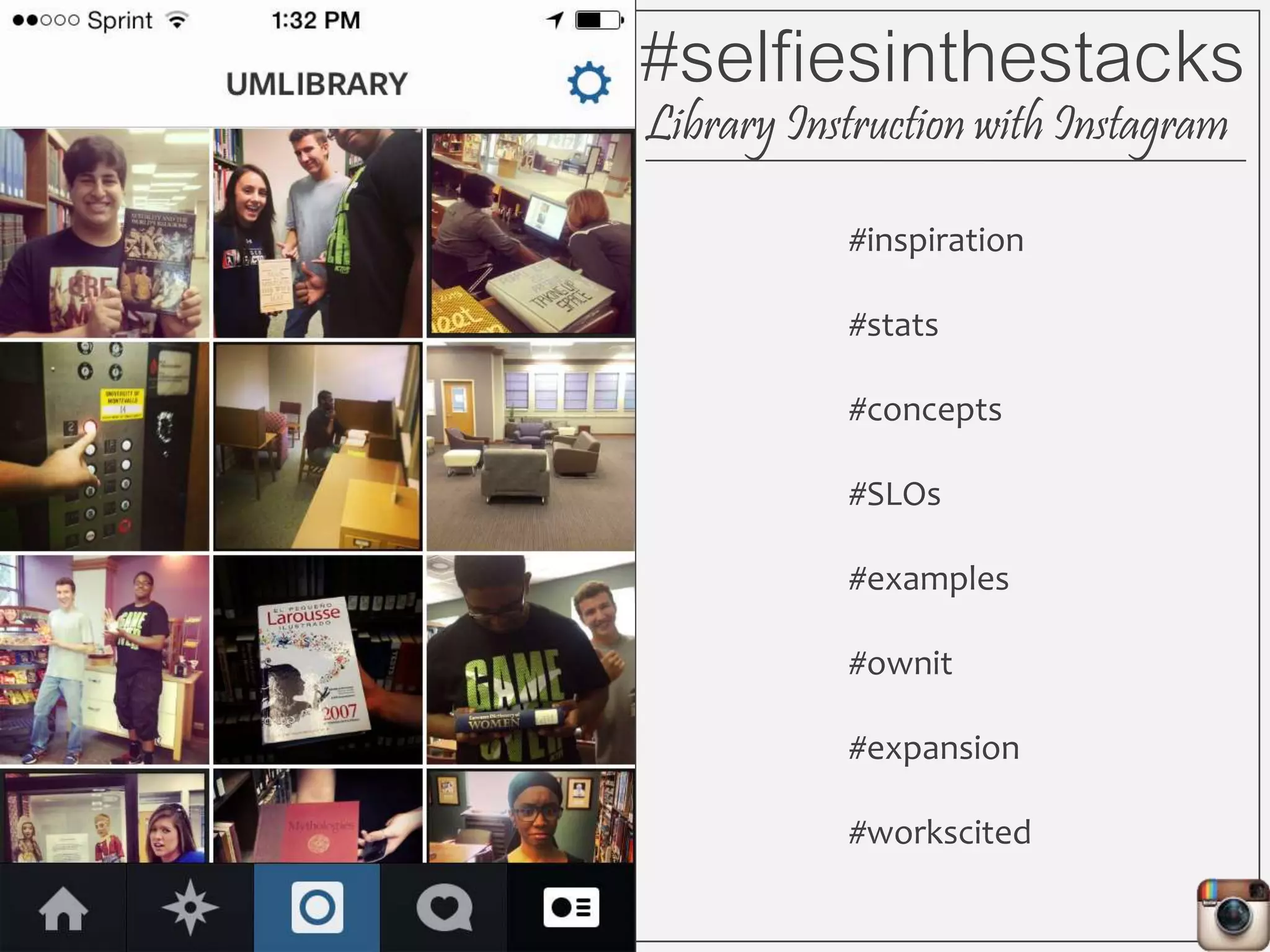
#inspiration
#stats
#concepts
#SLOs
#examples
#ownit
#assessment
#workscited
#selfiesinthestacks
Library Instruction with Instagram
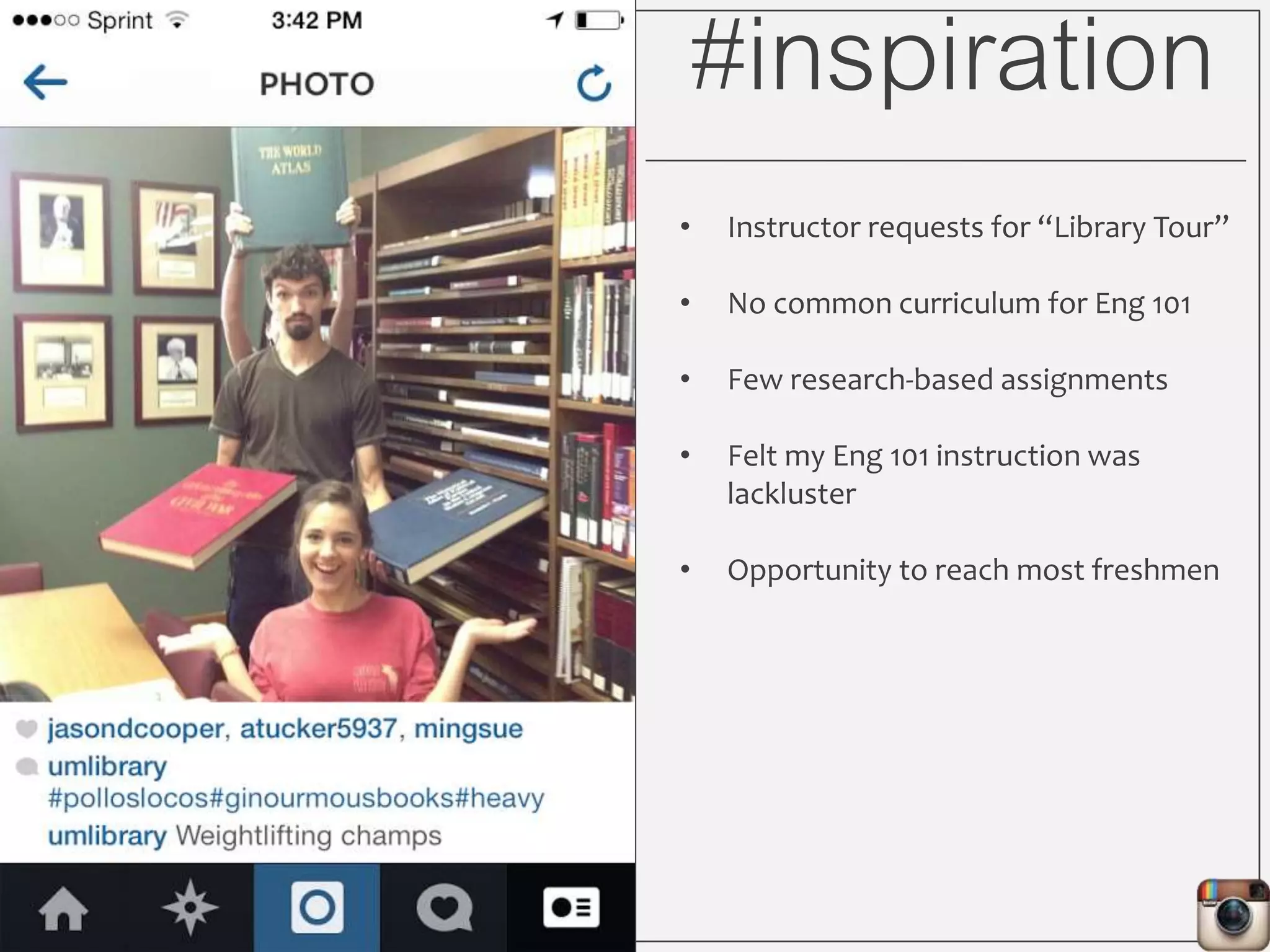
#inspiration
• Instructor requests for “Library Tour”
• No common curriculum for Eng 101
• Few research-based assignments
• Opportunity to reach most freshmen
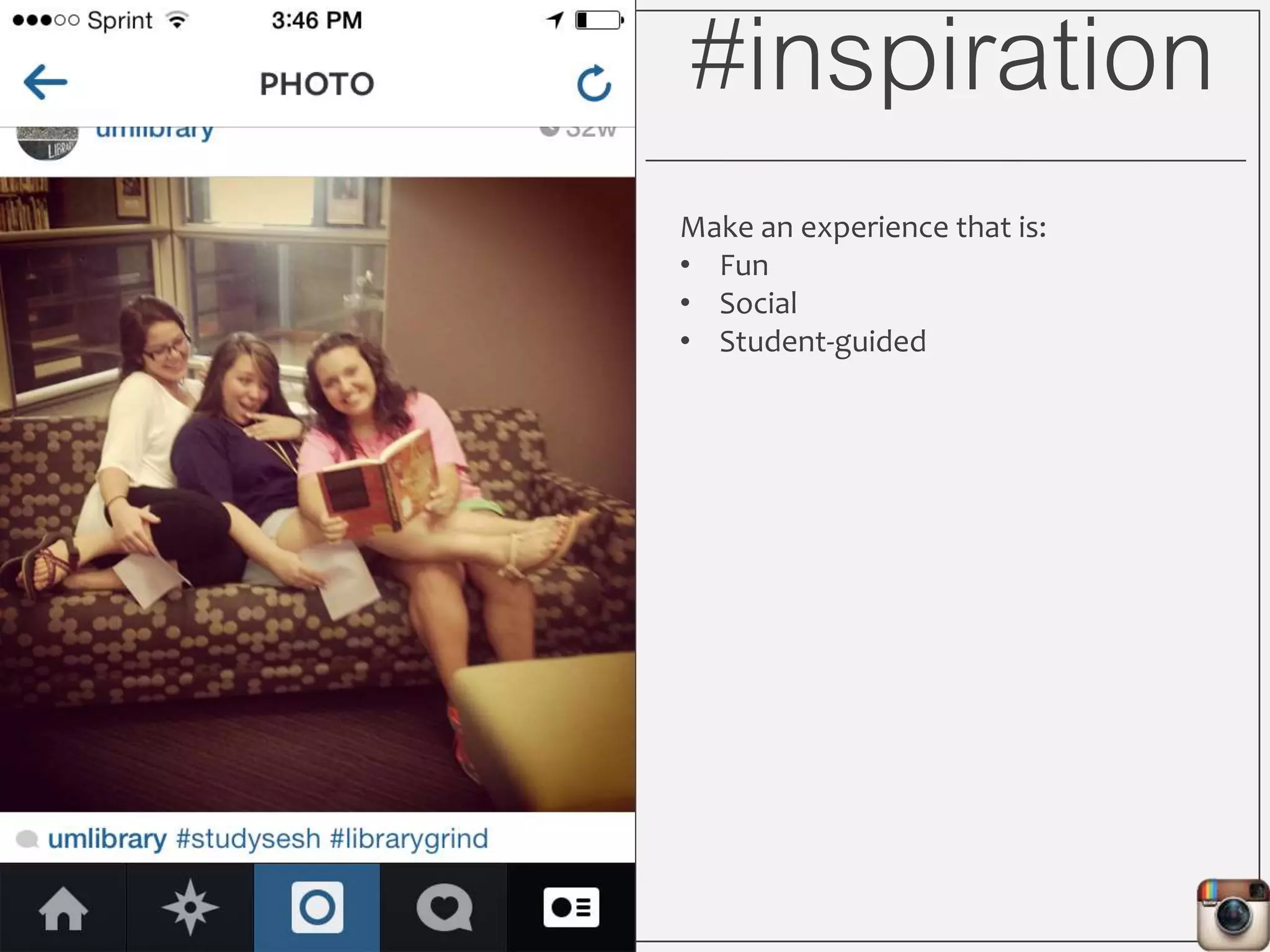
#inspiration
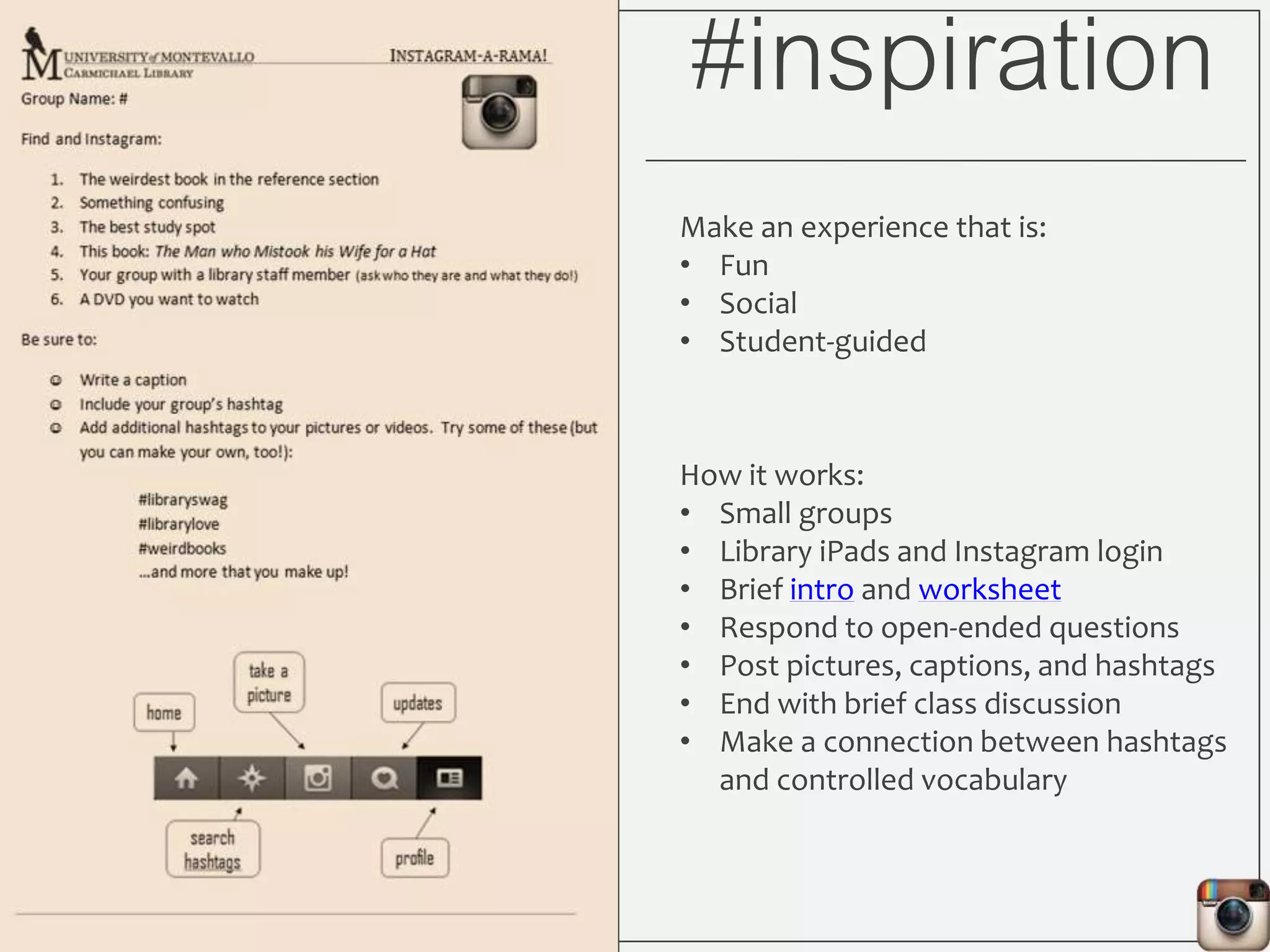
Make an experience that is:
• Fun
• Social
• Student-guided
#inspiration
Make an experience that is:
• Fun
• Social
• Student-guided
How it works:
• Small groups
• Library iPads and Instagram login
• Brief intro and worksheet
• Respond to open-ended questions
• Post pictures, captions, and hashtags
• End with brief class discussion
• Make a connection between hashtags
and controlled vocabulary
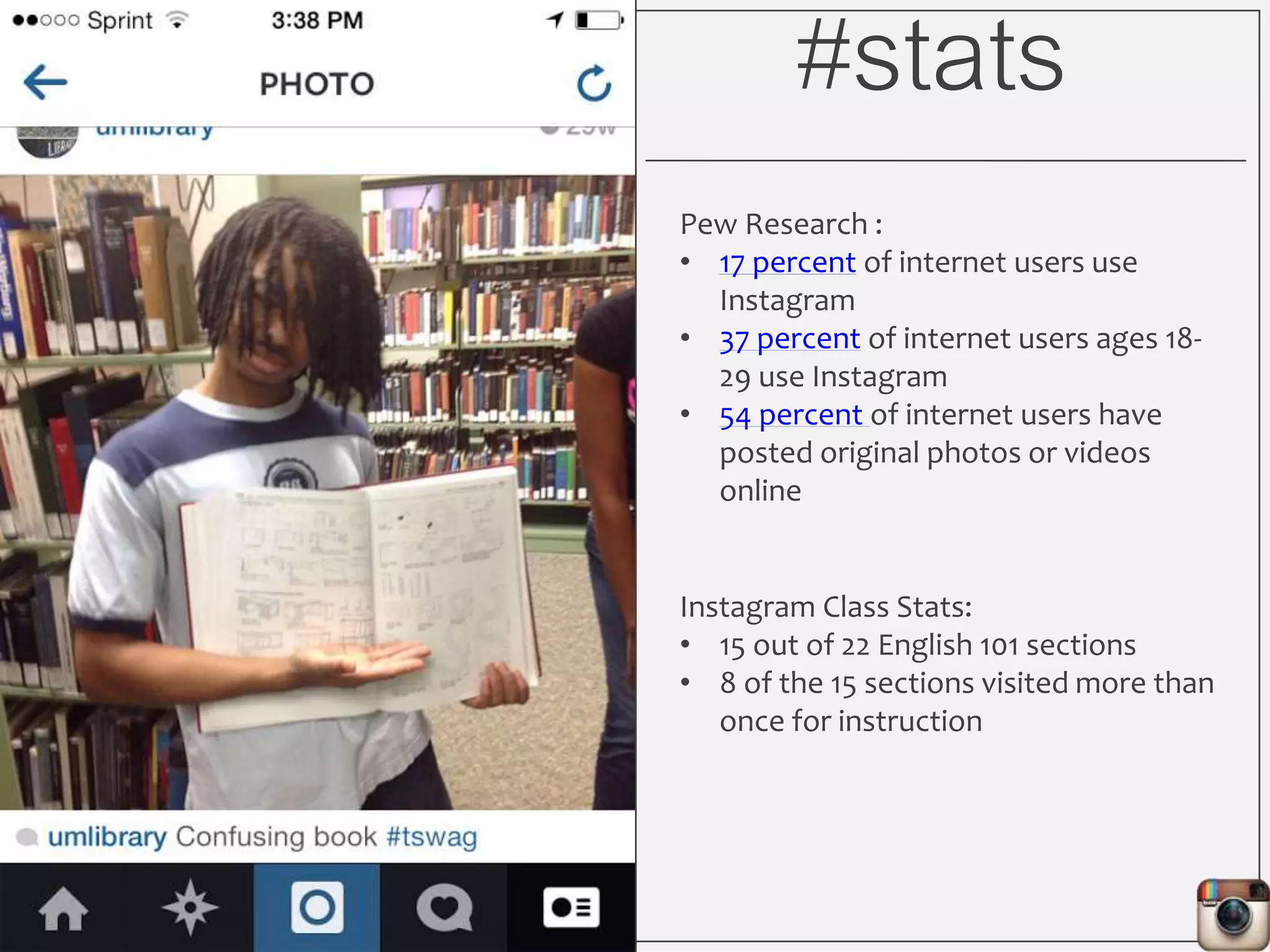
#stats
Pew Research :
• 17 percent of internet users use
Instagram
• 37 percent of internet users ages 18-
29 use Instagram
• 54 percent of internet users have
posted original photos or videos
online
Instagram Class Stats:
• 15 out of 22 English 101 sections
• 8 of the 15 sections visited more than
once for instruction
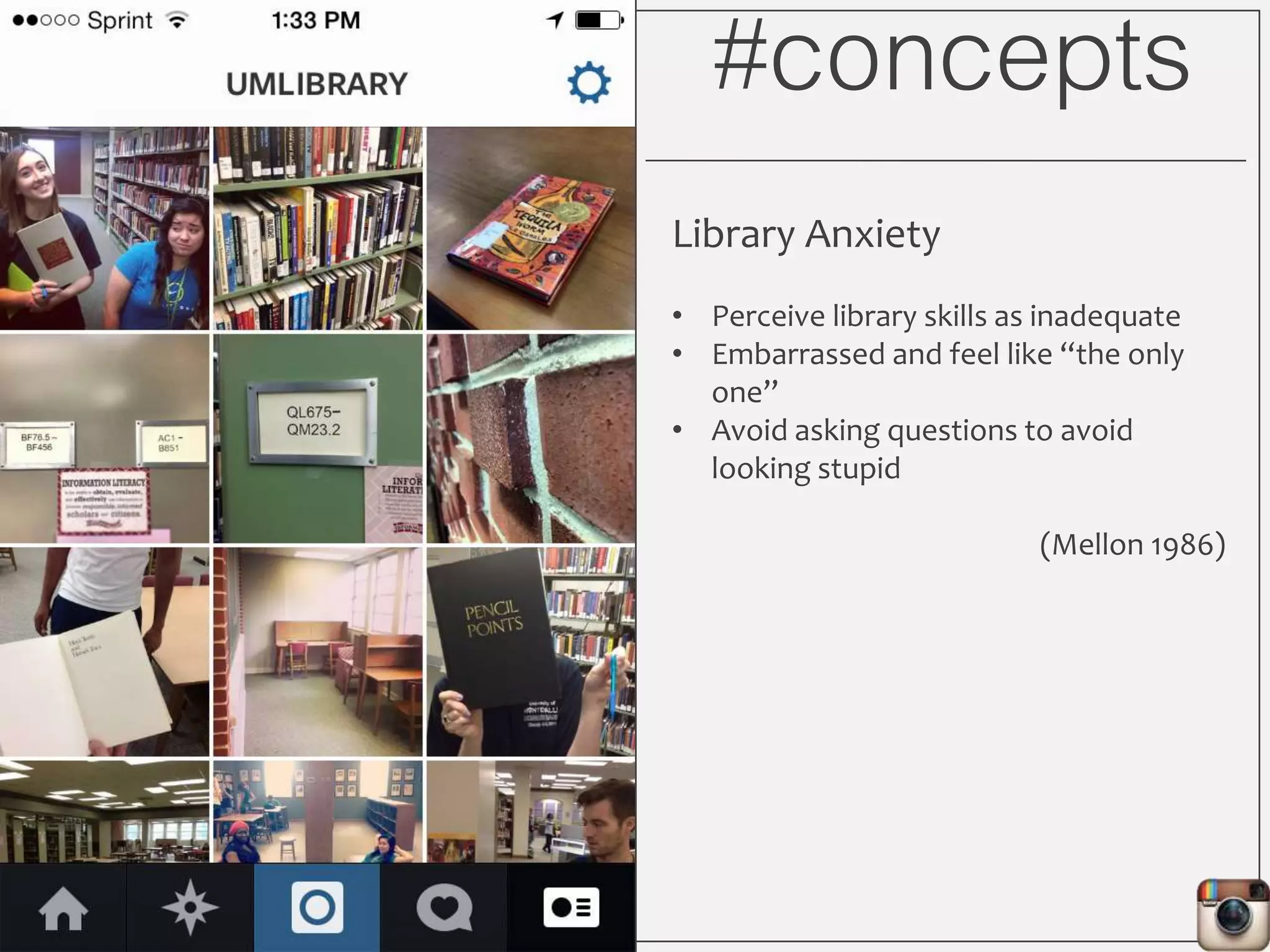
#concepts
Library Anxiety
• Perceive library skills as inadequate
• Embarrassed and feel like “the only
one”
• Avoid asking questions to avoid
looking stupid
(Mellon 1986)
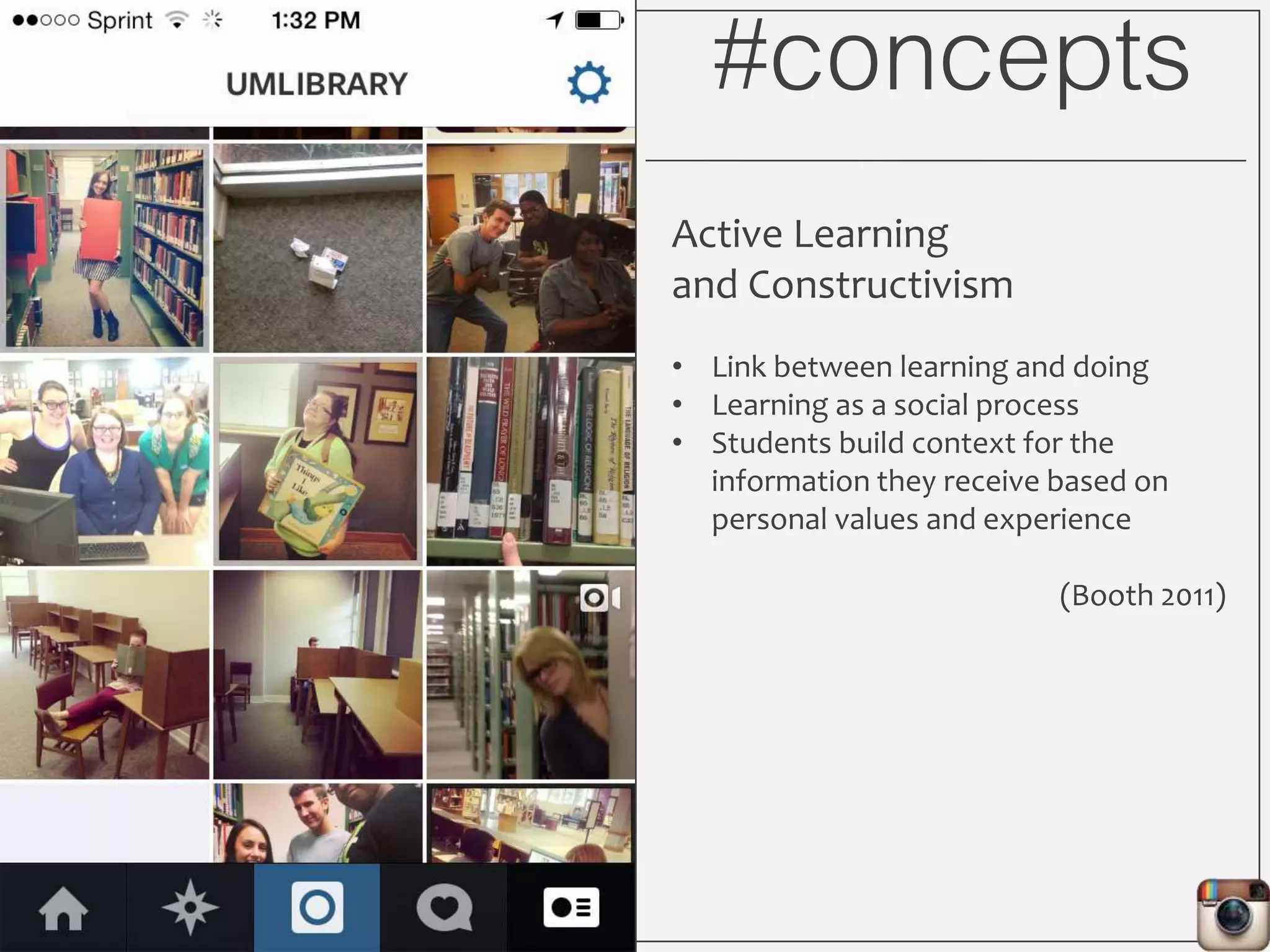
#concepts
Active Learning
and Constructivism
• Link between learning and doing
• Learning as a social process
• Students integrate new ideas with
preexisting values and experiences
(Booth 2011)
#concepts
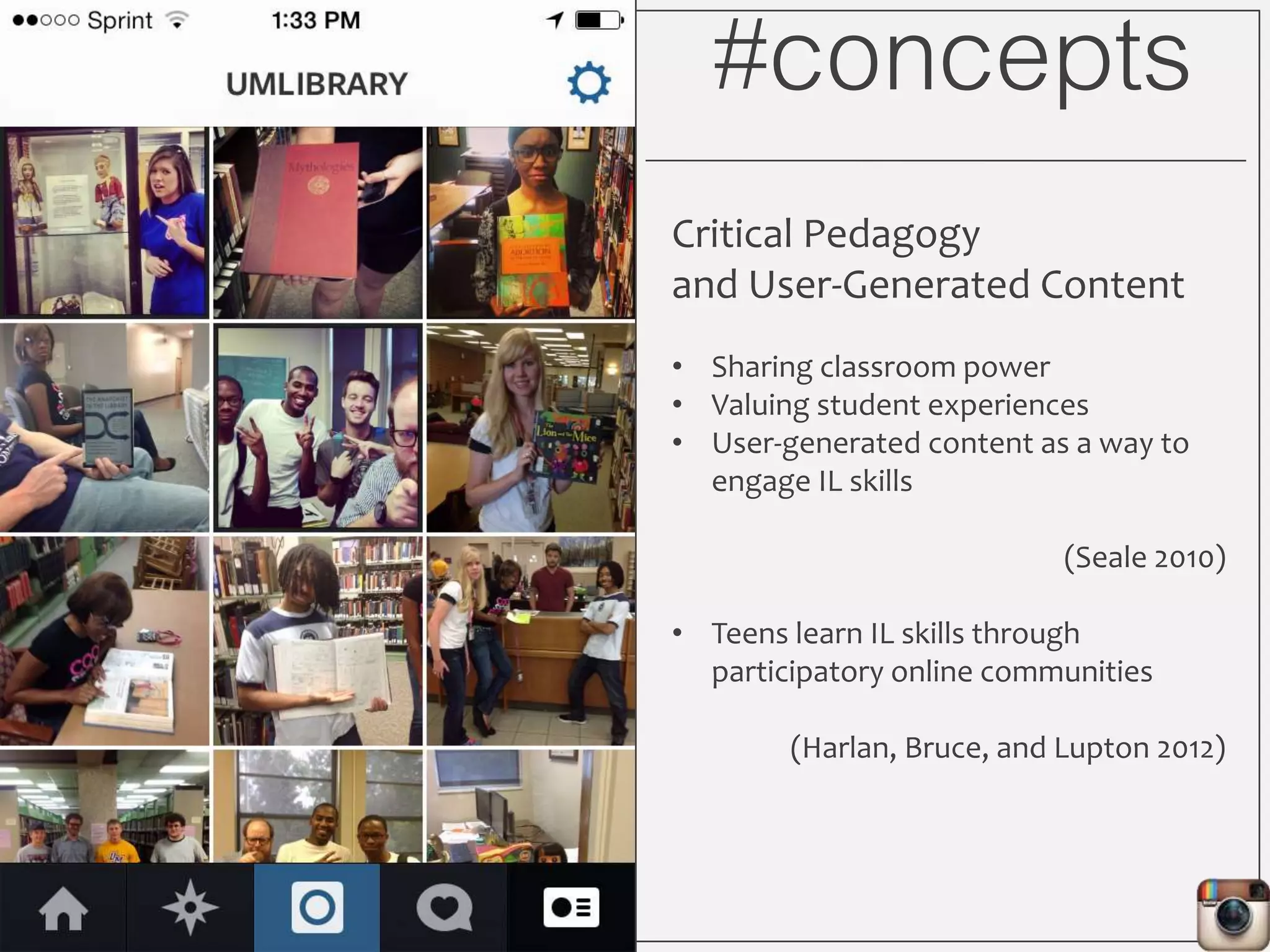
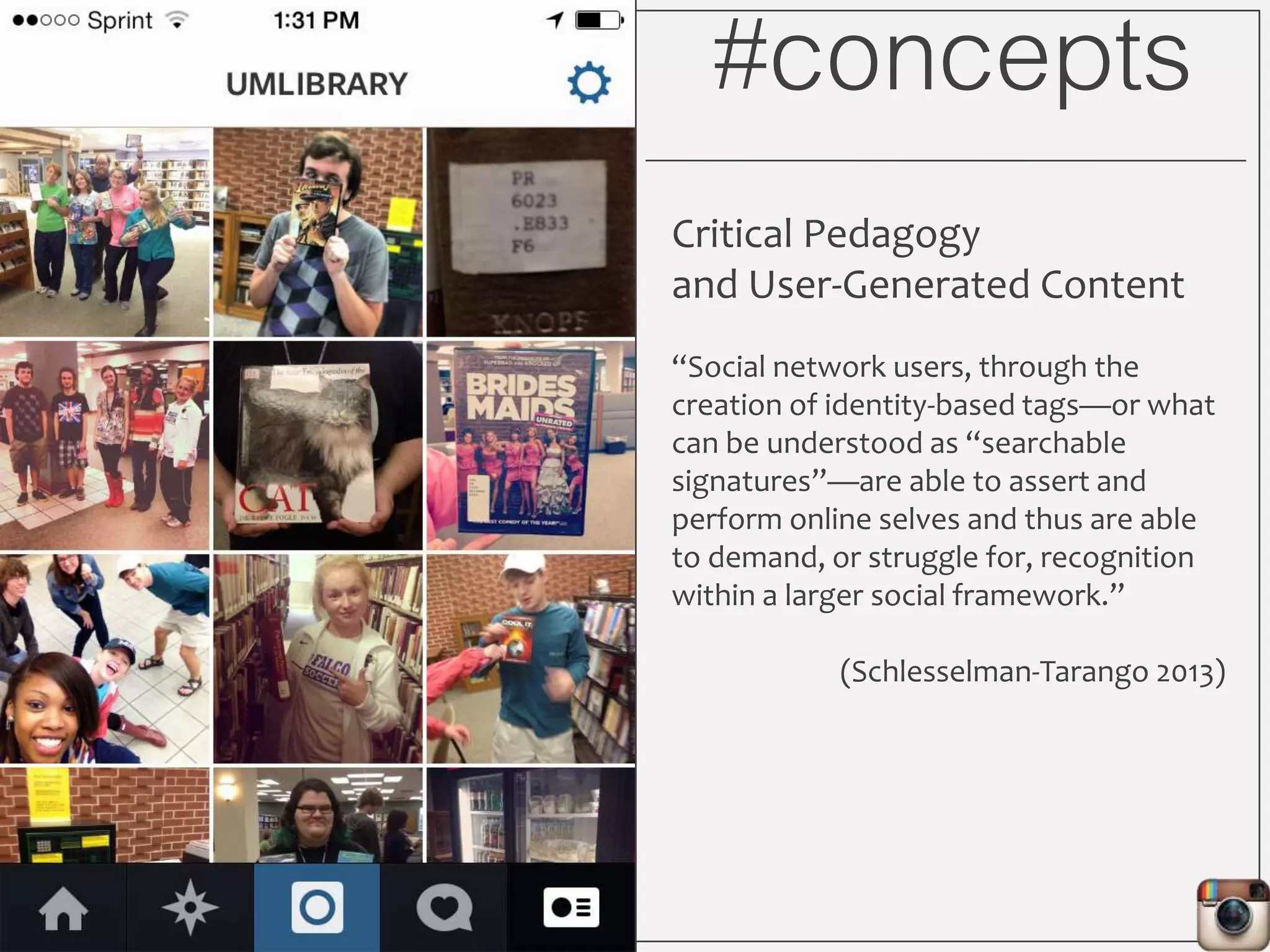
Critical Pedagogy
and User-Generated Content
• Sharing classroom power
• Valuing student experiences
• User-generated content as a way to
engage IL skills
(Seale 2010)
• Teens learn IL skills through
participatory online communities
(Harlan, Bruce, and Lupton 2012)
#concepts
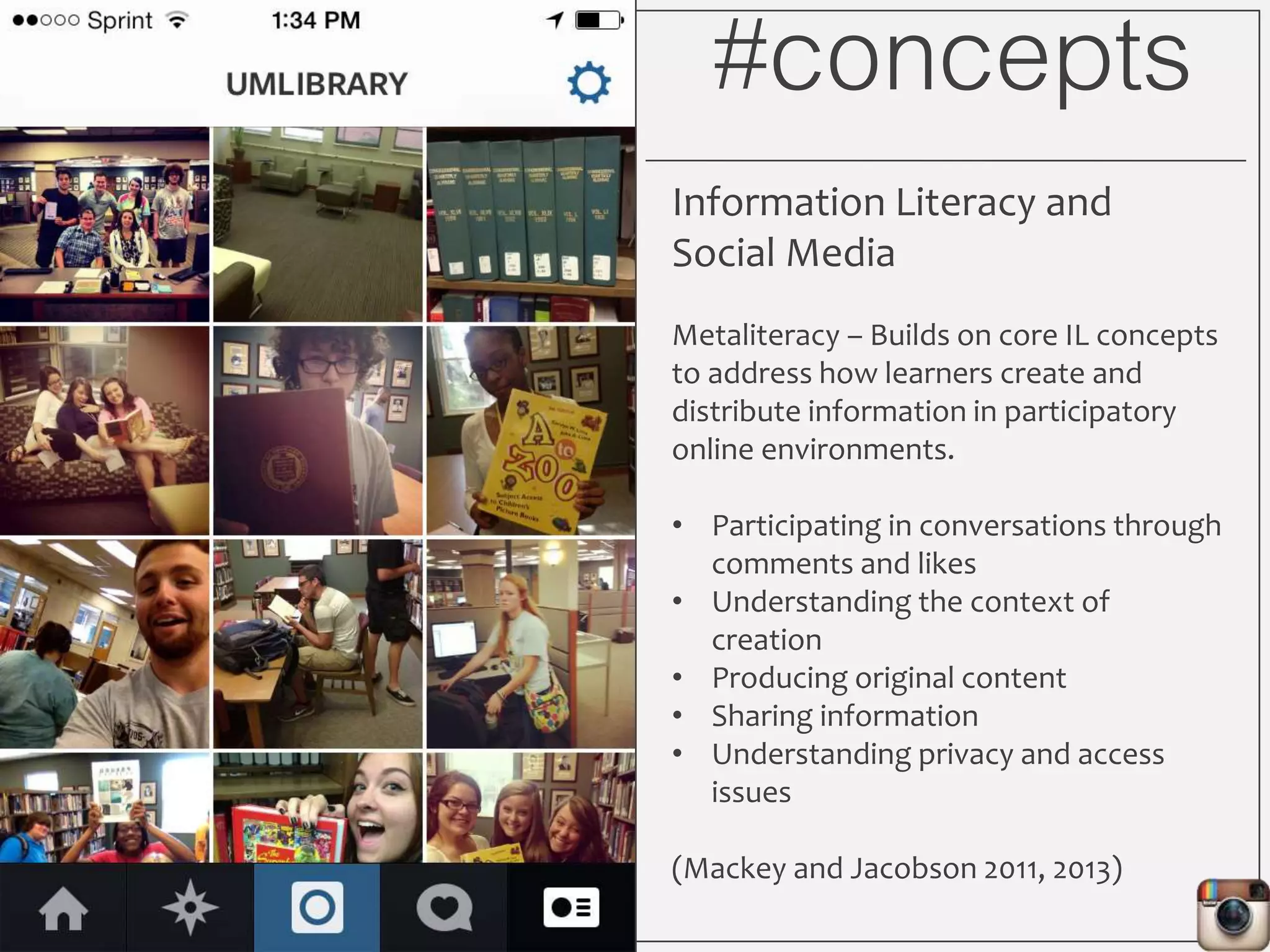
Information Literacy and
Social Media
Metaliteracy – Builds on core IL concepts
to address how learners create and
distribute information in participatory
online environments.
• Participating in conversations through
comments and likes
• Understanding the context of
creation
• Seeing oneself as a producer and
consumer of info
• Understanding privacy and access
issues
(Mackey and Jacobson 2011, 2013)
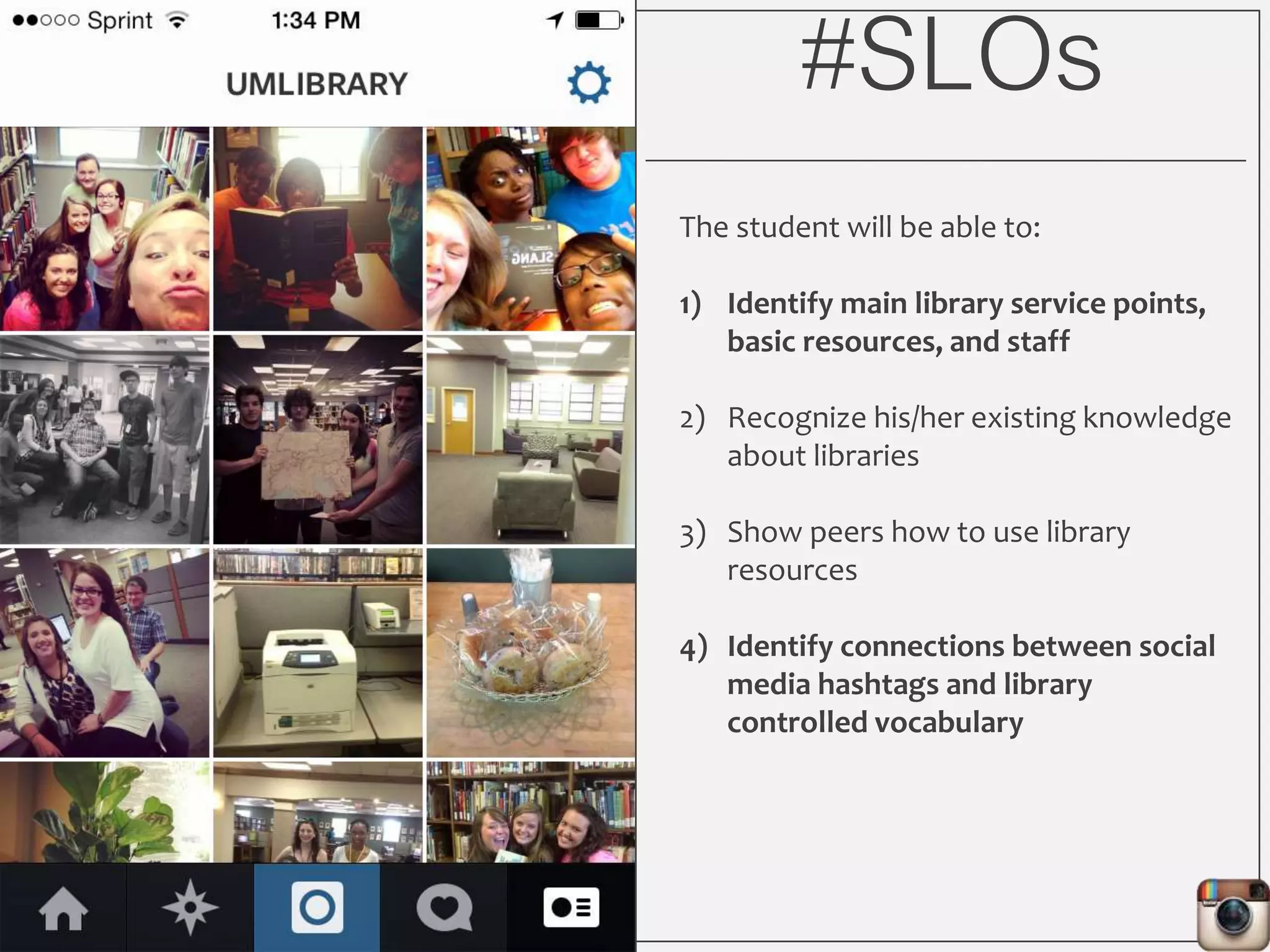
#SLOs
The student will be able to:
1) Identify main library service points,
basic resources, and staff
2) Recognize his/her existing knowledge
about libraries
3) Show peers how to use library
resources
4) Identify connections between social
media hashtags and library
controlled vocabulary
#examples
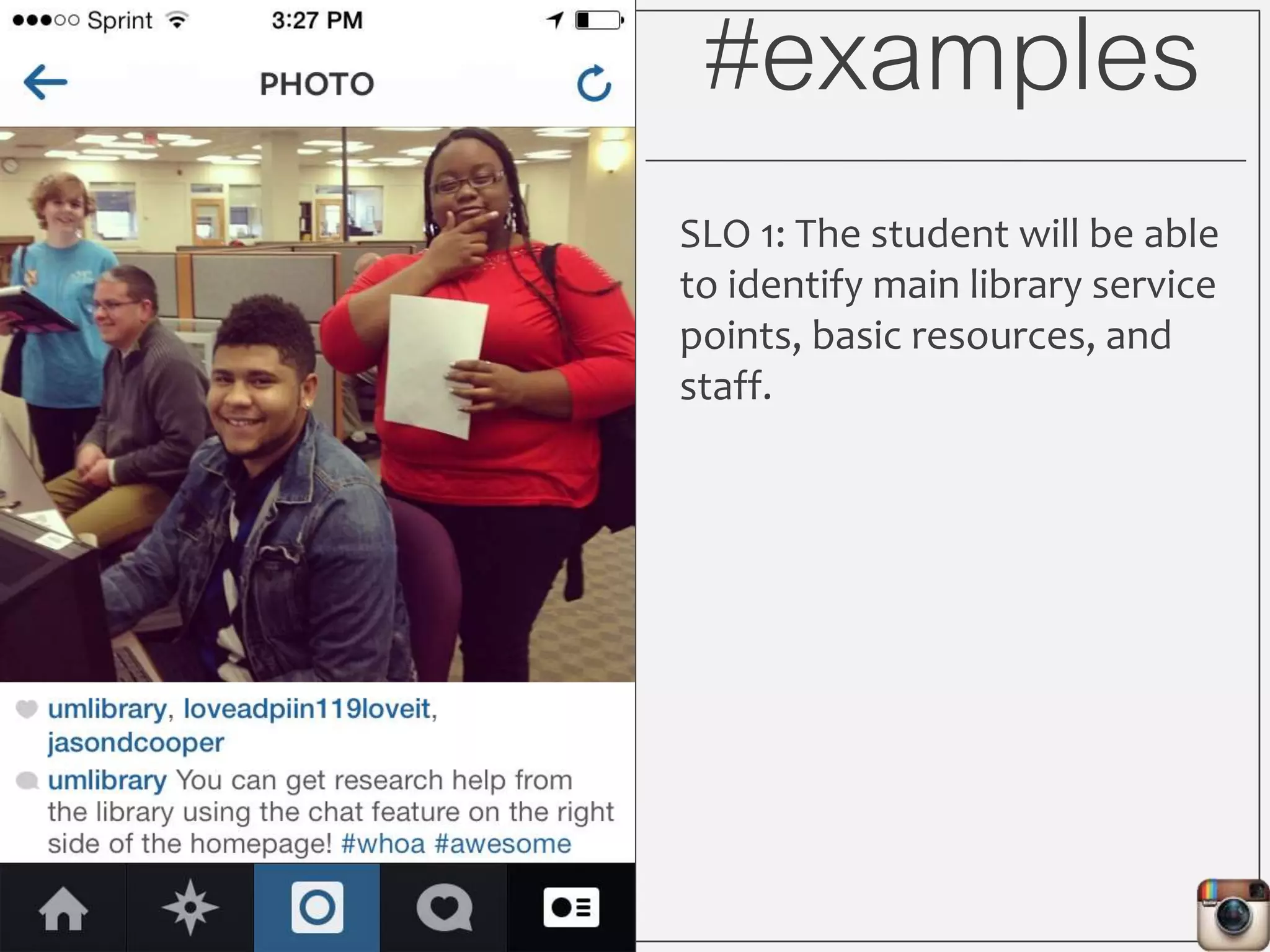
SLO 1: The student will be able
to identify main library service
points, basic resources, and
staff.
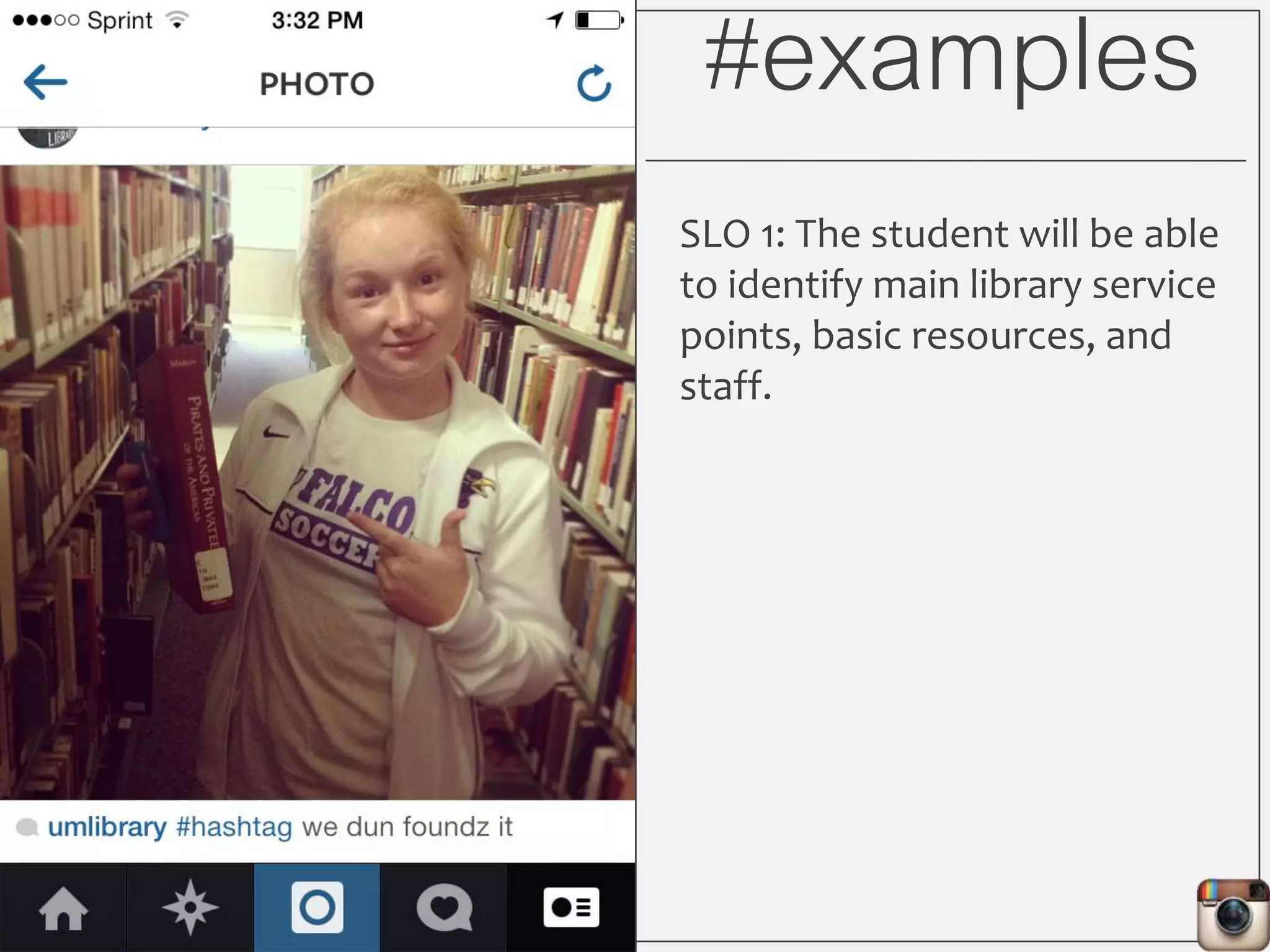
#examples
SLO 1: The student will be able
to identify main library service
points, basic resources, and
staff.
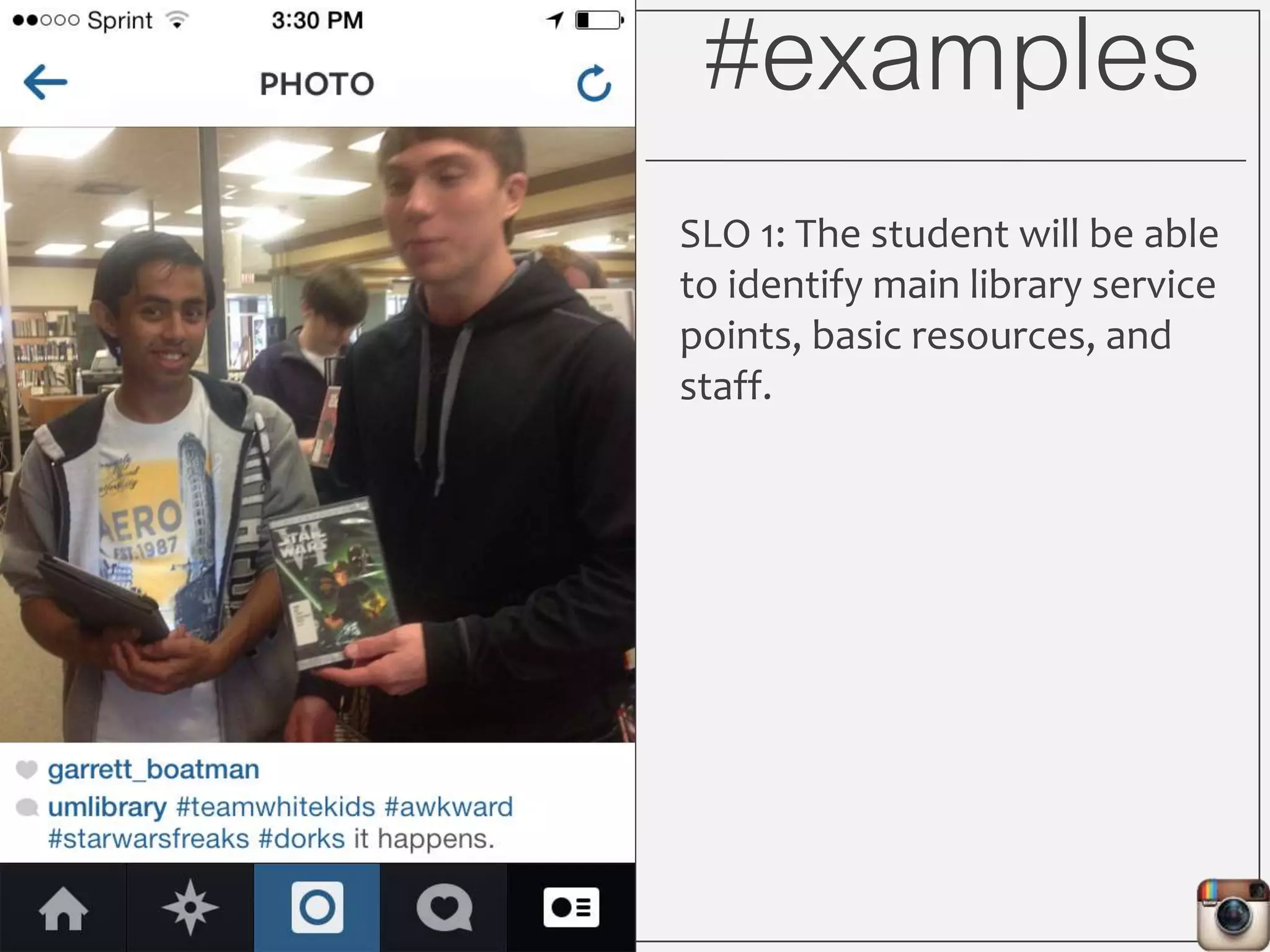
#examples
SLO 1: The student will be able
to identify main library service
points, basic resources, and
staff.
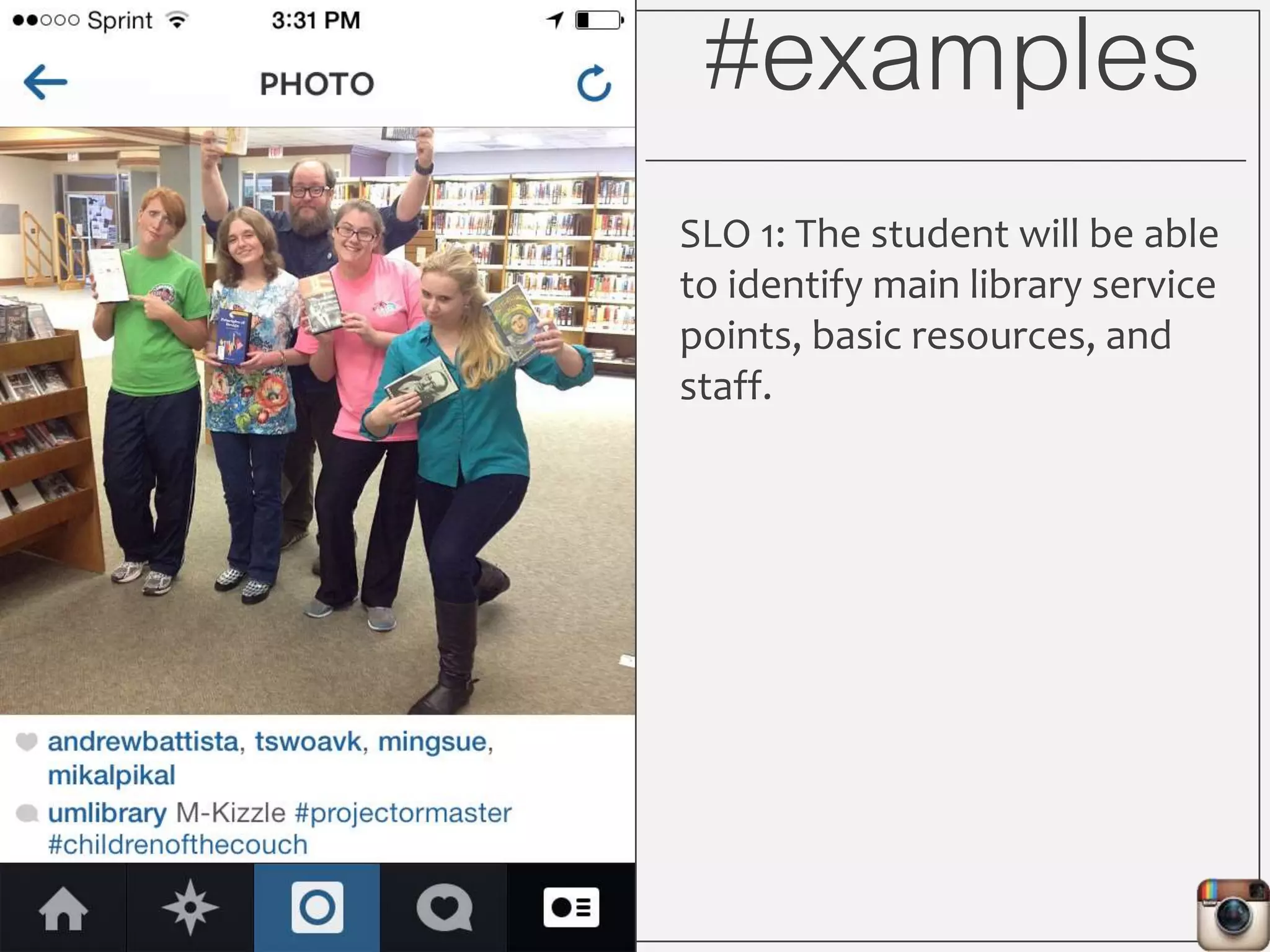
#examples
SLO 1: The student will be able
to identify main library service
points, basic resources, and
staff.
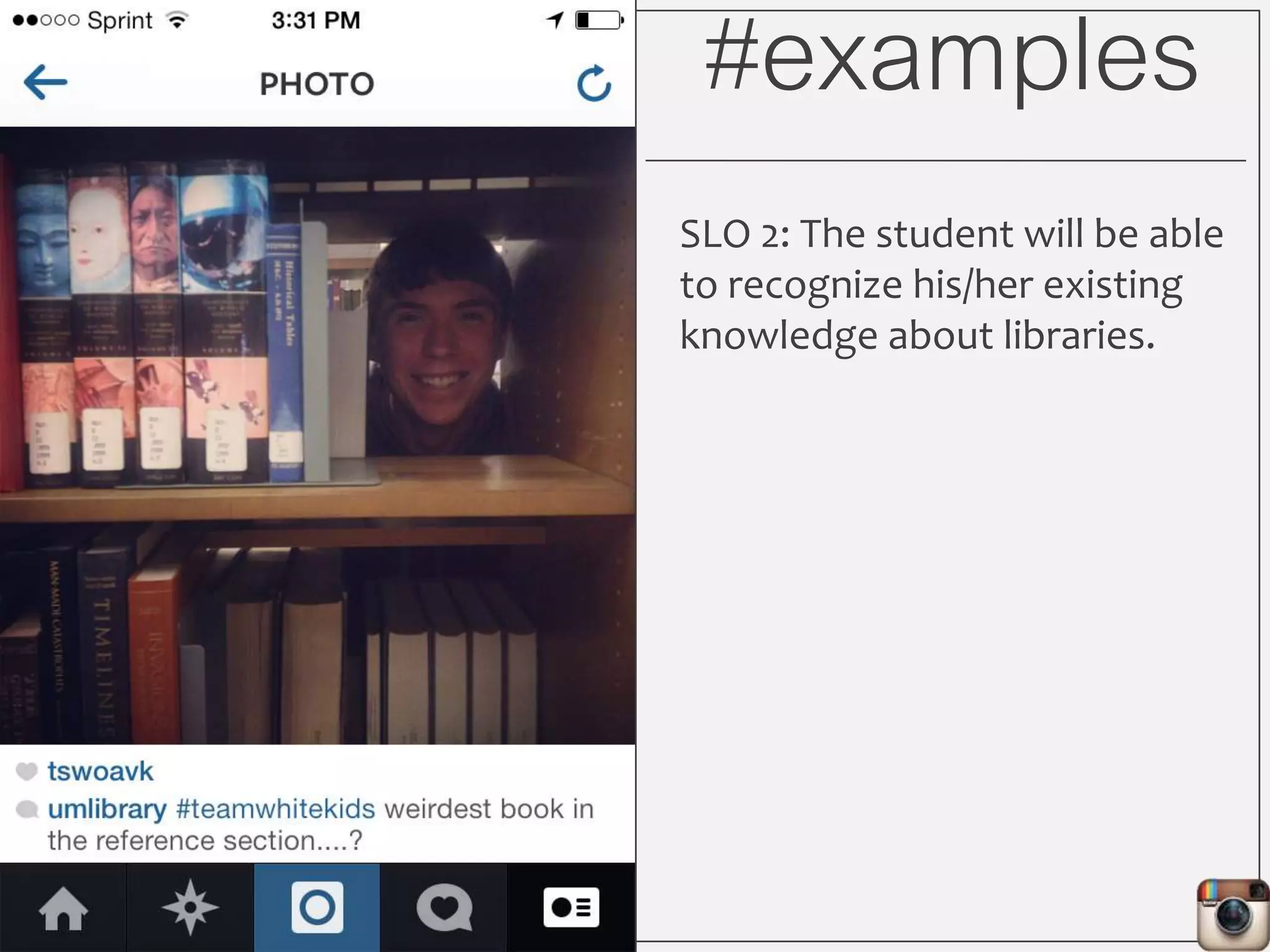
#examples
SLO 2: The student will be able
to recognize his/her existing
knowledge about libraries.
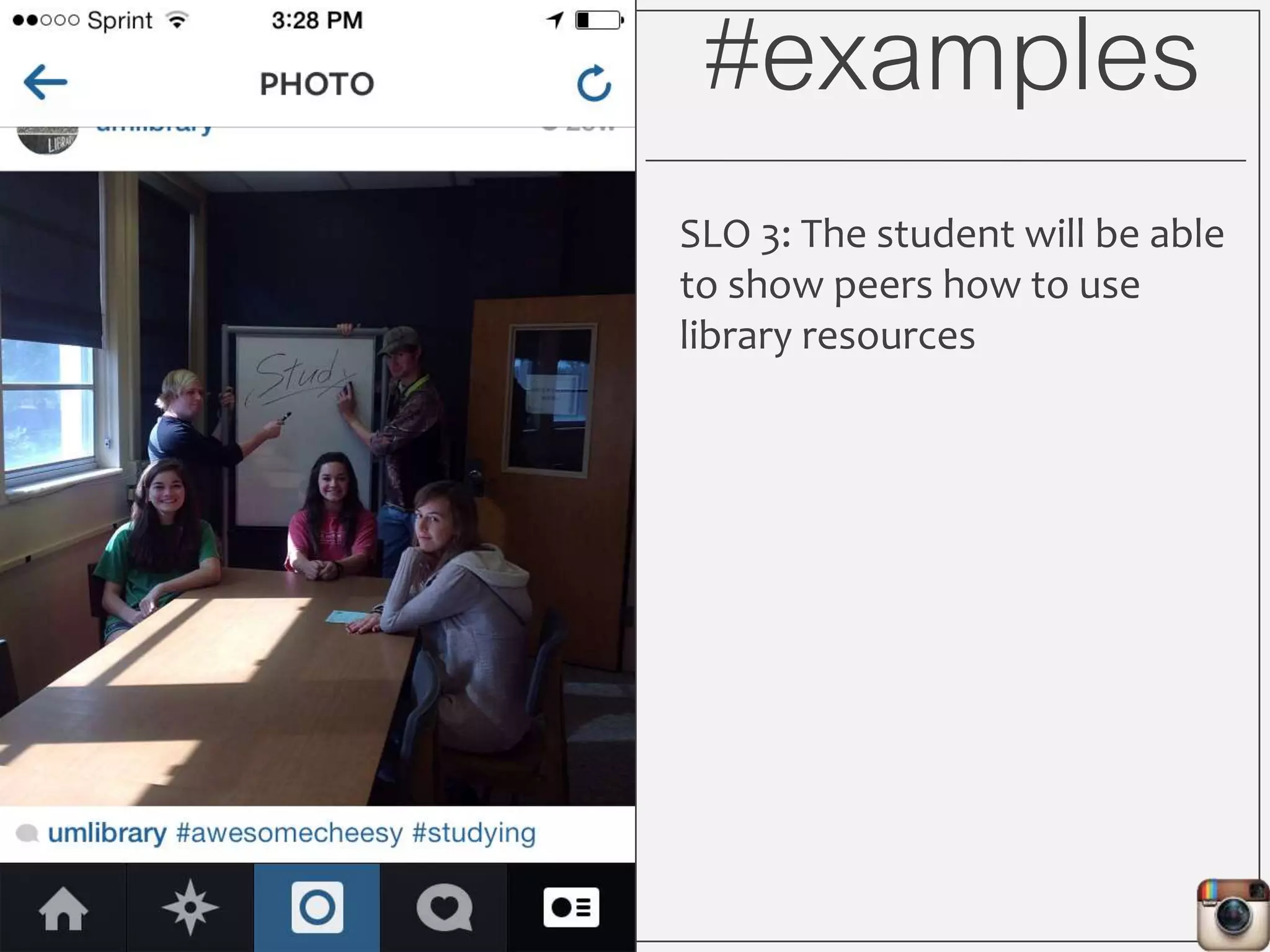
#examples
SLO 3: The student will be able
to show peers how to use
library resources
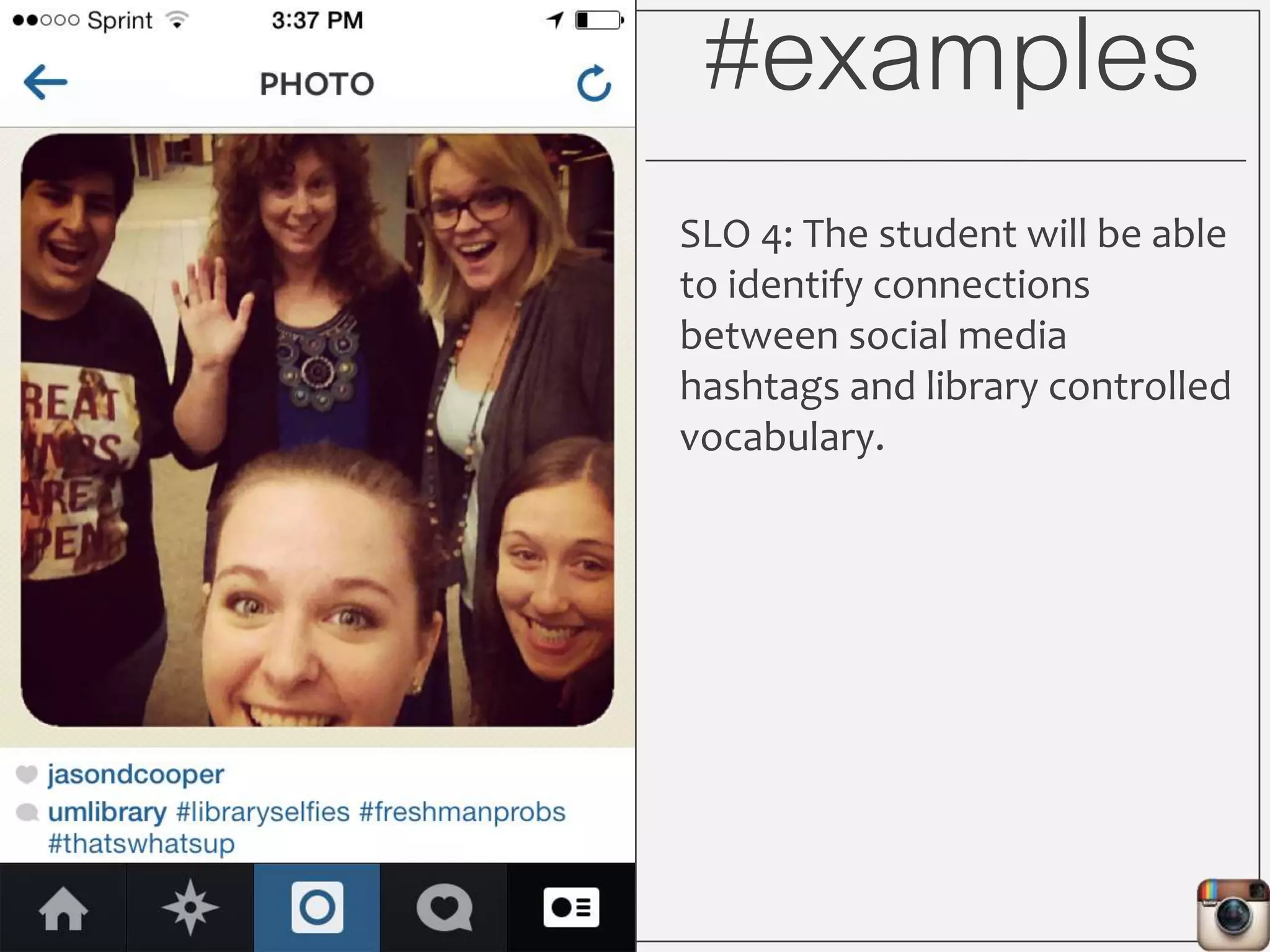
#examples
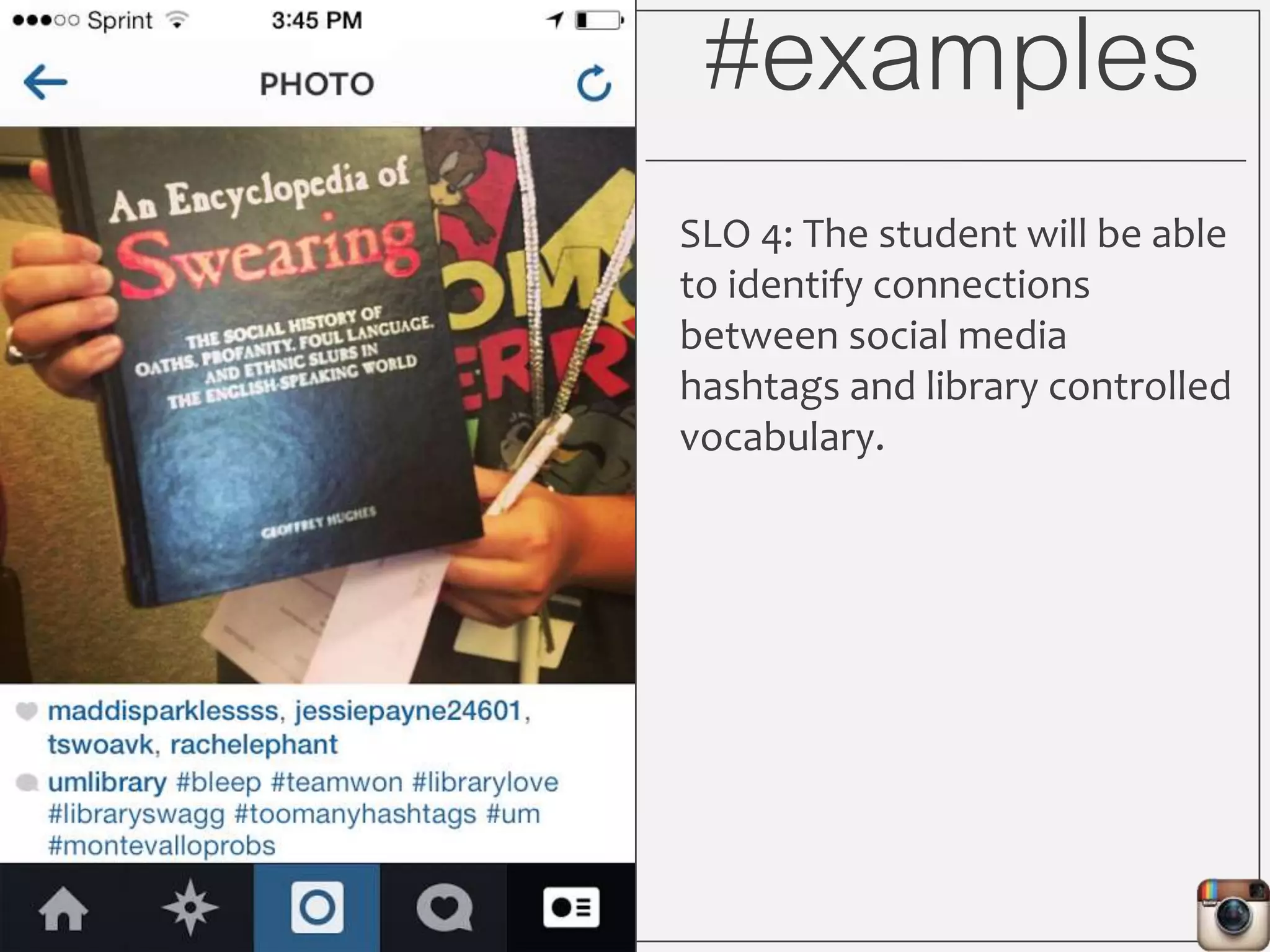
SLO 4: The student will be able
to identify connections
between social media
hashtags and library controlled
vocabulary.
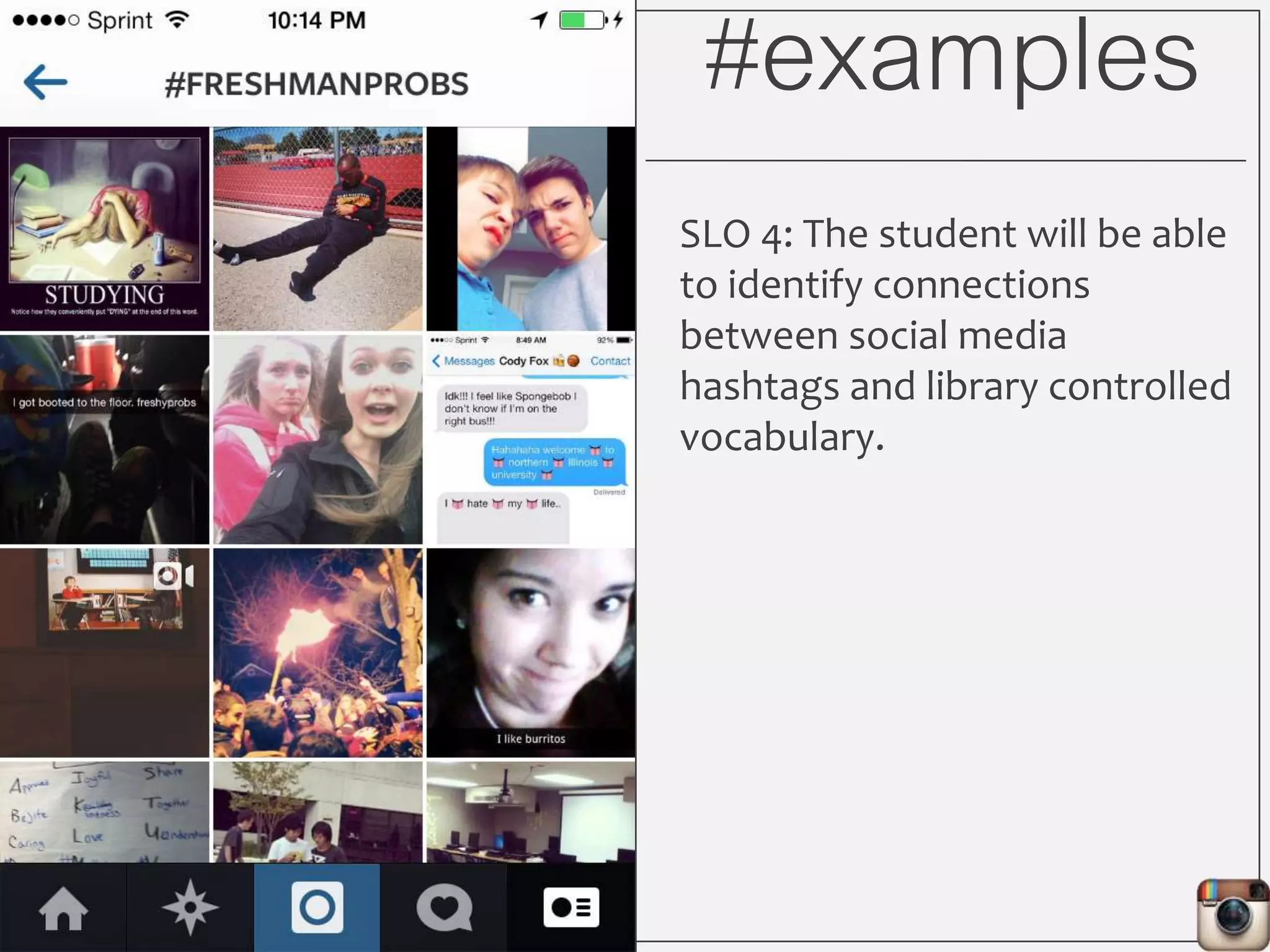
#examples
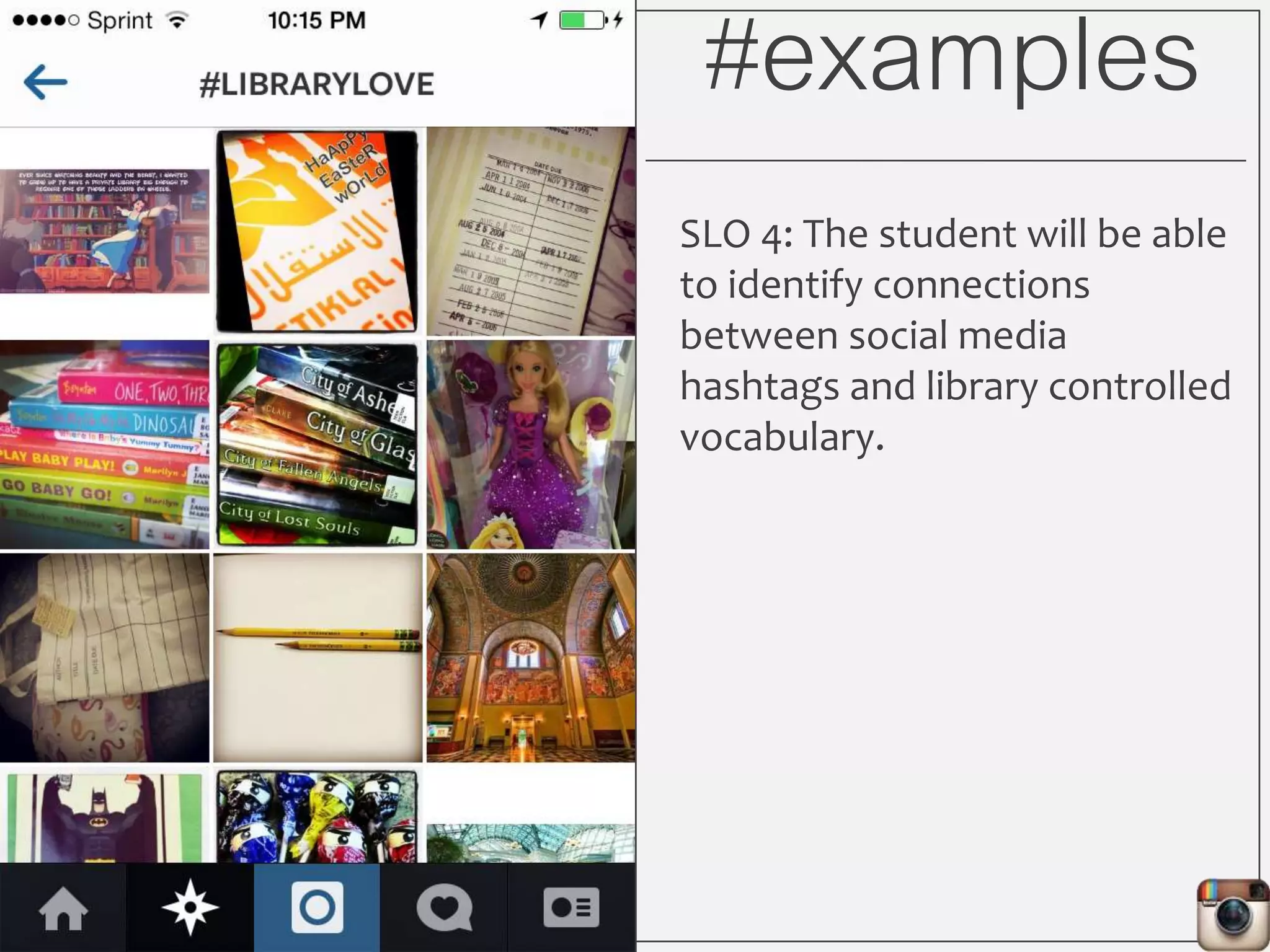
SLO 4: The student will be able
to identify connections
between social media
hashtags and library controlled
vocabulary.
#examples
SLO 4: The student will be able
to identify connections
between social media
hashtags and library controlled
vocabulary.
#examples
SLO 4: The student will be able
to identify connections
between social media
hashtags and library controlled
vocabulary.
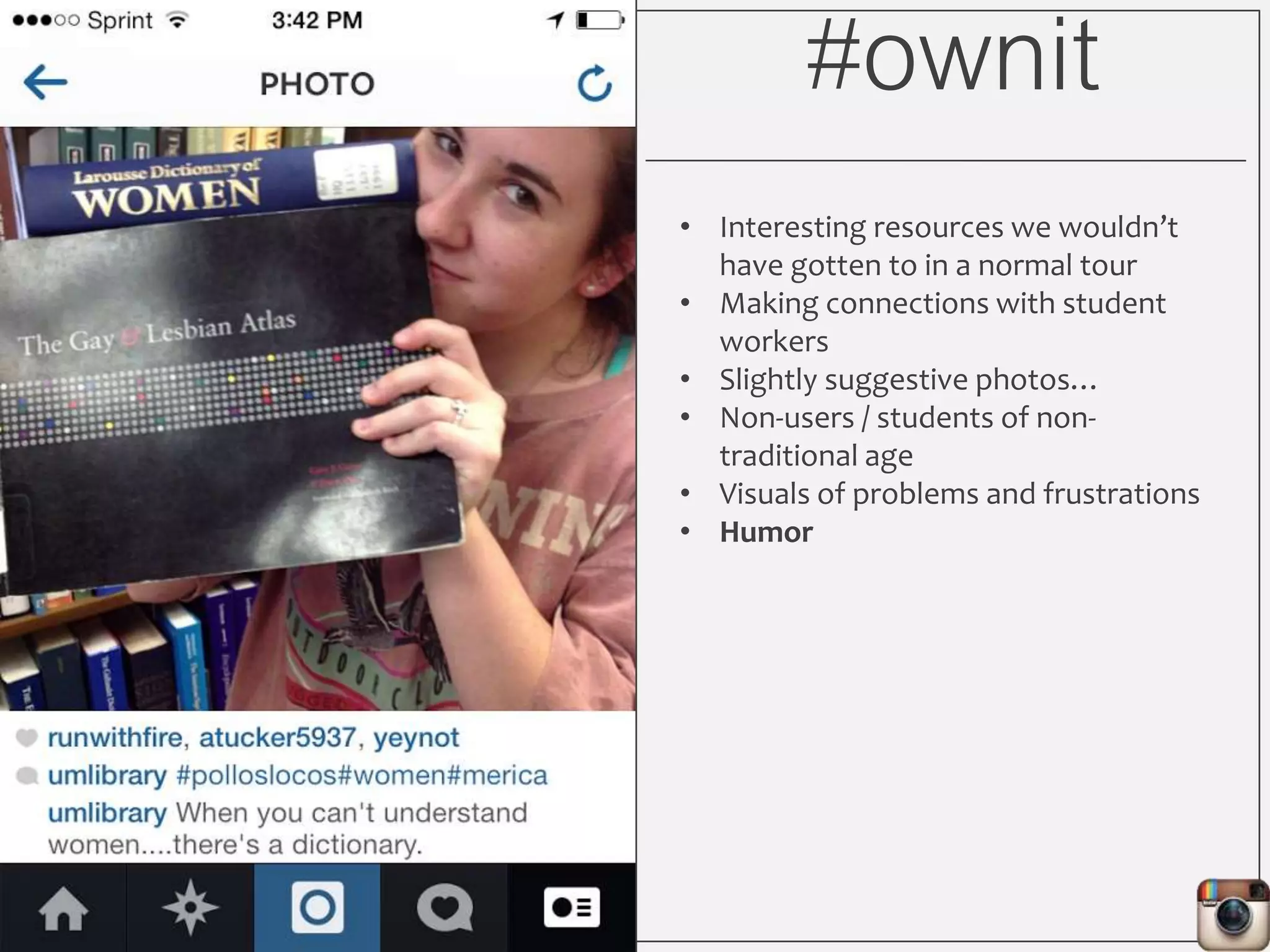
#ownit
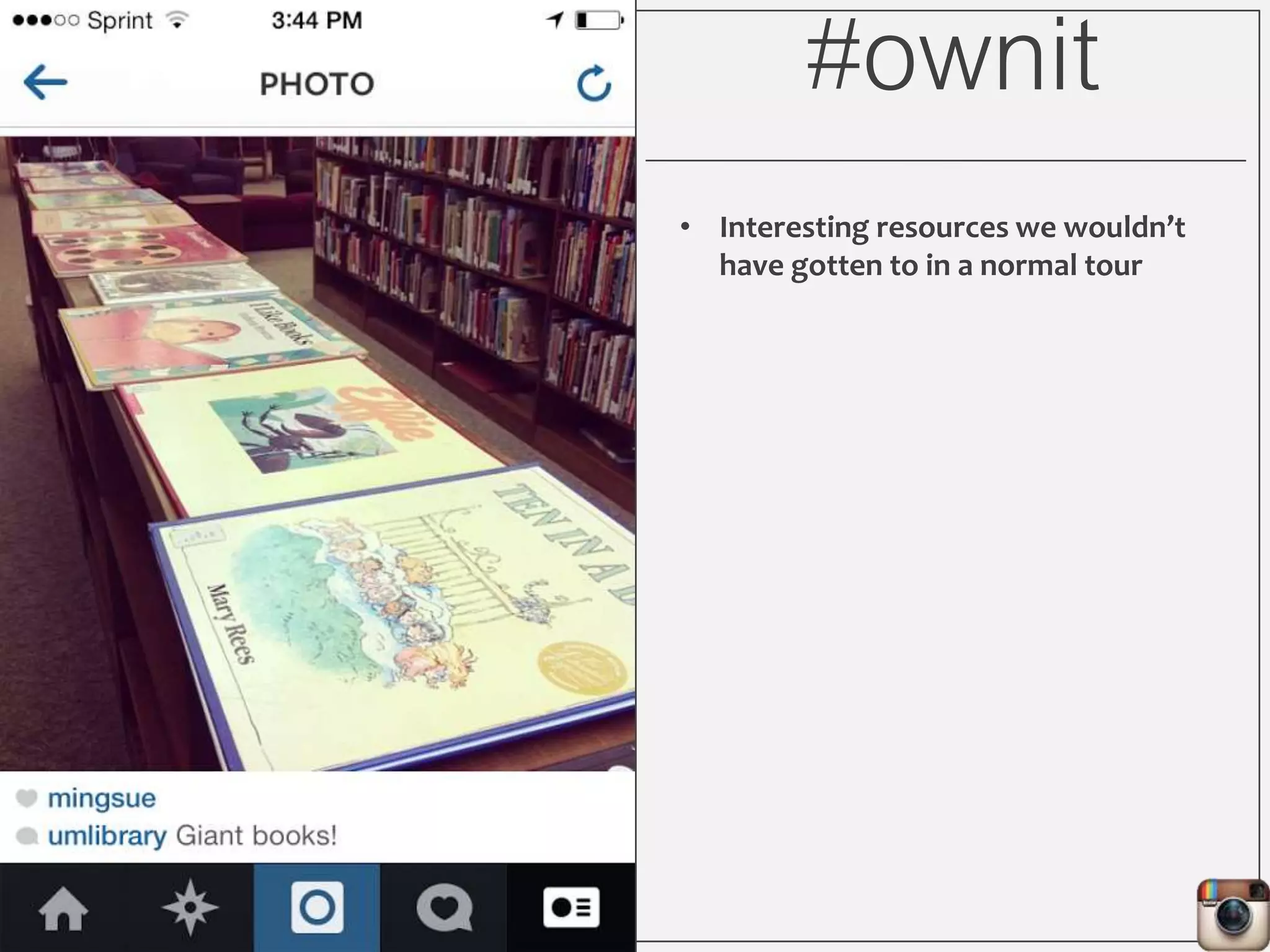
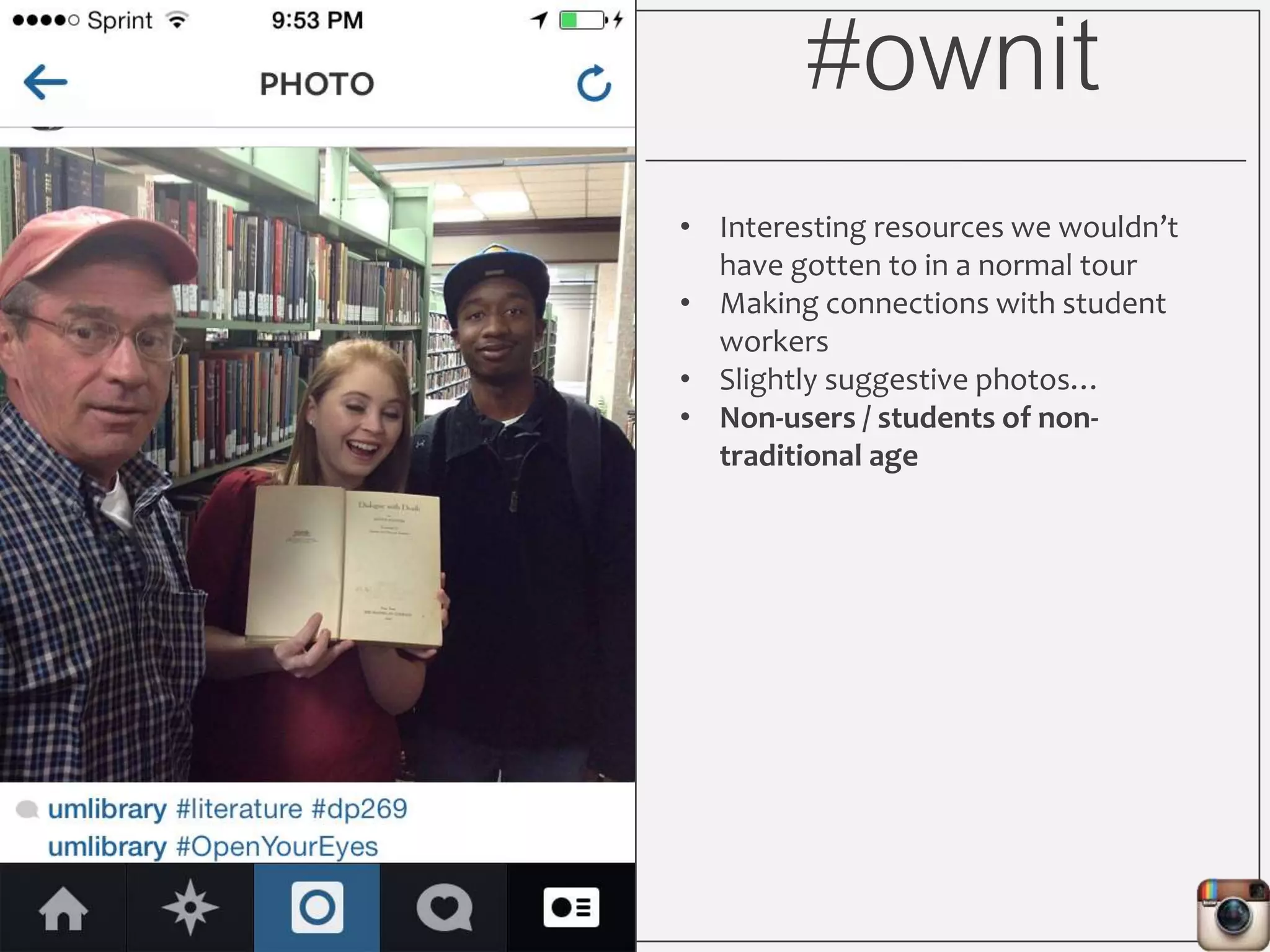
• Interesting resources we wouldn’t
have gotten to in a normal tour
#ownit
• Interesting resources we wouldn’t
have gotten to in a normal tour
#ownit
• Interesting resources we wouldn’t
have gotten to in a normal tour
#ownit
• Interesting resources we wouldn’t
have gotten to in a normal tour
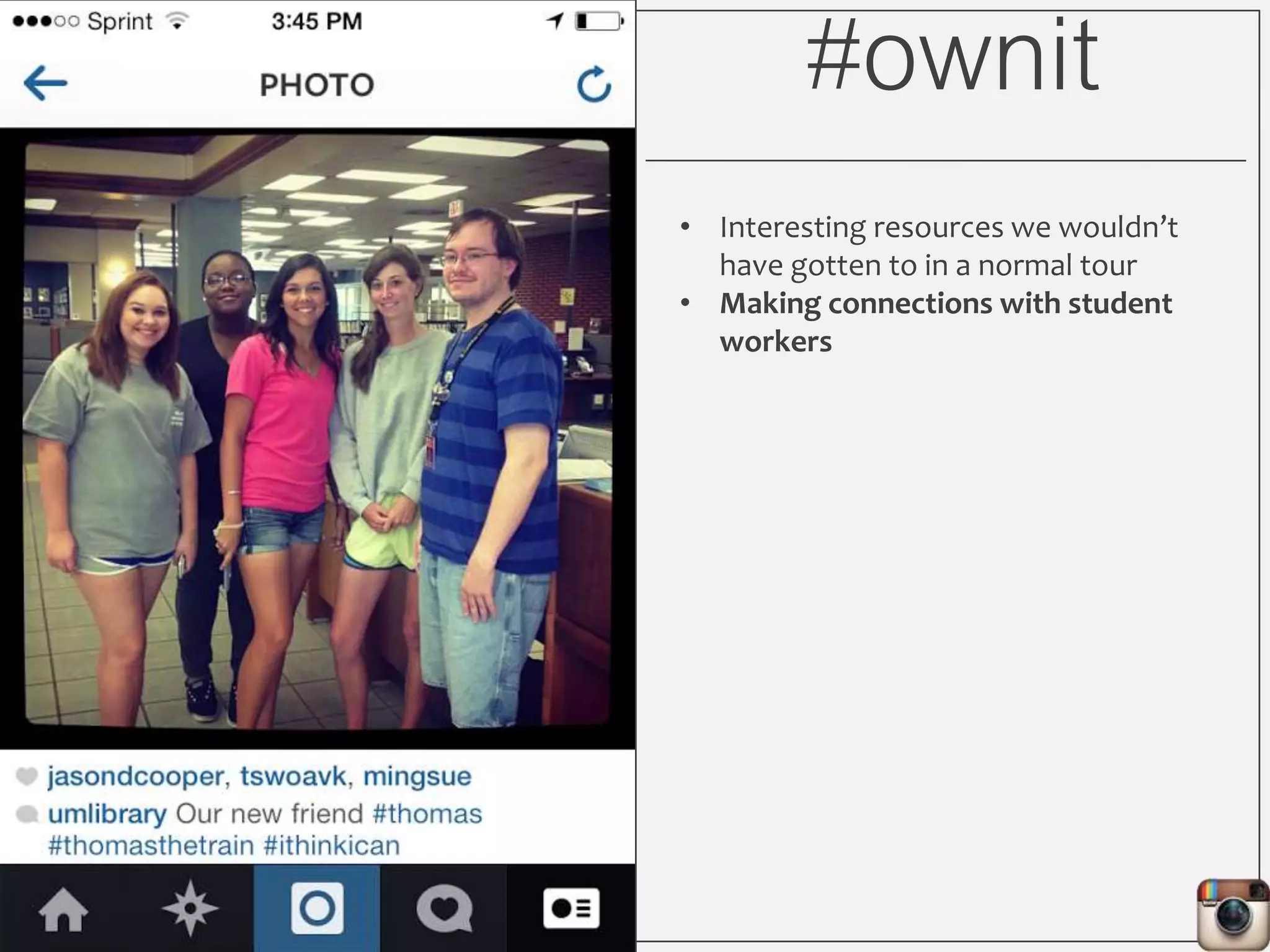
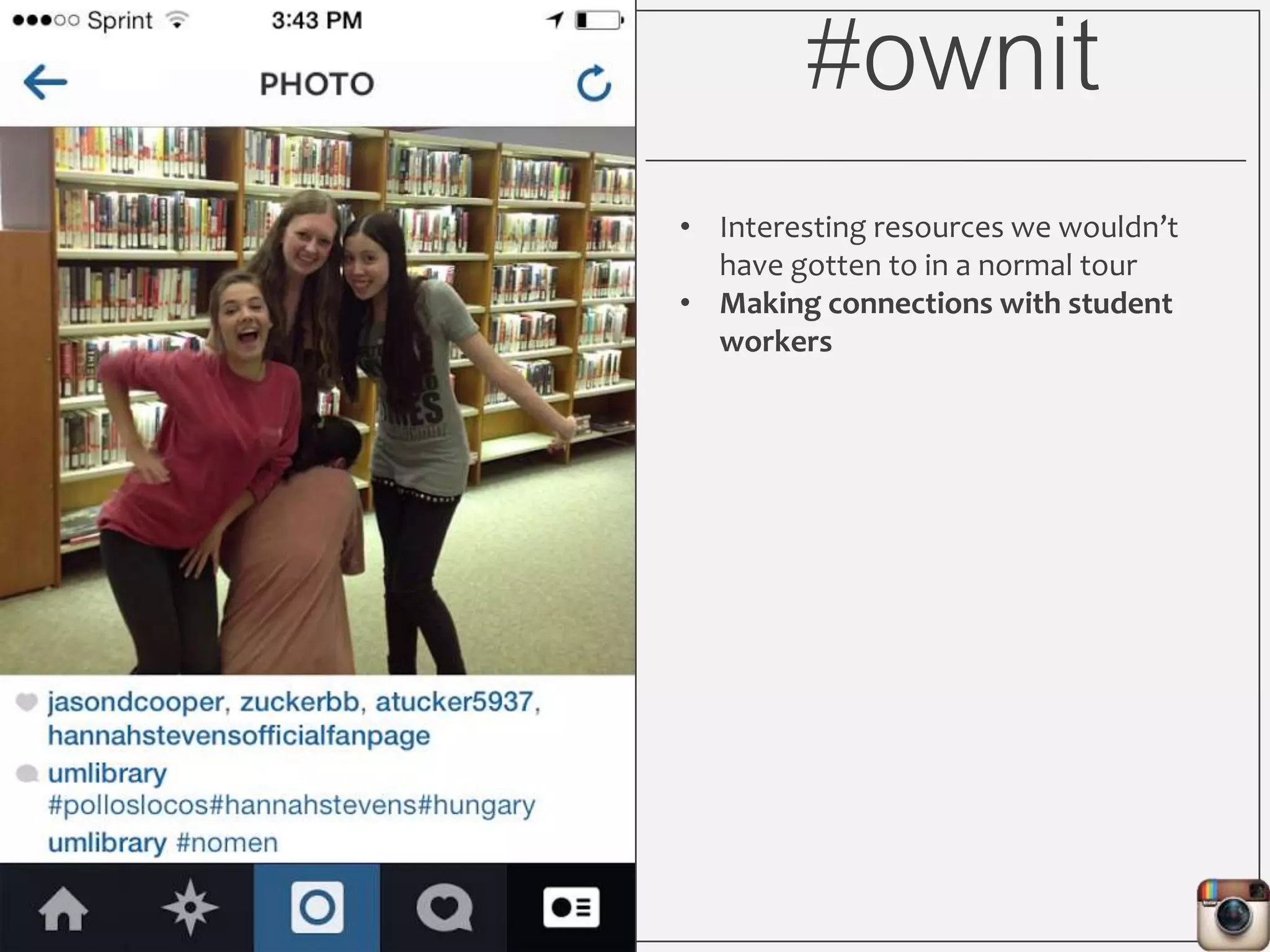
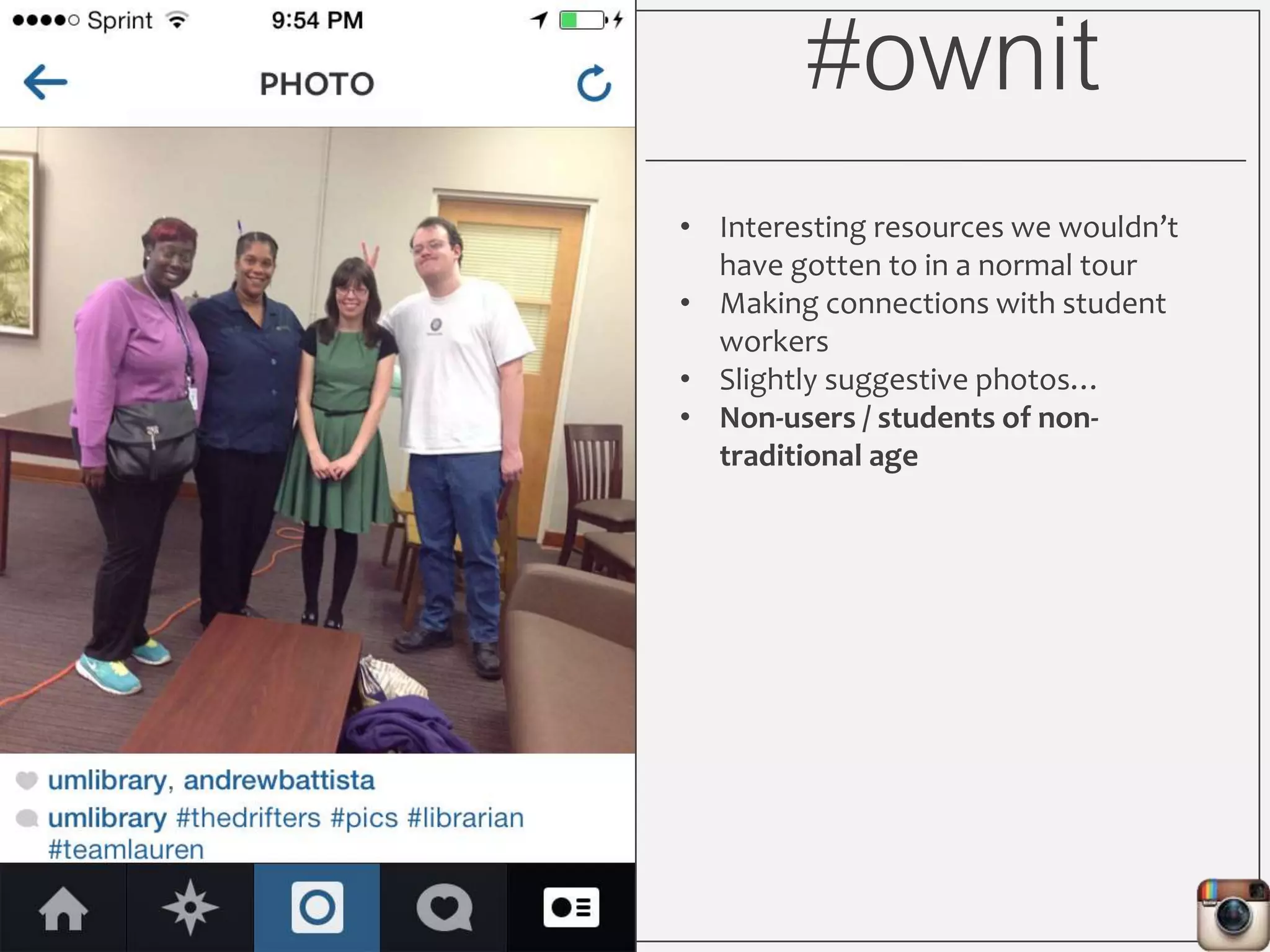
• Making connections with student
workers
#ownit
• Interesting resources we wouldn’t
have gotten to in a normal tour
• Making connections with student
workers
#ownit
• Interesting resources we wouldn’t
have gotten to in a normal tour
• Making connections with student
workers
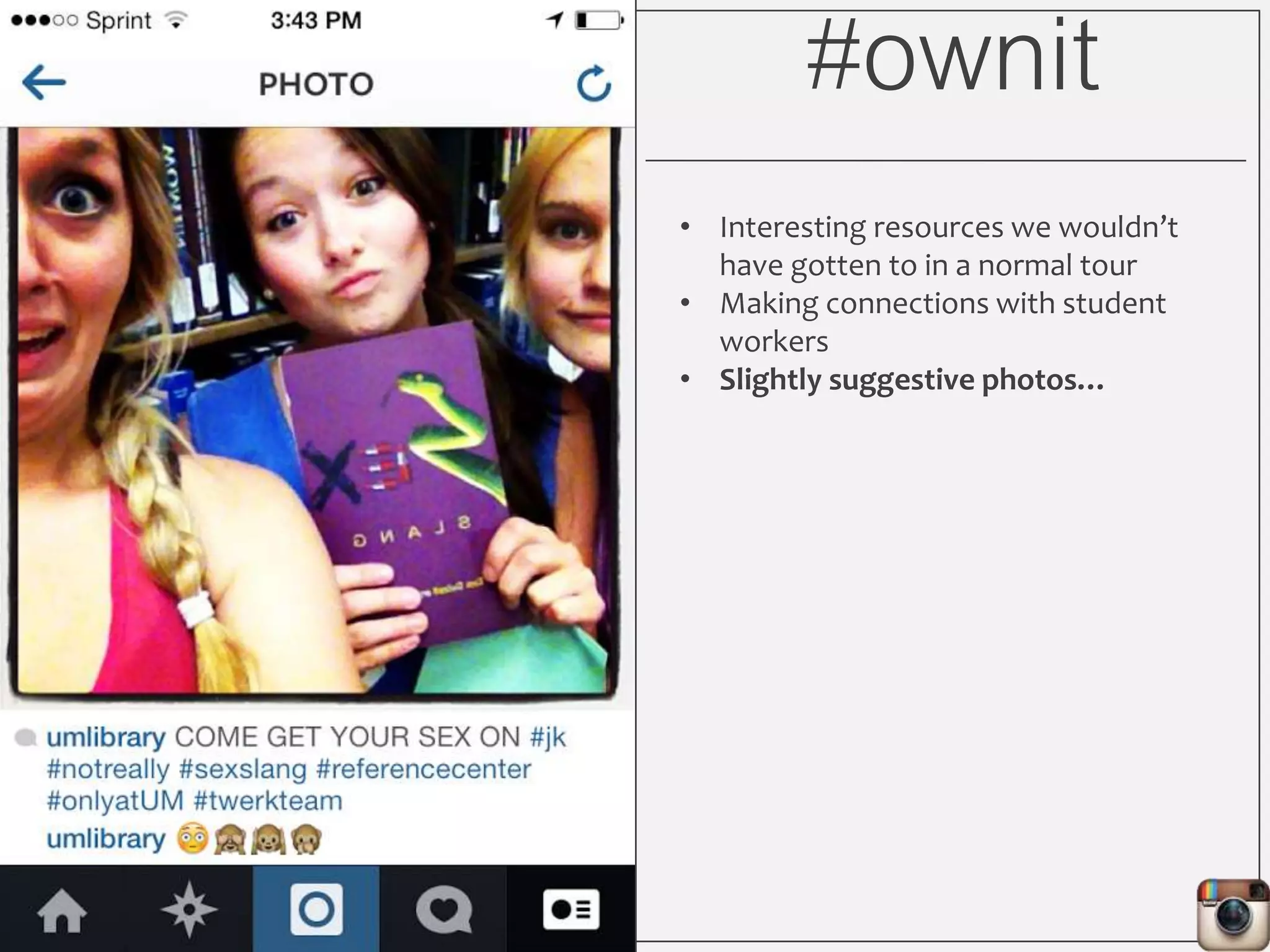
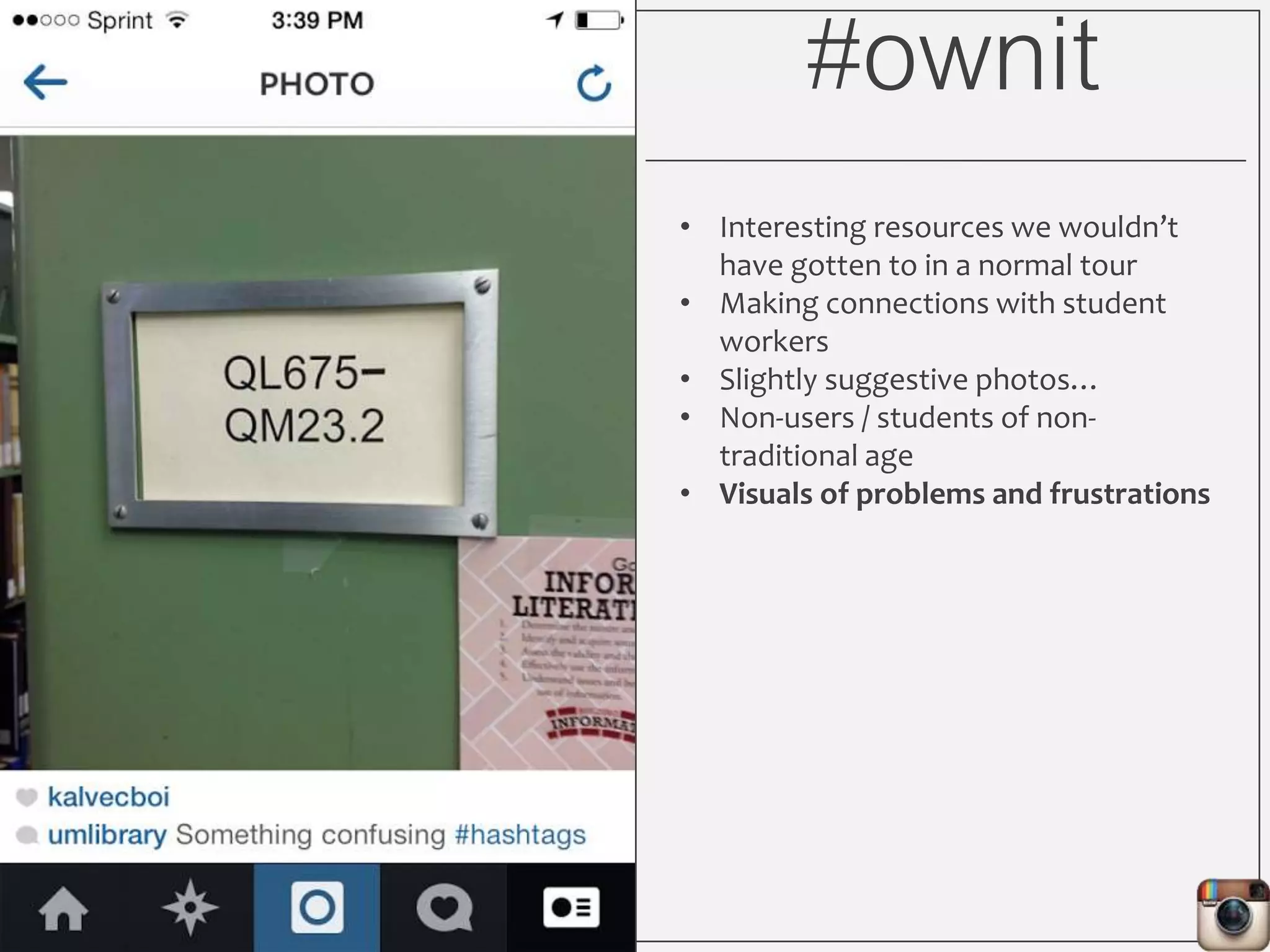
• Slightly suggestive photos…
#ownit
• Interesting resources we wouldn’t
have gotten to in a normal tour
• Making connections with student
workers
• Slightly suggestive photos…
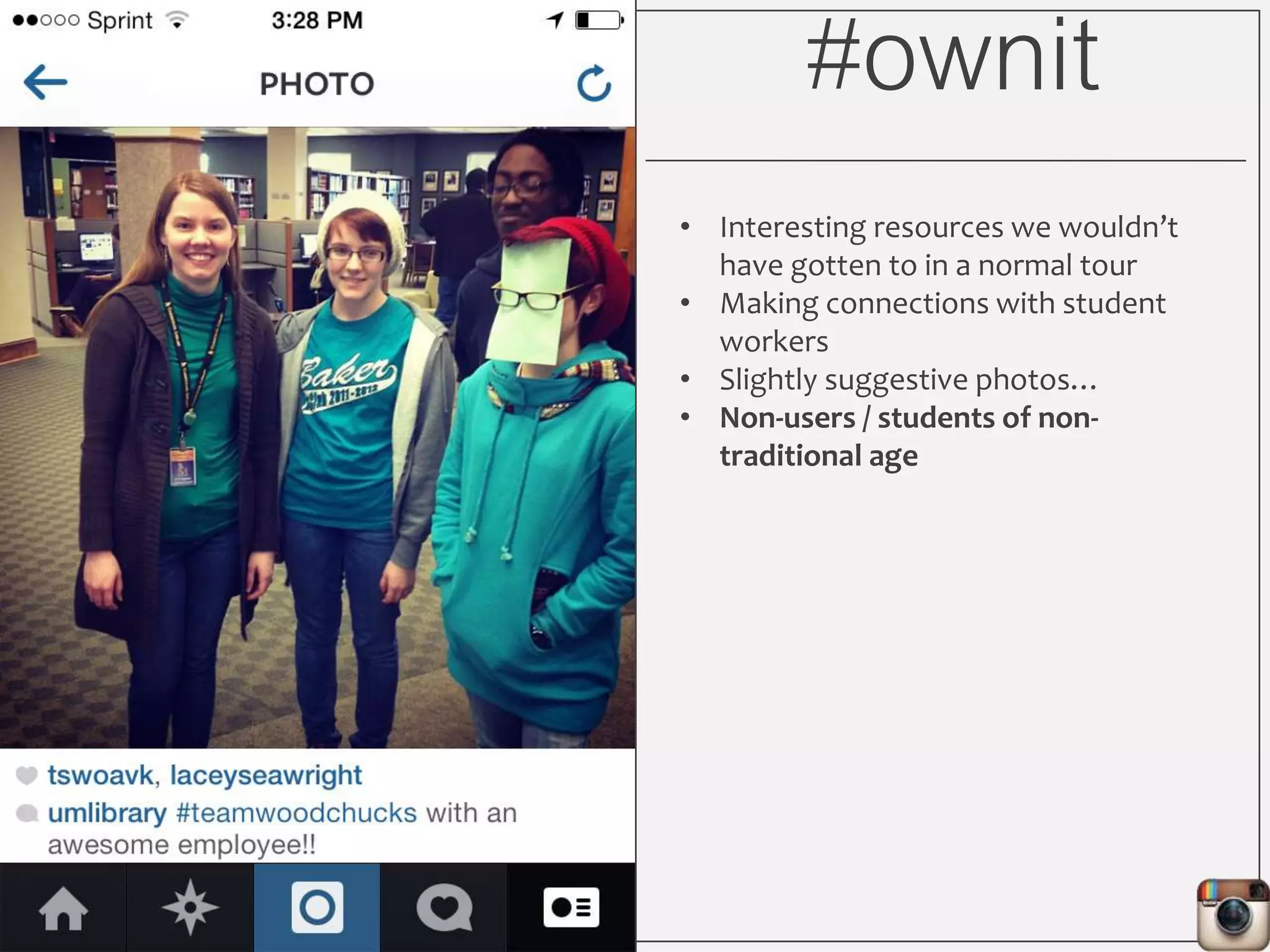
• Non-users / students of non-
traditional age
#ownit
• Interesting resources we wouldn’t
have gotten to in a normal tour
• Making connections with student
workers
• Slightly suggestive photos…
• Non-users / students of non-
traditional age
#ownit
• Interesting resources we wouldn’t
have gotten to in a normal tour
• Making connections with student
workers
• Slightly suggestive photos…
• Non-users / students of non-
traditional age
#ownit
• Interesting resources we wouldn’t
have gotten to in a normal tour
• Making connections with student
workers
• Slightly suggestive photos…
• Non-users / students of non-
traditional age
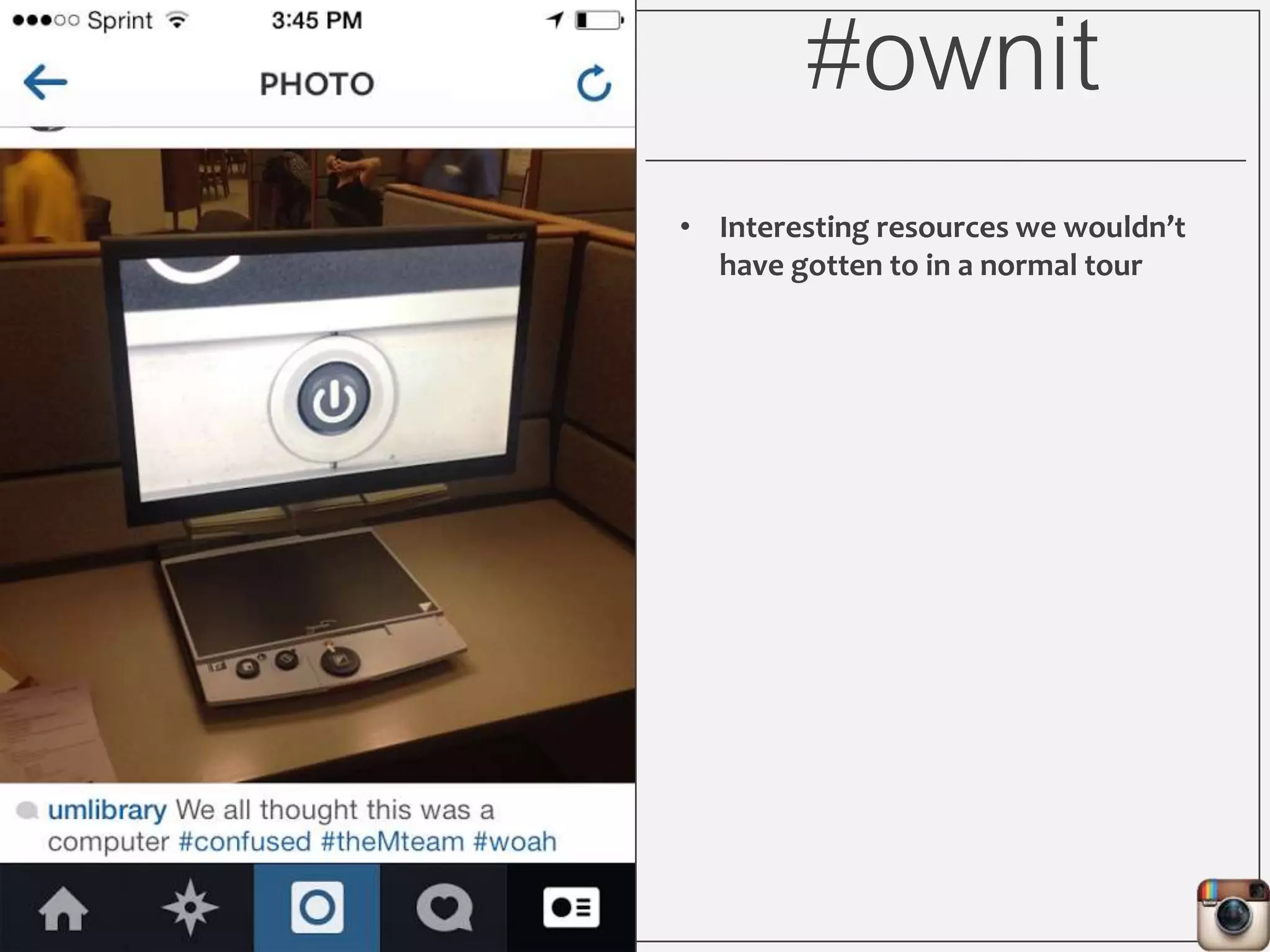
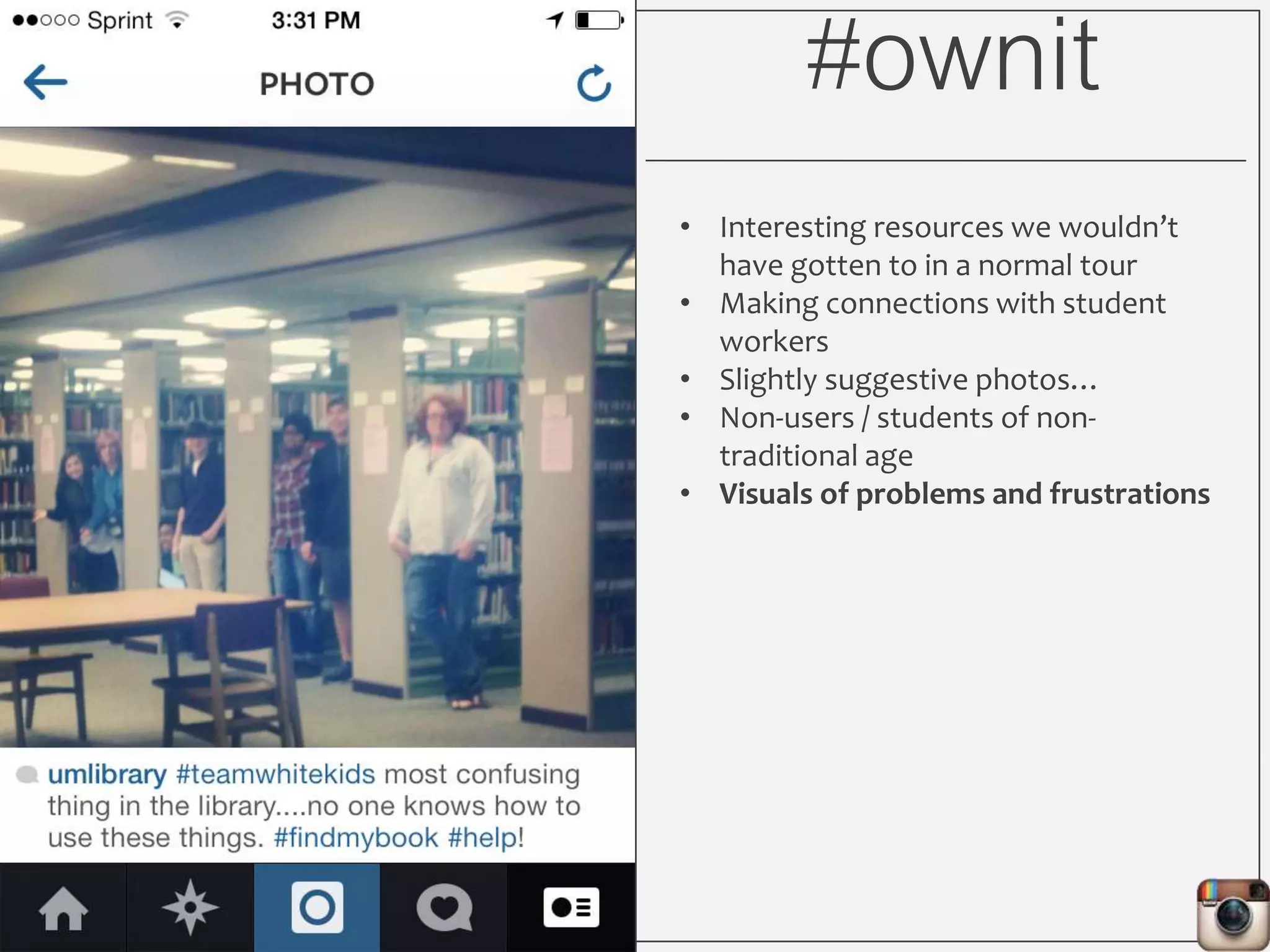
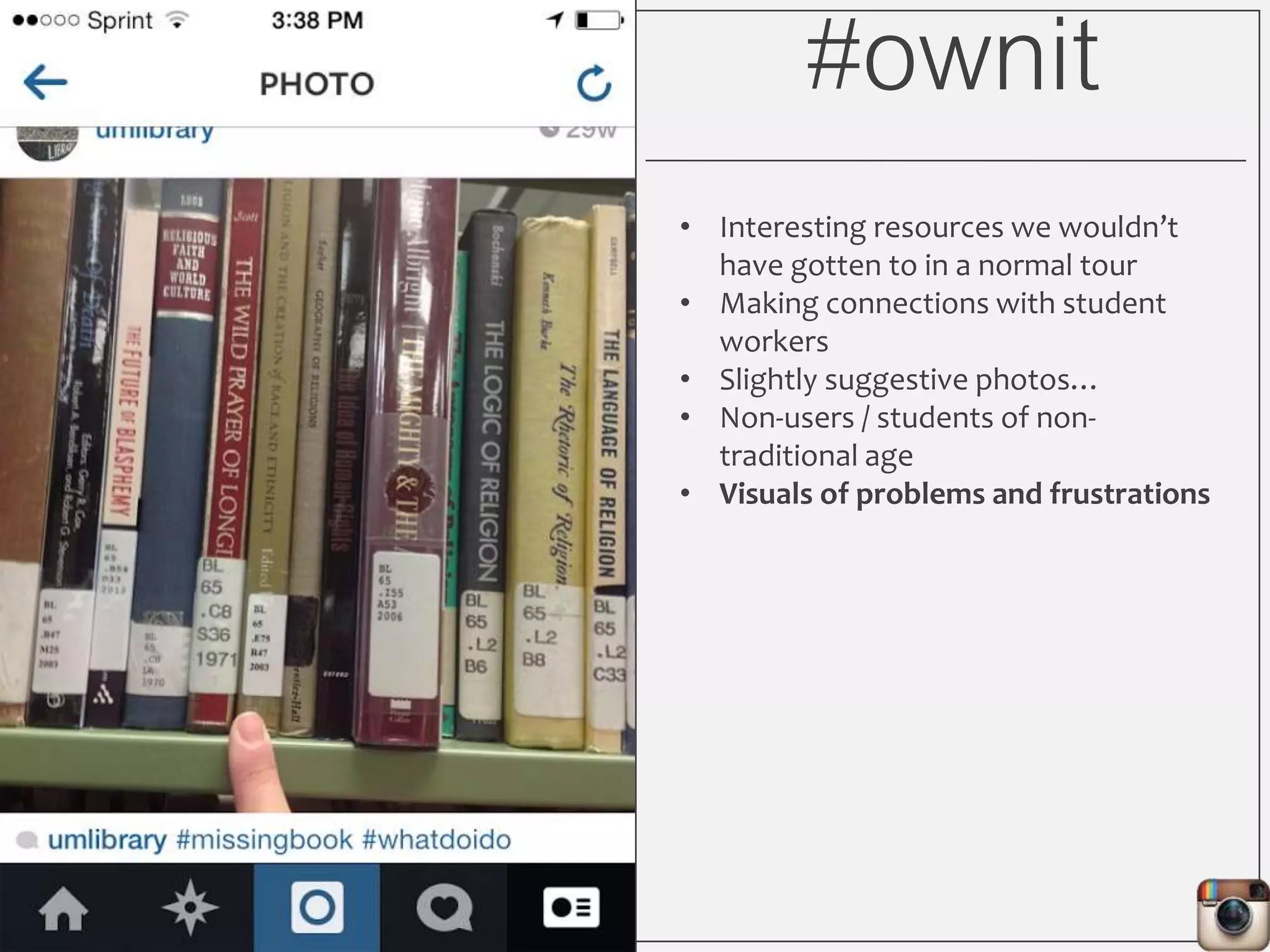
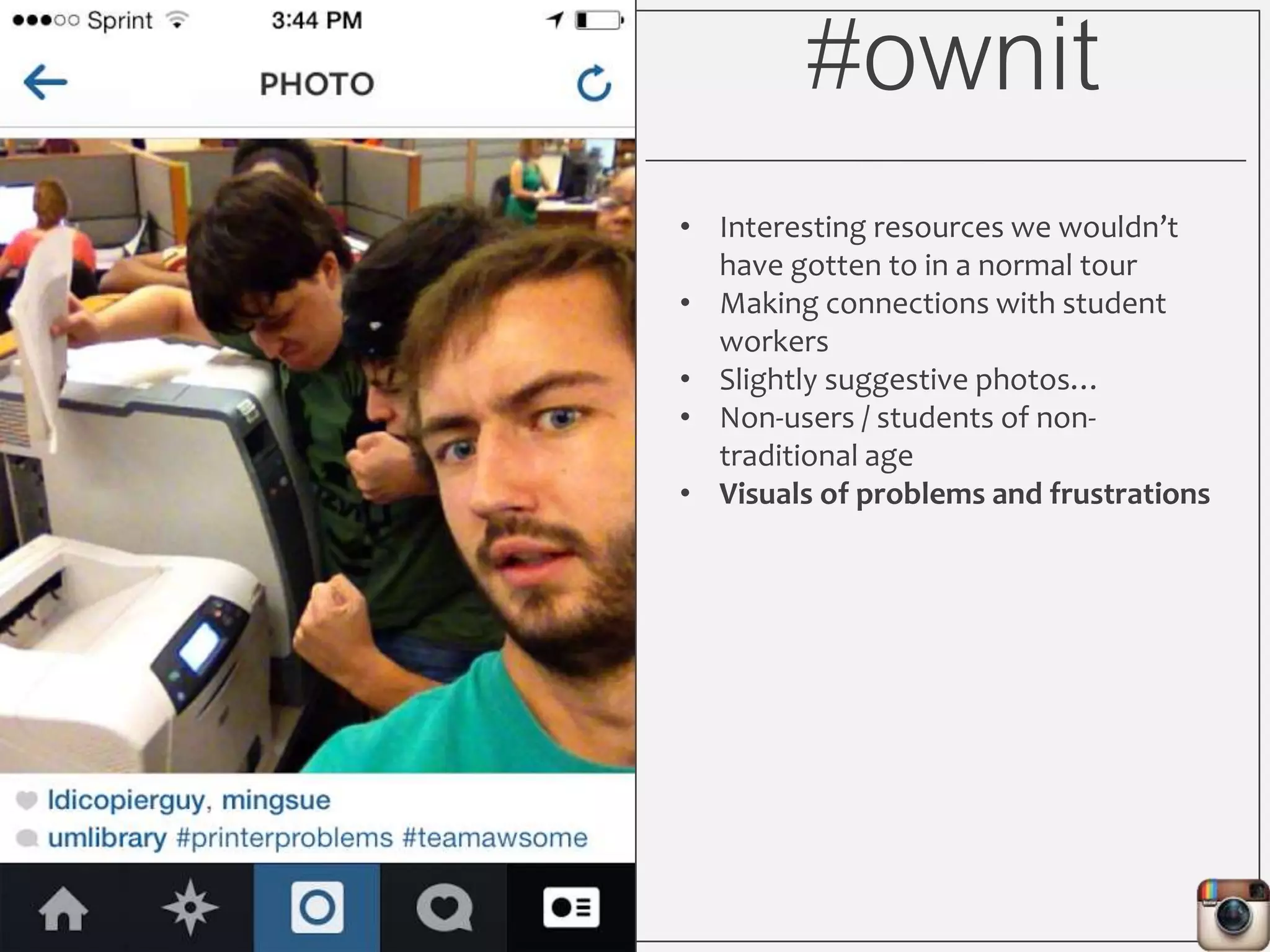
• Visuals of problems and frustrations
#ownit
• Interesting resources we wouldn’t
have gotten to in a normal tour
• Making connections with student
workers
• Slightly suggestive photos…
• Non-users / students of non-
traditional age
• Visuals of problems and frustrations
#ownit
• Interesting resources we wouldn’t
have gotten to in a normal tour
• Making connections with student
workers
• Slightly suggestive photos…
• Non-users / students of non-
traditional age
• Visuals of problems and frustrations
#ownit
• Interesting resources we wouldn’t
have gotten to in a normal tour
• Making connections with student
workers
• Slightly suggestive photos…
• Non-users / students of non-
traditional age
• Visuals of problems and frustrations
#ownit
• Interesting resources we wouldn’t
have gotten to in a normal tour
• Making connections with student
workers
• Slightly suggestive photos…
• Non-users / students of non-
traditional age
• Visuals of problems and frustrations
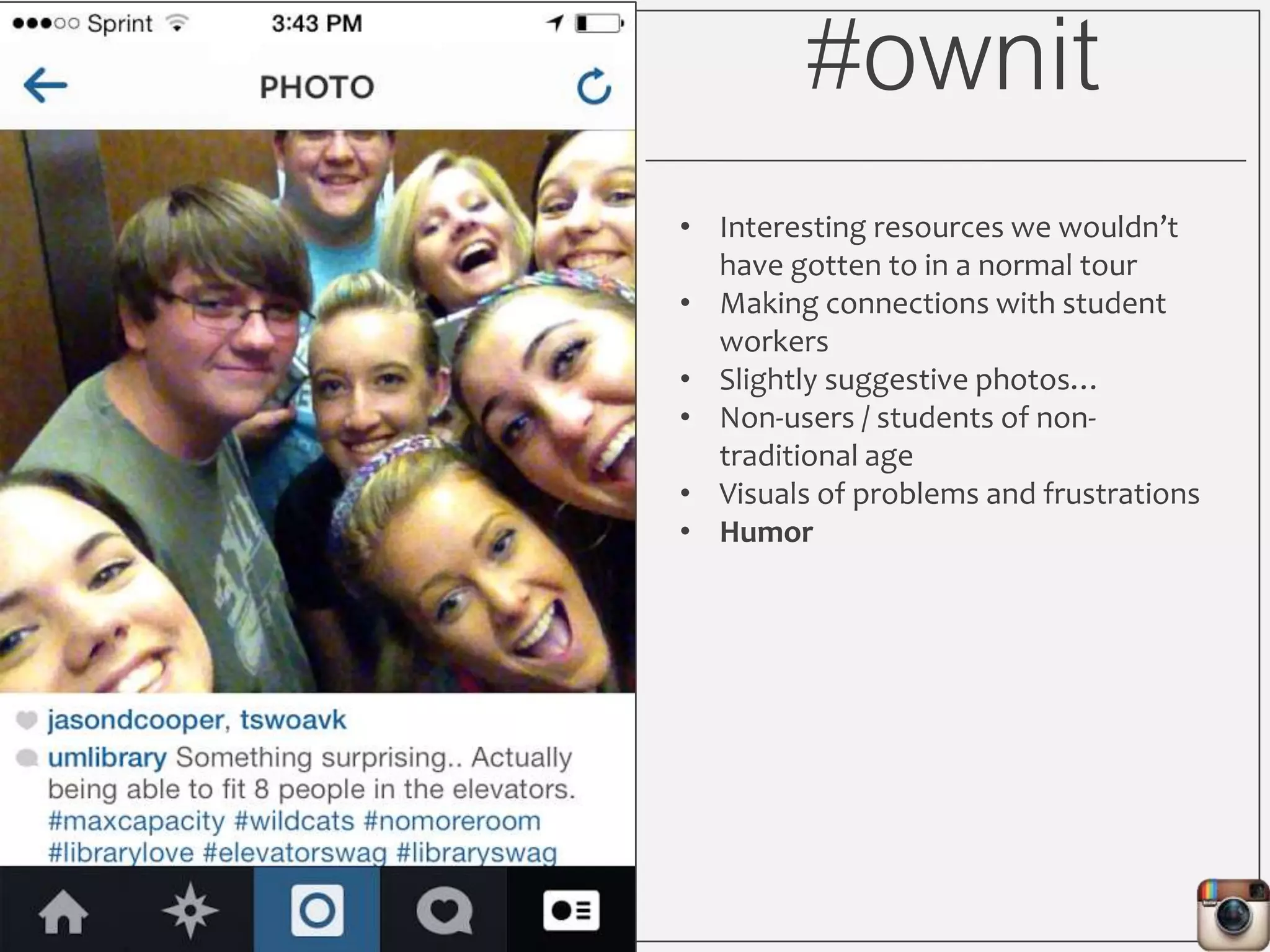
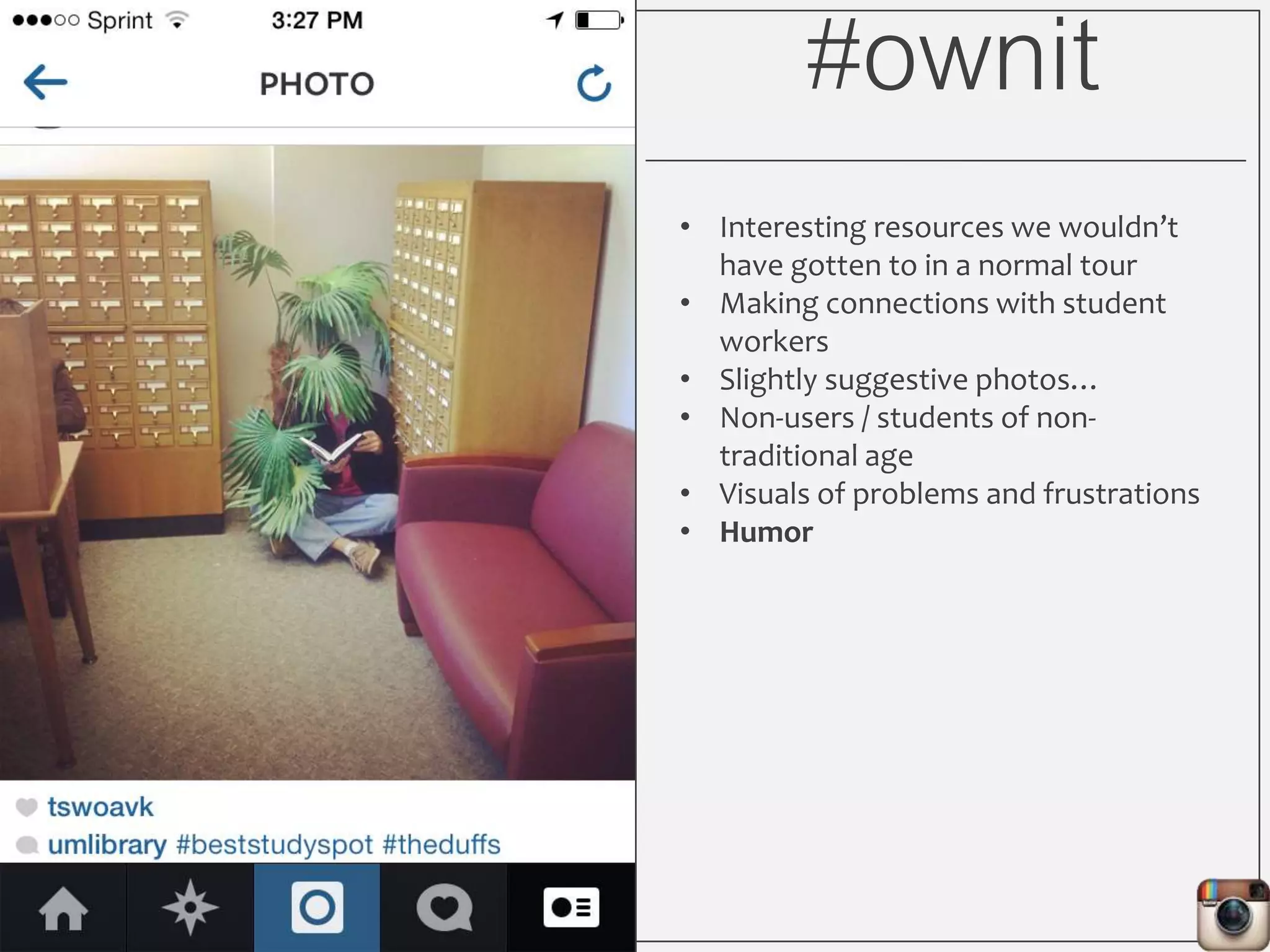
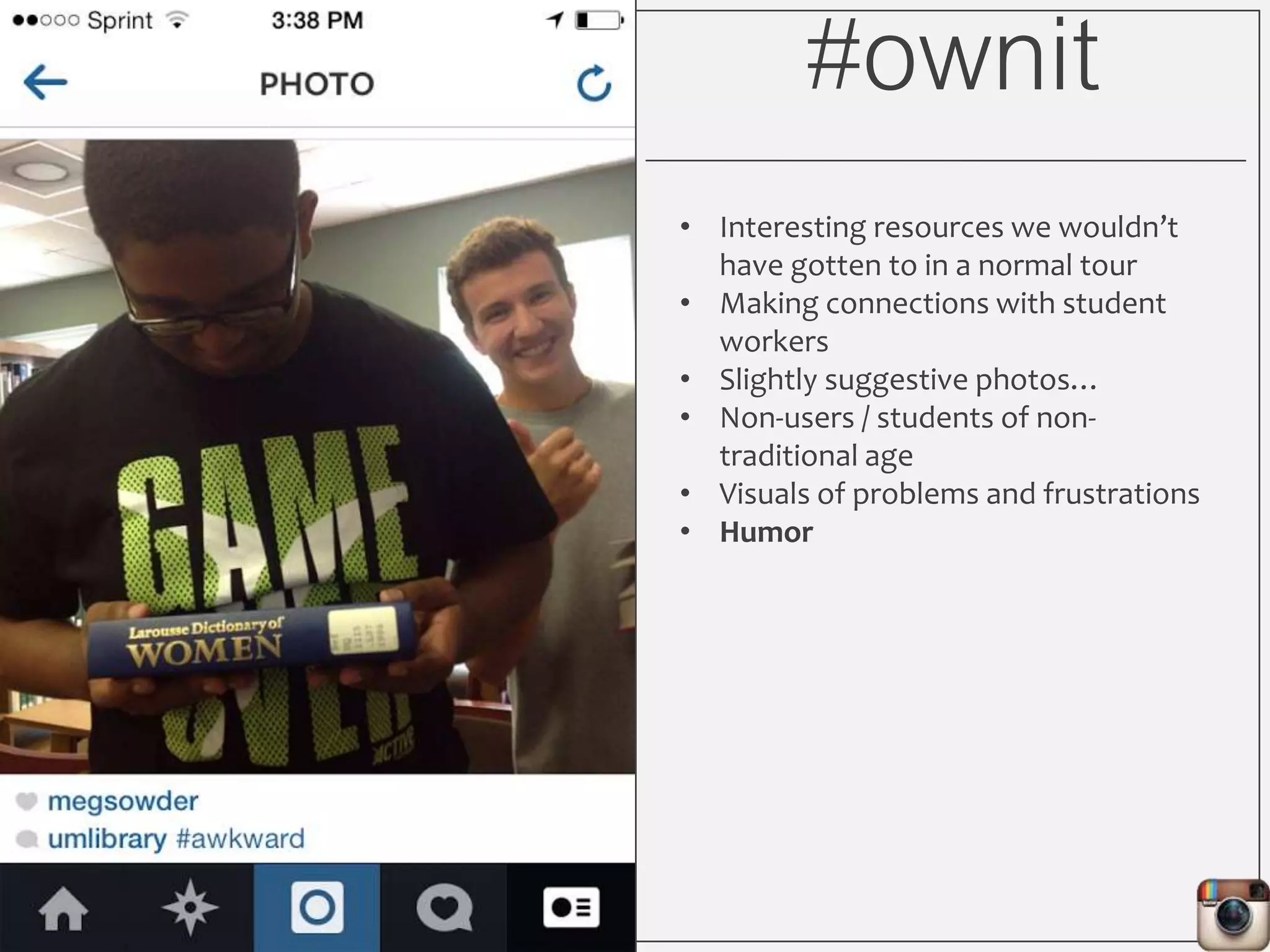
• Humor
#ownit
• Interesting resources we wouldn’t
have gotten to in a normal tour
• Making connections with student
workers
• Slightly suggestive photos…
• Non-users / students of non-
traditional age
• Visuals of problems and frustrations
• Humor
#ownit
• Interesting resources we wouldn’t
have gotten to in a normal tour
• Making connections with student
workers
• Slightly suggestive photos…
• Non-users / students of non-
traditional age
• Visuals of problems and frustrations
• Humor
#ownit
• Interesting resources we wouldn’t
have gotten to in a normal tour
• Making connections with student
workers
• Slightly suggestive photos…
• Non-users / students of non-
traditional age
• Visuals of problems and frustrations
• Humor
#assessment
• Google Form
• What is one new resource
you learned about today?
• “The chat thingy”
• “The computer search to
find a book”
• “There are so many people
that are willing to help!”
• “Where complete scores of
music are in the library.”
• “How to use Instagram at
school and not get in
trouble.”
#assessment
• What is something you still
have a question about?
• “I’m still confused about
how to print stuff, but I’m
sure the library staff will be
happy to help when the
time comes that I
desperately need to print
something.”
• “How the call number
system works.”
• “How to not be awkward in
the library.”
#workscited
Booth, C. (2011). Reflective teaching,
effective learning: Instructional literacy for
library educators. Chicago: American Library
Association.
Gibson, C., & Jacobson, T. (2014).
Framework for information literacy for
higher education. Retrieved from
http://acrl.ala.org/ilstandards/wp-
content/uploads/2014/02/Framework-for-IL-
for-HE-Draft-1-Part-1.pdf.
Harlan, M.A., Bruce, C., & Lupton, M. (2012).
Teen content creators: Experiences of using
information to learn. Library Trends, 60 (3),
569-587.
Jabobson, T.E., & Mackey, T.P. (2013).
Proposing a metaliteracy model to redefine
information literacy. Communications in
Information Literacy, 7(2), 84-91.
#workscited
Mackey, T. P., & Jacobson, T. E. (2011).
Reframing information literacy as a
metaliteracy. College & Research
Libraries, 72(1), 62-78.
Mellon, C. (1986). Library anxiety: A
grounded theory and its
development. College & Research
Libraries, 47(2), 160-165.
Seale, M. (2010). Information literacy
standards and the politics of knowledge
production: Using user-generated content to
incorporate critical pedagogy. In M.T.
Accardi, E. Drabinski, & A. Kumbier (Eds.),
Critical library instruction: Theories and
methods. (221-235). Duluth, MN: Library Juice
Press.
#contact
Lauren Wallis
Reference & Instruction Librarian
University of Montevallo
Presentation: tiny.cc/tilc2014
Email: lwallis@montevallo.edu
Instagram: instagram.com/lmwallis
Twitter: @LaurenMWallis
Blog: laurenwallis.wordpress.com

Library Instruction with Instagram

  • 1.
    #selfiesinthestacks Lauren Wallis Reference andInstruction Librarian University of Montevallo The Innovative Library Classroom May 13, 2014 Radford, VA tiny.cc/tilc2014 Library Instruction with Instagram
  • 2.
  • 3.
    #inspiration • Instructor requestsfor “Library Tour” • No common curriculum for Eng 101 • Few research-based assignments • Opportunity to reach most freshmen
  • 4.
    #inspiration Make an experiencethat is: • Fun • Social • Student-guided
  • 5.
    #inspiration Make an experiencethat is: • Fun • Social • Student-guided How it works: • Small groups • Library iPads and Instagram login • Brief intro and worksheet • Respond to open-ended questions • Post pictures, captions, and hashtags • End with brief class discussion • Make a connection between hashtags and controlled vocabulary
  • 6.
    #stats Pew Research : •17 percent of internet users use Instagram • 37 percent of internet users ages 18- 29 use Instagram • 54 percent of internet users have posted original photos or videos online Instagram Class Stats: • 15 out of 22 English 101 sections • 8 of the 15 sections visited more than once for instruction
  • 7.
    #concepts Library Anxiety • Perceivelibrary skills as inadequate • Embarrassed and feel like “the only one” • Avoid asking questions to avoid looking stupid (Mellon 1986)
  • 8.
    #concepts Active Learning and Constructivism •Link between learning and doing • Learning as a social process • Students integrate new ideas with preexisting values and experiences (Booth 2011)
  • 9.
    #concepts Critical Pedagogy and User-GeneratedContent • Sharing classroom power • Valuing student experiences • User-generated content as a way to engage IL skills (Seale 2010) • Teens learn IL skills through participatory online communities (Harlan, Bruce, and Lupton 2012)
  • 10.
    #concepts Information Literacy and SocialMedia Metaliteracy – Builds on core IL concepts to address how learners create and distribute information in participatory online environments. • Participating in conversations through comments and likes • Understanding the context of creation • Seeing oneself as a producer and consumer of info • Understanding privacy and access issues (Mackey and Jacobson 2011, 2013)
  • 11.
    #SLOs The student willbe able to: 1) Identify main library service points, basic resources, and staff 2) Recognize his/her existing knowledge about libraries 3) Show peers how to use library resources 4) Identify connections between social media hashtags and library controlled vocabulary
  • 12.
    #examples SLO 1: Thestudent will be able to identify main library service points, basic resources, and staff.
  • 13.
    #examples SLO 1: Thestudent will be able to identify main library service points, basic resources, and staff.
  • 14.
    #examples SLO 1: Thestudent will be able to identify main library service points, basic resources, and staff.
  • 15.
    #examples SLO 1: Thestudent will be able to identify main library service points, basic resources, and staff.
  • 16.
    #examples SLO 2: Thestudent will be able to recognize his/her existing knowledge about libraries.
  • 17.
    #examples SLO 3: Thestudent will be able to show peers how to use library resources
  • 18.
    #examples SLO 4: Thestudent will be able to identify connections between social media hashtags and library controlled vocabulary.
  • 19.
    #examples SLO 4: Thestudent will be able to identify connections between social media hashtags and library controlled vocabulary.
  • 20.
    #examples SLO 4: Thestudent will be able to identify connections between social media hashtags and library controlled vocabulary.
  • 21.
    #examples SLO 4: Thestudent will be able to identify connections between social media hashtags and library controlled vocabulary.
  • 24.
    #ownit • Interesting resourceswe wouldn’t have gotten to in a normal tour
  • 25.
    #ownit • Interesting resourceswe wouldn’t have gotten to in a normal tour
  • 26.
    #ownit • Interesting resourceswe wouldn’t have gotten to in a normal tour
  • 27.
    #ownit • Interesting resourceswe wouldn’t have gotten to in a normal tour • Making connections with student workers
  • 28.
    #ownit • Interesting resourceswe wouldn’t have gotten to in a normal tour • Making connections with student workers
  • 29.
    #ownit • Interesting resourceswe wouldn’t have gotten to in a normal tour • Making connections with student workers • Slightly suggestive photos…
  • 30.
    #ownit • Interesting resourceswe wouldn’t have gotten to in a normal tour • Making connections with student workers • Slightly suggestive photos… • Non-users / students of non- traditional age
  • 31.
    #ownit • Interesting resourceswe wouldn’t have gotten to in a normal tour • Making connections with student workers • Slightly suggestive photos… • Non-users / students of non- traditional age
  • 32.
    #ownit • Interesting resourceswe wouldn’t have gotten to in a normal tour • Making connections with student workers • Slightly suggestive photos… • Non-users / students of non- traditional age
  • 33.
    #ownit • Interesting resourceswe wouldn’t have gotten to in a normal tour • Making connections with student workers • Slightly suggestive photos… • Non-users / students of non- traditional age • Visuals of problems and frustrations
  • 34.
    #ownit • Interesting resourceswe wouldn’t have gotten to in a normal tour • Making connections with student workers • Slightly suggestive photos… • Non-users / students of non- traditional age • Visuals of problems and frustrations
  • 35.
    #ownit • Interesting resourceswe wouldn’t have gotten to in a normal tour • Making connections with student workers • Slightly suggestive photos… • Non-users / students of non- traditional age • Visuals of problems and frustrations
  • 36.
    #ownit • Interesting resourceswe wouldn’t have gotten to in a normal tour • Making connections with student workers • Slightly suggestive photos… • Non-users / students of non- traditional age • Visuals of problems and frustrations
  • 37.
    #ownit • Interesting resourceswe wouldn’t have gotten to in a normal tour • Making connections with student workers • Slightly suggestive photos… • Non-users / students of non- traditional age • Visuals of problems and frustrations • Humor
  • 38.
    #ownit • Interesting resourceswe wouldn’t have gotten to in a normal tour • Making connections with student workers • Slightly suggestive photos… • Non-users / students of non- traditional age • Visuals of problems and frustrations • Humor
  • 39.
    #ownit • Interesting resourceswe wouldn’t have gotten to in a normal tour • Making connections with student workers • Slightly suggestive photos… • Non-users / students of non- traditional age • Visuals of problems and frustrations • Humor
  • 40.
    #ownit • Interesting resourceswe wouldn’t have gotten to in a normal tour • Making connections with student workers • Slightly suggestive photos… • Non-users / students of non- traditional age • Visuals of problems and frustrations • Humor
  • 41.
    #assessment • Google Form •What is one new resource you learned about today? • “The chat thingy” • “The computer search to find a book” • “There are so many people that are willing to help!” • “Where complete scores of music are in the library.” • “How to use Instagram at school and not get in trouble.”
  • 42.
    #assessment • What issomething you still have a question about? • “I’m still confused about how to print stuff, but I’m sure the library staff will be happy to help when the time comes that I desperately need to print something.” • “How the call number system works.” • “How to not be awkward in the library.”
  • 43.
    #workscited Booth, C. (2011).Reflective teaching, effective learning: Instructional literacy for library educators. Chicago: American Library Association. Gibson, C., & Jacobson, T. (2014). Framework for information literacy for higher education. Retrieved from http://acrl.ala.org/ilstandards/wp- content/uploads/2014/02/Framework-for-IL- for-HE-Draft-1-Part-1.pdf. Harlan, M.A., Bruce, C., & Lupton, M. (2012). Teen content creators: Experiences of using information to learn. Library Trends, 60 (3), 569-587. Jabobson, T.E., & Mackey, T.P. (2013). Proposing a metaliteracy model to redefine information literacy. Communications in Information Literacy, 7(2), 84-91.
  • 44.
    #workscited Mackey, T. P.,& Jacobson, T. E. (2011). Reframing information literacy as a metaliteracy. College & Research Libraries, 72(1), 62-78. Mellon, C. (1986). Library anxiety: A grounded theory and its development. College & Research Libraries, 47(2), 160-165. Seale, M. (2010). Information literacy standards and the politics of knowledge production: Using user-generated content to incorporate critical pedagogy. In M.T. Accardi, E. Drabinski, & A. Kumbier (Eds.), Critical library instruction: Theories and methods. (221-235). Duluth, MN: Library Juice Press.
  • 45.
    #contact Lauren Wallis Reference &Instruction Librarian University of Montevallo Presentation: tiny.cc/tilc2014 Email: lwallis@montevallo.edu Instagram: instagram.com/lmwallis Twitter: @LaurenMWallis Blog: laurenwallis.wordpress.com