Library 2.0 Vision and Trends In the Campus Library
Web 2.0 Builds from 2 nd  generation web based services or Web 2.0 Blogs, wikis, social networking, folksonomy (del.icio.us, connotea) Collaborative, interactive, constantly changing
Library 2.0 Definitions Usability, interoperability, flexibility Community building – online and physical Outreach via blogs, wikis, etc User participation More transparent More human, ubiquitous and user centered
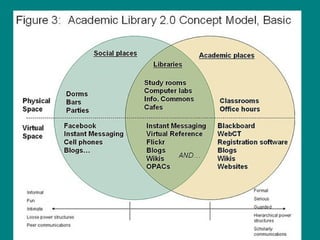
Academic Library 2.0 Model
The Campus Library My emphasis is on the social and academic interface in the physical structure of the library And called the “Learning Commons” “ The library of the future will need to become a true learning center…where information-technology resources are centrally…integrated to further student learning and to facilitate faculty and staff transformation. A transformed library will constitute both the symbolic and concrete heart of a learning-centered campus.” My take on this ----
Library as Learning Commons Create an interdisciplinary environment  combining social interaction with expanded learning opportunities and added value services: CAP, Tutoring and Testing New Ventures to create a fun and interesting learning environment Rotunda Art Gallery Scholar in Residence Word Cafes – Note: Word Café 10 is May 8th Writing workshops Is the learning commons part of L2.0?
Vision The Community College Library, the learning commons, will be a welcoming learning space on campus: A lively, student-centered space for advancing social interactions and dialogue with all types of learning and the world of information A helpful place for students to come to enhance their knowledge with librarians who assist them in finding, locating and evaluating information resources An intellectual center ensuring equitable access: to quality, cost-effective resources in a variety of formats, to technology and to services that students need  A collaborative space for students, faculty and librarians fostering self-sufficiency and lifelong learning in research and academic competencies across the disciplines  A comfortable campus space for individual and group work as well as for quiet study in a cultural/educational environment  (OCCLA May 2005)

Library 2dot0final

  • 1.
    Library 2.0 Visionand Trends In the Campus Library
  • 2.
    Web 2.0 Buildsfrom 2 nd generation web based services or Web 2.0 Blogs, wikis, social networking, folksonomy (del.icio.us, connotea) Collaborative, interactive, constantly changing
  • 3.
    Library 2.0 DefinitionsUsability, interoperability, flexibility Community building – online and physical Outreach via blogs, wikis, etc User participation More transparent More human, ubiquitous and user centered
  • 4.
  • 5.
    The Campus LibraryMy emphasis is on the social and academic interface in the physical structure of the library And called the “Learning Commons” “ The library of the future will need to become a true learning center…where information-technology resources are centrally…integrated to further student learning and to facilitate faculty and staff transformation. A transformed library will constitute both the symbolic and concrete heart of a learning-centered campus.” My take on this ----
  • 6.
    Library as LearningCommons Create an interdisciplinary environment combining social interaction with expanded learning opportunities and added value services: CAP, Tutoring and Testing New Ventures to create a fun and interesting learning environment Rotunda Art Gallery Scholar in Residence Word Cafes – Note: Word Café 10 is May 8th Writing workshops Is the learning commons part of L2.0?
  • 7.
    Vision The CommunityCollege Library, the learning commons, will be a welcoming learning space on campus: A lively, student-centered space for advancing social interactions and dialogue with all types of learning and the world of information A helpful place for students to come to enhance their knowledge with librarians who assist them in finding, locating and evaluating information resources An intellectual center ensuring equitable access: to quality, cost-effective resources in a variety of formats, to technology and to services that students need A collaborative space for students, faculty and librarians fostering self-sufficiency and lifelong learning in research and academic competencies across the disciplines A comfortable campus space for individual and group work as well as for quiet study in a cultural/educational environment (OCCLA May 2005)

Editor's Notes

  • #3 Think of mashups, open source software.
  • #4 One recent paper by a key library tecnologist gave 7 definitions and 62 views of what Library 2.0 is. Rather than bringing clarity to this concept he claimed his own paper was “confusing, ragged, and overlong.” So these concepts are vague at best and everyone has his or her own interpretation of the meaning of Web 2.0 and Library 2.0. My own emphasis will be on a very limited part of what I think the Library 2.0 is and what we at COCC are striving for.
  • #5 From a Master’s Thesis by Michael Habib. My focus: The relationship of Social and Academic places in Libraries My interest is in the top ½ of the graph, Cat and Tina will talk more about the bottom ½ Note the term “Information Commons” which in short means that libraries supply workstations and support for discovery to production, thus assiting in the complete learning cycle for students.
  • #6 Guskin and Marcy in “Dealing with the Future Now” Change July/August 2003. Here we see the relationship between the library as a learning commons and the mission of the college as learning-centered campus.
  • #7 I think so and there is a formally agreed upon vision for the CC Libraries of Oregon which I helped draft in 2005.
  • #8 On to the technology parts of what L2.0 is about with Tina.