

Anders Karlsson Principal Sales Engineer, MySQL MySQL Embedded - Getting started with libmysqld
Agenda Who am I? (Good question!) Why libmysqld? What is libmysqld? What is MySQL Emmbedded? And is it different from libmysqld? Programming with libmysqld API, Samples etc. Limitations of libmysqld Questions? Answers?
About Anders Karlsson Sales Engineer with Sun / MySQL for 5+ years I have been in the RDBMS business for 20+ years I have worked for many of the major vendors and with most of the vendor products I’ve been in roles as Sales Engineer Consultant Porting engineer Support engineer Etc. Outside MySQL I build websites (www.papablues.com), develop Open Source software (MyQuery, ndbtop etc), am a keen photographer and drives sub-standard cars, among other things. Also, I am pushing for ZFS to become GPL:  http://www.makezfsgpl.com
Why libmysqld? Libmysqld is compact and fast Libmysqld is easily integrated into an application Application installation is MUCH easier No separate server to install or run No need to run as service or daemon Low hardware requirements Zero maintenance MySQL hidden from end user
And why NOT libmysqld? Only ONE application can connect at the time! No server means less flexibility Application itself has larger footprint Includes both the server and the application Certain limitations exist No  Replication No  Client / Server connection No  authentication / security More functions must be implemented in the application Any mysql Client operations such as dump, restore, check etc.
What is libmysqld and why is it different? “ Normal” MySQL is a classic client/server based RDBMS The database server is a separate process from the client application The client and the sever communicates using standard networking (typically sockets or TCP/IP) The Server may, and again may not, run in a separate hardware environment  from the client The client talks to the server using a MySQL defined protocol, typically implemented in a client interface or “driver” or Connector
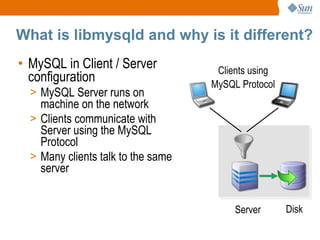
What is libmysqld and why is it different? MySQL in Client / Server configuration MySQL Server runs on machine on the network Clients communicate with Server using the MySQL Protocol Many clients talk to the same server Clients using MySQL Protocol Server Disk
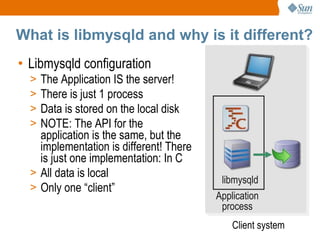
What is libmysqld and why is it different? Libmysqld is a SQL database layer tightly integrated with the application or “client” The database and the application runs in the same process space No special means of communication is needed as both the application and the database are in the same process, calling MySQL is similar to calling any other library function The interface between the Application or client is different, but the exposed component, the API, is the same as with Client / Server MySQL Although the API looks the same, the implementation is different!
What is libmysqld and why is it different? Libmysqld configuration The Application IS the server! There is just 1 process Data is stored on the local disk NOTE: The API for the application is the same, but the implementation is different! There is just one implementation: In C All data is local Only one “client” Application process libmysqld Client system
So where do I find libmysqld? Libmysqld is part of the usual MySQL distribution Just download the MySQL Server and you find On Windows : libmysqld is in the Embedded subdirectory, both debug and release versions are available, and in DLL and static builds On Linux : libmysqld.a is in the lib subdirectory where MySQL is installed Includefiles: Use the normal MySQL C API includefiles
Building libmysqld applications Develop applications in C Add calls to mysql_library_init() etc. Compile as usual Link with libmysqld Can be linked dynamically or statically A dynamic link is easier, just as a dynamic link with the MySQL C Client library is easier Set up an option file Ship application, possibly the libmysqld shared library and option file
The libmysqld API VERY similar to the MySQL C API Does NOT implement the MySQL Protocol! Only looks the same, implementation is different! Key functions that are different mysql_library_init() – Starts the internal “MySQL Server” mysql_library_end() – Shuts down the internal “MySQL Server” gracefully mysql_thread_init() / mysql_thread_end() mysql_options() – Set MYSQL_OPT_USE_EMBEDDED_CONNECTION before connecting
The mysql_library_init() function Initializes the MySQL internal server Passes parameters to the server in that process Must  be passed information on initialization files and sections in those No server is already running! This means all necessary server parameters needs to be specified! This means that this call is mostly different from when NOT using libmysqld! MUST  be called before mysql_init()!
The mysql_library_init() parameters Argument count (argc) Arguments (argv) – Like the parameters to mysqld, the first argument (as in argv[0] beging name of the program) being ignored. A list of option file sections to read If a -- defaults-file  or any other argument with an option file is passed, the config files section specifies whicg sections in this file to read The last section name is NULL If no option file is passed, this argument may be NULL.
static char *server_options[] = { "mysql_test", "--datadir=C:/mydata", NULL}; static char *server_groups[] = { "libmysqld_server", NULL}; int main(argc, argv) { MYSQL mysql; mysql_library_init(sizeof(server_options)/  sizeof(char *) – 1, server_options, (char  **) server_gropus); mysql = mysql_init(NULL); mysql_options(mysql,   MYSQL_OPT_USE_EMBEDDED_CONNECTION, NULL); mysql_real_connect(mysql, NULL, NULL, NULL,   "test", 0, NULL, 0); Initializing a libmysqld application
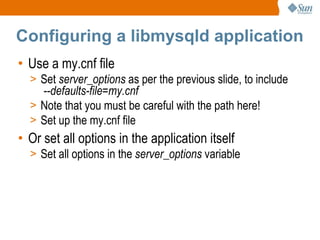
Configuring a libmysqld application Use a my.cnf file Set  server_options  as per the previous slide, to include   --defaults-file=my.cnf   Note that you must be careful with the path here! Set up the my.cnf file Or set all options in the application itself Set all options in the  server_options  variable
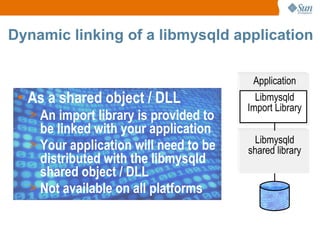
Dynamic linking of a libmysqld application As a shared object / DLL An import library is provided to be linked with your application Your application will need to be distributed with the libmysqld shared object / DLL Not available on all platforms Application Libmysqld Import Library Libmysqld shared library
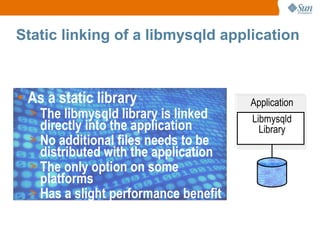
Static linking of a libmysqld application As a static library The libmysqld library is linked directly into the application No additional files needs to be distributed with the application The only option on some platforms Has a slight performance benefit Application Libmysqld Library
Linking a libmysqld application Note that dynamic linking does NOT necessarily allow you to update libmysqld by just changing the DLL / Shared object Typically, an application linked with MySQL version X needs libmysqld version X, even with dynamic linking For Windows, I recommed dynamic linking Windows static linking is complex, as the static library depends on a particular version of Visual C++ is used For Linux, I recommend static linking Not the least because that is the only option right now. But it is less problematic than on windows, and has a slight performance advantage
Managing libmysqld data Data format are the same for libmysqld as it is for the MySQL Server mysqld Hence: Data that can be freely copied with mysqld can be freely copied with libmysqld This relates to most storage engines, but in some cases with limitations MyISAM may use compression (which is common) and other MyISAM variations Starting a libmysqld application with InnoDB enabled (not using  --skip-innodb ) will create InnoDB data and transaction log files, as usual
Managing libmysqld data Offline tools for mysqld data may be used on libmysqld data myisampack myisamchk etc Online tools need to be implemented as part of the application mysqldump mysqlshow etc.
Libmysqld demo! The following demo application is available On sourceforge: http://sourceforge.net/projects/libmysqlddemo/ On MySQL Forge: http://forge.mysql.com/projects/project.php?id=323 The application is Windows dialog-based and written in C using the Win32 API Should be self contained, except for libmysqld of course, and the language file
Limitations of libmysqld No replication No events InnoDB is single threaded No authentication / authorization Single application access But that is the whole point of libmysqld Only C / C++
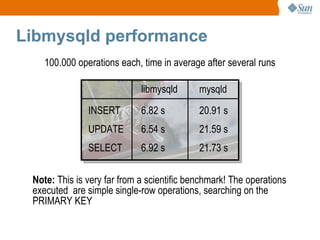
Libmysqld performance 100.000 operations each, time in average after several runs Note:  This is very far from a scientific benchmark! The operations executed  are simple single-row operations, searching on the PRIMARY KEY INSERT UPDATE SELECT libmysqld mysqld 6.82 s 6.54 s 6.92 s 20.91 s 21.59 s 21.73 s
Libmysqld performance So does this mean that libmysqld is faster than mysqld? No, it means that libmysqld has less overhead, that performance is better is a side-effect of that So why is this useful data then As it means that I need less OS and Hardware resources to achieve the same level of performance!
Resources and contacts Email me at: [email_address] Read my blog at: http://karlssonondatabases.blogspot.com/ MySQL Forum for Embedded systems: http://forums.mysql.com/list.php?58 Contribute to the community with samples and ideas, we need more of those for libmysqld http://forge.mysql.com
Questions? [email_address]

Libmysqld Introduction

  • 1.
    Anders Karlsson PrincipalSales Engineer, MySQL MySQL Embedded - Getting started with libmysqld
  • 2.
    Agenda Who amI? (Good question!) Why libmysqld? What is libmysqld? What is MySQL Emmbedded? And is it different from libmysqld? Programming with libmysqld API, Samples etc. Limitations of libmysqld Questions? Answers?
  • 3.
    About Anders KarlssonSales Engineer with Sun / MySQL for 5+ years I have been in the RDBMS business for 20+ years I have worked for many of the major vendors and with most of the vendor products I’ve been in roles as Sales Engineer Consultant Porting engineer Support engineer Etc. Outside MySQL I build websites (www.papablues.com), develop Open Source software (MyQuery, ndbtop etc), am a keen photographer and drives sub-standard cars, among other things. Also, I am pushing for ZFS to become GPL: http://www.makezfsgpl.com
  • 4.
    Why libmysqld? Libmysqldis compact and fast Libmysqld is easily integrated into an application Application installation is MUCH easier No separate server to install or run No need to run as service or daemon Low hardware requirements Zero maintenance MySQL hidden from end user
  • 5.
    And why NOTlibmysqld? Only ONE application can connect at the time! No server means less flexibility Application itself has larger footprint Includes both the server and the application Certain limitations exist No Replication No Client / Server connection No authentication / security More functions must be implemented in the application Any mysql Client operations such as dump, restore, check etc.
  • 6.
    What is libmysqldand why is it different? “ Normal” MySQL is a classic client/server based RDBMS The database server is a separate process from the client application The client and the sever communicates using standard networking (typically sockets or TCP/IP) The Server may, and again may not, run in a separate hardware environment from the client The client talks to the server using a MySQL defined protocol, typically implemented in a client interface or “driver” or Connector
  • 7.
    What is libmysqldand why is it different? MySQL in Client / Server configuration MySQL Server runs on machine on the network Clients communicate with Server using the MySQL Protocol Many clients talk to the same server Clients using MySQL Protocol Server Disk
  • 8.
    What is libmysqldand why is it different? Libmysqld is a SQL database layer tightly integrated with the application or “client” The database and the application runs in the same process space No special means of communication is needed as both the application and the database are in the same process, calling MySQL is similar to calling any other library function The interface between the Application or client is different, but the exposed component, the API, is the same as with Client / Server MySQL Although the API looks the same, the implementation is different!
  • 9.
    What is libmysqldand why is it different? Libmysqld configuration The Application IS the server! There is just 1 process Data is stored on the local disk NOTE: The API for the application is the same, but the implementation is different! There is just one implementation: In C All data is local Only one “client” Application process libmysqld Client system
  • 10.
    So where doI find libmysqld? Libmysqld is part of the usual MySQL distribution Just download the MySQL Server and you find On Windows : libmysqld is in the Embedded subdirectory, both debug and release versions are available, and in DLL and static builds On Linux : libmysqld.a is in the lib subdirectory where MySQL is installed Includefiles: Use the normal MySQL C API includefiles
  • 11.
    Building libmysqld applicationsDevelop applications in C Add calls to mysql_library_init() etc. Compile as usual Link with libmysqld Can be linked dynamically or statically A dynamic link is easier, just as a dynamic link with the MySQL C Client library is easier Set up an option file Ship application, possibly the libmysqld shared library and option file
  • 12.
    The libmysqld APIVERY similar to the MySQL C API Does NOT implement the MySQL Protocol! Only looks the same, implementation is different! Key functions that are different mysql_library_init() – Starts the internal “MySQL Server” mysql_library_end() – Shuts down the internal “MySQL Server” gracefully mysql_thread_init() / mysql_thread_end() mysql_options() – Set MYSQL_OPT_USE_EMBEDDED_CONNECTION before connecting
  • 13.
    The mysql_library_init() functionInitializes the MySQL internal server Passes parameters to the server in that process Must be passed information on initialization files and sections in those No server is already running! This means all necessary server parameters needs to be specified! This means that this call is mostly different from when NOT using libmysqld! MUST be called before mysql_init()!
  • 14.
    The mysql_library_init() parametersArgument count (argc) Arguments (argv) – Like the parameters to mysqld, the first argument (as in argv[0] beging name of the program) being ignored. A list of option file sections to read If a -- defaults-file or any other argument with an option file is passed, the config files section specifies whicg sections in this file to read The last section name is NULL If no option file is passed, this argument may be NULL.
  • 15.
    static char *server_options[]= { "mysql_test", "--datadir=C:/mydata", NULL}; static char *server_groups[] = { "libmysqld_server", NULL}; int main(argc, argv) { MYSQL mysql; mysql_library_init(sizeof(server_options)/ sizeof(char *) – 1, server_options, (char **) server_gropus); mysql = mysql_init(NULL); mysql_options(mysql, MYSQL_OPT_USE_EMBEDDED_CONNECTION, NULL); mysql_real_connect(mysql, NULL, NULL, NULL, "test", 0, NULL, 0); Initializing a libmysqld application
  • 16.
    Configuring a libmysqldapplication Use a my.cnf file Set server_options as per the previous slide, to include --defaults-file=my.cnf Note that you must be careful with the path here! Set up the my.cnf file Or set all options in the application itself Set all options in the server_options variable
  • 17.
    Dynamic linking ofa libmysqld application As a shared object / DLL An import library is provided to be linked with your application Your application will need to be distributed with the libmysqld shared object / DLL Not available on all platforms Application Libmysqld Import Library Libmysqld shared library
  • 18.
    Static linking ofa libmysqld application As a static library The libmysqld library is linked directly into the application No additional files needs to be distributed with the application The only option on some platforms Has a slight performance benefit Application Libmysqld Library
  • 19.
    Linking a libmysqldapplication Note that dynamic linking does NOT necessarily allow you to update libmysqld by just changing the DLL / Shared object Typically, an application linked with MySQL version X needs libmysqld version X, even with dynamic linking For Windows, I recommed dynamic linking Windows static linking is complex, as the static library depends on a particular version of Visual C++ is used For Linux, I recommend static linking Not the least because that is the only option right now. But it is less problematic than on windows, and has a slight performance advantage
  • 20.
    Managing libmysqld dataData format are the same for libmysqld as it is for the MySQL Server mysqld Hence: Data that can be freely copied with mysqld can be freely copied with libmysqld This relates to most storage engines, but in some cases with limitations MyISAM may use compression (which is common) and other MyISAM variations Starting a libmysqld application with InnoDB enabled (not using --skip-innodb ) will create InnoDB data and transaction log files, as usual
  • 21.
    Managing libmysqld dataOffline tools for mysqld data may be used on libmysqld data myisampack myisamchk etc Online tools need to be implemented as part of the application mysqldump mysqlshow etc.
  • 22.
    Libmysqld demo! Thefollowing demo application is available On sourceforge: http://sourceforge.net/projects/libmysqlddemo/ On MySQL Forge: http://forge.mysql.com/projects/project.php?id=323 The application is Windows dialog-based and written in C using the Win32 API Should be self contained, except for libmysqld of course, and the language file
  • 23.
    Limitations of libmysqldNo replication No events InnoDB is single threaded No authentication / authorization Single application access But that is the whole point of libmysqld Only C / C++
  • 24.
    Libmysqld performance 100.000operations each, time in average after several runs Note: This is very far from a scientific benchmark! The operations executed are simple single-row operations, searching on the PRIMARY KEY INSERT UPDATE SELECT libmysqld mysqld 6.82 s 6.54 s 6.92 s 20.91 s 21.59 s 21.73 s
  • 25.
    Libmysqld performance Sodoes this mean that libmysqld is faster than mysqld? No, it means that libmysqld has less overhead, that performance is better is a side-effect of that So why is this useful data then As it means that I need less OS and Hardware resources to achieve the same level of performance!
  • 26.
    Resources and contactsEmail me at: [email_address] Read my blog at: http://karlssonondatabases.blogspot.com/ MySQL Forum for Embedded systems: http://forums.mysql.com/list.php?58 Contribute to the community with samples and ideas, we need more of those for libmysqld http://forge.mysql.com
  • 27.