PHP mysqlnd plugins as an alternative to MySQL Proxy Get in, hurry up!  The mysqlnd plugin talk starts!
The mysqlnd green house Gardening mysqlnd – Concepts and Internals Ulf Wendel, MySQL/Sun/Oracle/WhatIsNext
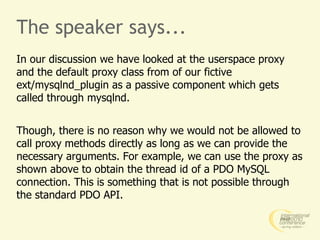
Use the URL not the slides! The slides are a quick copy of the real stuff at: http://blog.ulf-wendel.de/mysqlnd_plugin_ipc2010.html
Target audience PHP developers with  C programming knowledge.  Familarity with PHP  extension writing is benefitial. „ Das MySQL-Treibhaus erweitern ... Level: Experte“, Session description
The speaker says... Relax, it won't get that complicated.  I am trying to sieve out potential mysqlnd plugin implementors from the audience.
Quick poll: are you a man? Raise your hand, if you call yourself a man.  Not a lamer, not a sissy - a real man.  Cowboys, who of you calls himself an  Open Source developer? Please state your name!
The pub, the idea, the demo
The speaker says... No offline demo for Slideshare.  Maybe next time we meet in person! Cu!
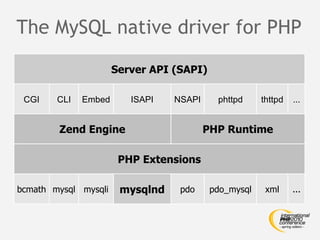
The MySQL native driver for PHP Server API (SAPI) CGI CLI Embed ISAPI NSAPI phttpd thttpd ... Zend Engine PHP Runtime PHP Extensions bcmath mysql mysqli mysqlnd pdo pdo_mysql xml ...
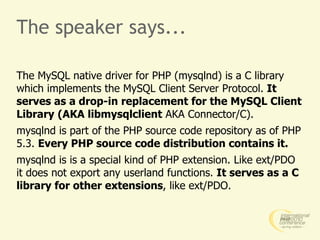
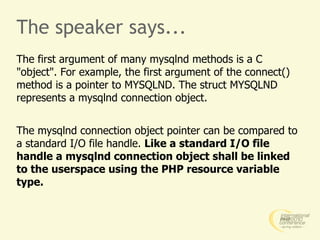
The speaker says... The MySQL native driver for PHP (mysqlnd) is a C library which implements the MySQL Client Server Protocol.  It serves as a drop-in replacement for the MySQL Client Library   (AKA libmysqlclient  AKA Connector/C). mysqlnd is part of the PHP source code repository as of PHP 5.3.  Every PHP source code distribution contains it. mysqlnd is is a special kind of PHP extension. Like ext/PDO it does not export any userland functions.  It serves as a C library for other extensions , like ext/PDO.
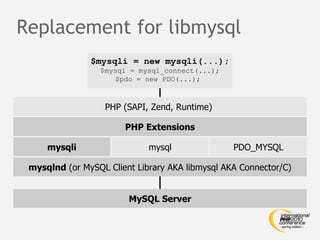
Replacement for libmysql $mysqli = new mysqli(...); $mysql = mysql_connect(...); $pdo = new PDO(...);
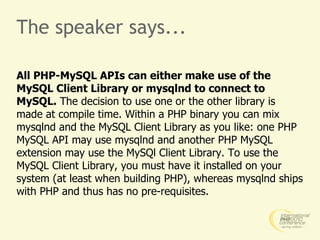
The speaker says... All PHP-MySQL APIs can either make use of the MySQL Client Library or mysqlnd to connect to MySQL.  The decision to use one or the other library is made at compile time. Within a PHP binary you can mix mysqlnd and the MySQL Client Library as you like: one PHP MySQL API may use mysqlnd and another PHP MySQL extension may use the MySQl Client Library. To use the MySQL Client Library, you must have it installed on your system (at least when building PHP), whereas mysqlnd ships with PHP and thus has no pre-requisites.
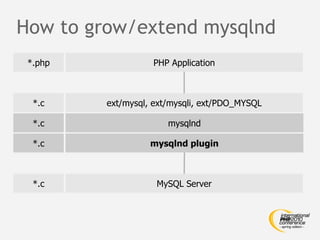
How to grow/extend mysqlnd
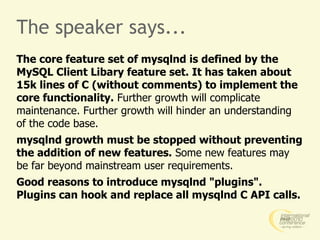
The speaker says... The core feature set of mysqlnd is defined by the MySQL Client Libary feature set. It has taken about 15k lines of C (without comments) to implement the core functionality.  Further growth will complicate maintenance. Further growth will hinder an understanding of the code base.  mysqlnd growth must be stopped without preventing the addition of new features.  Some new features may be far beyond mainstream user requirements. Good reasons to introduce mysqlnd "plugins". Plugins can hook and replace all mysqlnd C API calls.
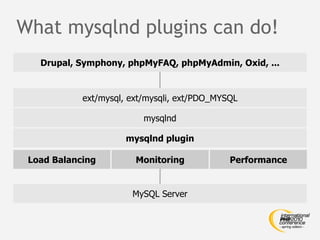
What mysqlnd plugins can do!
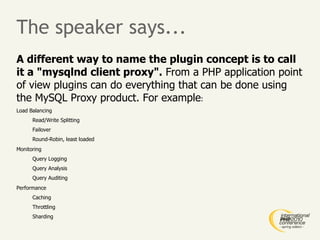
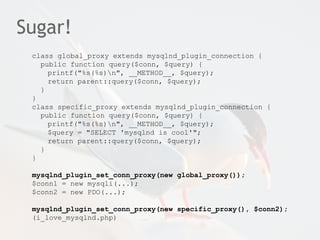
The speaker says... A different way to name the plugin concept is to call it a "mysqlnd client proxy".  From a PHP application point of view plugins can do everything that can be done using the MySQL Proxy product. For example : Load Balancing Read/Write Splitting
Failover
Round-Robin, least loaded Monitoring Query Logging
Query Analysis
Query Auditing Performance Caching
Throttling
Sharding
What are mysqlnd plugins? Extension Adds new functionality Proxy Surrogate
Intermediary
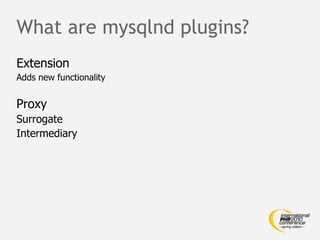
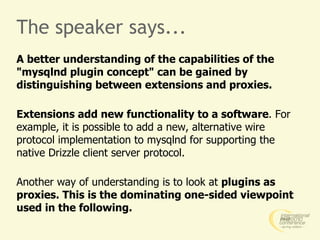
The speaker says... A better understanding of the capabilities of the "mysqlnd plugin concept" can be gained by   distinguishing between extensions and proxies. Extensions add new functionality to a software . For example, it is possible to add a new, alternative wire protocol implementation to mysqlnd for supporting the native Drizzle client server protocol. Another way of understanding is to look at  plugins as proxies. This is the dominating one-sided viewpoint used in the following.
Plugin vs. MySQL Proxy (I)
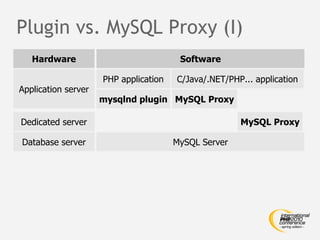
The speaker says... Hardware topology:  MySQL Proxy can either be installed on the PHP application server or be run on a dedicated machine. A mysqlnd plugin always runs on the application server. Running  a proxy on the application machines has two advantages: no single point of failure
easy to scale out (horizontal scale out, scale by client)
The speaker says... Hardware topology:  MySQL Proxy can either be installed on the PHP application server or be run on a dedicated machine. A mysqlnd plugin always runs on the application server. Running  a proxy on the application machines has two advantages: no single point of failure

easy to scale out (horizontal scale out, scale by client)
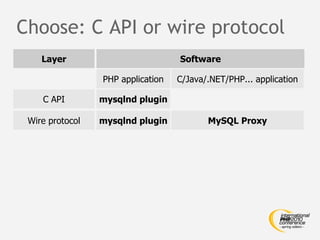
Choose: C API or wire protocol
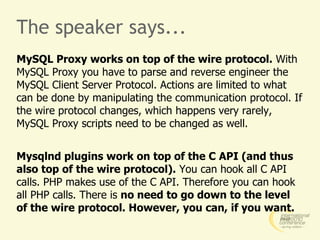
The speaker says... MySQL Proxy works on top of the wire protocol.  With MySQL Proxy you have to parse and reverse engineer the MySQL Client Server Protocol. Actions are limited to what can be done by manipulating the communication protocol. If the wire protocol changes, which happens very rarely, MySQL Proxy scripts need to be changed as well. Mysqlnd plugins work on top of the C API (and thus also top of the wire protocol).  You can hook all C API calls. PHP makes use of the C API. Therefore you can hook all PHP calls. There is  no need to go down to the level of the wire protocol. However, you can, if you want.
Follow me or leave the room!
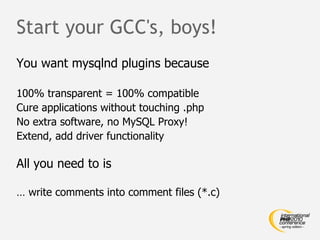
Start your GCC's, boys! You want mysqlnd plugins because 100% transparent = 100% compatible
Cure applications without touching .php
No extra software, no MySQL Proxy!
Extend, add driver functionality All you need to is …  write comments into comment files (*.c)
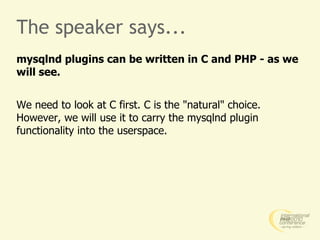
The speaker says... mysqlnd plugins can be written in C and PHP - as we will see. We need to look at C first. C is the "natural" choice. However, we will use it to carry the mysqlnd plugin functionality into the userspace.
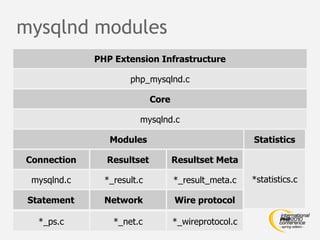
mysqlnd modules
The speaker says... Andrey Hristov is the core developer of mysqlnd.  He is probably the only person in the world to know each line of mysqlnd inside out. Andrey tried to modularize mysqlnd from the very beginning. First he created modules. Later on the modules became objects. Object oriented concepts crept into the design. Without knowing he had layed the foundations of what is called the mysqlnd plugin API today. The above listed modules can be understood as classes. The classes can be extended by plugins.
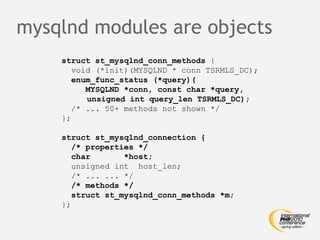
mysqlnd modules are objects struct st_mysqlnd_conn_methods  { void (*init)(MYSQLND * conn TSRMLS_DC); enum_func_status (*query)(   MYSQLND *conn, const char *query,   unsigned int query_len TSRMLS_DC); /* ... 50+ methods not shown */ }; struct st_mysqlnd_connection { /* properties */ char  *host; unsigned int  host_len; /* ... ... */ /* methods */ struct st_mysqlnd_conn_methods *m; };
The speaker says... Mysqlnd uses a classical C pattern for implementing object orientation. In C you use a struct to represent an object. Data members of the struct represent properties. Struct members pointing to functions represent methods. This always reminds me of PHP 4 but any comparison would only distract you.
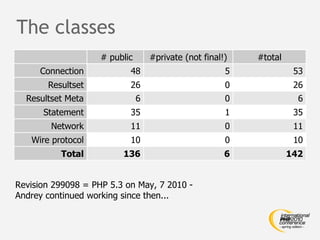
The classes # public #private (not final!) #total Connection 48 5 53 Resultset 26 0 26 Resultset Meta 6 0 6 Statement 35 1 35 Network 11 0 11 Wire protocol 10 0 10 Total 136 6 142 Revision 299098 = PHP 5.3 on May, 7 2010 -  Andrey continued working since then...
The speaker says... Some, few mysqlnd functions are marked as private. Private does not mean final.  It is possible to overwrite them but it is discouraged. Those private functions usually take care of internal reference counting.
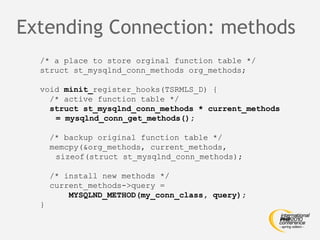
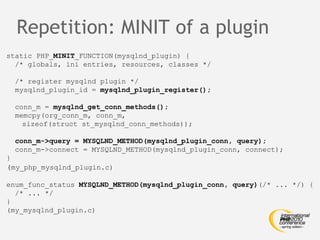
Extending Connection: methods /* a place to store orginal function table */ struct st_mysqlnd_conn_methods org_methods; void  minit_ register_hooks(TSRMLS_D) { /* active function table */ struct st_mysqlnd_conn_methods * current_methods = mysqlnd_conn_get_methods(); /* backup original function table */ memcpy(&org_methods, current_methods, sizeof(struct st_mysqlnd_conn_methods); /* install new methods */ current_methods->query =  MYSQLND_METHOD(my_conn_class, query); }
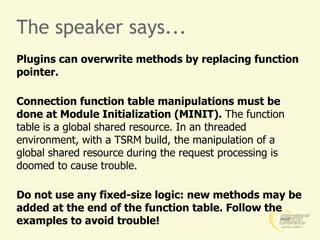
The speaker says... Plugins can overwrite methods by replacing function pointer. Connection function table manipulations must be done at Module Initialization (MINIT).  The function table is a global shared resource. In an threaded environment, with a TSRM build, the manipulation of a global shared resource during the request processing is doomed to cause trouble.  Do not use any fixed-size logic: new methods may be added at the end of the function table. Follow the examples to avoid trouble!
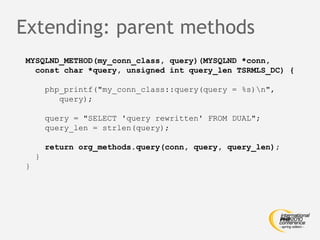
Extending: parent methods MYSQLND_METHOD(my_conn_class, query)(MYSQLND *conn, const char *query, unsigned int query_len TSRMLS_DC) { php_printf("my_conn_class::query(query = %s)\n", query); query = "SELECT 'query rewritten' FROM DUAL"; query_len = strlen(query); return org_methods.query(conn, query, query_len); } }
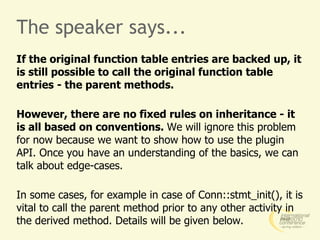
The speaker says... If the original function table entries are backed up, it is still possible to call the original function table entries - the parent methods. However, there are no fixed rules on inheritance - it is all based on conventions.  We will ignore this problem for now because we want to show how to use the plugin API. Once you have an understanding of the basics, we can talk about edge-cases. In some cases, for example in case of Conn::stmt_init(), it is vital to call the parent method prior to any other activity in the derived method. Details will be given below.
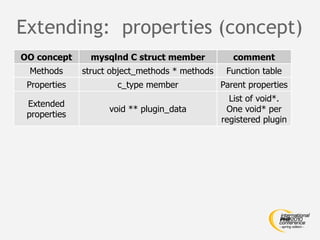
Extending:  properties (concept) OO concept mysqlnd C struct member comment Methods struct object_methods * methods Function table Properties c_type member Parent properties Extended properties void ** plugin_data List of void*. One void* per registered plugin
The speaker says... Basic idea: allow plugins to associate arbitrary data pointer with objects. See below for technical details.
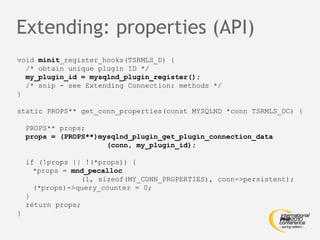
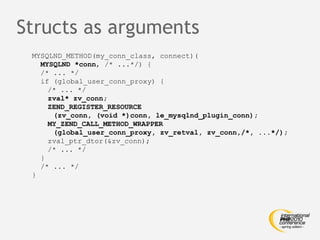
Extending: properties (API) void  minit _register_hooks(TSRMLS_D) { /* obtain unique plugin ID */ my_plugin_id = mysqlnd_plugin_register(); /* snip - see Extending Connection: methods */ } static PROPS** get_conn_properties(const MYSQLND *conn TSRMLS_DC) { PROPS** props; props = (PROPS**)mysqlnd_plugin_get_plugin_connection_data (conn, my_plugin_id); if (!props || !(*props)) { *props =  mnd_pecalloc (1, sizeof(MY_CONN_PROPERTIES), conn->persistent); (*props)->query_counter = 0; }  return props; }
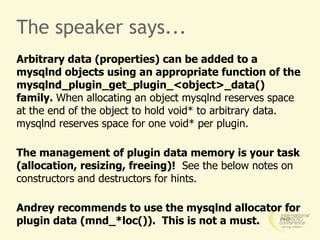
The speaker says... Arbitrary data (properties) can be added to a mysqlnd objects using an appropriate function of the mysqlnd_plugin_get_plugin_<object>_data() family.  When allocating an object mysqlnd reserves space at the end of the object to hold void* to arbitrary data. mysqlnd reserves space for one void* per plugin.  The management of plugin data memory is your task (allocation, resizing, freeing)!   See the below notes on constructors and destructors for hints.  Andrey recommends to use the mysqlnd allocator for plugin data (mnd_*loc()).  This is not a must.
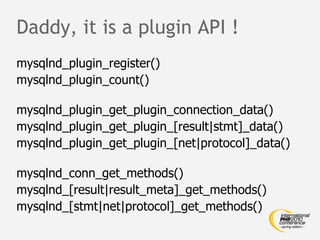
Daddy, it is a plugin API ! mysqlnd_plugin_register()
mysqlnd_plugin_count()
mysqlnd_plugin_get_plugin_connection_data()
mysqlnd_plugin_get_plugin_[result|stmt]_data()
mysqlnd_plugin_get_plugin_[net|protocol]_data()
mysqlnd_conn_get_methods()
mysqlnd_[result|result_meta]_get_methods()
mysqlnd_[stmt|net|protocol]_get_methods()
The speaker says... It just happened, … What you see is the first version. It is far from perfect. No surprise. ABI breaks should become very rare, However, there may be API additions.
Risks: a (silly) man's world Security: sissy
Limitations: use your leadfoot
Chaining: alphabetical = random order Recommended to call parent methods
Recommended to be cooperative
The speaker says... No limits, take care! A plugin has full access to the inner workings of mysqlnd. There are no security limits. Everything can be overwritten to implement friendly or hostile algorithms. Do not trust unknown plugins blindly .  Do not use unknown plugins before checking their source!  As we saw, plugins can associate data pointer with objects (&quot;properties&quot;). The pointer is not protected from other plugins in any meaningful way. The storage place is not secure. Simple offset arithmetic can be used to read other plugins data.
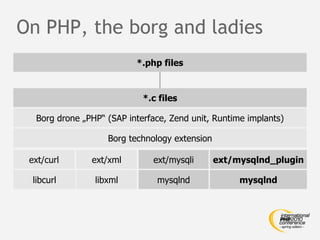
On PHP, the borg and ladies
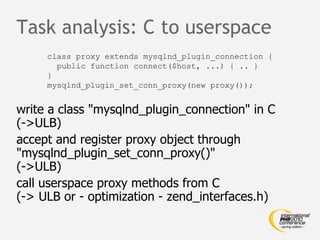
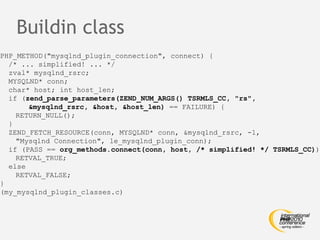
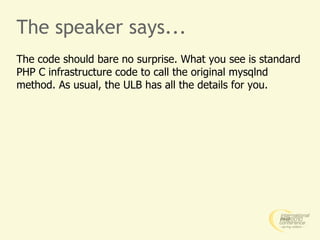
The speaker says... Few PHP users can write C code. PHP users love the convenience of a script language. Therefore it is  desired to expose C APIs to the userland. PHP is like the borg: it assimilates all technology it finds useful. PHP has been designed to assimilate C libraries. Assimilated C libraries are called extensions. Most PHP extensions expose a PHP API for use in *.php files. Mysqlnd is a C library. A mysqlnd plugin is yet another C library implemented as a PHP extension.  Nothing stops you from writing a mysqlnd plugin which exposes the mysqlnd plugin API to PHP users - for use in *.php files!
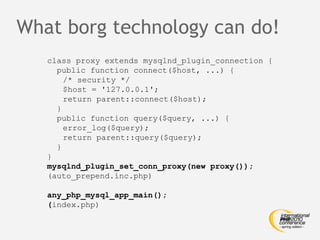
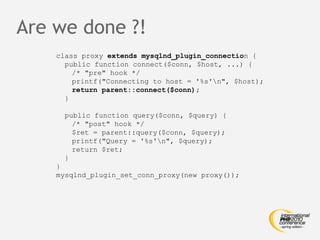
What borg technology can do! class proxy extends mysqlnd_plugin_connection { public function connect($host, ...) { /* security */ $host = '127.0.0.1'; return parent::connect($host); } public function query($query, ...) { error_log($query); return parent::query($query); } } mysqlnd_plugin_set_conn_proxy(new proxy()); (auto_prepend.inc.php) any_php_mysql_app_main(); ( index.php)
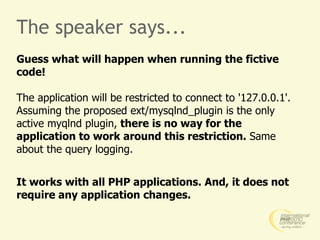
The speaker says... Guess what will happen when running the fictive code! The application will be restricted to connect to '127.0.0.1'. Assuming the proposed ext/mysqlnd_plugin is the only active myqlnd plugin,  there is no way for the application to work around this restriction.  Same about the query logging. It works with all PHP applications. And, it does not require any application changes.
Userspace plugin motivation Availability: maximum
Creative potential: endless
Ease of use: absolutely
Fun factor: tremendous US citizen: you must read and comply to the following security rules  Security, Limitations, Chaining: consult homeland security
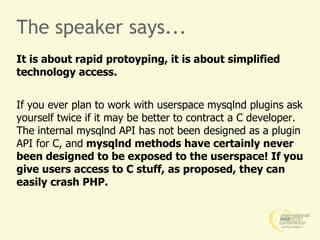
The C API has not been designed to be exposed to the userspace

The PHP mysqlnd plugin talk - plugins an alternative to MySQL Proxy

  • 1.
    PHP mysqlnd pluginsas an alternative to MySQL Proxy Get in, hurry up! The mysqlnd plugin talk starts!
  • 2.
    The mysqlnd greenhouse Gardening mysqlnd – Concepts and Internals Ulf Wendel, MySQL/Sun/Oracle/WhatIsNext
  • 3.
    Use the URLnot the slides! The slides are a quick copy of the real stuff at: http://blog.ulf-wendel.de/mysqlnd_plugin_ipc2010.html
  • 4.
    Target audience PHPdevelopers with C programming knowledge. Familarity with PHP extension writing is benefitial. „ Das MySQL-Treibhaus erweitern ... Level: Experte“, Session description
  • 5.
    The speaker says...Relax, it won't get that complicated. I am trying to sieve out potential mysqlnd plugin implementors from the audience.
  • 6.
    Quick poll: areyou a man? Raise your hand, if you call yourself a man. Not a lamer, not a sissy - a real man. Cowboys, who of you calls himself an Open Source developer? Please state your name!
  • 7.
    The pub, theidea, the demo
  • 8.
    The speaker says...No offline demo for Slideshare. Maybe next time we meet in person! Cu!
  • 9.
    The MySQL nativedriver for PHP Server API (SAPI) CGI CLI Embed ISAPI NSAPI phttpd thttpd ... Zend Engine PHP Runtime PHP Extensions bcmath mysql mysqli mysqlnd pdo pdo_mysql xml ...
  • 10.
    The speaker says...The MySQL native driver for PHP (mysqlnd) is a C library which implements the MySQL Client Server Protocol. It serves as a drop-in replacement for the MySQL Client Library (AKA libmysqlclient AKA Connector/C). mysqlnd is part of the PHP source code repository as of PHP 5.3. Every PHP source code distribution contains it. mysqlnd is is a special kind of PHP extension. Like ext/PDO it does not export any userland functions. It serves as a C library for other extensions , like ext/PDO.
  • 11.
    Replacement for libmysql$mysqli = new mysqli(...); $mysql = mysql_connect(...); $pdo = new PDO(...);
  • 12.
    The speaker says...All PHP-MySQL APIs can either make use of the MySQL Client Library or mysqlnd to connect to MySQL. The decision to use one or the other library is made at compile time. Within a PHP binary you can mix mysqlnd and the MySQL Client Library as you like: one PHP MySQL API may use mysqlnd and another PHP MySQL extension may use the MySQl Client Library. To use the MySQL Client Library, you must have it installed on your system (at least when building PHP), whereas mysqlnd ships with PHP and thus has no pre-requisites.
  • 13.
  • 14.
    The speaker says...The core feature set of mysqlnd is defined by the MySQL Client Libary feature set. It has taken about 15k lines of C (without comments) to implement the core functionality. Further growth will complicate maintenance. Further growth will hinder an understanding of the code base. mysqlnd growth must be stopped without preventing the addition of new features. Some new features may be far beyond mainstream user requirements. Good reasons to introduce mysqlnd &quot;plugins&quot;. Plugins can hook and replace all mysqlnd C API calls.
  • 15.
  • 16.
    The speaker says...A different way to name the plugin concept is to call it a &quot;mysqlnd client proxy&quot;. From a PHP application point of view plugins can do everything that can be done using the MySQL Proxy product. For example : Load Balancing Read/Write Splitting
  • 17.
  • 18.
    Round-Robin, least loadedMonitoring Query Logging
  • 19.
  • 20.
  • 21.
  • 22.
  • 23.
    What are mysqlndplugins? Extension Adds new functionality Proxy Surrogate
  • 24.
  • 25.
    The speaker says...A better understanding of the capabilities of the &quot;mysqlnd plugin concept&quot; can be gained by distinguishing between extensions and proxies. Extensions add new functionality to a software . For example, it is possible to add a new, alternative wire protocol implementation to mysqlnd for supporting the native Drizzle client server protocol. Another way of understanding is to look at plugins as proxies. This is the dominating one-sided viewpoint used in the following.
  • 26.
  • 27.
    The speaker says...Hardware topology: MySQL Proxy can either be installed on the PHP application server or be run on a dedicated machine. A mysqlnd plugin always runs on the application server. Running a proxy on the application machines has two advantages: no single point of failure
  • 28.
    easy to scaleout (horizontal scale out, scale by client)
  • 29.
    The speaker says...Hardware topology: MySQL Proxy can either be installed on the PHP application server or be run on a dedicated machine. A mysqlnd plugin always runs on the application server. Running a proxy on the application machines has two advantages: no single point of failure
  • 30.
    easy to scaleout (horizontal scale out, scale by client)
  • 31.
    Choose: C APIor wire protocol
  • 32.
    The speaker says...MySQL Proxy works on top of the wire protocol. With MySQL Proxy you have to parse and reverse engineer the MySQL Client Server Protocol. Actions are limited to what can be done by manipulating the communication protocol. If the wire protocol changes, which happens very rarely, MySQL Proxy scripts need to be changed as well. Mysqlnd plugins work on top of the C API (and thus also top of the wire protocol). You can hook all C API calls. PHP makes use of the C API. Therefore you can hook all PHP calls. There is no need to go down to the level of the wire protocol. However, you can, if you want.
  • 33.
    Follow me orleave the room!
  • 34.
    Start your GCC's,boys! You want mysqlnd plugins because 100% transparent = 100% compatible
  • 35.
  • 36.
    No extra software,no MySQL Proxy!
  • 37.
    Extend, add driverfunctionality All you need to is … write comments into comment files (*.c)
  • 38.
    The speaker says...mysqlnd plugins can be written in C and PHP - as we will see. We need to look at C first. C is the &quot;natural&quot; choice. However, we will use it to carry the mysqlnd plugin functionality into the userspace.
  • 39.
  • 40.
    The speaker says...Andrey Hristov is the core developer of mysqlnd. He is probably the only person in the world to know each line of mysqlnd inside out. Andrey tried to modularize mysqlnd from the very beginning. First he created modules. Later on the modules became objects. Object oriented concepts crept into the design. Without knowing he had layed the foundations of what is called the mysqlnd plugin API today. The above listed modules can be understood as classes. The classes can be extended by plugins.
  • 41.
    mysqlnd modules areobjects struct st_mysqlnd_conn_methods { void (*init)(MYSQLND * conn TSRMLS_DC); enum_func_status (*query)( MYSQLND *conn, const char *query, unsigned int query_len TSRMLS_DC); /* ... 50+ methods not shown */ }; struct st_mysqlnd_connection { /* properties */ char *host; unsigned int host_len; /* ... ... */ /* methods */ struct st_mysqlnd_conn_methods *m; };
  • 42.
    The speaker says...Mysqlnd uses a classical C pattern for implementing object orientation. In C you use a struct to represent an object. Data members of the struct represent properties. Struct members pointing to functions represent methods. This always reminds me of PHP 4 but any comparison would only distract you.
  • 43.
    The classes #public #private (not final!) #total Connection 48 5 53 Resultset 26 0 26 Resultset Meta 6 0 6 Statement 35 1 35 Network 11 0 11 Wire protocol 10 0 10 Total 136 6 142 Revision 299098 = PHP 5.3 on May, 7 2010 - Andrey continued working since then...
  • 44.
    The speaker says...Some, few mysqlnd functions are marked as private. Private does not mean final. It is possible to overwrite them but it is discouraged. Those private functions usually take care of internal reference counting.
  • 45.
    Extending Connection: methods/* a place to store orginal function table */ struct st_mysqlnd_conn_methods org_methods; void minit_ register_hooks(TSRMLS_D) { /* active function table */ struct st_mysqlnd_conn_methods * current_methods = mysqlnd_conn_get_methods(); /* backup original function table */ memcpy(&org_methods, current_methods, sizeof(struct st_mysqlnd_conn_methods); /* install new methods */ current_methods->query = MYSQLND_METHOD(my_conn_class, query); }
  • 46.
    The speaker says...Plugins can overwrite methods by replacing function pointer. Connection function table manipulations must be done at Module Initialization (MINIT). The function table is a global shared resource. In an threaded environment, with a TSRM build, the manipulation of a global shared resource during the request processing is doomed to cause trouble. Do not use any fixed-size logic: new methods may be added at the end of the function table. Follow the examples to avoid trouble!
  • 47.
    Extending: parent methodsMYSQLND_METHOD(my_conn_class, query)(MYSQLND *conn, const char *query, unsigned int query_len TSRMLS_DC) { php_printf(&quot;my_conn_class::query(query = %s)\n&quot;, query); query = &quot;SELECT 'query rewritten' FROM DUAL&quot;; query_len = strlen(query); return org_methods.query(conn, query, query_len); } }
  • 48.
    The speaker says...If the original function table entries are backed up, it is still possible to call the original function table entries - the parent methods. However, there are no fixed rules on inheritance - it is all based on conventions. We will ignore this problem for now because we want to show how to use the plugin API. Once you have an understanding of the basics, we can talk about edge-cases. In some cases, for example in case of Conn::stmt_init(), it is vital to call the parent method prior to any other activity in the derived method. Details will be given below.
  • 49.
    Extending: properties(concept) OO concept mysqlnd C struct member comment Methods struct object_methods * methods Function table Properties c_type member Parent properties Extended properties void ** plugin_data List of void*. One void* per registered plugin
  • 50.
    The speaker says...Basic idea: allow plugins to associate arbitrary data pointer with objects. See below for technical details.
  • 51.
    Extending: properties (API)void minit _register_hooks(TSRMLS_D) { /* obtain unique plugin ID */ my_plugin_id = mysqlnd_plugin_register(); /* snip - see Extending Connection: methods */ } static PROPS** get_conn_properties(const MYSQLND *conn TSRMLS_DC) { PROPS** props; props = (PROPS**)mysqlnd_plugin_get_plugin_connection_data (conn, my_plugin_id); if (!props || !(*props)) { *props = mnd_pecalloc (1, sizeof(MY_CONN_PROPERTIES), conn->persistent); (*props)->query_counter = 0; } return props; }
  • 52.
    The speaker says...Arbitrary data (properties) can be added to a mysqlnd objects using an appropriate function of the mysqlnd_plugin_get_plugin_<object>_data() family. When allocating an object mysqlnd reserves space at the end of the object to hold void* to arbitrary data. mysqlnd reserves space for one void* per plugin. The management of plugin data memory is your task (allocation, resizing, freeing)! See the below notes on constructors and destructors for hints. Andrey recommends to use the mysqlnd allocator for plugin data (mnd_*loc()). This is not a must.
  • 53.
    Daddy, it isa plugin API ! mysqlnd_plugin_register()
  • 54.
  • 55.
  • 56.
  • 57.
  • 58.
  • 59.
  • 60.
  • 61.
    The speaker says...It just happened, … What you see is the first version. It is far from perfect. No surprise. ABI breaks should become very rare, However, there may be API additions.
  • 62.
    Risks: a (silly)man's world Security: sissy
  • 63.
  • 64.
    Chaining: alphabetical =random order Recommended to call parent methods
  • 65.
    Recommended to becooperative
  • 66.
    The speaker says...No limits, take care! A plugin has full access to the inner workings of mysqlnd. There are no security limits. Everything can be overwritten to implement friendly or hostile algorithms. Do not trust unknown plugins blindly . Do not use unknown plugins before checking their source! As we saw, plugins can associate data pointer with objects (&quot;properties&quot;). The pointer is not protected from other plugins in any meaningful way. The storage place is not secure. Simple offset arithmetic can be used to read other plugins data.
  • 67.
    On PHP, theborg and ladies
  • 68.
    The speaker says...Few PHP users can write C code. PHP users love the convenience of a script language. Therefore it is desired to expose C APIs to the userland. PHP is like the borg: it assimilates all technology it finds useful. PHP has been designed to assimilate C libraries. Assimilated C libraries are called extensions. Most PHP extensions expose a PHP API for use in *.php files. Mysqlnd is a C library. A mysqlnd plugin is yet another C library implemented as a PHP extension. Nothing stops you from writing a mysqlnd plugin which exposes the mysqlnd plugin API to PHP users - for use in *.php files!
  • 69.
    What borg technologycan do! class proxy extends mysqlnd_plugin_connection { public function connect($host, ...) { /* security */ $host = '127.0.0.1'; return parent::connect($host); } public function query($query, ...) { error_log($query); return parent::query($query); } } mysqlnd_plugin_set_conn_proxy(new proxy()); (auto_prepend.inc.php) any_php_mysql_app_main(); ( index.php)
  • 70.
    The speaker says...Guess what will happen when running the fictive code! The application will be restricted to connect to '127.0.0.1'. Assuming the proposed ext/mysqlnd_plugin is the only active myqlnd plugin, there is no way for the application to work around this restriction. Same about the query logging. It works with all PHP applications. And, it does not require any application changes.
  • 71.
    Userspace plugin motivationAvailability: maximum
  • 72.
  • 73.
    Ease of use:absolutely
  • 74.
    Fun factor: tremendousUS citizen: you must read and comply to the following security rules Security, Limitations, Chaining: consult homeland security
  • 75.
    The C APIhas not been designed to be exposed to the userspace