Presentation By:
Febronie NAMBAJEMARIYA
CONTENTS
• Introduction
• What is LIFI
• History
• Why is it required?
• Working
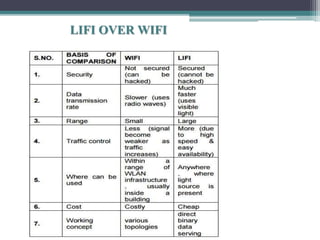
• LiFi over WiFi
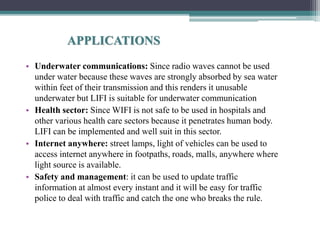
• Applications
• Disadvantages
• Ideas for more applications of this technology
• Conclusion
• Reference
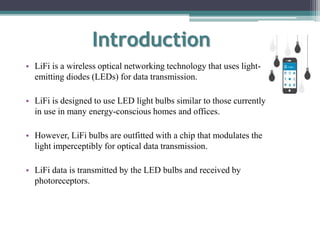
Introduction
• LiFi is a wireless optical networking technology that uses light-
emitting diodes (LEDs) for data transmission.
• LiFi is designed to use LED light bulbs similar to those currently
in use in many energy-conscious homes and offices.
• However, LiFi bulbs are outfitted with a chip that modulates the
light imperceptibly for optical data transmission.
• LiFi data is transmitted by the LED bulbs and received by
photoreceptors.
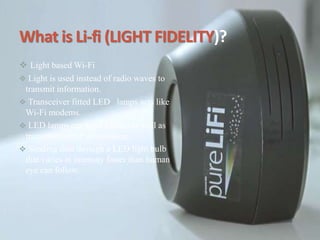
What is Li-fi (LIGHT FIDELITY)?
 Light based Wi-Fi
 Light is used instead of radio waves to
transmit information.
 Transceiver fitted LED lamps acts like
Wi-Fi modems.
 LED lamps can light a room as well as
transmit-receive information.
 Sending data through a LED light bulb
that varies in intensity faster than human
eye can follow.
History
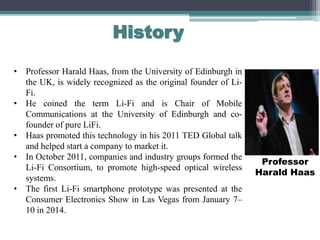
• Professor Harald Haas, from the University of Edinburgh in
the UK, is widely recognized as the original founder of Li-
Fi.
• He coined the term Li-Fi and is Chair of Mobile
Communications at the University of Edinburgh and co-
founder of pure LiFi.
• Haas promoted this technology in his 2011 TED Global talk
and helped start a company to market it.
• In October 2011, companies and industry groups formed the
Li-Fi Consortium, to promote high-speed optical wireless
systems.
• The first Li-Fi smartphone prototype was presented at the
Consumer Electronics Show in Las Vegas from January 7–
10 in 2014.
Professor
Harald Haas
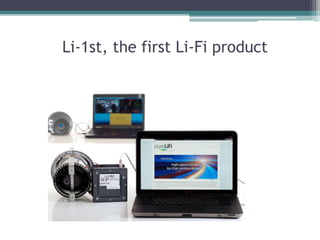
Li-1st, the first Li-Fi product
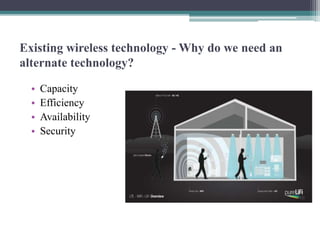
Existing wireless technology - Why do we need an
alternate technology?
• Capacity
• Efficiency
• Availability
• Security
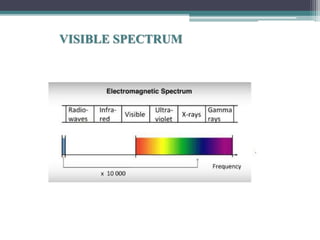
VISIBLE SPECTRUM
WORKING
 The LEDs can be switched on and off very quickly which gives nice
opportunity for data transfer in the form of Binary code.
 Switching ON an LED is logical ‘1’,switching of an LED is logical ‘0’.
 Hence it is possible to encode the data into the LED’s by using a
controller ,we just have to vary at which LED’s flicker depending on the
data we want to encode to give different strings of 0’s and 1’s.
 UK researches say that using a micro-LED light bulb they have
achieved a data transmission speed of 10Gbps using LI-FI.
working cont...
cont…
Main Components Of
Communication System
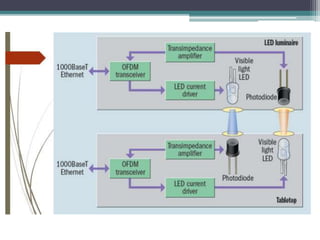
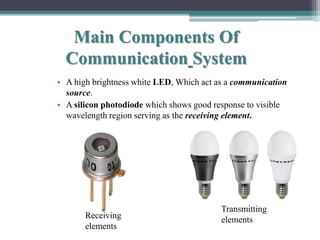
• A high brightness white LED, Which act as a communication
source.
• A silicon photodiode which shows good response to visible
wavelength region serving as the receiving element.
Receiving
elements
Transmitting
elements
Cont…
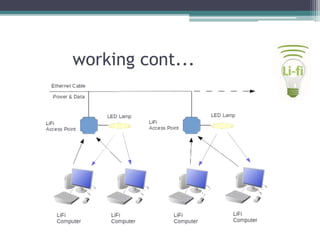
• LiFi is high speed bidirectional networked and mobile communication of data
using light. LiFi comprises of multiple light bulbs that form a wireles network.
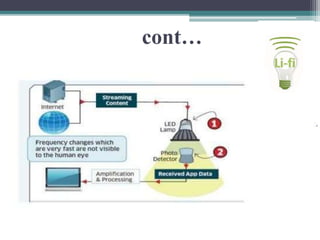
• When an electrical current is applied to a LED light bulb a stream of light
(photons) is emitted from the bulb. LED bulbs are semiconductor devices,
which means that the brightness of the light flowing through them can be
changed at extremely high speeds. This allows us to send a signal by
modulating the light at different rates. The signal can then be received by a
detector which interprets the changes in light intensity (the signal) as data.
• The intensity modulation cannot be seen by the human eye, and thus
communication is just as seamless as other radio systems, allowing the users to
be connected where there is LiFi enabled light. Using this technique, data can
be transmitted from a LED light bulb at high speeds.
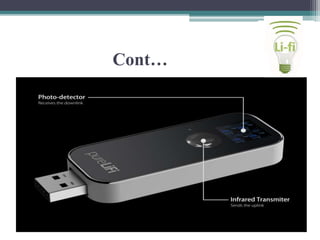
Cont…
cont…
LIFI OVER WIFI
APPLICATIONS
• Underwater communications: Since radio waves cannot be used
under water because these waves are strongly absorbed by sea water
within feet of their transmission and this renders it unusable
underwater but LIFI is suitable for underwater communication
• Health sector: Since WIFI is not safe to be used in hospitals and
other various health care sectors because it penetrates human body.
LIFI can be implemented and well suit in this sector.
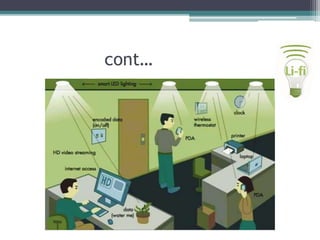
• Internet anywhere: street lamps, light of vehicles can be used to
access internet anywhere in footpaths, roads, malls, anywhere where
light source is available.
• Safety and management: it can be used to update traffic
information at almost every instant and it will be easy for traffic
police to deal with traffic and catch the one who breaks the rule.
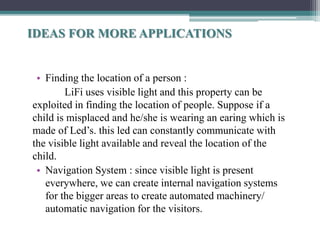
• Finding the location of a person :
LiFi uses visible light and this property can be
exploited in finding the location of people. Suppose if a
child is misplaced and he/she is wearing an earing which is
made of Led’s. this led can constantly communicate with
the visible light available and reveal the location of the
child.
• Navigation System : since visible light is present
everywhere, we can create internal navigation systems
for the bigger areas to create automated machinery/
automatic navigation for the visitors.
IDEAS FOR MORE APPLICATIONS
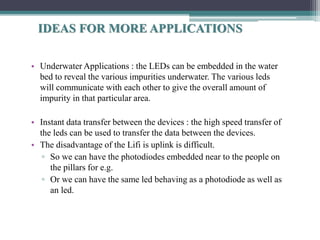
• Underwater Applications : the LEDs can be embedded in the water
bed to reveal the various impurities underwater. The various leds
will communicate with each other to give the overall amount of
impurity in that particular area.
• Instant data transfer between the devices : the high speed transfer of
the leds can be used to transfer the data between the devices.
• The disadvantage of the Lifi is uplink is difficult.
▫ So we can have the photodiodes embedded near to the people on
the pillars for e.g.
▫ Or we can have the same led behaving as a photodiode as well as
an led.
IDEAS FOR MORE APPLICATIONS
Advantages
• Higher speeds than Wi-Fi.
• 10000 times the frequency spectrum of radio.
• More secure because data cannot be intercepted without a clear
line of sight.
• Prevents piggybacking.
• Eliminates neighboring network interference.
• Unimpeded by radio interference.
• Does not create interference in sensitive electronics, making it
better for use in environments like hospitals and aircraft.
DISADVANTAGES
Nothing in this world is perfect and so does LIFI.
• These signals cannot penetrate walls. So the
person needs wired bulb in that room also.
• Only works if there is direct line of sight
between source and receiver.
• Used for broadcast and it is difficult to uplink.
conclusion
By using Li-Fi in all the lights in and around a building, the technology could
enable greater area of coverage than a single Wi-Fi router. Drawbacks to the
technology include the need for a clear line of sight, difficulties with mobility
and the requirement that lights stay on for operation.
REFERENCES
• http://www.ijstr.org/final-print/oct2014/Li-fi-A-New-Era-Of-
Wireless-Communication-Data-Sharing.pdf
• http://whatis.techtarget.com/definition/LiFi
• http://www.dvice.com/archives/2012/08/lifi_ten_way
s_i.php
• http://electronicsforu.com/electronicsforu
• http://purelifi.co.uk/what_is_li-fi/applicationsof_lifi/
• http://en.wikipedia.org/wiki/Li-Fi
Cont…

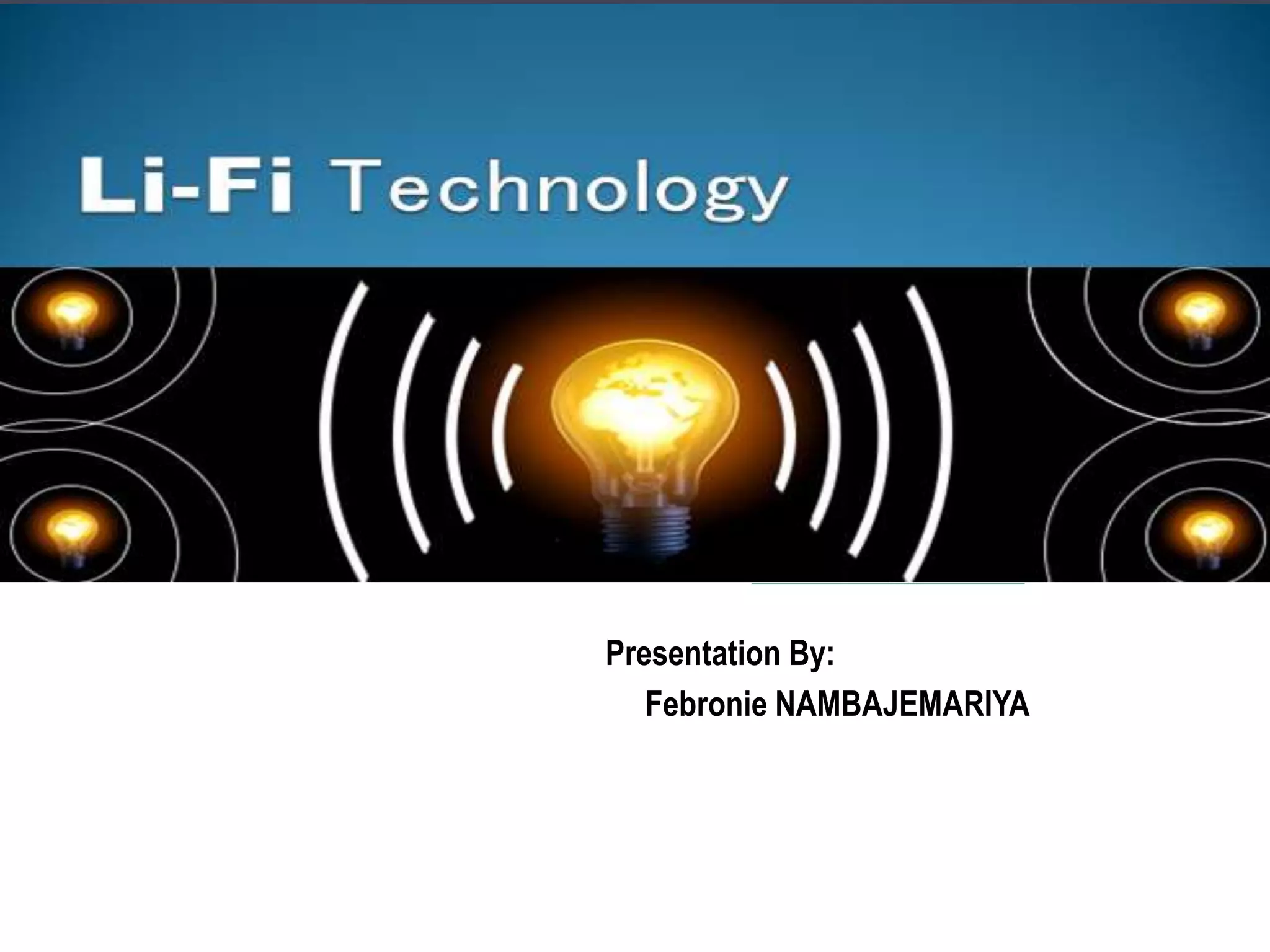
LiFi Technology

  • 1.
  • 2.
    CONTENTS • Introduction • Whatis LIFI • History • Why is it required? • Working • LiFi over WiFi • Applications • Disadvantages • Ideas for more applications of this technology • Conclusion • Reference
  • 3.
    Introduction • LiFi isa wireless optical networking technology that uses light- emitting diodes (LEDs) for data transmission. • LiFi is designed to use LED light bulbs similar to those currently in use in many energy-conscious homes and offices. • However, LiFi bulbs are outfitted with a chip that modulates the light imperceptibly for optical data transmission. • LiFi data is transmitted by the LED bulbs and received by photoreceptors.
  • 4.
    What is Li-fi(LIGHT FIDELITY)?  Light based Wi-Fi  Light is used instead of radio waves to transmit information.  Transceiver fitted LED lamps acts like Wi-Fi modems.  LED lamps can light a room as well as transmit-receive information.  Sending data through a LED light bulb that varies in intensity faster than human eye can follow.
  • 5.
    History • Professor HaraldHaas, from the University of Edinburgh in the UK, is widely recognized as the original founder of Li- Fi. • He coined the term Li-Fi and is Chair of Mobile Communications at the University of Edinburgh and co- founder of pure LiFi. • Haas promoted this technology in his 2011 TED Global talk and helped start a company to market it. • In October 2011, companies and industry groups formed the Li-Fi Consortium, to promote high-speed optical wireless systems. • The first Li-Fi smartphone prototype was presented at the Consumer Electronics Show in Las Vegas from January 7– 10 in 2014. Professor Harald Haas
  • 6.
    Li-1st, the firstLi-Fi product
  • 7.
    Existing wireless technology- Why do we need an alternate technology? • Capacity • Efficiency • Availability • Security
  • 8.
  • 9.
    WORKING  The LEDscan be switched on and off very quickly which gives nice opportunity for data transfer in the form of Binary code.  Switching ON an LED is logical ‘1’,switching of an LED is logical ‘0’.  Hence it is possible to encode the data into the LED’s by using a controller ,we just have to vary at which LED’s flicker depending on the data we want to encode to give different strings of 0’s and 1’s.  UK researches say that using a micro-LED light bulb they have achieved a data transmission speed of 10Gbps using LI-FI.
  • 10.
  • 12.
  • 13.
    Main Components Of CommunicationSystem • A high brightness white LED, Which act as a communication source. • A silicon photodiode which shows good response to visible wavelength region serving as the receiving element. Receiving elements Transmitting elements
  • 14.
    Cont… • LiFi ishigh speed bidirectional networked and mobile communication of data using light. LiFi comprises of multiple light bulbs that form a wireles network. • When an electrical current is applied to a LED light bulb a stream of light (photons) is emitted from the bulb. LED bulbs are semiconductor devices, which means that the brightness of the light flowing through them can be changed at extremely high speeds. This allows us to send a signal by modulating the light at different rates. The signal can then be received by a detector which interprets the changes in light intensity (the signal) as data. • The intensity modulation cannot be seen by the human eye, and thus communication is just as seamless as other radio systems, allowing the users to be connected where there is LiFi enabled light. Using this technique, data can be transmitted from a LED light bulb at high speeds.
  • 15.
  • 16.
  • 17.
  • 18.
    APPLICATIONS • Underwater communications:Since radio waves cannot be used under water because these waves are strongly absorbed by sea water within feet of their transmission and this renders it unusable underwater but LIFI is suitable for underwater communication • Health sector: Since WIFI is not safe to be used in hospitals and other various health care sectors because it penetrates human body. LIFI can be implemented and well suit in this sector. • Internet anywhere: street lamps, light of vehicles can be used to access internet anywhere in footpaths, roads, malls, anywhere where light source is available. • Safety and management: it can be used to update traffic information at almost every instant and it will be easy for traffic police to deal with traffic and catch the one who breaks the rule.
  • 19.
    • Finding thelocation of a person : LiFi uses visible light and this property can be exploited in finding the location of people. Suppose if a child is misplaced and he/she is wearing an earing which is made of Led’s. this led can constantly communicate with the visible light available and reveal the location of the child. • Navigation System : since visible light is present everywhere, we can create internal navigation systems for the bigger areas to create automated machinery/ automatic navigation for the visitors. IDEAS FOR MORE APPLICATIONS
  • 20.
    • Underwater Applications: the LEDs can be embedded in the water bed to reveal the various impurities underwater. The various leds will communicate with each other to give the overall amount of impurity in that particular area. • Instant data transfer between the devices : the high speed transfer of the leds can be used to transfer the data between the devices. • The disadvantage of the Lifi is uplink is difficult. ▫ So we can have the photodiodes embedded near to the people on the pillars for e.g. ▫ Or we can have the same led behaving as a photodiode as well as an led. IDEAS FOR MORE APPLICATIONS
  • 21.
    Advantages • Higher speedsthan Wi-Fi. • 10000 times the frequency spectrum of radio. • More secure because data cannot be intercepted without a clear line of sight. • Prevents piggybacking. • Eliminates neighboring network interference. • Unimpeded by radio interference. • Does not create interference in sensitive electronics, making it better for use in environments like hospitals and aircraft.
  • 22.
    DISADVANTAGES Nothing in thisworld is perfect and so does LIFI. • These signals cannot penetrate walls. So the person needs wired bulb in that room also. • Only works if there is direct line of sight between source and receiver. • Used for broadcast and it is difficult to uplink.
  • 23.
    conclusion By using Li-Fiin all the lights in and around a building, the technology could enable greater area of coverage than a single Wi-Fi router. Drawbacks to the technology include the need for a clear line of sight, difficulties with mobility and the requirement that lights stay on for operation.
  • 24.
    REFERENCES • http://www.ijstr.org/final-print/oct2014/Li-fi-A-New-Era-Of- Wireless-Communication-Data-Sharing.pdf • http://whatis.techtarget.com/definition/LiFi •http://www.dvice.com/archives/2012/08/lifi_ten_way s_i.php • http://electronicsforu.com/electronicsforu • http://purelifi.co.uk/what_is_li-fi/applicationsof_lifi/ • http://en.wikipedia.org/wiki/Li-Fi
  • 25.