1
AFAHO CASE MANAGEMENT PROTOCOL
UPDATED 4/6/16
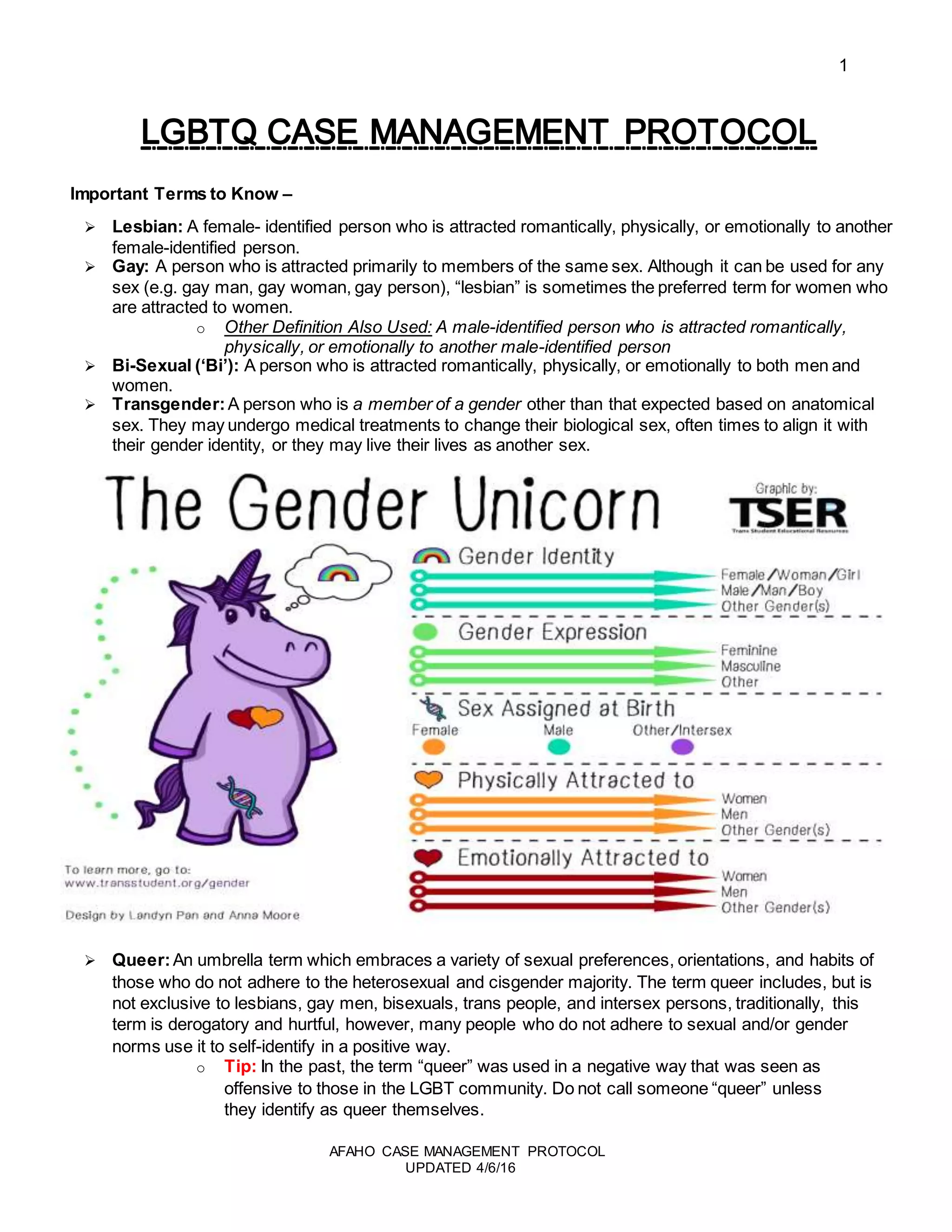
Important Terms to Know –
 Lesbian: A female- identified person who is attracted romantically, physically, or emotionally to another
female-identified person.
 Gay: A person who is attracted primarily to members of the same sex. Although it can be used for any
sex (e.g. gay man, gay woman, gay person), “lesbian” is sometimes the preferred term for women who
are attracted to women.
o Other Definition Also Used: A male-identified person who is attracted romantically,
physically, or emotionally to another male-identified person
 Bi-Sexual (‘Bi’): A person who is attracted romantically, physically, or emotionally to both men and
women.
 Transgender:A person who is a member of a gender other than that expected based on anatomical
sex. They may undergo medical treatments to change their biological sex, often times to align it with
their gender identity, or they may live their lives as another sex.
 Queer:An umbrella term which embraces a variety of sexual preferences, orientations, and habits of
those who do not adhere to the heterosexual and cisgender majority. The term queer includes, but is
not exclusive to lesbians, gay men, bisexuals, trans people, and intersex persons, traditionally, this
term is derogatory and hurtful, however, many people who do not adhere to sexual and/or gender
norms use it to self-identify in a positive way.
o Tip: In the past, the term “queer” was used in a negative way that was seen as
offensive to those in the LGBT community. Do not call someone “queer” unless
they identify as queer themselves.
2
AFAHO CASE MANAGEMENT PROTOCOL
UPDATED 4/6/16
 MSM:Men who have sex with men. MSM may not identify as gay or bisexual.
 WSW: Women who have sex with women. WSW may not identify as lesbians or bisexual.
Other Associated Terms –
 Intersex:Someone whose physical sex characteristics are not categorized as exclusively male or
exclusively female.
 Asexual: A person who is not attracted to anyone, or a person who does not have a sexual
orientation.
 Questioning: Refers to individuals who are unsure of their sexual orientation and/or gender identity.
 Homosexual: A clinical term for people who are attracted to members of the same sex. However,
some people find this term offensive.
 Ally: A person who does not identify as LGBTQ, but supports the rights and safety of those who do.
 In ‘The Closet’:Describes a person who keeps their sexual orientation or gender identity a secret
from some or all people.
 ‘Coming Out’: The process of acknowledging one’s sexual orientation and/or gender identity to other
people. For most LGBT people this could be a lifelong process.
 Sexual Orientation: A person’s primary physical, romantic, and/or emotional attraction to members
of the same and/or opposite sex, including lesbian, gay, bisexual and heterosexual (straight)
orientations.
 Gender Identity: The gender you feel you are inside (man, woman, neither or both). For
transgender people, their birth-assigned gender and their personal sense of gender identity do not
match.
 Homophobia: Refers to hostility, negative attitudes, and/or fear directed at LGB individuals. LGB
individuals who feel shame and self-hatred because of their sexual orientation are said to experience
internalized homophobia.
 Transphobia: Refers to hostility, negative attitudes, and/or fear directed at transgender individuals.
 Heterosexism:Describes institutionalized and systemic oppression against non-heterosexual
individuals and experiences.
Overview
When African and Caribbean immigrants and refugees come to AFAHO, they bring diverse experiences
and skills, but also stories of marginalization and oppression. Gender identity and sexual orientation could
very well be a part of client’s reasoning for relocating to the United States or Philadelphia. According to the
Office of Refugee Resettlement: “LGBT refugees often arrive alone and remain isolated upon resettlement
because they are excluded on the grounds of both their refugee and sexual minority statuses. While other
refugees enjoy the support of those with whom they share a country of origin, LGBT refugees are often
separated from their ethnic and national communities.”
The Human Rights Campaign has stated in 2007 alone, “1,265 LGB-biased hate crimes were reported to
the FBI, which is a 6-percent increase from 2006. Bias-motivated attacks on the basis of gender identity
are not tracked on the federal level.” Furthermore, it is vital to be mindful there are different definitions of
what it means to ‘gay’ or ‘lesbian’ depending on the specific sexual activity one engages in.
Clients may not disclose to AFAHO or family/friends for a variety of reasons including fear of ongoing
harassment and discrimination. As a case manager, making the client feel comfortable and at ease by
offering support and compassion is highly important. Regardless if the client has self-identified LGBTQ or
3
AFAHO CASE MANAGEMENT PROTOCOL
UPDATED 4/6/16
not, AFAHO staff has a responsibility to make clients feel safe and welcome in their new community. “The
resettlement network must commit to preventing LGBT refugees/asylees from facing the same
discrimination, barriers to accessing services, and violation of rights they [may have] experienced back
home.”
Dignity and Worth of the Client
During the intake process with a new client, they are asked what their sexual orientation is. At this point in
time, be mindful to ask questions in a nonjudgmental way.
 TIP: It can help to ask: “What gender identity/sexual orientation do you most identify with?” Or
“Who do you think you are most attracted to?”
 “And what does that mean? Can you explain that further?”
 “When did this happen?”
 “Is this what you mean?”
Discussion Example: An 20-year-old female refugee comes to AFAHO seeking assistance. She grew up in
Algeria where same-sex relationships and cross-dressing are illegal. Because Islam does not permit
homosexuality or lesbianism, the client feels excluded from many community activities and members. This
female refugee has experienced some forms of abuse including being discriminated against in the
Philadelphia community she resettled in.
4
AFAHO CASE MANAGEMENT PROTOCOL
UPDATED 4/6/16
Gay Affirmative Practice in SocialWork
Gay affirmative practice ‘‘affirms a lesbian, gay, or bisexual identity as an equally positive human
experience and expression to heterosexual identity’’ and provides a set of guidelines for treating gay,
lesbian, and bisexual individuals in a culturally competent manner. There are social work themes in gay
affirmative practice such person in environment, the strengths perspective, and various cultural
competencies models.
 Person in Environment: Gay, Lesbian, and Bisexual individuals are considered in the context of
their many environments and the many roles they play within these environments. For example,
when working with LGBTQ clients, case managers should pay attention to work and school
settings, who the client discloses their gender identity and/or sexual orientation to, and the
reactions they may encounter due to their disclosure.
 The Strengths Perspective: Gay, Lesbian, and Bisexual individuals possess many strengths
deriving from diverse past experiences. Additionally, immigrants and refugees often retain positive
characteristics such as, resiliency and desire for self-determination. Those assisting LGBTQ
persons can use:
o Self-Determination by supporting clients’ decisions regarding how to self-identify their
sexual orientation and when and to whom to disclose their sexual orientation;
o Focusing on Health, not anatomy by viewing clients’ identities as gay, lesbian, or
bisexual as equally healthy as heterosexual identities; and
o Consciousness Raising by challenging the homophobic and heterosexist messages
LGBTQ individuals have received up until this point and working with them to examine
how homophobia influences their lives and the decisions they make.
 Cultural Competency Models: Several theories and models suggest that culturally competent
practice with diverse client populations requires a unique knowledge base, set of attitudes and
beliefs, and skill base for a given population. This is applicable when working with a variety of
diverse ethnic and racial populations in addition to working with immigrant and refugee
populations.
The Beginning Stagesof Assisting LGBTQ Clients
 Building Rapport
o Establishing a positive relationship with the client is one the first steps to a supportive and goal-
oriented helping relationship.
o Even if a client did not self-identify as a being a part of the LGBTQ community, the case
manager can set the tone for a client to disclose their gender identity or sexual preference at a
later time. The ultimate goal is to create a safe space for the client.
 Being an Ally
o As stated previously, an ally is someone who supports and/or advocates for a community of
which s/he is not a member. One can be an ally to LGBTQ individuals just by accepting their
sexual orientation and/or gender identity or by actively supporting them through attending
5
AFAHO CASE MANAGEMENT PROTOCOL
UPDATED 4/6/16
community meetings and/or educating the public of the LGBTQ immigrant and refugee
population.
 Learning and Growing
o Learning and gaining education of the LGBTQ community is one of the best methods to
understanding this population better. One simple way to obtain more knowledge is to search
local LGBTQ organizations who work with the population. They could possibly conduct trainings
for community members to attend and also offer educational materials online. Forming
relationships with organizations can be very helpful in the future for future LGBTQ clients.
Philadelphia LGBTQ Organizations:
 William Way Community Center (Website: http://www.waygay.org/)
 Philadelphia Black Pride (Website: http://www.phillyblackpride.org/)
 Equality Pennsylvania (Website: http://equalitypa.org/)
 The Attic Youth Center (Website: www.atticyouthcenter.org)
 SafeGuards LGBT Health Resource Center (Phone Number: 215-985-6873; Email:
GoTest@AccessMatters.org)
 Trans-Health Information Center (Phone Number: 215-634-5272)
 Mazzoni Center - LGBTQ Health and Wellness Center (Website:
http://www.mazzonicenter.org/)
 Confronting Personal Biases
o We inherit various values and attitudes that shape who we are and how we interact with others.
Everyday these attitudes and values are challenged by those close to us and by individuals we
work on behalf of. It is important to acknowledge and question our personal biases, as well as, try to
understand why we have them on a daily basis to be effective allies of the LGBTQ community. We
have a professional obligation to offer quality services regardless of gender identity or sexual
orientation to all AFAHO clients.
o The National Association of Social Workers’ code of ethics calls for “Social workers [to] be aware of
the impact on ethical decision making of their clients’ and their own personal values and cultural
and religious beliefs and practices. [Social workers] should be aware of any conflicts between
personal and professional values and deal with them responsibly.”
 Finally, treat everyone with dignity and respect, regardless of sexual orientation and/or
gender identity. It is not the job of a case manager to judge or change the views of AFAHO
clients.
Applying Strength-BasedCase Management
Assisting LGBTQ clients is somewhat different than working with clients who do not identify as being
LGBTQ, however, the strength-based approach should be used in both cases. In this instance, those who
identify as LGBTQ have faced a variety of obstacles possibly stemming from their families, friends,
communities, and social stigmas. As case managers, we need to acknowledge these less than positive
experiences and communicate with our clients that they have support at AFAHO and in the community.
Even though LGBTQ immigrant and refugees may have experienced negative behaviors toward them, try to
seek out and identify positive experiences and supports the client may have currently or from the
past. Acknowledging that LGBTQ individuals have many positive strengths could be the first step to making
6
AFAHO CASE MANAGEMENT PROTOCOL
UPDATED 4/6/16
a difference in a client’s life. It also should be mentioned that identifying as LGBTQ is only piece of
someone's identity/life and does not define them as a whole.
Strengths Can Be:
 Personality Traits and Characteristics
o Are participants motivated to work towards meeting goals?
o Do they have a thirst for knowledge?
o Are they optimistic?
o Are they hard-working? Have a good job?
o Are they focused on meeting personal and professional goals?
o Do they seem adaptable to different environments and situations?
 Point out the courage and resilience they possess to be able to leave their familiar
surroundings for new opportunities.
 Skills
o Do they have the ability to speak multiple languages?
o What is their education background?
o Do they have a skill that makes them unique?
o What have they done for employment in the past?
o Are they resourceful?
o Are they comfortable speaking to large groups of people?
 People and Support Systems
o Do they have family who is supportive of them and their sexual orientation and/or gender
identity?
o Do they have friends who also have been resettled?
o Do they have connections to and support from the LGBT community in the US/abroad?
 Resources
o Do they have any economic resources?
o Do they utilize the resettlement agency and its resources?
o Have they utilized any LGBTQ services and programs?
Case managers and other AFAHO staff members have an opportunity to help LGBT participants secure
external resources as well as identify internal strengths. By doing so, case managers reframe challenging
circumstances, helping to positively shape participants’ perspectives.
 TIP: You can help participants reframe a situation by:
o Reminding participants that the adversity they experience may be out of their control, but the power
to respond to and overcome obstacles is in their hands.
o Assuring participants that they have support at the agency; people are dedicated to seeing them
succeed!
o Helping participants consider options that are available to them in the present.
o Assisting participants imagine possibilities and their vision of the future. Ask participants what they
would want to try.
o Helping them to cope with bullying, harassment, feelings of isolation, depression.
Adapted from “The Rainbow Response Heartland Alliance Field Manual
7
AFAHO CASE MANAGEMENT PROTOCOL
UPDATED 4/6/16
Communicationwith LGBTQClients
To support and encourage growth in clients, engaging in Active Listening can be a useful way to connect
and understand a client’s experiences.
Active Listening refers to: Affirming, Being Sensitive, and Clarifying
Affirming
Clients may divulge very personal information that is difficult for them to share. Recognize their courage
by acknowledging and responding to their statements. Clients will benefit from knowing that you are
invested in the conversation and that you care about their situation.
TIP: Suggested responses include:
 “Thank you for trusting me with this information.”
 “I’m sure that was not easy for you to talk about.”
 “I heard you say ________ … Is there more?”
Being Sensitive
Pushing clients to share more than what they are comfortable with will inhibit them from engaging in
future conversations, so follow their lead as they direct discussions. They may reference past
experiences that still trigger a great deal of pain, so it is important your participants know that you are
listening to what they are saying and that you are registering their statements and emotions.
TIP: Sample responses include:
 “I am sorry you experienced that.”
 “I can only imagine how hard that was for you.”
Statements like, “Well, it’s all okay now,” or “All will be better here in the United States, you don’t have to
worry anymore,” may unintentionally delegitimize participants’ feelings. Additionally, saying: “I know how
you feel” does not truly assist the client in anyway and can seem patronizing from their perspective.
Clarifying
Asking questions, if appropriate, can signal that you are actively engaged in the discussion.
TIP: Sample responses include:
 “And what does that mean? Can you explain that further?”
 “When did this happen?”
 “Is this what you mean?”
Use of Language
Oftentimes, LGBTQ individuals may not identify as the gender/sex they were born with. At this time, case
managers and other AFAHO staff members need to be mindful of using gendered pronouns with clients
when appropriate. By using pronouns, the client identifies with, the client-case manager relationship, as
well as the relationship the client has with AFAHO will be strengthened.
8
AFAHO CASE MANAGEMENT PROTOCOL
UPDATED 4/6/16
 The use of identify-specific pronouns should also extend into all forms of documentation
and note-taking of the client. This can assist the case manager in maintaining the use of the
identified pronoun throughout the time the client is with AFAHO.
Transgender True or False Quiz
1. A transgender woman is referred to as “he” or “him.”
� True �� False
2. All transgender individuals undergo medical procedures to align their physical appearance with
their gender identity.
� True �� False
3. One can determine an individual’s preferred pronouns by judging the person’s physical
appearance.
� True �� False
4. ‘Crossdresser’ is the preferred term over ‘transvestite.’
� True �� False
5. Transgender individuals identify as either gay or lesbian.
� True �� False
Answer Key
1. False: If the person identifies as female, feminine pronouns should be used. Transgender individuals
though may circumstantially alternate what pronouns they prefer, depending on where they are and how
they are feeling. If your participants let you know they identify as transgender, it is best to ask them what
pronouns they prefer.
2. False: Many transgender individuals never take steps to physically alter their bodies. These procedures
are very expensive and often unaffordable. Others are just not interested in this transition method.
9
AFAHO CASE MANAGEMENT PROTOCOL
UPDATED 4/6/16
3. False: For some transgender individuals, their gender expression, or how they present themselves,
does not correspond to the gender they identify as.
4. True. The term “transvestite” is known as a derogatory term.
5. False: Gender identity is different from sexual orientation. One’s gender identity does not determine who
one is sexually attracted to. Transgender individuals may identify as heterosexual, gay, lesbian, or
bisexual.
Resource: Rainbow Response-Heartland Alliance Field Manual
Safeguarding Confidentiality
Because being known as an LGBTQ individual can come with its own set of barriers, clients should feel at-
ease with disclosing personal information and the realities they have experienced. When immigrants and
refugees are resettled within a community of the same ethnic background as themselves, acceptance
within that community varies. An LGBTQ immigrant or refugee who has a support system of family and/or
friends, may have a better chance of acceptance. Even if an LGBTQ client has a support system, they may
still feel fear from past experiences of discrimination from the government, law enforcement, the
community, family members, and friends. LGBTQ immigrants or refugees can experience subtle or overt
discrimination at work and in shared spaces where others close to the same ethnic or immigrant identity
may also operate in. As always, preserving client confidentiality is extremely critical as a case manager and
will give peace of mind to the client.
LGBTQ Youth
Quick Facts
 Studies estimate that LGBT teens in US high schools hear anti-gay slurs on average 26 times
each day.
 A third of LGBT teens experience a physical threat during the school year, many of whom feel
as if they have nowhere to turn for support.
 LGBT teens drop out of school at a rate three times that of straight teenagers and are three
times more likely to attempt suicide than their heterosexual counterparts.
 LGBTQ youth may have a hard time accessing anti-violence services because they have to hide
their LGBT status from their parents, friends and teachers.
Bullying
LGBTQ youth experience situations of bullying and harassment in various places, but more often in
school settings. As immigrants or refugees, LGBTQ youth may encounter higher levels of
persecution because of their immigration status, race, or cultural practices. Additionally, physical,
emotional, and even sexual violence can be experienced by an LBGTQ youth. While bullying is a
common occurrence in schools, it should be taken very seriously to better assist the client.
Become an “Ask able” Person:
Self-awareness about personal beliefs and attitudes.
+
Knowledge about and appreciation of LGBTQ youth.
+
Competent social work and interpersonal skills.
+
Emphasize professional over personal values.
10
AFAHO CASE MANAGEMENT PROTOCOL
UPDATED 4/6/16
Tips to Discussing Bullying with Teens:
 Engage youth participants in a conversation about their experiences in school.
o “Have you been enjoying your classes?”
o “Are you making friends?”
 Youth who are bullied may feel ashamed to share this information with their case workers.
Find ways to initiate discussion around bullying and harassment.
 TIP: Sample suggestion for talking with Teens: “I remember when I was in school. Some of
the kids weren’t very nice. Have you found this to be true in your experience also? Do any of
your classmates’ bother or threaten you?”
Youth and Domestic Violence/IPV
LGBT youth can apply for protection under The Violence Against Women Act (VAWA) in some
circumstances. It is important to refer LGBT individuals who are victims of domestic violence at the
hands of a resident or citizen spouse to a lawyer.
LGBTQ Youth SupportResources
 The Attic Youth Center
255 S 16th St, Philadelphia, PA 19102
Phone: (215) 545-4331
Website: https://www.atticyouthcenter.org/
 Y-Hep at Philadelphia FIGHT
1417 Locust Street, between Broad and 15th Streets, Philadelphia, PA 19102
Phone: 215-564-6388
Website: http://fight.org/programs/y-hep/
 Covenant House Youth Shelter (For Homeless LGBTQ Youth)
31 East Armat Street
Philadelphia, PA 19144
Phone: (215) 951-5411
 The Pennsylvania Youth Congress (If the youth is interested in advocacy and more peer support)
1315 Spruce Street
Philadelphia, PA 19107
Email: info@payouthcongress.org
Website: http://payouthcongress.org/
The Elderly LGBTQPopulation
Quick Facts:
 Experts estimate that between 1.75 and 4 million Americans ages 60 and over are lesbian,
gay, bisexual or transgender (LGBT).
 The effects of a lifetime of stigma, discrimination, rejection and ridicule puts LGBT older
adults at greater risk for physical and mental illnesses, and other issues including: “social
isolation, depression and anxiety, poverty, chronic illnesses, delayed care-seeking, poor
nutrition, and premature mortality.”
11
AFAHO CASE MANAGEMENT PROTOCOL
UPDATED 4/6/16
 The elderly population is expected to grow in next three decades. “In 2008, African
Americans made up 8.3% of the older population. By 2050, the percentage of the older
population that is African American is projected to account for 11% of the older population.”
The elderly LGBTQ population is one that is oftentimes overlooked and not given much thought. While
AFAHO may not come across many elderly LGBTQ clients, it does not mean that they do not exist. One
characteristic of the elderly LGBTQ population is discrimination and oppression have played major roles
in their lives and disclosing to anyone, even later in life, may put them at a greater risk for continued
homophobia and heterosexism. It is important to not assume you can identify LGBT individuals by
appearances, experiences, or any other external characteristics. LGBT older adults do not all look the
same way or adopt the same mannerisms or ways of dressing. They also may have past life
experiences—such as being previously married or having children or grandchildren—that conflict with
common assumptions about LGBT people. In addition, remember a client’s sexual orientation and gender
identity are only two elements in someone’s life and do not define a person as a whole.
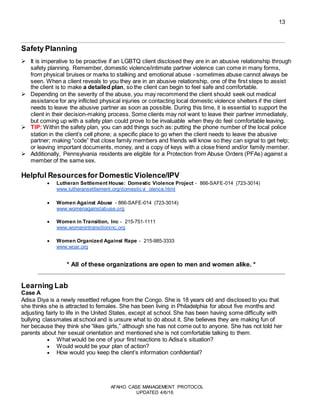
Domestic Violence/Intimate Partner Violence & LGBTQ Clients
 1 out of 4 same-sex relationships has experienced domestic violence.
 Well-Known Tactics of Abuse: Homophobia and Heterosexism
Abusive Partners May:
 Use threats to “out” partner.
 Tell partner no one will help them because of who they are.
 Tell partner they will be in trouble because they look more “masculine” or because they do not fit
into society’s traditional gender roles.
 Deny the situation based on the false notion that abuse only happens between a man and a
woman.
 LGBT abusers may monopolize support resources through an abuser's manipulation of friends and
family supports and generate sympathy and trust in order to cut off these resources to the survivor.
This is a particular issue to LGBT people and others living in small isolated communities, where
there are few community specific resources, neighborhoods or social outlets.
 Abusers of transgender victims may call them “it” or “freak”.
Victims May:
 Try to hide the abuse to prevent tarnishing the image of the LGBTQ community.
 Be reluctant to seek help from law enforcement and other systems because of the fear of being
discriminated against or mistreated just because of who they are.
 Be unaware that domestic violence organizations offer services for women and men regardless of
their sexual orientation or gender identity. (Most services are, or seem to be, for heterosexual
women.)
 Gay and lesbian victims are more likely to fight back than are heterosexual women. This can lead
law enforcement to conclude that the fighting was mutual, overlooking the larger context of domestic
violence and the history of power and control in the relationship.
 Survive in fear of being victimized by service providers (Resettlement and Post-Resettlement
Agencies, Hospitals, Welfare Offices, police, etc.)
 Transgender or intersex individuals may not feel like they will be able to find another partner who will
accept their bodies.
Reference: Women Against Abuse & Center for American Progress
12
AFAHO CASE MANAGEMENT PROTOCOL
UPDATED 4/6/16
LGBTQ Power and Control Wheel
Protection under The Violence Against Women Act (VAWA)
VAWA applies to spouses of citizens and permanent residents and also to children under 21 who have a parent
who is a permanent resident or citizen. VAWA allows these individuals to petition for permanent immigration
status without relying on the resident or citizen relative if that relative has been abusive. Survivors of same-sex
domestic violence/intimate partner violence can take advantage of protection under VAWA as of 2013.
13
AFAHO CASE MANAGEMENT PROTOCOL
UPDATED 4/6/16
Safety Planning
 It is imperative to be proactive if an LGBTQ client disclosed they are in an abusive relationship through
safety planning. Remember, domestic violence/intimate partner violence can come in many forms,
from physical bruises or marks to stalking and emotional abuse - sometimes abuse cannot always be
seen. When a client reveals to you they are in an abusive relationship, one of the first steps to assist
the client is to make a detailed plan, so the client can begin to feel safe and comfortable.
 Depending on the severity of the abuse, you may recommend the client should seek out medical
assistance for any inflicted physical injuries or contacting local domestic violence shelters if the client
needs to leave the abusive partner as soon as possible. During this time, it is essential to support the
client in their decision-making process. Some clients may not want to leave their partner immediately,
but coming up with a safety plan could prove to be invaluable when they do feel comfortable leaving.
 TIP: Within the safety plan, you can add things such as: putting the phone number of the local police
station in the client’s cell phone; a specific place to go when the client needs to leave the abusive
partner; making “code” that close family members and friends will know so they can signal to get help;
or leaving important documents, money, and a copy of keys with a close friend and/or family member.
 Additionally, Pennsylvania residents are eligible for a Protection from Abuse Orders (PFAs) against a
member of the same sex.
Helpful Resourcesfor Domestic Violence/IPV
 Lutheran Settlement House: Domestic Violence Project - 866-SAFE-014 (723-3014)
www.lutheransettlement.org/domesticvi olence.html
 Women Against Abuse - 866-SAFE-014 (723-3014)
www.womenagainstabuse.org
 Women in Transition, Inc - 215-751-1111
www.womenintransitioninc.org
 Women Organized Against Rape - 215-985-3333
www.woar.org
* All of these organizations are open to men and women alike. *
Learning Lab
Case A
Adisa Diya is a newly resettled refugee from the Congo. She is 18 years old and disclosed to you that
she thinks she is attracted to females. She has been living in Philadelphia for about five months and
adjusting fairly to life in the United States, except at school. She has been having some difficulty with
bullying classmates at school and is unsure what to do about it. She believes they are making fun of
her because they think she “likes girls,” although she has not come out to anyone. She has not told her
parents about her sexual orientation and mentioned she is not comfortable talking to them.
 What would be one of your first reactions to Adisa’s situation?
 Would would be your plan of action?
 How would you keep the client’s information confidential?
14
AFAHO CASE MANAGEMENT PROTOCOL
UPDATED 4/6/16
Case B
Taavi Obi is a 25 years old male immigrant from Ghana and has been living in Philadelphia for almost
two years. He was resettled in a neighborhood where he knows just about everyone. He has told you
that he is attracted to males and has come to AFAHO to seek assistance with housing. He feels like he
can “never be his true self” in the community he currently resides in. At the same time, you as the case
manager are friends with Taavi’s parents and feel caught in the middle of this situation.
 Do you think you should continue assisting Taavi with finding a new place to live?
Case C
Lafayette, who is 15 years old and bisexual, is being physically and emotionally abused by his father,
who will not accept his son’s sexual orientation and wants him out of the home. Lafayette’s mother
does not agree with her husband and wants Lafayette to stay in the home. What should the you do?
 What should the social worker explore with Lafayette?
 What approaches might the case manager take with this family?
 What should the social worker explore with Lafayette’s parents?
Video:
In Our Voices: The Journeys of LGBT Refugees and Asylees Video: https://vimeo.com/70976866
15
AFAHO CASE MANAGEMENT PROTOCOL
UPDATED 4/6/16
References
Appleby, G. A., & Anastas, J. W. (1998). Not just a passing phase: Social work with gay, lesbian,
and bisexual people. New York: Columbia University Press.
Center for American Progress (2016). Domestic Violence in the LGBT Community: A Fact Sheet.
Retrived from:
https://www.americanprogress.org/issues/lgbt/news/2011/06/14/9850/domestic-violence-
in-the-lgbt-community/
Davies, D. (1996). Towards a model of gay affirmative therapy. In D. Davies & C. Neal (Eds.).
Pink therapy: A guide for counselors and therapists working with lesbian, gay and bisexual
clients (pp. 24–40). Philadelphia: Open University Press.
Diverse Elders Coalition (2016). Who We Are.
Retrieved from: http://www.diverseelders.org/who-we-are/diverse-elders/black-elders/
Marzullo, Michelle A. and Alyn J. Libman (2009). Hate Crimes and Violence Against Lesbian,
Gay, Bisexual and Transgender People, Human Rights Campaign.
Retrieved from: http://hrc-assets.s3-website-us-east-
1.amazonaws.com//files/assets/resources/Hatecrimesandviolenceagainstlgbtpeople_200
9.pdf
National Association of Social Workers (2009). Moving the Margins:Training Curriculum for Child
Welfare Services with LGBTQ Youth in Out-of-Home Care.
Retreived from: http://www.socialworkers.org/diversity/outofhome/
National Research Center on LGBT Aging (2012). Inclusive Services for LGBT Older Adults A
Practical Guide To Creating Welcoming Agencies.
Retrieved from: http://www.lgbtagingcenter.org/resources/pdfs/NRC_guidebook.pdf
Rainbow Response: Heartland Alliance Field Manual (2015) A Practical Guide to Resettling
LGBT Refugees and Asylees.
Retreived from:
http://www.rainbowwelcome.org/uploads/pdfs/Rainbow%20Response_Heartland%20Allia
nce%20Field%20Manual.pdf
Tozer, E. E., & McClanahan, M. K. (1999). Treating the purple menace: Ethical considerations of
conversion therapy and affirmative alternatives. Counseling Psychologist, 27, 722–742.
Women Against Abuse (2015). LGBTQ Relationships. Education and Resources.
Retrieved from:
http://www.womenagainstabuse.org/education-resources/learn-about-abuse/lgbtq-relationships
16
AFAHO CASE MANAGEMENT PROTOCOL
UPDATED 4/6/16

LGBTQ CASE MANAGEMENT PROTOCOL-AFAHO

  • 1.
    1 AFAHO CASE MANAGEMENTPROTOCOL UPDATED 4/6/16 Important Terms to Know –  Lesbian: A female- identified person who is attracted romantically, physically, or emotionally to another female-identified person.  Gay: A person who is attracted primarily to members of the same sex. Although it can be used for any sex (e.g. gay man, gay woman, gay person), “lesbian” is sometimes the preferred term for women who are attracted to women. o Other Definition Also Used: A male-identified person who is attracted romantically, physically, or emotionally to another male-identified person  Bi-Sexual (‘Bi’): A person who is attracted romantically, physically, or emotionally to both men and women.  Transgender:A person who is a member of a gender other than that expected based on anatomical sex. They may undergo medical treatments to change their biological sex, often times to align it with their gender identity, or they may live their lives as another sex.  Queer:An umbrella term which embraces a variety of sexual preferences, orientations, and habits of those who do not adhere to the heterosexual and cisgender majority. The term queer includes, but is not exclusive to lesbians, gay men, bisexuals, trans people, and intersex persons, traditionally, this term is derogatory and hurtful, however, many people who do not adhere to sexual and/or gender norms use it to self-identify in a positive way. o Tip: In the past, the term “queer” was used in a negative way that was seen as offensive to those in the LGBT community. Do not call someone “queer” unless they identify as queer themselves.
  • 2.
    2 AFAHO CASE MANAGEMENTPROTOCOL UPDATED 4/6/16  MSM:Men who have sex with men. MSM may not identify as gay or bisexual.  WSW: Women who have sex with women. WSW may not identify as lesbians or bisexual. Other Associated Terms –  Intersex:Someone whose physical sex characteristics are not categorized as exclusively male or exclusively female.  Asexual: A person who is not attracted to anyone, or a person who does not have a sexual orientation.  Questioning: Refers to individuals who are unsure of their sexual orientation and/or gender identity.  Homosexual: A clinical term for people who are attracted to members of the same sex. However, some people find this term offensive.  Ally: A person who does not identify as LGBTQ, but supports the rights and safety of those who do.  In ‘The Closet’:Describes a person who keeps their sexual orientation or gender identity a secret from some or all people.  ‘Coming Out’: The process of acknowledging one’s sexual orientation and/or gender identity to other people. For most LGBT people this could be a lifelong process.  Sexual Orientation: A person’s primary physical, romantic, and/or emotional attraction to members of the same and/or opposite sex, including lesbian, gay, bisexual and heterosexual (straight) orientations.  Gender Identity: The gender you feel you are inside (man, woman, neither or both). For transgender people, their birth-assigned gender and their personal sense of gender identity do not match.  Homophobia: Refers to hostility, negative attitudes, and/or fear directed at LGB individuals. LGB individuals who feel shame and self-hatred because of their sexual orientation are said to experience internalized homophobia.  Transphobia: Refers to hostility, negative attitudes, and/or fear directed at transgender individuals.  Heterosexism:Describes institutionalized and systemic oppression against non-heterosexual individuals and experiences. Overview When African and Caribbean immigrants and refugees come to AFAHO, they bring diverse experiences and skills, but also stories of marginalization and oppression. Gender identity and sexual orientation could very well be a part of client’s reasoning for relocating to the United States or Philadelphia. According to the Office of Refugee Resettlement: “LGBT refugees often arrive alone and remain isolated upon resettlement because they are excluded on the grounds of both their refugee and sexual minority statuses. While other refugees enjoy the support of those with whom they share a country of origin, LGBT refugees are often separated from their ethnic and national communities.” The Human Rights Campaign has stated in 2007 alone, “1,265 LGB-biased hate crimes were reported to the FBI, which is a 6-percent increase from 2006. Bias-motivated attacks on the basis of gender identity are not tracked on the federal level.” Furthermore, it is vital to be mindful there are different definitions of what it means to ‘gay’ or ‘lesbian’ depending on the specific sexual activity one engages in. Clients may not disclose to AFAHO or family/friends for a variety of reasons including fear of ongoing harassment and discrimination. As a case manager, making the client feel comfortable and at ease by offering support and compassion is highly important. Regardless if the client has self-identified LGBTQ or
  • 3.
    3 AFAHO CASE MANAGEMENTPROTOCOL UPDATED 4/6/16 not, AFAHO staff has a responsibility to make clients feel safe and welcome in their new community. “The resettlement network must commit to preventing LGBT refugees/asylees from facing the same discrimination, barriers to accessing services, and violation of rights they [may have] experienced back home.” Dignity and Worth of the Client During the intake process with a new client, they are asked what their sexual orientation is. At this point in time, be mindful to ask questions in a nonjudgmental way.  TIP: It can help to ask: “What gender identity/sexual orientation do you most identify with?” Or “Who do you think you are most attracted to?”  “And what does that mean? Can you explain that further?”  “When did this happen?”  “Is this what you mean?” Discussion Example: An 20-year-old female refugee comes to AFAHO seeking assistance. She grew up in Algeria where same-sex relationships and cross-dressing are illegal. Because Islam does not permit homosexuality or lesbianism, the client feels excluded from many community activities and members. This female refugee has experienced some forms of abuse including being discriminated against in the Philadelphia community she resettled in.
  • 4.
    4 AFAHO CASE MANAGEMENTPROTOCOL UPDATED 4/6/16 Gay Affirmative Practice in SocialWork Gay affirmative practice ‘‘affirms a lesbian, gay, or bisexual identity as an equally positive human experience and expression to heterosexual identity’’ and provides a set of guidelines for treating gay, lesbian, and bisexual individuals in a culturally competent manner. There are social work themes in gay affirmative practice such person in environment, the strengths perspective, and various cultural competencies models.  Person in Environment: Gay, Lesbian, and Bisexual individuals are considered in the context of their many environments and the many roles they play within these environments. For example, when working with LGBTQ clients, case managers should pay attention to work and school settings, who the client discloses their gender identity and/or sexual orientation to, and the reactions they may encounter due to their disclosure.  The Strengths Perspective: Gay, Lesbian, and Bisexual individuals possess many strengths deriving from diverse past experiences. Additionally, immigrants and refugees often retain positive characteristics such as, resiliency and desire for self-determination. Those assisting LGBTQ persons can use: o Self-Determination by supporting clients’ decisions regarding how to self-identify their sexual orientation and when and to whom to disclose their sexual orientation; o Focusing on Health, not anatomy by viewing clients’ identities as gay, lesbian, or bisexual as equally healthy as heterosexual identities; and o Consciousness Raising by challenging the homophobic and heterosexist messages LGBTQ individuals have received up until this point and working with them to examine how homophobia influences their lives and the decisions they make.  Cultural Competency Models: Several theories and models suggest that culturally competent practice with diverse client populations requires a unique knowledge base, set of attitudes and beliefs, and skill base for a given population. This is applicable when working with a variety of diverse ethnic and racial populations in addition to working with immigrant and refugee populations. The Beginning Stagesof Assisting LGBTQ Clients  Building Rapport o Establishing a positive relationship with the client is one the first steps to a supportive and goal- oriented helping relationship. o Even if a client did not self-identify as a being a part of the LGBTQ community, the case manager can set the tone for a client to disclose their gender identity or sexual preference at a later time. The ultimate goal is to create a safe space for the client.  Being an Ally o As stated previously, an ally is someone who supports and/or advocates for a community of which s/he is not a member. One can be an ally to LGBTQ individuals just by accepting their sexual orientation and/or gender identity or by actively supporting them through attending
  • 5.
    5 AFAHO CASE MANAGEMENTPROTOCOL UPDATED 4/6/16 community meetings and/or educating the public of the LGBTQ immigrant and refugee population.  Learning and Growing o Learning and gaining education of the LGBTQ community is one of the best methods to understanding this population better. One simple way to obtain more knowledge is to search local LGBTQ organizations who work with the population. They could possibly conduct trainings for community members to attend and also offer educational materials online. Forming relationships with organizations can be very helpful in the future for future LGBTQ clients. Philadelphia LGBTQ Organizations:  William Way Community Center (Website: http://www.waygay.org/)  Philadelphia Black Pride (Website: http://www.phillyblackpride.org/)  Equality Pennsylvania (Website: http://equalitypa.org/)  The Attic Youth Center (Website: www.atticyouthcenter.org)  SafeGuards LGBT Health Resource Center (Phone Number: 215-985-6873; Email: GoTest@AccessMatters.org)  Trans-Health Information Center (Phone Number: 215-634-5272)  Mazzoni Center - LGBTQ Health and Wellness Center (Website: http://www.mazzonicenter.org/)  Confronting Personal Biases o We inherit various values and attitudes that shape who we are and how we interact with others. Everyday these attitudes and values are challenged by those close to us and by individuals we work on behalf of. It is important to acknowledge and question our personal biases, as well as, try to understand why we have them on a daily basis to be effective allies of the LGBTQ community. We have a professional obligation to offer quality services regardless of gender identity or sexual orientation to all AFAHO clients. o The National Association of Social Workers’ code of ethics calls for “Social workers [to] be aware of the impact on ethical decision making of their clients’ and their own personal values and cultural and religious beliefs and practices. [Social workers] should be aware of any conflicts between personal and professional values and deal with them responsibly.”  Finally, treat everyone with dignity and respect, regardless of sexual orientation and/or gender identity. It is not the job of a case manager to judge or change the views of AFAHO clients. Applying Strength-BasedCase Management Assisting LGBTQ clients is somewhat different than working with clients who do not identify as being LGBTQ, however, the strength-based approach should be used in both cases. In this instance, those who identify as LGBTQ have faced a variety of obstacles possibly stemming from their families, friends, communities, and social stigmas. As case managers, we need to acknowledge these less than positive experiences and communicate with our clients that they have support at AFAHO and in the community. Even though LGBTQ immigrant and refugees may have experienced negative behaviors toward them, try to seek out and identify positive experiences and supports the client may have currently or from the past. Acknowledging that LGBTQ individuals have many positive strengths could be the first step to making
  • 6.
    6 AFAHO CASE MANAGEMENTPROTOCOL UPDATED 4/6/16 a difference in a client’s life. It also should be mentioned that identifying as LGBTQ is only piece of someone's identity/life and does not define them as a whole. Strengths Can Be:  Personality Traits and Characteristics o Are participants motivated to work towards meeting goals? o Do they have a thirst for knowledge? o Are they optimistic? o Are they hard-working? Have a good job? o Are they focused on meeting personal and professional goals? o Do they seem adaptable to different environments and situations?  Point out the courage and resilience they possess to be able to leave their familiar surroundings for new opportunities.  Skills o Do they have the ability to speak multiple languages? o What is their education background? o Do they have a skill that makes them unique? o What have they done for employment in the past? o Are they resourceful? o Are they comfortable speaking to large groups of people?  People and Support Systems o Do they have family who is supportive of them and their sexual orientation and/or gender identity? o Do they have friends who also have been resettled? o Do they have connections to and support from the LGBT community in the US/abroad?  Resources o Do they have any economic resources? o Do they utilize the resettlement agency and its resources? o Have they utilized any LGBTQ services and programs? Case managers and other AFAHO staff members have an opportunity to help LGBT participants secure external resources as well as identify internal strengths. By doing so, case managers reframe challenging circumstances, helping to positively shape participants’ perspectives.  TIP: You can help participants reframe a situation by: o Reminding participants that the adversity they experience may be out of their control, but the power to respond to and overcome obstacles is in their hands. o Assuring participants that they have support at the agency; people are dedicated to seeing them succeed! o Helping participants consider options that are available to them in the present. o Assisting participants imagine possibilities and their vision of the future. Ask participants what they would want to try. o Helping them to cope with bullying, harassment, feelings of isolation, depression. Adapted from “The Rainbow Response Heartland Alliance Field Manual
  • 7.
    7 AFAHO CASE MANAGEMENTPROTOCOL UPDATED 4/6/16 Communicationwith LGBTQClients To support and encourage growth in clients, engaging in Active Listening can be a useful way to connect and understand a client’s experiences. Active Listening refers to: Affirming, Being Sensitive, and Clarifying Affirming Clients may divulge very personal information that is difficult for them to share. Recognize their courage by acknowledging and responding to their statements. Clients will benefit from knowing that you are invested in the conversation and that you care about their situation. TIP: Suggested responses include:  “Thank you for trusting me with this information.”  “I’m sure that was not easy for you to talk about.”  “I heard you say ________ … Is there more?” Being Sensitive Pushing clients to share more than what they are comfortable with will inhibit them from engaging in future conversations, so follow their lead as they direct discussions. They may reference past experiences that still trigger a great deal of pain, so it is important your participants know that you are listening to what they are saying and that you are registering their statements and emotions. TIP: Sample responses include:  “I am sorry you experienced that.”  “I can only imagine how hard that was for you.” Statements like, “Well, it’s all okay now,” or “All will be better here in the United States, you don’t have to worry anymore,” may unintentionally delegitimize participants’ feelings. Additionally, saying: “I know how you feel” does not truly assist the client in anyway and can seem patronizing from their perspective. Clarifying Asking questions, if appropriate, can signal that you are actively engaged in the discussion. TIP: Sample responses include:  “And what does that mean? Can you explain that further?”  “When did this happen?”  “Is this what you mean?” Use of Language Oftentimes, LGBTQ individuals may not identify as the gender/sex they were born with. At this time, case managers and other AFAHO staff members need to be mindful of using gendered pronouns with clients when appropriate. By using pronouns, the client identifies with, the client-case manager relationship, as well as the relationship the client has with AFAHO will be strengthened.
  • 8.
    8 AFAHO CASE MANAGEMENTPROTOCOL UPDATED 4/6/16  The use of identify-specific pronouns should also extend into all forms of documentation and note-taking of the client. This can assist the case manager in maintaining the use of the identified pronoun throughout the time the client is with AFAHO. Transgender True or False Quiz 1. A transgender woman is referred to as “he” or “him.” � True �� False 2. All transgender individuals undergo medical procedures to align their physical appearance with their gender identity. � True �� False 3. One can determine an individual’s preferred pronouns by judging the person’s physical appearance. � True �� False 4. ‘Crossdresser’ is the preferred term over ‘transvestite.’ � True �� False 5. Transgender individuals identify as either gay or lesbian. � True �� False Answer Key 1. False: If the person identifies as female, feminine pronouns should be used. Transgender individuals though may circumstantially alternate what pronouns they prefer, depending on where they are and how they are feeling. If your participants let you know they identify as transgender, it is best to ask them what pronouns they prefer. 2. False: Many transgender individuals never take steps to physically alter their bodies. These procedures are very expensive and often unaffordable. Others are just not interested in this transition method.
  • 9.
    9 AFAHO CASE MANAGEMENTPROTOCOL UPDATED 4/6/16 3. False: For some transgender individuals, their gender expression, or how they present themselves, does not correspond to the gender they identify as. 4. True. The term “transvestite” is known as a derogatory term. 5. False: Gender identity is different from sexual orientation. One’s gender identity does not determine who one is sexually attracted to. Transgender individuals may identify as heterosexual, gay, lesbian, or bisexual. Resource: Rainbow Response-Heartland Alliance Field Manual Safeguarding Confidentiality Because being known as an LGBTQ individual can come with its own set of barriers, clients should feel at- ease with disclosing personal information and the realities they have experienced. When immigrants and refugees are resettled within a community of the same ethnic background as themselves, acceptance within that community varies. An LGBTQ immigrant or refugee who has a support system of family and/or friends, may have a better chance of acceptance. Even if an LGBTQ client has a support system, they may still feel fear from past experiences of discrimination from the government, law enforcement, the community, family members, and friends. LGBTQ immigrants or refugees can experience subtle or overt discrimination at work and in shared spaces where others close to the same ethnic or immigrant identity may also operate in. As always, preserving client confidentiality is extremely critical as a case manager and will give peace of mind to the client. LGBTQ Youth Quick Facts  Studies estimate that LGBT teens in US high schools hear anti-gay slurs on average 26 times each day.  A third of LGBT teens experience a physical threat during the school year, many of whom feel as if they have nowhere to turn for support.  LGBT teens drop out of school at a rate three times that of straight teenagers and are three times more likely to attempt suicide than their heterosexual counterparts.  LGBTQ youth may have a hard time accessing anti-violence services because they have to hide their LGBT status from their parents, friends and teachers. Bullying LGBTQ youth experience situations of bullying and harassment in various places, but more often in school settings. As immigrants or refugees, LGBTQ youth may encounter higher levels of persecution because of their immigration status, race, or cultural practices. Additionally, physical, emotional, and even sexual violence can be experienced by an LBGTQ youth. While bullying is a common occurrence in schools, it should be taken very seriously to better assist the client. Become an “Ask able” Person: Self-awareness about personal beliefs and attitudes. + Knowledge about and appreciation of LGBTQ youth. + Competent social work and interpersonal skills. + Emphasize professional over personal values.
  • 10.
    10 AFAHO CASE MANAGEMENTPROTOCOL UPDATED 4/6/16 Tips to Discussing Bullying with Teens:  Engage youth participants in a conversation about their experiences in school. o “Have you been enjoying your classes?” o “Are you making friends?”  Youth who are bullied may feel ashamed to share this information with their case workers. Find ways to initiate discussion around bullying and harassment.  TIP: Sample suggestion for talking with Teens: “I remember when I was in school. Some of the kids weren’t very nice. Have you found this to be true in your experience also? Do any of your classmates’ bother or threaten you?” Youth and Domestic Violence/IPV LGBT youth can apply for protection under The Violence Against Women Act (VAWA) in some circumstances. It is important to refer LGBT individuals who are victims of domestic violence at the hands of a resident or citizen spouse to a lawyer. LGBTQ Youth SupportResources  The Attic Youth Center 255 S 16th St, Philadelphia, PA 19102 Phone: (215) 545-4331 Website: https://www.atticyouthcenter.org/  Y-Hep at Philadelphia FIGHT 1417 Locust Street, between Broad and 15th Streets, Philadelphia, PA 19102 Phone: 215-564-6388 Website: http://fight.org/programs/y-hep/  Covenant House Youth Shelter (For Homeless LGBTQ Youth) 31 East Armat Street Philadelphia, PA 19144 Phone: (215) 951-5411  The Pennsylvania Youth Congress (If the youth is interested in advocacy and more peer support) 1315 Spruce Street Philadelphia, PA 19107 Email: info@payouthcongress.org Website: http://payouthcongress.org/ The Elderly LGBTQPopulation Quick Facts:  Experts estimate that between 1.75 and 4 million Americans ages 60 and over are lesbian, gay, bisexual or transgender (LGBT).  The effects of a lifetime of stigma, discrimination, rejection and ridicule puts LGBT older adults at greater risk for physical and mental illnesses, and other issues including: “social isolation, depression and anxiety, poverty, chronic illnesses, delayed care-seeking, poor nutrition, and premature mortality.”
  • 11.
    11 AFAHO CASE MANAGEMENTPROTOCOL UPDATED 4/6/16  The elderly population is expected to grow in next three decades. “In 2008, African Americans made up 8.3% of the older population. By 2050, the percentage of the older population that is African American is projected to account for 11% of the older population.” The elderly LGBTQ population is one that is oftentimes overlooked and not given much thought. While AFAHO may not come across many elderly LGBTQ clients, it does not mean that they do not exist. One characteristic of the elderly LGBTQ population is discrimination and oppression have played major roles in their lives and disclosing to anyone, even later in life, may put them at a greater risk for continued homophobia and heterosexism. It is important to not assume you can identify LGBT individuals by appearances, experiences, or any other external characteristics. LGBT older adults do not all look the same way or adopt the same mannerisms or ways of dressing. They also may have past life experiences—such as being previously married or having children or grandchildren—that conflict with common assumptions about LGBT people. In addition, remember a client’s sexual orientation and gender identity are only two elements in someone’s life and do not define a person as a whole. Domestic Violence/Intimate Partner Violence & LGBTQ Clients  1 out of 4 same-sex relationships has experienced domestic violence.  Well-Known Tactics of Abuse: Homophobia and Heterosexism Abusive Partners May:  Use threats to “out” partner.  Tell partner no one will help them because of who they are.  Tell partner they will be in trouble because they look more “masculine” or because they do not fit into society’s traditional gender roles.  Deny the situation based on the false notion that abuse only happens between a man and a woman.  LGBT abusers may monopolize support resources through an abuser's manipulation of friends and family supports and generate sympathy and trust in order to cut off these resources to the survivor. This is a particular issue to LGBT people and others living in small isolated communities, where there are few community specific resources, neighborhoods or social outlets.  Abusers of transgender victims may call them “it” or “freak”. Victims May:  Try to hide the abuse to prevent tarnishing the image of the LGBTQ community.  Be reluctant to seek help from law enforcement and other systems because of the fear of being discriminated against or mistreated just because of who they are.  Be unaware that domestic violence organizations offer services for women and men regardless of their sexual orientation or gender identity. (Most services are, or seem to be, for heterosexual women.)  Gay and lesbian victims are more likely to fight back than are heterosexual women. This can lead law enforcement to conclude that the fighting was mutual, overlooking the larger context of domestic violence and the history of power and control in the relationship.  Survive in fear of being victimized by service providers (Resettlement and Post-Resettlement Agencies, Hospitals, Welfare Offices, police, etc.)  Transgender or intersex individuals may not feel like they will be able to find another partner who will accept their bodies. Reference: Women Against Abuse & Center for American Progress
  • 12.
    12 AFAHO CASE MANAGEMENTPROTOCOL UPDATED 4/6/16 LGBTQ Power and Control Wheel Protection under The Violence Against Women Act (VAWA) VAWA applies to spouses of citizens and permanent residents and also to children under 21 who have a parent who is a permanent resident or citizen. VAWA allows these individuals to petition for permanent immigration status without relying on the resident or citizen relative if that relative has been abusive. Survivors of same-sex domestic violence/intimate partner violence can take advantage of protection under VAWA as of 2013.
  • 13.
    13 AFAHO CASE MANAGEMENTPROTOCOL UPDATED 4/6/16 Safety Planning  It is imperative to be proactive if an LGBTQ client disclosed they are in an abusive relationship through safety planning. Remember, domestic violence/intimate partner violence can come in many forms, from physical bruises or marks to stalking and emotional abuse - sometimes abuse cannot always be seen. When a client reveals to you they are in an abusive relationship, one of the first steps to assist the client is to make a detailed plan, so the client can begin to feel safe and comfortable.  Depending on the severity of the abuse, you may recommend the client should seek out medical assistance for any inflicted physical injuries or contacting local domestic violence shelters if the client needs to leave the abusive partner as soon as possible. During this time, it is essential to support the client in their decision-making process. Some clients may not want to leave their partner immediately, but coming up with a safety plan could prove to be invaluable when they do feel comfortable leaving.  TIP: Within the safety plan, you can add things such as: putting the phone number of the local police station in the client’s cell phone; a specific place to go when the client needs to leave the abusive partner; making “code” that close family members and friends will know so they can signal to get help; or leaving important documents, money, and a copy of keys with a close friend and/or family member.  Additionally, Pennsylvania residents are eligible for a Protection from Abuse Orders (PFAs) against a member of the same sex. Helpful Resourcesfor Domestic Violence/IPV  Lutheran Settlement House: Domestic Violence Project - 866-SAFE-014 (723-3014) www.lutheransettlement.org/domesticvi olence.html  Women Against Abuse - 866-SAFE-014 (723-3014) www.womenagainstabuse.org  Women in Transition, Inc - 215-751-1111 www.womenintransitioninc.org  Women Organized Against Rape - 215-985-3333 www.woar.org * All of these organizations are open to men and women alike. * Learning Lab Case A Adisa Diya is a newly resettled refugee from the Congo. She is 18 years old and disclosed to you that she thinks she is attracted to females. She has been living in Philadelphia for about five months and adjusting fairly to life in the United States, except at school. She has been having some difficulty with bullying classmates at school and is unsure what to do about it. She believes they are making fun of her because they think she “likes girls,” although she has not come out to anyone. She has not told her parents about her sexual orientation and mentioned she is not comfortable talking to them.  What would be one of your first reactions to Adisa’s situation?  Would would be your plan of action?  How would you keep the client’s information confidential?
  • 14.
    14 AFAHO CASE MANAGEMENTPROTOCOL UPDATED 4/6/16 Case B Taavi Obi is a 25 years old male immigrant from Ghana and has been living in Philadelphia for almost two years. He was resettled in a neighborhood where he knows just about everyone. He has told you that he is attracted to males and has come to AFAHO to seek assistance with housing. He feels like he can “never be his true self” in the community he currently resides in. At the same time, you as the case manager are friends with Taavi’s parents and feel caught in the middle of this situation.  Do you think you should continue assisting Taavi with finding a new place to live? Case C Lafayette, who is 15 years old and bisexual, is being physically and emotionally abused by his father, who will not accept his son’s sexual orientation and wants him out of the home. Lafayette’s mother does not agree with her husband and wants Lafayette to stay in the home. What should the you do?  What should the social worker explore with Lafayette?  What approaches might the case manager take with this family?  What should the social worker explore with Lafayette’s parents? Video: In Our Voices: The Journeys of LGBT Refugees and Asylees Video: https://vimeo.com/70976866
  • 15.
    15 AFAHO CASE MANAGEMENTPROTOCOL UPDATED 4/6/16 References Appleby, G. A., & Anastas, J. W. (1998). Not just a passing phase: Social work with gay, lesbian, and bisexual people. New York: Columbia University Press. Center for American Progress (2016). Domestic Violence in the LGBT Community: A Fact Sheet. Retrived from: https://www.americanprogress.org/issues/lgbt/news/2011/06/14/9850/domestic-violence- in-the-lgbt-community/ Davies, D. (1996). Towards a model of gay affirmative therapy. In D. Davies & C. Neal (Eds.). Pink therapy: A guide for counselors and therapists working with lesbian, gay and bisexual clients (pp. 24–40). Philadelphia: Open University Press. Diverse Elders Coalition (2016). Who We Are. Retrieved from: http://www.diverseelders.org/who-we-are/diverse-elders/black-elders/ Marzullo, Michelle A. and Alyn J. Libman (2009). Hate Crimes and Violence Against Lesbian, Gay, Bisexual and Transgender People, Human Rights Campaign. Retrieved from: http://hrc-assets.s3-website-us-east- 1.amazonaws.com//files/assets/resources/Hatecrimesandviolenceagainstlgbtpeople_200 9.pdf National Association of Social Workers (2009). Moving the Margins:Training Curriculum for Child Welfare Services with LGBTQ Youth in Out-of-Home Care. Retreived from: http://www.socialworkers.org/diversity/outofhome/ National Research Center on LGBT Aging (2012). Inclusive Services for LGBT Older Adults A Practical Guide To Creating Welcoming Agencies. Retrieved from: http://www.lgbtagingcenter.org/resources/pdfs/NRC_guidebook.pdf Rainbow Response: Heartland Alliance Field Manual (2015) A Practical Guide to Resettling LGBT Refugees and Asylees. Retreived from: http://www.rainbowwelcome.org/uploads/pdfs/Rainbow%20Response_Heartland%20Allia nce%20Field%20Manual.pdf Tozer, E. E., & McClanahan, M. K. (1999). Treating the purple menace: Ethical considerations of conversion therapy and affirmative alternatives. Counseling Psychologist, 27, 722–742. Women Against Abuse (2015). LGBTQ Relationships. Education and Resources. Retrieved from: http://www.womenagainstabuse.org/education-resources/learn-about-abuse/lgbtq-relationships
  • 16.
    16 AFAHO CASE MANAGEMENTPROTOCOL UPDATED 4/6/16