Educational and
Social Issues for
LGBT Students in
U.S. Schools

Howard Johnston, Ph. D.
Secondary Education
University of South Florida

February 8, 2012
Kids Under Assault and At Risk

• LGBT students taunted, harassed, threatened,
  assaulted on a daily basis: 85% verbally harassed, 40%
  physically, 19% assaulted in past year.

• They hear anti-gay slurs 26 times a day, about every 14
  minutes.

• 31% had been threatened or injured at school in the
  last year.

• 2-3 times more likely to attempt suicide than
  heterosexual peers.
Effect on Education

• Bullied so often they cannot focus on education; afraid,
  embarrassed and ashamed to report abuse.

• More likely to skip school because of threats, abuse,
  property vandalism; 22% skipped school last month
  because they were afraid to go.

• 28% will drop out of school; 3 times the rate of peers.

• 4 out of 5 report they don’t know one supportive adult
  in school to whom they can turn for help.
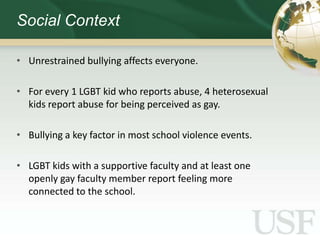
Social Context

• Unrestrained bullying affects everyone.

• For every 1 LGBT kid who reports abuse, 4 heterosexual
  kids report abuse for being perceived as gay.

• Bullying a key factor in most school violence events.

• LGBT kids with a supportive faculty and at least one
  openly gay faculty member report feeling more
  connected to the school.
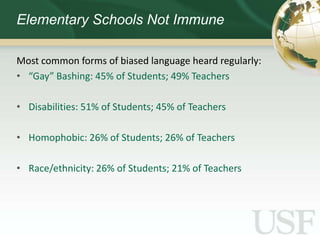
Elementary Schools Not Immune

Most common forms of biased language heard regularly:
• “Gay” Bashing: 45% of Students; 49% Teachers

• Disabilities: 51% of Students; 45% of Teachers

• Homophobic: 26% of Students; 26% of Teachers

• Race/ethnicity: 26% of Students; 21% of Teachers
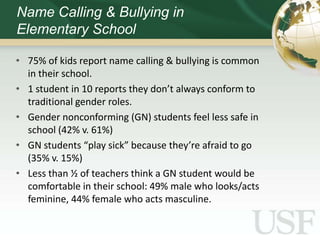
Name Calling & Bullying in
Elementary School

• 75% of kids report name calling & bullying is common
  in their school.
• 1 student in 10 reports they don’t always conform to
  traditional gender roles.
• Gender nonconforming (GN) students feel less safe in
  school (42% v. 61%)
• GN students “play sick” because they’re afraid to go
  (35% v. 15%)
• Less than ½ of teachers think a GN student would be
  comfortable in their school: 49% male who looks/acts
  feminine, 44% female who acts masculine.
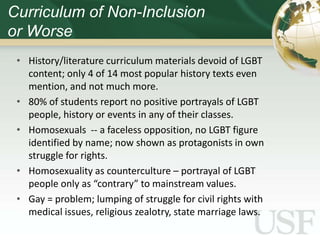
Curriculum of Non-Inclusion
or Worse
 • History/literature curriculum materials devoid of LGBT
   content; only 4 of 14 most popular history texts even
   mention, and not much more.
 • 80% of students report no positive portrayals of LGBT
   people, history or events in any of their classes.
 • Homosexuals -- a faceless opposition, no LGBT figure
   identified by name; now shown as protagonists in own
   struggle for rights.
 • Homosexuality as counterculture – portrayal of LGBT
   people only as “contrary” to mainstream values.
 • Gay = problem; lumping of struggle for civil rights with
   medical issues, religious zealotry, state marriage laws.
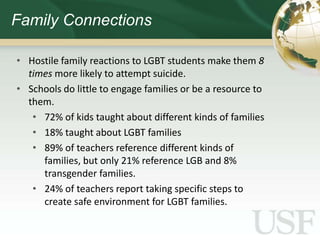
Family Connections

• Hostile family reactions to LGBT students make them 8
  times more likely to attempt suicide.
• Schools do little to engage families or be a resource to
  them.
   • 72% of kids taught about different kinds of families
   • 18% taught about LGBT families
   • 89% of teachers reference different kinds of
     families, but only 21% reference LGB and 8%
     transgender families.
   • 24% of teachers report taking specific steps to
     create safe environment for LGBT families.
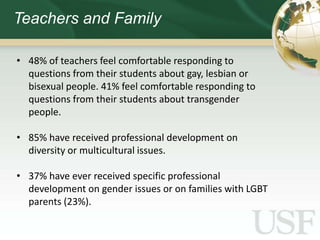
Teachers and Family

• 48% of teachers feel comfortable responding to
  questions from their students about gay, lesbian or
  bisexual people. 41% feel comfortable responding to
  questions from their students about transgender
  people.

• 85% have received professional development on
  diversity or multicultural issues.

• 37% have ever received specific professional
  development on gender issues or on families with LGBT
  parents (23%).
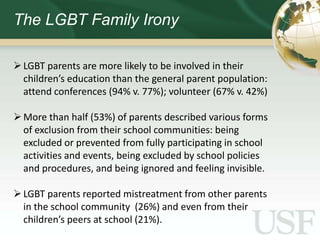
The LGBT Family Irony

 LGBT parents are more likely to be involved in their
  children’s education than the general parent population:
  attend conferences (94% v. 77%); volunteer (67% v. 42%)

 More than half (53%) of parents described various forms
  of exclusion from their school communities: being
  excluded or prevented from fully participating in school
  activities and events, being excluded by school policies
  and procedures, and being ignored and feeling invisible.

 LGBT parents reported mistreatment from other parents
  in the school community (26%) and even from their
  children’s peers at school (21%).
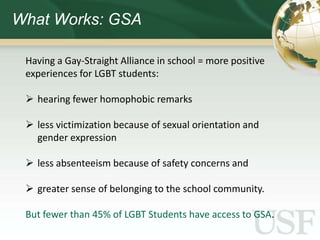
What Works: GSA

 Having a Gay-Straight Alliance in school = more positive
 experiences for LGBT students:

  hearing fewer homophobic remarks

  less victimization because of sexual orientation and
   gender expression

  less absenteeism because of safety concerns and

  greater sense of belonging to the school community.

 But fewer than 45% of LGBT Students have access to GSA.
What Works: Supportive
Staff
The presence of supportive staff contributed to:

 fewer reports of missing school

 fewer reports of feeling unsafe

 greater academic achievement

 higher educational aspirations

 greater sense of school belonging
What Works: Clear Policy

Students attending schools with an anti-bullying policy
that included protections based on sexual orientation
and/or gender identity/expression:
 heard fewer homophobic remarks
 experienced lower levels of victimization related to
   their sexual orientation
 were more likely to report that staff intervened when
   hearing homophobic remarks
 were more likely to report incidents of harassment and
   assault to school staff than students at schools with a
   general policy or no policy
Curriculum Solutions

 Tell the truth about people we already talk about.
   Jane Addams, Susan B. Anthony, James Baldwin, J. Edgar
   Hoover, Langston Hughes, Eleanor Roosevelt, Walt
   Whitman
 Broaden teaching of historic events to include LGBT
  experience.
   (1) Include material to illuminate dominant narrative,
   e.g., Rev. Wigglesworth’s Day of Doom
   (2) Help students understand how events impacted
   lives of LGBT people. (e.g., World War II and LGBT
   issues)
 Incorporate LGBT-related materials in teaching basic
  skills.
   Current events, social justice, constitutional
   protections
The Issues for Our Schools

Bullying is a public health and safety
 issue
Drop out prevention is a social &
 economic issue
Harassment is a criminal and social
 justice issue

These aren’t just LGBT issues; they
belong to all of us.
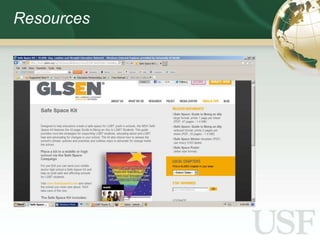
Resources


   http://www.glsen.org
Resources

Lgbt power point

  • 1.
    Educational and Social Issuesfor LGBT Students in U.S. Schools Howard Johnston, Ph. D. Secondary Education University of South Florida February 8, 2012
  • 2.
    Kids Under Assaultand At Risk • LGBT students taunted, harassed, threatened, assaulted on a daily basis: 85% verbally harassed, 40% physically, 19% assaulted in past year. • They hear anti-gay slurs 26 times a day, about every 14 minutes. • 31% had been threatened or injured at school in the last year. • 2-3 times more likely to attempt suicide than heterosexual peers.
  • 3.
    Effect on Education •Bullied so often they cannot focus on education; afraid, embarrassed and ashamed to report abuse. • More likely to skip school because of threats, abuse, property vandalism; 22% skipped school last month because they were afraid to go. • 28% will drop out of school; 3 times the rate of peers. • 4 out of 5 report they don’t know one supportive adult in school to whom they can turn for help.
  • 4.
    Social Context • Unrestrainedbullying affects everyone. • For every 1 LGBT kid who reports abuse, 4 heterosexual kids report abuse for being perceived as gay. • Bullying a key factor in most school violence events. • LGBT kids with a supportive faculty and at least one openly gay faculty member report feeling more connected to the school.
  • 5.
    Elementary Schools NotImmune Most common forms of biased language heard regularly: • “Gay” Bashing: 45% of Students; 49% Teachers • Disabilities: 51% of Students; 45% of Teachers • Homophobic: 26% of Students; 26% of Teachers • Race/ethnicity: 26% of Students; 21% of Teachers
  • 6.
    Name Calling &Bullying in Elementary School • 75% of kids report name calling & bullying is common in their school. • 1 student in 10 reports they don’t always conform to traditional gender roles. • Gender nonconforming (GN) students feel less safe in school (42% v. 61%) • GN students “play sick” because they’re afraid to go (35% v. 15%) • Less than ½ of teachers think a GN student would be comfortable in their school: 49% male who looks/acts feminine, 44% female who acts masculine.
  • 7.
    Curriculum of Non-Inclusion orWorse • History/literature curriculum materials devoid of LGBT content; only 4 of 14 most popular history texts even mention, and not much more. • 80% of students report no positive portrayals of LGBT people, history or events in any of their classes. • Homosexuals -- a faceless opposition, no LGBT figure identified by name; now shown as protagonists in own struggle for rights. • Homosexuality as counterculture – portrayal of LGBT people only as “contrary” to mainstream values. • Gay = problem; lumping of struggle for civil rights with medical issues, religious zealotry, state marriage laws.
  • 8.
    Family Connections • Hostilefamily reactions to LGBT students make them 8 times more likely to attempt suicide. • Schools do little to engage families or be a resource to them. • 72% of kids taught about different kinds of families • 18% taught about LGBT families • 89% of teachers reference different kinds of families, but only 21% reference LGB and 8% transgender families. • 24% of teachers report taking specific steps to create safe environment for LGBT families.
  • 9.
    Teachers and Family •48% of teachers feel comfortable responding to questions from their students about gay, lesbian or bisexual people. 41% feel comfortable responding to questions from their students about transgender people. • 85% have received professional development on diversity or multicultural issues. • 37% have ever received specific professional development on gender issues or on families with LGBT parents (23%).
  • 10.
    The LGBT FamilyIrony  LGBT parents are more likely to be involved in their children’s education than the general parent population: attend conferences (94% v. 77%); volunteer (67% v. 42%)  More than half (53%) of parents described various forms of exclusion from their school communities: being excluded or prevented from fully participating in school activities and events, being excluded by school policies and procedures, and being ignored and feeling invisible.  LGBT parents reported mistreatment from other parents in the school community (26%) and even from their children’s peers at school (21%).
  • 11.
    What Works: GSA Having a Gay-Straight Alliance in school = more positive experiences for LGBT students:  hearing fewer homophobic remarks  less victimization because of sexual orientation and gender expression  less absenteeism because of safety concerns and  greater sense of belonging to the school community. But fewer than 45% of LGBT Students have access to GSA.
  • 12.
    What Works: Supportive Staff Thepresence of supportive staff contributed to:  fewer reports of missing school  fewer reports of feeling unsafe  greater academic achievement  higher educational aspirations  greater sense of school belonging
  • 13.
    What Works: ClearPolicy Students attending schools with an anti-bullying policy that included protections based on sexual orientation and/or gender identity/expression:  heard fewer homophobic remarks  experienced lower levels of victimization related to their sexual orientation  were more likely to report that staff intervened when hearing homophobic remarks  were more likely to report incidents of harassment and assault to school staff than students at schools with a general policy or no policy
  • 14.
    Curriculum Solutions  Tellthe truth about people we already talk about. Jane Addams, Susan B. Anthony, James Baldwin, J. Edgar Hoover, Langston Hughes, Eleanor Roosevelt, Walt Whitman  Broaden teaching of historic events to include LGBT experience. (1) Include material to illuminate dominant narrative, e.g., Rev. Wigglesworth’s Day of Doom (2) Help students understand how events impacted lives of LGBT people. (e.g., World War II and LGBT issues)  Incorporate LGBT-related materials in teaching basic skills. Current events, social justice, constitutional protections
  • 15.
    The Issues forOur Schools Bullying is a public health and safety issue Drop out prevention is a social & economic issue Harassment is a criminal and social justice issue These aren’t just LGBT issues; they belong to all of us.
  • 16.
    Resources http://www.glsen.org
  • 17.