Foundations Roadshow
The changing face of
DFG provision in
Birmingham
Presented by
Timsey Deb & Shantina Morgan
Occupational Therapy Team Managers
The City of Birmingham
PAGE 2
 The population of Birmingham is estimated to be
approximately 1.3M with 25% of these being under the
age of 18 and 13% being aged 65+.
 The population of Birmingham is projected to increase by
7.2% between the period of 2016-2026. (Office for National
Statistics 2017 Population Estimates)
 The greatest percentage growth in Birmingham is
expected to be in the 65+ age group, with a projected
increase of up to 13.4% between 2016-2026.
 The projected increase for the 0-15 age group is 7.1%.
(Office for National Statistics Population Projections).
The City of Birmingham
 The population of Birmingham aged 18-64 predicted to have a
serious physical disability is estimated to be approximately
15K by 2025.
(From Projecting Adults Needs and Service Information).
 The total population of Birmingham aged 65 and over
predicted to have a limiting long-term illness whose day-to-
day activities would be limited is estimated to be
approximately 52K by 2025.
(From Projecting Older People Population Information).
 As a proxy measure of the number of children with a disability,
as of January 2018 the number of pupils with a
statement/Education, Health and Care Plan in Birmingham
schools was approximately 7K.
(From 2018 School Census data).
PAGE 3
Birmingham DFG Provision Prior to 2016
 Historical delivery model in place.
 In house team of OTs making recommendations for
citizens.
 In house Independent Living Service.
 Service consisted of technical officers and dedicated
admin support.
 Technical officers would be responsible for taking the OT
recommendations and devising schemes.
 Schemes passed to contractors to implement
 Technical Officer would sign off the works once
completed.
PAGE 4
2016 Decision
 A decision was made in April 2016 to split the
Independent Living Team.
 DFG provision was moved from Housing to the umbrella
of Occupational Therapy Services.
 The provision of adaptations in Council properties
remained in housing.
PAGE 5
Service Review
When the service was transferred over the following issues were
identified:
 Back logs dating back to 2013
 Technical Officers at full case load capacity
 No contingencies in place to cover sick leave and annual
leave of officers.
 Paper based systems
 It was also identified that over the years there had been a
general decline in the number of officers involved in the
service, however the number of referrals continued to
increase.
 No formal contract in place with contractors completing the
adaptations.
PAGE 6
PAGE 7
Service Review- Purpose
To identify ways to:
 Improve efficiencies of the service
 Improve on waiting times
 Provide confidence to Citizens that those working in their
property were in a contract with Birmingham City
Council.
 Ensure the most appropriate scheme was being
implemented for Citizens.
 To provide more choice for the citizens.
PAGE 8
Service Review Outcome
 It was clear that a change was required in order to be
able to address the initial issues that we identified.
 After a lot of work a decision was made to make
significant changes to the delivery of the DFG service.
Role of an Occupational Therapist
 An occupational therapist will consider all of the patient’s
needs - physical, psychological, social and
environmental. This support can make a real difference
giving people a renewed sense of purpose, opening up
new horizons, and changing the way they feel about the
future.
 An occupational therapist's skills lend themselves to new
emerging roles, such as working with asylum seekers or
refugees, working alongside police or fire services, or
liaising with psychiatric services.
PAGE 9
PAGE 10
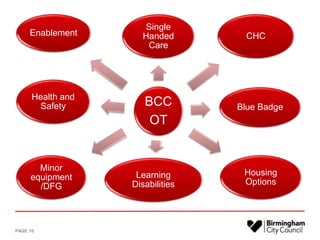
BCC
OT
Single
Handed
Care
CHC
Blue Badge
Housing
Options
Learning
Disabilities
Minor
equipment
/DFG
Health and
Safety
Enablement
New Service Overview
 The service was rebranded- Occupational Therapy
Disabled Facilities Grants (OTDFG) in 2017
 Service managed by Occupational Therapists.
 Procurement exercise was completed- a design to build
contract was put into place
 Streamlined processes
 Implemented paper light practices
PAGE 11
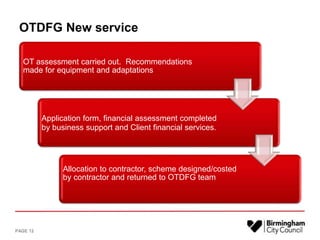
OTDFG New service
OT assessment carried out. Recommendations
made for equipment and adaptations
Application form, financial assessment completed
by business support and Client financial services.
Allocation to contractor, scheme designed/costed
by contractor and returned to OTDFG team
PAGE 12
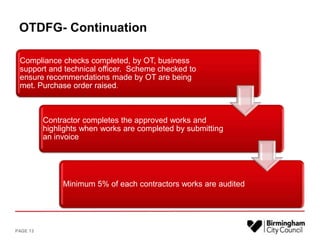
OTDFG- Continuation
Compliance checks completed, by OT, business
support and technical officer. Scheme checked to
ensure recommendations made by OT are being
met. Purchase order raised.
Contractor completes the approved works and
highlights when works are completed by submitting
an invoice
Minimum 5% of each contractors works are audited
PAGE 13
Ensuring efficiency
 Procured contract includes strict KPI
 Strict management of contractor framework
 Ability to implement sanctions should KPI’s,
overcharging or conduct elements be breached
 Contractors have the ability to meet the demands of the
service, this has been particularly noted during allocation
of additional DFG.
 Matched core role and responsibilities to reduce
duplication for example:
– Admin roles moved to designated in-house administration team
– Financial assessments moved to BCC client financial services
PAGE 14
Benefits to date
 Formal performance review of the service have not been
conducted, however initial findings are:
 Reduced waiting times for implementation of stair lifts
 Reduction in waiting times for adaptations
 More streamlined service for the citizen
 The ability to handle large amounts of cases at any one
time currently we have 1466 cases within our system at
different stages from new recommendations to works on
site.
PAGE 15
The Future for OTDFG
PAGE 16
 Move to Foundations Case Management system
 Electronic test of resources, with a view to trialling self
assessment.
 Development of a Housing Assistance policy to widen
Birmingham’s use of the DFG budget to assist citizens to
live independently.
 Finalise the Housing Assistance policy development
 Policy approved by Cabinet for implementation –
Summer 2020
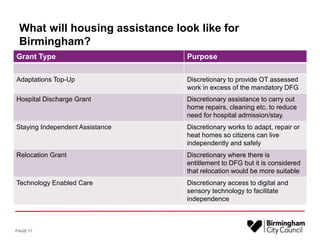
What will housing assistance look like for
Birmingham?
PAGE 17
Grant Type Purpose
Adaptations Top-Up Discretionary to provide OT assessed
work in excess of the mandatory DFG
Hospital Discharge Grant Discretionary assistance to carry out
home repairs, cleaning etc. to reduce
need for hospital admission/stay.
Staying Independent Assistance Discretionary works to adapt, repair or
heat homes so citizens can live
independently and safely
Relocation Grant Discretionary where there is
entitlement to DFG but it is considered
that relocation would be more suitable
Technology Enabled Care Discretionary access to digital and
sensory technology to facilitate
independence
Questions?
How to Contact Us?
Birmingham City Council OTDFG Team
Timsey.deb@birmingham.gov.uk
Birmingham City Council Adults OT Team
Shantina.morgan@birmingham.gov.uk
PAGE 19

DFG Roadshow - Birmingham CC

  • 1.
    Foundations Roadshow The changingface of DFG provision in Birmingham Presented by Timsey Deb & Shantina Morgan Occupational Therapy Team Managers
  • 2.
    The City ofBirmingham PAGE 2  The population of Birmingham is estimated to be approximately 1.3M with 25% of these being under the age of 18 and 13% being aged 65+.  The population of Birmingham is projected to increase by 7.2% between the period of 2016-2026. (Office for National Statistics 2017 Population Estimates)  The greatest percentage growth in Birmingham is expected to be in the 65+ age group, with a projected increase of up to 13.4% between 2016-2026.  The projected increase for the 0-15 age group is 7.1%. (Office for National Statistics Population Projections).
  • 3.
    The City ofBirmingham  The population of Birmingham aged 18-64 predicted to have a serious physical disability is estimated to be approximately 15K by 2025. (From Projecting Adults Needs and Service Information).  The total population of Birmingham aged 65 and over predicted to have a limiting long-term illness whose day-to- day activities would be limited is estimated to be approximately 52K by 2025. (From Projecting Older People Population Information).  As a proxy measure of the number of children with a disability, as of January 2018 the number of pupils with a statement/Education, Health and Care Plan in Birmingham schools was approximately 7K. (From 2018 School Census data). PAGE 3
  • 4.
    Birmingham DFG ProvisionPrior to 2016  Historical delivery model in place.  In house team of OTs making recommendations for citizens.  In house Independent Living Service.  Service consisted of technical officers and dedicated admin support.  Technical officers would be responsible for taking the OT recommendations and devising schemes.  Schemes passed to contractors to implement  Technical Officer would sign off the works once completed. PAGE 4
  • 5.
    2016 Decision  Adecision was made in April 2016 to split the Independent Living Team.  DFG provision was moved from Housing to the umbrella of Occupational Therapy Services.  The provision of adaptations in Council properties remained in housing. PAGE 5
  • 6.
    Service Review When theservice was transferred over the following issues were identified:  Back logs dating back to 2013  Technical Officers at full case load capacity  No contingencies in place to cover sick leave and annual leave of officers.  Paper based systems  It was also identified that over the years there had been a general decline in the number of officers involved in the service, however the number of referrals continued to increase.  No formal contract in place with contractors completing the adaptations. PAGE 6
  • 7.
    PAGE 7 Service Review-Purpose To identify ways to:  Improve efficiencies of the service  Improve on waiting times  Provide confidence to Citizens that those working in their property were in a contract with Birmingham City Council.  Ensure the most appropriate scheme was being implemented for Citizens.  To provide more choice for the citizens.
  • 8.
    PAGE 8 Service ReviewOutcome  It was clear that a change was required in order to be able to address the initial issues that we identified.  After a lot of work a decision was made to make significant changes to the delivery of the DFG service.
  • 9.
    Role of anOccupational Therapist  An occupational therapist will consider all of the patient’s needs - physical, psychological, social and environmental. This support can make a real difference giving people a renewed sense of purpose, opening up new horizons, and changing the way they feel about the future.  An occupational therapist's skills lend themselves to new emerging roles, such as working with asylum seekers or refugees, working alongside police or fire services, or liaising with psychiatric services. PAGE 9
  • 10.
  • 11.
    New Service Overview The service was rebranded- Occupational Therapy Disabled Facilities Grants (OTDFG) in 2017  Service managed by Occupational Therapists.  Procurement exercise was completed- a design to build contract was put into place  Streamlined processes  Implemented paper light practices PAGE 11
  • 12.
    OTDFG New service OTassessment carried out. Recommendations made for equipment and adaptations Application form, financial assessment completed by business support and Client financial services. Allocation to contractor, scheme designed/costed by contractor and returned to OTDFG team PAGE 12
  • 13.
    OTDFG- Continuation Compliance checkscompleted, by OT, business support and technical officer. Scheme checked to ensure recommendations made by OT are being met. Purchase order raised. Contractor completes the approved works and highlights when works are completed by submitting an invoice Minimum 5% of each contractors works are audited PAGE 13
  • 14.
    Ensuring efficiency  Procuredcontract includes strict KPI  Strict management of contractor framework  Ability to implement sanctions should KPI’s, overcharging or conduct elements be breached  Contractors have the ability to meet the demands of the service, this has been particularly noted during allocation of additional DFG.  Matched core role and responsibilities to reduce duplication for example: – Admin roles moved to designated in-house administration team – Financial assessments moved to BCC client financial services PAGE 14
  • 15.
    Benefits to date Formal performance review of the service have not been conducted, however initial findings are:  Reduced waiting times for implementation of stair lifts  Reduction in waiting times for adaptations  More streamlined service for the citizen  The ability to handle large amounts of cases at any one time currently we have 1466 cases within our system at different stages from new recommendations to works on site. PAGE 15
  • 16.
    The Future forOTDFG PAGE 16  Move to Foundations Case Management system  Electronic test of resources, with a view to trialling self assessment.  Development of a Housing Assistance policy to widen Birmingham’s use of the DFG budget to assist citizens to live independently.  Finalise the Housing Assistance policy development  Policy approved by Cabinet for implementation – Summer 2020
  • 17.
    What will housingassistance look like for Birmingham? PAGE 17 Grant Type Purpose Adaptations Top-Up Discretionary to provide OT assessed work in excess of the mandatory DFG Hospital Discharge Grant Discretionary assistance to carry out home repairs, cleaning etc. to reduce need for hospital admission/stay. Staying Independent Assistance Discretionary works to adapt, repair or heat homes so citizens can live independently and safely Relocation Grant Discretionary where there is entitlement to DFG but it is considered that relocation would be more suitable Technology Enabled Care Discretionary access to digital and sensory technology to facilitate independence
  • 18.
  • 19.
    How to ContactUs? Birmingham City Council OTDFG Team Timsey.deb@birmingham.gov.uk Birmingham City Council Adults OT Team Shantina.morgan@birmingham.gov.uk PAGE 19

Editor's Notes

  • #12 The new service was rebranded and under the umbrella of Occupational Therapy
  • #15 Reduced duplication of skills, as contractor have As OT we do not have the technical skills to know what it takes to build a extension, however we do have the expertise to ensure the best layouts that will meet the needs of citizens.