Delivering Care Across 
the Continuum 
Regulatory & Legislative Environment for Post-Acute Services 
Vicki Hoak, CEO, Pennsylvania Homecare Association 
September 17, 2014
Next 20 minutes… 
Today in Pennsylvania: Political Landscape 
Health Care Highlights 
Post-Acute Environment 
Moving Forward
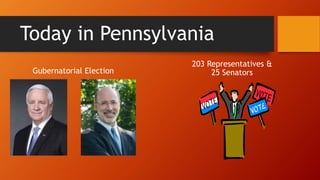
Today in Pennsylvania 
Gubernatorial Election 
25 Races 
203 Representatives & 
25 Senators
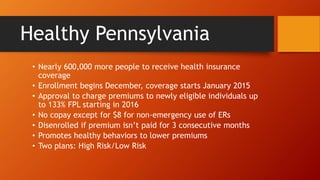
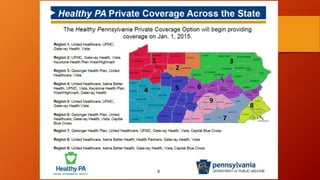
Healthy Pennsylvania 
• Nearly 600,000 more people to receive health insurance 
coverage 
• Enrollment begins December, coverage starts January 2015 
• Approval to charge premiums to newly eligible individuals up 
to 133% FPL starting in 2016 
• No copay except for $8 for non-emergency use of ERs 
• Disenrolled if premium isn’t paid for 3 consecutive months 
• Promotes healthy behaviors to lower premiums 
• Two plans: High Risk/Low Risk
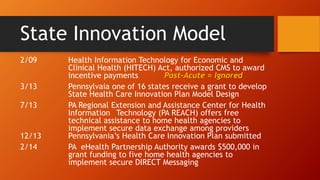
State Innovation Model 
2/09 Health Information Technology for Economic and 
Clinical Health (HITECH) Act, authorized CMS to award 
incentive payments Post-Acute = Ignored 
3/13 Pennsylvaia one of 16 states receive a grant to develop 
State Health Care Innovation Plan Model Design 
7/13 PA Regional Extension and Assistance Center for Health 
Information Technology (PA REACH) offers free 
technical assistance to home health agencies to 
implement secure data exchange among providers 
12/13 Pennsylvania’s Health Care Innovation Plan submitted 
2/14 PA eHealth Partnership Authority awards $500,000 in 
grant funding to five home health agencies to 
implement secure DIRECT Messaging
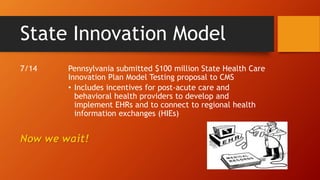
State Innovation Model 
7/14 Pennsylvania submitted $100 million State Health Care 
Innovation Plan Model Testing proposal to CMS 
• Includes incentives for post-acute care and 
behavioral health providers to develop and 
implement EHRs and to connect to regional health 
information exchanges (HIEs) 
Now we wait!
State Innovation Model 
• “A strong HIT infrastructure that allows health information to be 
shared among clinicians facilitates access to care and patient 
engagement…Pennsylvania will leverage SIM to…significantly 
increase use of HIT by providing incentives and technical 
assistance to providers in rural areas, providers with high 
Medicaid volume and those not eligible for Meaningful Use 
incentives to adopt electronic health records, connect to a 
regional health information exchange and use telemedicine as 
appropriate.” 
- Pennsylvania’s Submission 
• Adoption of EHRs among home health providers is approximately 
65%, but very few are connected to HIEs to optimize their benefits 
to patients and consumers.
If you are not at the table, 
you will be on the menu.
Where Does Post-Acute Fit? 
Triple Aim 
1. Improving patient experience 
2. Improve health of populations 
3. Reducing costs
Reducing Costs 
Why do you keep robbing banks? 
“Because that’s where the money is!” 
- Willie Sutton, notorious bank robber 
Rising Medicaid & Medicare $$$$
State Spending 
2014-15 DPW Budget 
• Medicaid spending ($8.6B) accounts for 75% of 
DPW’s budget and almost 29% of the entire 
State’s General Fund
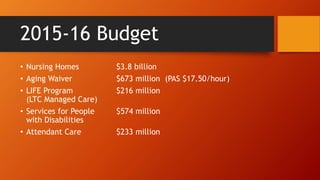
2015-16 Budget 
• Nursing Homes $3.8 billion 
• Aging Waiver $673 million (PAS $17.50/hour) 
• LIFE Program $216 million 
(LTC Managed Care) 
• Services for People $574 million 
with Disabilities 
• Attendant Care $233 million
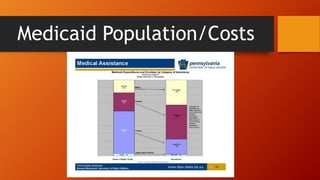
Medicaid Population/Costs
Medicaid Population/Costs 
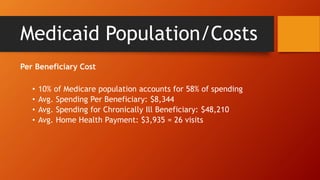
Per Beneficiary Cost 
• 10% of Medicare population accounts for 58% of spending 
• Avg. Spending Per Beneficiary: $8,344 
• Avg. Spending for Chronically Ill Beneficiary: $48,210 
• Avg. Home Health Payment: $3,935 = 26 visits
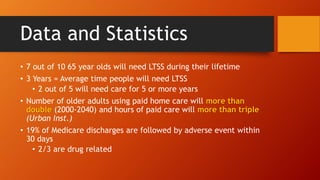
Data and Statistics 
• 7 out of 10 65 year olds will need LTSS during their lifetime 
• 3 Years = Average time people will need LTSS 
• 2 out of 5 will need care for 5 or more years 
• Number of older adults using paid home care will more than 
double (2000-2040) and hours of paid care will more than triple 
(Urban Inst.) 
• 19% of Medicare discharges are followed by adverse event within 
30 days 
• 2/3 are drug related
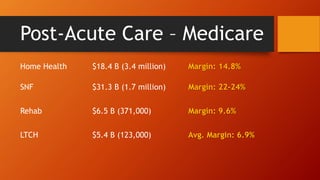
Post-Acute Care – Medicare 
Home Health $18.4 B (3.4 million) Margin: 14.8% 
SNF $31.3 B (1.7 million) Margin: 22-24% 
Rehab $6.5 B (371,000) Margin: 9.6% 
LTCH $5.4 B (123,000) Avg. Margin: 6.9%
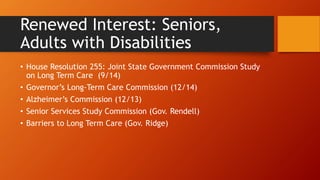
Renewed Interest: Seniors, 
Adults with Disabilities 
• House Resolution 255: Joint State Government Commission Study 
on Long Term Care (9/14) 
• Governor’s Long-Term Care Commission (12/14) 
• Alzheimer’s Commission (12/13) 
• Senior Services Study Commission (Gov. Rendell) 
• Barriers to Long Term Care (Gov. Ridge)
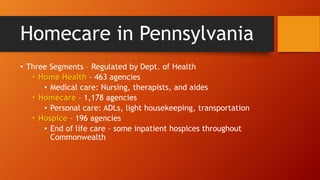
Homecare in Pennsylvania 
• Three Segments – Regulated by Dept. of Health 
• Home Health – 463 agencies 
• Medical care: Nursing, therapists, and aides 
• Homecare – 1,178 agencies 
• Personal care: ADLs, light housekeeping, transportation 
• Hospice – 196 agencies 
• End of life care – some inpatient hospices throughout 
Commonwealth
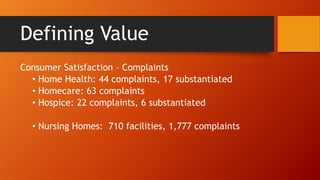
Defining Value 
Consumer Satisfaction – Complaints 
• Home Health: 44 complaints, 17 substantiated 
• Homecare: 63 complaints 
• Hospice: 22 complaints, 6 substantiated 
• Nursing Homes: 710 facilities, 1,777 complaints
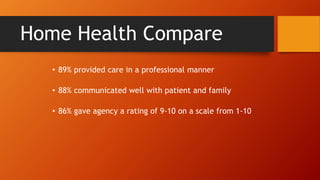
Home Health Compare 
• 89% provided care in a professional manner 
• 88% communicated well with patient and family 
• 86% gave agency a rating of 9-10 on a scale from 1-10
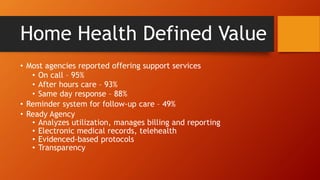
Home Health Defined Value 
• Most agencies reported offering support services 
• On call – 95% 
• After hours care – 93% 
• Same day response – 88% 
• Reminder system for follow-up care – 49% 
• Ready Agency 
• Analyzes utilization, manages billing and reporting 
• Electronic medical records, telehealth 
• Evidenced-based protocols 
• Transparency
Defining Value 
What does it take to be a good partner? 
We have to change the culture so that people are partners. In 
my experience, anything outside the hospital or medical office 
doors is a big black box. They’re (hospitals, docs) are the ones 
with most of the power, most of the dollars, so how do you 
position yourself to be a partner? 
- Richard Della Penna, MD
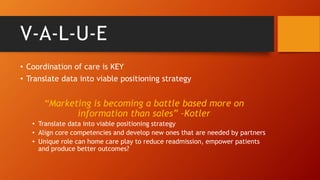
V-A-L-U-E 
• Coordination of care is KEY 
• Translate data into viable positioning strategy 
“Marketing is becoming a battle based more on 
information than sales” –Kotler 
• Translate data into viable positioning strategy 
• Align core competencies and develop new ones that are needed by partners 
• Unique role can home care play to reduce readmission, empower patients 
and produce better outcomes?
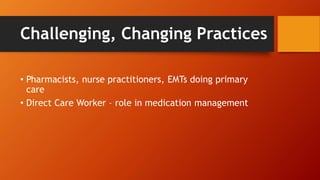
Challenging, Changing Practices 
• Pharmacists, nurse practitioners, EMTs doing primary 
care 
• Direct Care Worker – role in medication management
Emerging System 
• Creative destruction: Taking costs out of the system means taking 
money out of somebody’s pocket 
• There WILL BE some losers! 
• Hospitals account for 1/3 health care bill – target for cost cutting 
• HAP established a Family and Patient Council
Innovation in Pennsylvania 
• Pittsburgh Regional Health Initiative - $10.4M 
• 6 Primary Care Resource Centers 
• Goal: Reduce readmissions 
• Community Care Transitions – 7 
• Bundled Payments – St. Luke’s, Einstein 
• Highmark, Health Homes 
• Penn – Community Workers 
• Balancing Incentive 
• Community First Choice
Other Changes… 
• Reform Medicaid rules for eligibility 
• Allow spend down & presumptive eligibility for HCBS 
• Broaden role of direct care workers 
• Emphasis on chronic care managing, coaching 
• SNF – setting of last resort 
• Standardize assessment tool
Health Care IS Changing Colors… 
Players & payers are rearranging!
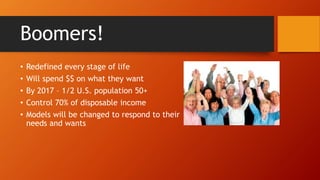
Boomers! 
• Redefined every stage of life 
• Will spend $$ on what they want 
• By 2017 – 1/2 U.S. population 50+ 
• Control 70% of disposable income 
• Models will be changed to respond to their 
needs and wants
Moving Forward 
• Release of LTC Commission Report (12/14) 
• MLTSS Demonstration – 2015-16 Budget & More! 
• Physician’s Expanded Role 
• Transitional Care and Chronic Care Management, Bi-partisan 
legislation: Better Care, Lower Cost Act 
• POLST Legislation
Post-Acute Population Models 
• Payment Reforms: Bundled payments, site neutral payments 
• Outcomes: Population Based Outcomes approach 
• Chronic Care Management - Fee for Docs 
• Electronic Health Records – integration of EHR for Post-Acute 
• Quality Measures Between Acute and Post-Acute Providers 
• 2015 Medicare Spending Per Beneficiary 
• Adverse Events – Focus on data 
• $41.92 for coordination of care
Other Thoughts 
• BACPAC – Bundling and Coordinating Post Acute Care 
• Under Medicare Part A and B 
• Establish a PAC bundle for qualifying hospital discharges . 
Instead of payment under Part A and B, there would be a single 
payment amount to a PAC coordinator, such as a hospital or 
insurance entity.
“ 
” 
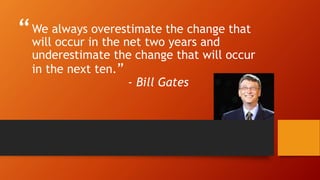
We always overestimate the change that 
will occur in the net two years and 
underestimate the change that will occur 
in the next ten.” 
- Bill Gates

Delivering Care Across the Continuum

  • 1.
    Delivering Care Across the Continuum Regulatory & Legislative Environment for Post-Acute Services Vicki Hoak, CEO, Pennsylvania Homecare Association September 17, 2014
  • 2.
    Next 20 minutes… Today in Pennsylvania: Political Landscape Health Care Highlights Post-Acute Environment Moving Forward
  • 3.
    Today in Pennsylvania Gubernatorial Election 25 Races 203 Representatives & 25 Senators
  • 4.
    Healthy Pennsylvania •Nearly 600,000 more people to receive health insurance coverage • Enrollment begins December, coverage starts January 2015 • Approval to charge premiums to newly eligible individuals up to 133% FPL starting in 2016 • No copay except for $8 for non-emergency use of ERs • Disenrolled if premium isn’t paid for 3 consecutive months • Promotes healthy behaviors to lower premiums • Two plans: High Risk/Low Risk
  • 6.
    State Innovation Model 2/09 Health Information Technology for Economic and Clinical Health (HITECH) Act, authorized CMS to award incentive payments Post-Acute = Ignored 3/13 Pennsylvaia one of 16 states receive a grant to develop State Health Care Innovation Plan Model Design 7/13 PA Regional Extension and Assistance Center for Health Information Technology (PA REACH) offers free technical assistance to home health agencies to implement secure data exchange among providers 12/13 Pennsylvania’s Health Care Innovation Plan submitted 2/14 PA eHealth Partnership Authority awards $500,000 in grant funding to five home health agencies to implement secure DIRECT Messaging
  • 7.
    State Innovation Model 7/14 Pennsylvania submitted $100 million State Health Care Innovation Plan Model Testing proposal to CMS • Includes incentives for post-acute care and behavioral health providers to develop and implement EHRs and to connect to regional health information exchanges (HIEs) Now we wait!
  • 8.
    State Innovation Model • “A strong HIT infrastructure that allows health information to be shared among clinicians facilitates access to care and patient engagement…Pennsylvania will leverage SIM to…significantly increase use of HIT by providing incentives and technical assistance to providers in rural areas, providers with high Medicaid volume and those not eligible for Meaningful Use incentives to adopt electronic health records, connect to a regional health information exchange and use telemedicine as appropriate.” - Pennsylvania’s Submission • Adoption of EHRs among home health providers is approximately 65%, but very few are connected to HIEs to optimize their benefits to patients and consumers.
  • 9.
    If you arenot at the table, you will be on the menu.
  • 10.
    Where Does Post-AcuteFit? Triple Aim 1. Improving patient experience 2. Improve health of populations 3. Reducing costs
  • 11.
    Reducing Costs Whydo you keep robbing banks? “Because that’s where the money is!” - Willie Sutton, notorious bank robber Rising Medicaid & Medicare $$$$
  • 12.
    State Spending 2014-15DPW Budget • Medicaid spending ($8.6B) accounts for 75% of DPW’s budget and almost 29% of the entire State’s General Fund
  • 13.
    2015-16 Budget •Nursing Homes $3.8 billion • Aging Waiver $673 million (PAS $17.50/hour) • LIFE Program $216 million (LTC Managed Care) • Services for People $574 million with Disabilities • Attendant Care $233 million
  • 14.
  • 15.
    Medicaid Population/Costs PerBeneficiary Cost • 10% of Medicare population accounts for 58% of spending • Avg. Spending Per Beneficiary: $8,344 • Avg. Spending for Chronically Ill Beneficiary: $48,210 • Avg. Home Health Payment: $3,935 = 26 visits
  • 16.
    Data and Statistics • 7 out of 10 65 year olds will need LTSS during their lifetime • 3 Years = Average time people will need LTSS • 2 out of 5 will need care for 5 or more years • Number of older adults using paid home care will more than double (2000-2040) and hours of paid care will more than triple (Urban Inst.) • 19% of Medicare discharges are followed by adverse event within 30 days • 2/3 are drug related
  • 17.
    Post-Acute Care –Medicare Home Health $18.4 B (3.4 million) Margin: 14.8% SNF $31.3 B (1.7 million) Margin: 22-24% Rehab $6.5 B (371,000) Margin: 9.6% LTCH $5.4 B (123,000) Avg. Margin: 6.9%
  • 18.
    Renewed Interest: Seniors, Adults with Disabilities • House Resolution 255: Joint State Government Commission Study on Long Term Care (9/14) • Governor’s Long-Term Care Commission (12/14) • Alzheimer’s Commission (12/13) • Senior Services Study Commission (Gov. Rendell) • Barriers to Long Term Care (Gov. Ridge)
  • 19.
    Homecare in Pennsylvania • Three Segments – Regulated by Dept. of Health • Home Health – 463 agencies • Medical care: Nursing, therapists, and aides • Homecare – 1,178 agencies • Personal care: ADLs, light housekeeping, transportation • Hospice – 196 agencies • End of life care – some inpatient hospices throughout Commonwealth
  • 20.
    Defining Value ConsumerSatisfaction – Complaints • Home Health: 44 complaints, 17 substantiated • Homecare: 63 complaints • Hospice: 22 complaints, 6 substantiated • Nursing Homes: 710 facilities, 1,777 complaints
  • 21.
    Home Health Compare • 89% provided care in a professional manner • 88% communicated well with patient and family • 86% gave agency a rating of 9-10 on a scale from 1-10
  • 22.
    Home Health DefinedValue • Most agencies reported offering support services • On call – 95% • After hours care – 93% • Same day response – 88% • Reminder system for follow-up care – 49% • Ready Agency • Analyzes utilization, manages billing and reporting • Electronic medical records, telehealth • Evidenced-based protocols • Transparency
  • 23.
    Defining Value Whatdoes it take to be a good partner? We have to change the culture so that people are partners. In my experience, anything outside the hospital or medical office doors is a big black box. They’re (hospitals, docs) are the ones with most of the power, most of the dollars, so how do you position yourself to be a partner? - Richard Della Penna, MD
  • 24.
    V-A-L-U-E • Coordinationof care is KEY • Translate data into viable positioning strategy “Marketing is becoming a battle based more on information than sales” –Kotler • Translate data into viable positioning strategy • Align core competencies and develop new ones that are needed by partners • Unique role can home care play to reduce readmission, empower patients and produce better outcomes?
  • 25.
    Challenging, Changing Practices • Pharmacists, nurse practitioners, EMTs doing primary care • Direct Care Worker – role in medication management
  • 26.
    Emerging System •Creative destruction: Taking costs out of the system means taking money out of somebody’s pocket • There WILL BE some losers! • Hospitals account for 1/3 health care bill – target for cost cutting • HAP established a Family and Patient Council
  • 27.
    Innovation in Pennsylvania • Pittsburgh Regional Health Initiative - $10.4M • 6 Primary Care Resource Centers • Goal: Reduce readmissions • Community Care Transitions – 7 • Bundled Payments – St. Luke’s, Einstein • Highmark, Health Homes • Penn – Community Workers • Balancing Incentive • Community First Choice
  • 28.
    Other Changes… •Reform Medicaid rules for eligibility • Allow spend down & presumptive eligibility for HCBS • Broaden role of direct care workers • Emphasis on chronic care managing, coaching • SNF – setting of last resort • Standardize assessment tool
  • 29.
    Health Care ISChanging Colors… Players & payers are rearranging!
  • 30.
    Boomers! • Redefinedevery stage of life • Will spend $$ on what they want • By 2017 – 1/2 U.S. population 50+ • Control 70% of disposable income • Models will be changed to respond to their needs and wants
  • 31.
    Moving Forward •Release of LTC Commission Report (12/14) • MLTSS Demonstration – 2015-16 Budget & More! • Physician’s Expanded Role • Transitional Care and Chronic Care Management, Bi-partisan legislation: Better Care, Lower Cost Act • POLST Legislation
  • 32.
    Post-Acute Population Models • Payment Reforms: Bundled payments, site neutral payments • Outcomes: Population Based Outcomes approach • Chronic Care Management - Fee for Docs • Electronic Health Records – integration of EHR for Post-Acute • Quality Measures Between Acute and Post-Acute Providers • 2015 Medicare Spending Per Beneficiary • Adverse Events – Focus on data • $41.92 for coordination of care
  • 33.
    Other Thoughts •BACPAC – Bundling and Coordinating Post Acute Care • Under Medicare Part A and B • Establish a PAC bundle for qualifying hospital discharges . Instead of payment under Part A and B, there would be a single payment amount to a PAC coordinator, such as a hospital or insurance entity.
  • 34.
    “ ” Wealways overestimate the change that will occur in the net two years and underestimate the change that will occur in the next ten.” - Bill Gates