LEWIS STRUCTURE OF
MOLECULAR COMPOUNDS
Ma. Christine Ruaza
THE LEWIS STRUCTURE
Electrons are located further outside of the nucleus of an atom
(see atoms of Na and F below). When atoms combine to form
compounds, the first sub-atomic particles in the atom to interact are
the electrons. The result of these electron interactions is called
chemical bonds. These chemical bonds are called ionic and covalent
bonds.
The ionic bond result from a transfer of electrons from one
species (usually a metal) to another (usually a nonmetal or polyatomic
ion). On the other hand, covalent bonds result from a sharing of
electrons by two or more atoms (usually nonmetals). This idea was the
basis for the formation of the Lewis structure proposed by Gilbert
Newton Lewis.
Lewis structure or the electron-dot structure utilizes the valence
electron and is represented by a dot.Take note that the valence electrons
are located in the outermost energy level (n) and these are the ones that
will interact first during a chemical reaction. As discussed, elements tend
to give off or accept an electron to be stable or to be a noble-gas
configuration statement is commonly known as the octet rule.
LEWIS STRUCTURE FOR MONOATOMIC ELEMENT:
Monatomic or monoatomic elements are elements that are stable as
single atoms. Mon- or Mono- means one. In order for an element to be stable
by itself, it needs to have a stable octet of valence electrons.
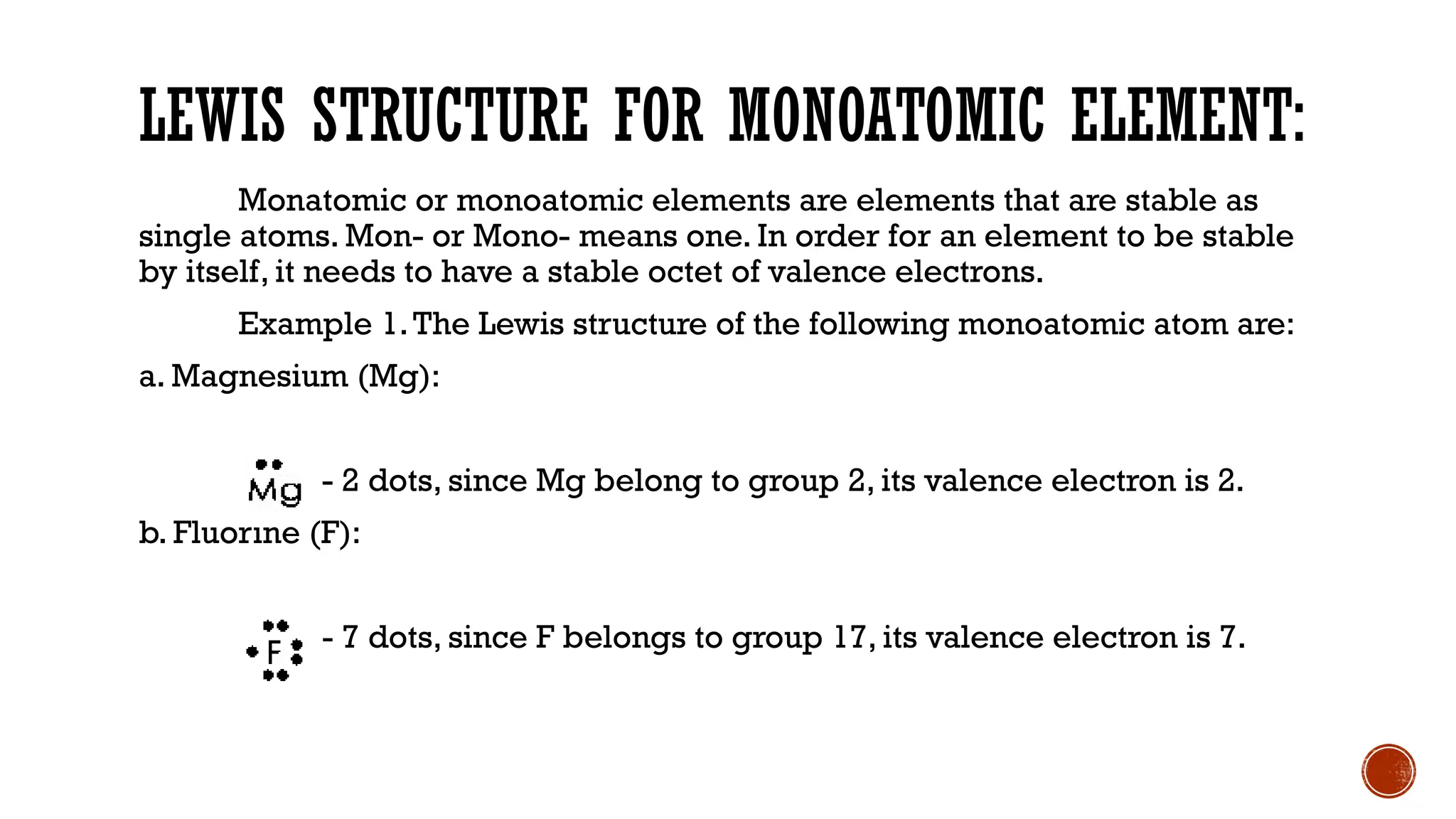
Example 1.The Lewis structure of the following monoatomic atom are:
a. Magnesium (Mg):
- 2 dots, since Mg belong to group 2, its valence electron is 2.
b. Fluorine (F):
- 7 dots, since F belongs to group 17, its valence electron is 7.
The table below makes it easier to identify the number of
valence electrons corresponding to a group. In addition, based on
the valence electron, we can also predict the charge or the oxidation
number/state of the elements. It’s worth noting that metals tend to
give off electrons to be stable and once it gives off, it becomes a
positive charge. In contrast, non-metals tend to accept electrons to
be stable and become a negative charge.
Take note that the valence electron of transition metals varies and will
not be included here.This is due to the overlapping of atomicorbitals.
You might be wondering why the oxidation number of group 18 or
noble gases is equal to zero.This is due to stability; the energy level of each
noble gas is already fully filled by electrons.That is why noble gases are
highly unreactive and do not want to give off or accept electrons in forming a
chemical bond. In addition, noble gases usually exist in nature as monoatomic.
LEWIS STRUCTURE FOR BINARY IONIC COMPOUND:
Binary ionic compounds are compounds containing two distinct atoms
and forming a bond. Since it is an ionic compound, it contains a metal that lose/s
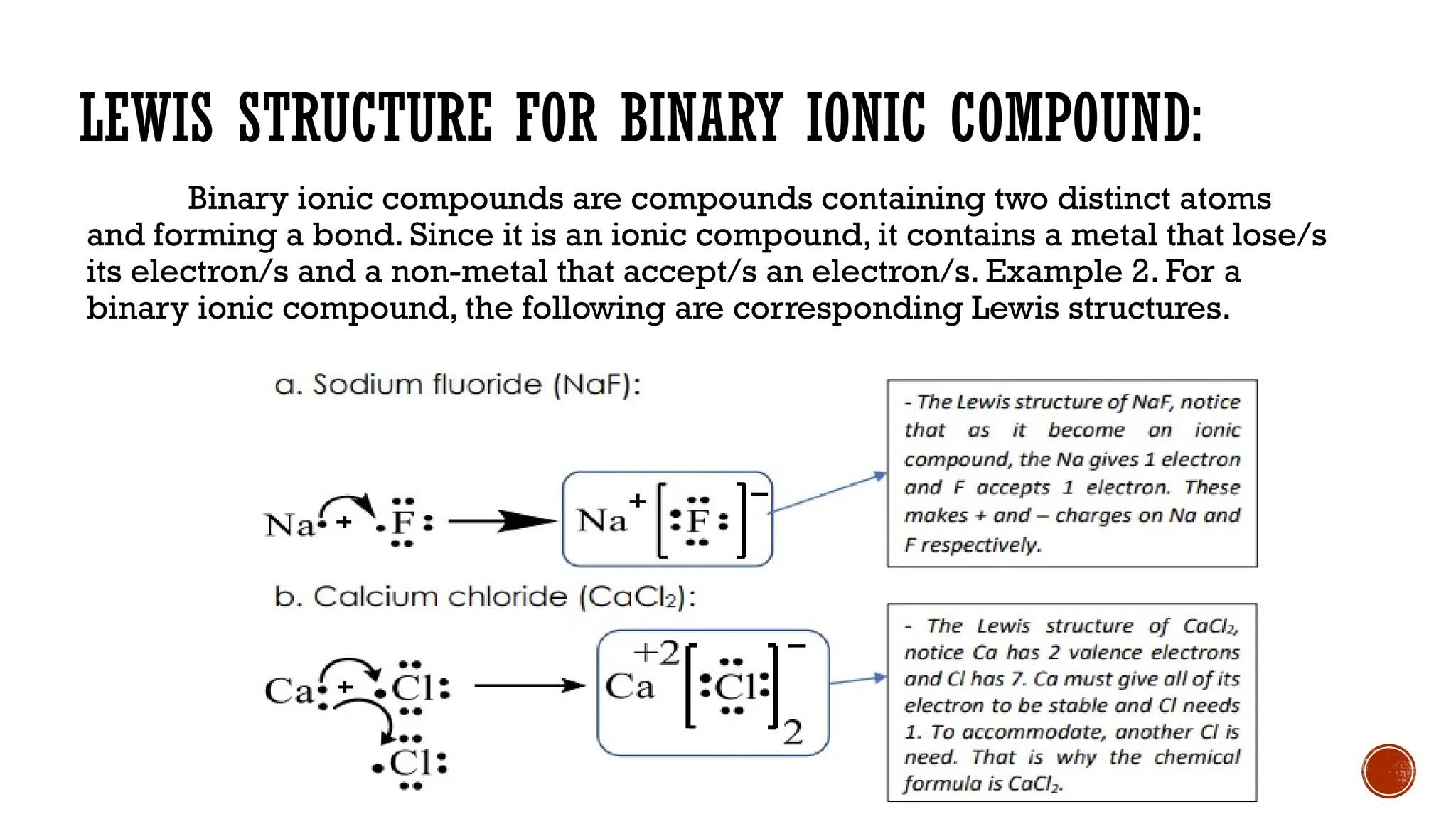
its electron/s and a non-metal that accept/s an electron/s. Example 2. For a
binary ionic compound, the following are corresponding Lewis structures.
There are ions that contain covalent bonds, covalent
bond contains a shared electron and is represented by a
line.This is in order for the atoms to satisfy their octet. One
line ( ) also known as single bonds shares 2 electrons, 2
─
lines ( ) or double bonds share 4 electrons, and triple bonds
═
( ) share 6 electrons.
≡
LEWIS STRUCTURE FOR POLYATOMIC IONS:
Polyatomic ions are covalent compounds that contain a charge,
also known as formal charges.The bonding within the atom is covalent
thus electrons are being shared between them. Example 3. For
polyatomic ions, the following are the steps in determining the Lewis
structure.
LEWIS-STRUCTURE-OF-MOLECULAR-COMPOUNDS.pptx

LEWIS-STRUCTURE-OF-MOLECULAR-COMPOUNDS.pptx

  • 1.
    LEWIS STRUCTURE OF MOLECULARCOMPOUNDS Ma. Christine Ruaza
  • 2.
    THE LEWIS STRUCTURE Electronsare located further outside of the nucleus of an atom (see atoms of Na and F below). When atoms combine to form compounds, the first sub-atomic particles in the atom to interact are the electrons. The result of these electron interactions is called chemical bonds. These chemical bonds are called ionic and covalent bonds. The ionic bond result from a transfer of electrons from one species (usually a metal) to another (usually a nonmetal or polyatomic ion). On the other hand, covalent bonds result from a sharing of electrons by two or more atoms (usually nonmetals). This idea was the basis for the formation of the Lewis structure proposed by Gilbert Newton Lewis.
  • 3.
    Lewis structure orthe electron-dot structure utilizes the valence electron and is represented by a dot.Take note that the valence electrons are located in the outermost energy level (n) and these are the ones that will interact first during a chemical reaction. As discussed, elements tend to give off or accept an electron to be stable or to be a noble-gas configuration statement is commonly known as the octet rule.
  • 4.
    LEWIS STRUCTURE FORMONOATOMIC ELEMENT: Monatomic or monoatomic elements are elements that are stable as single atoms. Mon- or Mono- means one. In order for an element to be stable by itself, it needs to have a stable octet of valence electrons. Example 1.The Lewis structure of the following monoatomic atom are: a. Magnesium (Mg): - 2 dots, since Mg belong to group 2, its valence electron is 2. b. Fluorine (F): - 7 dots, since F belongs to group 17, its valence electron is 7.
  • 5.
    The table belowmakes it easier to identify the number of valence electrons corresponding to a group. In addition, based on the valence electron, we can also predict the charge or the oxidation number/state of the elements. It’s worth noting that metals tend to give off electrons to be stable and once it gives off, it becomes a positive charge. In contrast, non-metals tend to accept electrons to be stable and become a negative charge. Take note that the valence electron of transition metals varies and will not be included here.This is due to the overlapping of atomicorbitals.
  • 6.
    You might bewondering why the oxidation number of group 18 or noble gases is equal to zero.This is due to stability; the energy level of each noble gas is already fully filled by electrons.That is why noble gases are highly unreactive and do not want to give off or accept electrons in forming a chemical bond. In addition, noble gases usually exist in nature as monoatomic.
  • 7.
    LEWIS STRUCTURE FORBINARY IONIC COMPOUND: Binary ionic compounds are compounds containing two distinct atoms and forming a bond. Since it is an ionic compound, it contains a metal that lose/s its electron/s and a non-metal that accept/s an electron/s. Example 2. For a binary ionic compound, the following are corresponding Lewis structures.
  • 8.
    There are ionsthat contain covalent bonds, covalent bond contains a shared electron and is represented by a line.This is in order for the atoms to satisfy their octet. One line ( ) also known as single bonds shares 2 electrons, 2 ─ lines ( ) or double bonds share 4 electrons, and triple bonds ═ ( ) share 6 electrons. ≡
  • 9.
    LEWIS STRUCTURE FORPOLYATOMIC IONS: Polyatomic ions are covalent compounds that contain a charge, also known as formal charges.The bonding within the atom is covalent thus electrons are being shared between them. Example 3. For polyatomic ions, the following are the steps in determining the Lewis structure.