AVHRA 
Business 
& 
Law 
Update 
December 
10, 
2014 
1
Stacy 
Luckensmeyer 
— Wenatchee 
Valley 
College 
Center 
for 
Entrepreneurship 
— Serial 
Entrepreneur
Reimi 
Marden 
— Owner/Founder 
of 
The 
Winning 
Edge, 
Image 
Consulting 
and 
Corporate 
Training 
Firm 
— 25 
years 
in 
the 
Training 
& 
Development 
industry 
— Extensive 
experience 
in 
the 
hospitality 
and 
gaming 
industries 
– 
designing 
training 
for 
hourly 
to 
Executive 
level 
team 
members 
3
Goals 
for 
Today: 
— Review 
the 
generational 
mix 
— Highlight 
generational 
similarities 
and 
ways 
to 
leverage 
differences 
— Discuss 
strategies 
to 
improve 
retention 
through 
enhanced 
recruitment 
and 
employee 
engagement 
— Share 
best 
practices 
for 
employee 
training 
design 
and 
delivery 
4
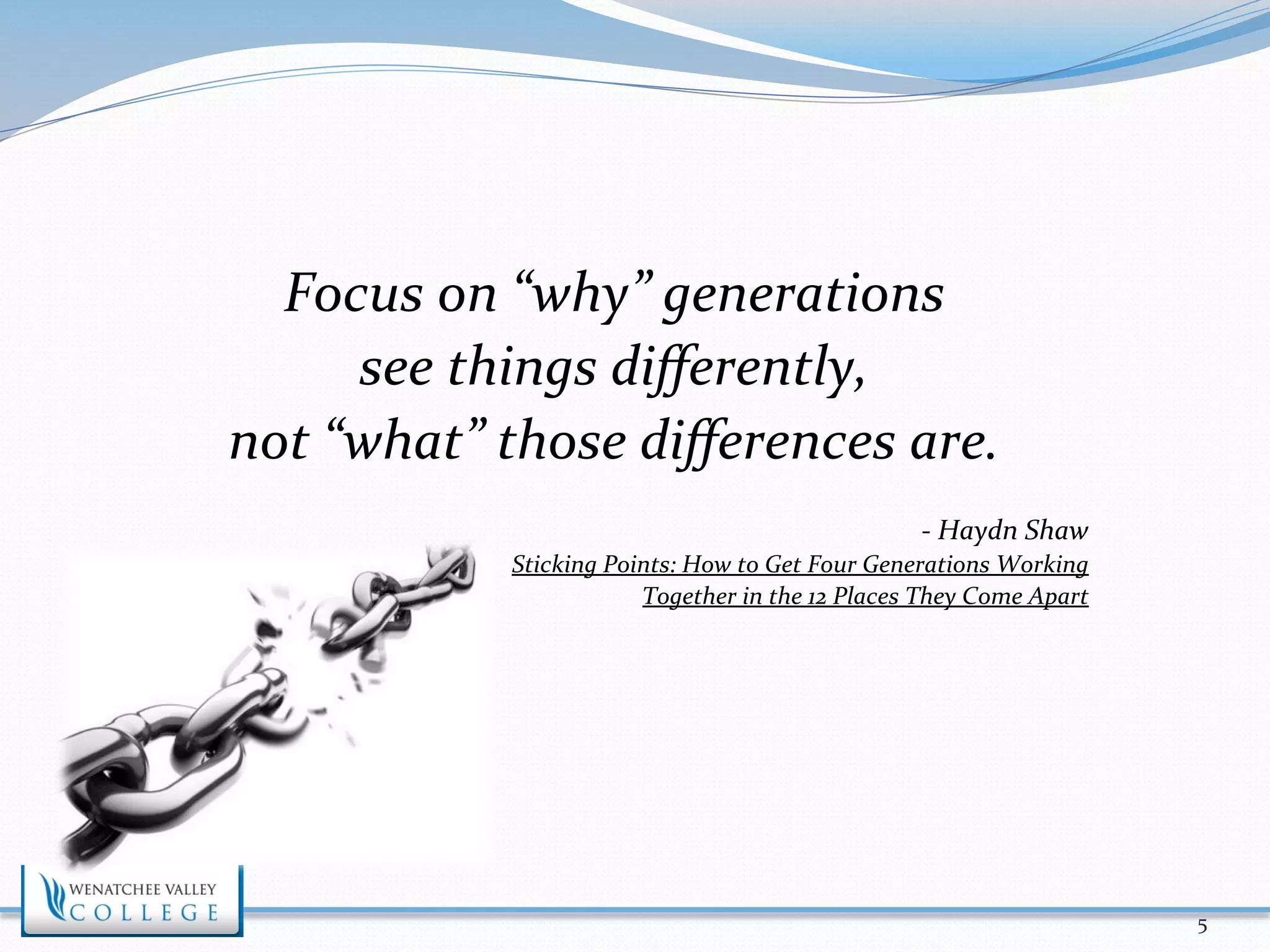
Focus 
on 
“why” 
generations 
see 
things 
differently, 
not 
“what” 
those 
differences 
are. 
-­‐ 
Haydn 
Shaw 
Sticking 
Points: 
How 
to 
Get 
Four 
Generations 
Working 
Together 
in 
the 
12 
Places 
They 
Come 
Apart 
5
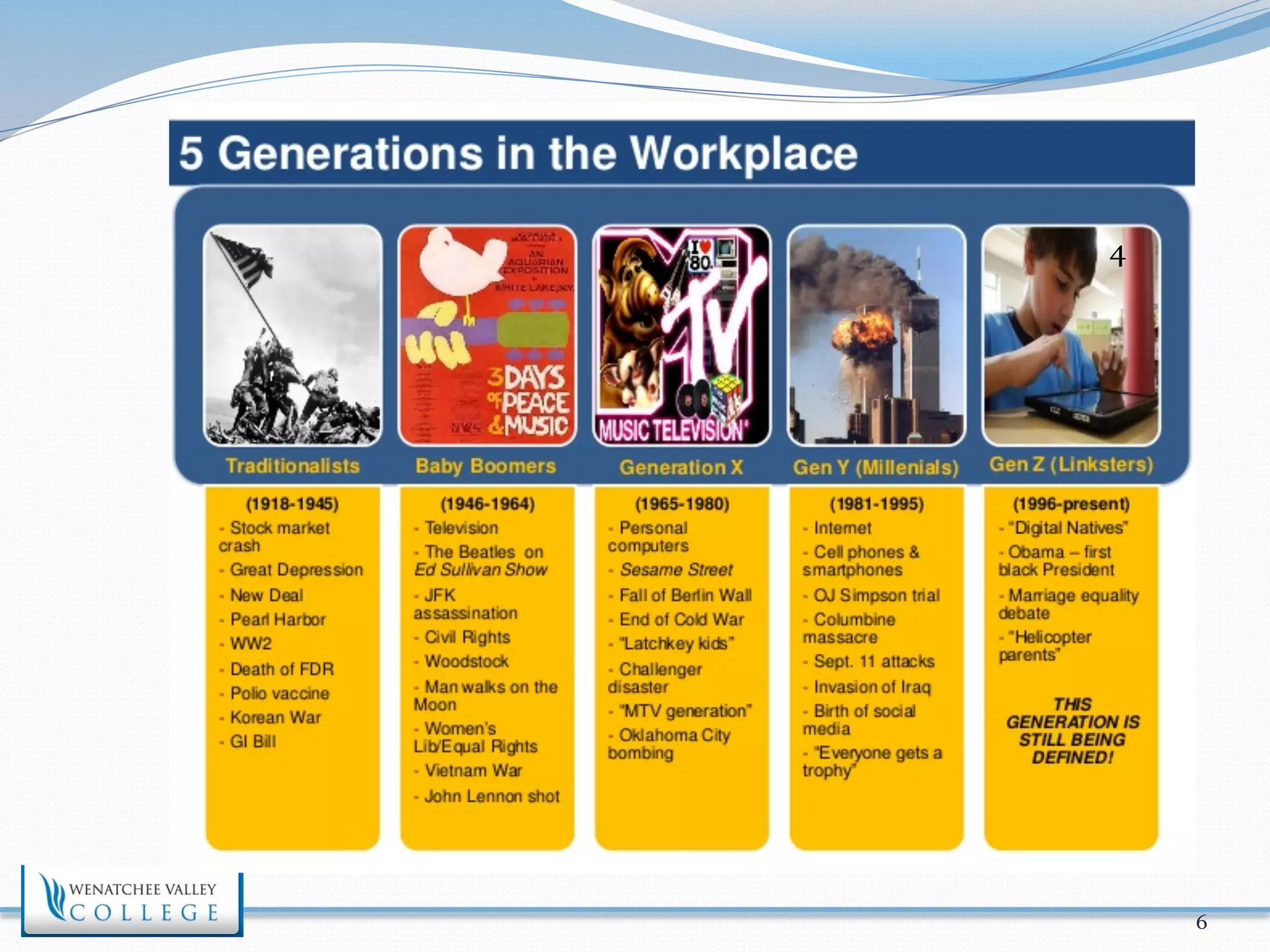
4 
6
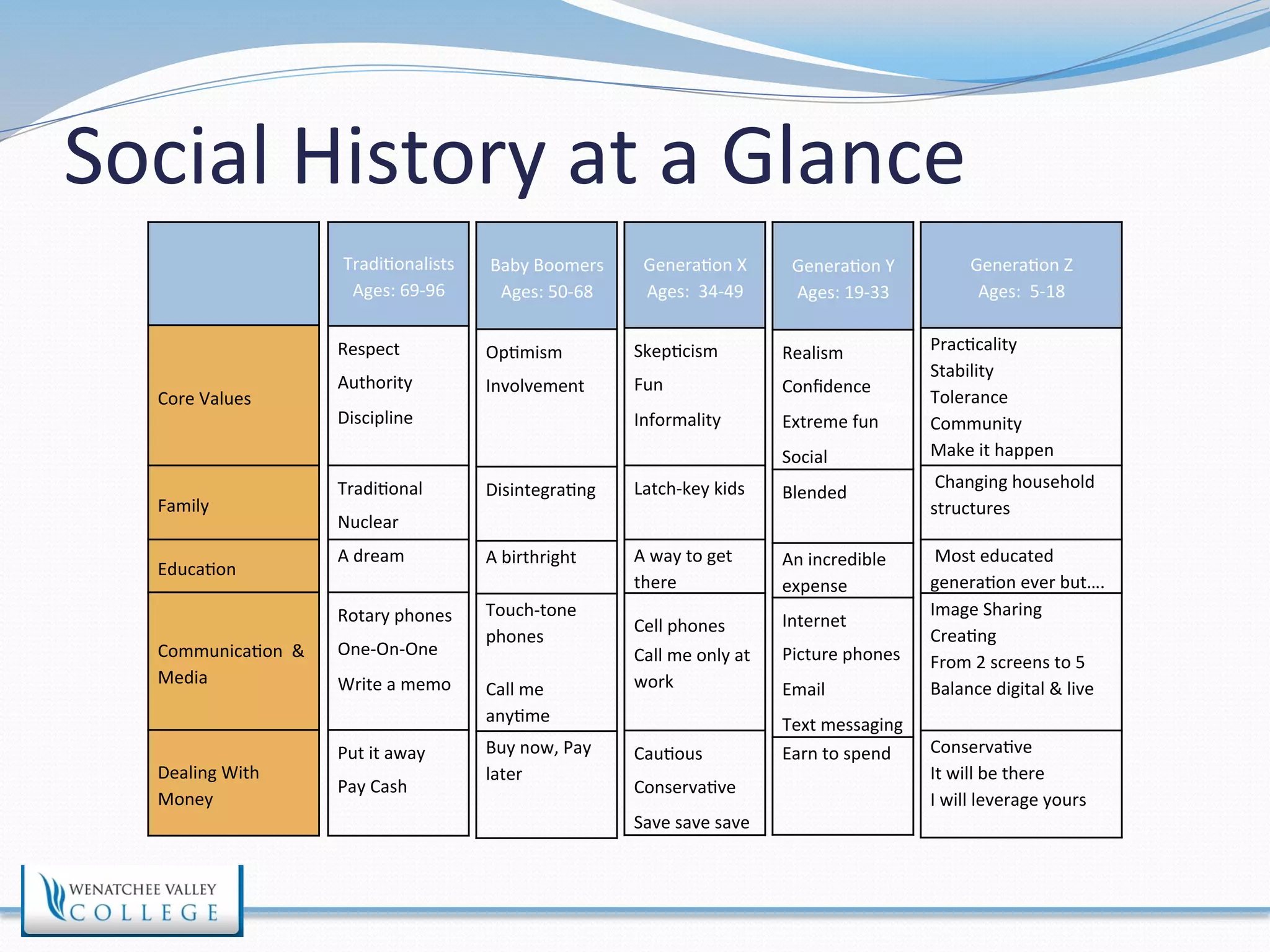
Social 
History 
at 
a 
Glance 
Core 
Values 
Family 
Educa>on 
Communica>on 
& 
Media 
Dealing 
With 
Money 
Tradi>onalists 
Ages: 
69-­‐96 
Respect 
Authority 
Discipline 
Tradi>onal 
Nuclear 
A 
dream 
Rotary 
phones 
One-­‐On-­‐One 
Write 
a 
memo 
Put 
it 
away 
Pay 
Cash 
Tradi>onalists 
Baby 
Boomers 
Ages: 
50-­‐68 
Op>mism 
Involvement 
Disintegra>ng 
A 
birthright 
Touch-­‐tone 
phones 
Call 
me 
any>me 
Buy 
now, 
Pay 
later 
Genera>on 
X 
Ages: 
34-­‐49 
Skep>cism 
Fun 
Informality 
Latch-­‐key 
kids 
A 
way 
to 
get 
there 
Cell 
phones 
Call 
me 
only 
at 
work 
Cau>ous 
Conserva>ve 
Save 
save 
save 
Genera>on 
Y 
Ages: 
19-­‐33 
Realism 
Confidence 
Extreme 
fun 
Social 
Blended 
An 
incredible 
expense 
Internet 
Picture 
phones 
Email 
Text 
messaging 
Earn 
to 
spend 
Genera>on 
Z 
Ages: 
5-­‐18 
Prac>cality 
Stability 
Tolerance 
Community 
Make 
it 
happen 
Changing 
household 
structures 
Most 
educated 
genera>on 
ever 
but…. 
Image 
Sharing 
Crea>ng 
From 
2 
screens 
to 
5 
Balance 
digital 
& 
live 
Conserva>ve 
It 
will 
be 
there 
I 
will 
leverage 
yours
A 
recent 
Time 
magazine 
article 
on 
the 
Millennials 
offered 
this 
quote 
from 
a 
forty-­‐something 
writer: 
“Veteran 
teachers 
are 
saying 
that 
never 
in 
their 
experience 
were 
young 
people 
so 
thirstily 
avid 
of 
pleasure 
as 
now…so 
selfish.” 
The 
source 
of 
the 
quote? 
A 
letter 
published 
in 
The 
Atlantic 
in 
1911. 
8
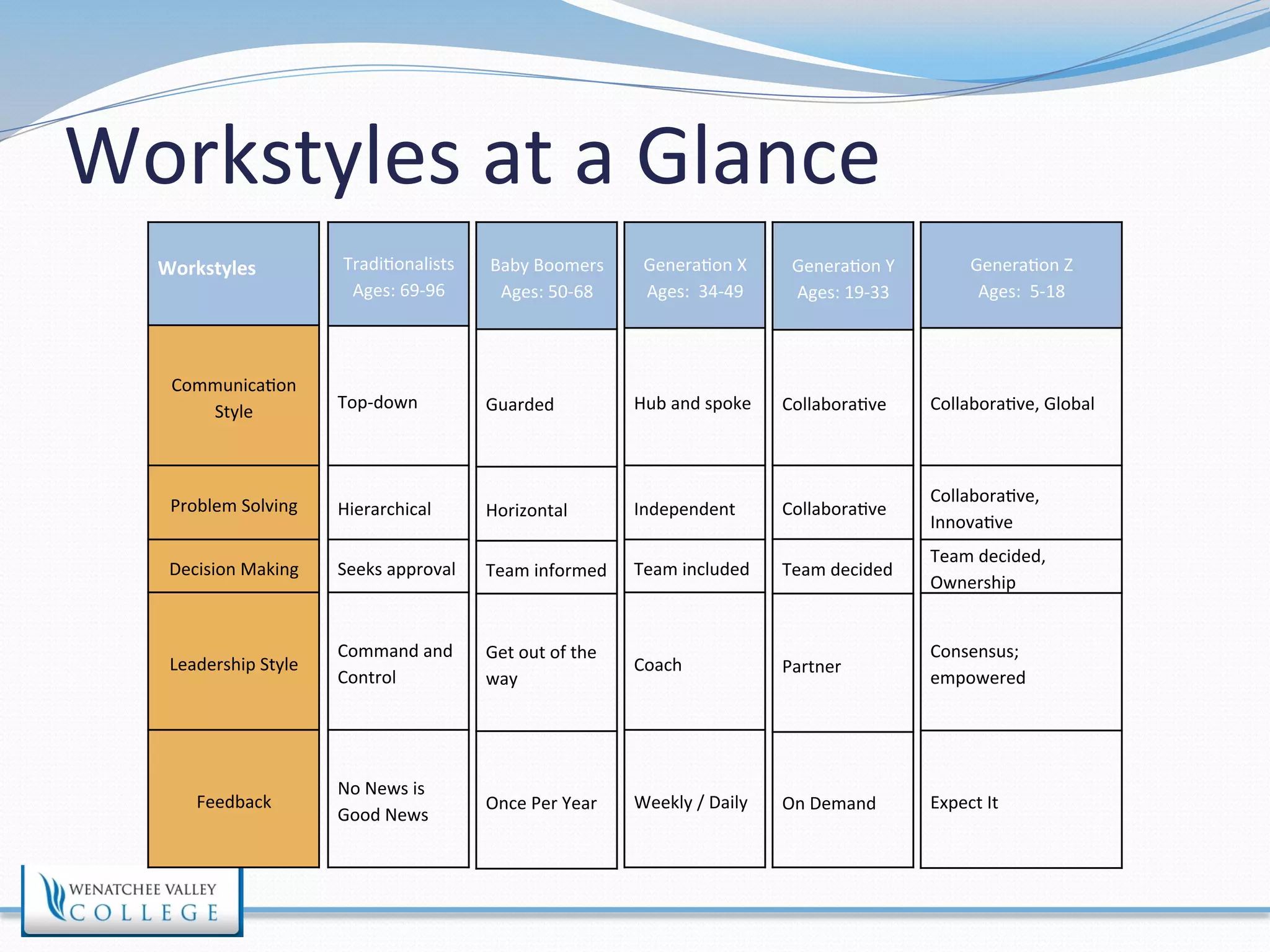
Workstyles 
at 
a 
Glance 
Workstyles 
Communica>on 
Style 
Problem 
Solving 
Decision 
Making 
Leadership 
Style 
Feedback 
Tradi>onalists 
Ages: 
69-­‐96 
Top-­‐down 
Hierarchical 
Seeks 
approval 
Command 
and 
Control 
No 
News 
is 
Good 
News 
Tradi>onalists 
Baby 
Boomers 
Ages: 
50-­‐68 
Guarded 
Horizontal 
Team 
informed 
Get 
out 
of 
the 
way 
Once 
Per 
Year 
Genera>on 
X 
Ages: 
34-­‐49 
Hub 
and 
spoke 
Independent 
Team 
included 
Coach 
Weekly 
/ 
Daily 
Genera>on 
Y 
Ages: 
19-­‐33 
Collabora>ve 
Collabora>ve 
Team 
decided 
Partner 
On 
Demand 
Genera>on 
Z 
Ages: 
5-­‐18 
Collabora>ve, 
Global 
Collabora>ve, 
Innova>ve 
Team 
decided, 
Ownership 
Consensus; 
empowered 
Expect 
It
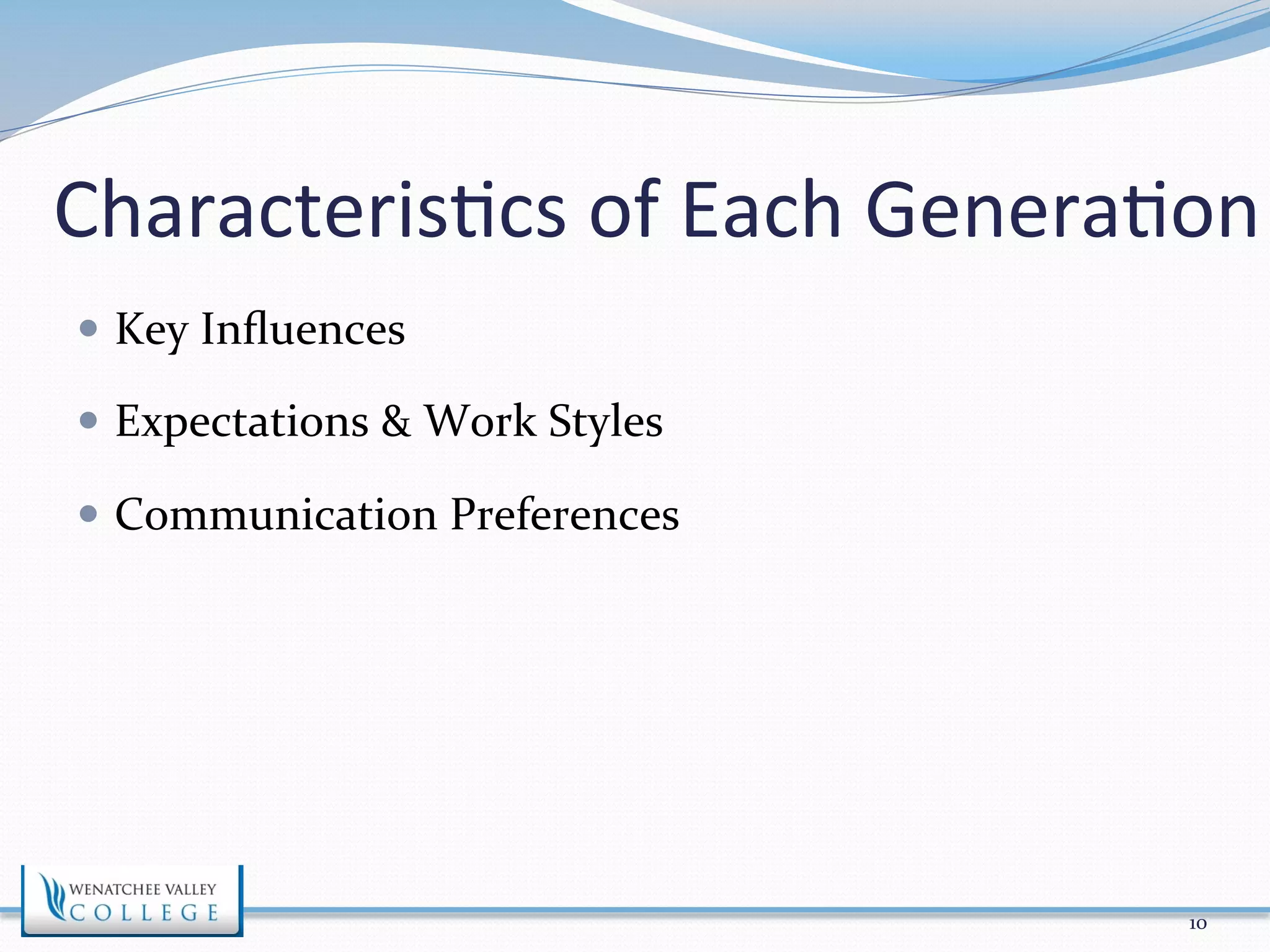
Characteris>cs 
of 
Each 
Genera>on 
— Key 
Influences 
— Expectations 
& 
Work 
Styles 
— Communication 
Preferences 
10
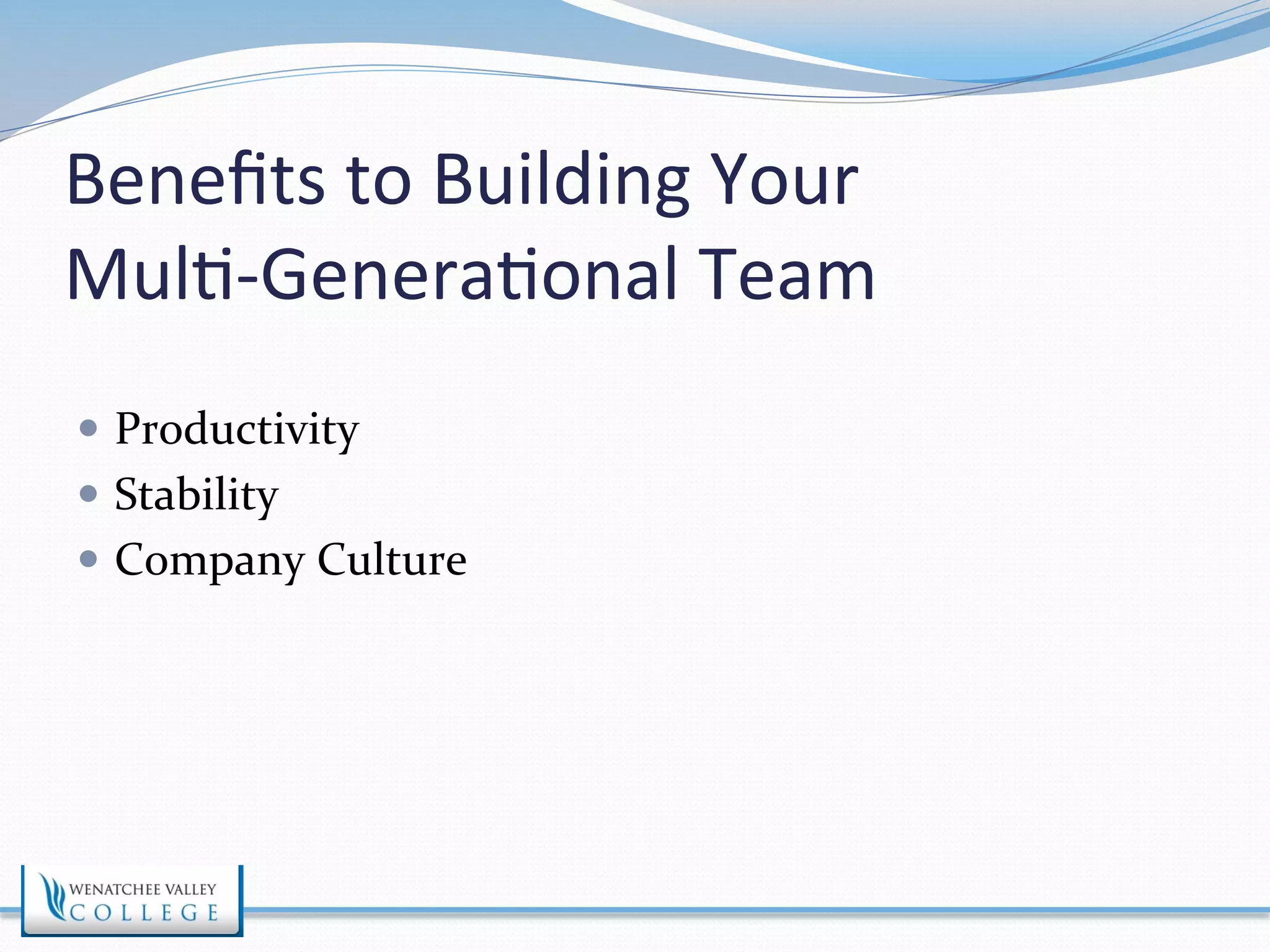
Benefits 
to 
Building 
Your 
Mul>-­‐Genera>onal 
Team 
— Productivity 
— Stability 
— Company 
Culture
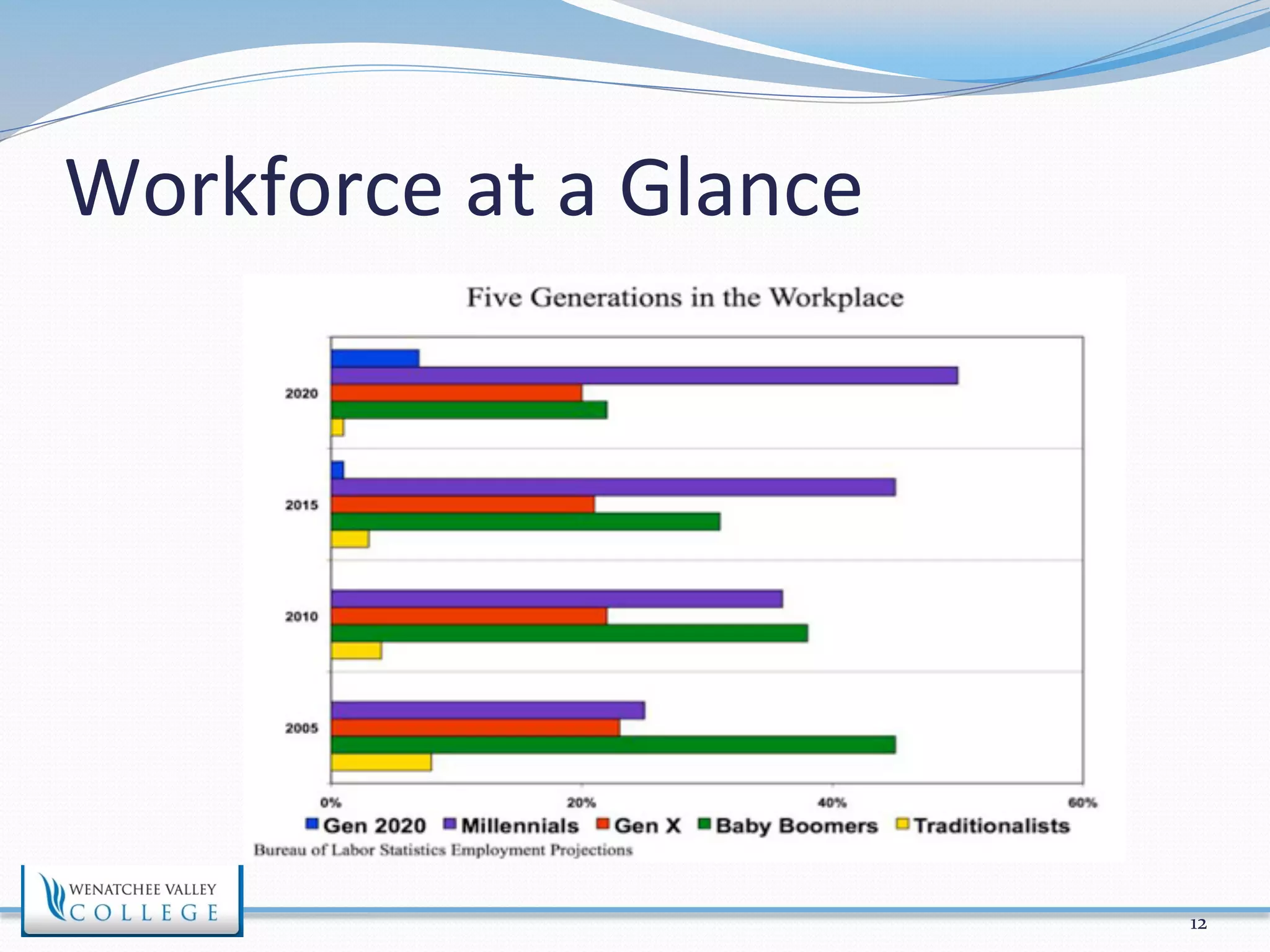
Workforce 
at 
a 
Glance 
12
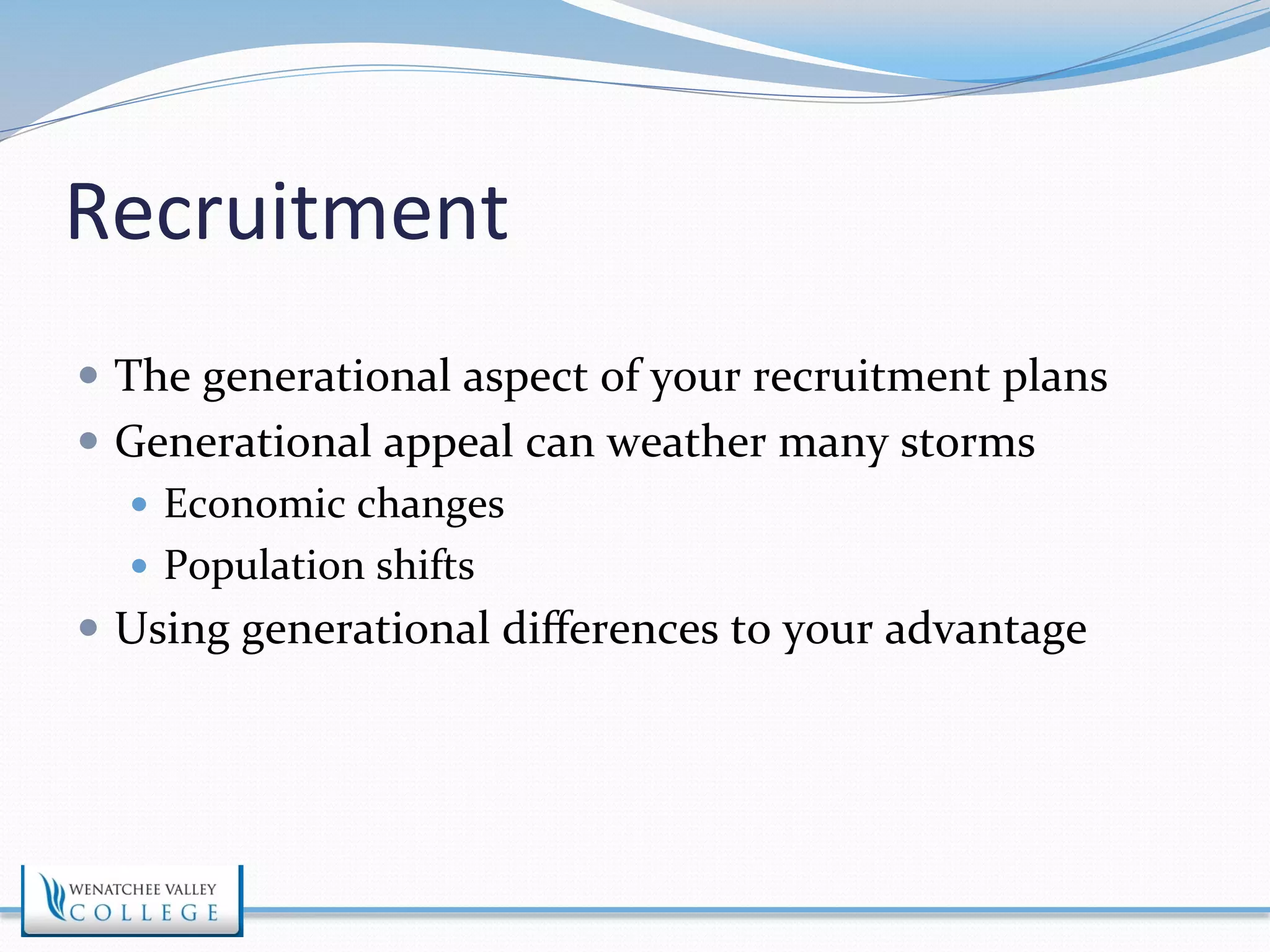
Recruitment 
— The 
generational 
aspect 
of 
your 
recruitment 
plans 
— Generational 
appeal 
can 
weather 
many 
storms 
— Economic 
changes 
— Population 
shifts 
— Using 
generational 
differences 
to 
your 
advantage
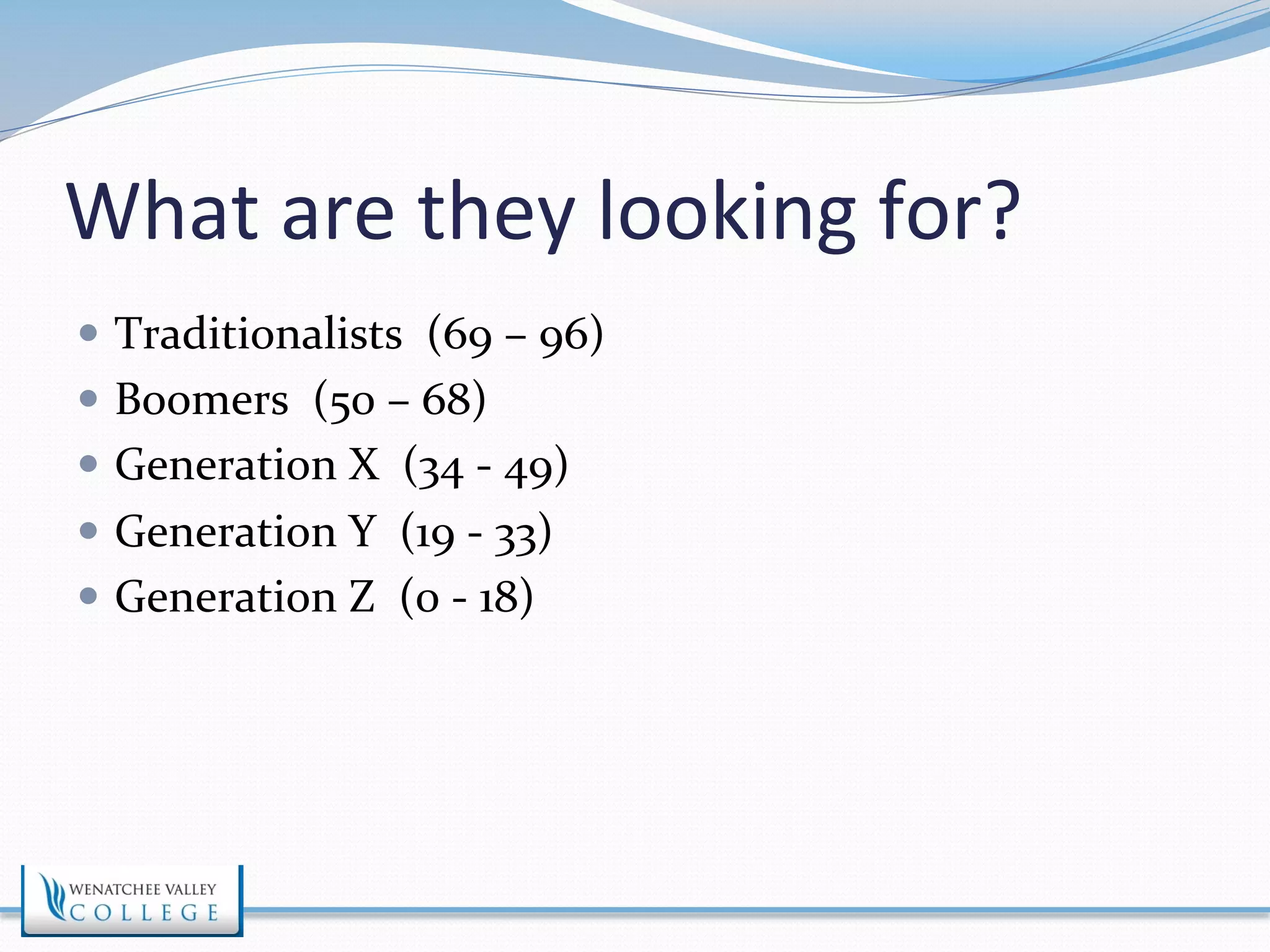
What 
are 
they 
looking 
for? 
— Traditionalists 
(69 
– 
96) 
— Boomers 
(50 
– 
68) 
— Generation 
X 
(34 
-­‐ 
49) 
— Generation 
Y 
(19 
-­‐ 
33) 
— Generation 
Z 
(0 
-­‐ 
18)
What 
do 
they 
have 
in 
common?
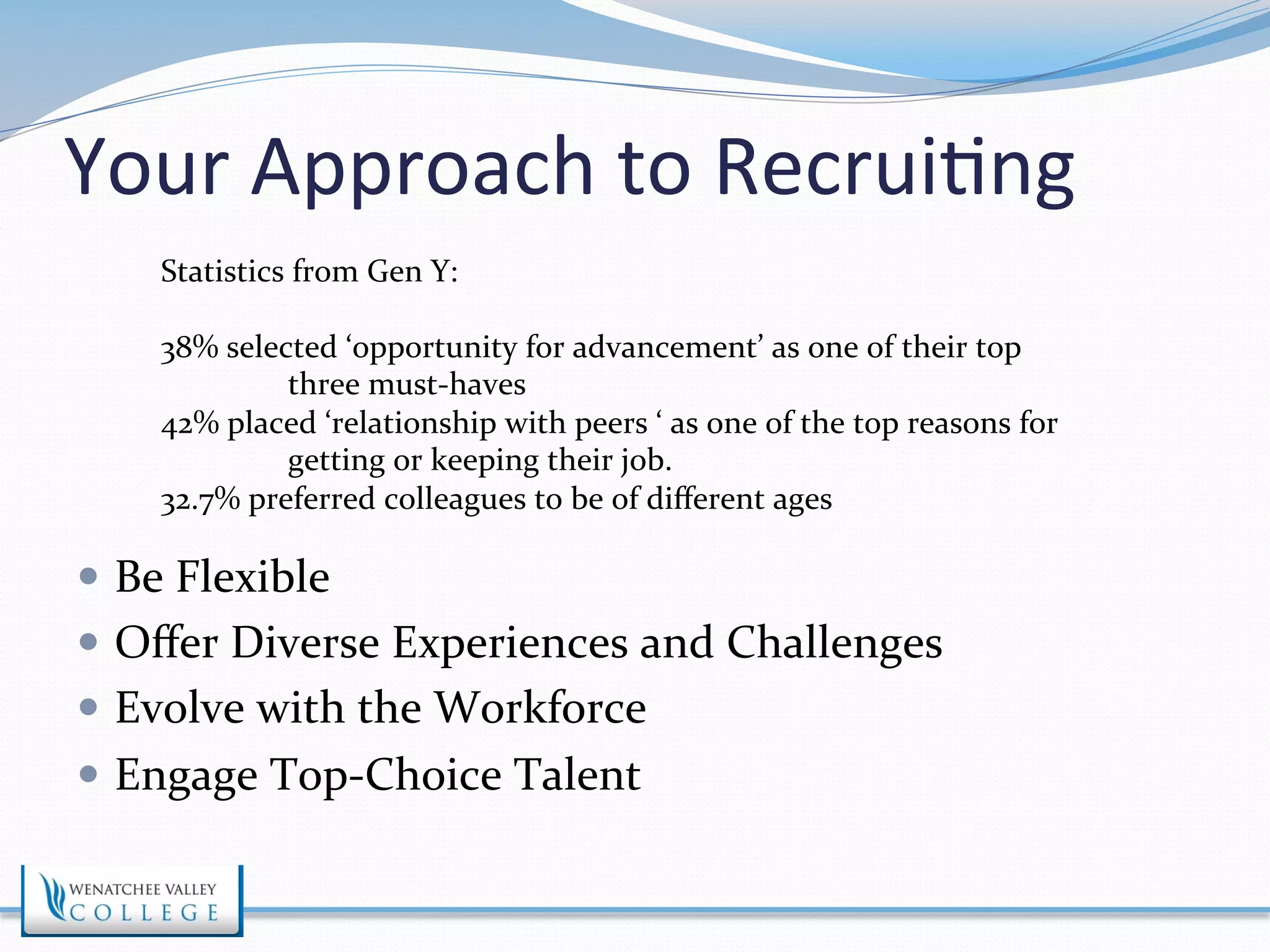
Your 
Approach 
to 
Recrui>ng 
Statistics 
from 
Gen 
Y: 
38% 
selected 
‘opportunity 
for 
advancement’ 
as 
one 
of 
their 
top 
three 
must-­‐haves 
42% 
placed 
‘relationship 
with 
peers 
‘ 
as 
one 
of 
the 
top 
reasons 
for 
getting 
or 
keeping 
their 
job. 
32.7% 
preferred 
colleagues 
to 
be 
of 
different 
ages 
— Be 
Flexible 
— Offer 
Diverse 
Experiences 
and 
Challenges 
— Evolve 
with 
the 
Workforce 
— Engage 
Top-­‐Choice 
Talent
Reten>on 
— Employee 
Engagement 
— Employee 
Satisfaction
Engagement 
Strategies 
— Acknowledge 
shared 
needs 
— Create 
a 
sense 
of 
teamwork 
that 
spans 
generations 
— Give 
employees 
meaningful 
and 
ongoing 
feedback 
— Recognition 
and 
reward 
— Adopt 
participative 
decision 
making 
and 
problem 
solving 
— Update 
company 
policies 
/ 
unwritten 
rules
Training 
Design 
& 
Delivery 
The 
most 
powerful 
tool 
to 
build 
commitment 
-­‐-­‐-­‐ 
— Offering 
regular 
opportunities 
to 
learn 
and 
develop 
— 
not 
just 
through 
training, 
but 
through 
a 
variety 
of 
challenging 
tasks 
— The 
opportunity 
to 
work 
with 
people 
who 
impart 
valuable 
knowledge, 
and 
regular 
developmental 
feedback. 
— As 
it 
turns 
out, 
this 
is 
how 
you 
build 
commitment 
in 
employees 
of 
all 
ages. 
19
LTeradia/onralinst 
&i 
Bnabyg 
Styles 
Boomers 
Gen 
Xers 
Gen 
Y/Millenials 
Gen 
Z 
Classroom 
Facilitated 
Independent 
Collaborated/Networked 
Values 
tradi>onal 
training 
Instructor-­‐led, 
Classroom-­‐ 
based 
learning 
programs 
Willing 
to 
adopt 
technology 
based 
learning 
formats 
(i.e 
e-­‐learning 
that 
provides 
greater 
flexibility) 
Relies 
heavily 
on 
collaboration 
with 
peers 
as 
a 
form 
of 
learning. 
Content 
can 
be 
accessed 
through 
technology 
anywhere, 
and 
ogen 
in 
very 
visual, 
engaging 
forms 
View 
educa>on 
and 
training 
as 
a 
perk 
or 
a 
way 
to 
get 
ahead 
of 
the 
pack 
Life 
long 
learner 
Expects 
con>nuous 
access 
to 
training 
and 
business 
communica>ons 
Expect 
to 
have 
access 
to 
technology; 
learning 
needs 
to 
be 
hands-­‐on, 
interactive, 
collaborative, 
and 
fun. 
Teaching 
and 
learning 
is 
designed 
to 
accommodate 
the 
needs 
of 
the 
student, 
is 
cri>cal 
Best 
to 
use 
them 
as 
classroom 
instructors 
or 
mentors 
Prefers 
short, 
highly-­‐ 
focused 
training 
that 
can 
be 
quickly 
downloaded 
and 
accessed 
via 
mobile 
phones, 
PDAs, 
or 
MP3 
players. 
Responds 
well 
to 
the 
engaging, 
compe>>ve 
nature 
of 
games 
and 
simula>ons 
and 
already 
is 
accustomed 
to 
using 
informal 
social 
networking 
tools, 
such 
as 
wikis, 
blogs, 
podcasts 
Discussion 
and 
applica>on 
of 
the 
content 
is 
cri>cal, 
learning 
takes 
place 
outside 
the 
classroom, 
but 
the 
essen>al 
engagement 
and 
prac>ce 
is 
s>ll 
conducted 
at 
school. 
20
Training 
Design 
& 
Delivery 
— Revise 
learning 
approaches 
to 
accommodate 
the 
younger 
workforce 
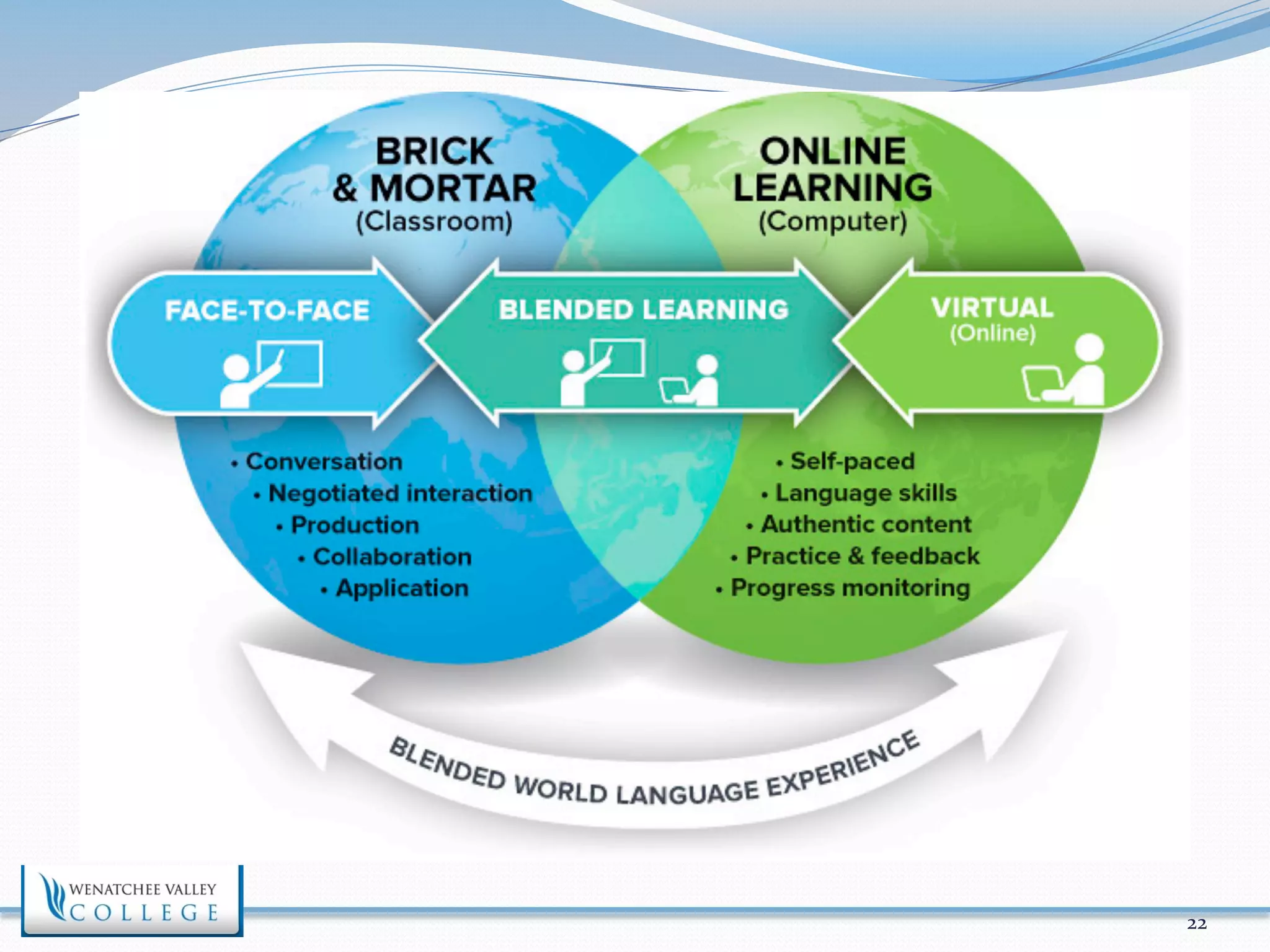
— Seek 
Blended 
Learning 
Methods 
— Seek 
Active 
Learning 
Methods 
21
22
Mix 
of 
Training 
Modali>es 
— Coaching: 
Up 
and 
down 
/ 
Influence 
— Mentoring: 
Bonding 
younger 
and 
older 
workers 
— Giving 
Feedback: 
Frequent 
/ 
on-­‐going 
/ 
celebrate 
accomplishments 
— Stretch 
Assignments: 
Encourage 
employee 
engagement 
— Classroom 
and 
online 
delivered 
courses 
23
Team 
Building 
Ac>vi>es 
to 
Strengthen 
Cohesion 
& 
Performance 
(See 
Appendix) 
24
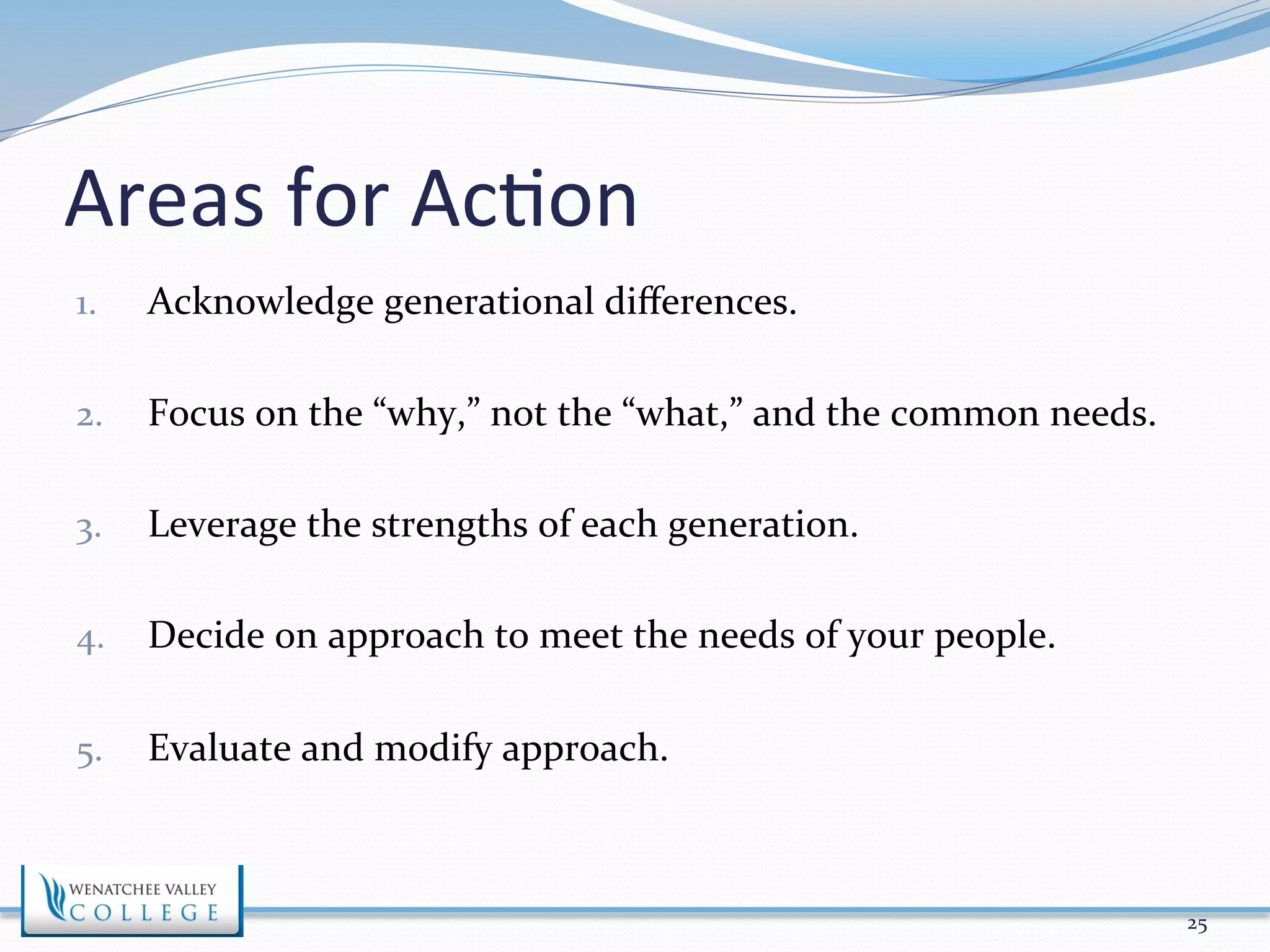
Areas 
for 
Ac>on 
25 
1. Acknowledge 
generational 
differences. 
2. Focus 
on 
the 
“why,” 
not 
the 
“what,” 
and 
the 
common 
needs. 
3. Leverage 
the 
strengths 
of 
each 
generation. 
4. Decide 
on 
approach 
to 
meet 
the 
needs 
of 
your 
people. 
5. Evaluate 
and 
modify 
approach.
What 
ac>on 
steps 
will 
you 
take? 
26
What 
We’ve 
Accomplished 
Today: 
þ Reviewed 
the 
generational 
mix 
þ Highlighted 
generational 
similarities 
and 
ways 
to 
leverage 
differences 
þ Discussed 
strategies 
to 
improve 
retention 
through 
enhanced 
recruitment 
and 
employee 
engagement 
þ Covered 
good 
practices 
for 
employee 
training 
design 
and 
delivery 
27
For 
more 
informa>on, 
contact: 
Stacy 
Luckensmeyer 
Center 
for 
Entrepreneurship 
& 
Continuing 
Education 
Wenatchee 
Valley 
College 
(509) 
682-­‐6915 
SLuckensmeyer@wvc.edu 
Reimi 
Marden 
The 
Winning 
Edge 
(702) 
645-­‐5488 
reimi@tweconsultinggroup.com 
28
Access 
Slides 
at 
Slide 
Share 
www.slideshare.net 
29
Resources 
1. "Consumer 
spending 
and 
U.S. 
employment 
from 
the 
2007—2009 
recession 
through 
2022" 
by 
Stephanie 
Hugie 
Barello. 
2. Use 
Reward 
to 
Bridge 
the 
Generations 
Gaps 
and 
Your 
People, 
by 
The 
Hays 
Group. 
3. It’s 
Not 
All 
About 
‘Y’: 
It’s 
Time 
to 
Prepare 
for 
Generation 
Z, 
Webinar 
by 
Alexia 
Vernon. 
4. PLACE 
INFO 
FOR 
THE 
5 
GEN 
GRAPHIC 
HERE. 
5. “Intergenerational 
Challenges 
at 
Work” 
slideshare 
presentation 
by 
Boomer 
Match 
to 
Business. 
6. “Creating 
Synergies 
in 
a 
Multi-­‐Generational 
Workplace” 
slideshare 
by 
Katrina 
Plourde, 
SPHR. 
7. Quiz: 
How 
Milennial 
Are 
You? 
By 
the 
Pew 
Research 
Center 
8. “What 
is 
Employee 
Engagement?” 
article 
by 
Custom 
Insight. 
9. “Communicating 
Across 
a 
MultiGenerational 
Compus” 
slideshare 
by 
Michelle 
Baker. 
10. “Three 
Reasons 
You 
Need 
To 
Adopt 
A 
Millennial 
Mindset 
Regardless 
Of 
Your 
Age” 
article 
by 
Jean 
Meister. 
30
— Training 
Tomorrow’s 
Workforce 
By 
Janice 
Ware, 
Rosemary 
Craft, 
and 
Steve 
Kerschenbaum 
http://www.kreativelearningsolutions.com/pdfs/Generational%20Dynamics/Training 
%20Tomorrow%27s%20Workforce_ASTD%20Pub.pdf 
— http://www.bls.gov/opub/ted/2014/ted_20140106.htm 
— http://www.slideshare.net/BizLib/effective-­‐employee-­‐training-­‐in-­‐a-­‐multigenerational-­‐ 
workforce?related=1 
— https://hbr.org/2013/05/hitting-­‐the-­‐intergenerational 
— http://www.teampedia.net/wiki/index.php?title=Category:Communication 
— http://extension.psu.edu/youth/intergenerational/curricula-­‐and-­‐activities/ 
intergenerational-­‐activities-­‐sourcebook/download 
31
APPENDIX: 
Intergenera>onal 
Exercises 
“You 
can 
discover 
more 
about 
someone 
in 
an 
hour 
of 
play 
than 
from 
a 
year 
of 
conversation.” 
-­‐ 
Plato 
32
Intergenera>onal 
Sweet 
Spot 
There 
is 
an 
intergenerational 
sweet 
spot 
we 
should 
aim 
for, 
a 
point 
of 
maximum 
engagement 
for 
all 
employees. 
But 
we 
miss 
it 
by 
fixating 
on 
minor 
differences 
and 
taking 
them 
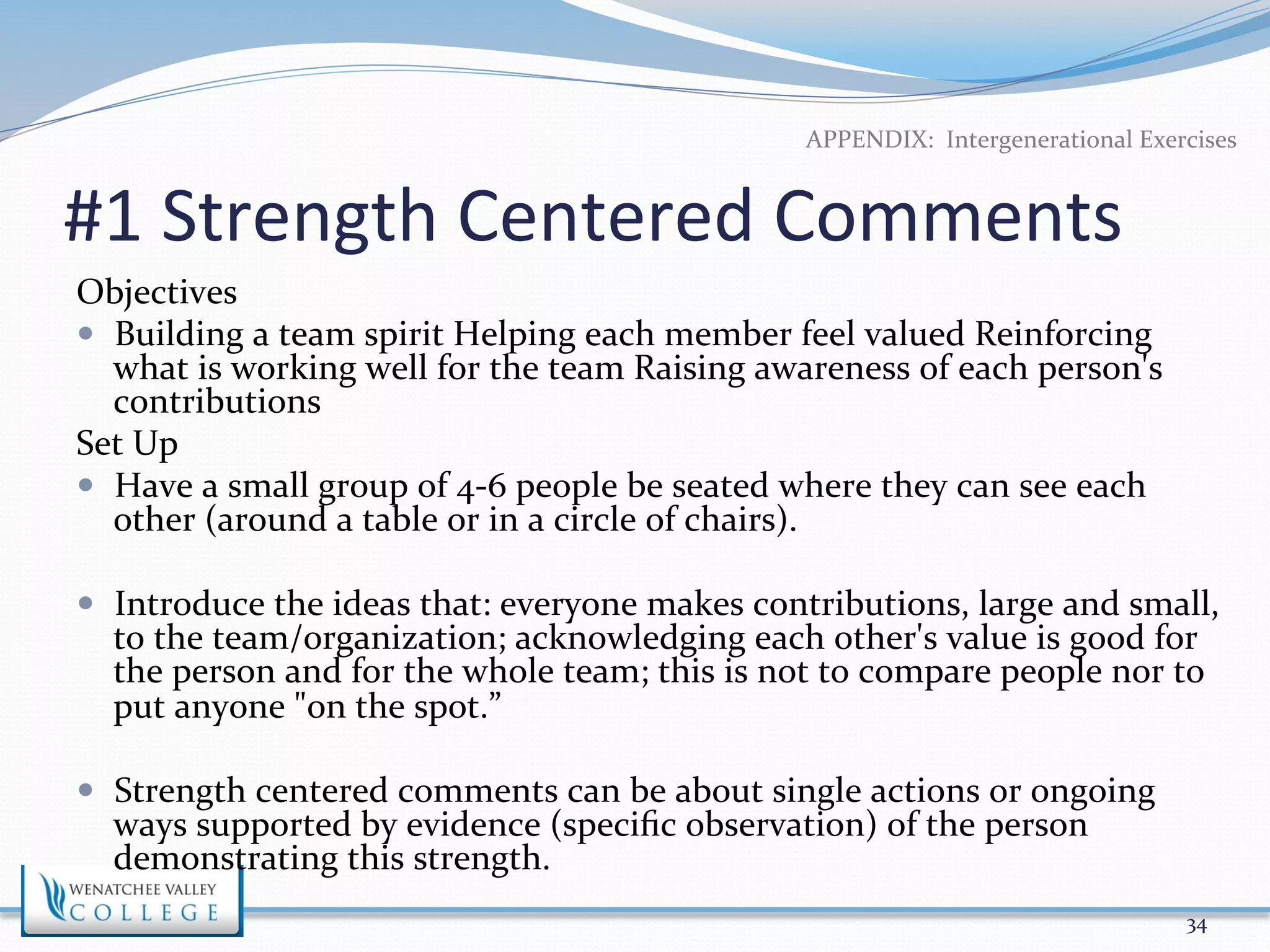
out 
of 
context, 
and 
by 
failing 
to 
appreciate 
the 
similarities 
among 
employees 
of 
different 
ages. 
-­‐ 
Monique 
Valcour 
Hitting 
the 
Generational 
Sweet 
Spot 
33
APPENDIX: 
Intergenerational 
Exercises 
#1 
Strength 
Centered 
Comments 
Objectives 
— Building 
a 
team 
spirit 
Helping 
each 
member 
feel 
valued 
Reinforcing 
what 
is 
working 
well 
for 
the 
team 
Raising 
awareness 
of 
each 
person's 
contributions 
Set 
Up 
— Have 
a 
small 
group 
of 
4-­‐6 
people 
be 
seated 
where 
they 
can 
see 
each 
other 
(around 
a 
table 
or 
in 
a 
circle 
of 
chairs). 
— Introduce 
the 
ideas 
that: 
everyone 
makes 
contributions, 
large 
and 
small, 
to 
the 
team/organization; 
acknowledging 
each 
other's 
value 
is 
good 
for 
the 
person 
and 
for 
the 
whole 
team; 
this 
is 
not 
to 
compare 
people 
nor 
to 
put 
anyone 
"on 
the 
spot.” 
— Strength 
centered 
comments 
can 
be 
about 
single 
actions 
or 
ongoing 
ways 
supported 
by 
evidence 
(specific 
observation) 
of 
the 
person 
demonstrating 
this 
strength. 
34
APPENDIX: 
Intergenerational 
Exercises 
#1 
Strength 
Centered 
Comments 
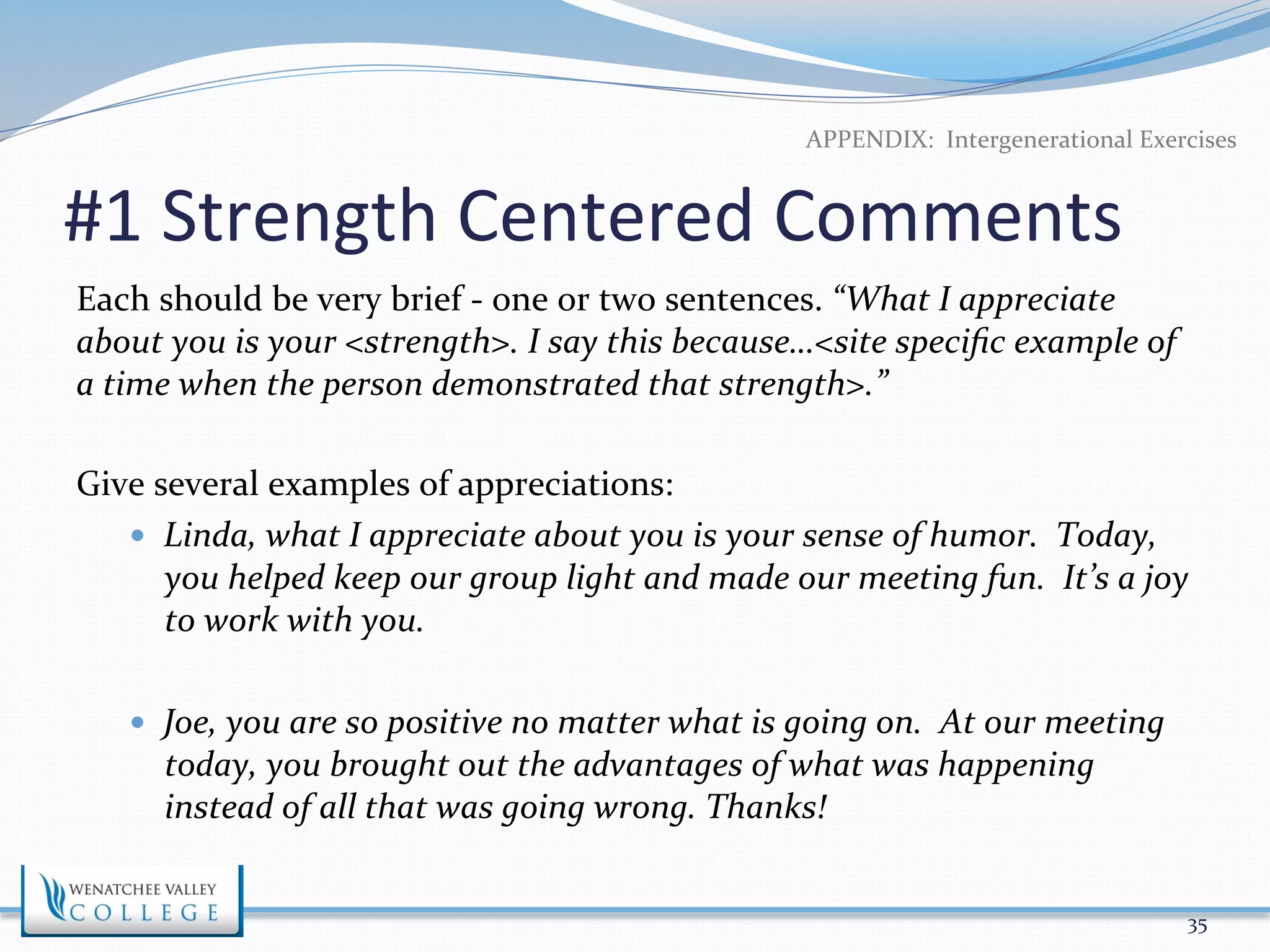
Each 
should 
be 
very 
brief 
-­‐ 
one 
or 
two 
sentences. 
“What 
I 
appreciate 
about 
you 
is 
your 
<strength>. 
I 
say 
this 
because…<site 
specific 
example 
of 
a 
time 
when 
the 
person 
demonstrated 
that 
strength>.” 
Give 
several 
examples 
of 
appreciations: 
— Linda, 
what 
I 
appreciate 
about 
you 
is 
your 
sense 
of 
humor. 
Today, 
you 
helped 
keep 
our 
group 
light 
and 
made 
our 
meeting 
fun. 
It’s 
a 
joy 
to 
work 
with 
you. 
— Joe, 
you 
are 
so 
positive 
no 
matter 
what 
is 
going 
on. 
At 
our 
meeting 
today, 
you 
brought 
out 
the 
advantages 
of 
what 
was 
happening 
instead 
of 
all 
that 
was 
going 
wrong. 
Thanks! 
35
APPENDIX: 
Intergenerational 
Exercises 
# 
1 
Strength 
Centered 
Comments 
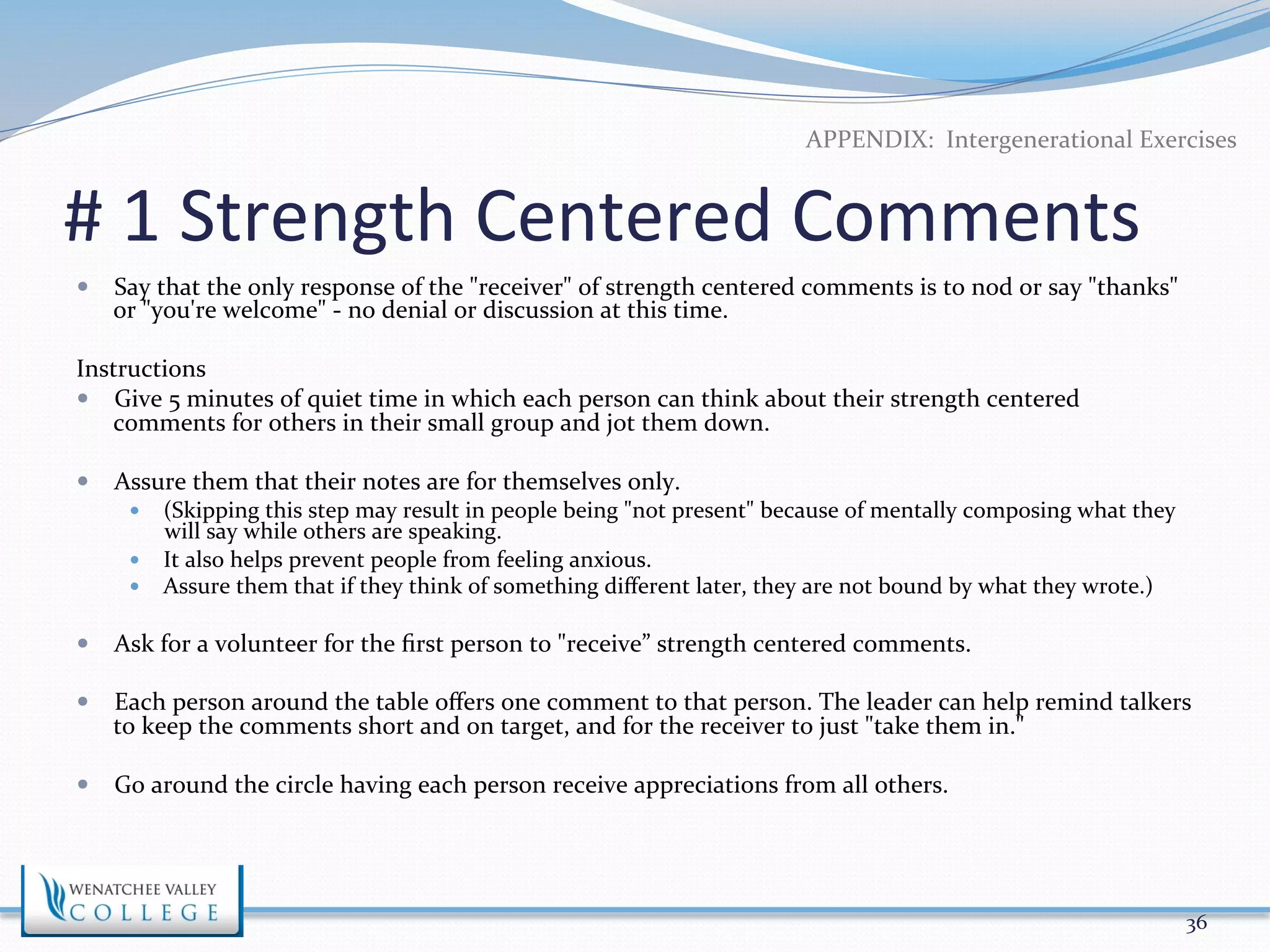
— Say 
that 
the 
only 
response 
of 
the 
"receiver" 
of 
strength 
centered 
comments 
is 
to 
nod 
or 
say 
"thanks" 
or 
"you're 
welcome" 
-­‐ 
no 
denial 
or 
discussion 
at 
this 
time. 
Instructions 
— Give 
5 
minutes 
of 
quiet 
time 
in 
which 
each 
person 
can 
think 
about 
their 
strength 
centered 
comments 
for 
others 
in 
their 
small 
group 
and 
jot 
them 
down. 
— Assure 
them 
that 
their 
notes 
are 
for 
themselves 
only. 
— (Skipping 
this 
step 
may 
result 
in 
people 
being 
"not 
present" 
because 
of 
mentally 
composing 
what 
they 
will 
say 
while 
others 
are 
speaking. 
— It 
also 
helps 
prevent 
people 
from 
feeling 
anxious. 
— Assure 
them 
that 
if 
they 
think 
of 
something 
different 
later, 
they 
are 
not 
bound 
by 
what 
they 
wrote.) 
— Ask 
for 
a 
volunteer 
for 
the 
first 
person 
to 
"receive” 
strength 
centered 
comments. 
— Each 
person 
around 
the 
table 
offers 
one 
comment 
to 
that 
person. 
The 
leader 
can 
help 
remind 
talkers 
to 
keep 
the 
comments 
short 
and 
on 
target, 
and 
for 
the 
receiver 
to 
just 
"take 
them 
in." 
— Go 
around 
the 
circle 
having 
each 
person 
receive 
appreciations 
from 
all 
others. 
36
APPENDIX: 
Intergenerational 
Exercises 
# 
1 
Strength 
Centered 
Comments 
Debrief 
Suggestions: 
— Have 
participants 
think 
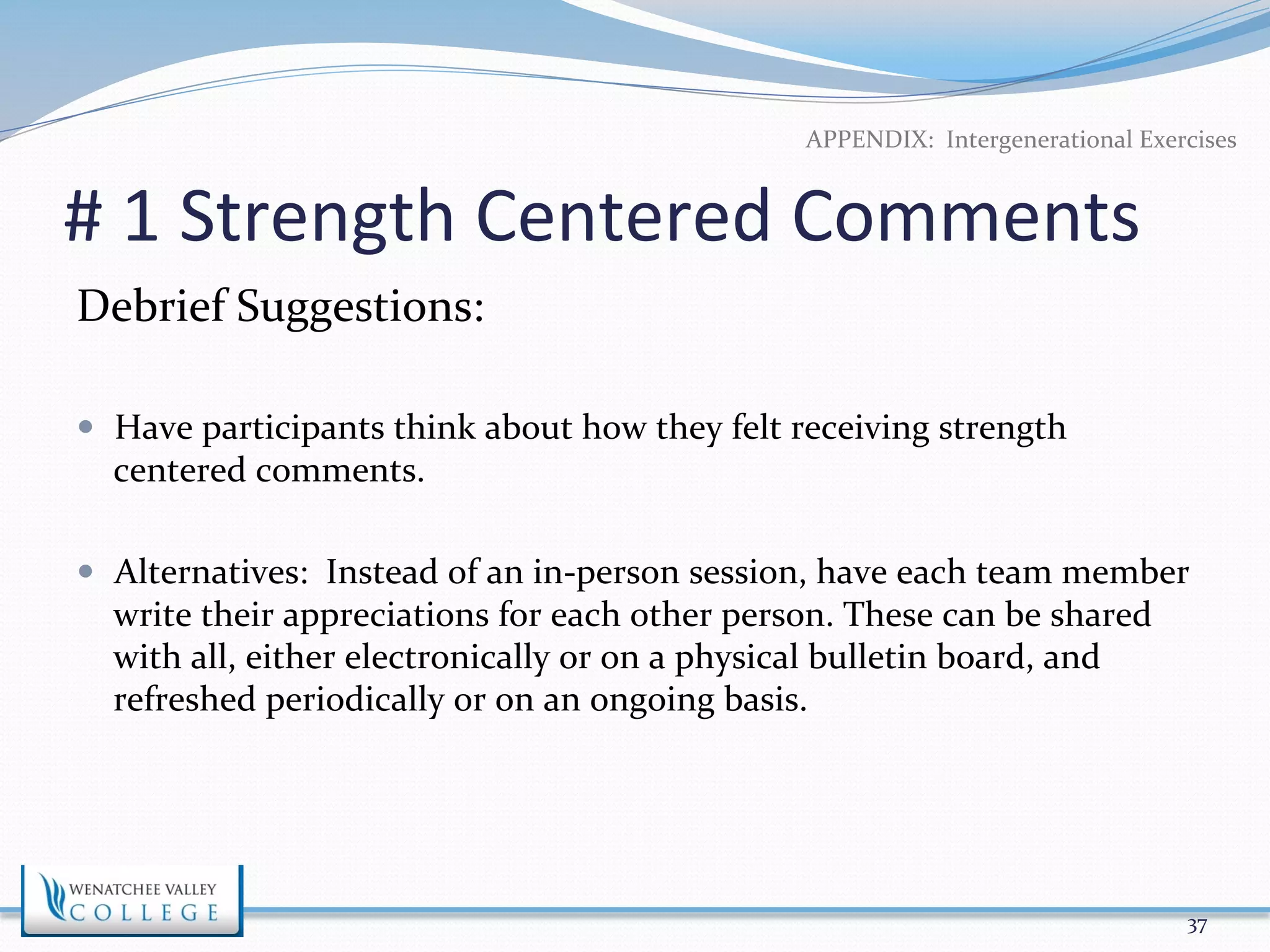
about 
how 
they 
felt 
receiving 
strength 
centered 
comments. 
— Alternatives: 
Instead 
of 
an 
in-­‐person 
session, 
have 
each 
team 
member 
write 
their 
appreciations 
for 
each 
other 
person. 
These 
can 
be 
shared 
with 
all, 
either 
electronically 
or 
on 
a 
physical 
bulletin 
board, 
and 
refreshed 
periodically 
or 
on 
an 
ongoing 
basis. 
37
APPENDIX: 
Intergenerational 
Exercises 
#2 
Quick 
Talk 
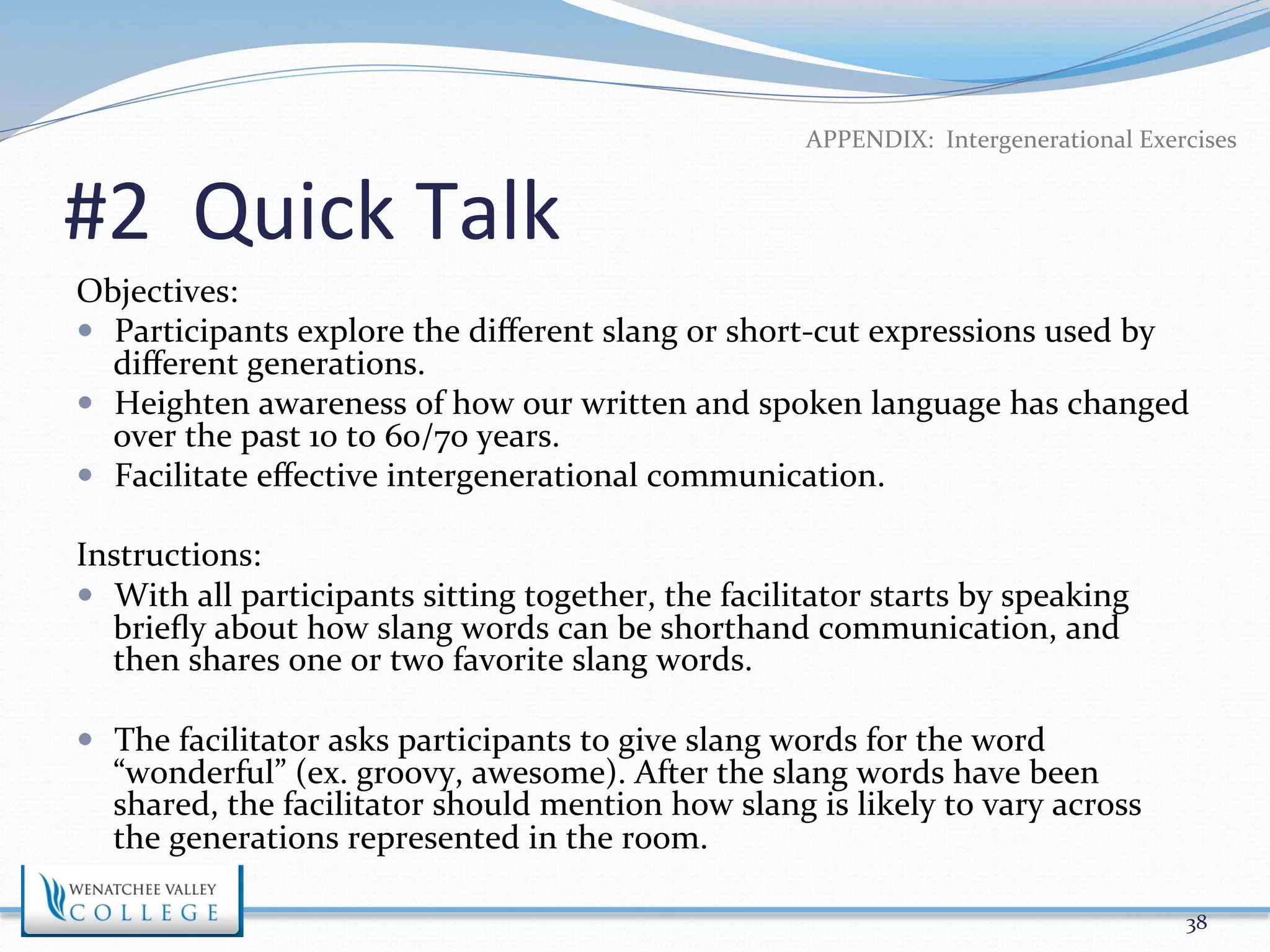
Objectives: 
— Participants 
explore 
the 
different 
slang 
or 
short-­‐cut 
expressions 
used 
by 
different 
generations. 
— Heighten 
awareness 
of 
how 
our 
written 
and 
spoken 
language 
has 
changed 
over 
the 
past 
10 
to 
60/70 
years. 
— Facilitate 
effective 
intergenerational 
communication. 
Instructions: 
— With 
all 
participants 
sitting 
together, 
the 
facilitator 
starts 
by 
speaking 
briefly 
about 
how 
slang 
words 
can 
be 
shorthand 
communication, 
and 
then 
shares 
one 
or 
two 
favorite 
slang 
words. 
— The 
facilitator 
asks 
participants 
to 
give 
slang 
words 
for 
the 
word 
“wonderful” 
(ex. 
groovy, 
awesome). 
After 
the 
slang 
words 
have 
been 
shared, 
the 
facilitator 
should 
mention 
how 
slang 
is 
likely 
to 
vary 
across 
the 
generations 
represented 
in 
the 
room. 
38
APPENDIX: 
Intergenerational 
Exercises 
#2 
Quick 
Talk 
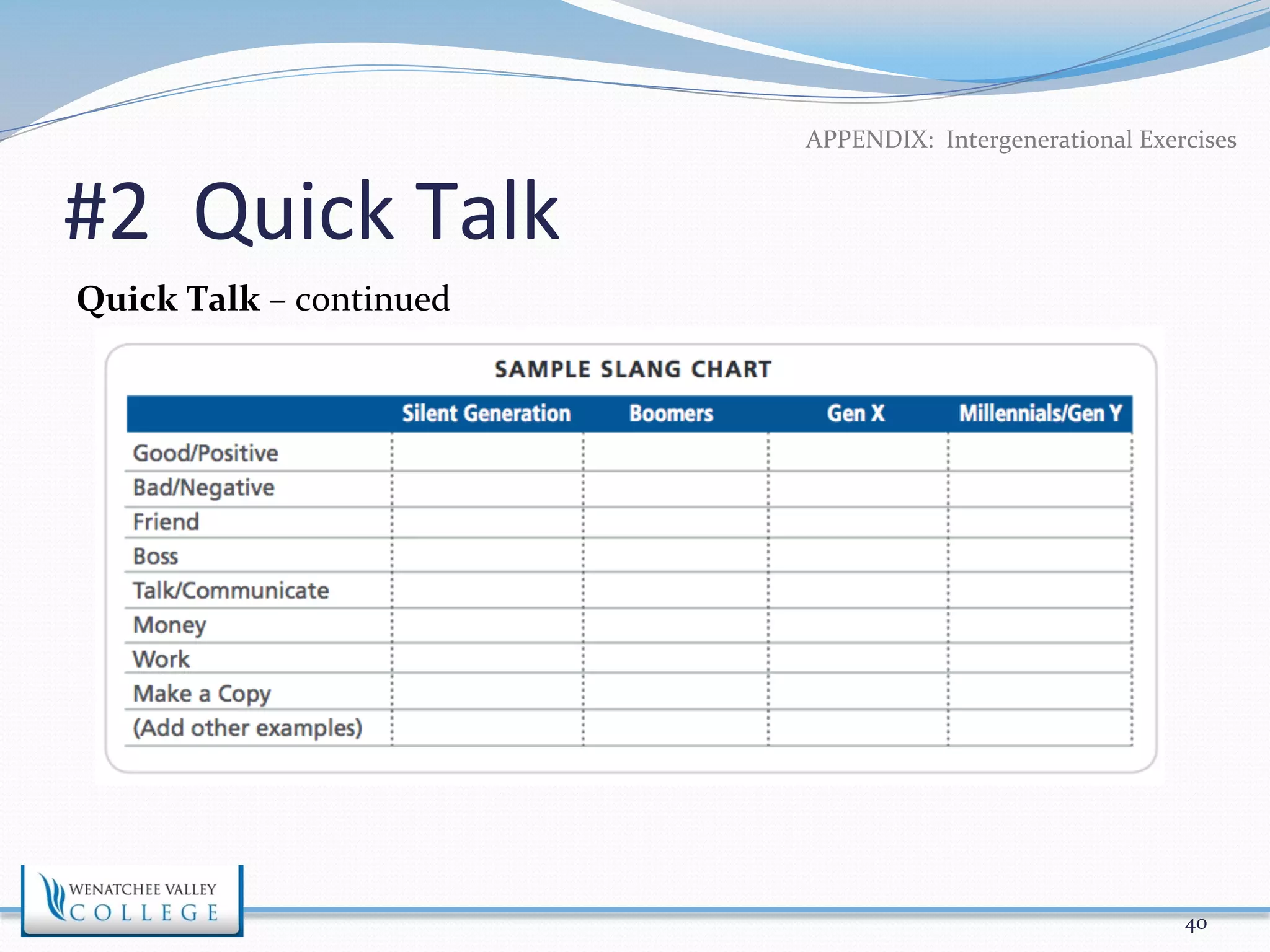
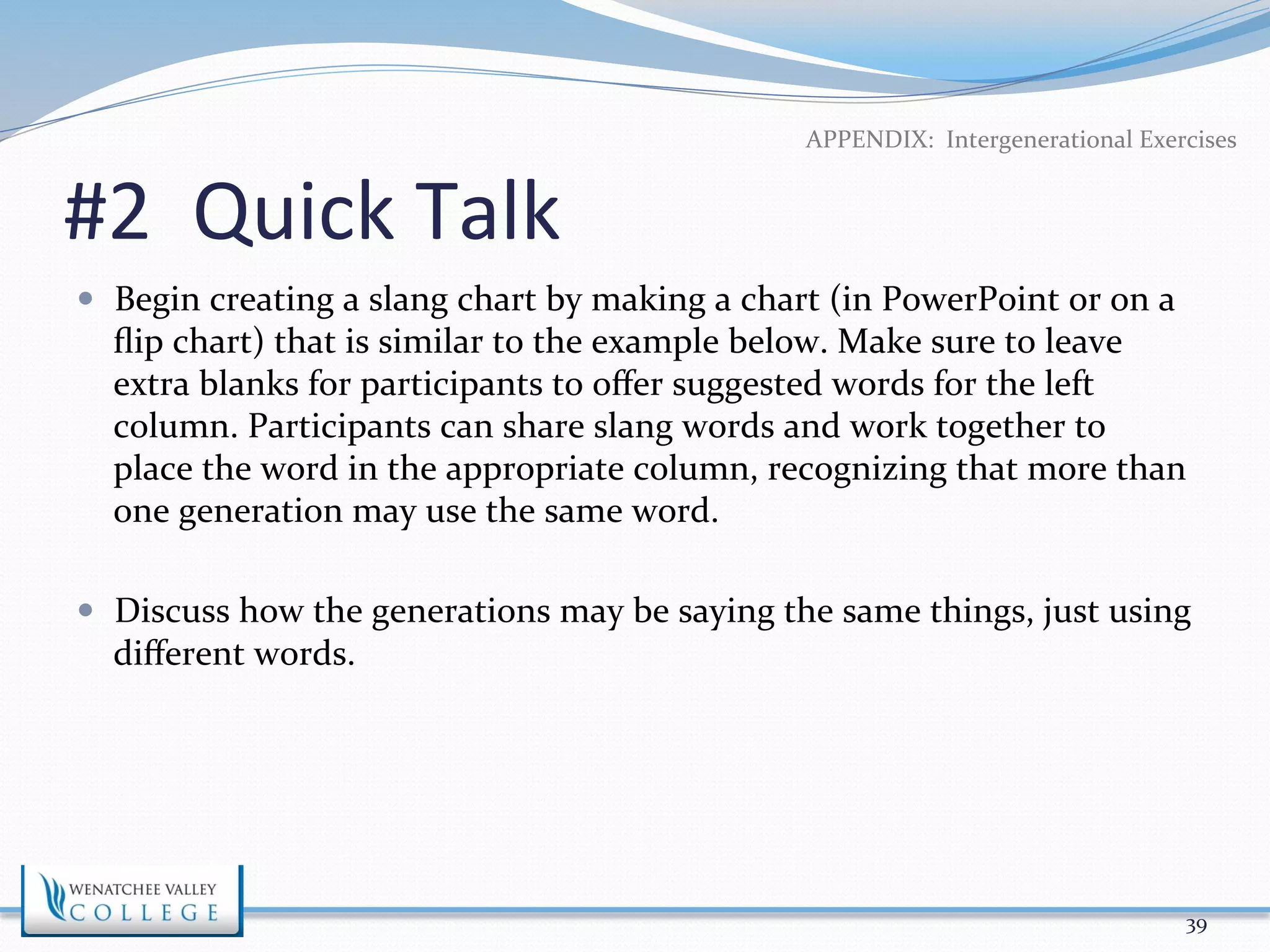
— Begin 
creating 
a 
slang 
chart 
by 
making 
a 
chart 
(in 
PowerPoint 
or 
on 
a 
flip 
chart) 
that 
is 
similar 
to 
the 
example 
below. 
Make 
sure 
to 
leave 
extra 
blanks 
for 
participants 
to 
offer 
suggested 
words 
for 
the 
left 
column. 
Participants 
can 
share 
slang 
words 
and 
work 
together 
to 
place 
the 
word 
in 
the 
appropriate 
column, 
recognizing 
that 
more 
than 
one 
generation 
may 
use 
the 
same 
word. 
— Discuss 
how 
the 
generations 
may 
be 
saying 
the 
same 
things, 
just 
using 
different 
words. 
39
#2 
Quick 
Talk 
Quick 
Talk 
– 
continued 
APPENDIX: 
Intergenerational 
Exercises 
40
APPENDIX: 
Intergenerational 
Exercises 
#3 
Common 
Ground 
Instructions: 
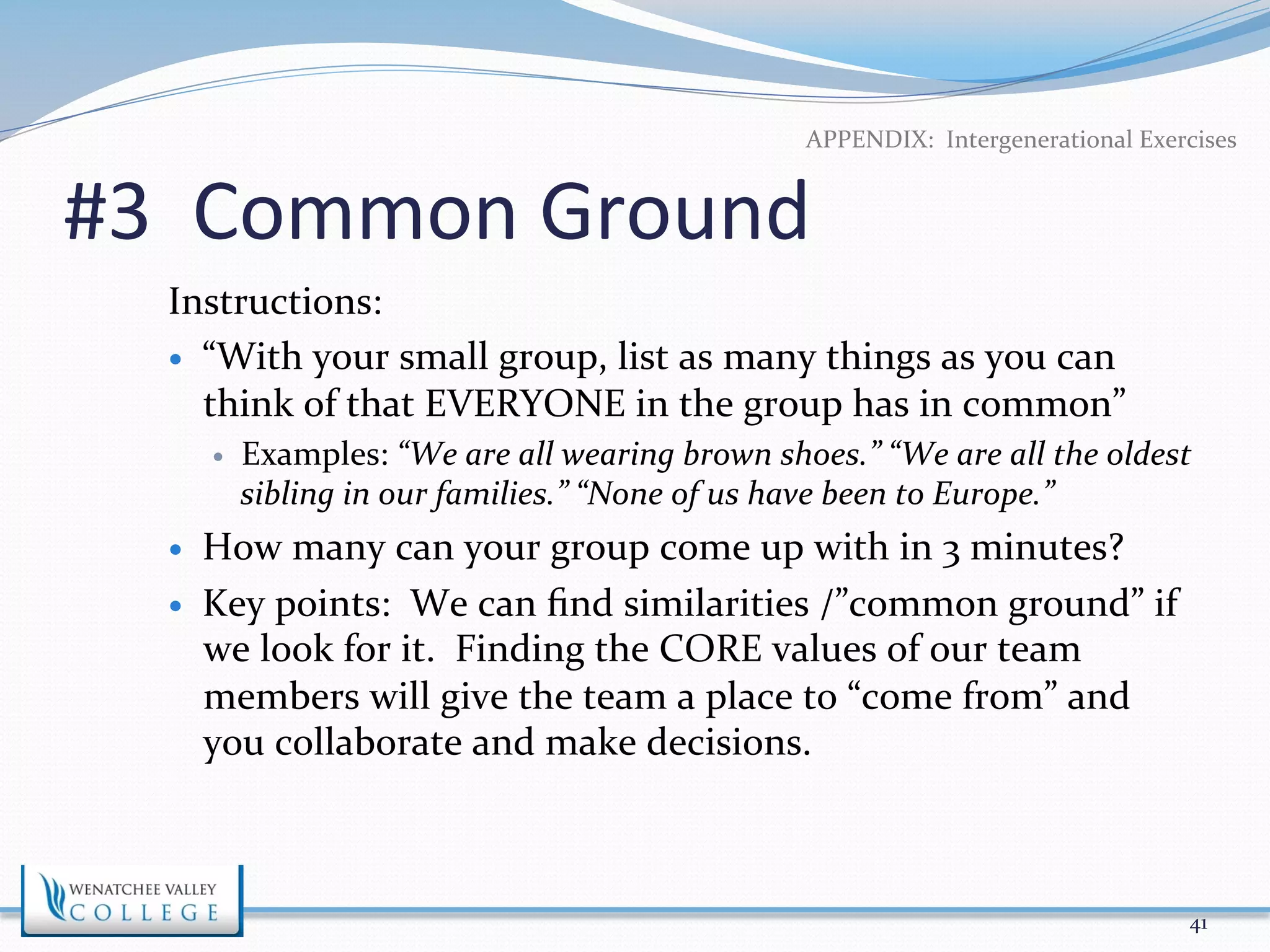
— “With 
your 
small 
group, 
list 
as 
many 
things 
as 
you 
can 
think 
of 
that 
EVERYONE 
in 
the 
group 
has 
in 
common” 
— Examples: 
“We 
are 
all 
wearing 
brown 
shoes.” 
“We 
are 
all 
the 
oldest 
sibling 
in 
our 
families.” 
“None 
of 
us 
have 
been 
to 
Europe.” 
— How 
many 
can 
your 
group 
come 
up 
with 
in 
3 
minutes? 
— Key 
points: 
We 
can 
find 
similarities 
/”common 
ground” 
if 
we 
look 
for 
it. 
Finding 
the 
CORE 
values 
of 
our 
team 
members 
will 
give 
the 
team 
a 
place 
to 
“come 
from” 
and 
you 
collaborate 
and 
make 
decisions. 
41
APPENDIX: 
Intergenerational 
Exercises 
#4 
Jigsaw 
Puzzle 
Pieces 
Objectives 
— Help 
teams 
think 
about 
collaboration, 
communication 
and 
strategy. 
Materials 
— A 
jigsaw 
puzzle 
(Childs 
100 
pieces 
or 
less). 
One 
for 
each 
group. 
Size 
of 
group 
is 
adaptable. 
Set 
Up 
— Each 
team 
gets 
a 
puzzle 
to 
assemble. 
Directions 
— The 
goal 
for 
each 
team 
is 
to 
assemble 
the 
puzzle 
as 
fast 
as 
they 
can 
following 
the 
rules 
set 
forth 
-­‐ 
e.g. 
highlighting 
similar 
challenges 
teams 
face 
in 
working 
together 
in 
the 
company 
— Give 
people 
time 
to 
work 
on 
it. 
— 1st 
Round: 
The 
team 
is 
not 
allowed 
to 
speak 
to 
each 
other. 
— 2nd 
Round: 
The 
team 
is 
allowed 
to 
speak. 
— 3rd 
Round: 
The 
team 
is 
asked 
to 
plan 
their 
approach 
to 
assembling 
the 
puzzle 
before 
they 
begin. 
— Facilitate 
discussion 
about 
how 
this 
relates 
to 
what 
the 
group 
is 
doing 
in 
real 
life 
(i.e. 
how 
group 
is 
working 
together) 
Debrief 
— How 
is 
this 
similar 
to 
what 
we 
are 
trying 
to 
do 
as 
a 
team? 
How 
is 
this 
different? 
— Did 
you 
collaborate 
with 
other 
team 
members? 
Why 
or 
why 
not? 
How 
did 
that 
help 
or 
hinder 
your 
progress? 
— What 
are 
the 
implications 
back 
on 
the 
job? 
— So 
what? 
what 
do 
we 
want 
to 
take 
away 
from 
this? 
42
APPENDIX: 
Intergenerational 
Exercises 
#5 
Pin 
the 
Trait 
on 
the 
Genera>on 
Set 
Up 
— Everyone 
will 
be 
given 
a 
card 
with 
a 
generational 
trait. 
— Attach 
your 
card 
to 
the 
generation 
with 
which 
it 
is 
most 
closely 
associated. 
— We’ll 
discuss 
as 
a 
group 
-­‐ 
be 
prepared 
to 
explain 
what 
you 
chose 
and 
why! 
43
APPENDIX: 
Intergenerational 
Exercises 
#6 
Human 
Treasure 
Hunt 
Instructions: 
— Create 
a 
list 
of 
15-­‐30 
statements 
to 
distribute 
to 
your 
group. 
— Give 
the 
group 
a 
period 
of 
time 
to 
find 
people 
who 
meet 
different 
the 
criteria 
of 
different 
statements 
on 
the 
list. 
— When 
participants 
find 
someone 
who 
meets 
the 
criteria, 
they 
ask 
that 
person 
to 
sign 
their 
list. 
— At 
the 
end 
of 
the 
activity, 
read 
off 
the 
various 
statements 
and 
ask 
anyone 
who 
meets 
the 
criteria 
to 
stand 
up. 
The 
list 
of 
statements 
makes 
learning 
about 
multi-­‐ 
generations 
fun 
and 
relevant 
to 
those 
they 
work 
with. 
— Statements 
could 
include: 
44
APPENDIX: 
Intergenerational 
Exercises 
# 
7 
Data 
Match 
Objectives 
— Draw 
attention 
to 
how 
people 
of 
different 
generations 
often 
share 
interests 
and 
life 
experiences. 
— Promote 
casual 
conversation. 
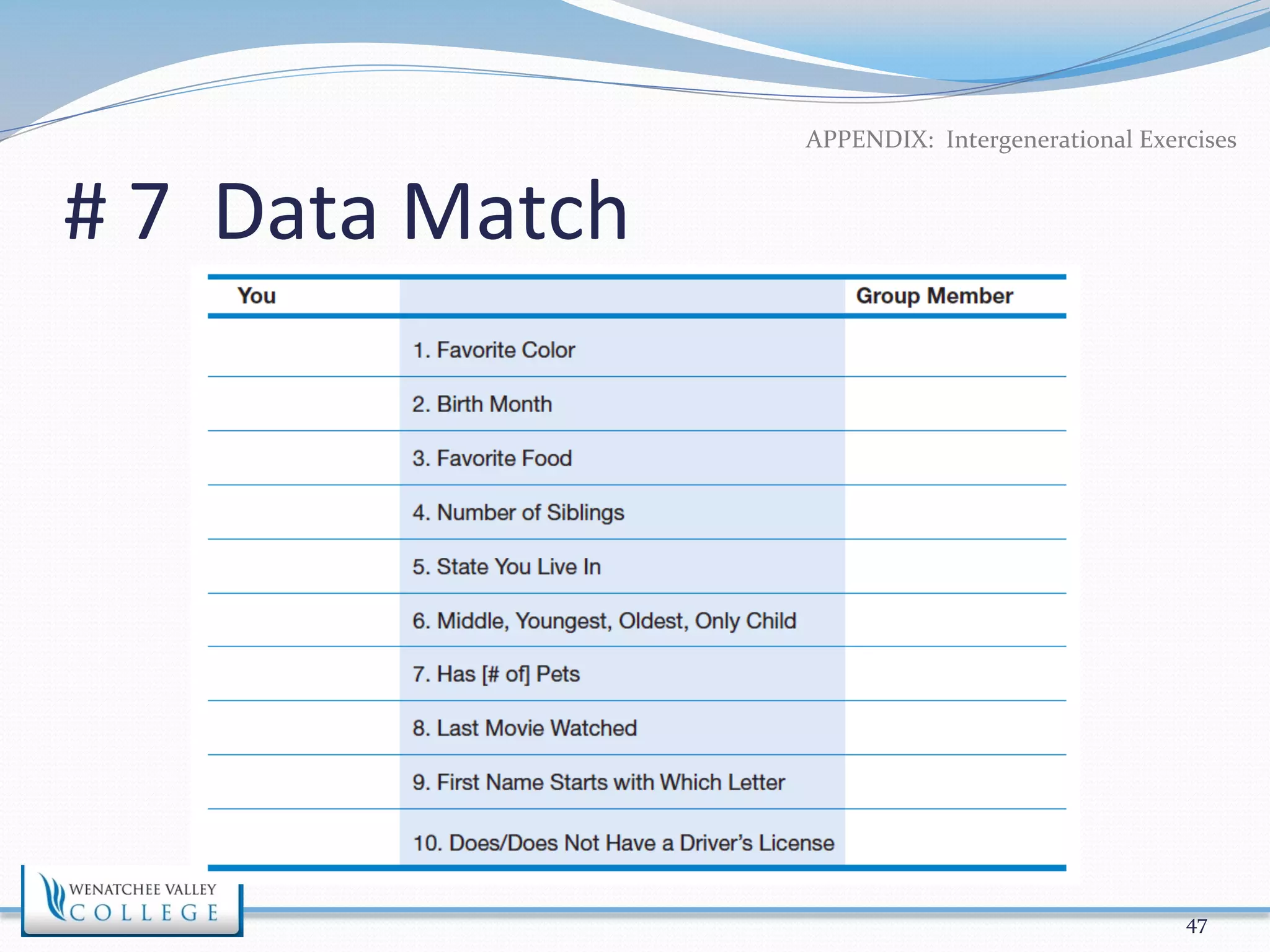
Steps 
1. 
Preparation: 
— Ahead 
of 
time, 
print 
copies 
of 
sheets 
of 
paper 
with 
the 
following 
questions 
written 
on 
them 
with 
a 
blank 
on 
each 
side 
of 
the 
question 
(or 
two 
blanks 
to 
one 
side). 
Additional 
questions 
can 
be 
added 
that 
follow 
a 
similar 
theme. 
45
# 
7 
Data 
Match 
2. 
Play: 
APPENDIX: 
Intergenerational 
Exercises 
— Provide 
each 
participant 
with 
one 
sheet 
and 
ask 
them 
to 
fill 
out 
the 
answers 
to 
the 
questions 
under 
the 
YOU 
column 
so 
that 
one 
side 
will 
be 
filled 
in. 
— Once 
everyone 
has 
answered 
the 
questions, 
have 
them 
move 
around 
the 
room 
and 
look 
for 
people 
who 
share 
the 
same 
answers. 
— For 
example, 
participants 
will 
want 
to 
find 
people 
born 
in 
their 
same 
month, 
people 
who 
have 
the 
same 
number 
of 
pets 
or 
who 
are 
also 
a 
middle 
child. 
— Once 
everyone 
is 
done, 
the 
group 
should 
sit 
down 
again 
and 
share 
some 
of 
the 
things 
that 
they 
learned. 
46
# 
7 
Data 
Match 
APPENDIX: 
Intergenerational 
Exercises 
47

Leveraging Your Intergenerational Workforce for AVHRA

  • 1.
    AVHRA Business & Law Update December 10, 2014 1
  • 2.
    Stacy Luckensmeyer —Wenatchee Valley College Center for Entrepreneurship — Serial Entrepreneur
  • 3.
    Reimi Marden —Owner/Founder of The Winning Edge, Image Consulting and Corporate Training Firm — 25 years in the Training & Development industry — Extensive experience in the hospitality and gaming industries – designing training for hourly to Executive level team members 3
  • 4.
    Goals for Today: — Review the generational mix — Highlight generational similarities and ways to leverage differences — Discuss strategies to improve retention through enhanced recruitment and employee engagement — Share best practices for employee training design and delivery 4
  • 5.
    Focus on “why” generations see things differently, not “what” those differences are. -­‐ Haydn Shaw Sticking Points: How to Get Four Generations Working Together in the 12 Places They Come Apart 5
  • 6.
  • 7.
    Social History at a Glance Core Values Family Educa>on Communica>on & Media Dealing With Money Tradi>onalists Ages: 69-­‐96 Respect Authority Discipline Tradi>onal Nuclear A dream Rotary phones One-­‐On-­‐One Write a memo Put it away Pay Cash Tradi>onalists Baby Boomers Ages: 50-­‐68 Op>mism Involvement Disintegra>ng A birthright Touch-­‐tone phones Call me any>me Buy now, Pay later Genera>on X Ages: 34-­‐49 Skep>cism Fun Informality Latch-­‐key kids A way to get there Cell phones Call me only at work Cau>ous Conserva>ve Save save save Genera>on Y Ages: 19-­‐33 Realism Confidence Extreme fun Social Blended An incredible expense Internet Picture phones Email Text messaging Earn to spend Genera>on Z Ages: 5-­‐18 Prac>cality Stability Tolerance Community Make it happen Changing household structures Most educated genera>on ever but…. Image Sharing Crea>ng From 2 screens to 5 Balance digital & live Conserva>ve It will be there I will leverage yours
  • 8.
    A recent Time magazine article on the Millennials offered this quote from a forty-­‐something writer: “Veteran teachers are saying that never in their experience were young people so thirstily avid of pleasure as now…so selfish.” The source of the quote? A letter published in The Atlantic in 1911. 8
  • 9.
    Workstyles at a Glance Workstyles Communica>on Style Problem Solving Decision Making Leadership Style Feedback Tradi>onalists Ages: 69-­‐96 Top-­‐down Hierarchical Seeks approval Command and Control No News is Good News Tradi>onalists Baby Boomers Ages: 50-­‐68 Guarded Horizontal Team informed Get out of the way Once Per Year Genera>on X Ages: 34-­‐49 Hub and spoke Independent Team included Coach Weekly / Daily Genera>on Y Ages: 19-­‐33 Collabora>ve Collabora>ve Team decided Partner On Demand Genera>on Z Ages: 5-­‐18 Collabora>ve, Global Collabora>ve, Innova>ve Team decided, Ownership Consensus; empowered Expect It
  • 10.
    Characteris>cs of Each Genera>on — Key Influences — Expectations & Work Styles — Communication Preferences 10
  • 11.
    Benefits to Building Your Mul>-­‐Genera>onal Team — Productivity — Stability — Company Culture
  • 12.
    Workforce at a Glance 12
  • 13.
    Recruitment — The generational aspect of your recruitment plans — Generational appeal can weather many storms — Economic changes — Population shifts — Using generational differences to your advantage
  • 14.
    What are they looking for? — Traditionalists (69 – 96) — Boomers (50 – 68) — Generation X (34 -­‐ 49) — Generation Y (19 -­‐ 33) — Generation Z (0 -­‐ 18)
  • 15.
    What do they have in common?
  • 16.
    Your Approach to Recrui>ng Statistics from Gen Y: 38% selected ‘opportunity for advancement’ as one of their top three must-­‐haves 42% placed ‘relationship with peers ‘ as one of the top reasons for getting or keeping their job. 32.7% preferred colleagues to be of different ages — Be Flexible — Offer Diverse Experiences and Challenges — Evolve with the Workforce — Engage Top-­‐Choice Talent
  • 17.
    Reten>on — Employee Engagement — Employee Satisfaction
  • 18.
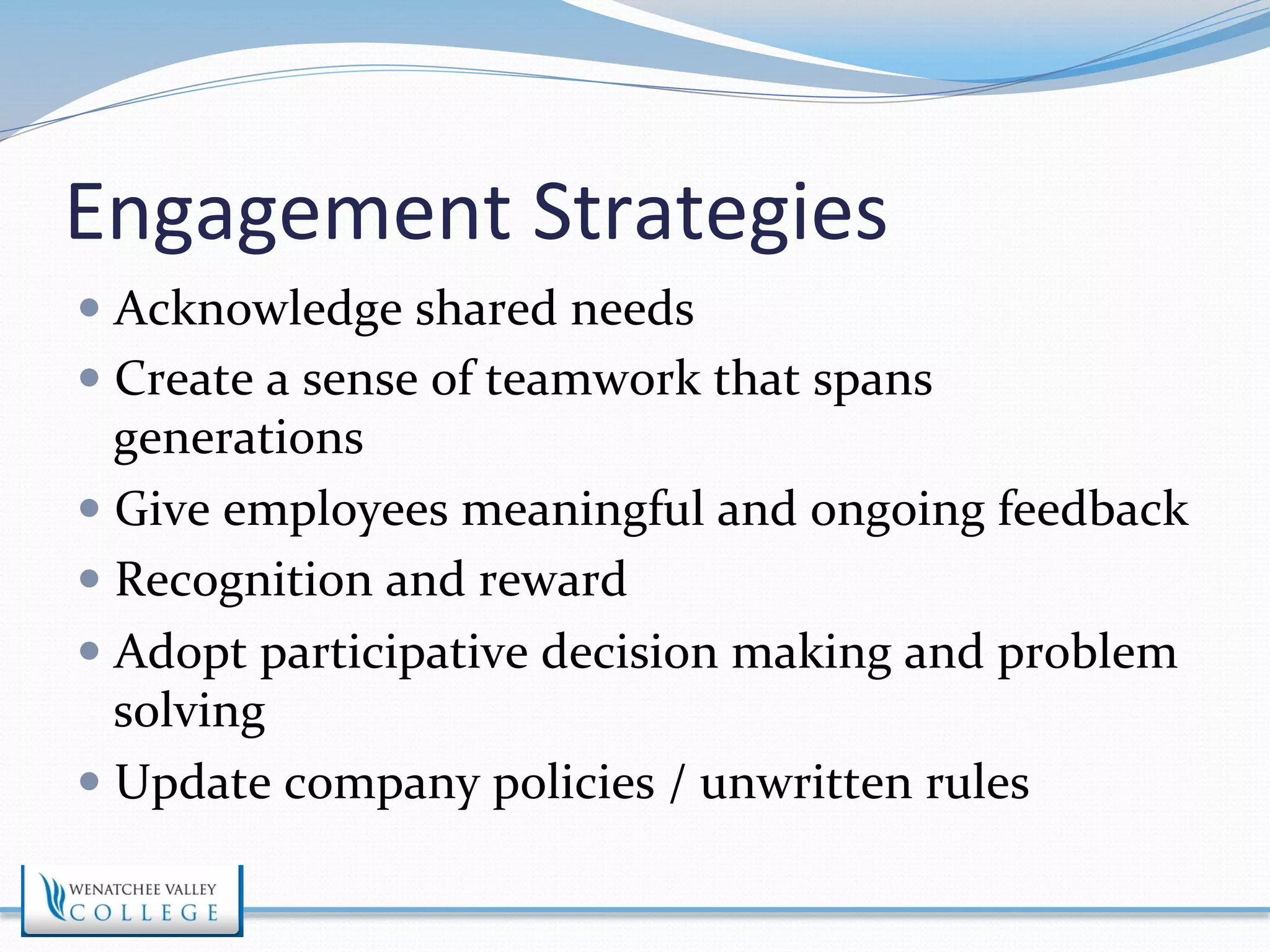
    Engagement Strategies —Acknowledge shared needs — Create a sense of teamwork that spans generations — Give employees meaningful and ongoing feedback — Recognition and reward — Adopt participative decision making and problem solving — Update company policies / unwritten rules
  • 19.
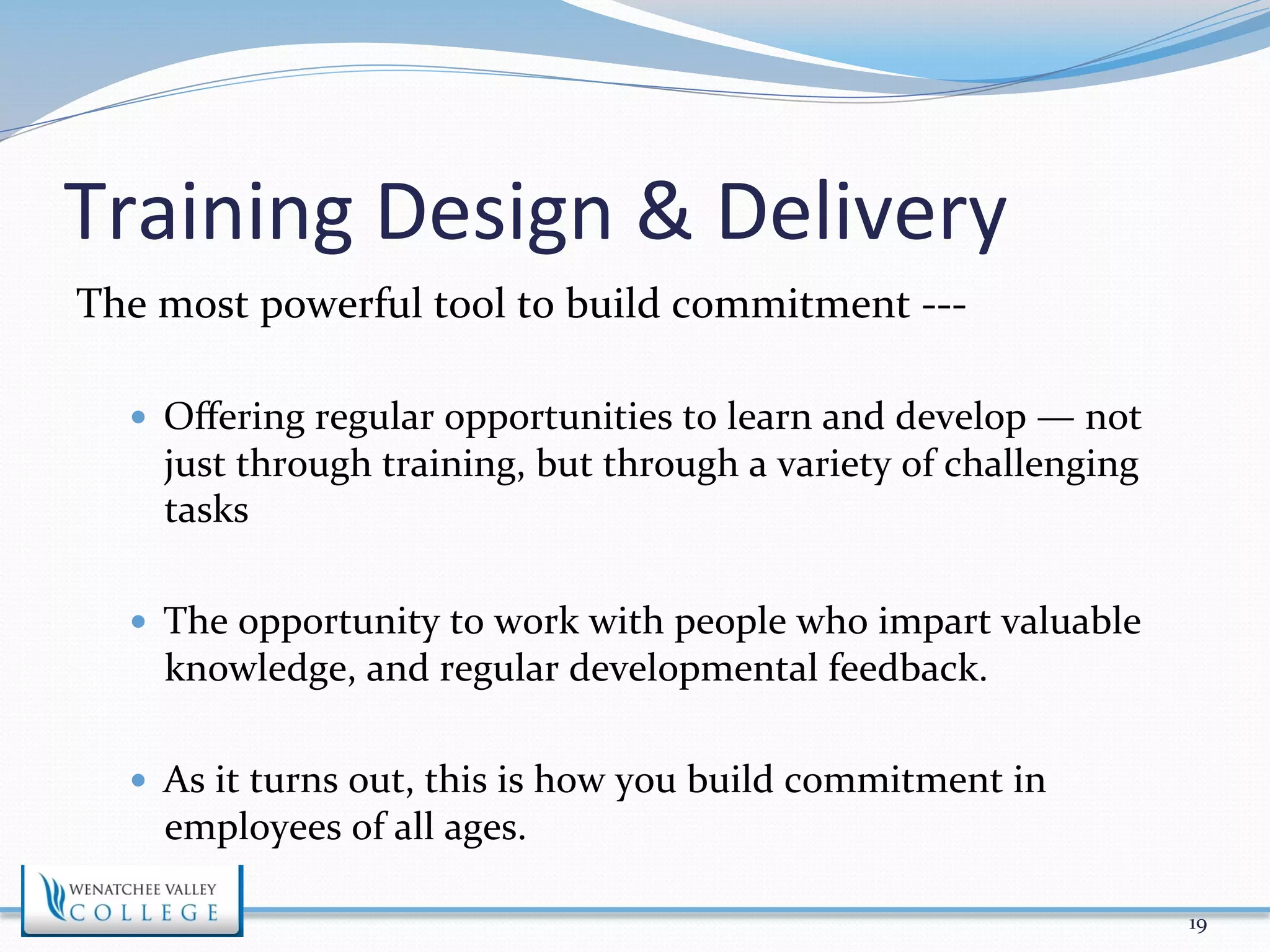
    Training Design & Delivery The most powerful tool to build commitment -­‐-­‐-­‐ — Offering regular opportunities to learn and develop — not just through training, but through a variety of challenging tasks — The opportunity to work with people who impart valuable knowledge, and regular developmental feedback. — As it turns out, this is how you build commitment in employees of all ages. 19
  • 20.
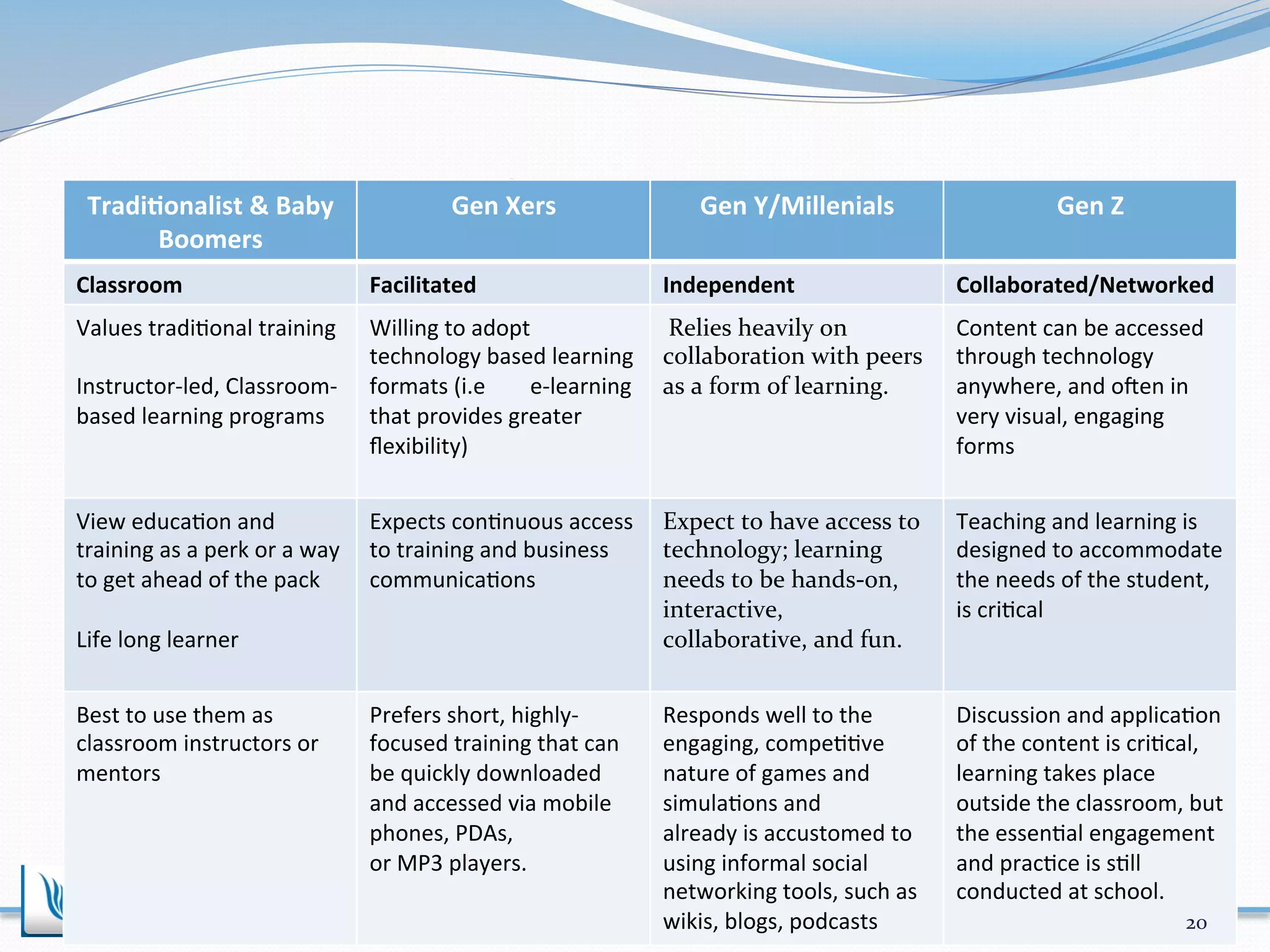
    LTeradia/onralinst &i Bnabyg Styles Boomers Gen Xers Gen Y/Millenials Gen Z Classroom Facilitated Independent Collaborated/Networked Values tradi>onal training Instructor-­‐led, Classroom-­‐ based learning programs Willing to adopt technology based learning formats (i.e e-­‐learning that provides greater flexibility) Relies heavily on collaboration with peers as a form of learning. Content can be accessed through technology anywhere, and ogen in very visual, engaging forms View educa>on and training as a perk or a way to get ahead of the pack Life long learner Expects con>nuous access to training and business communica>ons Expect to have access to technology; learning needs to be hands-­‐on, interactive, collaborative, and fun. Teaching and learning is designed to accommodate the needs of the student, is cri>cal Best to use them as classroom instructors or mentors Prefers short, highly-­‐ focused training that can be quickly downloaded and accessed via mobile phones, PDAs, or MP3 players. Responds well to the engaging, compe>>ve nature of games and simula>ons and already is accustomed to using informal social networking tools, such as wikis, blogs, podcasts Discussion and applica>on of the content is cri>cal, learning takes place outside the classroom, but the essen>al engagement and prac>ce is s>ll conducted at school. 20
  • 21.
    Training Design & Delivery — Revise learning approaches to accommodate the younger workforce — Seek Blended Learning Methods — Seek Active Learning Methods 21
  • 22.
  • 23.
    Mix of Training Modali>es — Coaching: Up and down / Influence — Mentoring: Bonding younger and older workers — Giving Feedback: Frequent / on-­‐going / celebrate accomplishments — Stretch Assignments: Encourage employee engagement — Classroom and online delivered courses 23
  • 24.
    Team Building Ac>vi>es to Strengthen Cohesion & Performance (See Appendix) 24
  • 25.
    Areas for Ac>on 25 1. Acknowledge generational differences. 2. Focus on the “why,” not the “what,” and the common needs. 3. Leverage the strengths of each generation. 4. Decide on approach to meet the needs of your people. 5. Evaluate and modify approach.
  • 26.
    What ac>on steps will you take? 26
  • 27.
    What We’ve Accomplished Today: þ Reviewed the generational mix þ Highlighted generational similarities and ways to leverage differences þ Discussed strategies to improve retention through enhanced recruitment and employee engagement þ Covered good practices for employee training design and delivery 27
  • 28.
    For more informa>on, contact: Stacy Luckensmeyer Center for Entrepreneurship & Continuing Education Wenatchee Valley College (509) 682-­‐6915 SLuckensmeyer@wvc.edu Reimi Marden The Winning Edge (702) 645-­‐5488 reimi@tweconsultinggroup.com 28
  • 29.
    Access Slides at Slide Share www.slideshare.net 29
  • 30.
    Resources 1. "Consumer spending and U.S. employment from the 2007—2009 recession through 2022" by Stephanie Hugie Barello. 2. Use Reward to Bridge the Generations Gaps and Your People, by The Hays Group. 3. It’s Not All About ‘Y’: It’s Time to Prepare for Generation Z, Webinar by Alexia Vernon. 4. PLACE INFO FOR THE 5 GEN GRAPHIC HERE. 5. “Intergenerational Challenges at Work” slideshare presentation by Boomer Match to Business. 6. “Creating Synergies in a Multi-­‐Generational Workplace” slideshare by Katrina Plourde, SPHR. 7. Quiz: How Milennial Are You? By the Pew Research Center 8. “What is Employee Engagement?” article by Custom Insight. 9. “Communicating Across a MultiGenerational Compus” slideshare by Michelle Baker. 10. “Three Reasons You Need To Adopt A Millennial Mindset Regardless Of Your Age” article by Jean Meister. 30
  • 31.
    — Training Tomorrow’s Workforce By Janice Ware, Rosemary Craft, and Steve Kerschenbaum http://www.kreativelearningsolutions.com/pdfs/Generational%20Dynamics/Training %20Tomorrow%27s%20Workforce_ASTD%20Pub.pdf — http://www.bls.gov/opub/ted/2014/ted_20140106.htm — http://www.slideshare.net/BizLib/effective-­‐employee-­‐training-­‐in-­‐a-­‐multigenerational-­‐ workforce?related=1 — https://hbr.org/2013/05/hitting-­‐the-­‐intergenerational — http://www.teampedia.net/wiki/index.php?title=Category:Communication — http://extension.psu.edu/youth/intergenerational/curricula-­‐and-­‐activities/ intergenerational-­‐activities-­‐sourcebook/download 31
  • 32.
    APPENDIX: Intergenera>onal Exercises “You can discover more about someone in an hour of play than from a year of conversation.” -­‐ Plato 32
  • 33.
    Intergenera>onal Sweet Spot There is an intergenerational sweet spot we should aim for, a point of maximum engagement for all employees. But we miss it by fixating on minor differences and taking them out of context, and by failing to appreciate the similarities among employees of different ages. -­‐ Monique Valcour Hitting the Generational Sweet Spot 33
  • 34.
    APPENDIX: Intergenerational Exercises #1 Strength Centered Comments Objectives — Building a team spirit Helping each member feel valued Reinforcing what is working well for the team Raising awareness of each person's contributions Set Up — Have a small group of 4-­‐6 people be seated where they can see each other (around a table or in a circle of chairs). — Introduce the ideas that: everyone makes contributions, large and small, to the team/organization; acknowledging each other's value is good for the person and for the whole team; this is not to compare people nor to put anyone "on the spot.” — Strength centered comments can be about single actions or ongoing ways supported by evidence (specific observation) of the person demonstrating this strength. 34
  • 35.
    APPENDIX: Intergenerational Exercises #1 Strength Centered Comments Each should be very brief -­‐ one or two sentences. “What I appreciate about you is your <strength>. I say this because…<site specific example of a time when the person demonstrated that strength>.” Give several examples of appreciations: — Linda, what I appreciate about you is your sense of humor. Today, you helped keep our group light and made our meeting fun. It’s a joy to work with you. — Joe, you are so positive no matter what is going on. At our meeting today, you brought out the advantages of what was happening instead of all that was going wrong. Thanks! 35
  • 36.
    APPENDIX: Intergenerational Exercises # 1 Strength Centered Comments — Say that the only response of the "receiver" of strength centered comments is to nod or say "thanks" or "you're welcome" -­‐ no denial or discussion at this time. Instructions — Give 5 minutes of quiet time in which each person can think about their strength centered comments for others in their small group and jot them down. — Assure them that their notes are for themselves only. — (Skipping this step may result in people being "not present" because of mentally composing what they will say while others are speaking. — It also helps prevent people from feeling anxious. — Assure them that if they think of something different later, they are not bound by what they wrote.) — Ask for a volunteer for the first person to "receive” strength centered comments. — Each person around the table offers one comment to that person. The leader can help remind talkers to keep the comments short and on target, and for the receiver to just "take them in." — Go around the circle having each person receive appreciations from all others. 36
  • 37.
    APPENDIX: Intergenerational Exercises # 1 Strength Centered Comments Debrief Suggestions: — Have participants think about how they felt receiving strength centered comments. — Alternatives: Instead of an in-­‐person session, have each team member write their appreciations for each other person. These can be shared with all, either electronically or on a physical bulletin board, and refreshed periodically or on an ongoing basis. 37
  • 38.
    APPENDIX: Intergenerational Exercises #2 Quick Talk Objectives: — Participants explore the different slang or short-­‐cut expressions used by different generations. — Heighten awareness of how our written and spoken language has changed over the past 10 to 60/70 years. — Facilitate effective intergenerational communication. Instructions: — With all participants sitting together, the facilitator starts by speaking briefly about how slang words can be shorthand communication, and then shares one or two favorite slang words. — The facilitator asks participants to give slang words for the word “wonderful” (ex. groovy, awesome). After the slang words have been shared, the facilitator should mention how slang is likely to vary across the generations represented in the room. 38
  • 39.
    APPENDIX: Intergenerational Exercises #2 Quick Talk — Begin creating a slang chart by making a chart (in PowerPoint or on a flip chart) that is similar to the example below. Make sure to leave extra blanks for participants to offer suggested words for the left column. Participants can share slang words and work together to place the word in the appropriate column, recognizing that more than one generation may use the same word. — Discuss how the generations may be saying the same things, just using different words. 39
  • 40.
    #2 Quick Talk Quick Talk – continued APPENDIX: Intergenerational Exercises 40
  • 41.
    APPENDIX: Intergenerational Exercises #3 Common Ground Instructions: — “With your small group, list as many things as you can think of that EVERYONE in the group has in common” — Examples: “We are all wearing brown shoes.” “We are all the oldest sibling in our families.” “None of us have been to Europe.” — How many can your group come up with in 3 minutes? — Key points: We can find similarities /”common ground” if we look for it. Finding the CORE values of our team members will give the team a place to “come from” and you collaborate and make decisions. 41
  • 42.
    APPENDIX: Intergenerational Exercises #4 Jigsaw Puzzle Pieces Objectives — Help teams think about collaboration, communication and strategy. Materials — A jigsaw puzzle (Childs 100 pieces or less). One for each group. Size of group is adaptable. Set Up — Each team gets a puzzle to assemble. Directions — The goal for each team is to assemble the puzzle as fast as they can following the rules set forth -­‐ e.g. highlighting similar challenges teams face in working together in the company — Give people time to work on it. — 1st Round: The team is not allowed to speak to each other. — 2nd Round: The team is allowed to speak. — 3rd Round: The team is asked to plan their approach to assembling the puzzle before they begin. — Facilitate discussion about how this relates to what the group is doing in real life (i.e. how group is working together) Debrief — How is this similar to what we are trying to do as a team? How is this different? — Did you collaborate with other team members? Why or why not? How did that help or hinder your progress? — What are the implications back on the job? — So what? what do we want to take away from this? 42
  • 43.
    APPENDIX: Intergenerational Exercises #5 Pin the Trait on the Genera>on Set Up — Everyone will be given a card with a generational trait. — Attach your card to the generation with which it is most closely associated. — We’ll discuss as a group -­‐ be prepared to explain what you chose and why! 43
  • 44.
    APPENDIX: Intergenerational Exercises #6 Human Treasure Hunt Instructions: — Create a list of 15-­‐30 statements to distribute to your group. — Give the group a period of time to find people who meet different the criteria of different statements on the list. — When participants find someone who meets the criteria, they ask that person to sign their list. — At the end of the activity, read off the various statements and ask anyone who meets the criteria to stand up. The list of statements makes learning about multi-­‐ generations fun and relevant to those they work with. — Statements could include: 44
  • 45.
    APPENDIX: Intergenerational Exercises # 7 Data Match Objectives — Draw attention to how people of different generations often share interests and life experiences. — Promote casual conversation. Steps 1. Preparation: — Ahead of time, print copies of sheets of paper with the following questions written on them with a blank on each side of the question (or two blanks to one side). Additional questions can be added that follow a similar theme. 45
  • 46.
    # 7 Data Match 2. Play: APPENDIX: Intergenerational Exercises — Provide each participant with one sheet and ask them to fill out the answers to the questions under the YOU column so that one side will be filled in. — Once everyone has answered the questions, have them move around the room and look for people who share the same answers. — For example, participants will want to find people born in their same month, people who have the same number of pets or who are also a middle child. — Once everyone is done, the group should sit down again and share some of the things that they learned. 46
  • 47.
    # 7 Data Match APPENDIX: Intergenerational Exercises 47