General Issues In the workforce  and HR’s role in managing them Presented by  < Connie,  Jeff,  Sarbani,  Jinman > Team  Presentation, April. 7, 2008
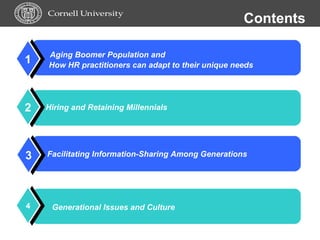
Contents Aging Boomer Population and  How HR practitioners can adapt to their unique needs  1 Hiring and Retaining Millennials   2 Facilitating Information-Sharing Among Generations   3 Generational Issues and Culture 4
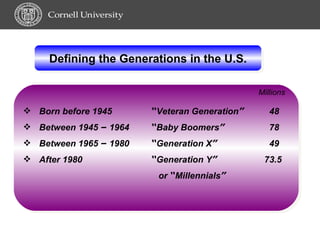
Defining the Generations in the U.S. Born before 1945   “ Veteran Generation ”   48 Between 1945  –  1964 “ Baby Boomers ”   78 Between 1965  –  1980 “ Generation X ”   49  After 1980 “ Generation Y ”   73.5   or  “ Millennials ” Millions
Impact of  “ Boomers ”  on the Workforce Labor Shortages: The Employment Policy Foundation  projects shortage of 10 million workers by 2015,  35 million by 2030 Leadership Vacuum and Knowledge Gap Economic Burden of Retirees
Practices for Managing the  “ Boomers ” Establishing a Motivational Culture for Boomers Recruiting Baby Boomers Career Management for an Older Workforce Programs Addressing Work/Life Balance  Flexibility in Phasing Retirement
SC Johnson Number One for Workers Over 50  AARP commended SC Johnson for creating a workplace of excellence by offering a variety of exceptional benefits including compressed work schedules, paid sabbaticals, summer hours, and a December &quot;holiday shutdown.&quot;
FOR IMMEDIATE RELEASE January 17, 2008  PARTNERSHIP FOR PUBLIC SERVICE AND IBM TEAM TO STEER BABY BOOMERS TO MISSION CRITICAL GOVERNMENT JOBS
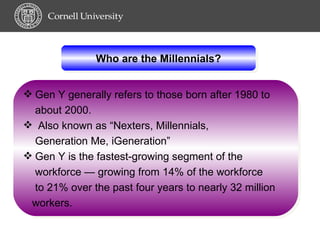
Who are the Millennials? Gen Y generally refers to those born after 1980 to  about 2000. Also known as “Nexters, Millennials,  Generation Me, iGeneration” Gen Y is the fastest-growing segment of the  workforce — growing from 14% of the workforce  to 21% over the past four years to nearly 32 million  workers.
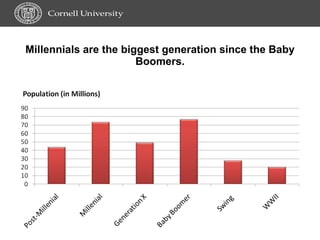
Millennials are the biggest generation since the Baby Boomers.
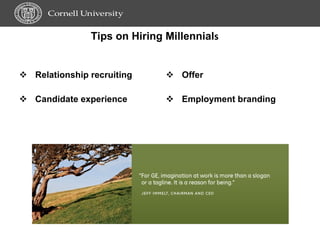
Tips on Hiring Millennial s Relationship recruiting  Candidate experience Offer Employment branding
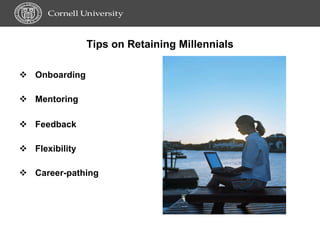
Tips on Retaining Millennials Onboarding Mentoring Feedback Flexibility Career-pathing
Promotes Technology Flexible Work Schedule Changes have trickled up through the company
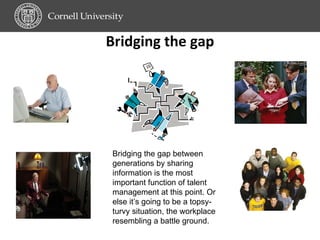
Bridging the gap Bridging the gap between generations by sharing information is the most important function of talent management at this point. Or else it’s going to be a topsy-turvy situation, the workplace resembling a battle ground.
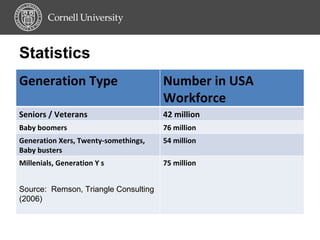
Statistics Generation Type Number in USA Workforce Seniors / Veterans 42 million Baby boomers 76 million Generation Xers, Twenty-somethings, Baby busters 54 million  Millenials, Generation Y s Source:  Remson, Triangle Consulting (2006) 75 million
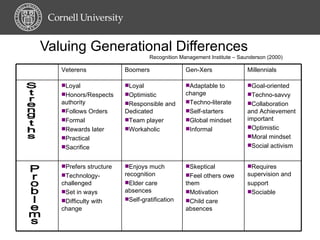
Valuing Generational Differences   Recognition Management Institute – Saunderson (2000) Strengths Problems Veterens Boomers Gen-Xers Millennials Loyal Honors/Respects authority Follows Orders Formal Rewards later Practical Sacrifice Loyal Optimistic Responsible and Dedicated Team player Workaholic Adaptable to change Techno-literate Self-starters Global mindset Informal Goal-oriented Techno-savvy Collaboration and Achievement important Optimistic Moral mindset Social activism Prefers structure Technology-challenged Set in ways Difficulty with change Enjoys much recognition Elder care absences Self-gratification Skeptical Feel others owe them Motivation Child care absences Requires supervision and support Sociable
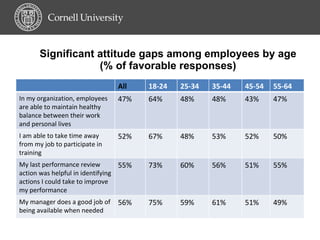
Significant attitude gaps among employees by age (% of favorable responses) All 18-24 25-34 35-44 45-54 55-64 In my organization, employees are able to maintain healthy balance between their work and personal lives 47% 64% 48% 48% 43% 47% I am able to take time away from my job to participate in training 52% 67% 48% 53% 52% 50% My last performance review action was helpful in identifying actions I could take to improve my performance 55% 73% 60% 56% 51% 55% My manager does a good job of being available when needed 56% 75% 59% 61% 51% 49%
t
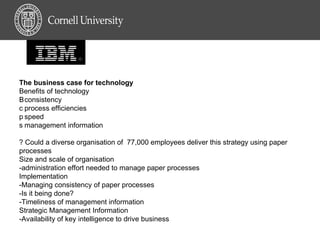
The business case for technology  Benefits of technology 􀂃 consistency 􀂃 process efficiencies 􀂃 speed 􀂃 management information  ? Could a diverse organisation of  77,000 employees deliver this strategy using paper processes  Size and scale of organisation -administration effort needed to manage paper processes  Implementation -Managing consistency of paper processes -Is it being done? -Timeliness of management information  Strategic Management Information -Availability of key intelligence to drive business
Information sharing trends across generations  Ways to remain connected Trend 1: Continuous presence Trend 2 :Multi-modal tasking Trend 3 :Virtual Intimacy Trend 4: Workflow learning
Introducing a new logo: Not Just Idle Chat: Instant Messaging - Its Presence  as a Business tool
Recommendations Management of technology gap through generation blend Generational attitudes shape workers’ responses to  technologies in the workplace. To avoid a generational clash and exploit the power of intergenerational collaboration and knowledge, every organization needs to think differently. The baby-boomers should be willing to be trained to bridge the digital divide. They, in turn, should share their knowledge and expertise with the younger generation.
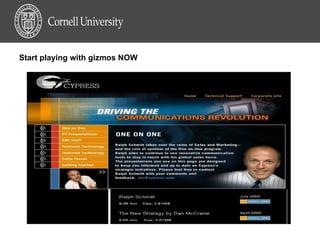
Start playing with gizmos NOW
Generational Issues and Culture   -- General practices in Korea -- Case of Korean company -- Case of U.S. company
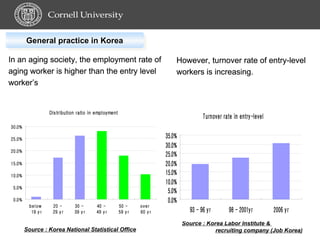
In an aging society, the employment rate of aging worker is higher than the entry level worker’s However, turnover rate of entry-level workers is increasing. Source : Korea National Statistical Office Source : Korea Labor Institute &  recruiting company (Job Korea) In an aging society, the employment rate of aging worker is higher than the entry level worker’s However, turnover rate of entry-level workers is increasing. In an aging society, the employment rate of aging worker is higher than the entry level worker’s However, turnover rate of entry-level workers is increasing. General practice in Korea
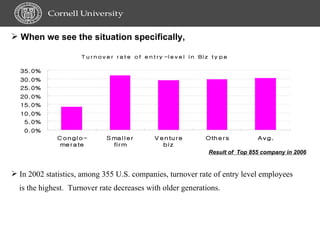
When we see the situation specifically, Result of  Top 855 company in 2006 In 2002 statistics, among 355 U.S. companies, turnover rate of entry level employees is the highest.  Turnover rate decreases with older generations.
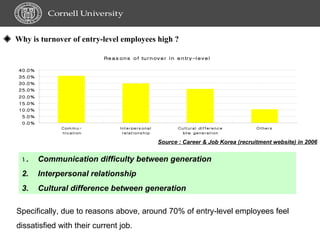
◈  Why is turnover of entry-level employees high ? Communication difficulty between generation Interpersonal relationship Cultural difference between generation Specifically, due to reasons above, around 70% of entry-level employees feel dissatisfied with their current job. Source : Career & Job Korea (recruitment website) in 2006
However, recently, many companies have been making efforts to decrease the turnover rate of entry-level by implementing the following methods: Mentoring system, Entry-level employee Caring Program, Incubating course,  Direct-contact program with CEO, etc.
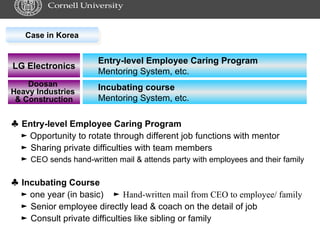
Case in Korea ♣  Incubating Course ►   one year (in basic)  ►  Hand-written mail from CEO to employee/ family ►  Senior employee directly lead & coach on the detail of job ►  Consult private difficulties like sibling or family ♣  Entry-level Employee Caring Program ►   Opportunity to rotate through different job functions with mentor  ►  Sharing private difficulties with team members ►  CEO sends hand-written mail & attends party with employees and their family LG Electronics Entry-level Employee Caring Program Mentoring System, etc. Doosan  Heavy Industries  & Construction Incubating course Mentoring System, etc.
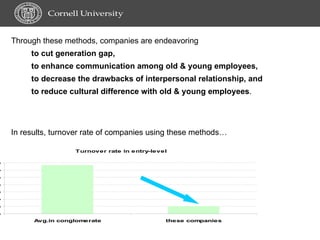
Through these methods, companies are endeavoring to cut generation gap, to enhance communication among old & young employees, to decrease the drawbacks of interpersonal relationship, and to reduce cultural difference with old & young employees . In results, turnover rate of companies using these methods…
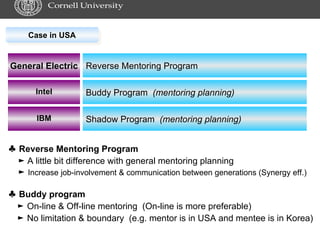
Case in USA ♣  Buddy program ►  On-line & Off-line mentoring  (On-line is more preferable) ►  No limitation & boundary  (e.g. mentor is in USA and mentee is in Korea) ♣  Reverse Mentoring Program ►   A little bit difference with general mentoring planning ►  Increase job-involvement & communication between generations (Synergy eff.) General Electric Reverse Mentoring Program Intel Buddy Program  (mentoring planning) IBM Shadow Program  (mentoring planning)
Sources 1) SHRM - Workplace Visions/ Generational Differences: Myths and Realities   2)  http://www.businessweek.com/careers/content/sep2007/ca20070913_426598.htm?chan=careers_special+report+--+best+places+to+launch+a+career_best+places+to+launch+a+career   3)  http://www.businessweek.com/managing/content/sep2007/ca20070918_595361.htm?chan=careers_special+report+--+best+places+to+launch+a+career_best+places+to+launch+a+career   4)  http://www.usatoday.com/money/workplace/2005-11-06-gen-y_x.htm   5)  http://www.time.com/time/magazine/article/0,9171,1640395,00.html   6)  http://www.markerconsulting.com/articles/103/2/Attracting-and-Retaining-Gen-quotYquot---the-Millennials/Page2.html   7)  http://www.youtube.com/watch?v=Kv52oVIcUKk   -- clip from CBS “60 Minutes” 8)  http://www.hreonline.com/HRE/story.jsp?storyId=84159035   9) Gayeski, D. (2005).  Managing learning and communication systems as business assets. Upper Saddle River, NJ: Pearson/Prentice-Hall. 10)  http://www.wiley.com/WileyCDA/WileyTitle/productCd-0470193964.html 11)

Generational Issues

  • 1.
    General Issues Inthe workforce and HR’s role in managing them Presented by < Connie, Jeff, Sarbani, Jinman > Team Presentation, April. 7, 2008
  • 2.
    Contents Aging BoomerPopulation and How HR practitioners can adapt to their unique needs 1 Hiring and Retaining Millennials 2 Facilitating Information-Sharing Among Generations 3 Generational Issues and Culture 4
  • 3.
    Defining the Generationsin the U.S. Born before 1945 “ Veteran Generation ” 48 Between 1945 – 1964 “ Baby Boomers ” 78 Between 1965 – 1980 “ Generation X ” 49 After 1980 “ Generation Y ” 73.5 or “ Millennials ” Millions
  • 4.
    Impact of “ Boomers ” on the Workforce Labor Shortages: The Employment Policy Foundation projects shortage of 10 million workers by 2015, 35 million by 2030 Leadership Vacuum and Knowledge Gap Economic Burden of Retirees
  • 5.
    Practices for Managingthe “ Boomers ” Establishing a Motivational Culture for Boomers Recruiting Baby Boomers Career Management for an Older Workforce Programs Addressing Work/Life Balance Flexibility in Phasing Retirement
  • 6.
    SC Johnson NumberOne for Workers Over 50 AARP commended SC Johnson for creating a workplace of excellence by offering a variety of exceptional benefits including compressed work schedules, paid sabbaticals, summer hours, and a December &quot;holiday shutdown.&quot;
  • 7.
    FOR IMMEDIATE RELEASEJanuary 17, 2008 PARTNERSHIP FOR PUBLIC SERVICE AND IBM TEAM TO STEER BABY BOOMERS TO MISSION CRITICAL GOVERNMENT JOBS
  • 8.
    Who are theMillennials? Gen Y generally refers to those born after 1980 to about 2000. Also known as “Nexters, Millennials, Generation Me, iGeneration” Gen Y is the fastest-growing segment of the workforce — growing from 14% of the workforce to 21% over the past four years to nearly 32 million workers.
  • 9.
    Millennials are thebiggest generation since the Baby Boomers.
  • 10.
    Tips on HiringMillennial s Relationship recruiting Candidate experience Offer Employment branding
  • 11.
    Tips on RetainingMillennials Onboarding Mentoring Feedback Flexibility Career-pathing
  • 12.
    Promotes Technology FlexibleWork Schedule Changes have trickled up through the company
  • 13.
    Bridging the gapBridging the gap between generations by sharing information is the most important function of talent management at this point. Or else it’s going to be a topsy-turvy situation, the workplace resembling a battle ground.
  • 14.
    Statistics Generation TypeNumber in USA Workforce Seniors / Veterans 42 million Baby boomers 76 million Generation Xers, Twenty-somethings, Baby busters 54 million Millenials, Generation Y s Source: Remson, Triangle Consulting (2006) 75 million
  • 15.
    Valuing Generational Differences Recognition Management Institute – Saunderson (2000) Strengths Problems Veterens Boomers Gen-Xers Millennials Loyal Honors/Respects authority Follows Orders Formal Rewards later Practical Sacrifice Loyal Optimistic Responsible and Dedicated Team player Workaholic Adaptable to change Techno-literate Self-starters Global mindset Informal Goal-oriented Techno-savvy Collaboration and Achievement important Optimistic Moral mindset Social activism Prefers structure Technology-challenged Set in ways Difficulty with change Enjoys much recognition Elder care absences Self-gratification Skeptical Feel others owe them Motivation Child care absences Requires supervision and support Sociable
  • 16.
    Significant attitude gapsamong employees by age (% of favorable responses) All 18-24 25-34 35-44 45-54 55-64 In my organization, employees are able to maintain healthy balance between their work and personal lives 47% 64% 48% 48% 43% 47% I am able to take time away from my job to participate in training 52% 67% 48% 53% 52% 50% My last performance review action was helpful in identifying actions I could take to improve my performance 55% 73% 60% 56% 51% 55% My manager does a good job of being available when needed 56% 75% 59% 61% 51% 49%
  • 17.
  • 18.
    The business casefor technology Benefits of technology 􀂃 consistency 􀂃 process efficiencies 􀂃 speed 􀂃 management information ? Could a diverse organisation of 77,000 employees deliver this strategy using paper processes Size and scale of organisation -administration effort needed to manage paper processes Implementation -Managing consistency of paper processes -Is it being done? -Timeliness of management information Strategic Management Information -Availability of key intelligence to drive business
  • 19.
    Information sharing trendsacross generations Ways to remain connected Trend 1: Continuous presence Trend 2 :Multi-modal tasking Trend 3 :Virtual Intimacy Trend 4: Workflow learning
  • 20.
    Introducing a newlogo: Not Just Idle Chat: Instant Messaging - Its Presence as a Business tool
  • 21.
    Recommendations Management oftechnology gap through generation blend Generational attitudes shape workers’ responses to technologies in the workplace. To avoid a generational clash and exploit the power of intergenerational collaboration and knowledge, every organization needs to think differently. The baby-boomers should be willing to be trained to bridge the digital divide. They, in turn, should share their knowledge and expertise with the younger generation.
  • 22.
  • 23.
    Generational Issues andCulture -- General practices in Korea -- Case of Korean company -- Case of U.S. company
  • 24.
    In an agingsociety, the employment rate of aging worker is higher than the entry level worker’s However, turnover rate of entry-level workers is increasing. Source : Korea National Statistical Office Source : Korea Labor Institute & recruiting company (Job Korea) In an aging society, the employment rate of aging worker is higher than the entry level worker’s However, turnover rate of entry-level workers is increasing. In an aging society, the employment rate of aging worker is higher than the entry level worker’s However, turnover rate of entry-level workers is increasing. General practice in Korea
  • 25.
    When we seethe situation specifically, Result of Top 855 company in 2006 In 2002 statistics, among 355 U.S. companies, turnover rate of entry level employees is the highest. Turnover rate decreases with older generations.
  • 26.
    ◈ Whyis turnover of entry-level employees high ? Communication difficulty between generation Interpersonal relationship Cultural difference between generation Specifically, due to reasons above, around 70% of entry-level employees feel dissatisfied with their current job. Source : Career & Job Korea (recruitment website) in 2006
  • 27.
    However, recently, manycompanies have been making efforts to decrease the turnover rate of entry-level by implementing the following methods: Mentoring system, Entry-level employee Caring Program, Incubating course, Direct-contact program with CEO, etc.
  • 28.
    Case in Korea♣ Incubating Course ► one year (in basic) ► Hand-written mail from CEO to employee/ family ► Senior employee directly lead & coach on the detail of job ► Consult private difficulties like sibling or family ♣ Entry-level Employee Caring Program ► Opportunity to rotate through different job functions with mentor ► Sharing private difficulties with team members ► CEO sends hand-written mail & attends party with employees and their family LG Electronics Entry-level Employee Caring Program Mentoring System, etc. Doosan Heavy Industries & Construction Incubating course Mentoring System, etc.
  • 29.
    Through these methods,companies are endeavoring to cut generation gap, to enhance communication among old & young employees, to decrease the drawbacks of interpersonal relationship, and to reduce cultural difference with old & young employees . In results, turnover rate of companies using these methods…
  • 30.
    Case in USA♣ Buddy program ► On-line & Off-line mentoring (On-line is more preferable) ► No limitation & boundary (e.g. mentor is in USA and mentee is in Korea) ♣ Reverse Mentoring Program ► A little bit difference with general mentoring planning ► Increase job-involvement & communication between generations (Synergy eff.) General Electric Reverse Mentoring Program Intel Buddy Program (mentoring planning) IBM Shadow Program (mentoring planning)
  • 31.
    Sources 1) SHRM- Workplace Visions/ Generational Differences: Myths and Realities   2) http://www.businessweek.com/careers/content/sep2007/ca20070913_426598.htm?chan=careers_special+report+--+best+places+to+launch+a+career_best+places+to+launch+a+career   3) http://www.businessweek.com/managing/content/sep2007/ca20070918_595361.htm?chan=careers_special+report+--+best+places+to+launch+a+career_best+places+to+launch+a+career   4) http://www.usatoday.com/money/workplace/2005-11-06-gen-y_x.htm   5) http://www.time.com/time/magazine/article/0,9171,1640395,00.html   6) http://www.markerconsulting.com/articles/103/2/Attracting-and-Retaining-Gen-quotYquot---the-Millennials/Page2.html   7) http://www.youtube.com/watch?v=Kv52oVIcUKk -- clip from CBS “60 Minutes” 8) http://www.hreonline.com/HRE/story.jsp?storyId=84159035 9) Gayeski, D. (2005). Managing learning and communication systems as business assets. Upper Saddle River, NJ: Pearson/Prentice-Hall. 10) http://www.wiley.com/WileyCDA/WileyTitle/productCd-0470193964.html 11)