Leveraging Model-Driven
Technologies for JSON Artefacts:
The Shipyard Case Study
Alessandro Colantoni, Antonio Garmendia, Luca Berardinelli, Manuel Wimmer
Institute for Business Informatics – Software Engineering Johannes Kepler University, Linz, Austria
Johannes Bräuer
Dynatrace GmbH, Linz
MODELS 2021, Practice and Innovation Track, Oct 14th, 2021 (virtual)
Outline
◦Context:
▪ JSON & JSON Schema
▪ Use Case Scenarios
◦MDE for JSON/JSON Schema:
▪ Bridging Approach steps in details
▪ Case study in DevOps domain: Keptn and Shipyard DSL
◦Conclusions and Future Work
2
Context: JSON and JSON Schema
• JSON is an open, textual, human readable data
serialization format (.json) with a wide range of application,
primarily used in data exchange Web scenarios
[1] IETF, “JSON Schema Draft 2020-12,” https://json-schema.org/draft/ 2020-12/json-schema-core.html, accessed: 2021-19-02.
[2] JSON Schema meta-schema: https://json-schema.org/draft-07/schema
{
"name": "Alessandro",
"surname": "Colantoni",
"affiliation": {
"universityName": "Johannes Kepler University",
"city": "Linz"
},
"contacts": [
{"email": "alessandro.colantoni@jku.at"},
{"phone": "+4373224684248"},
]
} .json
“name” : “value” pairs
[array]
{object}
JSON document / schema instance
JSON document / schema
• JSON Schema is a draft standard issued by IETF.
A schema is “a JSON media type for defining the structure
of JSON data. JSON Schema is intended to define
validation, documentation, hyperlink navigation, and
interaction control of JSON data.” [1]
{
"$schema": "http://json-schema.org/draft-07/schema#"
"type":"object",
"properties":{
"name":{"type":"string},
"surname":{"type":"string}
},
"additionalProperties":true
} .json
Reference to JSON Schema draft standard
contacts array property not foreseen but is allowed!
• IETF publishes a JSON Schema Draft [2] every 6 months
{
"$schema": "http://json-schema.org/draft-07/schema#",
"$id": "http://json-schema.org/draft-07/schema#",
"title": "Core schema meta-schema",
…
} .json
JSON document / (meta)schema instance
JSON document / (meta)schema
Defined by itself
3
Context: Actors and Use Cases
Metaschema Specification
Tool Support
Domain-specific Activities
(schemas and schema instances)
Tool
Provider(s)
Domain
Expert(s)
Data/Language
Engineer(s)
Schema Specification
Managing (meta)schemas and schema instances. Typical
tools include editors, parsers, validators, “utilities”…
Data Engineers define data structures. JSON
Schema is used also for defining the structure of
“scripting languages”.
JSON users needing JSON for their
domain. This is the largest category.
IETF is issuing and maintaining metaschema drafts, i.e., IETF.
https://json-schema.org/implementations.html
JSON users
schema instance
c2
metaschema
c2
schema
Now…
Meta-Language
Engineer
4
Contributions: Bridging JSONware/Modelware (1)
Metaschema Specification
Tool Support
Domain-specific Activities
(schemas and schema instances)
Tool
Provider(s)
Domain
Expert(s)
Data/Language
Engineer(s)
Schema Specification
JSON users
schema instance
c2
metaschema
c2
schema
JSONware TS
M3
M2
M1
1
Modelware TS
model
c2
metalanguage
c2
metamodel
M3
M2
M1
1 Semi-automated JSONware/Modelware Bridging Approach.
Metalayers are explicitly spotted in JSONware.
Meta-Language
Engineer
…After 5
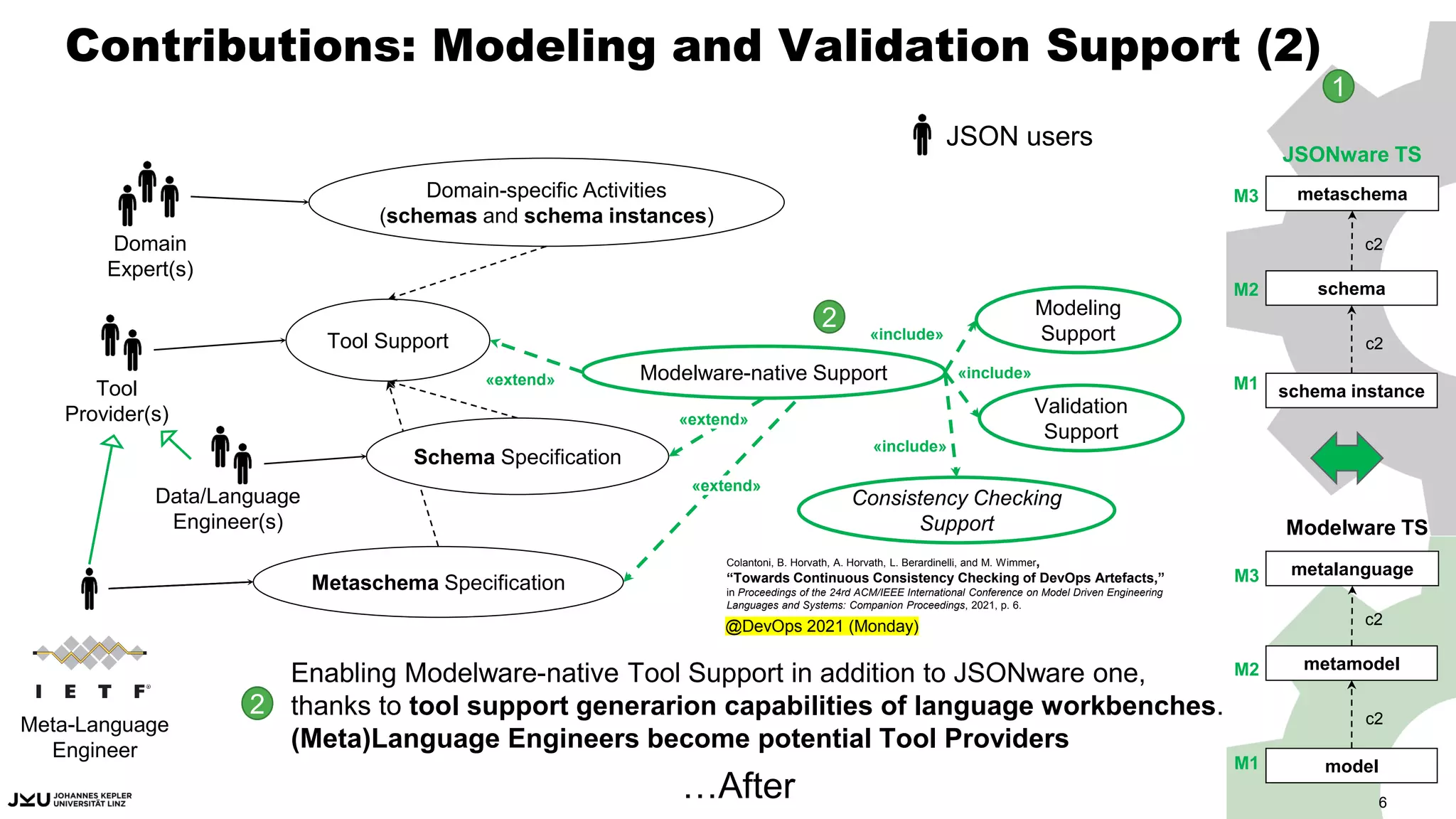
Contributions: Modeling and Validation Support (2)
Metaschema Specification
Tool Support
Domain-specific Activities
(schemas and schema instances)
Tool
Provider(s)
Domain
Expert(s)
Data/Language
Engineer(s)
Schema Specification
JSON users
schema instance
c2
metaschema
c2
schema
JSONware TS
M3
M2
M1
1
Modelware TS
model
c2
metalanguage
c2
metamodel
M3
M2
M1
Enabling Modelware-native Tool Support in addition to JSONware one,
thanks to tool support generarion capabilities of language workbenches.
(Meta)Language Engineers become potential Tool Providers
Modelware-native Support
«extend»
Validation
Support
Modeling
Support
«extend»
«extend»
«include»
«include»
Consistency Checking
Support
«include»
2
2
…After
Meta-Language
Engineer
Colantoni, B. Horvath, A. Horvath, L. Berardinelli, and M. Wimmer,
“Towards Continuous Consistency Checking of DevOps Artefacts,”
in Proceedings of the 24rd ACM/IEEE International Conference on Model Driven Engineering
Languages and Systems: Companion Proceedings, 2021, p. 6.
6
@DevOps 2021 (Monday)
Contributions: Transparent to JSON users (3)
Metaschema Specification
Tool Support
Domain-specific Activities
(schemas and schema instances)
Tool
Provider(s)
Domain
Expert(s)
Data/Language
Engineer(s)
Schema Specification
JSON users
schema instance
c2
metaschema
c2
schema
MDE users
JSONware TS
M3
M2
M1
1
Modelware TS
model
c2
metalanguage
c2
metamodel
M3
M2
M1
«include»
Transparent Approach for JSON users, typically MDE-agnostic,
by adopting JSON textual concrete syntax
3
…After
Meta-Language
Engineer
JSONware-native
support
3
Modelware-native Support
«extend»
Validation
Support
Modeling
Support
«extend»
«extend»
«include»
«include»
Consistency Checking
Support
«include»
2
7
Colantoni, B. Horvath, A. Horvath, L. Berardinelli, and M. Wimmer,
“Towards Continuous Consistency Checking of DevOps Artefacts,”
in Proceedings of the 24rd ACM/IEEE International Conference on Model Driven Engineering
Languages and Systems: Companion Proceedings, 2021, p. 6.
@DevOps 2021 (Monday)
Case Study Scenario: Shipyard DSL for Keptn (CD)
Metaschema Specification
Tool Support
Continuous Delivery Workflow
Specification (DevOps)
Tool
Provider(s)
Domain
Expert(s)
Meta-Language
Engineer
Data/Language
Engineer(s)
Schema Specification
JSON users
schema instance
c2
metaschema
c2
schema
MDE users
JSONware TS
M3
M2
M1
1
Modelware TS
model
c2
metalanguage
c2
metamodel
M3
M2
M1
is an open-source project for orchestrating continuous delivery (CD)
and operational processes of cloud-native applications
https://keptn.sh/
JSONware-native
support
3
Modelware-native Support
«extend»
Validation
Support
Modeling
Support
«extend»
«extend»
«include»
«include»
Consistency Checking
Support
«include»
2
«include»
8
Colantoni, B. Horvath, A. Horvath, L. Berardinelli, and M. Wimmer,
“Towards Continuous Consistency Checking of DevOps Artefacts,”
in Proceedings of the 24rd ACM/IEEE International Conference on Model Driven Engineering
Languages and Systems: Companion Proceedings, 2021, p. 6.
@DevOps 2021 (Monday)
Bridging JSONware/Modelware in Details
• 8 steps across meta layers (domain
independent/specific)
• Different stakeholders / different views
• Metalanguage Engineers (i.e., IETF) perform
manual steps
• Other stakeholders enjoy automation via
novel transformations (JsonSchema2Ecore)
and existing ones (e.g., Ecore2Xtext)
• Supporting Technologies:
EMF, Xtext, ATL, Xtend
: 7-8
Domain
Expert(s)
Tool
Provider(s)
Language
Engineer(s)
: 2,6
: 3-6
Meta-Language
Engineer
: 1-2
metaschema
JSONware
c2
Ecore
metalanguage
c2
metaschema
metamodel
Modelware (via EMF)
c2
Xtext
metagrammar
c2
metaschema
grammar
1
2
M3
M2
M1 document
(schema instance)
c2
schema
c2
schema
schema
metamodel
schema
grammar
document
model
schema
model
c2
c2
4
5
6
7
8
3
c2
schema
schema
model
c2
4
3
schema
metamodel
schema
grammar
5
6
document
(schema instance)
document
model
7
8
domain-specific
domain-independent
9
Let’s introduce it step by step
Approach: Generate Metaschema Artefacts
c2
metaschema
JSONware TS
c2
Ecore
metalanguage
c2
metaschema
metamodel
Modelware (via EMF)
c2
Xtext
metagrammar
c2
metaschema
grammar
1
2
M3
M2
M1 document
(schema instance)
c2
schema
c2
schema
schema
metamodel
schema
grammar
document
model
schema
model
c2
c2
4
5
6
7
8
3
c2
Meta-Language
Engineer
: 1-2
domain-independent
10
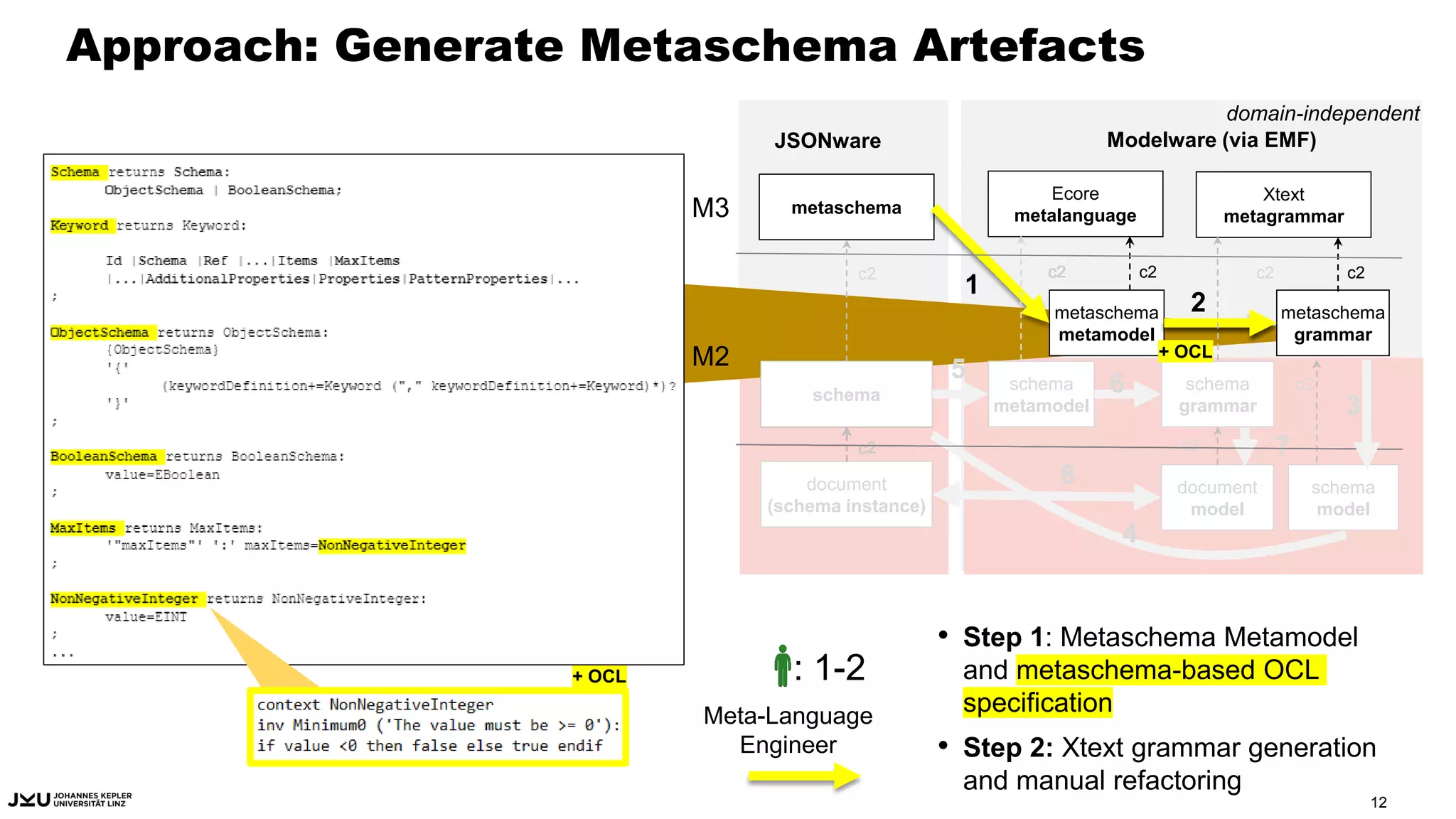
• Step 1: Metaschema Metamodel
and metaschema-based OCL
specification
• Step 2: Xtext grammar generation
and manual refactoring
Approach: Generate Metaschema Artefacts
document
(schema instance)
c2
metaschema
c2
schema
JSONware
c2
Ecore
metalanguage
metaschema
metamodel
Modelware (via EMF)
c2
Xtext
metagrammar
c2
metaschema
grammar
1
2
M3
M2
M1
c2
schema
schema
metamodel
schema
grammar
document
model
schema
model
c2
c2
4
5
6
7
8
3
c2
Meta-Language
Engineer
: 1-2
domain-independent
metaschema metamodel
11
+ OCL
M1
+ OCL
• Step 1: Metaschema Metamodel
and metaschema-based OCL
specification
• Step 2: Xtext grammar generation
and manual refactoring
Approach: Generate Metaschema Artefacts
metaschema
JSONware
c2
Ecore
metalanguage
c2
metaschema
metamodel
Modelware (via EMF)
c2
Xtext
metagrammar
c2
metaschema
grammar
1
2
M3
M2
document
(schema instance)
c2
schema
c2
schema
schema
metamodel
schema
grammar
document
model
schema
model
c2
c2
4
5
6
7
8
3
c2 c2
+ OCL
• Step 1: Metaschema Metamodel
and metaschema-based OCL
specification
• Step 2: Xtext grammar generation
and manual refactoring
Meta-Language
Engineer
: 1-2
domain-independent
12
+ OCL
Approach: Editing/Modeling Schema Documents
metaschema
JSONware
c2
Ecore
metalanguage
c2
metaschema
metamodel
Modelware (via EMF)
c2
Xtext
metagrammar
c2
metaschema
grammar
1
2
M3
M2
M1 document
(schema instance)
c2
schema
c2
schema
schema
metamodel
schema
grammar
document
model
schema
model
c2
c2
5
6
7
8
3
c2
c2
• Step 3: Schema Model in Modelware
• Step 4: JSONware/Modelware
bidirectional bridge
Data/Language
Engineer(s)
: 3-6
Shipyard Schema: CD stages as sequences of stages and then tasks
domain-specific
schema
domain-independent
13
+ OCL
3
schema
model
4
4
domain-specific
Approach: Generate Schema Artefacts
metaschema
JSONware
c2
Ecore
metalanguage
c2
metaschema
metamodel
Modelware (via EMF)
c2
Xtext
metagrammar
c2
metaschema
grammar
1
2
M3
M2
M1 document
(schema instance)
c2
schema
c2
schema
schema
metamodel
schema
grammar
document
model
schema
model
c2
c2
4
5
6
7
8
3
c2
c2
4
3
schema
grammar
6
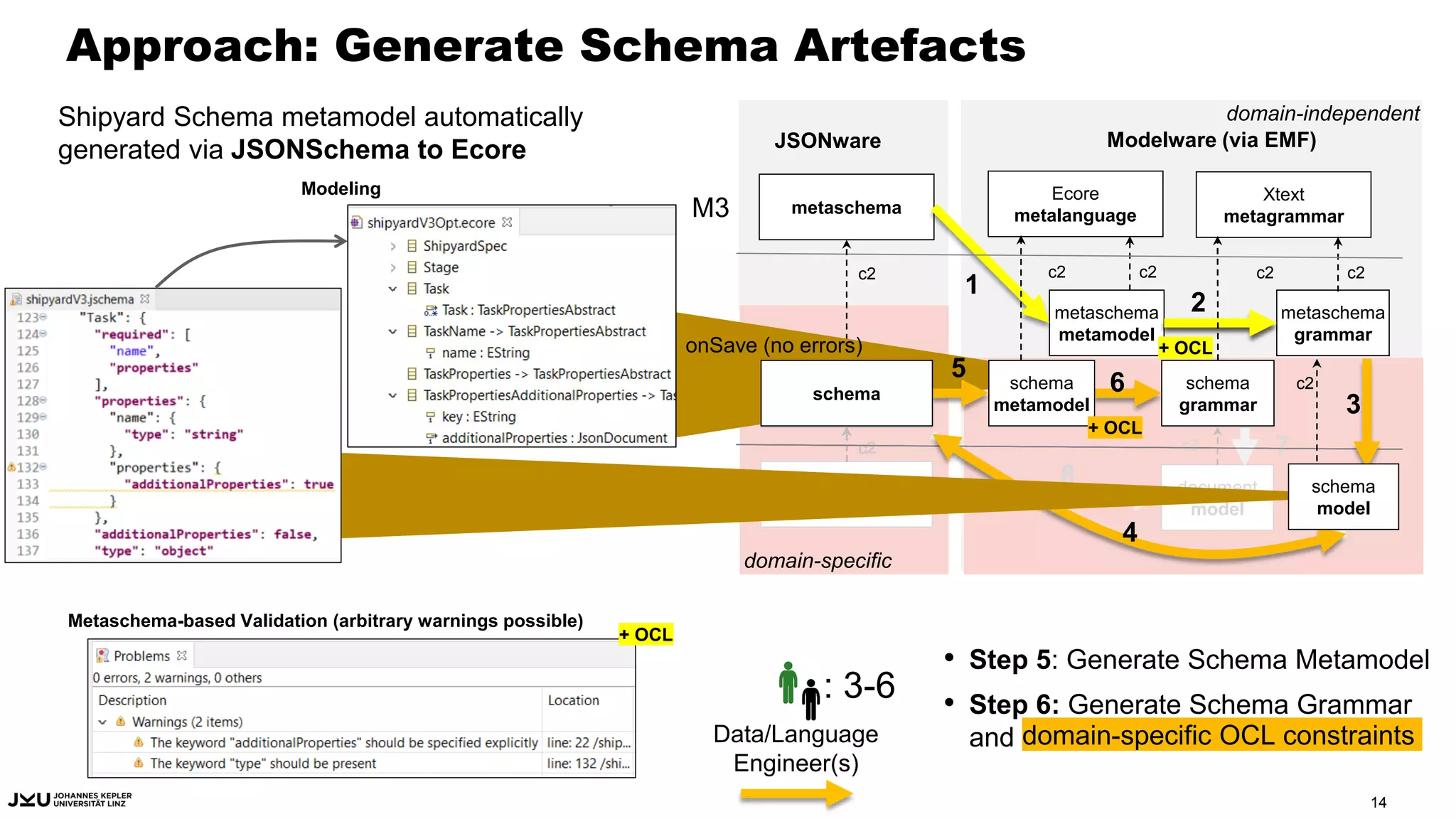
• Step 5: Generate Schema Metamodel
• Step 6: Generate Schema Grammar
and
Shipyard Schema metamodel automatically
generated via JSONSchema to Ecore
schema
model
domain-independent
Data/Language
Engineer(s)
: 3-6
schema
metamodel
Modeling
Metaschema-based Validation (arbitrary warnings possible)
+ OCL
domain-specific OCL constraints
14
+ OCL
onSave (no errors) + OCL
5
schema
Approach: Modeling/Validating CD Workflow in Shipyard
metaschema
JSONware
c2
Ecore
metalanguage
c2
metaschema
metamodel
Modelware (via EMF)
c2
Xtext
metagrammar
c2
metaschema
grammar
1
2
M3
M2
M1
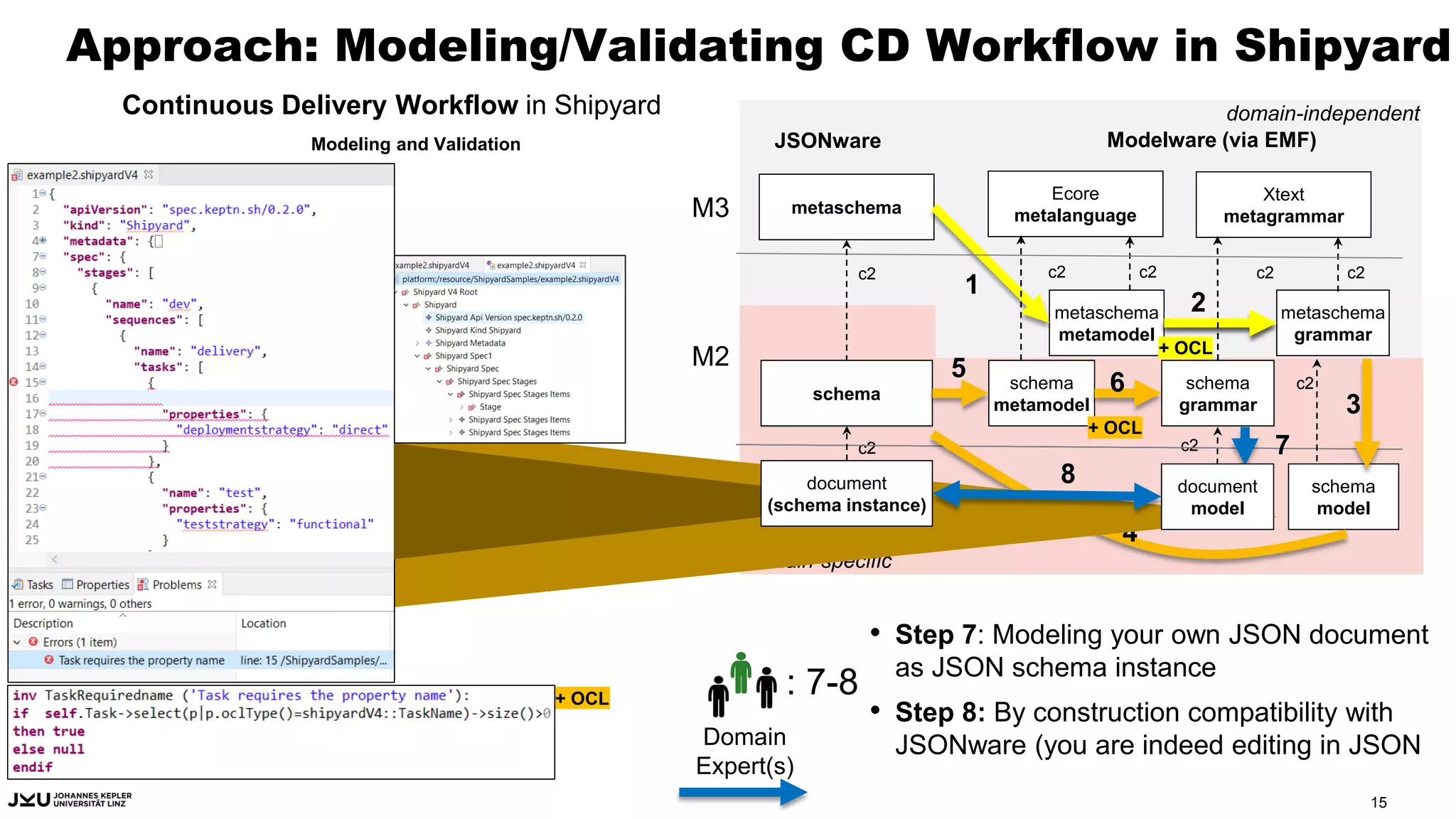
• Step 7: Modeling your own JSON document
as JSON schema instance
• Step 8: By construction compatibility with
JSONware (you are indeed editing in JSON
document
(schema instance)
c2
schema
c2
schema
schema
metamodel
schema
grammar
document
model
schema
model
c2
c2
4
5
6
7
8
3
c2
schema
schema
model
c2
4
3
schema
metamodel
schema
grammar
5
6
Continuous Delivery Workflow in Shipyard
7
8
domain-specific
domain-independent
: 7-8
Domain
Expert(s)
15
Modeling and Validation
+ OCL
+ OCL
+ OCL
document
model
document
(schema instance)
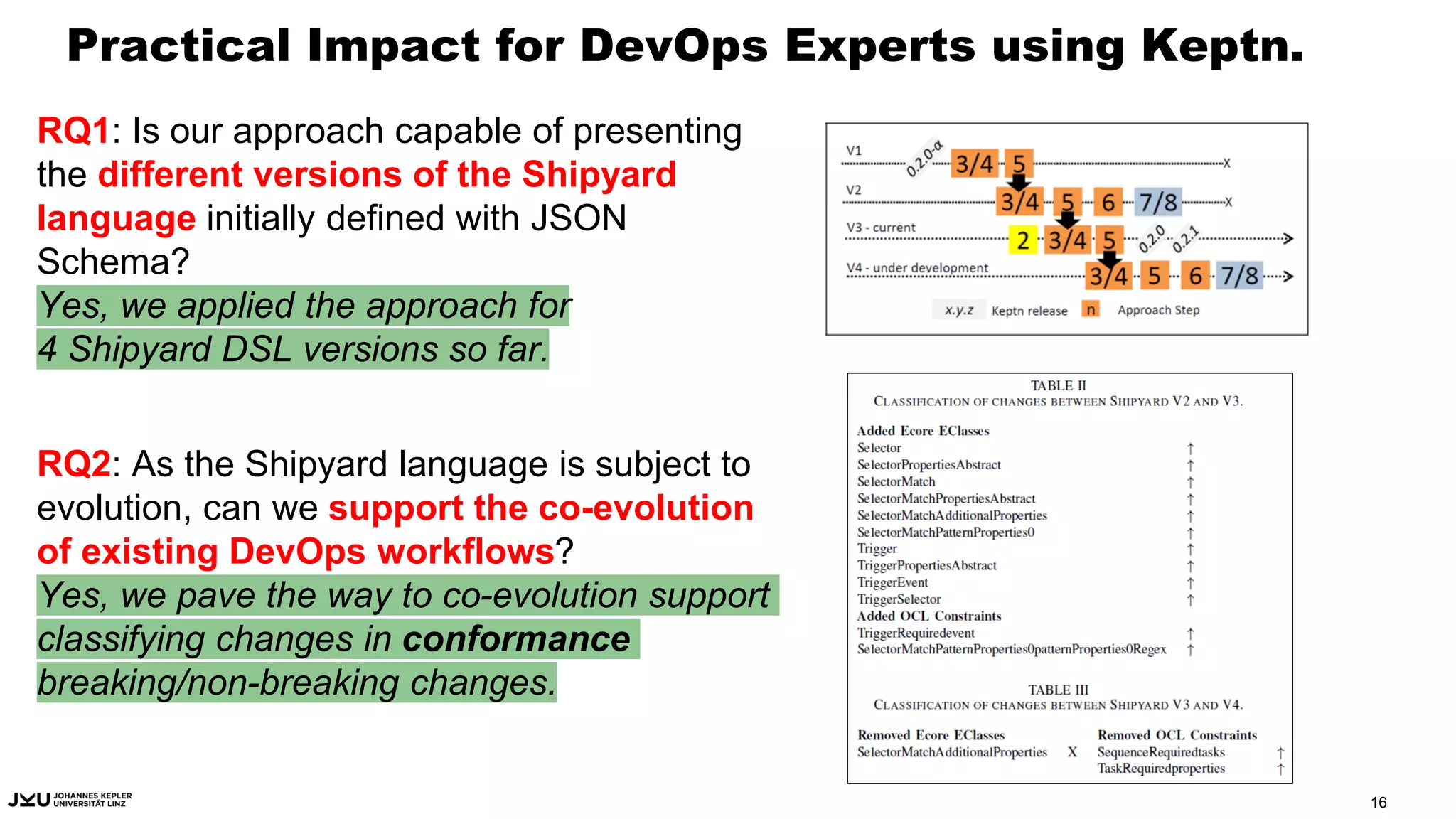
Practical Impact for DevOps Experts using Keptn.
RQ1: Is our approach capable of presenting
the different versions of the Shipyard
language initially defined with JSON
Schema?
Yes, we applied the approach for
4 Shipyard DSL versions so far.
RQ2: As the Shipyard language is subject to
evolution, can we support the co-evolution
of existing DevOps workflows?
Yes, we pave the way to co-evolution support
classifying changes in conformance
breaking/non-breaking changes.
16
Conclusions and Future Work
• We presented a bridge between JSONware and Modelware
(via Eclipse-based technologies)
• Goal: bringing the benefits of model-driven technologies to JSONware
• We concentrated on Modeling and Validation. Consistency Management
across JSON artefacts have been presented at DevOps workshop
• We are going to collect and analyse feedback from Keptn community to
assess the introduction of MDE to an MDE-agnostic community
17
Leveraging Model-Driven
Technologies for JSON Artefacts:
The Shipyard Case Study
Alessandro Colantoni, Antonio Garmendia, Luca Berardinelli, Manuel Wimmer
Institute for Business Informatics – Software Engineering Johannes Kepler University, Linz, Austria
Johannes Bräuer
Dynatrace GmbH, Linz
MODELS 2021, Practice and Innovation Track, Oct 14th, 2021 (virtual)
Thanks for your attention
Question Time
On JSONSchema2Ecore Transformation
Is bidirectional?
MDE Expert viewpoint: No.
• We provide a JSON Schema to Ecore transformation
• We do not provide (yet) an Ecore to JSON Schema. An arbitrary Ecore cannot be
transformed into JSON Schema
JSON Schema Expert (MDE agnostic) viewpoint: n.a.
• She/he is an unaware modeler thanks JSON Native concrete syntax preserved.
19
Context: JSON and JSON Schema
• Additional Properties: true
In this case any JSON fragment can be attached to a
schema instance.
We created the JSONDocumentFragment for this purpose,
to support validation of such JSON fragments within our
Xtext-based editors.
{
"name": "Alessandro",
"surname": "Colantoni“,
"affiliation": {
"universityName": "Johannes Kepler University",
"city": "Linz"
},
"contacts": [
{"email": "alessandro.colantoni@jku.at"},
{"phone": "+4373224684248"},
]
} .json
“name” : “value” pairs
[array]
{object}
JSON document / schema instance
JSON document / schema
{
"$schema": "http://json-schema.org/draft-07/schema#"
"type":"object",
"properties":{
"name":{"type":"string},
"surname":{"type":"string}
},
"additionalProperties":true
} .json
Reference to JSON Schema draft standard
contacts array property not foreseen but is allowed!
{
"$schema": "http://json-schema.org/draft-07/schema#",
"$id": "http://json-schema.org/draft-07/schema#",
"title": "Core schema meta-schema",
…
} .json
JSON document / (meta)schema instance
JSON document / (meta)schema
Defined by itself
20

Leveraging Model-Driven Technologies for JSON Artefacts: The Shipyard Case Study

  • 1.
    Leveraging Model-Driven Technologies forJSON Artefacts: The Shipyard Case Study Alessandro Colantoni, Antonio Garmendia, Luca Berardinelli, Manuel Wimmer Institute for Business Informatics – Software Engineering Johannes Kepler University, Linz, Austria Johannes Bräuer Dynatrace GmbH, Linz MODELS 2021, Practice and Innovation Track, Oct 14th, 2021 (virtual)
  • 2.
    Outline ◦Context: ▪ JSON &JSON Schema ▪ Use Case Scenarios ◦MDE for JSON/JSON Schema: ▪ Bridging Approach steps in details ▪ Case study in DevOps domain: Keptn and Shipyard DSL ◦Conclusions and Future Work 2
  • 3.
    Context: JSON andJSON Schema • JSON is an open, textual, human readable data serialization format (.json) with a wide range of application, primarily used in data exchange Web scenarios [1] IETF, “JSON Schema Draft 2020-12,” https://json-schema.org/draft/ 2020-12/json-schema-core.html, accessed: 2021-19-02. [2] JSON Schema meta-schema: https://json-schema.org/draft-07/schema { "name": "Alessandro", "surname": "Colantoni", "affiliation": { "universityName": "Johannes Kepler University", "city": "Linz" }, "contacts": [ {"email": "alessandro.colantoni@jku.at"}, {"phone": "+4373224684248"}, ] } .json “name” : “value” pairs [array] {object} JSON document / schema instance JSON document / schema • JSON Schema is a draft standard issued by IETF. A schema is “a JSON media type for defining the structure of JSON data. JSON Schema is intended to define validation, documentation, hyperlink navigation, and interaction control of JSON data.” [1] { "$schema": "http://json-schema.org/draft-07/schema#" "type":"object", "properties":{ "name":{"type":"string}, "surname":{"type":"string} }, "additionalProperties":true } .json Reference to JSON Schema draft standard contacts array property not foreseen but is allowed! • IETF publishes a JSON Schema Draft [2] every 6 months { "$schema": "http://json-schema.org/draft-07/schema#", "$id": "http://json-schema.org/draft-07/schema#", "title": "Core schema meta-schema", … } .json JSON document / (meta)schema instance JSON document / (meta)schema Defined by itself 3
  • 4.
    Context: Actors andUse Cases Metaschema Specification Tool Support Domain-specific Activities (schemas and schema instances) Tool Provider(s) Domain Expert(s) Data/Language Engineer(s) Schema Specification Managing (meta)schemas and schema instances. Typical tools include editors, parsers, validators, “utilities”… Data Engineers define data structures. JSON Schema is used also for defining the structure of “scripting languages”. JSON users needing JSON for their domain. This is the largest category. IETF is issuing and maintaining metaschema drafts, i.e., IETF. https://json-schema.org/implementations.html JSON users schema instance c2 metaschema c2 schema Now… Meta-Language Engineer 4
  • 5.
    Contributions: Bridging JSONware/Modelware(1) Metaschema Specification Tool Support Domain-specific Activities (schemas and schema instances) Tool Provider(s) Domain Expert(s) Data/Language Engineer(s) Schema Specification JSON users schema instance c2 metaschema c2 schema JSONware TS M3 M2 M1 1 Modelware TS model c2 metalanguage c2 metamodel M3 M2 M1 1 Semi-automated JSONware/Modelware Bridging Approach. Metalayers are explicitly spotted in JSONware. Meta-Language Engineer …After 5
  • 6.
    Contributions: Modeling andValidation Support (2) Metaschema Specification Tool Support Domain-specific Activities (schemas and schema instances) Tool Provider(s) Domain Expert(s) Data/Language Engineer(s) Schema Specification JSON users schema instance c2 metaschema c2 schema JSONware TS M3 M2 M1 1 Modelware TS model c2 metalanguage c2 metamodel M3 M2 M1 Enabling Modelware-native Tool Support in addition to JSONware one, thanks to tool support generarion capabilities of language workbenches. (Meta)Language Engineers become potential Tool Providers Modelware-native Support «extend» Validation Support Modeling Support «extend» «extend» «include» «include» Consistency Checking Support «include» 2 2 …After Meta-Language Engineer Colantoni, B. Horvath, A. Horvath, L. Berardinelli, and M. Wimmer, “Towards Continuous Consistency Checking of DevOps Artefacts,” in Proceedings of the 24rd ACM/IEEE International Conference on Model Driven Engineering Languages and Systems: Companion Proceedings, 2021, p. 6. 6 @DevOps 2021 (Monday)
  • 7.
    Contributions: Transparent toJSON users (3) Metaschema Specification Tool Support Domain-specific Activities (schemas and schema instances) Tool Provider(s) Domain Expert(s) Data/Language Engineer(s) Schema Specification JSON users schema instance c2 metaschema c2 schema MDE users JSONware TS M3 M2 M1 1 Modelware TS model c2 metalanguage c2 metamodel M3 M2 M1 «include» Transparent Approach for JSON users, typically MDE-agnostic, by adopting JSON textual concrete syntax 3 …After Meta-Language Engineer JSONware-native support 3 Modelware-native Support «extend» Validation Support Modeling Support «extend» «extend» «include» «include» Consistency Checking Support «include» 2 7 Colantoni, B. Horvath, A. Horvath, L. Berardinelli, and M. Wimmer, “Towards Continuous Consistency Checking of DevOps Artefacts,” in Proceedings of the 24rd ACM/IEEE International Conference on Model Driven Engineering Languages and Systems: Companion Proceedings, 2021, p. 6. @DevOps 2021 (Monday)
  • 8.
    Case Study Scenario:Shipyard DSL for Keptn (CD) Metaschema Specification Tool Support Continuous Delivery Workflow Specification (DevOps) Tool Provider(s) Domain Expert(s) Meta-Language Engineer Data/Language Engineer(s) Schema Specification JSON users schema instance c2 metaschema c2 schema MDE users JSONware TS M3 M2 M1 1 Modelware TS model c2 metalanguage c2 metamodel M3 M2 M1 is an open-source project for orchestrating continuous delivery (CD) and operational processes of cloud-native applications https://keptn.sh/ JSONware-native support 3 Modelware-native Support «extend» Validation Support Modeling Support «extend» «extend» «include» «include» Consistency Checking Support «include» 2 «include» 8 Colantoni, B. Horvath, A. Horvath, L. Berardinelli, and M. Wimmer, “Towards Continuous Consistency Checking of DevOps Artefacts,” in Proceedings of the 24rd ACM/IEEE International Conference on Model Driven Engineering Languages and Systems: Companion Proceedings, 2021, p. 6. @DevOps 2021 (Monday)
  • 9.
    Bridging JSONware/Modelware inDetails • 8 steps across meta layers (domain independent/specific) • Different stakeholders / different views • Metalanguage Engineers (i.e., IETF) perform manual steps • Other stakeholders enjoy automation via novel transformations (JsonSchema2Ecore) and existing ones (e.g., Ecore2Xtext) • Supporting Technologies: EMF, Xtext, ATL, Xtend : 7-8 Domain Expert(s) Tool Provider(s) Language Engineer(s) : 2,6 : 3-6 Meta-Language Engineer : 1-2 metaschema JSONware c2 Ecore metalanguage c2 metaschema metamodel Modelware (via EMF) c2 Xtext metagrammar c2 metaschema grammar 1 2 M3 M2 M1 document (schema instance) c2 schema c2 schema schema metamodel schema grammar document model schema model c2 c2 4 5 6 7 8 3 c2 schema schema model c2 4 3 schema metamodel schema grammar 5 6 document (schema instance) document model 7 8 domain-specific domain-independent 9 Let’s introduce it step by step
  • 10.
    Approach: Generate MetaschemaArtefacts c2 metaschema JSONware TS c2 Ecore metalanguage c2 metaschema metamodel Modelware (via EMF) c2 Xtext metagrammar c2 metaschema grammar 1 2 M3 M2 M1 document (schema instance) c2 schema c2 schema schema metamodel schema grammar document model schema model c2 c2 4 5 6 7 8 3 c2 Meta-Language Engineer : 1-2 domain-independent 10 • Step 1: Metaschema Metamodel and metaschema-based OCL specification • Step 2: Xtext grammar generation and manual refactoring
  • 11.
    Approach: Generate MetaschemaArtefacts document (schema instance) c2 metaschema c2 schema JSONware c2 Ecore metalanguage metaschema metamodel Modelware (via EMF) c2 Xtext metagrammar c2 metaschema grammar 1 2 M3 M2 M1 c2 schema schema metamodel schema grammar document model schema model c2 c2 4 5 6 7 8 3 c2 Meta-Language Engineer : 1-2 domain-independent metaschema metamodel 11 + OCL M1 + OCL • Step 1: Metaschema Metamodel and metaschema-based OCL specification • Step 2: Xtext grammar generation and manual refactoring
  • 12.
    Approach: Generate MetaschemaArtefacts metaschema JSONware c2 Ecore metalanguage c2 metaschema metamodel Modelware (via EMF) c2 Xtext metagrammar c2 metaschema grammar 1 2 M3 M2 document (schema instance) c2 schema c2 schema schema metamodel schema grammar document model schema model c2 c2 4 5 6 7 8 3 c2 c2 + OCL • Step 1: Metaschema Metamodel and metaschema-based OCL specification • Step 2: Xtext grammar generation and manual refactoring Meta-Language Engineer : 1-2 domain-independent 12 + OCL
  • 13.
    Approach: Editing/Modeling SchemaDocuments metaschema JSONware c2 Ecore metalanguage c2 metaschema metamodel Modelware (via EMF) c2 Xtext metagrammar c2 metaschema grammar 1 2 M3 M2 M1 document (schema instance) c2 schema c2 schema schema metamodel schema grammar document model schema model c2 c2 5 6 7 8 3 c2 c2 • Step 3: Schema Model in Modelware • Step 4: JSONware/Modelware bidirectional bridge Data/Language Engineer(s) : 3-6 Shipyard Schema: CD stages as sequences of stages and then tasks domain-specific schema domain-independent 13 + OCL 3 schema model 4 4
  • 14.
    domain-specific Approach: Generate SchemaArtefacts metaschema JSONware c2 Ecore metalanguage c2 metaschema metamodel Modelware (via EMF) c2 Xtext metagrammar c2 metaschema grammar 1 2 M3 M2 M1 document (schema instance) c2 schema c2 schema schema metamodel schema grammar document model schema model c2 c2 4 5 6 7 8 3 c2 c2 4 3 schema grammar 6 • Step 5: Generate Schema Metamodel • Step 6: Generate Schema Grammar and Shipyard Schema metamodel automatically generated via JSONSchema to Ecore schema model domain-independent Data/Language Engineer(s) : 3-6 schema metamodel Modeling Metaschema-based Validation (arbitrary warnings possible) + OCL domain-specific OCL constraints 14 + OCL onSave (no errors) + OCL 5 schema
  • 15.
    Approach: Modeling/Validating CDWorkflow in Shipyard metaschema JSONware c2 Ecore metalanguage c2 metaschema metamodel Modelware (via EMF) c2 Xtext metagrammar c2 metaschema grammar 1 2 M3 M2 M1 • Step 7: Modeling your own JSON document as JSON schema instance • Step 8: By construction compatibility with JSONware (you are indeed editing in JSON document (schema instance) c2 schema c2 schema schema metamodel schema grammar document model schema model c2 c2 4 5 6 7 8 3 c2 schema schema model c2 4 3 schema metamodel schema grammar 5 6 Continuous Delivery Workflow in Shipyard 7 8 domain-specific domain-independent : 7-8 Domain Expert(s) 15 Modeling and Validation + OCL + OCL + OCL document model document (schema instance)
  • 16.
    Practical Impact forDevOps Experts using Keptn. RQ1: Is our approach capable of presenting the different versions of the Shipyard language initially defined with JSON Schema? Yes, we applied the approach for 4 Shipyard DSL versions so far. RQ2: As the Shipyard language is subject to evolution, can we support the co-evolution of existing DevOps workflows? Yes, we pave the way to co-evolution support classifying changes in conformance breaking/non-breaking changes. 16
  • 17.
    Conclusions and FutureWork • We presented a bridge between JSONware and Modelware (via Eclipse-based technologies) • Goal: bringing the benefits of model-driven technologies to JSONware • We concentrated on Modeling and Validation. Consistency Management across JSON artefacts have been presented at DevOps workshop • We are going to collect and analyse feedback from Keptn community to assess the introduction of MDE to an MDE-agnostic community 17
  • 18.
    Leveraging Model-Driven Technologies forJSON Artefacts: The Shipyard Case Study Alessandro Colantoni, Antonio Garmendia, Luca Berardinelli, Manuel Wimmer Institute for Business Informatics – Software Engineering Johannes Kepler University, Linz, Austria Johannes Bräuer Dynatrace GmbH, Linz MODELS 2021, Practice and Innovation Track, Oct 14th, 2021 (virtual) Thanks for your attention Question Time
  • 19.
    On JSONSchema2Ecore Transformation Isbidirectional? MDE Expert viewpoint: No. • We provide a JSON Schema to Ecore transformation • We do not provide (yet) an Ecore to JSON Schema. An arbitrary Ecore cannot be transformed into JSON Schema JSON Schema Expert (MDE agnostic) viewpoint: n.a. • She/he is an unaware modeler thanks JSON Native concrete syntax preserved. 19
  • 20.
    Context: JSON andJSON Schema • Additional Properties: true In this case any JSON fragment can be attached to a schema instance. We created the JSONDocumentFragment for this purpose, to support validation of such JSON fragments within our Xtext-based editors. { "name": "Alessandro", "surname": "Colantoni“, "affiliation": { "universityName": "Johannes Kepler University", "city": "Linz" }, "contacts": [ {"email": "alessandro.colantoni@jku.at"}, {"phone": "+4373224684248"}, ] } .json “name” : “value” pairs [array] {object} JSON document / schema instance JSON document / schema { "$schema": "http://json-schema.org/draft-07/schema#" "type":"object", "properties":{ "name":{"type":"string}, "surname":{"type":"string} }, "additionalProperties":true } .json Reference to JSON Schema draft standard contacts array property not foreseen but is allowed! { "$schema": "http://json-schema.org/draft-07/schema#", "$id": "http://json-schema.org/draft-07/schema#", "title": "Core schema meta-schema", … } .json JSON document / (meta)schema instance JSON document / (meta)schema Defined by itself 20