Responding to theTrauma & Mental Health Needs of YoungPeople Experiencing HomelessnessThe early intervention outreach mental health clinic evaluation findings Caitlin Dixona , Leticia Funstonb , Catherine Ryana, Professor Kay Wilhelmb,caSt Vincent’s Mental Health Services, bFaces in the Street, Urban Mental Health Research Institute,cConsultation Liaison Psychiatry , St Vincent’s Hospital, Sydney,  Australia
Youth Homelessness in NSW 4987 young people aged between 12 - 18 years; 2685 aged between 19 - 24 (Chamberlain & MacKenzie, 2009). The NSW Homelessness Action Plan 2009 - 2014 identifies young people aged 12 – 24 years living in inner city areas as a priority group.
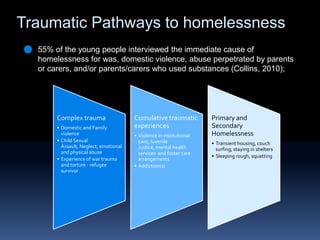
Traumatic Pathways to homelessness55% of the young people interviewed the immediate cause of homelessness for was, domestic violence, abuse perpetrated by parents or carers, and/or parents/carers who used substances (Collins, 2010);
In Melbourne, 3/4 of young people in the sample (N = 1677) had progressed to adult homelessness. These findings reinforce the argument that the longer people are homeless, the more difficult it becomes to get out of homelessness; Among those who remained homeless into adulthood, 65% had substance use issues(Johnson & Chamberlain, 2008).
Homelessness, trauma and mental illness A study conducted in Melbourne found 26% of  homeless young people surveyed reported a level of psychological distress indicative of a psychiatric disorder (Rossiter, Mallett, Myers, & Rosenthal, 2003).Approximately 18% of homeless young people live with trauma-related symptoms meeting the diagnostic criteria for Post Traumatic Stress Disorder (Stelwart, Steiman, Cauce, Cochran, Whitbeck & Hoyt, 2004). One study found that all adult women (N = 38) and over 90% of men (N = 119) experiencing homelessness in Sydney reported at least one event of trauma in their life;50% of the women and 10% of men reported that they had been sexually assaulted whilst homeless, 58% suffered serious physical assault and 55% witnessed someone being badly injured or killed (Buhrich, Hodder, Teesson, 2000).
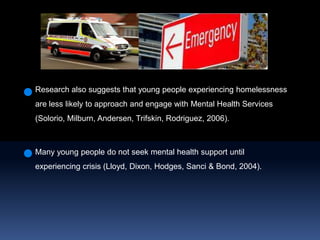
Research also suggests that young people experiencing homelessness are less likely to approach and engage with Mental Health Services (Solorio, Milburn, Andersen, Trifskin, Rodriguez, 2006).Many young people do not seek mental health support until experiencing crisis (Lloyd, Dixon, Hodges, Sanci & Bond,2004).
Multiple barriers to accessing mental health careLack of “youth friendly” services and dominance of adult mental health system (Marven, 2005)Negative experiences with MHS and feeling dissatisfied with MHS service workers (Keys, Mallett, Edwards and Rosenthal, 2004)Lack of outreach multidisciplinary mental health services  (Solorio, Milburn, Andersen, Trifskin, Rodriguez, 2006).“Wrong door approach” or services not adequately resourced to manage complexity of client needs  i.e. AOD use and mental illness (Welch & Mooney, 2001)
Program for Early Intervention and Prevention of Disease (PEIPOD):Outreach mental health clinic
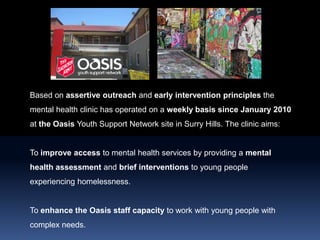
Based on assertive outreach and early intervention principles the mental health clinic has operated on a weekly basis since January 2010 at theOasis Youth Support Network site in Surry Hills. The clinic aims: To improve access to mental health services by providing a mental health assessment and brief interventions to young people experiencing homelessness.  To enhance the Oasis staff capacity to work with young people with complex needs.
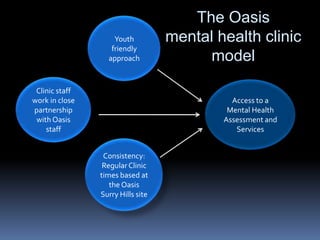
The Oasis mental health clinic modelYouth friendly approach Clinic staff work in close partnership with Oasis staffAccess to a Mental Health Assessment and ServicesConsistency: Regular Clinic times based at the Oasis Surry Hills site
			Evaluationaims: To describe the Clinic and to explore client and staff perspectives regarding the extent to which the Clinic interventions have:1.  Facilitated access to Mental Health Services;2. Improved young peoples’ experience of Mental Health Services and; 3.Enhanced the capacity for Oasis to work with homeless young people with complex needs staying at Oasis.
	         Method: Case file audit of triage forms and assessment notes for clinic attendees between January 2010 and January 2011.  29 case files were included in this audit. Client interviews and client survey: Focus Groups with staff: One focus group with PEIPOD mental health staff and two focus groups with Oasis accommodation staff
Results: Case file audit Case file audit N = 29 young people assessed by the Oasis clinic between January and December 201011 female clients18 male clientsAge range: 16 – 22 years Average age: 19 years
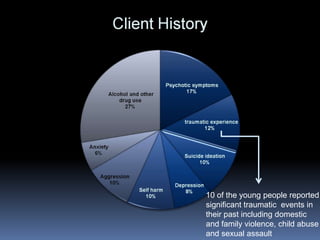
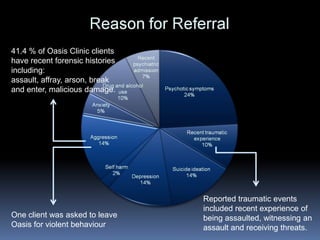
10 of the young people reported significant traumatic  events in their past including domestic and family violence, child abuse and sexual assault
41.4 % of Oasis Clinic clients have recent forensic histories including: assault, affray, arson, break and enter, malicious damage. Reported traumatic events included recent experience of being assaulted, witnessing an assault and receiving threats. One client was asked to leave Oasis for violent behaviour
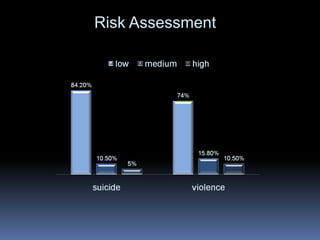
Risk Assessment
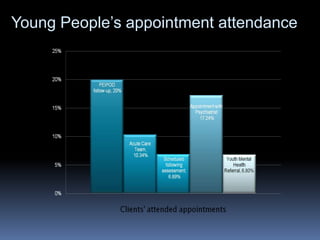
Young People’s appointment attendance
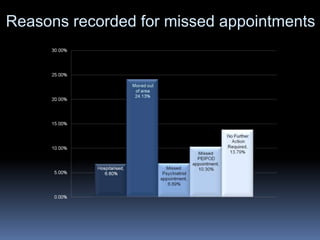
Reasons recorded for missed appointments
Current supportsThe following supports were mentioned however data was not recorded in all instances.Centrelink   Oasis   Friends   Family contact    Case management   Juvenile Justice support worker   Community Services support
Barriers to engaging with young people staying at Oasis
Young people are highly mobileS2: But often they would be gone the next day.  They have been asked to leave or there has been some sort of incident.  Or even that day.  And that’s constant.  All the time.S1: And we don’t know where they have gone. S2: But they can bounce back in a few weeks or few months.S1: They go out early in the morning.  That’s one challenge.  We go at nine in the morning, which I would think is quite early for a young person.  But they’re up earlier and sometimes they’re out at eight. S2: Or they are intoxicated by nine o’clock. S1: And we miss that window because there is no point in seeing them in the afternoon because they have been out doing whatever all day.  It’s pretty hard to get there any earlier.S2: It’s pot luck.S1: It’s their lifestyle. Conversation from PEIPOD staff focus group held October 2010
Case file audit findings24.13% did not engage with services as they had moved out of area1 client planning to move overseas following clinic appointment 4 clients planning to move out of Sydney following appointment5 clients missed their initial Oasis clinic appointment 1 client planned to move but Oasis staff unsure where
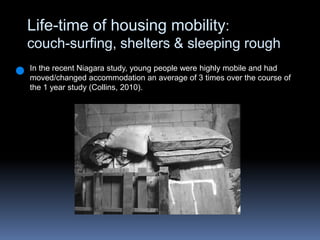
Life-time of housing mobility: couch-surfing, shelters & sleeping roughIn the recent Niagara study, young people were highly mobile and had moved/changed accommodation an average of 3 times over the course of the 1 year study (Collins, 2010).
High turn over of casual staff at OasisIt can be difficult because it’s all casual staff.  They might not be aware of what’s been happening for the person or why the person is being referred or even who the person is. PEIPOD staff…we may lose information there about things that could have been followed through and implemented.  -PEIPOD staffStaff turnover is relatively high in this sector – due to limited funding and resourcing (National Youth Commission, 2008).
Qualitative Themes “Trauma robs the victim of a sense of power and control: the guiding principal of recovery is to restore control to the survivor”Judith Herman, 1992, p. 159
Creating Safety and Consistency:Meeting young people on their “turf”
Outreach and Early Intervention  So, for instance, say we were to take (a young person) down to the Hospital now, they’re going to feel uncomfortable in that sort of space….going crazy, that sort of stuff, but in their comfort zone it makes them a little more...able to respond to the program. Oasis staffWe struggle often with getting our clients to go down to the Hospital so it’s quite good that PEIPOD are coming here and being able to chat to them and sort of have the early contact if they’re not quite sure if they should go or they’re a bit nervous.   It gives them an option instead of going down to hospital. Oasis staffIt’s very good the Clinic’s on site. So clients don’t have to come up here to the health centre…it’s on their turf So it’s not out of reach for them, they don’t have to make a lot of effort . PEIPOD staffThis is a chance to go in and try to meet them at a location and engage them when they are not acutely unwell hopefully and give them a chance for them to talk through their mental health issues, picking it up a bit earlier.’  PEIPOD staff
Building connections and trust with young people Itry make them feel comfortable…  “we’re not wanting to put you on medication”, I think that’s the biggest fear that some of these kids have… they are fearful of the potential outcome’. PEIPOD staff(The Clinic staff) builds relationships with the young people certainly.   Mental health is, it’s not a big deal.  Like if one person has to go through mental health away from here…it seems less scary. Oasis staffThere might be several attempts to see somebody. One day they are just not in a good mood, they don’t want to speak with you and the next time they will talk to you. But it’s definitely about gaining their trust and to try explain to them that we are not there just to take them away and make them do things, force them to do things they don’t want to do. PEIPOD staff  From my personal experience with the Clinic, I know they do explore…a range of things, not just mental health; they explore all aspects of the clients life, so it’s a process and the young people generally respond to it . Oasis staff
Consistency, flexibility andease of accessIt’s easy access for young people to get mental health support. Oasis staffIt’s very opportunistic and I think that’s one of the beauties of the OASIS Clinic.  They know we’re there every Wednesday.  So they may not, on that day, want to engage but next week they might want to.  So I think that fluctuates, but I think that every opportunity is given to the young person to engage with us and, you know, I guess there’s some choice on their behalf… PEIPOD staffSometimes you to see someone else, but they’re not there, but you end up seeing another person and they actually do need to be seen.  PEIPOD staff
Importance of a mental health assessment - Clarifying young people’s mental health needs Some people have been on medication for years and it’s never been reviewed.  You know anti-psychotic medications for two or three years and they may not need to be on them. PEIPOD staffIt’s surprising the number we see in the clinic that then don’t need a mental health service… We can work out some strategies for managing other needs that person might have. PEIPOD staffWithout the clinic, there would be young people that slipped through the net and they would have gone on another few months, years of being untreated got themselves into all sorts of problems maybe ended up in the prison system before that mental health problem is picked up… I mean this is an ideal time to get in there and stop that happening if possible. PEIPOD staffI think previously they didn’t really get that unless they were acute or coming to ED in that they would get referred to us in a community health centre setting but they would never make it to an appointment.  They were too chaotic.PEIPOD staff
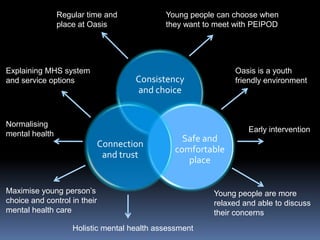
Regular time and place at OasisYoung people can choose when they want to meet with PEIPOD Explaining MHS system and service optionsOasis is a youth friendly environmentNormalising mental health Early interventionMaximise young person’s choice and control in their mental health care Young people are more relaxed and able to discuss their concernsHolistic mental health assessment
 Supporting the young person’s support network
Mental Health and Youth Support Partnership (The PEIPOD staff) are great…I don’t have a clinical background,  so to just to say we have concerns about someone, with their behaviours, they help us with a decision in referring instead of us being completely on our own backs. Oasis staffOasis staff can see why we come to the conclusion that we do about our impression of a young person’s mental health needs because we are not doing any assessment in isolation we involve them’Peipod staff
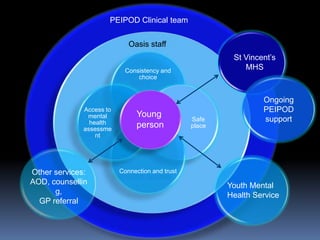
PEIPOD Clinical teamOasis staffSt Vincent’s MHSOngoing PEIPOD support Young personOther services: AOD, counselling, GP referralYouth Mental Health Service
Service gaps identified andpossible strategiesEnhancing communication with casual staff members at OasisDetermine if clients have taken up referrals to other services i.e. alcohol and other drug counselling, GP appointmentsImproved Resources: need to Include a Registrar or Doctor within the assessment/clinicExpand the youth mental health clinic to other youth service sites
Questions & Comments? THANK YOU
References:A Way Home: Reducing Homelessness in NSW, NSW Homelessness Action Plan 2009 – 2014 Chamberlain, C.,  & MacKenzie, D. (2009). Counting the homeless 2006: New South Wales. Cat. no. HOU 204. Canberra: AIHWBonin, J., Fournier, L. &Blais, R. (2007). Predictors of Mental health Service Utilization by People using Resources for Homeless People in Canada, Psychiatric Services: 58, 936-941.Darbyshire P., Muir-Cochrane E., Fereday J., Jureidini J & Drummond, A. (2006). Engagement with health and social care services: perceptions of homeless young people with mental health problems, Health and Social Carein the CommunityCollins, S. (2010). Sofas, Shelters and Strangers: A report on youth homelessness in Niagra, Niagra Community Services.Farmer, Robinson, Elliot & Eyles (2006) Weighing up Triangulation and Contradictory Evidence in Mixed Methods Organisational Research, International Journal of Multiple Research Approaches, 1 (1), 27 - 39 French, R., Reardon, M., & Smith, P (2003).  Engaging with a Mental Health Service: Perspectives of At-Risk Youth. The Child & Adolescent Social Work Journal, 20 (6), 529-548Herman, J. (1992). Trauma and Recovery, New York: Basic Books. Gallet, W. (2008). Finding My Place: The Salvation Army’s Response to Youth Homelessness, The Salvation Army Australia Eastern Territory, Communications and Public Relations Department.Johnson, G. & Chamberlain, C. (2008). ‘From Youth to Adult Homelessness’, Australian Journal of Social Issues, 43(4), 563–582Kamieniecki, G. (2001). ‘Prevalence of psychological distress and psychiatric disorders among homeless youth in Australia: a comparative review’, Australian and New Zealand Journal of Psychiatry, 35 (3), 352–358.
Keys, D., Mallett, S., Edwards, J., & Rosenthal, D. (2004). Who can help me? Homeless Young Persons Perceptions of Services: A report of selected results from Project i: Homeless Young People in Melbourne and Los Angeles (2000 –2005)  Department of Public Health, University of Melbourne.Lloyd, S. Dixon, M. Hodges, C. Sanci, L. Bond, L. (2004), Attitudes Towards andPathways to and from the Young People’s Health Service Mental Health Services,Young People’s Health Service and beyondblue, Melbourne.Martijn, C.& Sharpe, L. (2005).  Pathways to Youth Homelessness, Social Science and Medicine. Social Science and Medicine, 62, 1-12.McManus, H. & Thompson, S. (2008). ‘Trauma Among Unaccompanied Homeless Youth: The Integration of Street Culture into a Model of Intervention, Journal of Aggression, Maltreatment and Trauma, 16(1), 92-108.Mildred, H. (2007). Eastern Health Child and Adolescent Mental Health Service, Supplementary Material, Melbourne Day 14. Robinson, C. (2010).  Rough Living: Surviving violence and homelessness, UTSePress in association with the Public Interest Advocacy Centre: Sydney. Rossiter, B., Mallet, S., Myers, P. & Rosenthal D. (2003). Living Well? Homeless young people in Melbourne. Parity, 16(2), 13-14.Solorio, R., Milburn, N., Andersen, R. Trifskin, S. & Rodriguez, M. (2006). Emotional Distress and Mental Health Service Use Among Urban Homeless Adolescents, Journal of Behavioural Health Services and Research 33, (4), 381-393Stewart, Steinman, M., Cauce, A., Cochran, B., Whitbeck, L. & Hoyt, D. (2004). Victimization and posttraumatic stress disorder among homeless adolescents. Journal of the American Academy of Child and Adolescent Psychiatry. 43, 325–331Welch, M., & Mooney, J. (2001). Managing services that manage people with a coexisting mental health and substance use disorder. Australasian Psychiatry, 9, 345–349.

Leticia Funston presentation

  • 1.
    Responding to theTrauma& Mental Health Needs of YoungPeople Experiencing HomelessnessThe early intervention outreach mental health clinic evaluation findings Caitlin Dixona , Leticia Funstonb , Catherine Ryana, Professor Kay Wilhelmb,caSt Vincent’s Mental Health Services, bFaces in the Street, Urban Mental Health Research Institute,cConsultation Liaison Psychiatry , St Vincent’s Hospital, Sydney, Australia
  • 3.
    Youth Homelessness inNSW 4987 young people aged between 12 - 18 years; 2685 aged between 19 - 24 (Chamberlain & MacKenzie, 2009). The NSW Homelessness Action Plan 2009 - 2014 identifies young people aged 12 – 24 years living in inner city areas as a priority group.
  • 4.
    Traumatic Pathways tohomelessness55% of the young people interviewed the immediate cause of homelessness for was, domestic violence, abuse perpetrated by parents or carers, and/or parents/carers who used substances (Collins, 2010);
  • 5.
    In Melbourne, 3/4of young people in the sample (N = 1677) had progressed to adult homelessness. These findings reinforce the argument that the longer people are homeless, the more difficult it becomes to get out of homelessness; Among those who remained homeless into adulthood, 65% had substance use issues(Johnson & Chamberlain, 2008).
  • 6.
    Homelessness, trauma andmental illness A study conducted in Melbourne found 26% of homeless young people surveyed reported a level of psychological distress indicative of a psychiatric disorder (Rossiter, Mallett, Myers, & Rosenthal, 2003).Approximately 18% of homeless young people live with trauma-related symptoms meeting the diagnostic criteria for Post Traumatic Stress Disorder (Stelwart, Steiman, Cauce, Cochran, Whitbeck & Hoyt, 2004). One study found that all adult women (N = 38) and over 90% of men (N = 119) experiencing homelessness in Sydney reported at least one event of trauma in their life;50% of the women and 10% of men reported that they had been sexually assaulted whilst homeless, 58% suffered serious physical assault and 55% witnessed someone being badly injured or killed (Buhrich, Hodder, Teesson, 2000).
  • 7.
    Research also suggeststhat young people experiencing homelessness are less likely to approach and engage with Mental Health Services (Solorio, Milburn, Andersen, Trifskin, Rodriguez, 2006).Many young people do not seek mental health support until experiencing crisis (Lloyd, Dixon, Hodges, Sanci & Bond,2004).
  • 8.
    Multiple barriers toaccessing mental health careLack of “youth friendly” services and dominance of adult mental health system (Marven, 2005)Negative experiences with MHS and feeling dissatisfied with MHS service workers (Keys, Mallett, Edwards and Rosenthal, 2004)Lack of outreach multidisciplinary mental health services (Solorio, Milburn, Andersen, Trifskin, Rodriguez, 2006).“Wrong door approach” or services not adequately resourced to manage complexity of client needs i.e. AOD use and mental illness (Welch & Mooney, 2001)
  • 9.
    Program for EarlyIntervention and Prevention of Disease (PEIPOD):Outreach mental health clinic
  • 10.
    Based on assertiveoutreach and early intervention principles the mental health clinic has operated on a weekly basis since January 2010 at theOasis Youth Support Network site in Surry Hills. The clinic aims: To improve access to mental health services by providing a mental health assessment and brief interventions to young people experiencing homelessness. To enhance the Oasis staff capacity to work with young people with complex needs.
  • 11.
    The Oasis mentalhealth clinic modelYouth friendly approach Clinic staff work in close partnership with Oasis staffAccess to a Mental Health Assessment and ServicesConsistency: Regular Clinic times based at the Oasis Surry Hills site
  • 12.
    Evaluationaims: To describethe Clinic and to explore client and staff perspectives regarding the extent to which the Clinic interventions have:1. Facilitated access to Mental Health Services;2. Improved young peoples’ experience of Mental Health Services and; 3.Enhanced the capacity for Oasis to work with homeless young people with complex needs staying at Oasis.
  • 13.
    Method: Case file audit of triage forms and assessment notes for clinic attendees between January 2010 and January 2011. 29 case files were included in this audit. Client interviews and client survey: Focus Groups with staff: One focus group with PEIPOD mental health staff and two focus groups with Oasis accommodation staff
  • 14.
    Results: Case fileaudit Case file audit N = 29 young people assessed by the Oasis clinic between January and December 201011 female clients18 male clientsAge range: 16 – 22 years Average age: 19 years
  • 15.
    10 of theyoung people reported significant traumatic events in their past including domestic and family violence, child abuse and sexual assault
  • 16.
    41.4 % ofOasis Clinic clients have recent forensic histories including: assault, affray, arson, break and enter, malicious damage. Reported traumatic events included recent experience of being assaulted, witnessing an assault and receiving threats. One client was asked to leave Oasis for violent behaviour
  • 17.
  • 18.
  • 19.
    Reasons recorded formissed appointments
  • 20.
    Current supportsThe followingsupports were mentioned however data was not recorded in all instances.Centrelink Oasis Friends Family contact Case management Juvenile Justice support worker Community Services support
  • 21.
    Barriers to engagingwith young people staying at Oasis
  • 22.
    Young people arehighly mobileS2: But often they would be gone the next day. They have been asked to leave or there has been some sort of incident. Or even that day. And that’s constant. All the time.S1: And we don’t know where they have gone. S2: But they can bounce back in a few weeks or few months.S1: They go out early in the morning. That’s one challenge. We go at nine in the morning, which I would think is quite early for a young person. But they’re up earlier and sometimes they’re out at eight. S2: Or they are intoxicated by nine o’clock. S1: And we miss that window because there is no point in seeing them in the afternoon because they have been out doing whatever all day. It’s pretty hard to get there any earlier.S2: It’s pot luck.S1: It’s their lifestyle. Conversation from PEIPOD staff focus group held October 2010
  • 23.
    Case file auditfindings24.13% did not engage with services as they had moved out of area1 client planning to move overseas following clinic appointment 4 clients planning to move out of Sydney following appointment5 clients missed their initial Oasis clinic appointment 1 client planned to move but Oasis staff unsure where
  • 24.
    Life-time of housingmobility: couch-surfing, shelters & sleeping roughIn the recent Niagara study, young people were highly mobile and had moved/changed accommodation an average of 3 times over the course of the 1 year study (Collins, 2010).
  • 25.
    High turn overof casual staff at OasisIt can be difficult because it’s all casual staff. They might not be aware of what’s been happening for the person or why the person is being referred or even who the person is. PEIPOD staff…we may lose information there about things that could have been followed through and implemented. -PEIPOD staffStaff turnover is relatively high in this sector – due to limited funding and resourcing (National Youth Commission, 2008).
  • 26.
    Qualitative Themes “Traumarobs the victim of a sense of power and control: the guiding principal of recovery is to restore control to the survivor”Judith Herman, 1992, p. 159
  • 27.
    Creating Safety andConsistency:Meeting young people on their “turf”
  • 28.
    Outreach and EarlyIntervention So, for instance, say we were to take (a young person) down to the Hospital now, they’re going to feel uncomfortable in that sort of space….going crazy, that sort of stuff, but in their comfort zone it makes them a little more...able to respond to the program. Oasis staffWe struggle often with getting our clients to go down to the Hospital so it’s quite good that PEIPOD are coming here and being able to chat to them and sort of have the early contact if they’re not quite sure if they should go or they’re a bit nervous. It gives them an option instead of going down to hospital. Oasis staffIt’s very good the Clinic’s on site. So clients don’t have to come up here to the health centre…it’s on their turf So it’s not out of reach for them, they don’t have to make a lot of effort . PEIPOD staffThis is a chance to go in and try to meet them at a location and engage them when they are not acutely unwell hopefully and give them a chance for them to talk through their mental health issues, picking it up a bit earlier.’ PEIPOD staff
  • 29.
    Building connections andtrust with young people Itry make them feel comfortable… “we’re not wanting to put you on medication”, I think that’s the biggest fear that some of these kids have… they are fearful of the potential outcome’. PEIPOD staff(The Clinic staff) builds relationships with the young people certainly. Mental health is, it’s not a big deal. Like if one person has to go through mental health away from here…it seems less scary. Oasis staffThere might be several attempts to see somebody. One day they are just not in a good mood, they don’t want to speak with you and the next time they will talk to you. But it’s definitely about gaining their trust and to try explain to them that we are not there just to take them away and make them do things, force them to do things they don’t want to do. PEIPOD staff From my personal experience with the Clinic, I know they do explore…a range of things, not just mental health; they explore all aspects of the clients life, so it’s a process and the young people generally respond to it . Oasis staff
  • 30.
    Consistency, flexibility andeaseof accessIt’s easy access for young people to get mental health support. Oasis staffIt’s very opportunistic and I think that’s one of the beauties of the OASIS Clinic. They know we’re there every Wednesday. So they may not, on that day, want to engage but next week they might want to. So I think that fluctuates, but I think that every opportunity is given to the young person to engage with us and, you know, I guess there’s some choice on their behalf… PEIPOD staffSometimes you to see someone else, but they’re not there, but you end up seeing another person and they actually do need to be seen. PEIPOD staff
  • 31.
    Importance of amental health assessment - Clarifying young people’s mental health needs Some people have been on medication for years and it’s never been reviewed. You know anti-psychotic medications for two or three years and they may not need to be on them. PEIPOD staffIt’s surprising the number we see in the clinic that then don’t need a mental health service… We can work out some strategies for managing other needs that person might have. PEIPOD staffWithout the clinic, there would be young people that slipped through the net and they would have gone on another few months, years of being untreated got themselves into all sorts of problems maybe ended up in the prison system before that mental health problem is picked up… I mean this is an ideal time to get in there and stop that happening if possible. PEIPOD staffI think previously they didn’t really get that unless they were acute or coming to ED in that they would get referred to us in a community health centre setting but they would never make it to an appointment. They were too chaotic.PEIPOD staff
  • 32.
    Regular time andplace at OasisYoung people can choose when they want to meet with PEIPOD Explaining MHS system and service optionsOasis is a youth friendly environmentNormalising mental health Early interventionMaximise young person’s choice and control in their mental health care Young people are more relaxed and able to discuss their concernsHolistic mental health assessment
  • 33.
    Supporting theyoung person’s support network
  • 34.
    Mental Health andYouth Support Partnership (The PEIPOD staff) are great…I don’t have a clinical background, so to just to say we have concerns about someone, with their behaviours, they help us with a decision in referring instead of us being completely on our own backs. Oasis staffOasis staff can see why we come to the conclusion that we do about our impression of a young person’s mental health needs because we are not doing any assessment in isolation we involve them’Peipod staff
  • 35.
    PEIPOD Clinical teamOasisstaffSt Vincent’s MHSOngoing PEIPOD support Young personOther services: AOD, counselling, GP referralYouth Mental Health Service
  • 36.
    Service gaps identifiedandpossible strategiesEnhancing communication with casual staff members at OasisDetermine if clients have taken up referrals to other services i.e. alcohol and other drug counselling, GP appointmentsImproved Resources: need to Include a Registrar or Doctor within the assessment/clinicExpand the youth mental health clinic to other youth service sites
  • 37.
  • 38.
    References:A Way Home:Reducing Homelessness in NSW, NSW Homelessness Action Plan 2009 – 2014 Chamberlain, C., & MacKenzie, D. (2009). Counting the homeless 2006: New South Wales. Cat. no. HOU 204. Canberra: AIHWBonin, J., Fournier, L. &Blais, R. (2007). Predictors of Mental health Service Utilization by People using Resources for Homeless People in Canada, Psychiatric Services: 58, 936-941.Darbyshire P., Muir-Cochrane E., Fereday J., Jureidini J & Drummond, A. (2006). Engagement with health and social care services: perceptions of homeless young people with mental health problems, Health and Social Carein the CommunityCollins, S. (2010). Sofas, Shelters and Strangers: A report on youth homelessness in Niagra, Niagra Community Services.Farmer, Robinson, Elliot & Eyles (2006) Weighing up Triangulation and Contradictory Evidence in Mixed Methods Organisational Research, International Journal of Multiple Research Approaches, 1 (1), 27 - 39 French, R., Reardon, M., & Smith, P (2003).  Engaging with a Mental Health Service: Perspectives of At-Risk Youth. The Child & Adolescent Social Work Journal, 20 (6), 529-548Herman, J. (1992). Trauma and Recovery, New York: Basic Books. Gallet, W. (2008). Finding My Place: The Salvation Army’s Response to Youth Homelessness, The Salvation Army Australia Eastern Territory, Communications and Public Relations Department.Johnson, G. & Chamberlain, C. (2008). ‘From Youth to Adult Homelessness’, Australian Journal of Social Issues, 43(4), 563–582Kamieniecki, G. (2001). ‘Prevalence of psychological distress and psychiatric disorders among homeless youth in Australia: a comparative review’, Australian and New Zealand Journal of Psychiatry, 35 (3), 352–358.
  • 39.
    Keys, D., Mallett,S., Edwards, J., & Rosenthal, D. (2004). Who can help me? Homeless Young Persons Perceptions of Services: A report of selected results from Project i: Homeless Young People in Melbourne and Los Angeles (2000 –2005) Department of Public Health, University of Melbourne.Lloyd, S. Dixon, M. Hodges, C. Sanci, L. Bond, L. (2004), Attitudes Towards andPathways to and from the Young People’s Health Service Mental Health Services,Young People’s Health Service and beyondblue, Melbourne.Martijn, C.& Sharpe, L. (2005). Pathways to Youth Homelessness, Social Science and Medicine. Social Science and Medicine, 62, 1-12.McManus, H. & Thompson, S. (2008). ‘Trauma Among Unaccompanied Homeless Youth: The Integration of Street Culture into a Model of Intervention, Journal of Aggression, Maltreatment and Trauma, 16(1), 92-108.Mildred, H. (2007). Eastern Health Child and Adolescent Mental Health Service, Supplementary Material, Melbourne Day 14. Robinson, C. (2010). Rough Living: Surviving violence and homelessness, UTSePress in association with the Public Interest Advocacy Centre: Sydney. Rossiter, B., Mallet, S., Myers, P. & Rosenthal D. (2003). Living Well? Homeless young people in Melbourne. Parity, 16(2), 13-14.Solorio, R., Milburn, N., Andersen, R. Trifskin, S. & Rodriguez, M. (2006). Emotional Distress and Mental Health Service Use Among Urban Homeless Adolescents, Journal of Behavioural Health Services and Research 33, (4), 381-393Stewart, Steinman, M., Cauce, A., Cochran, B., Whitbeck, L. & Hoyt, D. (2004). Victimization and posttraumatic stress disorder among homeless adolescents. Journal of the American Academy of Child and Adolescent Psychiatry. 43, 325–331Welch, M., & Mooney, J. (2001). Managing services that manage people with a coexisting mental health and substance use disorder. Australasian Psychiatry, 9, 345–349.