Employee
Corrective Action
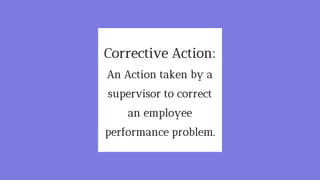
Corrective Action:
An Action taken by a
supervisor to correct
an employee
performance problem.
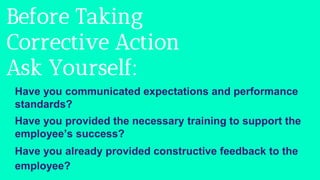
Before Taking
Corrective Action
Ask Yourself:
Have you communicated expectations and performance
standards?
Have you provided the necessary training to support the
employee’s success?
Have you already provided constructive feedback to the
employee?
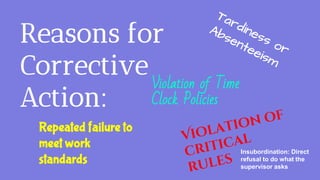
Reasons for
Corrective
Action:
Violation of Time
Clock Policies
Repeated failure to
meet work
standards
Insubordination: Direct
refusal to do what the
supervisor asks
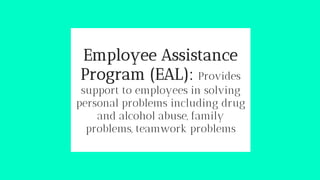
Employee Assistance
Program (EAL): Provides
support to employees in solving
personal problems including drug
and alcohol abuse, family
problems, teamwork problems
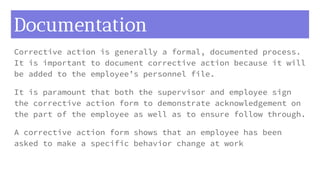
Documentation
Corrective action is generally a formal, documented process.
It is important to document corrective action because it will
be added to the employee’s personnel file.
It is paramount that both the supervisor and employee sign
the corrective action form to demonstrate acknowledgement on
the part of the employee as well as to ensure follow through.
A corrective action form shows that an employee has been
asked to make a specific behavior change at work
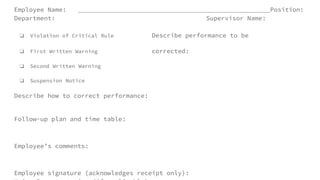
Employee Name: Position:
Department: Supervisor Name:
❏ Violation of Critical Rule Describe performance to be
❏ First Written Warning corrected:
❏ Second Written Warning
❏ Suspension Notice
Describe how to correct performance:
Follow-up plan and time table:
Employee’s comments:
Employee signature (acknowledges receipt only):
Progressive Discipline:
A series of defined steps a CDM takes when an
employee does not correct a performance problem
after being given the opportunity to do so. The
specific model of is determined by the policies and
procedures found within the human resources
department.
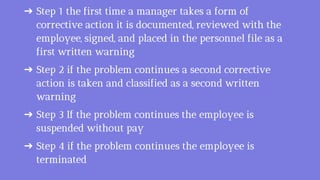
➔ Step 1 the first time a manager takes a form of
corrective action it is documented, reviewed with the
employee, signed, and placed in the personnel file as a
first written warning
➔ Step 2 if the problem continues a second corrective
action is taken and classified as a second written
warning
➔ Step 3 If the problem continues the employee is
suspended without pay
➔ Step 4 if the problem continues the employee is
terminated
Reasons For
Termination:
● The employee's performance issue relates to an attitude that you
are not able to influence
● The employee simply lacks the ability to perform the job as
defined even with training
Review
What is Corrective Action?
What are some reasons For Corrective
Action?
What are the 4 steps a CDM should take?
Reasons for Termination?
So..wha-wha-What’stheScenario?
An employee continually clocks in late, and has continually
been prompted regarding facility standards. What steps should
be taken to rectify this?
You observe a new employee improperly filling out the cooling
logs. What steps should be taken to correct this behavior?
An employee leaves work without speaking to the supervisor
multiple hours early. When contact was made with the employee
they say that they were ill, while another employee says they
left to go to a party. What corrective actions should be
taken? Give an example of how you would document this

Employee Corrective Action

  • 1.
  • 2.
    Corrective Action: An Actiontaken by a supervisor to correct an employee performance problem.
  • 3.
    Before Taking Corrective Action AskYourself: Have you communicated expectations and performance standards? Have you provided the necessary training to support the employee’s success? Have you already provided constructive feedback to the employee?
  • 4.
    Reasons for Corrective Action: Violation ofTime Clock Policies Repeated failure to meet work standards Insubordination: Direct refusal to do what the supervisor asks
  • 5.
    Employee Assistance Program (EAL):Provides support to employees in solving personal problems including drug and alcohol abuse, family problems, teamwork problems
  • 6.
    Documentation Corrective action isgenerally a formal, documented process. It is important to document corrective action because it will be added to the employee’s personnel file. It is paramount that both the supervisor and employee sign the corrective action form to demonstrate acknowledgement on the part of the employee as well as to ensure follow through. A corrective action form shows that an employee has been asked to make a specific behavior change at work
  • 7.
    Employee Name: Position: Department:Supervisor Name: ❏ Violation of Critical Rule Describe performance to be ❏ First Written Warning corrected: ❏ Second Written Warning ❏ Suspension Notice Describe how to correct performance: Follow-up plan and time table: Employee’s comments: Employee signature (acknowledges receipt only):
  • 8.
    Progressive Discipline: A seriesof defined steps a CDM takes when an employee does not correct a performance problem after being given the opportunity to do so. The specific model of is determined by the policies and procedures found within the human resources department.
  • 9.
    ➔ Step 1the first time a manager takes a form of corrective action it is documented, reviewed with the employee, signed, and placed in the personnel file as a first written warning ➔ Step 2 if the problem continues a second corrective action is taken and classified as a second written warning ➔ Step 3 If the problem continues the employee is suspended without pay ➔ Step 4 if the problem continues the employee is terminated
  • 10.
    Reasons For Termination: ● Theemployee's performance issue relates to an attitude that you are not able to influence ● The employee simply lacks the ability to perform the job as defined even with training
  • 11.
    Review What is CorrectiveAction? What are some reasons For Corrective Action? What are the 4 steps a CDM should take? Reasons for Termination?
  • 12.
    So..wha-wha-What’stheScenario? An employee continuallyclocks in late, and has continually been prompted regarding facility standards. What steps should be taken to rectify this? You observe a new employee improperly filling out the cooling logs. What steps should be taken to correct this behavior? An employee leaves work without speaking to the supervisor multiple hours early. When contact was made with the employee they say that they were ill, while another employee says they left to go to a party. What corrective actions should be taken? Give an example of how you would document this