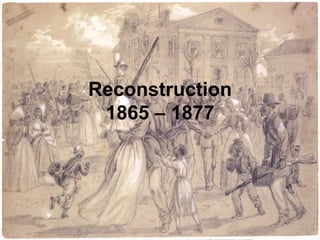
Reconstruction1865 – 1877
TRUE OR FALSEOver 650,000 men died in the Civil War, but only a small number of Confederate soldiers.
FALSEApproximately 290,000 Confederates (over one-fifth of the South's adult white male population) died in the Civil WarMost white Southerners had suffered the loss of loved onesAfrican Americans Collecting Bones of Soldiers Killed in the Battle - Cold Harbor, VA, April 1865 (Obtained from www. civilwarphotogallery.com
TRUE OR FALSEMost white Southern families were able to recover their losses soon after the war ended, and rebuilt their plantations with the help of the newly freed African Americans.
FALSETwo-thirds of southern shipping and 9,000 miles of railroad destroyedDestruction of farmland, buildings, machinery, animals, bridges, canals, levees, roads, banks and factories Value of southern farm property plunged 70%Ruins of Depot, Blown up on Sherman's Departure – Atlanta GA, 1864 (Obtained from www. civilwarphotogallery.com
TRUE OR FALSEMost Northerners were aware of the conditions in the South but did not do much to assist with the rebuilding efforts and the relief for newly freed African Americans.
TRUENorthern magazine and newspaper correspondents wrote stories about the conditions of the South – battlefields, trenches, plantations, etc.Federal government did a little to assist the needyThe South harbored deep feelings of hatred toward the North, manifesting later with black codesAlfred R. Waud, Artist of Harper's Weekly, Sketching on Battlefield - Gettysburg, PA, July 1863 (Obtained from www. civilwarphotogallery.com)
Brainstorming ActivityHow should the nation be reconstructed?
WARTIMERECONSTRUCTION
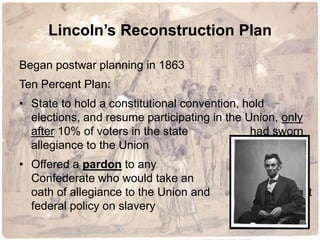
Lincoln’s Reconstruction PlanBegan postwar planning in 1863Ten Percent Plan:State to hold a constitutional convention, hold elections, and resume participating in the Union, only after 10% of voters in the state 	                 had sworn allegiance to the UnionOffered a pardon to any                              Confederate who would take an                              oath of allegiance to the Union and                     accept federal policy on slavery
Lincoln’s Reconstruction PlanTen Percent Plan (Cont’d):Denied pardons to all Confederate                        		      military and government officials,             				  and southerners who had killed 		                African American war prisonersNo requirement for voting rights                                	               for African AmericansDid not readmit southern states to                             the Union since in Lincoln’s view,                            the secession had not been                    constitutional
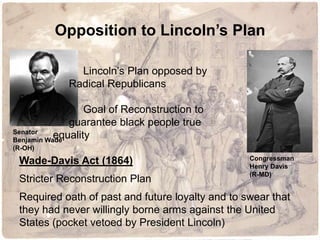
Opposition to Lincoln’s Plan   				Lincoln’s Plan opposed by 								      Radical Republicansgoal of 					Goal of Reconstruction to 								      guarantee black people true 							      equalityWade-Davis Act (1864)Stricter Reconstruction PlanRequired oath of past and future loyalty and to swear that they had never willingly borne arms against the United States (pocket vetoed by President Lincoln)Senator Benjamin Wade(R-OH)Congressman Henry Davis(R-MD)
Thirteenth Amendment“Neither slavery nor involuntary servitude, except as a punishment for crime whereof the party shall have been duly convicted, shall exist within the United States, or any place subject to their jurisdiction.”Approved in the Senate on April 8, 1864, and the House on January 31, 1865 (ratified in December, 1865)
Lincoln’s AssassinationAssassination of Abraham Lincoln on April 14, 1865
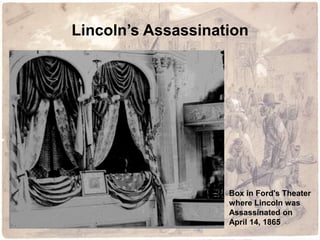
Lincoln’s AssassinationBox in Ford's Theater where Lincoln was Assassinated onApril 14, 1865
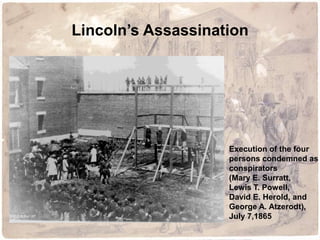
Lincoln’s AssassinationExecution of the four persons condemned asconspirators (Mary E. Surratt, Lewis T. Powell, David E. Herold, and George A. Atzerodt), July 7,1865
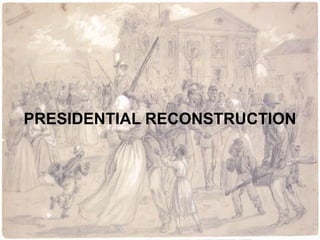
PRESIDENTIAL RECONSTRUCTION
Andrew JohnsonBorn poor in North Carolina, Johnson grew up to be a tailorLearned to read and write with his wife’s help, and later entered politics in TN as a Democrat (governor and Congressman)Did not like rich plantation owners, 				 and had strong support of poor 				           white SouthernersThe only southern senator who 				  remained in Congress after 					  secession
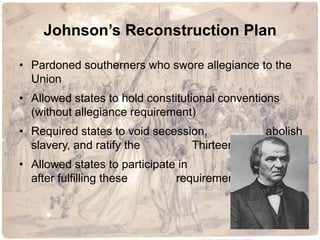
Johnson’s Reconstruction PlanPardoned southerners who swore allegiance to the UnionAllowed states to hold constitutional conventions (without allegiance requirement)Required states to void secession, 			       abolish slavery, and ratify the 			    Thirteenth AmendmentAllowed states to participate in 			         elections after fulfilling these 			    requirements
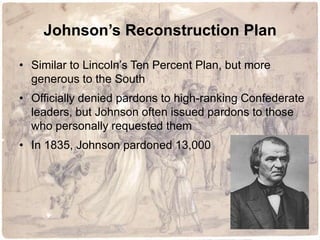
Johnson’s Reconstruction PlanSimilar to Lincoln’s Ten Percent Plan, but more generous to the SouthOfficially denied pardons to high-ranking Confederate leaders, but Johnson often issued pardons to those who personally requested themIn 1835, Johnson pardoned 13,000 	 southerners
Lesson1 ppt reconstruction

Lesson1 ppt reconstruction

  • 1.
  • 2.
    TRUE OR FALSEOver650,000 men died in the Civil War, but only a small number of Confederate soldiers.
  • 3.
    FALSEApproximately 290,000 Confederates(over one-fifth of the South's adult white male population) died in the Civil WarMost white Southerners had suffered the loss of loved onesAfrican Americans Collecting Bones of Soldiers Killed in the Battle - Cold Harbor, VA, April 1865 (Obtained from www. civilwarphotogallery.com
  • 4.
    TRUE OR FALSEMostwhite Southern families were able to recover their losses soon after the war ended, and rebuilt their plantations with the help of the newly freed African Americans.
  • 5.
    FALSETwo-thirds of southernshipping and 9,000 miles of railroad destroyedDestruction of farmland, buildings, machinery, animals, bridges, canals, levees, roads, banks and factories Value of southern farm property plunged 70%Ruins of Depot, Blown up on Sherman's Departure – Atlanta GA, 1864 (Obtained from www. civilwarphotogallery.com
  • 6.
    TRUE OR FALSEMostNortherners were aware of the conditions in the South but did not do much to assist with the rebuilding efforts and the relief for newly freed African Americans.
  • 7.
    TRUENorthern magazine andnewspaper correspondents wrote stories about the conditions of the South – battlefields, trenches, plantations, etc.Federal government did a little to assist the needyThe South harbored deep feelings of hatred toward the North, manifesting later with black codesAlfred R. Waud, Artist of Harper's Weekly, Sketching on Battlefield - Gettysburg, PA, July 1863 (Obtained from www. civilwarphotogallery.com)
  • 8.
    Brainstorming ActivityHow shouldthe nation be reconstructed?
  • 9.
  • 10.
    Lincoln’s Reconstruction PlanBeganpostwar planning in 1863Ten Percent Plan:State to hold a constitutional convention, hold elections, and resume participating in the Union, only after 10% of voters in the state had sworn allegiance to the UnionOffered a pardon to any Confederate who would take an oath of allegiance to the Union and accept federal policy on slavery
  • 11.
    Lincoln’s Reconstruction PlanTenPercent Plan (Cont’d):Denied pardons to all Confederate military and government officials, and southerners who had killed African American war prisonersNo requirement for voting rights for African AmericansDid not readmit southern states to the Union since in Lincoln’s view, the secession had not been constitutional
  • 12.
    Opposition to Lincoln’sPlan Lincoln’s Plan opposed by Radical Republicansgoal of Goal of Reconstruction to guarantee black people true equalityWade-Davis Act (1864)Stricter Reconstruction PlanRequired oath of past and future loyalty and to swear that they had never willingly borne arms against the United States (pocket vetoed by President Lincoln)Senator Benjamin Wade(R-OH)Congressman Henry Davis(R-MD)
  • 13.
    Thirteenth Amendment“Neither slaverynor involuntary servitude, except as a punishment for crime whereof the party shall have been duly convicted, shall exist within the United States, or any place subject to their jurisdiction.”Approved in the Senate on April 8, 1864, and the House on January 31, 1865 (ratified in December, 1865)
  • 14.
    Lincoln’s AssassinationAssassination ofAbraham Lincoln on April 14, 1865
  • 15.
    Lincoln’s AssassinationBox inFord's Theater where Lincoln was Assassinated onApril 14, 1865
  • 16.
    Lincoln’s AssassinationExecution ofthe four persons condemned asconspirators (Mary E. Surratt, Lewis T. Powell, David E. Herold, and George A. Atzerodt), July 7,1865
  • 17.
  • 18.
    Andrew JohnsonBorn poorin North Carolina, Johnson grew up to be a tailorLearned to read and write with his wife’s help, and later entered politics in TN as a Democrat (governor and Congressman)Did not like rich plantation owners, and had strong support of poor white SouthernersThe only southern senator who remained in Congress after secession
  • 19.
    Johnson’s Reconstruction PlanPardonedsoutherners who swore allegiance to the UnionAllowed states to hold constitutional conventions (without allegiance requirement)Required states to void secession, abolish slavery, and ratify the Thirteenth AmendmentAllowed states to participate in elections after fulfilling these requirements
  • 20.
    Johnson’s Reconstruction PlanSimilarto Lincoln’s Ten Percent Plan, but more generous to the SouthOfficially denied pardons to high-ranking Confederate leaders, but Johnson often issued pardons to those who personally requested themIn 1835, Johnson pardoned 13,000 southerners

Editor's Notes

  • #2 Federal government’s controversial effort to repair the damage to the South and to restore southern states to the Union
  • #4 The North lost 364,000 soldiers, and more than 38,000 African AmericansThe North’s decision to destroy southern homes and property resulted in countless civilian deaths
  • #6 Difficult social problems with the sudden elevation of slaves to the status of free laborers and enfranchised citizens.
  • #8 The Southhad sustained immense damage. Entire cities lay in ruins. Thousands of people lacked the means to provide food, clothing, or shelter for themselves or their dependents. The Federal government did little to assist the needy. The creation of the Freedmen’s Bureau was one of the few efforts to do so.
  • #11 Ten Percent Plan – forgiving to the SouthPardon: an official forgiveness of a crime
  • #13 Attempt by Congress to wrest control over the Reconstruction process from the PresidentLincoln’s Plan seen as threat to congressional authority
  • #15 On the evening of April 14, 1865, while attending a special performance of the comedy, "Our American Cousin," President Abraham Lincoln was shot. Accompanying him at Ford's Theater that night were his wife, Mary Todd Lincoln, a twenty-eight year-old officer named Major Henry R. Rathbone, and Rathbone's fiancee, Clara Harris. After the play was in progress, a figure with a drawn derringer pistol stepped into the presidential box, aimed, and fired. The president slumped forward. The assassin, John Wilkes Booth, dropped the pistol and waved a dagger. Rathbone lunged at him, and though slashed in the arm, forced the killer to the railing. Booth leapt from the balcony and caught the spur of his left boot on a flag draped over the rail, and shattered a bone in his leg on landing. Though injured, he rushed out the back door, and disappeared into the night on horseback.A doctor in the audience immediately went upstairs to the box. The bullet had entered through Lincoln's left ear and lodged behind his right eye. He was paralyzed and barely breathing. He was carried across Tenth Street, to a boarding-house opposite the theater, but the doctors' best efforts failed. Nine hours later, at 7:22 AM on April 15th, Lincoln died.
  • #19 Lincoln picked him as a running mate in 1864 to appease Democratic voters