Meagen Farrell @farrellink farrellink.com
Teaching Adults: A 2014 GED® Test Resource Book by New Readers Press
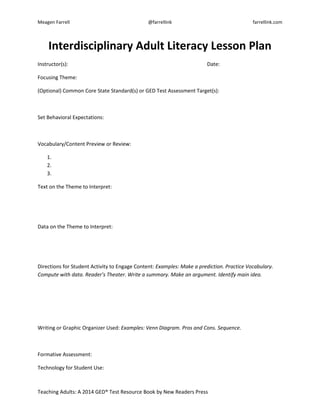
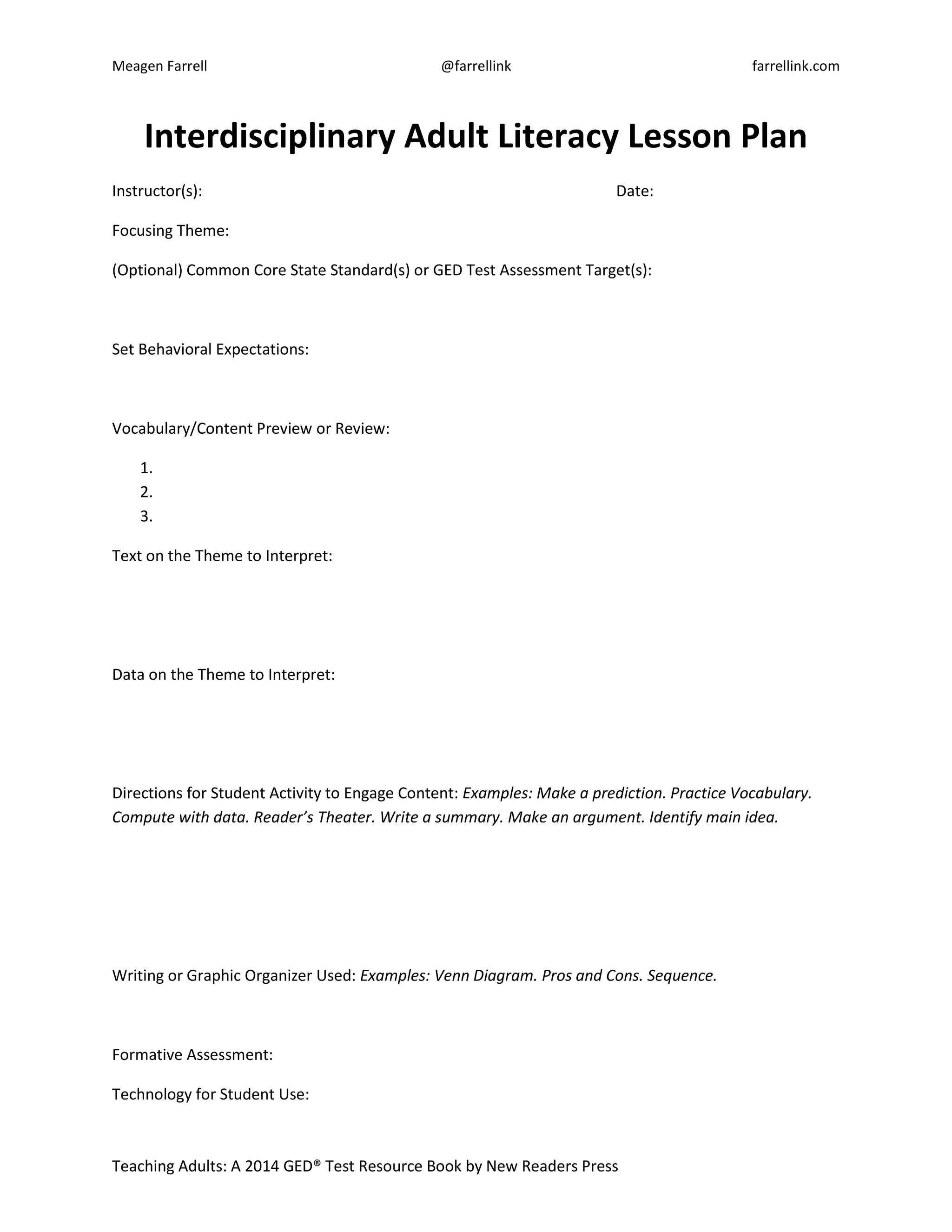
Interdisciplinary Adult Literacy Lesson Plan
Instructor(s): Date:
Focusing Theme:
(Optional) Common Core State Standard(s) or GED Test Assessment Target(s):
Set Behavioral Expectations:
Vocabulary/Content Preview or Review:
1.
2.
3.
Text on the Theme to Interpret:
Data on the Theme to Interpret:
Directions for Student Activity to Engage Content: Examples: Make a prediction. Practice Vocabulary.
Compute with data. Reader’s Theater. Write a summary. Make an argument. Identify main idea.
Writing or Graphic Organizer Used: Examples: Venn Diagram. Pros and Cons. Sequence.
Formative Assessment:
Technology for Student Use:
Meagen Farrell @farrellink farrellink.com
Teaching Adults: A 2014 GED® Test Resource Book by New Readers Press
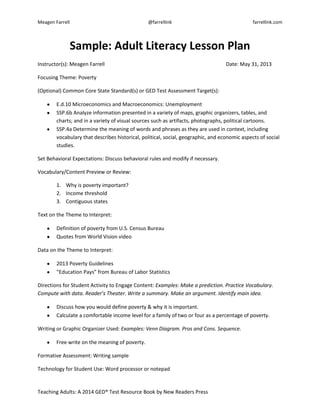
Sample: Adult Literacy Lesson Plan
Instructor(s): Meagen Farrell Date: May 31, 2013
Focusing Theme: Poverty
(Optional) Common Core State Standard(s) or GED Test Assessment Target(s):
E.d.10 Microeconomics and Macroeconomics: Unemployment
SSP.6b Analyze information presented in a variety of maps, graphic organizers, tables, and
charts; and in a variety of visual sources such as artifacts, photographs, political cartoons.
SSP.4a Determine the meaning of words and phrases as they are used in context, including
vocabulary that describes historical, political, social, geographic, and economic aspects of social
studies.
Set Behavioral Expectations: Discuss behavioral rules and modify if necessary.
Vocabulary/Content Preview or Review:
1. Why is poverty important?
2. Income threshold
3. Contiguous states
Text on the Theme to Interpret:
Definition of poverty from U.S. Census Bureau
Quotes from World Vision video
Data on the Theme to Interpret:
2013 Poverty Guidelines
“Education Pays” from Bureau of Labor Statistics
Directions for Student Activity to Engage Content: Examples: Make a prediction. Practice Vocabulary.
Compute with data. Reader’s Theater. Write a summary. Make an argument. Identify main idea.
Discuss how you would define poverty & why it is important.
Calculate a comfortable income level for a family of two or four as a percentage of poverty.
Writing or Graphic Organizer Used: Examples: Venn Diagram. Pros and Cons. Sequence.
Free write on the meaning of poverty.
Formative Assessment: Writing sample
Technology for Student Use: Word processor or notepad

2014 GED Test Lesson Plan Template & Sample: Education Pays

  • 1.
    Meagen Farrell @farrellinkfarrellink.com Teaching Adults: A 2014 GED® Test Resource Book by New Readers Press Interdisciplinary Adult Literacy Lesson Plan Instructor(s): Date: Focusing Theme: (Optional) Common Core State Standard(s) or GED Test Assessment Target(s): Set Behavioral Expectations: Vocabulary/Content Preview or Review: 1. 2. 3. Text on the Theme to Interpret: Data on the Theme to Interpret: Directions for Student Activity to Engage Content: Examples: Make a prediction. Practice Vocabulary. Compute with data. Reader’s Theater. Write a summary. Make an argument. Identify main idea. Writing or Graphic Organizer Used: Examples: Venn Diagram. Pros and Cons. Sequence. Formative Assessment: Technology for Student Use:
  • 2.
    Meagen Farrell @farrellinkfarrellink.com Teaching Adults: A 2014 GED® Test Resource Book by New Readers Press Sample: Adult Literacy Lesson Plan Instructor(s): Meagen Farrell Date: May 31, 2013 Focusing Theme: Poverty (Optional) Common Core State Standard(s) or GED Test Assessment Target(s): E.d.10 Microeconomics and Macroeconomics: Unemployment SSP.6b Analyze information presented in a variety of maps, graphic organizers, tables, and charts; and in a variety of visual sources such as artifacts, photographs, political cartoons. SSP.4a Determine the meaning of words and phrases as they are used in context, including vocabulary that describes historical, political, social, geographic, and economic aspects of social studies. Set Behavioral Expectations: Discuss behavioral rules and modify if necessary. Vocabulary/Content Preview or Review: 1. Why is poverty important? 2. Income threshold 3. Contiguous states Text on the Theme to Interpret: Definition of poverty from U.S. Census Bureau Quotes from World Vision video Data on the Theme to Interpret: 2013 Poverty Guidelines “Education Pays” from Bureau of Labor Statistics Directions for Student Activity to Engage Content: Examples: Make a prediction. Practice Vocabulary. Compute with data. Reader’s Theater. Write a summary. Make an argument. Identify main idea. Discuss how you would define poverty & why it is important. Calculate a comfortable income level for a family of two or four as a percentage of poverty. Writing or Graphic Organizer Used: Examples: Venn Diagram. Pros and Cons. Sequence. Free write on the meaning of poverty. Formative Assessment: Writing sample Technology for Student Use: Word processor or notepad