NG Sum Yi Cindy 11001748


                       Asia’s World City - Writing
                                 LESSON PLAN


Class:              Secondary 3 (Average to above-average)


Lesson Duration:    80 minutes


Textbook:           Oxford English Continuous Assessment Pack 3A (Homework)


Previous           Students have learnt:
knowledge:         1. popular local tourist attractions such as Giant Buddha and Ocean
                       Park Hong Kong
                   2. local food such as dim sum, egg tart and Hong Kong-style milk tea
                   3. detailed description of a particular place
                   4. sequence words and phrases such as first, next, thereafter and finally
                   5. simple present tense


Learning           By the end of the lesson, students should be able to:
objectives:        1. identify the text type ‘itinerary’ and tell its key features
                   2. plan their writing using mind-map
                   3. write a 3-day itinerary for a family trip to Hong Kong


Language           1. Writing an itinerary using phrases and expressions such as ‘arrive at’,
Focus:                ‘visit/spend time in/enjoy/experience…’, ‘go to … (place) by…’,
                      ‘have breakfast/lunch/dinner at…’, and ‘return to… by…’.
                   2. Speaking: discussion


Teaching           PowerPoint slides (Appendix I), Itinerary samples collected from different
Materials:         travel agencies (Appendix II), Homework (Appendix III).


                                                                                           1
NG Sum Yi Cindy 11001748


Procedures:

   Time
                              Teaching Steps                                  Purpose
 Allocation
 3 minutes    1. T does a revision on vocabulary items           Let Ss to recall some vocabulary
                 about local tourist attractions with Ss by      items learnt in the previous lesson
                 showing pictures on the PowerPoint
                 slides (Appendix I).

 1 minute     2. T distributes the itinerary samples             Prepare Ss for scanning practice
                 (Appendix II) to Ss

 3 minutes    3. T asks Ss if they have read this kind of    Recall Ss’ memory of reading
                 texts before and to tell what the text type itinerary in the Reading lesson
                 is

              4. T tells Ss the following:                       Present new language to Ss: use of
                 i.    Definition of itinerary                   itinerary
                ii.    When it is usually found
               iii.    Why it is useful

 10 minutes   5. T asks Ss to scan the itinerary samples         Provide instructions; let Ss
                 (Appendix II).                                  practice scanning and discussion
                                                                 skills
                  The samples are briefly introduced in
                  the Reading lesson:
                   i.   (in point form)
                        http://www.ctshk.com/english/leisu
                        re/gdhighlights/sg3.htm
                  ii.   (travel brochure)
                        http://www.hongthai.com.sg/files/t
                        our_files/OOLS6D_E.pdf
                 iii.   (in paragraph form)
                        http://www.newshan.com/tour/Pac
                        kageTour/Hong_Kong/4DHKGG.h
                        tml

                    T tells Ss the following:                    Let Ss process the features of the
                 i.       Form groups of 3                       itinerary on their own
                ii.       Each member is responsible for
                          reading one sample
               iii.       Report to each other after reading
               iv.        Identify their common features
                          such as headings, sub-headings,
                          time, main body (descriptions of
                          places to be visited, activities and
                          events), and use of tense

 8 minutes    6. T asks each group to report their
                 findings.

                                                                                                2
NG Sum Yi Cindy 11001748


                  T asks Ss the following questions if
                  necessary:
               i.     Where is the heading? What is it
                      about? What does ‘D’ stand for? Is
                      there a place? What do we call that
                      ‘place’ of the tour?
              ii.     Where are the subheadings? What
                      are they about? What is the use of
                      numbers there?
             iii.     Where are the main body parts?
                      What do they tell you? Any
                      information about tourist attractions?
                      Which attraction do tourists go first
                      and next? How do you know that?
                      Any words/phrases provide hints?
             iv.      What is the tense used?

10 minutes   7. T goes over the itinerary samples one by Q&A to check Ss’ understanding
                 one quickly by asking Ss to call out the  of the texts
                 answers to the following:
                 i.   What is the duration and
                      destination of the tour?
                ii.   Where do tourists visit on different
                      days of the tour?
               iii.   What do tourists eat for their
                      breakfast, lunch and dinner on
                      different days of the tour?
               iv.    What do tourists do on different
                      days of the tour?
                v.    What is(are) the tense(s) used in
                      each sample itinerary?

2 minutes    8. With reference to Step 7, T summaries          Present new language to Ss:
                the components of an itinerary and what        structure of an itinerary
                they tell the readers with the help of
                PowerPoint slides (Appendix I).

3 minutes    9. Focus on itinerary sample 1 (Appendix          Provide instructions to S
                II), T asks Ss to underline all verbs in
                sentences about where tourists go and
                what they do. For example:

               i.   In the morning, pick up from a
                    designated hotel.
              ii.   Explore the world famous Dafen Oil
                    Painting Village.

5 minutes    10. T asks Ss to report all verbs; lists them     Present new language to Ss:
                 on the board and explains the difficult       Common verbs used in itinerary

                                                                                             3
NG Sum Yi Cindy 11001748


                 ones.                                      writing

                 T might add a few more to the list such
                 as take a tour around/stroll around.

4 minutes   11. Focus on sample 2, T asks Ss to             Provide instructions to Ss
                underline all sequence words and
                phrases in sentences about where
                tourists go and what they do. For
                example:

               i.   Next, proceed to Harbor Town
                    Factory Outlet for shopping…
             ii.    Thereafter, stop by Duty Free Shop to
                    purchase local products…

2 minutes   12. T asks Ss to report all underlined words;   Revise the previously learnt
                lists them on the board.                    language: Common sequence
                                                            words and phrases used in
                                                            itinerary writing

1 minute    13. Focus on itinerary sample 2 (Appendix       Provide instructions to Ss
                II), T asks Ss to underline all verbs in
                negative form (don’t) in sentences about
                where tourists go and what they do. For
                example:

               i.    Don’t miss the latest Superman
                     Escape ride
             ii.     Don’t miss a walk down memory
                     lane on Sesame Street Beach
             iii.    Don’t be shy to participate in
                     demonstrations such as sheep
                     Shearing

2 minutes   14. T lists them on the board; explains these   Present new language to Ss:
                forms that arouse readers’ emotions and     Negative forms used in itinerary
                persuade them to join the tour              writing

8 minutes   15. T asks Ss to do the following:              Let Ss practice all the language
              i.     Think of three places or activities    input (verbs, sequence words and
                     they want to do or to for school       phrases, and negative forms)
                     picnic
             ii.     Write them in a short paragraph
                     and post it as comment to the blog
                     (about 40 words).

5 minutes   16. T asks Ss to read the partner’s writing     Peer evaluation and assess Ss’
                and to give comments on it.                 language practice


                                                                                             4
NG Sum Yi Cindy 11001748


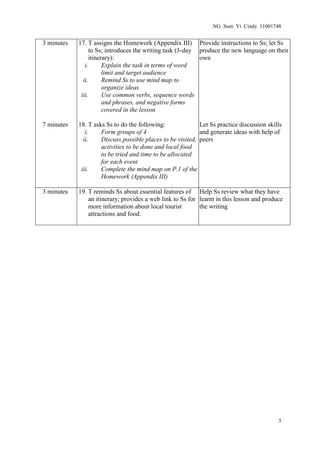
3 minutes   17. T assigns the Homework (Appendix III) Provide instructions to Ss; let Ss
                 to Ss; introduces the writing task (3-day produce the new language on their
                 itinerary):                               own
               i.      Explain the task in terms of word
                       limit and target audience
              ii.      Remind Ss to use mind map to
                       organize ideas
             iii.      Use common verbs, sequence words
                       and phrases, and negative forms
                       covered in the lesson

7 minutes   18. T asks Ss to do the following:              Let Ss practice discussion skills
               i.    Form groups of 4                       and generate ideas with help of
              ii.    Discuss possible places to be visited, peers
                     activities to be done and local food
                     to be tried and time to be allocated
                     for each event
             iii.    Complete the mind map on P.1 of the
                     Homework (Appendix III)

3 minutes   19. T reminds Ss about essential features of Help Ss review what they have
                an itinerary; provides a web link to Ss for learnt in this lesson and produce
                more information about local tourist        the writing
                attractions and food.


                                                                                           5

Lesson Plan Writing

  • 1.
    NG Sum YiCindy 11001748 Asia’s World City - Writing LESSON PLAN Class: Secondary 3 (Average to above-average) Lesson Duration: 80 minutes Textbook: Oxford English Continuous Assessment Pack 3A (Homework) Previous Students have learnt: knowledge: 1. popular local tourist attractions such as Giant Buddha and Ocean Park Hong Kong 2. local food such as dim sum, egg tart and Hong Kong-style milk tea 3. detailed description of a particular place 4. sequence words and phrases such as first, next, thereafter and finally 5. simple present tense Learning By the end of the lesson, students should be able to: objectives: 1. identify the text type ‘itinerary’ and tell its key features 2. plan their writing using mind-map 3. write a 3-day itinerary for a family trip to Hong Kong Language 1. Writing an itinerary using phrases and expressions such as ‘arrive at’, Focus: ‘visit/spend time in/enjoy/experience…’, ‘go to … (place) by…’, ‘have breakfast/lunch/dinner at…’, and ‘return to… by…’. 2. Speaking: discussion Teaching PowerPoint slides (Appendix I), Itinerary samples collected from different Materials: travel agencies (Appendix II), Homework (Appendix III). 1
  • 2.
    NG Sum YiCindy 11001748 Procedures: Time Teaching Steps Purpose Allocation 3 minutes 1. T does a revision on vocabulary items Let Ss to recall some vocabulary about local tourist attractions with Ss by items learnt in the previous lesson showing pictures on the PowerPoint slides (Appendix I). 1 minute 2. T distributes the itinerary samples Prepare Ss for scanning practice (Appendix II) to Ss 3 minutes 3. T asks Ss if they have read this kind of Recall Ss’ memory of reading texts before and to tell what the text type itinerary in the Reading lesson is 4. T tells Ss the following: Present new language to Ss: use of i. Definition of itinerary itinerary ii. When it is usually found iii. Why it is useful 10 minutes 5. T asks Ss to scan the itinerary samples Provide instructions; let Ss (Appendix II). practice scanning and discussion skills The samples are briefly introduced in the Reading lesson: i. (in point form) http://www.ctshk.com/english/leisu re/gdhighlights/sg3.htm ii. (travel brochure) http://www.hongthai.com.sg/files/t our_files/OOLS6D_E.pdf iii. (in paragraph form) http://www.newshan.com/tour/Pac kageTour/Hong_Kong/4DHKGG.h tml T tells Ss the following: Let Ss process the features of the i. Form groups of 3 itinerary on their own ii. Each member is responsible for reading one sample iii. Report to each other after reading iv. Identify their common features such as headings, sub-headings, time, main body (descriptions of places to be visited, activities and events), and use of tense 8 minutes 6. T asks each group to report their findings. 2
  • 3.
    NG Sum YiCindy 11001748 T asks Ss the following questions if necessary: i. Where is the heading? What is it about? What does ‘D’ stand for? Is there a place? What do we call that ‘place’ of the tour? ii. Where are the subheadings? What are they about? What is the use of numbers there? iii. Where are the main body parts? What do they tell you? Any information about tourist attractions? Which attraction do tourists go first and next? How do you know that? Any words/phrases provide hints? iv. What is the tense used? 10 minutes 7. T goes over the itinerary samples one by Q&A to check Ss’ understanding one quickly by asking Ss to call out the of the texts answers to the following: i. What is the duration and destination of the tour? ii. Where do tourists visit on different days of the tour? iii. What do tourists eat for their breakfast, lunch and dinner on different days of the tour? iv. What do tourists do on different days of the tour? v. What is(are) the tense(s) used in each sample itinerary? 2 minutes 8. With reference to Step 7, T summaries Present new language to Ss: the components of an itinerary and what structure of an itinerary they tell the readers with the help of PowerPoint slides (Appendix I). 3 minutes 9. Focus on itinerary sample 1 (Appendix Provide instructions to S II), T asks Ss to underline all verbs in sentences about where tourists go and what they do. For example: i. In the morning, pick up from a designated hotel. ii. Explore the world famous Dafen Oil Painting Village. 5 minutes 10. T asks Ss to report all verbs; lists them Present new language to Ss: on the board and explains the difficult Common verbs used in itinerary 3
  • 4.
    NG Sum YiCindy 11001748 ones. writing T might add a few more to the list such as take a tour around/stroll around. 4 minutes 11. Focus on sample 2, T asks Ss to Provide instructions to Ss underline all sequence words and phrases in sentences about where tourists go and what they do. For example: i. Next, proceed to Harbor Town Factory Outlet for shopping… ii. Thereafter, stop by Duty Free Shop to purchase local products… 2 minutes 12. T asks Ss to report all underlined words; Revise the previously learnt lists them on the board. language: Common sequence words and phrases used in itinerary writing 1 minute 13. Focus on itinerary sample 2 (Appendix Provide instructions to Ss II), T asks Ss to underline all verbs in negative form (don’t) in sentences about where tourists go and what they do. For example: i. Don’t miss the latest Superman Escape ride ii. Don’t miss a walk down memory lane on Sesame Street Beach iii. Don’t be shy to participate in demonstrations such as sheep Shearing 2 minutes 14. T lists them on the board; explains these Present new language to Ss: forms that arouse readers’ emotions and Negative forms used in itinerary persuade them to join the tour writing 8 minutes 15. T asks Ss to do the following: Let Ss practice all the language i. Think of three places or activities input (verbs, sequence words and they want to do or to for school phrases, and negative forms) picnic ii. Write them in a short paragraph and post it as comment to the blog (about 40 words). 5 minutes 16. T asks Ss to read the partner’s writing Peer evaluation and assess Ss’ and to give comments on it. language practice 4
  • 5.
    NG Sum YiCindy 11001748 3 minutes 17. T assigns the Homework (Appendix III) Provide instructions to Ss; let Ss to Ss; introduces the writing task (3-day produce the new language on their itinerary): own i. Explain the task in terms of word limit and target audience ii. Remind Ss to use mind map to organize ideas iii. Use common verbs, sequence words and phrases, and negative forms covered in the lesson 7 minutes 18. T asks Ss to do the following: Let Ss practice discussion skills i. Form groups of 4 and generate ideas with help of ii. Discuss possible places to be visited, peers activities to be done and local food to be tried and time to be allocated for each event iii. Complete the mind map on P.1 of the Homework (Appendix III) 3 minutes 19. T reminds Ss about essential features of Help Ss review what they have an itinerary; provides a web link to Ss for learnt in this lesson and produce more information about local tourist the writing attractions and food. 5