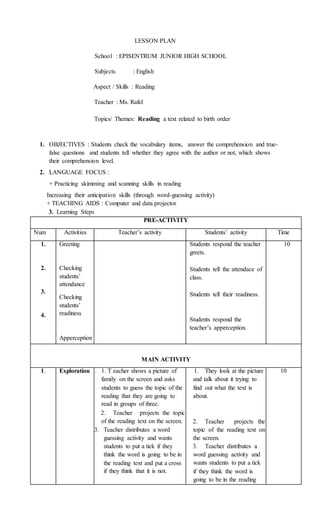
LESSON PLAN
School : EPISENTRUM JUNIOR HIGH SCHOOL
Subjects : English
Aspect / Skills : Reading
Teacher : Ms. Rafel
Topics/ Themes: Reading a text related to birth order
1. OBJECTIVES : Students check the vocabulary items, answer the comprehension and true-
false questions and students tell whether they agree with the author or not, which shows
their comprehension level.
2. LANGUAGE FOCUS :
+ Practicing skimming and scanning skills in reading
Increasing their anticipation skills (through word-guessing activity)
+ TEACHING AIDS : Computer and data projector
3. Learning Steps
PRE-ACTIVITY
Num Activities Teacher’s activity Students’ activity Time
1.
2.
3.
4.
Greeting
Checking
students’
attendance
Checking
students’
readiness
Apperception
• Students respond the teacher
greets.
• Students tell the attendace of
class.
• Students tell their readiness.
• Students respond the
teacher’s apperception.
10
MAIN ACTIVITY
1. Exploration 1. 1. T eacher shows a picture of
family on the screen and asks
students to guess the topic of the
reading that they are going to
read in groups of three.
2. Teacher projects the topic
of the reading text on the screen.
3. Teacher distributes a word
guessing activity and wants
students to put a tick if they
think the word is going to be in
the reading text and put a cross
if they think that it is not.
1. They look at the picture
and talk about it trying to
find out what the text is
about.
2. Teacher projects the
topic of the reading text on
the screen.
3. Teacher distributes a
word guessing activity and
wants students to put a tick
if they think the word is
going to be in the reading
10
text and put a cross if they
think that it is not.
2. Elaboration 1. Teacher distributes the reading
text and asks students to read it
quickly.
2. T monitors the students while
they are reading so that he can
see whether they understand it
or not.
3. 3. T opens a video and asks
students to watch it.
4. T wants students to match
the characters in the video with
their birth orders.
5. T distributes an activity
sheet on which there different
types of questions including
“open-ended, multiple choice
and true false questions” and
ask students to answer them.
1. Students read the text.
2. Students watch
the video.
3. They try to tell which
character is first born, middle
born and last born.
4. Ms. Dewi try to answer
them.After they are ready they
share their answers with the
whole class and get Classdojo
points.
30
The Reading Text
First-born, middleor last-born?
“Where do you come in your family?” According to Frank Sulloway, a US sociologist, the
order in which we came into this world -first-born, middle or last-born- can not only help
shape our personality, it could affect the success of our relationships, too. Sulloway has
interviewed more than 6000 people over the past 26 years in an attempt to prove this theory:
5
“Children compete for a place in the family”, he says, “and if one role has already been
taken, later-born children have to choose from what's left”. Because firstborns begin life
with exclusive parental attention, they are often more open to accepting their parents' values,
while later-born children, forced to compete for a place in the family, may grow into
rebellious adults.
10 So if birth order has such a significant impact on our behavior, does it affect our
interactions with other people? Can we, for example, judge the suitability of our partners by
their birth order? Absolutely, says Sulloway, “Birth order is an excellent way of telling
whether a relationship will survive. For example, a marriage between a typical first-born
husband who's dominating and assertive, and a later-born wife who likes being looked after,
is
15 very likely to work out”.
According to Kevin Leman, A psychologist, parents often try very hard to make sure that
everything is perfect for their first born son or daughter, which leads first born children to be
perfectionist. He also claims that the middle child will often excel at i.e. be good at
something that the first born child is not as good at. For example, a first born may be very
good in 20 school, while the second child is gifted in athletics. Middle children often
play the role of peacekeeper in the family, mediating between the older and younger
siblings. Unlike first and middle born children, last born children, who are very social and
outgoing, take fewer responsibilities and have more freedom, which makes them free-
spirited and creative.
Appendix II – The Questions
COMPREHENSION
1. Find a word or expression in the text which, in context, is similar in meaning to:
a. be good at (par. 3): b. talented (par. 3):
c. appropriateness (par. 2): d. privileged (par. 1) :
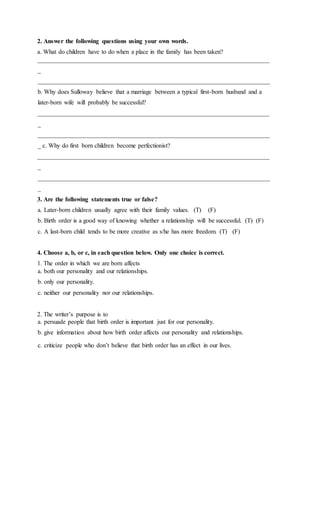
2. Answer the following questions using your own words.
a. What do children have to do when a place in the family has been taken?
__________________________________________________________________________
_
__________________________________________________________________________
b. Why does Sulloway believe that a marriage between a typical first-born husband and a
later-born wife will probably be successful?
__________________________________________________________________________
_
__________________________________________________________________________
_ c. Why do first born children become perfectionist?
__________________________________________________________________________
_
__________________________________________________________________________
_
3. Are the following statements true or false?
a. Later-born children usually agree with their family values. (T) (F)
b. Birth order is a good way of knowing whether a relationship will be successful. (T) (F)
c. A last-born child tends to be more creative as s/he has more freedom. (T) (F)
4. Choose a, b, or c, in each question below. Only one choice is correct.
1. The order in which we are born affects
a. both our personality and our relationships.
b. only our personality.
c. neither our personality nor our relationships.
2. The writer’s purpose is to
a. persuade people that birth order is important just for our personality.
b. give information about how birth order affects our personality and relationships.
c. criticize people who don’t believe that birth order has an effect in our lives.

Lesson plan reading

  • 1.
    LESSON PLAN School :EPISENTRUM JUNIOR HIGH SCHOOL Subjects : English Aspect / Skills : Reading Teacher : Ms. Rafel Topics/ Themes: Reading a text related to birth order 1. OBJECTIVES : Students check the vocabulary items, answer the comprehension and true- false questions and students tell whether they agree with the author or not, which shows their comprehension level. 2. LANGUAGE FOCUS : + Practicing skimming and scanning skills in reading Increasing their anticipation skills (through word-guessing activity) + TEACHING AIDS : Computer and data projector 3. Learning Steps PRE-ACTIVITY Num Activities Teacher’s activity Students’ activity Time 1. 2. 3. 4. Greeting Checking students’ attendance Checking students’ readiness Apperception • Students respond the teacher greets. • Students tell the attendace of class. • Students tell their readiness. • Students respond the teacher’s apperception. 10 MAIN ACTIVITY 1. Exploration 1. 1. T eacher shows a picture of family on the screen and asks students to guess the topic of the reading that they are going to read in groups of three. 2. Teacher projects the topic of the reading text on the screen. 3. Teacher distributes a word guessing activity and wants students to put a tick if they think the word is going to be in the reading text and put a cross if they think that it is not. 1. They look at the picture and talk about it trying to find out what the text is about. 2. Teacher projects the topic of the reading text on the screen. 3. Teacher distributes a word guessing activity and wants students to put a tick if they think the word is going to be in the reading 10
  • 2.
    text and puta cross if they think that it is not. 2. Elaboration 1. Teacher distributes the reading text and asks students to read it quickly. 2. T monitors the students while they are reading so that he can see whether they understand it or not. 3. 3. T opens a video and asks students to watch it. 4. T wants students to match the characters in the video with their birth orders. 5. T distributes an activity sheet on which there different types of questions including “open-ended, multiple choice and true false questions” and ask students to answer them. 1. Students read the text. 2. Students watch the video. 3. They try to tell which character is first born, middle born and last born. 4. Ms. Dewi try to answer them.After they are ready they share their answers with the whole class and get Classdojo points. 30
  • 3.
    The Reading Text First-born,middleor last-born? “Where do you come in your family?” According to Frank Sulloway, a US sociologist, the order in which we came into this world -first-born, middle or last-born- can not only help shape our personality, it could affect the success of our relationships, too. Sulloway has interviewed more than 6000 people over the past 26 years in an attempt to prove this theory: 5 “Children compete for a place in the family”, he says, “and if one role has already been taken, later-born children have to choose from what's left”. Because firstborns begin life with exclusive parental attention, they are often more open to accepting their parents' values, while later-born children, forced to compete for a place in the family, may grow into rebellious adults. 10 So if birth order has such a significant impact on our behavior, does it affect our interactions with other people? Can we, for example, judge the suitability of our partners by their birth order? Absolutely, says Sulloway, “Birth order is an excellent way of telling whether a relationship will survive. For example, a marriage between a typical first-born husband who's dominating and assertive, and a later-born wife who likes being looked after, is 15 very likely to work out”. According to Kevin Leman, A psychologist, parents often try very hard to make sure that everything is perfect for their first born son or daughter, which leads first born children to be perfectionist. He also claims that the middle child will often excel at i.e. be good at something that the first born child is not as good at. For example, a first born may be very good in 20 school, while the second child is gifted in athletics. Middle children often play the role of peacekeeper in the family, mediating between the older and younger siblings. Unlike first and middle born children, last born children, who are very social and outgoing, take fewer responsibilities and have more freedom, which makes them free- spirited and creative. Appendix II – The Questions COMPREHENSION 1. Find a word or expression in the text which, in context, is similar in meaning to: a. be good at (par. 3): b. talented (par. 3): c. appropriateness (par. 2): d. privileged (par. 1) :
  • 4.
    2. Answer thefollowing questions using your own words. a. What do children have to do when a place in the family has been taken? __________________________________________________________________________ _ __________________________________________________________________________ b. Why does Sulloway believe that a marriage between a typical first-born husband and a later-born wife will probably be successful? __________________________________________________________________________ _ __________________________________________________________________________ _ c. Why do first born children become perfectionist? __________________________________________________________________________ _ __________________________________________________________________________ _ 3. Are the following statements true or false? a. Later-born children usually agree with their family values. (T) (F) b. Birth order is a good way of knowing whether a relationship will be successful. (T) (F) c. A last-born child tends to be more creative as s/he has more freedom. (T) (F) 4. Choose a, b, or c, in each question below. Only one choice is correct. 1. The order in which we are born affects a. both our personality and our relationships. b. only our personality. c. neither our personality nor our relationships. 2. The writer’s purpose is to a. persuade people that birth order is important just for our personality. b. give information about how birth order affects our personality and relationships. c. criticize people who don’t believe that birth order has an effect in our lives.