Lesson Plan
Preparation
“ An effective and meaningful
learning experience is a product of
careful planning”
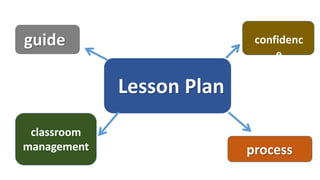
Lesson Plan
guide
classroom
management
confidenc
e
process
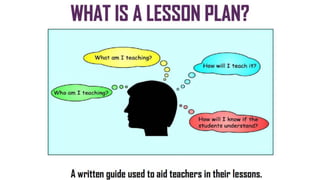
What exactly will
I do?
How will I determine
my progress or
achievement?
How can the goal
be
accomplished?
Why is it
important to
me?
How long?
details standard steps importance deadline
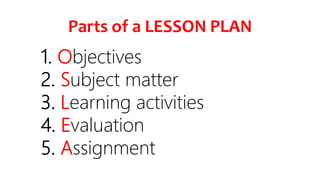
Parts of a LESSON PLAN
1. Objectives
2. Subject matter
3. Learning activities
4. Evaluation
5. Assignment
1. OBJECTIVE
 Must be both observable and measurable to be effective.
 Use of words like understand and learn in writing objectives are
generally not acceptable as they are difficult to measure.
 Unambiguous
 Results oriented / clearly written / specific
 Measurable by both quantitative and qualitative criteria
 Communicate a successful learning in behavioral terms
 Written in terms of performance
1. OBJECTIVE
parts
domains
Parts of an OBJECTIVE
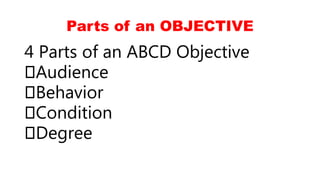
4 Parts of an ABCD Objective
Audience
Behavior
Condition
Degree
Parts of an OBJECTIVE
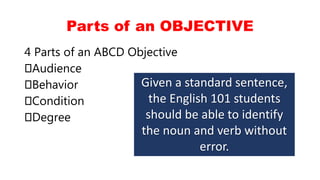
4 Parts of an ABCD Objective
Audience
Behavior
Condition
Degree
Given a standard sentence,
the English 101 students
should be able to identify
the noun and verb without
error.
Parts of an OBJECTIVE
4 Parts of an ABCD Objective
Audience - intended learner
Behavior - demonstration of knowledge or skills
Condition - how or where the learners will perform
the task
Degree - standard for acceptable performance
Parts of an OBJECTIVE
Given a calculator and a scratch paper, the
student will be able to multiply simple
fractions,
Parts of an OBJECTIVE
1. Given a map of the Philippines, the student will be able to list the
38 independent cities in 20 minutes.
2. Given a sentence written in the past or present tense, the student
will rewrite the sentence in future tense with no errors in tense or
tense contradiction.
3. Given examples and non-examples of constructivist activities in a
college classroom, the student will be able to identify the
constructivist examples and explain why each example is or isn't a
constructivist activity in 20 words or less
Parts of an OBJECTIVE
4. Given the mathematical formula for the area of a circle,
paraphrase it using your own words in less than 20 words.
5. By memory, give the definition of punishment.
6. By memory, state the formula for the area of a circle orally.
Parts of an OBJECTIVE
7. Given a poem, identify the specific poetic strategies employed in
it.
8. Given a political situation, write an essay which is not more than
500 words.
9. Given a math word problem, determine the two strategies that
would be necessary to solve it.
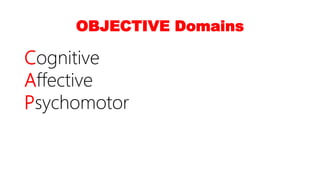
OBJECTIVE Domains
Cognitive
Affective
Psychomotor
OBJECTIVE Domains
Cognitive
Emphasizes remembering or reproducing something
which has presumably been learned
Deal with what a learner should know, understand,
comprehend, solve, spell, critique, etc.
OBJECTIVE Domains
Affective
Composed of two different types of
behaviors: reflexive (attitudes) and voluntary
reactions and actions (values)
OBJECTIVE Domains
Psychomotor
Emphasizes some muscular motor skill, some manipulation
of material and objects, or some act that requires a
neuromuscular coordination
Concerned with how a learner moves or controls his/her
OBJECTIVE Domains
Cognitive
Affective
Psychomotor
KNOWLEDGE
COMPREHENSION
APPLICATION
ANALYSIS
SYNTHESIS
EVALUATION
COGNITIVE DOMAIN
RECALL
UNDERSTANDING
USING KNOWLEDGE TO
NEW SITUATION
BREAKING DOWN
CONCEPTS
PUTTING TOGETHER
JUDGEMENT
Bloom's Taxonomy
COGNITIVE DOMAIN
Definitions Verbs
Remembering: Can the student recall or
remember the information?
Define, duplicate , list, memorize, recall, repeat,
reproduce, state
Definitions Verbs
Remembering: Can the student recall or
remember the information?
Define, duplicate , list, memorize, recall, repeat,
reproduce, state
Understanding: Can the students explain
ideas or concepts?
classify, describe, discuss, explain, identify,
locate, reconize, report, select, translate,
paraphrase
Definitions Verbs
Remembering: Can the student recall or
remember the information?
Define, duplicate , list, memorize, recall, repeat,
reproduce, state
Understanding: Can the students explain
ideas or concepts?
classify, describe, discuss, explain, identify,
locate, reconize, report, select, translate,
paraphrase
Applying: Can the students use the
information in a new way?
choose, demonstrate, dramatize, employ,
illustrate, interpret, operate, schedule, sketch,
solve , use , write
Definitions Verbs
Remembering: Can the student recall or
remember the information?
Define, duplicate , list, memorize, recall, repeat,
reproduce, state
Understanding: Can the students explain
ideas or concepts?
classify, describe, discuss, explain, identify,
locate, reconize, report, select, translate,
paraphrase
Applying: Can the students use the
information in a new way?
choose, demonstrate, dramatize, employ,
illustrate, interpret, operate, schedule, sketch,
solve , use , write
Analyzing: Can the students distinguish
between the different parts?
Appraise, compare, contrast, criticize,
differentiate, discriminate, distinguish, examine,
experiment, question, test
Definitions Verbs
Remembering: Can the student recall or
remember the information?
Define, duplicate , list, memorize, recall, repeat,
reproduce, state
Understanding: Can the students explain
ideas or concepts?
classify, describe, discuss, explain, identify,
locate, reconize, report, select, translate,
paraphrase
Applying: Can the students use the
information in a new way?
choose, demonstrate, dramatize, employ,
illustrate, interpret, operate, schedule, sketch,
solve , use , write
Analyzing: Can the students distinguish
between the different parts?
Appraise, compare, contrast, criticize,
differentiate, discriminate, distinguish, examine,
experiment, question, test
Evaluating: Can the students justify a stand
or decision?
Appraise , argue, defend, judge, select, support,
value, evaluate
Definitions Verbs
Remembering: Can the student recall or
remember the information?
Define, duplicate , list, memorize, recall, repeat,
reproduce, state
Understanding: Can the students explain
ideas or concepts?
classify, describe, discuss, explain, identify,
locate, reconize, report, select, translate,
paraphrase
Applying: Can the students use the
information in a new way?
choose, demonstrate, dramatize, employ,
illustrate, interpret, operate, schedule, sketch,
solve , use , write
Analyzing: Can the students distinguish
between the different parts?
Appraise, compare, contrast, criticize,
differentiate, discriminate, distinguish, examine,
experiment, question, test
Evaluating: Can the students justify a stand
or decision?
Appraise , argue, defend, judge, select, support,
value, evaluate
Creating: Can the students create a new
product or point of view?
assemble, construct, create, design, develop,
formulate, write
Lesson plan ppt (with ABCD).pptx

Lesson plan ppt (with ABCD).pptx

  • 1.
  • 2.
    “ An effectiveand meaningful learning experience is a product of careful planning”
  • 3.
  • 5.
    What exactly will Ido? How will I determine my progress or achievement? How can the goal be accomplished? Why is it important to me? How long? details standard steps importance deadline
  • 6.
    Parts of aLESSON PLAN 1. Objectives 2. Subject matter 3. Learning activities 4. Evaluation 5. Assignment
  • 7.
    1. OBJECTIVE  Mustbe both observable and measurable to be effective.  Use of words like understand and learn in writing objectives are generally not acceptable as they are difficult to measure.  Unambiguous  Results oriented / clearly written / specific  Measurable by both quantitative and qualitative criteria  Communicate a successful learning in behavioral terms  Written in terms of performance
  • 8.
  • 9.
    Parts of anOBJECTIVE 4 Parts of an ABCD Objective Audience Behavior Condition Degree
  • 10.
    Parts of anOBJECTIVE 4 Parts of an ABCD Objective Audience Behavior Condition Degree Given a standard sentence, the English 101 students should be able to identify the noun and verb without error.
  • 11.
    Parts of anOBJECTIVE 4 Parts of an ABCD Objective Audience - intended learner Behavior - demonstration of knowledge or skills Condition - how or where the learners will perform the task Degree - standard for acceptable performance
  • 12.
    Parts of anOBJECTIVE Given a calculator and a scratch paper, the student will be able to multiply simple fractions,
  • 13.
    Parts of anOBJECTIVE 1. Given a map of the Philippines, the student will be able to list the 38 independent cities in 20 minutes. 2. Given a sentence written in the past or present tense, the student will rewrite the sentence in future tense with no errors in tense or tense contradiction. 3. Given examples and non-examples of constructivist activities in a college classroom, the student will be able to identify the constructivist examples and explain why each example is or isn't a constructivist activity in 20 words or less
  • 14.
    Parts of anOBJECTIVE 4. Given the mathematical formula for the area of a circle, paraphrase it using your own words in less than 20 words. 5. By memory, give the definition of punishment. 6. By memory, state the formula for the area of a circle orally.
  • 15.
    Parts of anOBJECTIVE 7. Given a poem, identify the specific poetic strategies employed in it. 8. Given a political situation, write an essay which is not more than 500 words. 9. Given a math word problem, determine the two strategies that would be necessary to solve it.
  • 16.
  • 17.
    OBJECTIVE Domains Cognitive Emphasizes rememberingor reproducing something which has presumably been learned Deal with what a learner should know, understand, comprehend, solve, spell, critique, etc.
  • 18.
    OBJECTIVE Domains Affective Composed oftwo different types of behaviors: reflexive (attitudes) and voluntary reactions and actions (values)
  • 19.
    OBJECTIVE Domains Psychomotor Emphasizes somemuscular motor skill, some manipulation of material and objects, or some act that requires a neuromuscular coordination Concerned with how a learner moves or controls his/her
  • 20.
  • 21.
    KNOWLEDGE COMPREHENSION APPLICATION ANALYSIS SYNTHESIS EVALUATION COGNITIVE DOMAIN RECALL UNDERSTANDING USING KNOWLEDGETO NEW SITUATION BREAKING DOWN CONCEPTS PUTTING TOGETHER JUDGEMENT Bloom's Taxonomy
  • 22.
  • 23.
    Definitions Verbs Remembering: Canthe student recall or remember the information? Define, duplicate , list, memorize, recall, repeat, reproduce, state
  • 24.
    Definitions Verbs Remembering: Canthe student recall or remember the information? Define, duplicate , list, memorize, recall, repeat, reproduce, state Understanding: Can the students explain ideas or concepts? classify, describe, discuss, explain, identify, locate, reconize, report, select, translate, paraphrase
  • 25.
    Definitions Verbs Remembering: Canthe student recall or remember the information? Define, duplicate , list, memorize, recall, repeat, reproduce, state Understanding: Can the students explain ideas or concepts? classify, describe, discuss, explain, identify, locate, reconize, report, select, translate, paraphrase Applying: Can the students use the information in a new way? choose, demonstrate, dramatize, employ, illustrate, interpret, operate, schedule, sketch, solve , use , write
  • 26.
    Definitions Verbs Remembering: Canthe student recall or remember the information? Define, duplicate , list, memorize, recall, repeat, reproduce, state Understanding: Can the students explain ideas or concepts? classify, describe, discuss, explain, identify, locate, reconize, report, select, translate, paraphrase Applying: Can the students use the information in a new way? choose, demonstrate, dramatize, employ, illustrate, interpret, operate, schedule, sketch, solve , use , write Analyzing: Can the students distinguish between the different parts? Appraise, compare, contrast, criticize, differentiate, discriminate, distinguish, examine, experiment, question, test
  • 27.
    Definitions Verbs Remembering: Canthe student recall or remember the information? Define, duplicate , list, memorize, recall, repeat, reproduce, state Understanding: Can the students explain ideas or concepts? classify, describe, discuss, explain, identify, locate, reconize, report, select, translate, paraphrase Applying: Can the students use the information in a new way? choose, demonstrate, dramatize, employ, illustrate, interpret, operate, schedule, sketch, solve , use , write Analyzing: Can the students distinguish between the different parts? Appraise, compare, contrast, criticize, differentiate, discriminate, distinguish, examine, experiment, question, test Evaluating: Can the students justify a stand or decision? Appraise , argue, defend, judge, select, support, value, evaluate
  • 28.
    Definitions Verbs Remembering: Canthe student recall or remember the information? Define, duplicate , list, memorize, recall, repeat, reproduce, state Understanding: Can the students explain ideas or concepts? classify, describe, discuss, explain, identify, locate, reconize, report, select, translate, paraphrase Applying: Can the students use the information in a new way? choose, demonstrate, dramatize, employ, illustrate, interpret, operate, schedule, sketch, solve , use , write Analyzing: Can the students distinguish between the different parts? Appraise, compare, contrast, criticize, differentiate, discriminate, distinguish, examine, experiment, question, test Evaluating: Can the students justify a stand or decision? Appraise , argue, defend, judge, select, support, value, evaluate Creating: Can the students create a new product or point of view? assemble, construct, create, design, develop, formulate, write

Editor's Notes

  • #22 knowledge - remember previously learned information comprehension- demonstrate understandning of facts; explain concepts in own words application- use of concept in real life analysis- breaking down into simpler parts and find evidence to support generalization sysnthesis- evaluation- judgements basing on a certain standard or criteria old 1956 revised -2001 by anderson