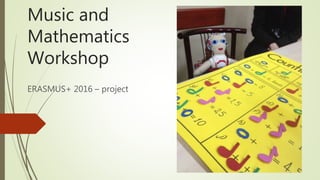
Music and
Mathematics
Workshop
ERASMUS+ 2016 – project
The workshop
The workshop is designed for 1.-4. graders. The
objective is to demonstrate the connection between
mathematics and the note values.
1) Getting to know note values
2) Addition exercise with beats
3) The time signature exercise – composing one’s own
rhythm
4) Practising one’s own rhythm and playing it to others
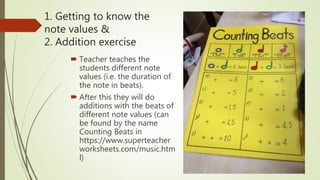
1. Getting to know the
note values &
2. Addition exercise
 Teacher teaches the
students different note
values (i.e. the duration of
the note in beats).
 After this they will do
additions with the beats of
different note values (can
be found by the name
Counting Beats in
https://www.superteacher
worksheets.com/music.htm
l)
3. The time signature exercise – composing
one’s own rhythm
When the students are familiar with different note
values, teacher will introduce them different time
signatures (2/4, 3/4, 4/4).
After this the students will complete the time
signature exercise(can be found
http://musicmattersblog.com/2009/01/23/rhythmic-
dictation-worksheet/) where they will have to
compose their own rhythms in different time
signatures
4. Practising one’s own rhythm and playing
it to others
The students learn one of their own rhythms
composed in the time signature exercise and if they
want they can present it to others with a rhythm
instrument of their liking.
If teacher wants to make the exercise more
challenging the performances can be a rhythmic
dictation exercises for other students. That is, one
student plays his/her rhythm and others have to
write it down.

Music and mathematics workshop

  • 1.
  • 2.
    The workshop The workshopis designed for 1.-4. graders. The objective is to demonstrate the connection between mathematics and the note values. 1) Getting to know note values 2) Addition exercise with beats 3) The time signature exercise – composing one’s own rhythm 4) Practising one’s own rhythm and playing it to others
  • 3.
    1. Getting toknow the note values & 2. Addition exercise  Teacher teaches the students different note values (i.e. the duration of the note in beats).  After this they will do additions with the beats of different note values (can be found by the name Counting Beats in https://www.superteacher worksheets.com/music.htm l)
  • 4.
    3. The timesignature exercise – composing one’s own rhythm When the students are familiar with different note values, teacher will introduce them different time signatures (2/4, 3/4, 4/4). After this the students will complete the time signature exercise(can be found http://musicmattersblog.com/2009/01/23/rhythmic- dictation-worksheet/) where they will have to compose their own rhythms in different time signatures
  • 5.
    4. Practising one’sown rhythm and playing it to others The students learn one of their own rhythms composed in the time signature exercise and if they want they can present it to others with a rhythm instrument of their liking. If teacher wants to make the exercise more challenging the performances can be a rhythmic dictation exercises for other students. That is, one student plays his/her rhythm and others have to write it down.