5th May 2015
Unit B4 Provide facial skincare treatment
Unit B8 Provide make-up services
28.4.15
Countdown has begun!!!!
1. 3 lessons until half term week
commencing 25.5.15
2. Salon 141 bookings need 100%
commitment to attend
3. 4 lessons after half term, last day
with me this academic year 23.6.15
4. Facial exam booked for Tuesday 2nd
June
5. Make-up exam booked for Tuesday
16th June
Contact details
 Please update your e mail and contact
numbers.
 Friends on facebook; Courtney and
Kelly
Objectives
New Anatomy topics Recap Anatomy topics
1. Locate and describe
the action of specific
facial muscles
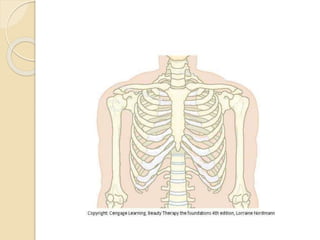
2. Locate and label bones
of the face, cranium
and shoulder girdle
3. Compare
characteristics of skin
conditions
4. Label diagram of the
skin
 Describe position and action
of facial muscles
 Identify layers of epidermis
and their functions
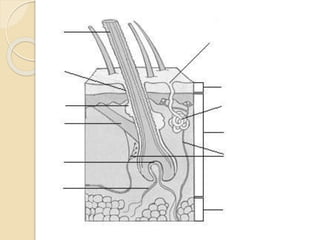
 Label the structure of the skin
 State the functions of the skin
 Compare characteristics of
skin types; normal, dry, oily
and combination
 Explain the benefits and
effects of cleansers and
toners
 Identify contra indications that
restrict and prevent facial
treatments
Objectives
By the end of the session today
you will be able to …..
Make-Up B8 Morning session Facials B4 Afternoon session
 Identify lighting required for day make-
up
 List the correct products to be used in a
day make-up
 List procedure/order of work
 Prepare self for carrying out make-up
application
 Demonstrate preparation of trolley and
equipment (sanitising and sterilising)
 Complete make-up consultation
 Demonstrate correct preparation of
client for make-up include cleanse
 Perform skin analysis and assess clients
face shape
 Demonstrate correct way to choose
foundation colour (warm/cool)
 Perform application of day make-up
 Identify reasons and benefits for
using different exfoliation products
 Evaluate benefits of a brush
cleanse procedure
 State benefits and contra-
indications to using hot towels to
warm the skin
 Observe health and safety
precautions
 Perform eye, lip, face cleanse and
skin analysis evaluating findings
 Demonstrate brush cleanse and
exfoliation techniques
 Perform massage techniques from
movement 1 – 25
 Peer and self evaluate techniques
B8 Provide make-up services
 E3 open book exam
 E4 open book exam
 Minimum of 3 practical assessments;
Age
16 – 30 years
31 – 50 years
Over 50 years
Skin types
Oily
Dry
Combination
Occasions
Day
Evening
Special
All make-up products listed and aftercare advice
Treatment timings
Make-up
Day = 30 minutes
Evening = 45 minutes
Special occasion = 45 minutes
Facials
Basic = 60 minutes
Luxury = 75 minutes
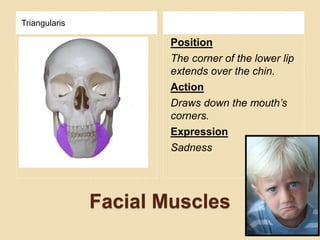
Facial Muscles
Triangularis
Position
The corner of the lower lip
extends over the chin.
Action
Draws down the mouth’s
corners.
Expression
Sadness
Facial Muscles
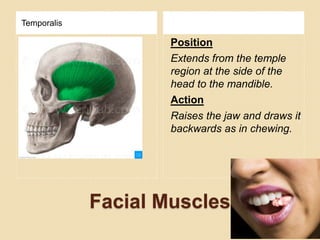
Temporalis
Position
Extends from the temple
region at the side of the
head to the mandible.
Action
Raises the jaw and draws it
backwards as in chewing.
Facial Muscles
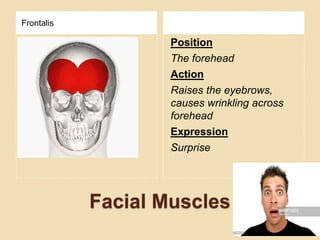
Frontalis
Position
The forehead
Action
Raises the eyebrows,
causes wrinkling across
forehead
Expression
Surprise
Facial Muscles
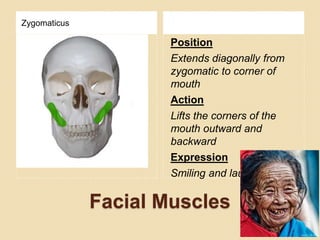
Zygomaticus
Position
Extends diagonally from
zygomatic to corner of
mouth
Action
Lifts the corners of the
mouth outward and
backward
Expression
Smiling and laughing
Facial Muscles
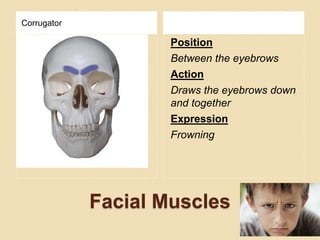
Corrugator
Position
Between the eyebrows
Action
Draws the eyebrows down
and together
Expression
Frowning
Facial Muscles
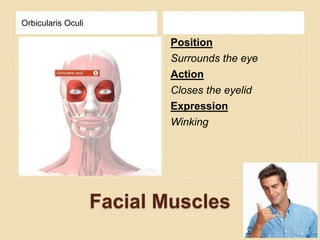
Orbicularis Oculi
Position
Surrounds the eye
Action
Closes the eyelid
Expression
Winking
Facial Muscles
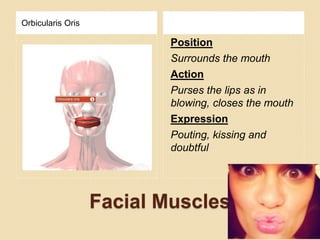
Orbicularis Oris
Position
Surrounds the mouth
Action
Purses the lips as in
blowing, closes the mouth
Expression
Pouting, kissing and
doubtful
Facial Muscles
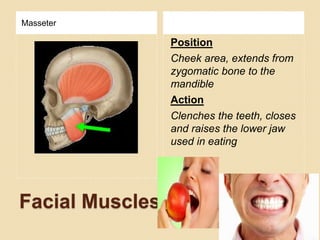
Masseter
Position
Cheek area, extends from
zygomatic bone to the
mandible
Action
Clenches the teeth, closes
and raises the lower jaw
used in eating
Facial Muscles
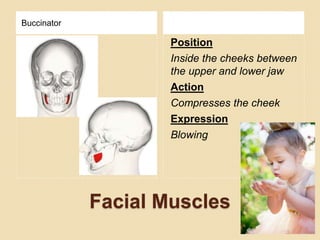
Buccinator
Position
Inside the cheeks between
the upper and lower jaw
Action
Compresses the cheek
Expression
Blowing
Facial Muscles
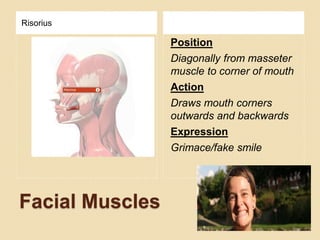
Risorius
Position
Diagonally from masseter
muscle to corner of mouth
Action
Draws mouth corners
outwards and backwards
Expression
Grimace/fake smile
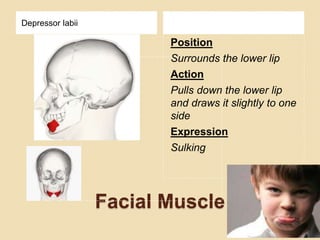
Facial Muscle
Depressor labii
Position
Surrounds the lower lip
Action
Pulls down the lower lip
and draws it slightly to one
side
Expression
Sulking
Facial Muscles- Homework
 Depressor labbi
 Platysma
 Mentalis
 Nasalis
 Procerus
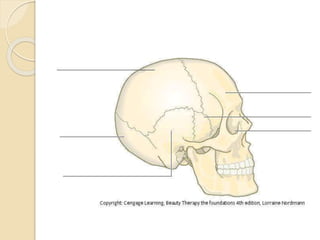
Bones of the cranium and
skull
 Bones are made from a specialized
form of connective tissue
 They support, protect and connect
different parts of the body
 Bones are made up of 2 types of
tissue; compact (hard outer layer of
the bone) and cancellous (spongy
inside of bone, contains red and
yellow bone marrow. Red produces
new red blood cells and yellow stores
fat cells)
Bones of the head
 Bones that form the head are known
as the skull
 Divided into 2 parts; face and cranium
 Total of 22 bones
 Our facial bones form our features
 Support other structures such as eyes
and teeth
 Cranium surrounds and protects the
brain
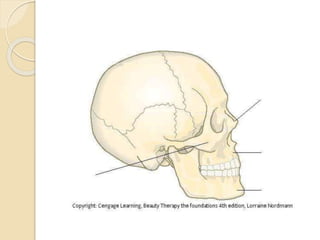
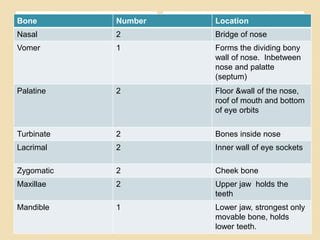
Facial Bones
Bone Number Location
Nasal 2 Bridge of nose
Vomer 1 Forms the dividing bony
wall of nose. Inbetween
nose and palatte
(septum)
Palatine 2 Floor &wall of the nose,
roof of mouth and bottom
of eye orbits
Turbinate 2 Bones inside nose
Lacrimal 2 Inner wall of eye sockets
Zygomatic 2 Cheek bone
Maxillae 2 Upper jaw holds the
teeth
Mandible 1 Lower jaw, strongest only
movable bone, holds
lower teeth.
Facial Bones
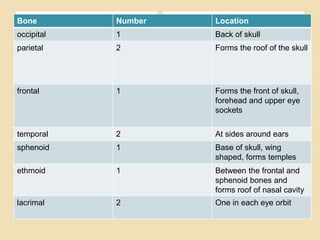
Bone Number Location
occipital 1 Back of skull
parietal 2 Forms the roof of the skull
frontal 1 Forms the front of skull,
forehead and upper eye
sockets
temporal 2 At sides around ears
sphenoid 1 Base of skull, wing
shaped, forms temples
ethmoid 1 Between the frontal and
sphenoid bones and
forms roof of nasal cavity
lacrimal 2 One in each eye orbit
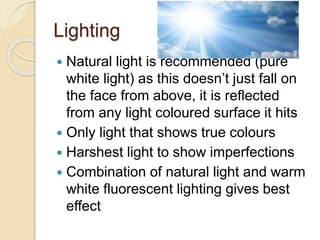
Lighting
 Natural light is recommended (pure
white light) as this doesn’t just fall on
the face from above, it is reflected
from any light coloured surface it hits
 Only light that shows true colours
 Harshest light to show imperfections
 Combination of natural light and warm
white fluorescent lighting gives best
effect
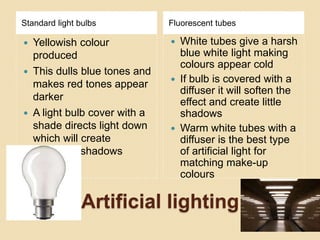
Artificial lighting
Standard light bulbs Fluorescent tubes
 Yellowish colour
produced
 This dulls blue tones and
makes red tones appear
darker
 A light bulb cover with a
shade directs light down
which will create
unnatural shadows
 White tubes give a harsh
blue white light making
colours appear cold
 If bulb is covered with a
diffuser it will soften the
effect and create little
shadows
 Warm white tubes with a
diffuser is the best type
of artificial light for
matching make-up
colours
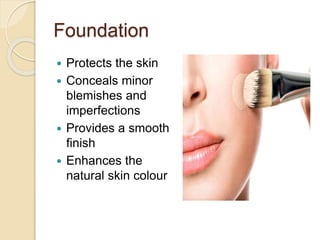
Foundation
 Protects the skin
 Conceals minor
blemishes and
imperfections
 Provides a smooth
finish
 Enhances the
natural skin colour
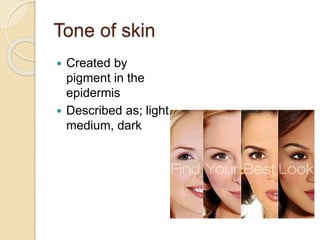
Tone of skin
 Created by
pigment in the
epidermis
 Described as; light,
medium, dark
CONSULTATION
When discussing the
treatment with the client you
need to ensure that the
questions are open ended,
to gain as much information
from your client as
possible…
 What are your reasons for coming
today?
 What results would you like to achieve
from having a facial?
 What medical conditions do you have?
 What skin care routine do currently
follow at home?
 What products do you currently use?
Starter Activity
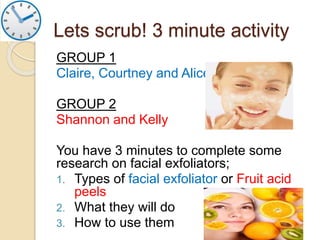
Lets scrub! 3 minute activity
GROUP 1
Claire, Courtney and Alice
GROUP 2
Shannon and Kelly
You have 3 minutes to complete some
research on facial exfoliators;
1. Types of facial exfoliator or Fruit acid
peels
2. What they will do
3. How to use them
Brush Cleansing
 Aids desquamation
 Stimulates cell renewal
 Removes surface matter
 Deep cleanses and refines
 Relaxes muscle fibres
 Stimulates superficial tissues
 Aids removal of waste products from
the area
 Increases blood and lymph circulation
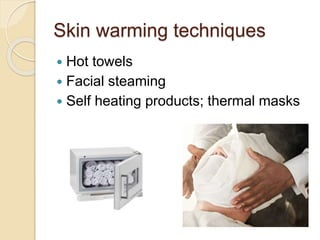
Skin warming techniques
 Hot towels
 Facial steaming
 Self heating products; thermal masks
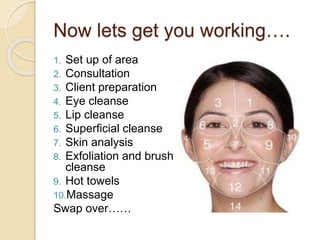
Now lets get you working….
1. Set up of area
2. Consultation
3. Client preparation
4. Eye cleanse
5. Lip cleanse
6. Superficial cleanse
7. Skin analysis
8. Exfoliation and brush
cleanse
9. Hot towels
10.Massage
Swap over……
Evaluation of treatment
 Am I in the correct uniform?
 Was my consultation thorough?
 What area am I most confident with?
 What area do I need to practice more?
 How long did my treatment take?
 Was my pressure correct?
 Did I remain professional throughout?
 Did I keep my working area tidy?
 Did I complete a detailed skin analysis
 What would I do different next time?
Homework
 Research position and action of next 5
muscles
 Complete skin ethnicity handout
 Find out functions of blood circulation
 Find out functions of lymphatic
circulation
 USE ORACLE FOR SUPPORT
 Practice massage in salon – time routine

Lesson plan 3 5.5.15

  • 1.
    5th May 2015 UnitB4 Provide facial skincare treatment Unit B8 Provide make-up services 28.4.15
  • 2.
    Countdown has begun!!!! 1.3 lessons until half term week commencing 25.5.15 2. Salon 141 bookings need 100% commitment to attend 3. 4 lessons after half term, last day with me this academic year 23.6.15 4. Facial exam booked for Tuesday 2nd June 5. Make-up exam booked for Tuesday 16th June
  • 3.
    Contact details  Pleaseupdate your e mail and contact numbers.  Friends on facebook; Courtney and Kelly
  • 4.
    Objectives New Anatomy topicsRecap Anatomy topics 1. Locate and describe the action of specific facial muscles 2. Locate and label bones of the face, cranium and shoulder girdle 3. Compare characteristics of skin conditions 4. Label diagram of the skin  Describe position and action of facial muscles  Identify layers of epidermis and their functions  Label the structure of the skin  State the functions of the skin  Compare characteristics of skin types; normal, dry, oily and combination  Explain the benefits and effects of cleansers and toners  Identify contra indications that restrict and prevent facial treatments
  • 5.
    Objectives By the endof the session today you will be able to ….. Make-Up B8 Morning session Facials B4 Afternoon session  Identify lighting required for day make- up  List the correct products to be used in a day make-up  List procedure/order of work  Prepare self for carrying out make-up application  Demonstrate preparation of trolley and equipment (sanitising and sterilising)  Complete make-up consultation  Demonstrate correct preparation of client for make-up include cleanse  Perform skin analysis and assess clients face shape  Demonstrate correct way to choose foundation colour (warm/cool)  Perform application of day make-up  Identify reasons and benefits for using different exfoliation products  Evaluate benefits of a brush cleanse procedure  State benefits and contra- indications to using hot towels to warm the skin  Observe health and safety precautions  Perform eye, lip, face cleanse and skin analysis evaluating findings  Demonstrate brush cleanse and exfoliation techniques  Perform massage techniques from movement 1 – 25  Peer and self evaluate techniques
  • 6.
    B8 Provide make-upservices  E3 open book exam  E4 open book exam  Minimum of 3 practical assessments; Age 16 – 30 years 31 – 50 years Over 50 years Skin types Oily Dry Combination Occasions Day Evening Special All make-up products listed and aftercare advice
  • 7.
    Treatment timings Make-up Day =30 minutes Evening = 45 minutes Special occasion = 45 minutes Facials Basic = 60 minutes Luxury = 75 minutes
  • 8.
    Facial Muscles Triangularis Position The cornerof the lower lip extends over the chin. Action Draws down the mouth’s corners. Expression Sadness
  • 9.
    Facial Muscles Temporalis Position Extends fromthe temple region at the side of the head to the mandible. Action Raises the jaw and draws it backwards as in chewing.
  • 10.
    Facial Muscles Frontalis Position The forehead Action Raisesthe eyebrows, causes wrinkling across forehead Expression Surprise
  • 11.
    Facial Muscles Zygomaticus Position Extends diagonallyfrom zygomatic to corner of mouth Action Lifts the corners of the mouth outward and backward Expression Smiling and laughing
  • 12.
    Facial Muscles Corrugator Position Between theeyebrows Action Draws the eyebrows down and together Expression Frowning
  • 13.
    Facial Muscles Orbicularis Oculi Position Surroundsthe eye Action Closes the eyelid Expression Winking
  • 14.
    Facial Muscles Orbicularis Oris Position Surroundsthe mouth Action Purses the lips as in blowing, closes the mouth Expression Pouting, kissing and doubtful
  • 15.
    Facial Muscles Masseter Position Cheek area,extends from zygomatic bone to the mandible Action Clenches the teeth, closes and raises the lower jaw used in eating
  • 16.
    Facial Muscles Buccinator Position Inside thecheeks between the upper and lower jaw Action Compresses the cheek Expression Blowing
  • 17.
    Facial Muscles Risorius Position Diagonally frommasseter muscle to corner of mouth Action Draws mouth corners outwards and backwards Expression Grimace/fake smile
  • 18.
    Facial Muscle Depressor labii Position Surroundsthe lower lip Action Pulls down the lower lip and draws it slightly to one side Expression Sulking
  • 19.
    Facial Muscles- Homework Depressor labbi  Platysma  Mentalis  Nasalis  Procerus
  • 20.
    Bones of thecranium and skull  Bones are made from a specialized form of connective tissue  They support, protect and connect different parts of the body  Bones are made up of 2 types of tissue; compact (hard outer layer of the bone) and cancellous (spongy inside of bone, contains red and yellow bone marrow. Red produces new red blood cells and yellow stores fat cells)
  • 21.
    Bones of thehead  Bones that form the head are known as the skull  Divided into 2 parts; face and cranium  Total of 22 bones  Our facial bones form our features  Support other structures such as eyes and teeth  Cranium surrounds and protects the brain
  • 28.
    Facial Bones Bone NumberLocation Nasal 2 Bridge of nose Vomer 1 Forms the dividing bony wall of nose. Inbetween nose and palatte (septum) Palatine 2 Floor &wall of the nose, roof of mouth and bottom of eye orbits Turbinate 2 Bones inside nose Lacrimal 2 Inner wall of eye sockets Zygomatic 2 Cheek bone Maxillae 2 Upper jaw holds the teeth Mandible 1 Lower jaw, strongest only movable bone, holds lower teeth.
  • 29.
    Facial Bones Bone NumberLocation occipital 1 Back of skull parietal 2 Forms the roof of the skull frontal 1 Forms the front of skull, forehead and upper eye sockets temporal 2 At sides around ears sphenoid 1 Base of skull, wing shaped, forms temples ethmoid 1 Between the frontal and sphenoid bones and forms roof of nasal cavity lacrimal 2 One in each eye orbit
  • 30.
    Lighting  Natural lightis recommended (pure white light) as this doesn’t just fall on the face from above, it is reflected from any light coloured surface it hits  Only light that shows true colours  Harshest light to show imperfections  Combination of natural light and warm white fluorescent lighting gives best effect
  • 31.
    Artificial lighting Standard lightbulbs Fluorescent tubes  Yellowish colour produced  This dulls blue tones and makes red tones appear darker  A light bulb cover with a shade directs light down which will create unnatural shadows  White tubes give a harsh blue white light making colours appear cold  If bulb is covered with a diffuser it will soften the effect and create little shadows  Warm white tubes with a diffuser is the best type of artificial light for matching make-up colours
  • 32.
    Foundation  Protects theskin  Conceals minor blemishes and imperfections  Provides a smooth finish  Enhances the natural skin colour
  • 33.
    Tone of skin Created by pigment in the epidermis  Described as; light, medium, dark
  • 35.
    CONSULTATION When discussing the treatmentwith the client you need to ensure that the questions are open ended, to gain as much information from your client as possible…  What are your reasons for coming today?  What results would you like to achieve from having a facial?  What medical conditions do you have?  What skin care routine do currently follow at home?  What products do you currently use?
  • 36.
  • 37.
    Lets scrub! 3minute activity GROUP 1 Claire, Courtney and Alice GROUP 2 Shannon and Kelly You have 3 minutes to complete some research on facial exfoliators; 1. Types of facial exfoliator or Fruit acid peels 2. What they will do 3. How to use them
  • 38.
    Brush Cleansing  Aidsdesquamation  Stimulates cell renewal  Removes surface matter  Deep cleanses and refines  Relaxes muscle fibres  Stimulates superficial tissues  Aids removal of waste products from the area  Increases blood and lymph circulation
  • 39.
    Skin warming techniques Hot towels  Facial steaming  Self heating products; thermal masks
  • 40.
    Now lets getyou working…. 1. Set up of area 2. Consultation 3. Client preparation 4. Eye cleanse 5. Lip cleanse 6. Superficial cleanse 7. Skin analysis 8. Exfoliation and brush cleanse 9. Hot towels 10.Massage Swap over……
  • 41.
    Evaluation of treatment Am I in the correct uniform?  Was my consultation thorough?  What area am I most confident with?  What area do I need to practice more?  How long did my treatment take?  Was my pressure correct?  Did I remain professional throughout?  Did I keep my working area tidy?  Did I complete a detailed skin analysis  What would I do different next time?
  • 42.
    Homework  Research positionand action of next 5 muscles  Complete skin ethnicity handout  Find out functions of blood circulation  Find out functions of lymphatic circulation  USE ORACLE FOR SUPPORT  Practice massage in salon – time routine