Unit B4 Provide facial skincare treatment
28.4.15
Key topics
1. Functions of skin
2. Layers of epidermis
3. Appendages in the dermis
4. Skin analysis
5. Skin types
6. Layers of skin
7. Reasons for having facials
8. Working environment requirements
9. Questions to ask in the consultation
Objectives
1. Locate and describe the action of specific facial
muscles
2. Compare benefits of skin care preparations
3. State 3 reasons why clients have facials
4. List 5 benefits of having a facial
5. List 5 desirable characteristics of a working
environment
6. Complete a full consultation whilst working in pairs
7. Observe a demo of eye cleanse, lip cleanse,
superficial cleanse, skin analysis and deep cleanse
8. Identify skin conditions found on your clients skin
9. Perform eye cleanse, lip cleanse, superficial cleanse
& skin analysis
B4 Provide facial skin care
treatment Unit Requirements
 Practical observation on 3 occasions
involving a different client
 2 online exams; 1 open book and 1
anatomy based paper
Facial Muscles
Triangularis
Position
The corner of the lower lip
extends over the chin.
Action
Draws down the mouth’s
corners.
Expression
Sadness
Facial Muscles
Temporalis
Position
Extends from the temple
region at the side of the
head to the mandible.
Action
Raises the jaw and draws it
backwards as in chewing.
Facial Muscles
Frontalis
Position
The forehead
Action
Raises the eyebrows,
causes wrinkling across
forehead
Expression
Surprise
Facial Muscles
Zygomaticus
Position
Extends diagonally from
zygomatic to corner of
mouth
Action
Lifts the corners of the
mouth outward and
backward
Expression
Smiling and laughing
Facial Muscles
Corrugator
Position
Between the eyebrows
Action
Draws the eyebrows down
and together
Expression
Frowning
Facial Muscles
Orbicularis Oculi
Position
Surrounds the eye
Action
Closes the eyelid
Expression
Winking
Facial Muscles- Homework
 Orbicularis oris
 Buccinator
 Risorius
 Masseter
 Triangularis
 Depressor labii
Cleansing Toning
 To remove make-up
 To remove surface dirt &
dead skin cells
 To prepare the skin for
deep cleansing
 To aid in desquamation
 To breakdown the acid
mantle
 An astringent effect on
the skin
 Mild tightening effect on
the skin
 To close the pores
 To remove trace
elements of cleanser
 To restore the acid
mantle
Reasons and benefits of …
Lets see what you can
discover….
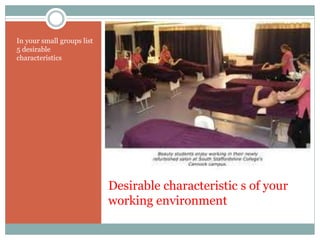
Desirable characteristic s of your
working environment
In your small groups list
5 desirable
characteristics
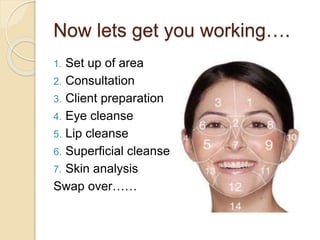
Now lets get you working….
1. Set up of area
2. Consultation
3. Client preparation
4. Eye cleanse
5. Lip cleanse
6. Superficial cleanse
7. Skin analysis
Swap over……
Anatomy and physiology
 Structure of skin
 Functions of skin
 Skin Types
 Facial muscles
 Bones of head, neck and shoulder girdle
 Functions of blood and lymph
 Contra indications
 Skin care preparations
 Massage effects
 Contra actions
 Homecare
Activity for you …..
 In pairs see if you can analyse what
skin types you have and list reasons
for your choices.
Normal skin
 Pore size is small or medium
 Moisture content is good
 Skin texture is smooth and even,
neither too thick or too thin
 Healthy colour
 Elasticity is good when young
 Skin feels firm to the touch
 Skin pigmentation is even
 Skin usually free from blemishes
Dry skin
 Pores are small and tight
 Moisture content is poor
 Skin texture is coarse and thin, with patches
of visible flaking skin
 Tendency toward sensitivity (often broken
capillaries)
 Premature ageing is common, fine lines
around eyes, mouth and neck leading to
deeper lines
 Skin pigmentation may be uneven, disorders
such as ephelides (freckles) usually found
 Milia often found on eyes and cheeks
Oily skin
 Pores are enlarged
 Moisture content is high
 Skin is coarse and thick
 Sallow in colour
 Skin tone is good
 Skin is prone to shine
 Uneven pigmentation
 Skin disorders may be apparent –
comedones, pustules, papules, milia,
cysts
Combination skin
 Pores in T zone are enlarged, while in the
cheek they are small to medium
 Moisture content is high in oily areas, but
poor in dry areas
 Skin is coarse and thick in oily areas but thin
in dry
 Skin is sallow in oily areas but sensitive and
high colour in the dry
 Uneven pigmentation
 Blemishes, pustules and comedones on oily
areas
 Milia and broken capillaries appear in dry
areas
Why clients have facials What are the benefits?
Name 3
reasons
why
Name 5
benefits
Why do clients have facials?
Desirable
characteristics
of your working
environment
In your small groups list 5 desirable characteristics
CONSULTATION
When discussing the
treatment with the client you
need to ensure that the
questions are open ended,
to gain as much information
from your client as
possible…
 What are your reasons for coming
today?
 What results would you like to achieve
from having a facial?
 What medical conditions do you have?
 What skin care routine do currently
follow at home?
 What products do you currently use?
DEMONSTRATION
The first stage of your
facial routine…
1. Eye cleanse
2. Lip cleanse
3. Superficial cleanse
4. Skin analysis
Now lets get you working….
1. Set up of area
2. Consultation
3. Client preparation
4. Eye cleanse
5. Lip cleanse
6. Superficial cleanse
7. Skin analysis
Swap over……
Lesson 2 facials 28.4.15

Lesson 2 facials 28.4.15

  • 1.
    Unit B4 Providefacial skincare treatment 28.4.15
  • 2.
    Key topics 1. Functionsof skin 2. Layers of epidermis 3. Appendages in the dermis 4. Skin analysis 5. Skin types 6. Layers of skin 7. Reasons for having facials 8. Working environment requirements 9. Questions to ask in the consultation
  • 3.
    Objectives 1. Locate anddescribe the action of specific facial muscles 2. Compare benefits of skin care preparations 3. State 3 reasons why clients have facials 4. List 5 benefits of having a facial 5. List 5 desirable characteristics of a working environment 6. Complete a full consultation whilst working in pairs 7. Observe a demo of eye cleanse, lip cleanse, superficial cleanse, skin analysis and deep cleanse 8. Identify skin conditions found on your clients skin 9. Perform eye cleanse, lip cleanse, superficial cleanse & skin analysis
  • 4.
    B4 Provide facialskin care treatment Unit Requirements  Practical observation on 3 occasions involving a different client  2 online exams; 1 open book and 1 anatomy based paper
  • 5.
    Facial Muscles Triangularis Position The cornerof the lower lip extends over the chin. Action Draws down the mouth’s corners. Expression Sadness
  • 6.
    Facial Muscles Temporalis Position Extends fromthe temple region at the side of the head to the mandible. Action Raises the jaw and draws it backwards as in chewing.
  • 7.
    Facial Muscles Frontalis Position The forehead Action Raisesthe eyebrows, causes wrinkling across forehead Expression Surprise
  • 8.
    Facial Muscles Zygomaticus Position Extends diagonallyfrom zygomatic to corner of mouth Action Lifts the corners of the mouth outward and backward Expression Smiling and laughing
  • 9.
    Facial Muscles Corrugator Position Between theeyebrows Action Draws the eyebrows down and together Expression Frowning
  • 10.
    Facial Muscles Orbicularis Oculi Position Surroundsthe eye Action Closes the eyelid Expression Winking
  • 11.
    Facial Muscles- Homework Orbicularis oris  Buccinator  Risorius  Masseter  Triangularis  Depressor labii
  • 12.
    Cleansing Toning  Toremove make-up  To remove surface dirt & dead skin cells  To prepare the skin for deep cleansing  To aid in desquamation  To breakdown the acid mantle  An astringent effect on the skin  Mild tightening effect on the skin  To close the pores  To remove trace elements of cleanser  To restore the acid mantle Reasons and benefits of …
  • 13.
    Lets see whatyou can discover….
  • 14.
    Desirable characteristic sof your working environment In your small groups list 5 desirable characteristics
  • 15.
    Now lets getyou working…. 1. Set up of area 2. Consultation 3. Client preparation 4. Eye cleanse 5. Lip cleanse 6. Superficial cleanse 7. Skin analysis Swap over……
  • 16.
    Anatomy and physiology Structure of skin  Functions of skin  Skin Types  Facial muscles  Bones of head, neck and shoulder girdle  Functions of blood and lymph  Contra indications  Skin care preparations  Massage effects  Contra actions  Homecare
  • 18.
    Activity for you…..  In pairs see if you can analyse what skin types you have and list reasons for your choices.
  • 19.
    Normal skin  Poresize is small or medium  Moisture content is good  Skin texture is smooth and even, neither too thick or too thin  Healthy colour  Elasticity is good when young  Skin feels firm to the touch  Skin pigmentation is even  Skin usually free from blemishes
  • 21.
    Dry skin  Poresare small and tight  Moisture content is poor  Skin texture is coarse and thin, with patches of visible flaking skin  Tendency toward sensitivity (often broken capillaries)  Premature ageing is common, fine lines around eyes, mouth and neck leading to deeper lines  Skin pigmentation may be uneven, disorders such as ephelides (freckles) usually found  Milia often found on eyes and cheeks
  • 23.
    Oily skin  Poresare enlarged  Moisture content is high  Skin is coarse and thick  Sallow in colour  Skin tone is good  Skin is prone to shine  Uneven pigmentation  Skin disorders may be apparent – comedones, pustules, papules, milia, cysts
  • 25.
    Combination skin  Poresin T zone are enlarged, while in the cheek they are small to medium  Moisture content is high in oily areas, but poor in dry areas  Skin is coarse and thick in oily areas but thin in dry  Skin is sallow in oily areas but sensitive and high colour in the dry  Uneven pigmentation  Blemishes, pustules and comedones on oily areas  Milia and broken capillaries appear in dry areas
  • 27.
    Why clients havefacials What are the benefits? Name 3 reasons why Name 5 benefits Why do clients have facials?
  • 28.
    Desirable characteristics of your working environment Inyour small groups list 5 desirable characteristics
  • 29.
    CONSULTATION When discussing the treatmentwith the client you need to ensure that the questions are open ended, to gain as much information from your client as possible…  What are your reasons for coming today?  What results would you like to achieve from having a facial?  What medical conditions do you have?  What skin care routine do currently follow at home?  What products do you currently use?
  • 30.
    DEMONSTRATION The first stageof your facial routine… 1. Eye cleanse 2. Lip cleanse 3. Superficial cleanse 4. Skin analysis
  • 31.
    Now lets getyou working…. 1. Set up of area 2. Consultation 3. Client preparation 4. Eye cleanse 5. Lip cleanse 6. Superficial cleanse 7. Skin analysis Swap over……