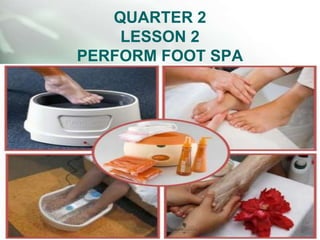
QUARTER 2
LESSON 2
PERFORM FOOT SPA
PRE-FOOT SPA TREATMENT
Foot Spa Treatment is another relaxing service offered
in the salon
that pampers our tired feet which is the most exercised part
of our body as it
carries our weight and performs most of the time during the
day. Aside from
relaxing our feet, it can also help prevent and cure many
symptoms such as
headache, stress, asthma, constipation, sinusitis,
migraine and improve the
circulation of the blood as one of the most beneficial effects
of foot massage..
TOOL SUPPLIES EQUIPMENT
Benefit of Foot Spa
Foot spa, anyone?
One of the many ways you can keep your
feet healthy and happy is a foot spa. More
than just beautifying the feet, a foot spa
gives the following benefits:
Promotes blood circulation. A foot spa
improves blood circulation, aside from
energizing and relaxing the body.
Relieves stress. Soaking feet in warm
water and massaging feet eases tension
and the stresses of the day.
Eases arthritic pain. Just putting your feet up
already results in some relief. Imagine how
much more relief a foot spa can bring,
especially to muscles and joints suffering from
arthritis.
Reduces headaches. Many nerve joints are
located on the underside of the feet.
Massaging these points during a foot spa
helps in treating headaches and migraines.
Helps detoxify the body. Soaking the feet,
especially in a foot bath with Epsom salts,
helps release toxic metals in the body while
helping to absorb magnesium and sulphates
which bring many benefits to your health.
Before You Start
Before starting the procedure, you need to get
your equipment ready first. These tools include:
Nail clipper, nail file, cuticle pusher and nipper,
foot file (pumice stone or emery board)
Foot bath or any container big enough to
submerge both feet in ankle-high water
Warm water
Foot wash
Epsom salts and essential oils of your choice
Foot scrub
Foot lotions or creams of your choice
Towels
Socks
What To Do
Now, the procedure:
1. Prepare all your tools, making sure everything
is within reach.
2. Fill your footbath with water hot enough for
you to tolerate, but not too hot that it will burn or
scald your feet.
3. Add Epsom salts, a few drops of your favorite
essential oil and some foot wash (if desired). If
you do not have a foot wash, body wash or
shampoo will do. Stir, making sure that
everything is well mixed.
4. Soak your feet in the foot bath for 10-15
minutes. The solution will then remove the dirt
and soften your toenails and feet.
Remove your feet from the water and dry
thoroughly.
6.Remove nail polish (if you are wearing
some) from your toenails and then trim your
nails to the desired length and file them to
get the shape you want.
7.Using a foot file or a pumice stone, gently
exfoliate your feet, concentrating on the
heel and its sides.
8. Apply a foot scrub and gently work it into
your toes, the undersides of your feet, the
heels and the ankles for added exfoliation.
(If you do not have foot scrub, you can use
a mixture of brown sugar and coconut or
olive oil.) For some added pleasure, gently
massage your feet, especially those aching
parts.
9.Rinse the scrub off your
feet and pat your feet dry.
10. Moisturize your feet
with your preferred lotion
or cream, working the
lotion on your feet while
massaging gently.
11. Put on socks to seal
the moisture in.
Method 2
Fill a plastic tub with warm water. Any
plastic container that is big enough to fit
both of your feet will do just fine. For a
more luxurious experience, make sure that
the tub is tall enough to reach halfway up
your calves. You can also use one of those
tubs made specifically for foot spas if you
really want to get fancy.Consider adding
some marbles or smooth stones into the
bottom of the tub. This way, you can roll
your feet over them and give yourself a foot
massage!
Method 3:
Put Foot Soak
>Add your desired herbs, salts, or oils.
>Squirt some bubble bath solution if you
like bubbles and wish to soften your feet.
>Add 10 drops of essential oil for
fragrance and aromatherapy. Peppermint,
lavender, or lemongrass are all great
options.[4]
>If you want a nicer, visual appearance,
add a of mint or a handful of rose petals.
>To soften your feet, use 1 cup (125
grams) of powdered milk (dairy or soy)
and 1 tablespoon (15 milliliters) of almond
oil instead.
Method 4:
Soak your feet in the water for 10 to 15
minutes. Pull the tub over in front of a
comfortable chair. Sit down in the chair,
then slip your feet into the tub. Read a
book or close your eyes and listen to
some music. You can even combine the
foot spa with another treatment, such
as a face mask or eye mask.[5]Dirty
water is not very relaxing, so make sure
that your feet are clean. If they are dirty,
rinse them off first in the shower,
bathtub, or sink.
Method 5
Exfoliate your feet with a scrub or manicure
brush after soaking. Once the 10 to 15 minutes
are up, it is time for some exfoliation! Use a
manicure brush or a small body brush for a
simple treatment. For a fancier treatment, use a
homemade or store-bought foot scrub instead.
Focus the exfoliation on your heels, where the
skin is the most calloused.[6]If you used the foot
scrub, be sure to rinse it off using your foot soak
water.
For exceptionally calloused heels, consider using
a pumice stone.
Keep your feet over the tub so that you can
splash water on them whenever it is necessary.
Method 6
Follow up with a foot massage. If
you added marbles to the tub, you
can simply roll your feet back-and-
forth across them. You can also use a
store-bought massager, or give
yourself a traditional foot massage
using your hands.Don't stress about
doing the massage correctly, like a
professional would. Do what feels the
best to you.
Method 7
Pat your feet dry
Summary:
Classroom rules and procedures are
important, but they may vary from one
teacher to another. Rules and procedures
typically fall into several categories
including: general expectations for
behavior; beginning and ending the day
or period; transitions and interruptions;
materials & equipments; group work; and
teacher-led activities. In all cases, it is
important to involve students in the
design of classroom rules and
procedures.
Disciplinary Interventions
The lack of discipline is the most
serious problem facing schools
today.
The higher the grade level, the more
disciplinary problems occur in public
schools.
What are the action steps
you are encouraged to
follow?
Action Step 1
Employ specific techniques that
acknowledge and reinforce acceptable
behavior and acknowledge and provide
negative consequences for
unacceptable behavior.
Five categories of disciplinary interventions
can be used to provide a balance of positive
and negative consequences:
teacher reaction
tangible recognition
direct cost
group contingency
home contingency
Teacher Reaction
Verbal and physical teacher reactions are
the simplest ways to acknowledge and
reinforce acceptable behavior and to
acknowledge and provide negative
consequences for unacceptable behavior.
Emmer, Evertson, and Worsham (2003) list a
variety of teacher reactions that include the
following:
 Make eye contact with an offending
student by moving closer to him or her.
 Use physical signal to indicate that a given
action is inappropriate.
 If a student is not following a procedure,
provide him/her with simple verbal reminder.
 If a student is “off task” but not
misbehaving, state the desired appropriate
behavior.
 If a student does not respond to more
subtle interventions, simply tell the student to
stop the inappropriate behavior.
Tangible Recognition
 involves the use of some concrete symbol
of appropriate behavior. It is important for
any system of tangible recognition to be
accompanied by a thorough discussion of
the rationale behind it. Care should be taken
to ensure that tangible recognition is not
perceived as some type of bribe or form of
coercion relative to student behavior.
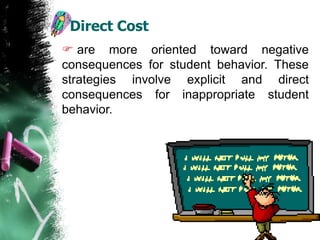
Direct Cost
 are more oriented toward negative
consequences for student behavior. These
strategies involve explicit and direct
consequences for inappropriate student
behavior.
Isolation Time out
 refers to the removal of a student from the
classroom reserved for disruptive students. It
requires that students have a clear
understanding as to the specific behaviors
that will lead to its use. Students should be
aware that isolation time out would be used
only when other attempts to correct the
disruptive behavior within the regular context
of the classroom have been exhausted.
Overcorrection
 is a procedure that is used when a student
has misbehaved in a way that destroys or
alters some objects in the classroom.
Student would be asked to overcompensate
for the behavior.
Group Contingency
Group contingency techniques operate in a
fashion similar to concrete recognition
techniques except that they apply to a group
of students as opposed to individuals
Interdependent Group
Contingency Techniques
 require every student in the group to
meet the behavioral criterion for the group
to earn credit.
Dependent Group Contingency
Technique
 requires a specific individual or a specific
set of individuals in the group to meet the
criterion for the group to earn credit.
Home Contingency
Home contingency involves making parents
aware of the positive and negative behaviors
of their children. This is done in the form of a
short note, a letter, a phone call, or a visit to
the parents of the student.
Action Step 2
Establish clear limits for unacceptable
behavior and an effective system to
record these behavior.
To use positive and negative
consequences effectively, you must
establish limits. Setting limits is a perfect
opportunity to involve students in their own
management. Rather than you establishing
the limits in isolation, the class could do so
after discussing with them why the target
behavior is important and what are fair
expectations regarding that behavior. The
limit established by consensus approach
would be the best limit for the class.
Summary:
The guiding principle for disciplinary
interventions is that they should include a
healthy balance between negative for
inappropriate behavior and positive
consequences for appropriate behavior.
Specific techniques that involve both positive
and negative consequences include teacher
reaction, tangible recognition, direct cost,
group contingency, and home contingency.
Whatever the approach, it is important to
establish behavioral limits and a record-
keeping system that allows you to keep track
of student behavior efficiently and
unobtrusively.
Communicating with Students
Everyday you communicate with
your students using different forms
of communication, verbal or non-
verbal. Though ability to
communicate is inherent to all
human beings, the skill to
communicate properly must be
learned.
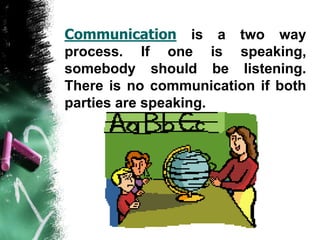
Communication is a two way
process. If one is speaking,
somebody should be listening.
There is no communication if both
parties are speaking.
Communicating with students involves the
following aspects:
1. Using descriptive rather than judgmental
language;
2. Teaching students to listen to you;
3. Listening to students;
4. Using supportive Replies;
5. Avoiding Unintended Messages; and
6. Professional confidence and student’s
rights.
Using descriptive rather than
judgmental language
Research studies indicate that students
feel less threatened, less defensive, and
more willing to engage in learning
activities when working with teachers
who consistently use descriptive
language than they are when working
with teachers who use a more
judgmental language style.
Descriptive language verbally
portrays a situation, a behavior,
an achievement, or a feeling.
Judgmental language verbally
summarizes an evaluation of a
behavior, achievement or person
with a characterization or label.
Judgmental language that
focuses on personalities is
particularly detrimental to a
climate of cooperation.
The consequences of judgmental
language
Judgmental language makes pupils
uncomfortable in the teacher’s presence
because they believe that their teacher has
little respect for them.
Pupils develop a disruptive behavior pattern
as they live up to what they perceive to be
their teacher's expectation.
How would you avoid using
judgmental language
1. Avoid labels.
2. Learn to distinguish between a student’s
accomplishments and the value of the
student.
3. Do not view a student’s display of off-
task behavior as a reflection of
character flaws.
4. Be responsible for teaching each student
to be on task and to achieve learning
objectives.
5. Do not include judgment of student’s
characters among your responsibilities.
6. Do not hesitate in communicating your
feeling about specific behavior or
achievements of students. However, do
not allow those feelings to influence the
degree to which you respect, care for
and value students.
In order to consistently use a descriptive
language style, you must resist event
silent thoughts that characterize students
with labels such as, “smart”, “slow”, “good
reader”, “well behaved”, “problem child”,
“honest”, “intelligent”, “under achiever”,
and the paradoxical “overachiever”.
Instead of thinking of students according
to labels, you should focus on learning
tasks, circumstances, and situations.
Teaching Students to Listen to You
There are at least seven ways how you could
teach your students to listen to you:
1. Use descriptive language.
2. Use words judiciously.
3. Think before talking.
4. Avoid useless words.
5. Speak only to intended listeners.
6. Be aware of your body languages.
7. Speak only to the attentive.
The Judicious Use of Words
In general, students are likely to pay
attention whenever you speak if they know
that whenever you speak you really have
something to say. By judiciously using
words that inform and by avoiding inane
talk, you leave your students with the idea
that they miss something by not hearing you
whenever you speak to them.
Thinking Before Talking
Rather than immediately reacting with the
first word that comes to mind, it is usually
wise for a teacher to pause and carefully
frame words before speaking to
students.
Often, adults send inane messages to
children because they immediately react
to circumstances before they get more
relevant information.
More and More Useless Words
Students begin to learn to ignore teacher-
talk when teachers act as if they are
initiating a self-initiating behavior.
Students may begin tuning a teacher out
when that teacher makes judgments that
only the students can make.
Speaking Only to Intended Listeners
When the situation warrants, teachers
should make it clear that what she has to
say is meant only for a particular pupil.
Other pupils don’t have to stop their work
only to find that the teacher’s message
does not apply to them.
Body Language
How you position your body when
speaking to students has a major impact
on what messages students receive.
Teachers sometimes make the mistake of
saying one thing to students, but
communicating another as a consequence
of their body language. Your voice
sometimes provides a hint of stress and
indicates to your pupils that you are not
really in control.
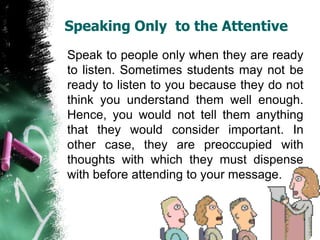
Speaking Only to the Attentive
Speak to people only when they are ready
to listen. Sometimes students may not be
ready to listen to you because they do not
think you understand them well enough.
Hence, you would not tell them anything
that they would consider important. In
other case, they are preoccupied with
thoughts with which they must dispense
with before attending to your message.
Listening to Students
A reasonably accurate understanding of
your students’ thoughts and attitudes is vital
to your ability to identify student’s needs,
decide learning goals, design learning
activities, and evaluate how well learning
goals are achieved. You also need to
understand students’ thoughts and attitudes
in order to decide what messages you
should communicate and when and how
each message should be communicated. By
listening to them, you will discover how to
get students to listen to you.
Using Supportive Replies
This includes accepting feelings,
relieving frustration and defusing
conflicts.
Accepting Feelings
Expressions of feelings receive a
support when the listener indicates
that the expression has been
understood and accepted.
Relieving Frustration
Frustration can be quite
incapacitating and sometimes a
person must relieve his or her
frustration before addressing the
source of the frustration. Having
another person’s empathy can
sometimes serve to relieve
frustration.
Defusing Conflict
By acknowledging students’
feelings with supportive replies,
you can avoid arguments and
dispense with excuses for not
being on-task.
Avoiding Unintended Messages
Unintended messages, unwittingly
communicated to students by teachers,
can cause many of the misunderstandings
about expectations that lead students to
become off-task. However, you can reduce
miscommunication when you send
unintended messages by :
modeling a business attitude;
avoiding disruptions in your own learning
activities;
avoiding destructive positive
reinforcers; and
avoiding destructive punishments.
Professional Confidence and
Students Rights
Violation of Trust
Trust between a teacher and a student is an
important ingredient in establishing a
classroom climate that is conducive to
cooperation, on-task behaviors, and
engagement in learning activities. Teachers
violate that trust when they gossip about
students or share information obtained through
their role as teachers with people who need
not privy to that information. Once students
acquire the idea that teachers gossip about
them, they are far less likely to feel
comfortable in trusting those teachers.
The following have a right &
need to know about students’
achievement levels and
behaviors:
• Students themselves
• Students parents/ guardians
• Professional personnel
 guidance councilor
 principal
 subject area supervisor / curriculum
director
Summary:
If there is one skill that is neglected or not
being developed by teachers, it is the ability
to communicate with students effectively.
Communicating with students involves
several skills which must be learned by
heart by all teachers.
Descriptive language should be used by
teachers rather than judgmental language.
To teach students to listen to you, you
should be aware of what, when, how, and
whom to speak.
Listening to pupils means to stop talking
and lend ears to students. Teachers should
listen not only to what pupils say but listen
also to what they do not say.
Pupils seek reply when they communicate
with their teachers. Replies should be
supportive. You can do this by accepting
feelings, relieving frustration and avoiding
conflicting statements.
Misinterpretations often occur when
teachers communicate with pupils. Thus,
teachers should be sensitive enough when
communicating with students. Teachers
should also avoid disrupting their own
learning activities because it carries
unintended message.
Trust is the most important ingredient in
communication. Teachers should engage in
activities in the classroom that promote trust
and confidence among pupils.
Teacher-Student Relationship
If a teacher has a good relationship with
students, then students more readily accept the
rules and procedures and the disciplinary
actions that follow their violations. Without the
foundation of a good relationship, students
commonly resist rules and procedures along
with the consequent disciplinary actions.
Product also of good teacher-student
relationship is responsible communication
between them.
Researchers indicate that on average,
teachers who have high-quality
relationships with their students had
31 percent fewer discipline problems,
rule violations, and related problems
over a year’s time with their students.
Effective teacher-student relationships
have nothing to do with teacher’s
personality or even with whether the
students view the teacher as a friend.
Rather, the most effective teacher-student
relationships are characterized by specific
teacher behaviors:
• exhibiting appropriate levels of
dominance
• exhibiting appropriate levels of
cooperation
• and being aware of high-needs students
Appropriate Levels of Dominance
Wubbels and his colleagues (1999) define
dominance as the ability to provide clear
purpose and strong guidance regarding both
academics and student behavior.
Teachers can exhibit appropriate dominance by:
 establishing clear behavioral expectations
and learning goals
 establishing clear rules and procedures
 providing consequences for students
behavior
 exhibiting assertive behavior
According to Emmer and colleagues (2003),
assertive behavior is the ability to stand up
for one’s legitimate rights in ways that make
it less likely that others will ignore or
circumvent them.
Assertive behavior differs significantly from
both passive behavior and aggressive behavior.
Researchers explain that teachers display
assertive behavior in the classroom when they:
 Use assertive body language by
maintaining an erect posture, facing the
offending student but keeping enough
distance so as not to appear threatening and
matching the facial expression with the
content of the message being presented to
students;
 Use an appropriate tone of voice, speaking
clearly and deliberately in a pitch that is slightly
but not greatly elevated from normal classroom
speech, avoiding any display of emotions in the
voice.
 Persist until students respond with the
appropriate behavior. Do not ignore an
appropriate behavior; do not be diverted by a
student denying, arguing, or blaming, but listen
to legitimate explanations.
 providing clarity about the content and
expectations of an upcoming instructional unit.
Important teacher actions to achieve this end
include:
 Establishing and communicating learning
goals at the beginning of a unit of instruction.
 Providing feedback of those goals.
 Continually and systematically re-visiting the
goals.
 Providing summative feedback regarding
the goals.
Appropriate Levels of Cooperation
Cooperation is characterized by a concern for
the needs and opinions of others. Although not
the antithesis of dominance, cooperation
certainly occupies a different realm. Whereas
dominance focuses on the teacher as the
driving force in the classroom, cooperation
focuses on the students and teacher
functioning as a team. The interaction of these
two dynamics; dominance and cooperation is a
central force in effective teacher-student
relationships.
You can convey appropriate levels of
cooperation by:
 providing flexible learning goals.
 take a personal interest in each student
Some practical strategies that emphasize
equitable and positive classroom interactions
with all students:
 Make eye contact with each student.
 Deliberately move toward and stand close
to each student during the class period.
 Attribute the ownership of ideas to the
students who initiated them.
 Allow and encourage all students to
participate in class discussions and
interactions.
 Provide appropriate wait time for all
students to respond to questions, regardless
of their past performance or your perception of
your ability.
Awareness of High-Needs Students
Although the classroom teacher is certainly
not in a position to address the students’
severe problems, teachers with effective
management skills are aware of high-needs
students and have a repertoire of specific
techniques for meeting some of their needs.
Five Categories of
High-Needs
Students
Passive
Behavior that avoids the domination of others
or the pain of negative experiences. The child
attempts to protect self from criticism,
ridicule, or rejection, possibly reacting to
abuse and neglect.
Passive students fall into two subcategories:
 those who fear relationships
 those who fear failure.
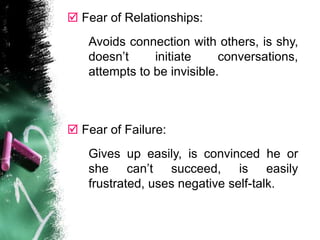
 Fear of Relationships:
 Fear of Failure:
Avoids connection with others, is shy,
doesn’t initiate conversations,
attempts to be invisible.
Gives up easily, is convinced he or
she can’t succeed, is easily
frustrated, uses negative self-talk.
Aggressive Students
Hostile
 have poor anger control, low
capacity for empathy, and an inability to
see the consequences of their actions.
Oppositional
 consistently resist following orders,
argue with adults, use harsh language,
and tend to annoy others.
Covert
 often nearby when trouble starts and
never quite do what authority figures
ask of them.
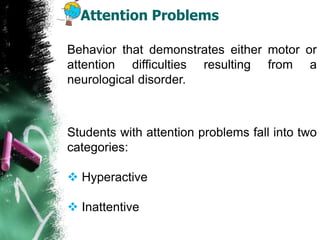
Attention Problems
Behavior that demonstrates either motor or
attention difficulties resulting from a
neurological disorder.
Students with attention problems fall into two
categories:
 Hyperactive
 Inattentive
 Hyperactive:
 Inattentive:
Has difficulty with motor control, both
physically and verbally. Fidgets,
leaves seat frequently, interrupts,
talks excessively.
Has difficulty staying focused and
following through projects. Has
difficulty with listening, remembering
and organizing.
Perfectionist
Behavior that is geared toward avoiding the
embarrassment and assumed shame of
making mistakes. The child fears what will
happen if errors are discovered. Has
unrealistically high expectations of self. Has
Possibly received criticism or lack of
acceptance while making mistakes during
the process of learning.
Tends to focus too much on the small details
of projects. Will avoid projects if unsure of
outcome. Focuses on results and not on
relationships. Is self-critical.
Socially Inept
Behavior that is based on the
misinterpretation of nonverbal signals of
others. The child misunderstands facial
expressions and body language. Hasn’t
received adequate training in these areas
and has poor role modeling.
Attempts to make friends but is inept and
unsuccessful. Is forced to be alone. Is often
teased for unusual behavior, appearance, or
lack of social skills.
Summary:
Teacher-student relationships are critical to the
success of three of the other aspects of effective
classroom management. To build good relationships
with students, it is important to communicate
appropriate levels of dominance and to let students
know that you are in control of the class and are
willing to lead. It is also important to communicate
appropriate levels of cooperation and to convey the
message that you are interested in the concerns of
students as individuals and the class as a whole.
You may need to make a special effort to build
positive relationships with high-needs students, but
using the proper techniques in working with these
students can enhance the chance of successful
classroom management.
Thank
you!

FOOT SPA.ppt

  • 1.
  • 2.
    PRE-FOOT SPA TREATMENT FootSpa Treatment is another relaxing service offered in the salon that pampers our tired feet which is the most exercised part of our body as it carries our weight and performs most of the time during the day. Aside from relaxing our feet, it can also help prevent and cure many symptoms such as headache, stress, asthma, constipation, sinusitis, migraine and improve the circulation of the blood as one of the most beneficial effects of foot massage..
  • 4.
  • 6.
    Benefit of FootSpa Foot spa, anyone? One of the many ways you can keep your feet healthy and happy is a foot spa. More than just beautifying the feet, a foot spa gives the following benefits: Promotes blood circulation. A foot spa improves blood circulation, aside from energizing and relaxing the body. Relieves stress. Soaking feet in warm water and massaging feet eases tension and the stresses of the day.
  • 7.
    Eases arthritic pain.Just putting your feet up already results in some relief. Imagine how much more relief a foot spa can bring, especially to muscles and joints suffering from arthritis. Reduces headaches. Many nerve joints are located on the underside of the feet. Massaging these points during a foot spa helps in treating headaches and migraines. Helps detoxify the body. Soaking the feet, especially in a foot bath with Epsom salts, helps release toxic metals in the body while helping to absorb magnesium and sulphates which bring many benefits to your health.
  • 8.
    Before You Start Beforestarting the procedure, you need to get your equipment ready first. These tools include: Nail clipper, nail file, cuticle pusher and nipper, foot file (pumice stone or emery board) Foot bath or any container big enough to submerge both feet in ankle-high water Warm water Foot wash Epsom salts and essential oils of your choice Foot scrub Foot lotions or creams of your choice Towels Socks
  • 9.
    What To Do Now,the procedure: 1. Prepare all your tools, making sure everything is within reach. 2. Fill your footbath with water hot enough for you to tolerate, but not too hot that it will burn or scald your feet. 3. Add Epsom salts, a few drops of your favorite essential oil and some foot wash (if desired). If you do not have a foot wash, body wash or shampoo will do. Stir, making sure that everything is well mixed. 4. Soak your feet in the foot bath for 10-15 minutes. The solution will then remove the dirt and soften your toenails and feet. Remove your feet from the water and dry thoroughly.
  • 10.
    6.Remove nail polish(if you are wearing some) from your toenails and then trim your nails to the desired length and file them to get the shape you want. 7.Using a foot file or a pumice stone, gently exfoliate your feet, concentrating on the heel and its sides. 8. Apply a foot scrub and gently work it into your toes, the undersides of your feet, the heels and the ankles for added exfoliation. (If you do not have foot scrub, you can use a mixture of brown sugar and coconut or olive oil.) For some added pleasure, gently massage your feet, especially those aching parts.
  • 11.
    9.Rinse the scruboff your feet and pat your feet dry. 10. Moisturize your feet with your preferred lotion or cream, working the lotion on your feet while massaging gently. 11. Put on socks to seal the moisture in.
  • 12.
    Method 2 Fill aplastic tub with warm water. Any plastic container that is big enough to fit both of your feet will do just fine. For a more luxurious experience, make sure that the tub is tall enough to reach halfway up your calves. You can also use one of those tubs made specifically for foot spas if you really want to get fancy.Consider adding some marbles or smooth stones into the bottom of the tub. This way, you can roll your feet over them and give yourself a foot massage!
  • 13.
    Method 3: Put FootSoak >Add your desired herbs, salts, or oils. >Squirt some bubble bath solution if you like bubbles and wish to soften your feet. >Add 10 drops of essential oil for fragrance and aromatherapy. Peppermint, lavender, or lemongrass are all great options.[4] >If you want a nicer, visual appearance, add a of mint or a handful of rose petals. >To soften your feet, use 1 cup (125 grams) of powdered milk (dairy or soy) and 1 tablespoon (15 milliliters) of almond oil instead.
  • 14.
    Method 4: Soak yourfeet in the water for 10 to 15 minutes. Pull the tub over in front of a comfortable chair. Sit down in the chair, then slip your feet into the tub. Read a book or close your eyes and listen to some music. You can even combine the foot spa with another treatment, such as a face mask or eye mask.[5]Dirty water is not very relaxing, so make sure that your feet are clean. If they are dirty, rinse them off first in the shower, bathtub, or sink.
  • 15.
    Method 5 Exfoliate yourfeet with a scrub or manicure brush after soaking. Once the 10 to 15 minutes are up, it is time for some exfoliation! Use a manicure brush or a small body brush for a simple treatment. For a fancier treatment, use a homemade or store-bought foot scrub instead. Focus the exfoliation on your heels, where the skin is the most calloused.[6]If you used the foot scrub, be sure to rinse it off using your foot soak water. For exceptionally calloused heels, consider using a pumice stone. Keep your feet over the tub so that you can splash water on them whenever it is necessary.
  • 16.
    Method 6 Follow upwith a foot massage. If you added marbles to the tub, you can simply roll your feet back-and- forth across them. You can also use a store-bought massager, or give yourself a traditional foot massage using your hands.Don't stress about doing the massage correctly, like a professional would. Do what feels the best to you.
  • 17.
  • 18.
    Summary: Classroom rules andprocedures are important, but they may vary from one teacher to another. Rules and procedures typically fall into several categories including: general expectations for behavior; beginning and ending the day or period; transitions and interruptions; materials & equipments; group work; and teacher-led activities. In all cases, it is important to involve students in the design of classroom rules and procedures.
  • 19.
    Disciplinary Interventions The lackof discipline is the most serious problem facing schools today. The higher the grade level, the more disciplinary problems occur in public schools.
  • 20.
    What are theaction steps you are encouraged to follow?
  • 21.
    Action Step 1 Employspecific techniques that acknowledge and reinforce acceptable behavior and acknowledge and provide negative consequences for unacceptable behavior.
  • 22.
    Five categories ofdisciplinary interventions can be used to provide a balance of positive and negative consequences: teacher reaction tangible recognition direct cost group contingency home contingency
  • 23.
    Teacher Reaction Verbal andphysical teacher reactions are the simplest ways to acknowledge and reinforce acceptable behavior and to acknowledge and provide negative consequences for unacceptable behavior.
  • 24.
    Emmer, Evertson, andWorsham (2003) list a variety of teacher reactions that include the following:  Make eye contact with an offending student by moving closer to him or her.  Use physical signal to indicate that a given action is inappropriate.  If a student is not following a procedure, provide him/her with simple verbal reminder.  If a student is “off task” but not misbehaving, state the desired appropriate behavior.  If a student does not respond to more subtle interventions, simply tell the student to stop the inappropriate behavior.
  • 25.
    Tangible Recognition  involvesthe use of some concrete symbol of appropriate behavior. It is important for any system of tangible recognition to be accompanied by a thorough discussion of the rationale behind it. Care should be taken to ensure that tangible recognition is not perceived as some type of bribe or form of coercion relative to student behavior.
  • 26.
    Direct Cost  aremore oriented toward negative consequences for student behavior. These strategies involve explicit and direct consequences for inappropriate student behavior.
  • 27.
    Isolation Time out refers to the removal of a student from the classroom reserved for disruptive students. It requires that students have a clear understanding as to the specific behaviors that will lead to its use. Students should be aware that isolation time out would be used only when other attempts to correct the disruptive behavior within the regular context of the classroom have been exhausted.
  • 28.
    Overcorrection  is aprocedure that is used when a student has misbehaved in a way that destroys or alters some objects in the classroom. Student would be asked to overcompensate for the behavior.
  • 29.
    Group Contingency Group contingencytechniques operate in a fashion similar to concrete recognition techniques except that they apply to a group of students as opposed to individuals
  • 30.
    Interdependent Group Contingency Techniques require every student in the group to meet the behavioral criterion for the group to earn credit.
  • 31.
    Dependent Group Contingency Technique requires a specific individual or a specific set of individuals in the group to meet the criterion for the group to earn credit.
  • 32.
    Home Contingency Home contingencyinvolves making parents aware of the positive and negative behaviors of their children. This is done in the form of a short note, a letter, a phone call, or a visit to the parents of the student.
  • 33.
    Action Step 2 Establishclear limits for unacceptable behavior and an effective system to record these behavior.
  • 34.
    To use positiveand negative consequences effectively, you must establish limits. Setting limits is a perfect opportunity to involve students in their own management. Rather than you establishing the limits in isolation, the class could do so after discussing with them why the target behavior is important and what are fair expectations regarding that behavior. The limit established by consensus approach would be the best limit for the class.
  • 35.
    Summary: The guiding principlefor disciplinary interventions is that they should include a healthy balance between negative for inappropriate behavior and positive consequences for appropriate behavior. Specific techniques that involve both positive and negative consequences include teacher reaction, tangible recognition, direct cost, group contingency, and home contingency. Whatever the approach, it is important to establish behavioral limits and a record- keeping system that allows you to keep track of student behavior efficiently and unobtrusively.
  • 36.
    Communicating with Students Everydayyou communicate with your students using different forms of communication, verbal or non- verbal. Though ability to communicate is inherent to all human beings, the skill to communicate properly must be learned.
  • 37.
    Communication is atwo way process. If one is speaking, somebody should be listening. There is no communication if both parties are speaking.
  • 38.
    Communicating with studentsinvolves the following aspects: 1. Using descriptive rather than judgmental language; 2. Teaching students to listen to you; 3. Listening to students; 4. Using supportive Replies; 5. Avoiding Unintended Messages; and 6. Professional confidence and student’s rights.
  • 39.
    Using descriptive ratherthan judgmental language Research studies indicate that students feel less threatened, less defensive, and more willing to engage in learning activities when working with teachers who consistently use descriptive language than they are when working with teachers who use a more judgmental language style.
  • 40.
    Descriptive language verbally portraysa situation, a behavior, an achievement, or a feeling. Judgmental language verbally summarizes an evaluation of a behavior, achievement or person with a characterization or label. Judgmental language that focuses on personalities is particularly detrimental to a climate of cooperation.
  • 41.
    The consequences ofjudgmental language Judgmental language makes pupils uncomfortable in the teacher’s presence because they believe that their teacher has little respect for them. Pupils develop a disruptive behavior pattern as they live up to what they perceive to be their teacher's expectation.
  • 42.
    How would youavoid using judgmental language 1. Avoid labels. 2. Learn to distinguish between a student’s accomplishments and the value of the student. 3. Do not view a student’s display of off- task behavior as a reflection of character flaws.
  • 43.
    4. Be responsiblefor teaching each student to be on task and to achieve learning objectives. 5. Do not include judgment of student’s characters among your responsibilities. 6. Do not hesitate in communicating your feeling about specific behavior or achievements of students. However, do not allow those feelings to influence the degree to which you respect, care for and value students.
  • 44.
    In order toconsistently use a descriptive language style, you must resist event silent thoughts that characterize students with labels such as, “smart”, “slow”, “good reader”, “well behaved”, “problem child”, “honest”, “intelligent”, “under achiever”, and the paradoxical “overachiever”. Instead of thinking of students according to labels, you should focus on learning tasks, circumstances, and situations.
  • 45.
    Teaching Students toListen to You There are at least seven ways how you could teach your students to listen to you: 1. Use descriptive language. 2. Use words judiciously. 3. Think before talking. 4. Avoid useless words. 5. Speak only to intended listeners. 6. Be aware of your body languages. 7. Speak only to the attentive.
  • 46.
    The Judicious Useof Words In general, students are likely to pay attention whenever you speak if they know that whenever you speak you really have something to say. By judiciously using words that inform and by avoiding inane talk, you leave your students with the idea that they miss something by not hearing you whenever you speak to them.
  • 47.
    Thinking Before Talking Ratherthan immediately reacting with the first word that comes to mind, it is usually wise for a teacher to pause and carefully frame words before speaking to students. Often, adults send inane messages to children because they immediately react to circumstances before they get more relevant information.
  • 48.
    More and MoreUseless Words Students begin to learn to ignore teacher- talk when teachers act as if they are initiating a self-initiating behavior. Students may begin tuning a teacher out when that teacher makes judgments that only the students can make.
  • 49.
    Speaking Only toIntended Listeners When the situation warrants, teachers should make it clear that what she has to say is meant only for a particular pupil. Other pupils don’t have to stop their work only to find that the teacher’s message does not apply to them.
  • 50.
    Body Language How youposition your body when speaking to students has a major impact on what messages students receive. Teachers sometimes make the mistake of saying one thing to students, but communicating another as a consequence of their body language. Your voice sometimes provides a hint of stress and indicates to your pupils that you are not really in control.
  • 51.
    Speaking Only tothe Attentive Speak to people only when they are ready to listen. Sometimes students may not be ready to listen to you because they do not think you understand them well enough. Hence, you would not tell them anything that they would consider important. In other case, they are preoccupied with thoughts with which they must dispense with before attending to your message.
  • 52.
    Listening to Students Areasonably accurate understanding of your students’ thoughts and attitudes is vital to your ability to identify student’s needs, decide learning goals, design learning activities, and evaluate how well learning goals are achieved. You also need to understand students’ thoughts and attitudes in order to decide what messages you should communicate and when and how each message should be communicated. By listening to them, you will discover how to get students to listen to you.
  • 53.
    Using Supportive Replies Thisincludes accepting feelings, relieving frustration and defusing conflicts.
  • 54.
    Accepting Feelings Expressions offeelings receive a support when the listener indicates that the expression has been understood and accepted.
  • 55.
    Relieving Frustration Frustration canbe quite incapacitating and sometimes a person must relieve his or her frustration before addressing the source of the frustration. Having another person’s empathy can sometimes serve to relieve frustration.
  • 56.
    Defusing Conflict By acknowledgingstudents’ feelings with supportive replies, you can avoid arguments and dispense with excuses for not being on-task.
  • 57.
    Avoiding Unintended Messages Unintendedmessages, unwittingly communicated to students by teachers, can cause many of the misunderstandings about expectations that lead students to become off-task. However, you can reduce miscommunication when you send unintended messages by : modeling a business attitude; avoiding disruptions in your own learning activities; avoiding destructive positive reinforcers; and avoiding destructive punishments.
  • 58.
    Professional Confidence and StudentsRights Violation of Trust Trust between a teacher and a student is an important ingredient in establishing a classroom climate that is conducive to cooperation, on-task behaviors, and engagement in learning activities. Teachers violate that trust when they gossip about students or share information obtained through their role as teachers with people who need not privy to that information. Once students acquire the idea that teachers gossip about them, they are far less likely to feel comfortable in trusting those teachers.
  • 59.
    The following havea right & need to know about students’ achievement levels and behaviors: • Students themselves • Students parents/ guardians • Professional personnel  guidance councilor  principal  subject area supervisor / curriculum director
  • 60.
    Summary: If there isone skill that is neglected or not being developed by teachers, it is the ability to communicate with students effectively. Communicating with students involves several skills which must be learned by heart by all teachers. Descriptive language should be used by teachers rather than judgmental language. To teach students to listen to you, you should be aware of what, when, how, and whom to speak.
  • 61.
    Listening to pupilsmeans to stop talking and lend ears to students. Teachers should listen not only to what pupils say but listen also to what they do not say. Pupils seek reply when they communicate with their teachers. Replies should be supportive. You can do this by accepting feelings, relieving frustration and avoiding conflicting statements.
  • 62.
    Misinterpretations often occurwhen teachers communicate with pupils. Thus, teachers should be sensitive enough when communicating with students. Teachers should also avoid disrupting their own learning activities because it carries unintended message. Trust is the most important ingredient in communication. Teachers should engage in activities in the classroom that promote trust and confidence among pupils.
  • 63.
    Teacher-Student Relationship If ateacher has a good relationship with students, then students more readily accept the rules and procedures and the disciplinary actions that follow their violations. Without the foundation of a good relationship, students commonly resist rules and procedures along with the consequent disciplinary actions. Product also of good teacher-student relationship is responsible communication between them.
  • 64.
    Researchers indicate thaton average, teachers who have high-quality relationships with their students had 31 percent fewer discipline problems, rule violations, and related problems over a year’s time with their students.
  • 65.
    Effective teacher-student relationships havenothing to do with teacher’s personality or even with whether the students view the teacher as a friend. Rather, the most effective teacher-student relationships are characterized by specific teacher behaviors: • exhibiting appropriate levels of dominance • exhibiting appropriate levels of cooperation • and being aware of high-needs students
  • 66.
    Appropriate Levels ofDominance Wubbels and his colleagues (1999) define dominance as the ability to provide clear purpose and strong guidance regarding both academics and student behavior. Teachers can exhibit appropriate dominance by:  establishing clear behavioral expectations and learning goals  establishing clear rules and procedures  providing consequences for students behavior
  • 67.
     exhibiting assertivebehavior According to Emmer and colleagues (2003), assertive behavior is the ability to stand up for one’s legitimate rights in ways that make it less likely that others will ignore or circumvent them.
  • 68.
    Assertive behavior differssignificantly from both passive behavior and aggressive behavior. Researchers explain that teachers display assertive behavior in the classroom when they:  Use assertive body language by maintaining an erect posture, facing the offending student but keeping enough distance so as not to appear threatening and matching the facial expression with the content of the message being presented to students;
  • 69.
     Use anappropriate tone of voice, speaking clearly and deliberately in a pitch that is slightly but not greatly elevated from normal classroom speech, avoiding any display of emotions in the voice.  Persist until students respond with the appropriate behavior. Do not ignore an appropriate behavior; do not be diverted by a student denying, arguing, or blaming, but listen to legitimate explanations.
  • 70.
     providing clarityabout the content and expectations of an upcoming instructional unit. Important teacher actions to achieve this end include:  Establishing and communicating learning goals at the beginning of a unit of instruction.  Providing feedback of those goals.  Continually and systematically re-visiting the goals.  Providing summative feedback regarding the goals.
  • 71.
    Appropriate Levels ofCooperation Cooperation is characterized by a concern for the needs and opinions of others. Although not the antithesis of dominance, cooperation certainly occupies a different realm. Whereas dominance focuses on the teacher as the driving force in the classroom, cooperation focuses on the students and teacher functioning as a team. The interaction of these two dynamics; dominance and cooperation is a central force in effective teacher-student relationships.
  • 72.
    You can conveyappropriate levels of cooperation by:  providing flexible learning goals.  take a personal interest in each student
  • 73.
    Some practical strategiesthat emphasize equitable and positive classroom interactions with all students:  Make eye contact with each student.  Deliberately move toward and stand close to each student during the class period.  Attribute the ownership of ideas to the students who initiated them.  Allow and encourage all students to participate in class discussions and interactions.  Provide appropriate wait time for all students to respond to questions, regardless of their past performance or your perception of your ability.
  • 74.
    Awareness of High-NeedsStudents Although the classroom teacher is certainly not in a position to address the students’ severe problems, teachers with effective management skills are aware of high-needs students and have a repertoire of specific techniques for meeting some of their needs.
  • 75.
  • 76.
    Passive Behavior that avoidsthe domination of others or the pain of negative experiences. The child attempts to protect self from criticism, ridicule, or rejection, possibly reacting to abuse and neglect. Passive students fall into two subcategories:  those who fear relationships  those who fear failure.
  • 77.
     Fear ofRelationships:  Fear of Failure: Avoids connection with others, is shy, doesn’t initiate conversations, attempts to be invisible. Gives up easily, is convinced he or she can’t succeed, is easily frustrated, uses negative self-talk.
  • 78.
    Aggressive Students Hostile  havepoor anger control, low capacity for empathy, and an inability to see the consequences of their actions. Oppositional  consistently resist following orders, argue with adults, use harsh language, and tend to annoy others. Covert  often nearby when trouble starts and never quite do what authority figures ask of them.
  • 79.
    Attention Problems Behavior thatdemonstrates either motor or attention difficulties resulting from a neurological disorder. Students with attention problems fall into two categories:  Hyperactive  Inattentive
  • 80.
     Hyperactive:  Inattentive: Hasdifficulty with motor control, both physically and verbally. Fidgets, leaves seat frequently, interrupts, talks excessively. Has difficulty staying focused and following through projects. Has difficulty with listening, remembering and organizing.
  • 81.
    Perfectionist Behavior that isgeared toward avoiding the embarrassment and assumed shame of making mistakes. The child fears what will happen if errors are discovered. Has unrealistically high expectations of self. Has Possibly received criticism or lack of acceptance while making mistakes during the process of learning. Tends to focus too much on the small details of projects. Will avoid projects if unsure of outcome. Focuses on results and not on relationships. Is self-critical.
  • 82.
    Socially Inept Behavior thatis based on the misinterpretation of nonverbal signals of others. The child misunderstands facial expressions and body language. Hasn’t received adequate training in these areas and has poor role modeling. Attempts to make friends but is inept and unsuccessful. Is forced to be alone. Is often teased for unusual behavior, appearance, or lack of social skills.
  • 83.
    Summary: Teacher-student relationships arecritical to the success of three of the other aspects of effective classroom management. To build good relationships with students, it is important to communicate appropriate levels of dominance and to let students know that you are in control of the class and are willing to lead. It is also important to communicate appropriate levels of cooperation and to convey the message that you are interested in the concerns of students as individuals and the class as a whole. You may need to make a special effort to build positive relationships with high-needs students, but using the proper techniques in working with these students can enhance the chance of successful classroom management.
  • 84.