LESSON PLAN 11
Teachers: Estela N Braun, Liliana Monserrat.
StudentTeacher: Víctor Camargo, Jésica Perez.
School: Escuela Nº2 Remedios de Escalada de San Martín.
Timetable: Tuesday 16.40 – 17.20 / Friday 15.55 – 16.35.
Date: 01/11/13.
Topic: Water Cycle.
Class Nº15

AIMS
To review vocabulary introduced the previous class.
To introduce new vocabulary related to the water cycle.
To discuss the different ways in which human beings use water.
To engage students in communicative exchanges.

OBJECTIVES
To learn new vocabulary items related to the water cycle.
To solve a word search puzzle.
To relate the use of water with their everyday lives.
To learn the worldwide water usage.
ACTIVITIES
ACTIVITY
Activity 1:
To revise vocabulary and to
introduce some new items,
the student teacher will
project a picture1 of the
water cycle and explain it.
Activity 2:
The students will solve a
wordsearch puzzle2. They
will have to find the words
presented thus far.

TYPE OF
INTERACTION
Whole-class /
Individual

SpeakingListe 10’
ning

Blackboard
Flashcards
Beamer

Individual

Writing

10’

Photocopies
provided by
the student
teacher

Speaking
Writing

20’

Blackboard

Activity 3:
Pair work
The student teacher will
project another image that
shows different ways in
which humans use water,
e.g. agriculture, public
supply, recreation,
domestic, etc.
Then, the students will
copy 4 (four) questions3 in
their notebooks and will
discuss and answer them in
pairs with the student
teacher’s help.
At the end, the answers will Whole class
be shared with the whole
class.
Extra activity:
Individual
The students will be
provided with a short text4
andwill have tounderline
the key words of the water
cycle.

MACROSKILL

TIMING

MATERIALS

Photocopies
provided by
the student
teacher
Reference:
1
2
3

In pairs, answer the questions.

1 Do you use a lot of water at home?
2 What do you use water for, apart from drinking?
3 Does everyone have access to drinking water?
4 What would you do if you had no drinking water at home?

4

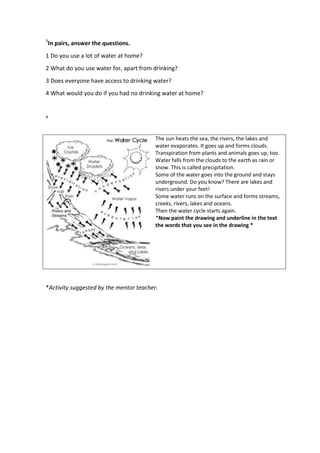
The sun heats the sea, the rivers, the lakes and
water evaporates. It goes up and forms clouds.
Transpiration from plants and animals goes up, too.
Water falls from the clouds to the earth as rain or
snow. This is called precipitation.
Some of the water goes into the ground and stays
underground. Do you know? There are lakes and
rivers under your feet!
Some water runs on the surface and forms streams,
creeks, rivers, lakes and oceans.
Then the water cycle starts again.
*Now paint the drawing and underline in the text
the words that you see in the drawing *

*Activity suggested by the mentor teacher.

Lesson Plan 11

  • 1.
    LESSON PLAN 11 Teachers:Estela N Braun, Liliana Monserrat. StudentTeacher: Víctor Camargo, Jésica Perez. School: Escuela Nº2 Remedios de Escalada de San Martín. Timetable: Tuesday 16.40 – 17.20 / Friday 15.55 – 16.35. Date: 01/11/13. Topic: Water Cycle. Class Nº15 AIMS To review vocabulary introduced the previous class. To introduce new vocabulary related to the water cycle. To discuss the different ways in which human beings use water. To engage students in communicative exchanges. OBJECTIVES To learn new vocabulary items related to the water cycle. To solve a word search puzzle. To relate the use of water with their everyday lives. To learn the worldwide water usage.
  • 2.
    ACTIVITIES ACTIVITY Activity 1: To revisevocabulary and to introduce some new items, the student teacher will project a picture1 of the water cycle and explain it. Activity 2: The students will solve a wordsearch puzzle2. They will have to find the words presented thus far. TYPE OF INTERACTION Whole-class / Individual SpeakingListe 10’ ning Blackboard Flashcards Beamer Individual Writing 10’ Photocopies provided by the student teacher Speaking Writing 20’ Blackboard Activity 3: Pair work The student teacher will project another image that shows different ways in which humans use water, e.g. agriculture, public supply, recreation, domestic, etc. Then, the students will copy 4 (four) questions3 in their notebooks and will discuss and answer them in pairs with the student teacher’s help. At the end, the answers will Whole class be shared with the whole class. Extra activity: Individual The students will be provided with a short text4 andwill have tounderline the key words of the water cycle. MACROSKILL TIMING MATERIALS Photocopies provided by the student teacher
  • 3.
  • 4.
  • 5.
    3 In pairs, answerthe questions. 1 Do you use a lot of water at home? 2 What do you use water for, apart from drinking? 3 Does everyone have access to drinking water? 4 What would you do if you had no drinking water at home? 4 The sun heats the sea, the rivers, the lakes and water evaporates. It goes up and forms clouds. Transpiration from plants and animals goes up, too. Water falls from the clouds to the earth as rain or snow. This is called precipitation. Some of the water goes into the ground and stays underground. Do you know? There are lakes and rivers under your feet! Some water runs on the surface and forms streams, creeks, rivers, lakes and oceans. Then the water cycle starts again. *Now paint the drawing and underline in the text the words that you see in the drawing * *Activity suggested by the mentor teacher.