TOYOZU TECHNICAL SCHOOL
FOUNDATION, INC.
ATS NC II TRAINING SESSION
Batch 2021
OPENING PRAYER
Lord, help us in our online studies today. Give us
concentration so that may we listen, understand,
learn and have peaceful mind and may we always
remember that god is always with us
Good
Morning!
TTSFI ATS NC IITrainees
LESSON:
Checking Clutch Fluid and Lines
ATS NC IITraining Session
Objectives:
 Check the fluid level of clutch system
 Appreciate the importance of fluid leveling in
reservoir in clutch system
LESSON:
Checking Clutch Fluid and Lines
INTRODUCTION
Clutch fluid is viscous oil that is used
to operate a clutch in an automobile or other
vehicle with a manual transmission. The fluid
is poured into a tank or unit called a master
cylinder, which pumps fluid through the
clutch assembly.
INTRODUCTION
This assembly is responsible for
moving the clutch during operation of the
transmission. This fluid can be used in cars,
trucks, motorcycles, heavy machinery, and
any other vehicle that requires shifting
between gears in a transmission.
INTRODUCTION
Many people believe that clutch fluid is
its own specifically designed fluid that is
meant for use exclusively in clutch systems,
but this is not the case. It is almost always
brake fluid used in a different context.
INTRODUCTION
Brake fluid is measured based on its
heat tolerance; the range is usually
measured on a 2-5 scale.
Clutch/Brake Fluid
The Department of Transportation
(DOT), is responsible for the rating system
in most of North America, so brake fluid and
clutch fluid are measured as DOT 2, DOT 3,
DOT 4, and DOT 5 in those countries.
Clutch/Brake Fluid
Clutch fluid is often rated DOT 3 or
DOT 4, since it does not require an
especially high heat tolerance. Similar
measurement systems are used in other
countries to measure the same heat
tolerance.
Procedures
in
Checking Clutch
Fluid and Lines
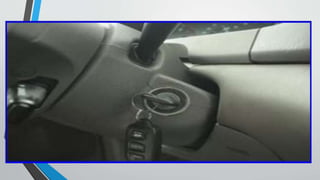
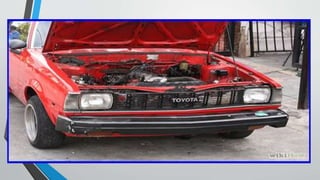
Step 1:
Turn the engine off before opening the
hood.
Step 2:
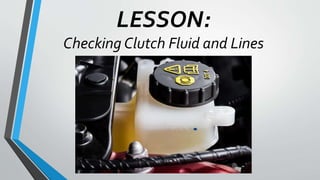
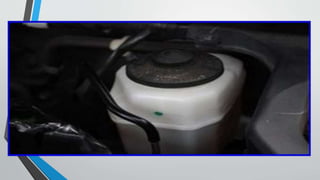
Find the clutch fluid reservoir. It's
usually close to the back of the engine, near
the brake fluid reservoir.
Step 3:
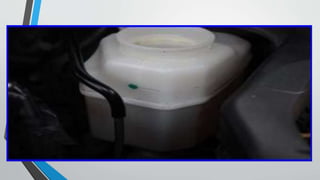
Take off the cap of the master cylinder
reservoir.
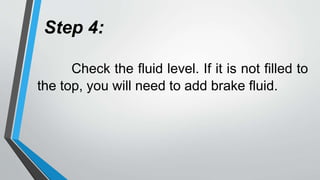
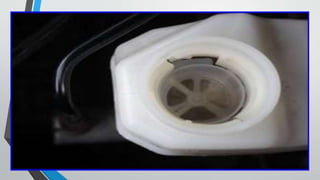
Step 4:
Check the fluid level. If it is not filled to
the top, you will need to add brake fluid.
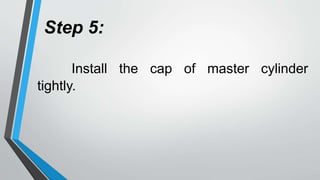
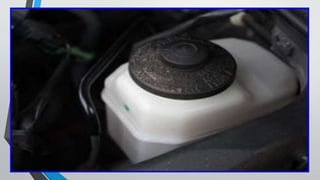
Step 5:
Install the cap of master cylinder
tightly.
Done……
Let’s Have
an Open
Forum
THANK
YOU!!!

Lesson - Checking Clutch Fluid and Lines.pptx