Net Present Value

When we evaluate projects we must
   look at future cash inflows

           WHY?????
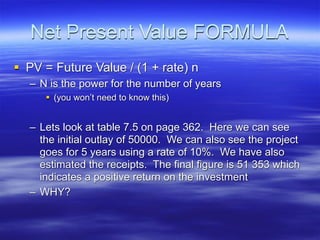
Net Present Value FORMULA
 PV = Future Value / (1 + rate) n
  – N is the power for the number of years
      (you won’t need to know this)


  – Lets look at table 7.5 on page 362. Here we can see
    the initial outlay of 50000. We can also see the project
    goes for 5 years using a rate of 10%. We have also
    estimated the receipts. The final figure is 51 353 which
    indicates a positive return on the investment
  – WHY?
For your interpretation
 Evaluate the project on the top of page 363.
  – Is this viable? Why?
  – Why would a business want to know what is going to
    happen in the future?

  Questions for you to do now
      Using the same format as above calculate the NPV for the
       following question.
      Project Y with an outlay of 120 000 with estimated receipts of
      Yr 1 - 30 000, Yr 2 - 20 000, Yr 3 - 25 000, Yr 4 - 40 000,
       Yr 5 - 25 000
      Rate is 9%
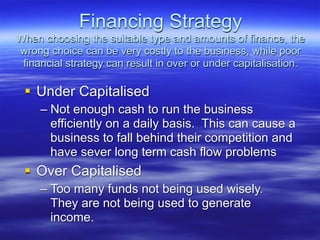
Financing Strategy
When choosing the suitable type and amounts of finance, the
wrong choice can be very costly to the business, while poor
 financial strategy can result in over or under capitalisation.

  Under Capitalised
     – Not enough cash to run the business
       efficiently on a daily basis. This can cause a
       business to fall behind their competition and
       have sever long term cash flow problems
  Over Capitalised
     – Too many funds not being used wisely.
       They are not being used to generate
       income.
Question
 Answer question 2 on page 364 in a
  paragraph of 200 words. Make sure to give
  valid reasons to support your opinion.

Lesson 4 pp4.ppt

  • 1.
    Net Present Value Whenwe evaluate projects we must look at future cash inflows WHY?????
  • 2.
    Net Present ValueFORMULA  PV = Future Value / (1 + rate) n – N is the power for the number of years  (you won’t need to know this) – Lets look at table 7.5 on page 362. Here we can see the initial outlay of 50000. We can also see the project goes for 5 years using a rate of 10%. We have also estimated the receipts. The final figure is 51 353 which indicates a positive return on the investment – WHY?
  • 3.
    For your interpretation Evaluate the project on the top of page 363. – Is this viable? Why? – Why would a business want to know what is going to happen in the future? Questions for you to do now  Using the same format as above calculate the NPV for the following question.  Project Y with an outlay of 120 000 with estimated receipts of  Yr 1 - 30 000, Yr 2 - 20 000, Yr 3 - 25 000, Yr 4 - 40 000, Yr 5 - 25 000  Rate is 9%
  • 4.
    Financing Strategy When choosingthe suitable type and amounts of finance, the wrong choice can be very costly to the business, while poor financial strategy can result in over or under capitalisation.  Under Capitalised – Not enough cash to run the business efficiently on a daily basis. This can cause a business to fall behind their competition and have sever long term cash flow problems  Over Capitalised – Too many funds not being used wisely. They are not being used to generate income.
  • 5.
    Question  Answer question2 on page 364 in a paragraph of 200 words. Make sure to give valid reasons to support your opinion.

Editor's Notes