          
Unit 5: Lesson 4
 A picture story
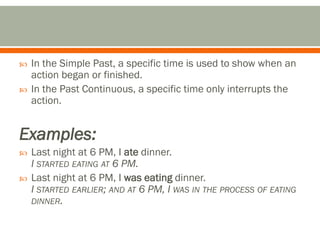
   In the Simple Past, a specific time is used to show when an
    action began or finished.
   In the Past Continuous, a specific time only interrupts the
    action.


Examples:
   Last night at 6 PM, I ate dinner.
    I STARTED EATING AT 6 PM.
   Last night at 6 PM, I was eating dinner.
    I STARTED EARLIER; AND AT 6 PM, I WAS IN THE PROCESS OF EATING
    DINNER.
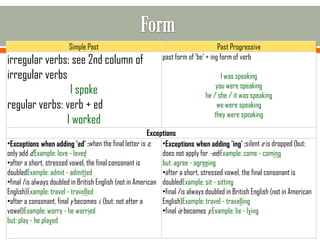
Simple Past                                                   Past Progressive
irregular verbs: see 2nd column of                              past form of 'be' + ing form of verb

irregular verbs                                                                         I was speaking
                                                                                      you were speaking
                I spoke                                                           he / she / it was speaking
regular verbs: verb + ed                                                              we were speaking
                                                                                     they were speaking
               I worked
                                                           Exceptions
•Exceptions when adding 'ed' :when the final letter is e, •Exceptions when adding 'ing' :silent e is dropped (but:
only add d.Example: love - loved                                does not apply for -ee)Example: come - coming
•after a short, stressed vowel, the final consonant is          but: agree - agreeing
doubledExample: admit - admitted                                •after a short, stressed vowel, the final consonant is
•final l is always doubled in British English (not in American doubledExample: sit - sitting
English)Example: travel - travelled                             •final l is always doubled in British English (not in American
•after a consonant, final y becomes i. (but: not after a        English)Example: travel - travelling
vowel)Example: worry - he worried                               •final ie becomes y.Example: lie - lying
but: play - he played
After another or at the same time?
Do you want to express that the actions in the
past happened one after another or at the same
time?
              Simple Past                            Past Progressive
after another                           at the same time
She came home, switched on the computer Simon was playing on the computer while
and checked her e-mails.                his brother was watching TV.
   New action or already in progress?
If you want to express that a new action happened in the middle of another action,
you need both tenses: Simple Past the new action and Past Progressive for the
action already in progress.


               Simple Past                              Past Progressive
new action                                 action already in progress
My mobile rang (when I was sitting in a    While I was sitting in a meeting, (my
meeting.)                                  mobile suddenly rang.)
  Only mentioning or emphasizing progress?
Do you just want to mention that an action took place in the
past (also used for short actions)? Or do you want to put
emphasis on the progress, e.g. that an action was taking place
at a certain time?

               Simple Past                     Past Progressive
just mentioning                    emphasising progress
Colin played football yesterday.   Yesterday at six o'clock, Colin was playing
                                   football.
   state: be, cost, fit, mean, suit
                      Example: We were on holiday.
   possession: belong, have
                      Example: Sam had a cat.
   senses: feel, hear, see, smell, taste, touch
                      Example: He felt the cold.
   feelings: hate, hope, like, love, prefer, regret, want, wish
                      Example: Jane loved pizza.
   brain work: believe, know, think, understand
                      Example: I did not understand him.
   introductory clauses for direct speech: answer, ask, reply, say
                      Example: “I am watching TV,“ he said.
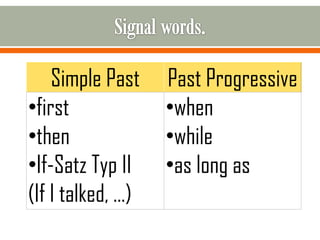
Simple Past    Past Progressive
•first             •when
•then              •while
•If-Satz Typ II    •as long as
(If I talked, …)
Comprehension Quiz


• Hello everybody! My name is Past Simple Boy because I am
  very nostalgic and I always talk about the past. This is an old
  picture of me. I was eighteen in this picture. It was thirteen
  years ago.
• I studied at University at that time. I lived with my friends
  Paco and Javi in a big and old flat. We didn't study much and
  we enjoyed our life. Every weekend we went to the disco
  and met new girls. I remember I had a girlfriend called
  Margarita.
• I finished my studies in 1995. A year later I started to work
  as a Language teacher in a Secondary school. Life is not
  too bad, but those days were fantastic!
• Do you know about your parents' life when they were young?
3


        4
    2
1

Lesson 4

  • 1.
     Unit 5: Lesson 4 A picture story
  • 2.
    In the Simple Past, a specific time is used to show when an action began or finished.  In the Past Continuous, a specific time only interrupts the action. Examples:  Last night at 6 PM, I ate dinner. I STARTED EATING AT 6 PM.  Last night at 6 PM, I was eating dinner. I STARTED EARLIER; AND AT 6 PM, I WAS IN THE PROCESS OF EATING DINNER.
  • 3.
    Simple Past Past Progressive irregular verbs: see 2nd column of past form of 'be' + ing form of verb irregular verbs I was speaking you were speaking I spoke he / she / it was speaking regular verbs: verb + ed we were speaking they were speaking I worked Exceptions •Exceptions when adding 'ed' :when the final letter is e, •Exceptions when adding 'ing' :silent e is dropped (but: only add d.Example: love - loved does not apply for -ee)Example: come - coming •after a short, stressed vowel, the final consonant is but: agree - agreeing doubledExample: admit - admitted •after a short, stressed vowel, the final consonant is •final l is always doubled in British English (not in American doubledExample: sit - sitting English)Example: travel - travelled •final l is always doubled in British English (not in American •after a consonant, final y becomes i. (but: not after a English)Example: travel - travelling vowel)Example: worry - he worried •final ie becomes y.Example: lie - lying but: play - he played
  • 4.
    After another orat the same time? Do you want to express that the actions in the past happened one after another or at the same time? Simple Past Past Progressive after another at the same time She came home, switched on the computer Simon was playing on the computer while and checked her e-mails. his brother was watching TV.
  • 5.
    New action or already in progress? If you want to express that a new action happened in the middle of another action, you need both tenses: Simple Past the new action and Past Progressive for the action already in progress. Simple Past Past Progressive new action action already in progress My mobile rang (when I was sitting in a While I was sitting in a meeting, (my meeting.) mobile suddenly rang.)
  • 6.
     Onlymentioning or emphasizing progress? Do you just want to mention that an action took place in the past (also used for short actions)? Or do you want to put emphasis on the progress, e.g. that an action was taking place at a certain time? Simple Past Past Progressive just mentioning emphasising progress Colin played football yesterday. Yesterday at six o'clock, Colin was playing football.
  • 7.
    state: be, cost, fit, mean, suit Example: We were on holiday.  possession: belong, have Example: Sam had a cat.  senses: feel, hear, see, smell, taste, touch Example: He felt the cold.  feelings: hate, hope, like, love, prefer, regret, want, wish Example: Jane loved pizza.  brain work: believe, know, think, understand Example: I did not understand him.  introductory clauses for direct speech: answer, ask, reply, say Example: “I am watching TV,“ he said.
  • 8.
    Simple Past Past Progressive •first •when •then •while •If-Satz Typ II •as long as (If I talked, …)
  • 9.
    Comprehension Quiz • Helloeverybody! My name is Past Simple Boy because I am very nostalgic and I always talk about the past. This is an old picture of me. I was eighteen in this picture. It was thirteen years ago. • I studied at University at that time. I lived with my friends Paco and Javi in a big and old flat. We didn't study much and we enjoyed our life. Every weekend we went to the disco and met new girls. I remember I had a girlfriend called Margarita. • I finished my studies in 1995. A year later I started to work as a Language teacher in a Secondary school. Life is not too bad, but those days were fantastic! • Do you know about your parents' life when they were young?
  • 10.
    3 4 2 1