EXPLORING THE
REGRESSION ANALYSIS
CHAPTER 6 l LESSON 3 l STATISTICS AND PROBABILITY
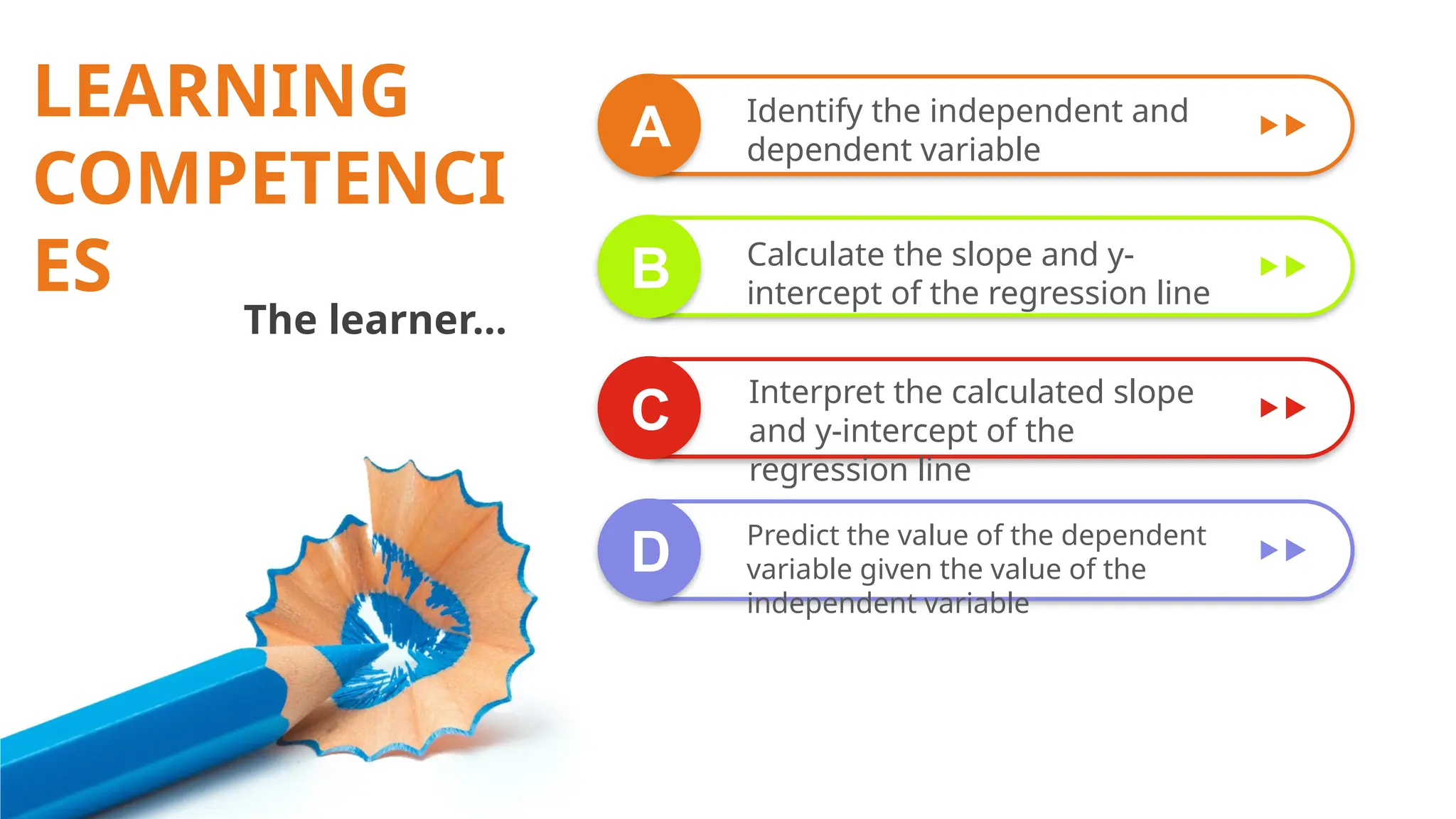
Identify the independent and
dependent variable
A
B
C
D
LEARNING
COMPETENCI
ES
The learner…
Calculate the slope and y-
intercept of the regression line
Interpret the calculated slope
and y-intercept of the
regression line
Predict the value of the dependent
variable given the value of the
independent variable
TESTING THE SIGNIFICANCE
OF r
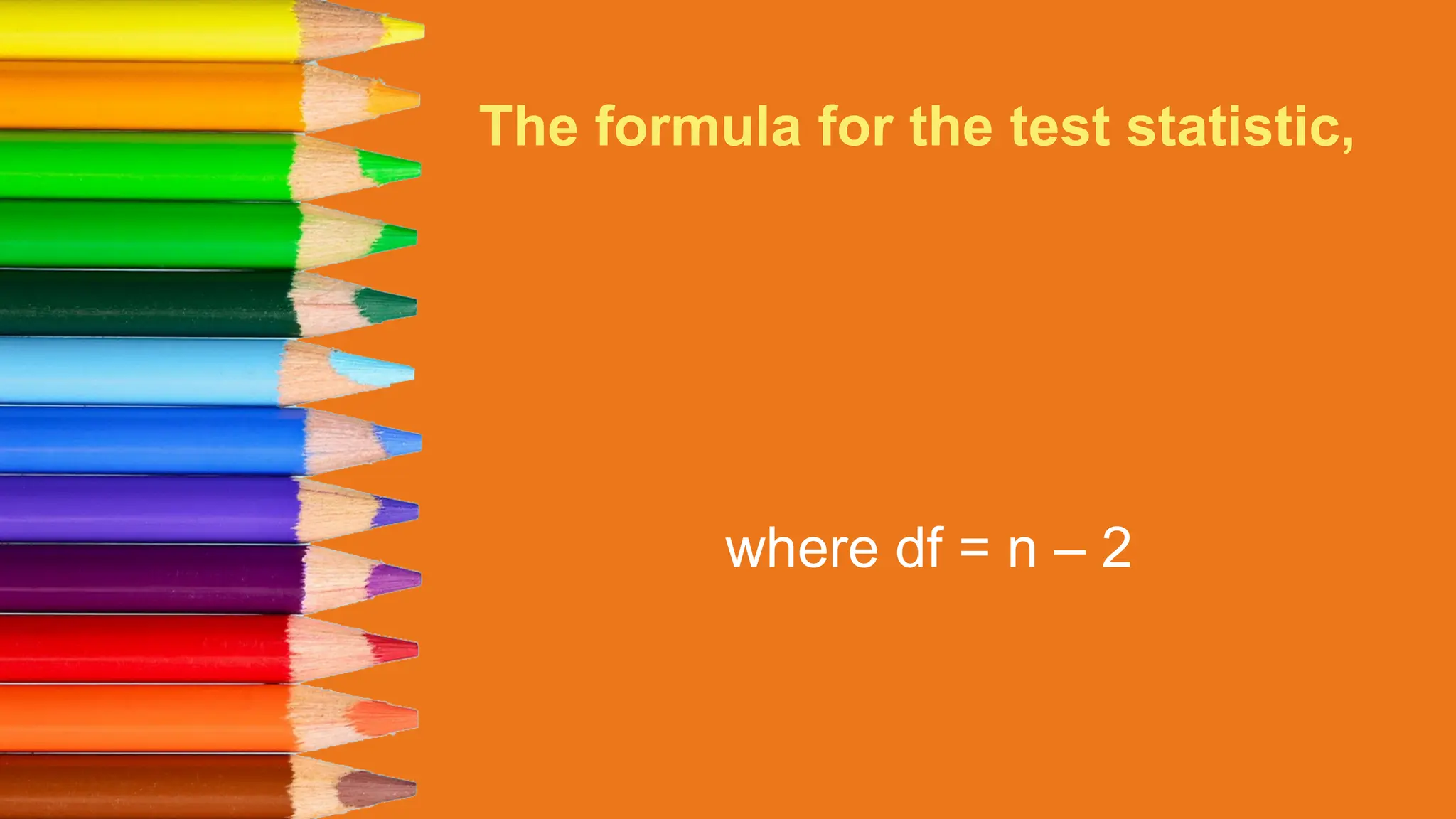
The formula for the test statistic,
where df = n – 2
STEPS IN TESTING THE SIGNIFICANCE OF r
Step 1. State the null and alternative
hypotheses.
Step 2. Compute for the value of t.
Step 3. Compare the computed value of
t
with the critical value of t. The
degree of freedom is n – 2. The test
calls for a two-tailed test.
Step 4. Decision and Conclusion
PROBLEM 1. FAMILY INCOME AND
SAVINGS
A researcher investigated the relationship
between family income and savings.
Using the data from 15 families, the
computed r between income and savings
was found to be 0.76. Is the computed r
significant at 0.05 level of
significance? Can we conclude that the
relationship really exists?
PROBLEM 1. FAMILY INCOME AND
SAVINGS
A researcher investigated the
relationship between family
income and savings.
Using the data from 15
families, the
computed r between income
and savings was found to
be 0.76. Is the computed r
significant at 0.05 level of
significance? Can we
conclude that the relationship
really exists?
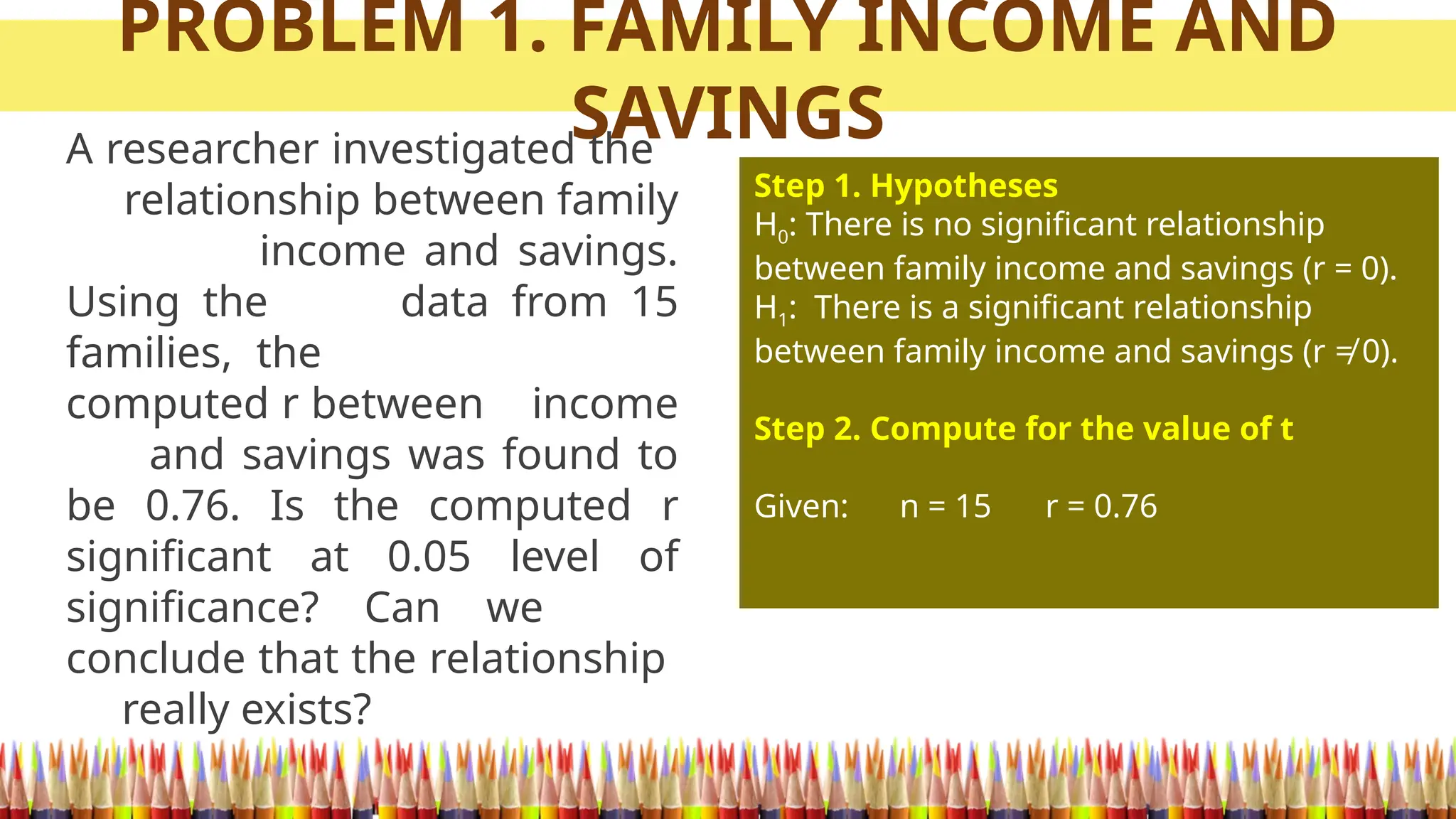
Step 1. Hypotheses
H0: There is no significant relationship
between family income and savings (r = 0).
H1: There is a significant relationship
between family income and savings (r ≠ 0).
Step 2. Compute for the value of t
Given: n = 15 r = 0.76
PROBLEM 1. FAMILY INCOME AND
SAVINGS
A researcher investigated the
relationship between family
income and savings.
Using the data from 15
families, the
computed r between income
and savings was found to
be 0.76. Is the computed r
significant at 0.05 level of
significance? Can we
conclude that the relationship
really exists?
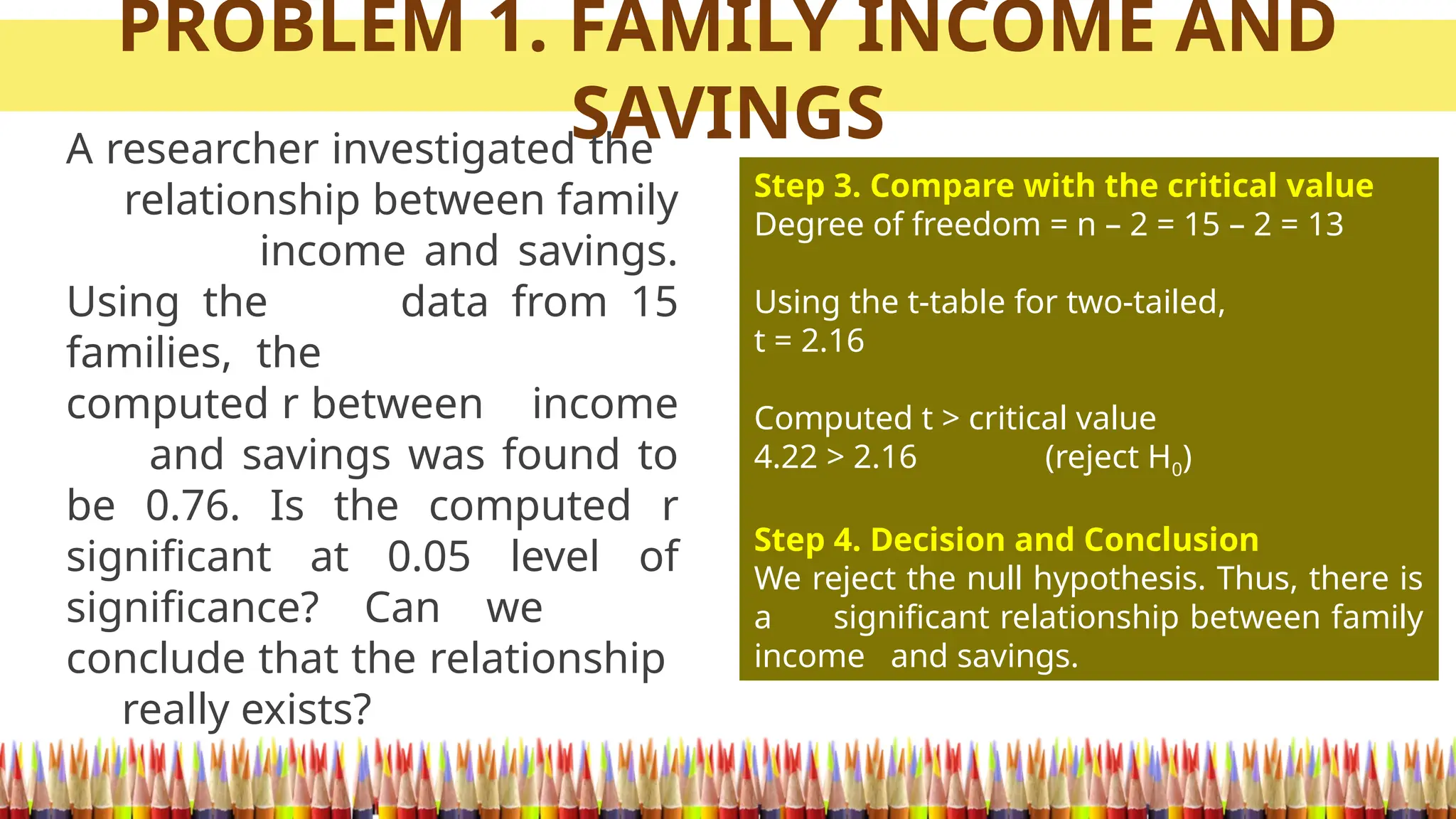
Step 3. Compare with the critical value
Degree of freedom = n – 2 = 15 – 2 = 13
Using the t-table for two-tailed,
t = 2.16
Computed t > critical value
4.22 > 2.16 (reject H0)
Step 4. Decision and Conclusion
We reject the null hypothesis. Thus, there is
a significant relationship between family
income and savings.
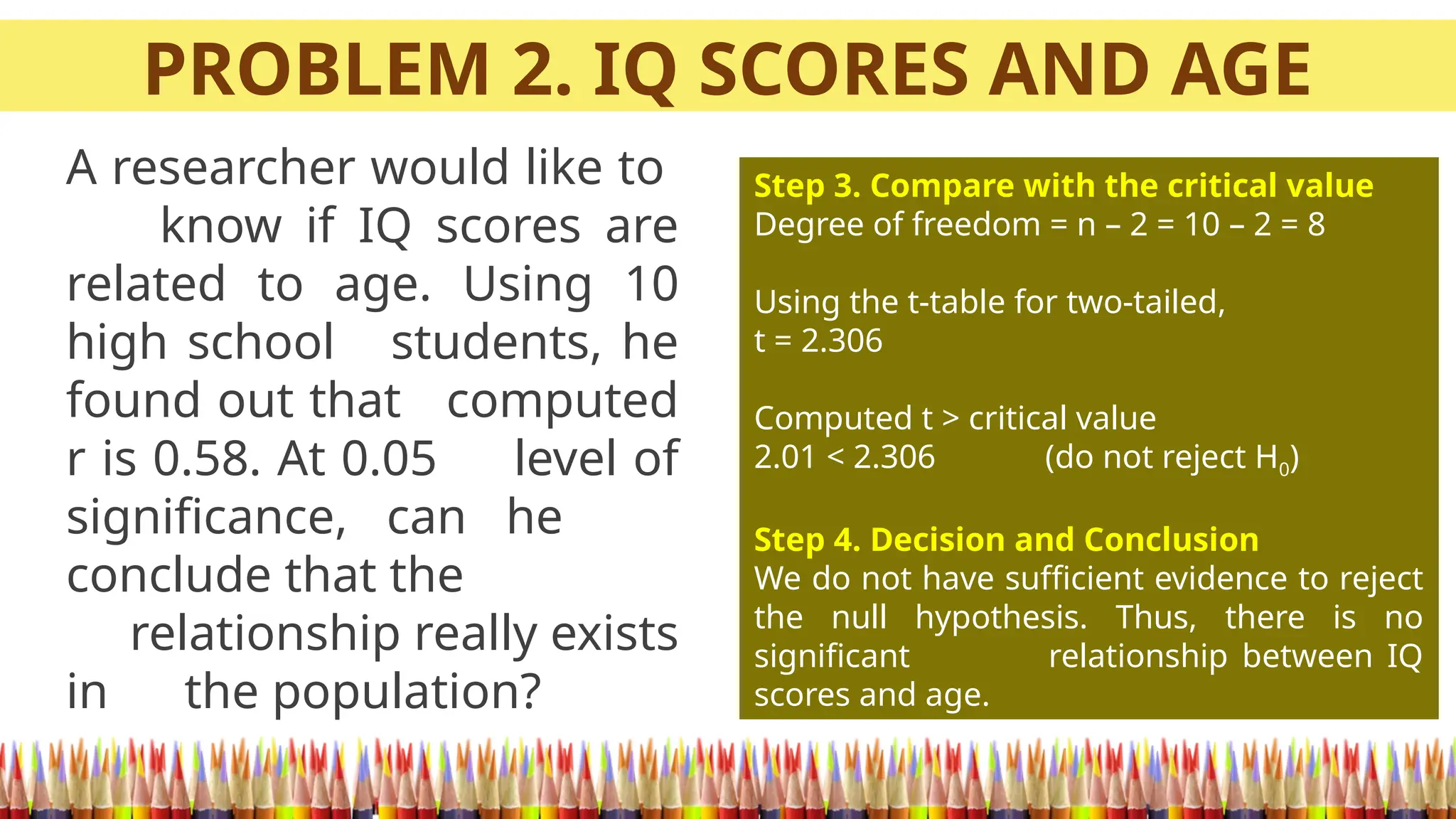
PROBLEM 2. IQ SCORES AND AGE
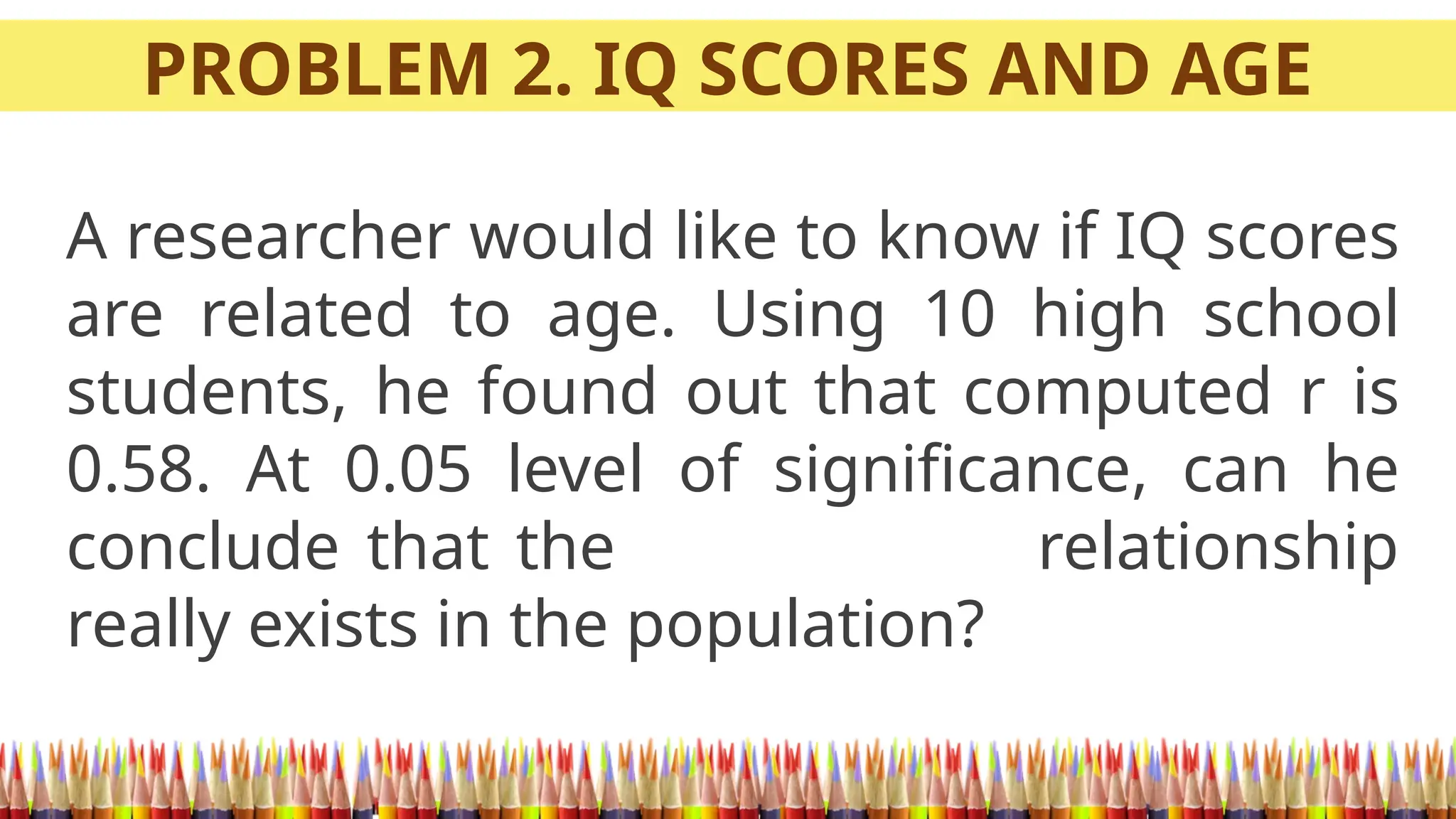
A researcher would like to know if IQ scores
are related to age. Using 10 high school
students, he found out that computed r is
0.58. At 0.05 level of significance, can he
conclude that the relationship
really exists in the population?
PROBLEM 2. IQ SCORES AND AGE
A researcher would like to
know if IQ scores are
related to age. Using 10
high school students, he
found out that computed
r is 0.58. At 0.05 level of
significance, can he
conclude that the
relationship really exists
in the population?
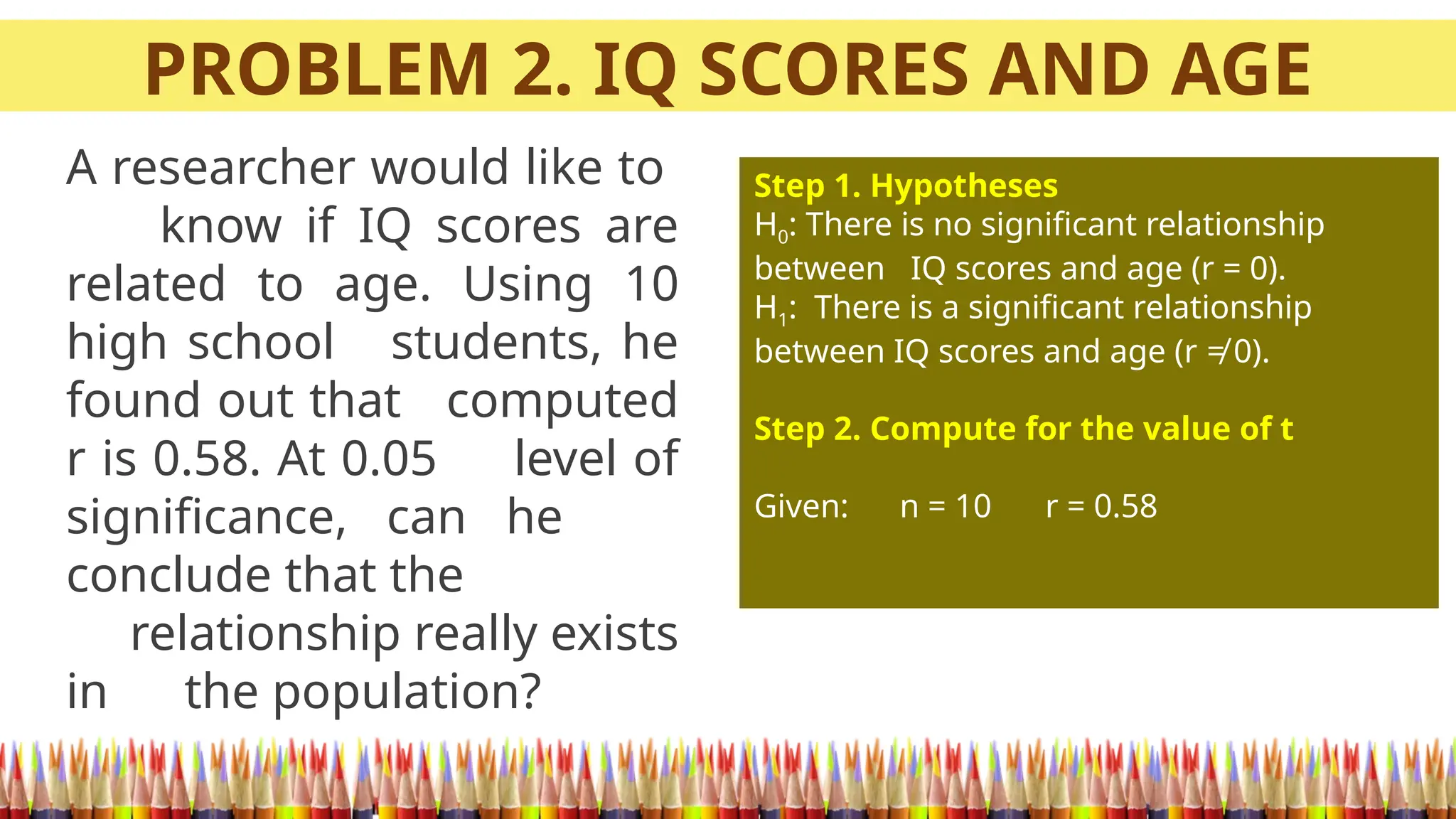
Step 1. Hypotheses
H0: There is no significant relationship
between IQ scores and age (r = 0).
H1: There is a significant relationship
between IQ scores and age (r ≠ 0).
Step 2. Compute for the value of t
Given: n = 10 r = 0.58
PROBLEM 2. IQ SCORES AND AGE
A researcher would like to
know if IQ scores are
related to age. Using 10
high school students, he
found out that computed
r is 0.58. At 0.05 level of
significance, can he
conclude that the
relationship really exists
in the population?
Step 3. Compare with the critical value
Degree of freedom = n – 2 = 10 – 2 = 8
Using the t-table for two-tailed,
t = 2.306
Computed t > critical value
2.01 < 2.306 (do not reject H0)
Step 4. Decision and Conclusion
We do not have sufficient evidence to reject
the null hypothesis. Thus, there is no
significant relationship between IQ
scores and age.
Note: If the computed r is
significant, the regression analysis
can be performed.
DEPENDENT AND
INDEPENDENT VARIABLES
Dependent variables
Are variables that are being predicted
or explained
Independent variables
Are variables that are being used to
predict or explain the dependent variables
When two variables are related,
one is the dependent variable while
the other is the independent
variable.
“ depends upon .”
Identify the dependent and independent variables in
each pair of the following variables.
Pair 1: Monthly Salary and annual income of the
worker
Dependent Variable:
Independent Variable:
Identify the dependent and independent variables in
each pair of the following variables.
Pair 1: Monthly Salary and annual income of the
worker
Annual income depends upon the monthly
salary
Dependent Variable:
Annual Income
Independent Variable:
Monthly Salary
Identify the dependent and independent variables in
each pair of the following variables.
Pair 2: IQ and academic performance of a
student
Dependent Variable:
Independent Variable:
Identify the dependent and independent variables in
each pair of the following variables.
Pair 2: IQ and academic performance of a
student
Academic performance depends upon the IQ
Dependent Variable:
Academic Performance
Independent Variable:
IQ
Identify the dependent and independent variables in
each pair of the following variables.
Pair 3: Temperature and volume of air in a
balloon
Dependent Variable:
Independent Variable:
Identify the dependent and independent variables in
each pair of the following variables.
Pair 3: Temperature and volume of air in a
balloon
Volume of air in a balloon depends upon the
temperature
Dependent Variable:
Volume of air in a balloon
Independent Variable:
Temperature
Identify the dependent and independent variables in
each pair of the following variables.
Pair 4: Altitude and acceleration due to gravity
Dependent Variable:
Independent Variable:
Identify the dependent and independent variables in
each pair of the following variables.
Pair 4: Altitude and acceleration due to gravity
Acceleration depends upon altitude
Dependent Variable:
Acceleration
Independent Variable:
Altitude
Identify the dependent and independent variables in
each pair of the following variables.
Pair 5: Demand and price of goods
Dependent Variable:
Independent Variable:
Identify the dependent and independent variables in
each pair of the following variables.
Pair 5: Height of the son and height of the
father
Height of the son depends upon the height of the
father
Dependent Variable:
Height of the Son
Independent Variable:
Height of the Father
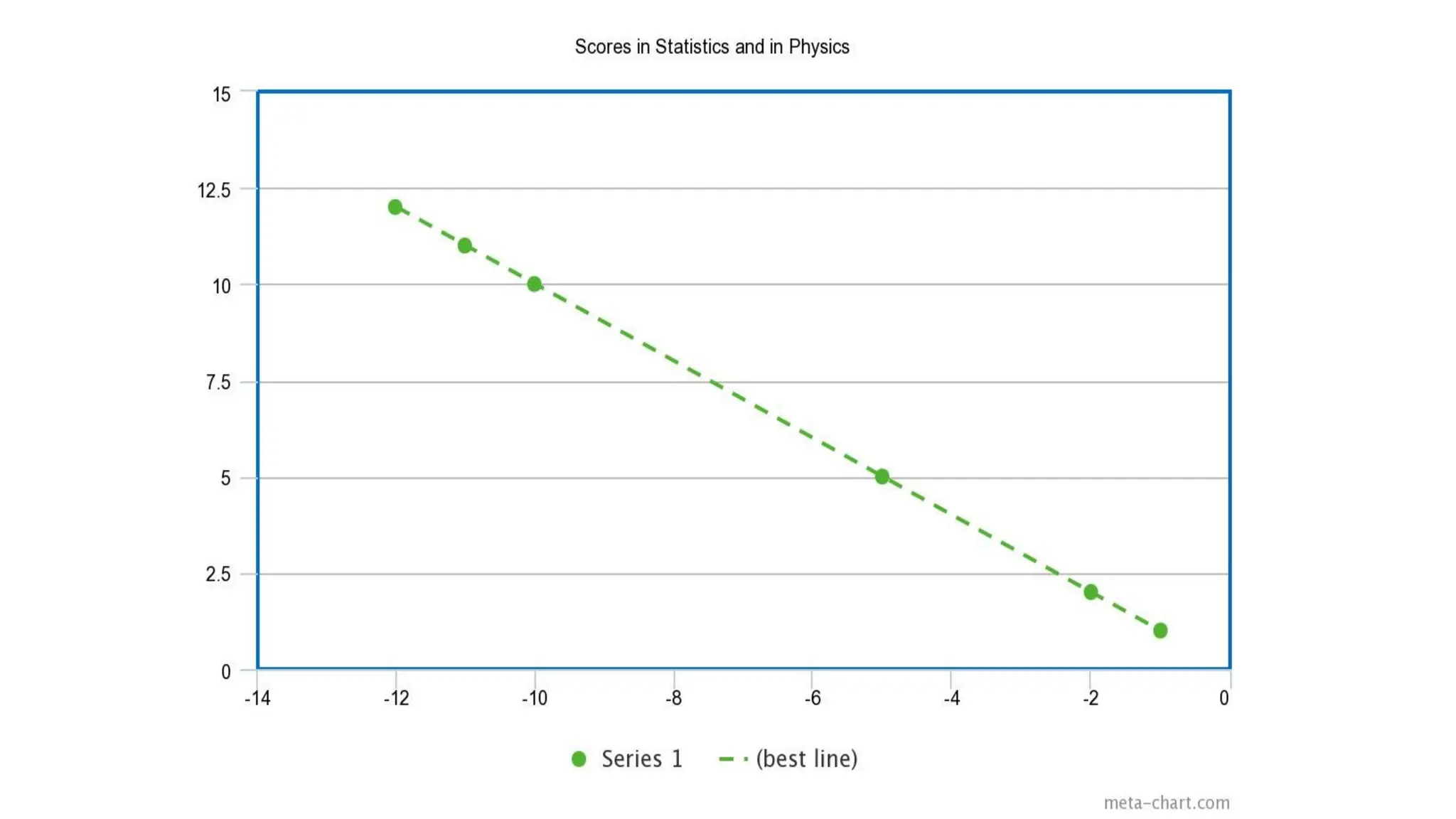
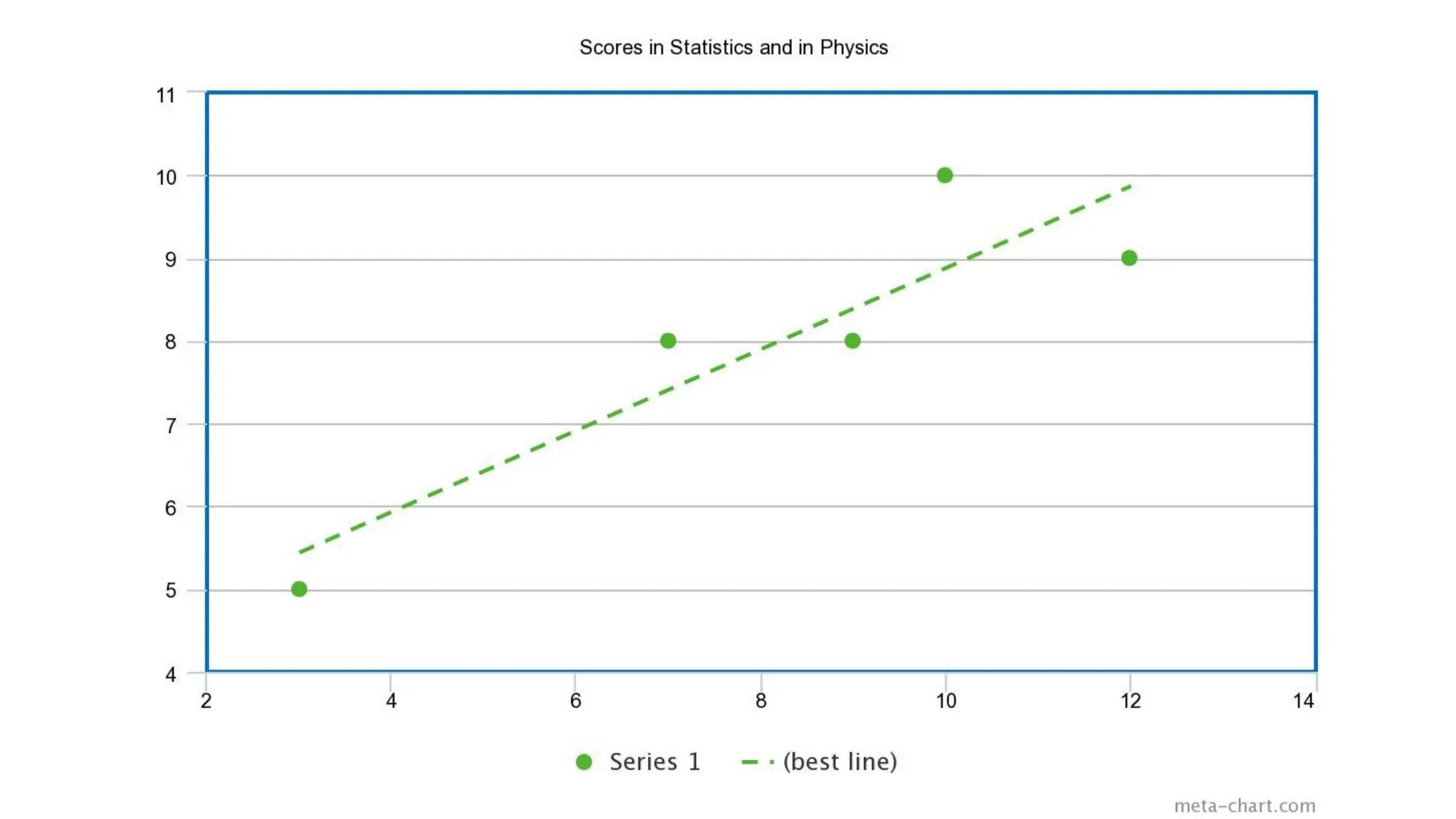
TREND LINE
The line “closest” to the points in the
scatterplot
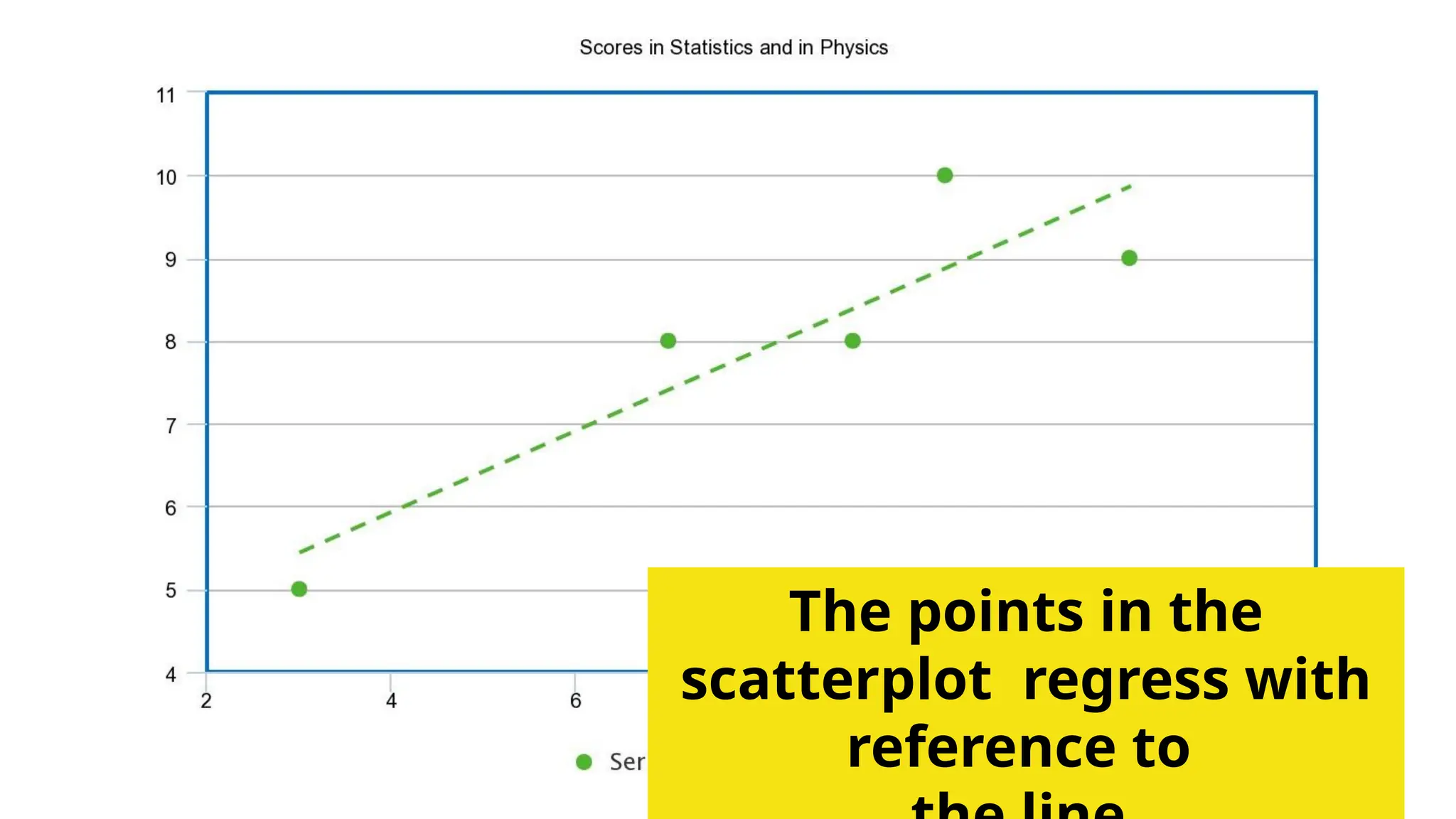
The points in the
scatterplot regress with
reference to
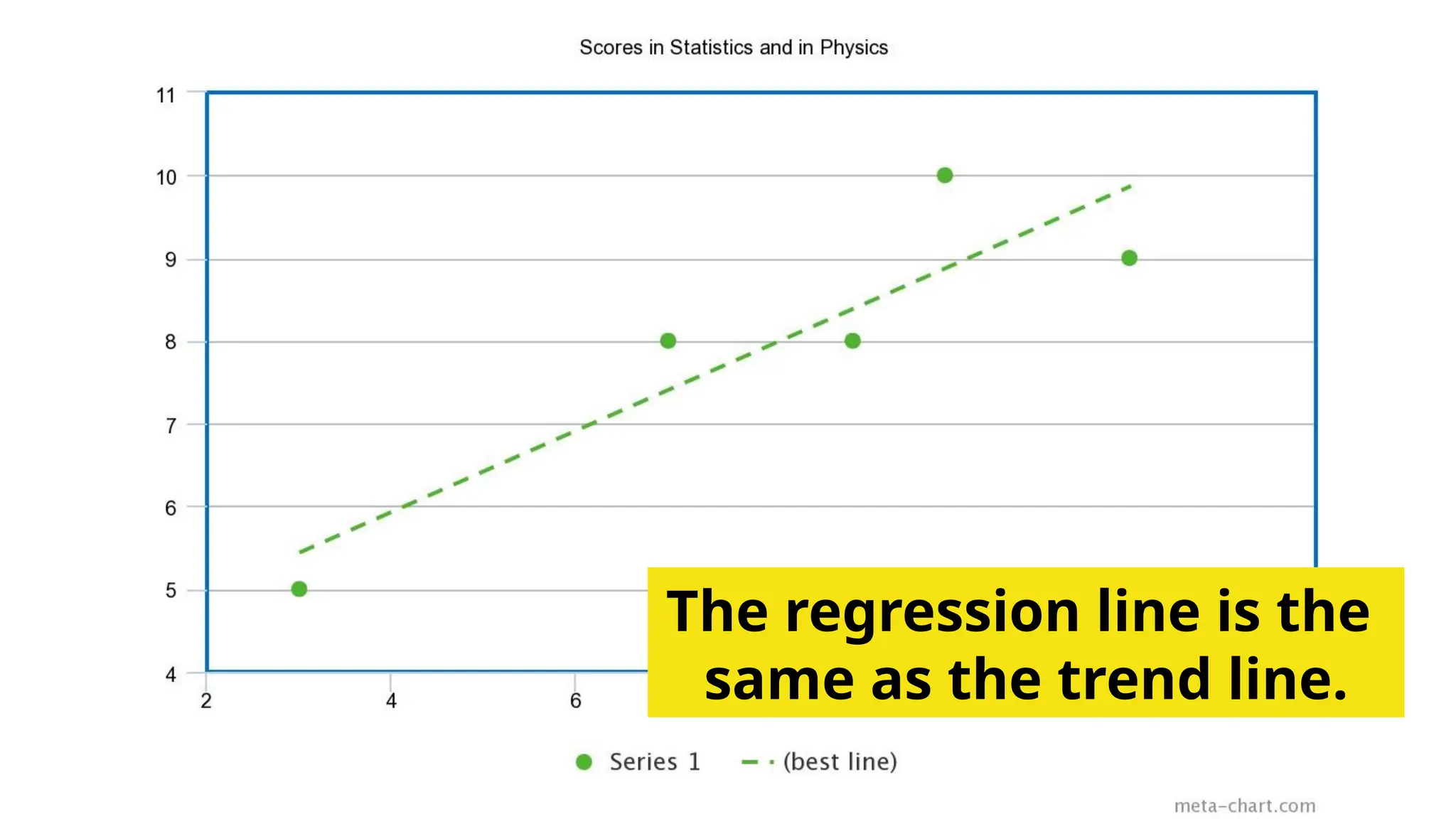
The regression line is the
same as the trend line.
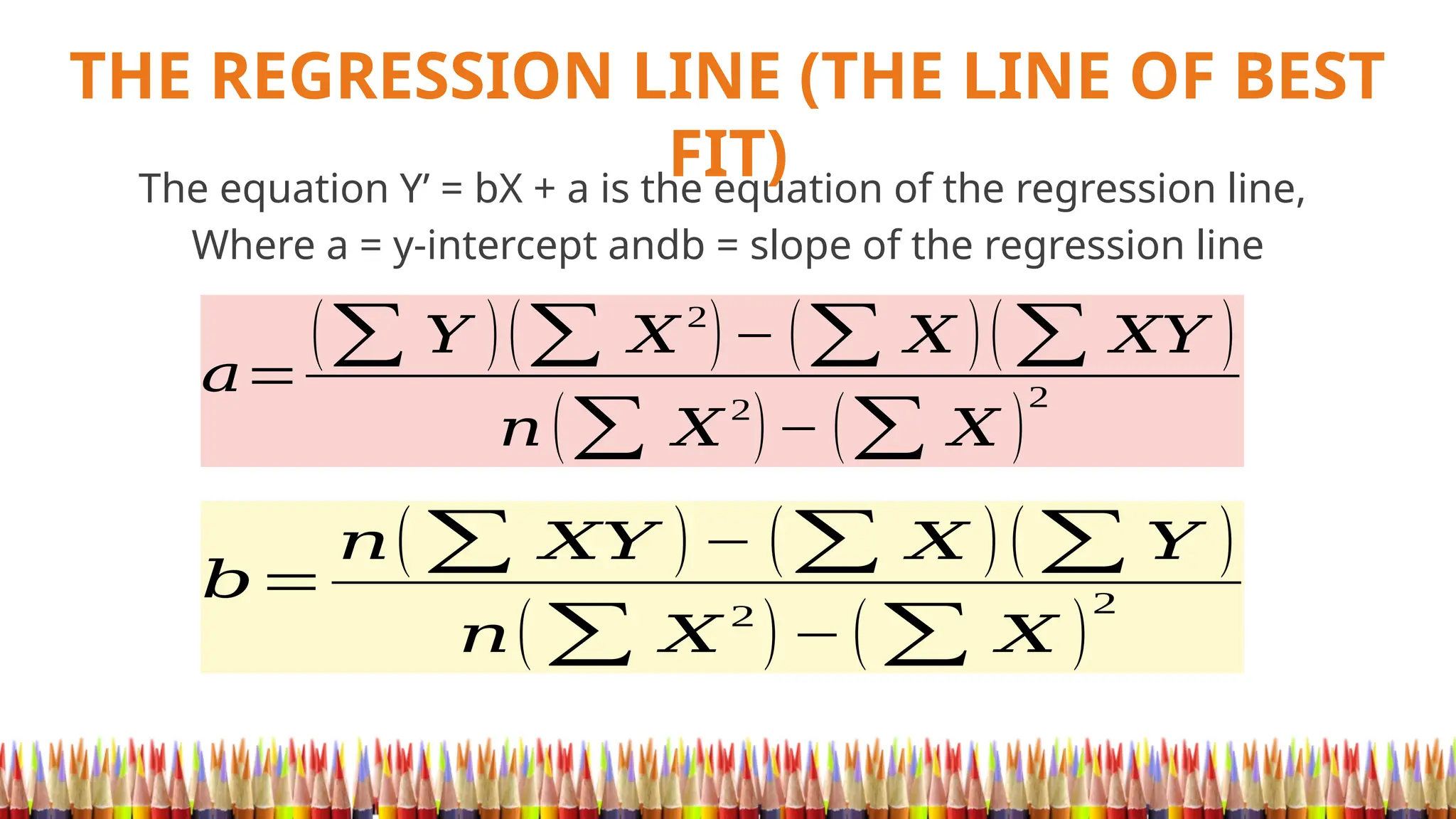
THE REGRESSION LINE (THE LINE OF BEST
FIT)
The equation Y’ = bX + a is the equation of the regression line,
Where a = y-intercept andb = slope of the regression line
𝑎=
(∑ 𝑌 )(∑ 𝑋2
)− (∑ 𝑋 )(∑ 𝑋𝑌 )
𝑛 (∑ 𝑋
2
)− (∑ 𝑋 )
2
𝑏=
𝑛(∑ 𝑋𝑌 )− (∑ 𝑋 )(∑ 𝑌 )
𝑛(∑ 𝑋
2
)−(∑ 𝑋 )
2
REVIEW ON
SLOPE AND Y-
INTERCEPT
Determine the slope and y-
intercept in the following linear
equations:
a)y = 3x – 5
b)y = -4x
PREDICTING THE VALUE OF Y IF X IS KNOWN
The regression line Y’ = bX + a is also
called the line of prediction. Since in
the analysis, only the y distance was
considered, the line cannot be
used to predict X from Y.
PREDICTING THE VALUE OF Y IF X IS KNOWN
Step 1. Find the value of the correlation coefficient.
Step 2. Test the significance of r. If r is significant,
proceed to the regression analysis (Proceed to Step
3). If r is not significant, regression analysis
cannot be done (Stop).
PREDICTING THE VALUE OF Y IF X IS KNOWN
Step 3. Find the values of a and b.
Step 4. Substitute the values a and b in the
regression line Y’ = bX + a.
PROBLEM 3. NUMBER OF ABSENCES AND
NUMBER OF MISSED QUIZZES
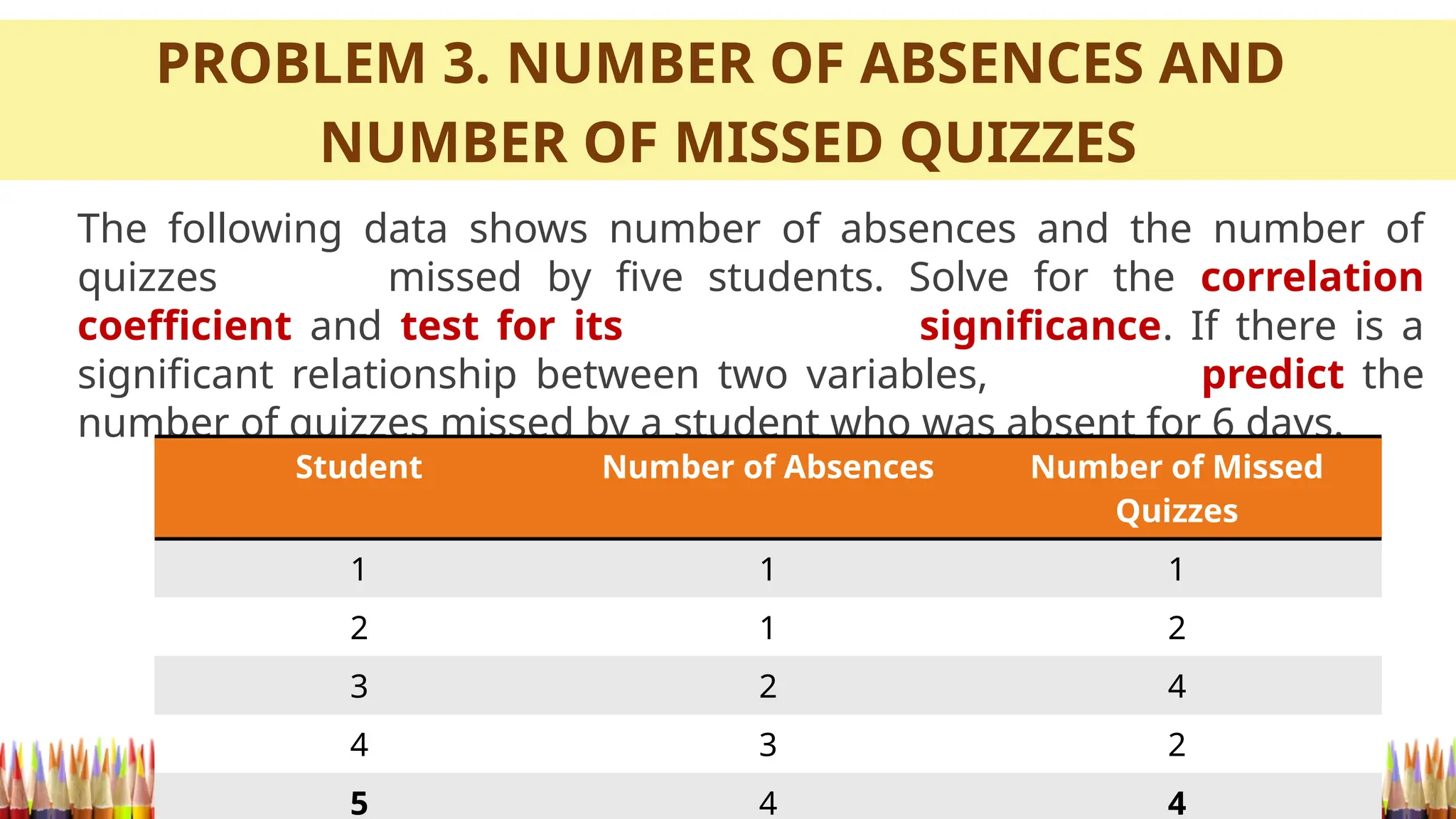
The following data shows number of absences and the number of
quizzes missed by five students. Solve for the correlation
coefficient and test for its significance. If there is a
significant relationship between two variables, predict the
number of quizzes missed by a student who was absent for 6 days.
Student Number of Absences Number of Missed
Quizzes
1 1 1
2 1 2
3 2 4
4 3 2
5 4 4
Solving for the Correlation Coefficient
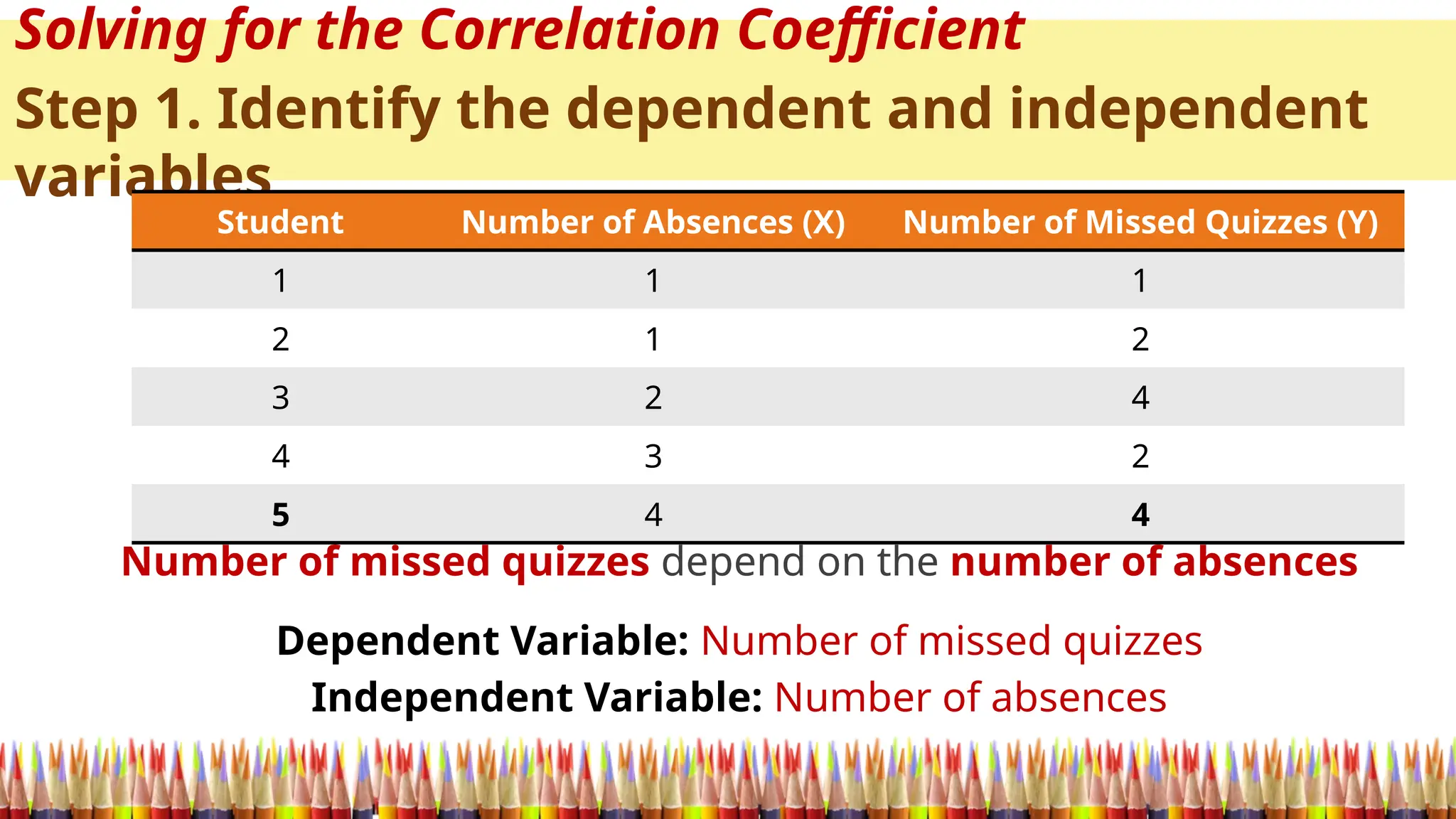
Step 1. Identify the dependent and independent
variables
Number of missed quizzes depend on the number of absences
Dependent Variable: Number of missed quizzes
Independent Variable: Number of absences
Student Number of Absences (X) Number of Missed Quizzes (Y)
1 1 1
2 1 2
3 2 4
4 3 2
5 4 4
Solving for the Correlation Coefficient
Step 2. Compute for the correlation coefficient
𝑟 =
𝑛∑ 𝑋𝑌 −(∑ 𝑋 )(∑ 𝑌 )
√[𝑛∑ 𝑋2
−(∑ 𝑋 )
2
][𝑛∑ 𝑌 2
−(∑ 𝑌 )
2
]
Student X Y X2
Y2
XY
1 1 1
2 1 2
3 2 4
4 3 2
5 4 4
Solving for the Correlation Coefficient
Step 2. Compute for the correlation coefficient
𝑟 =
5(33)−(11)(13)
√[5(31)−(11)
2
][5( 41)−(13)
2
]
Student X Y X2
Y2
XY
1 1 1 1 1 1
2 1 2 1 4 2
3 2 4 4 16 8
4 3 2 9 4 6
5 4 4 16 16 16
Solving for the Correlation Coefficient
Step 2. Compute for the correlation coefficient
𝑟=
5(33)−(11)(13)
√[5(31)−(11)
2
][5(41)−(13)
2
]
=
22
√(34)(36)
=𝟎.𝟔𝟑
Student X Y X2
Y2
XY
1 1 1 1 1 1
2 1 2 1 4 2
3 2 4 4 16 8
4 3 2 9 4 6
5 4 4 16 16 16
Testing the Significance of r
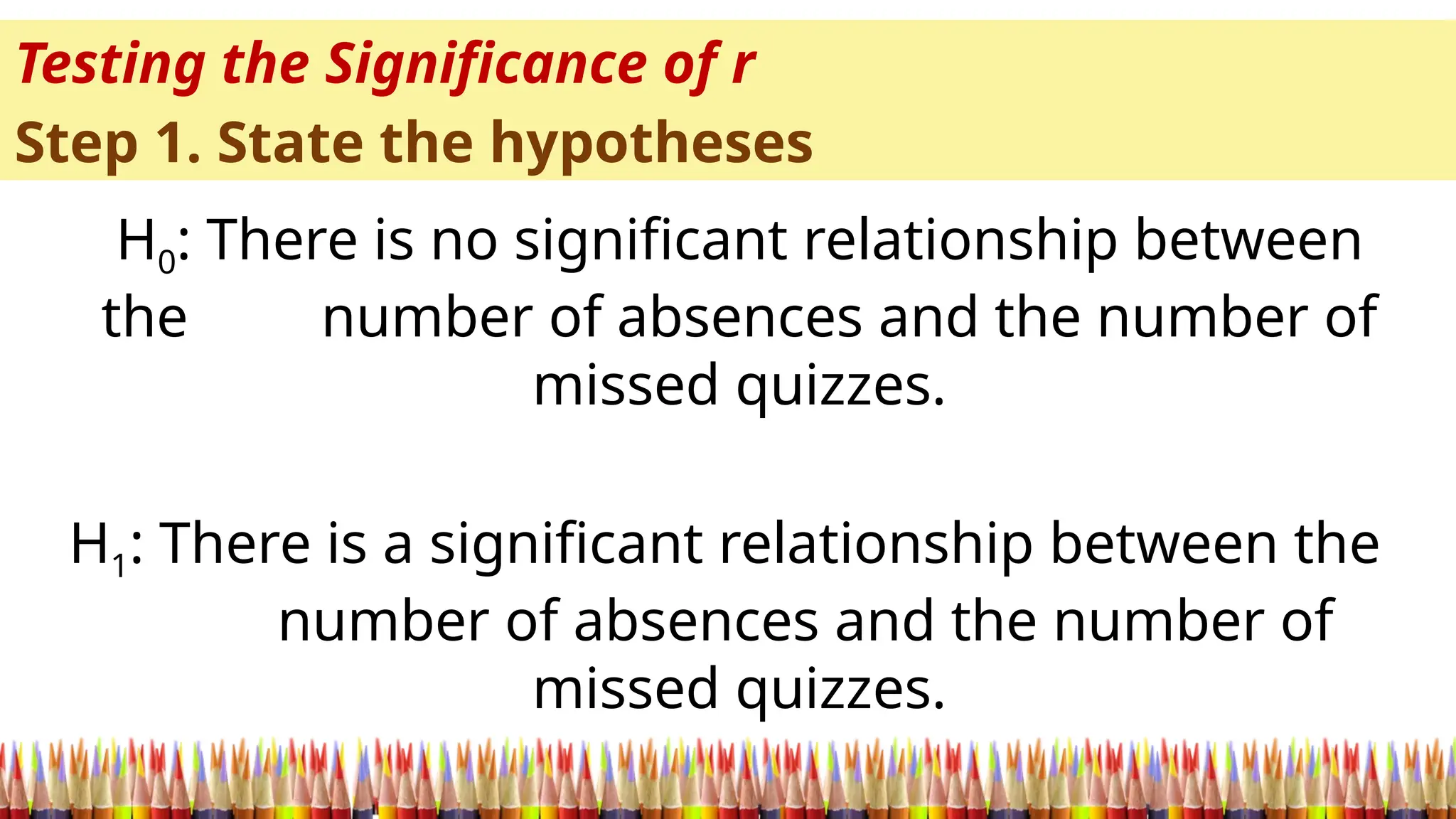
Step 1. State the hypotheses
H0: There is no significant relationship between
the number of absences and the number of
missed quizzes.
H1: There is a significant relationship between the
number of absences and the number of
missed quizzes.
Testing the Significance of r
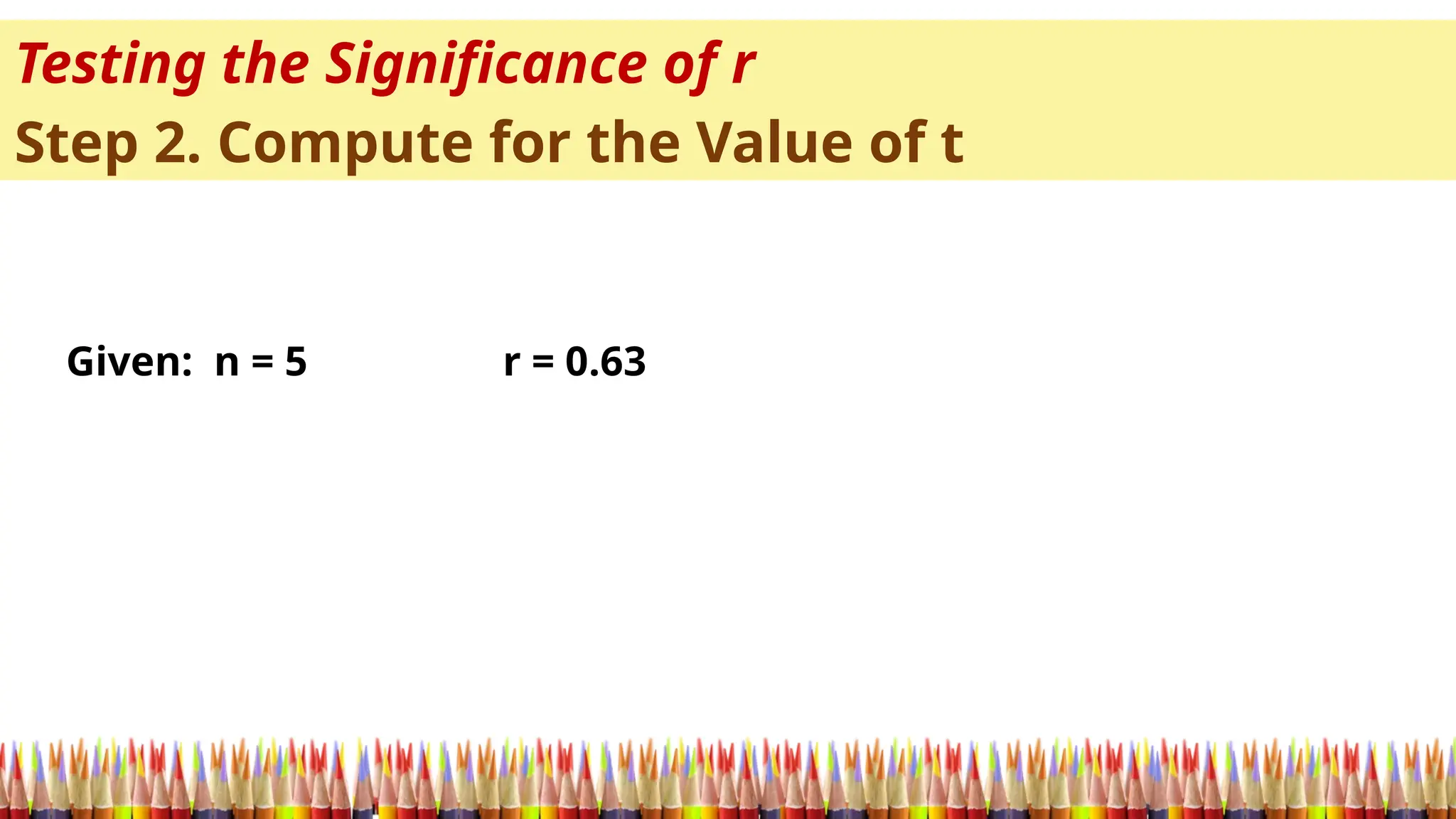
Step 2. Compute for the Value of t
Given: n = 5 r = 0.63
Testing the Significance of r
Step 3. Compare computed value with critical
value
Degree of Freedom = 5 – 2 = 3
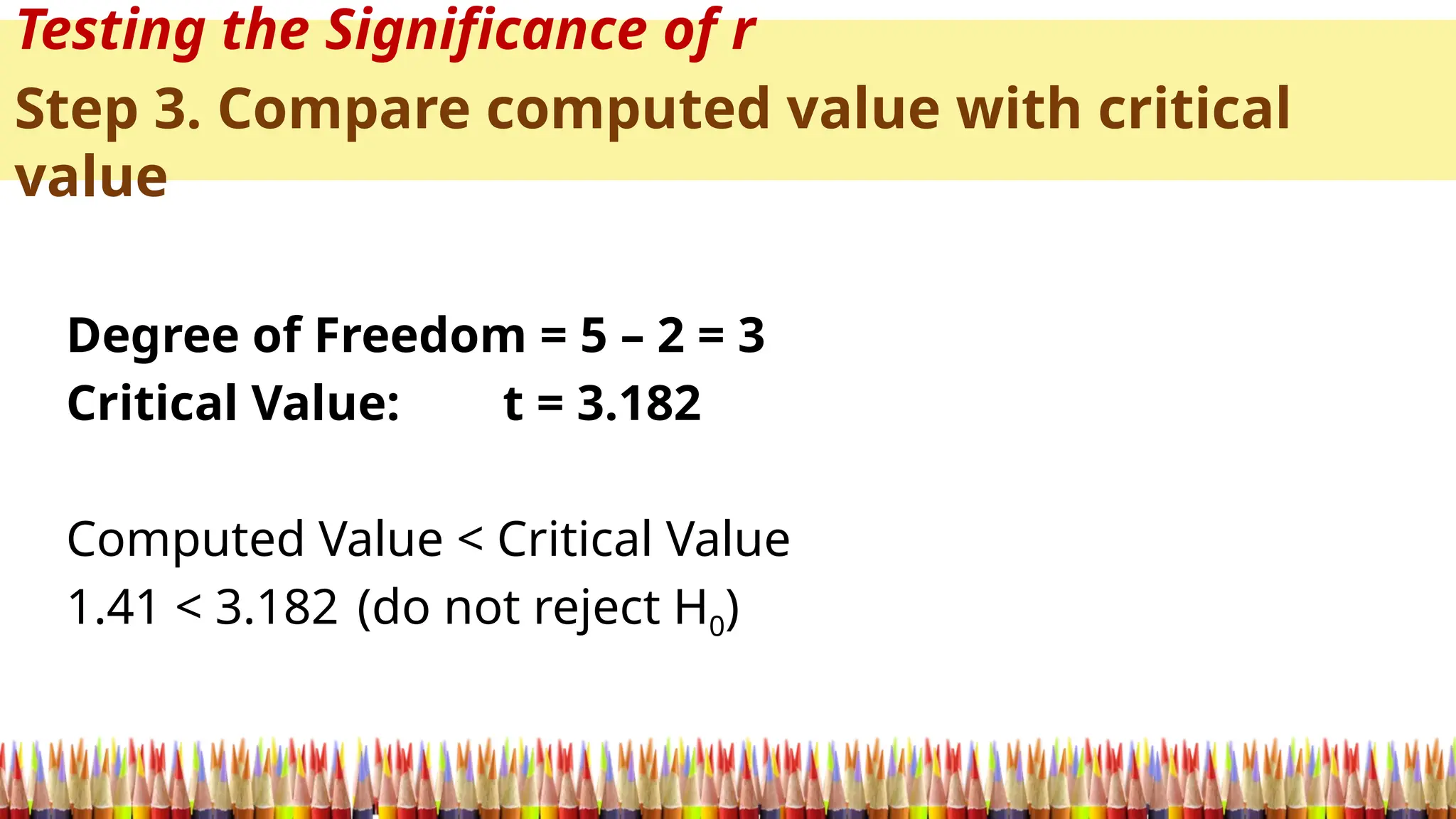
Critical Value: t = 3.182
Computed Value < Critical Value
1.41 < 3.182 (do not reject H0)
Testing the Significance of r
Step 4. Decision and Conclusion
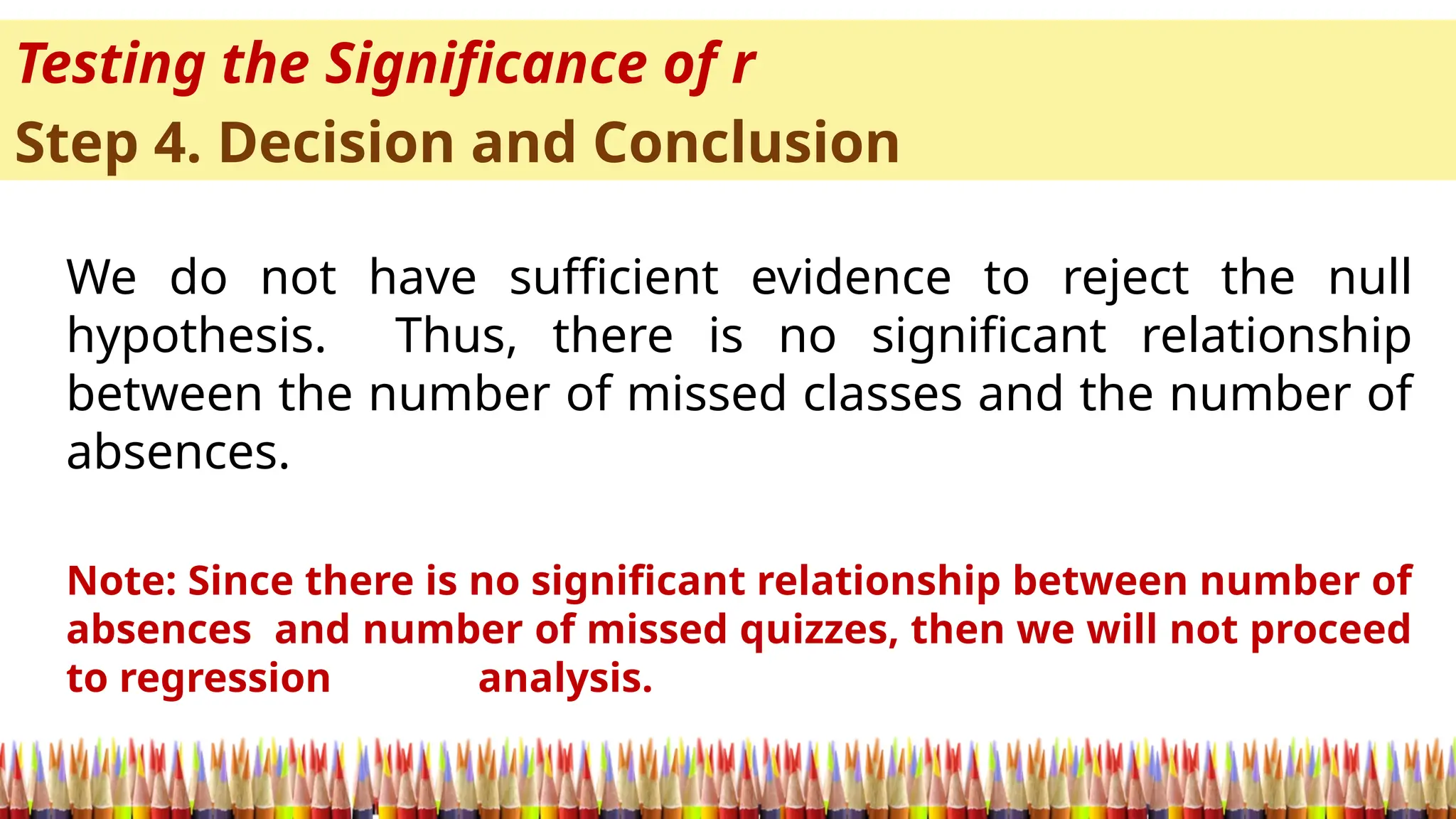
We do not have sufficient evidence to reject the null
hypothesis. Thus, there is no significant relationship
between the number of missed classes and the number of
absences.
Note: Since there is no significant relationship between number of
absences and number of missed quizzes, then we will not proceed
to regression analysis.
PROBLEM 4. HEIGHT OF THE FATHER AND
SON
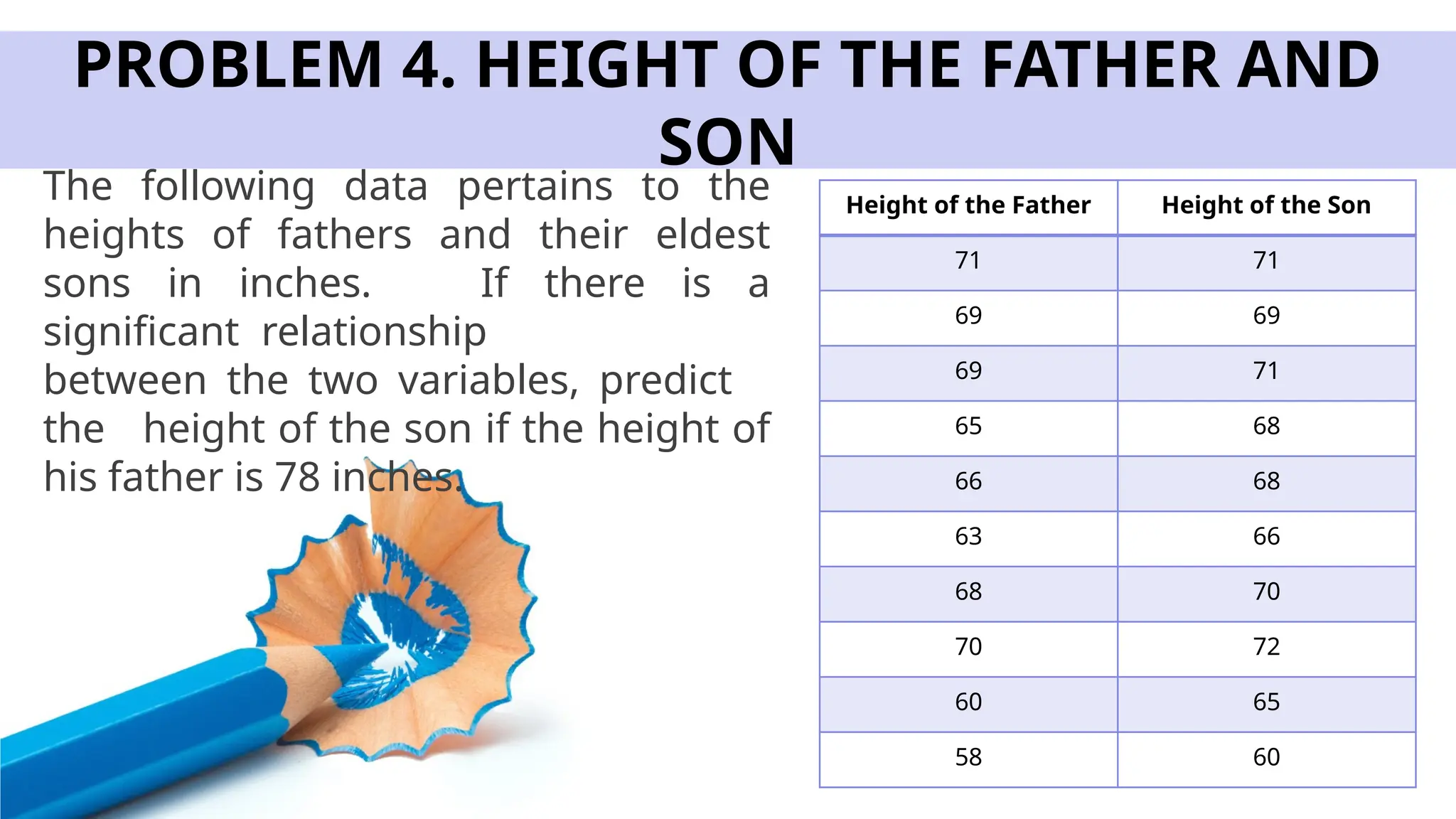
The following data pertains to the
heights of fathers and their eldest
sons in inches. If there is a
significant relationship
between the two variables, predict
the height of the son if the height of
his father is 78 inches.
Height of the Father Height of the Son
71 71
69 69
69 71
65 68
66 68
63 66
68 70
70 72
60 65
58 60
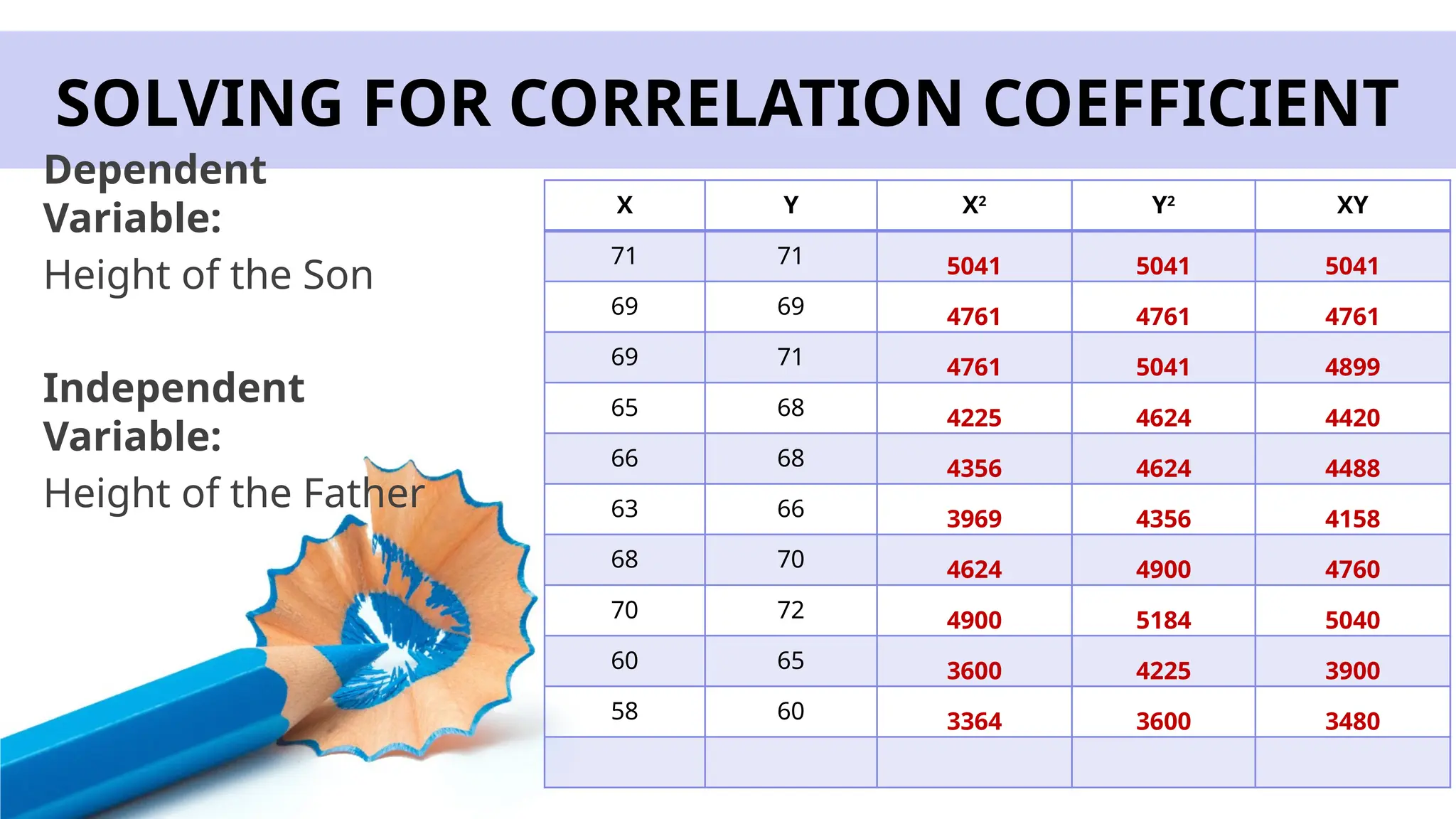
SOLVING FOR CORRELATION COEFFICIENT
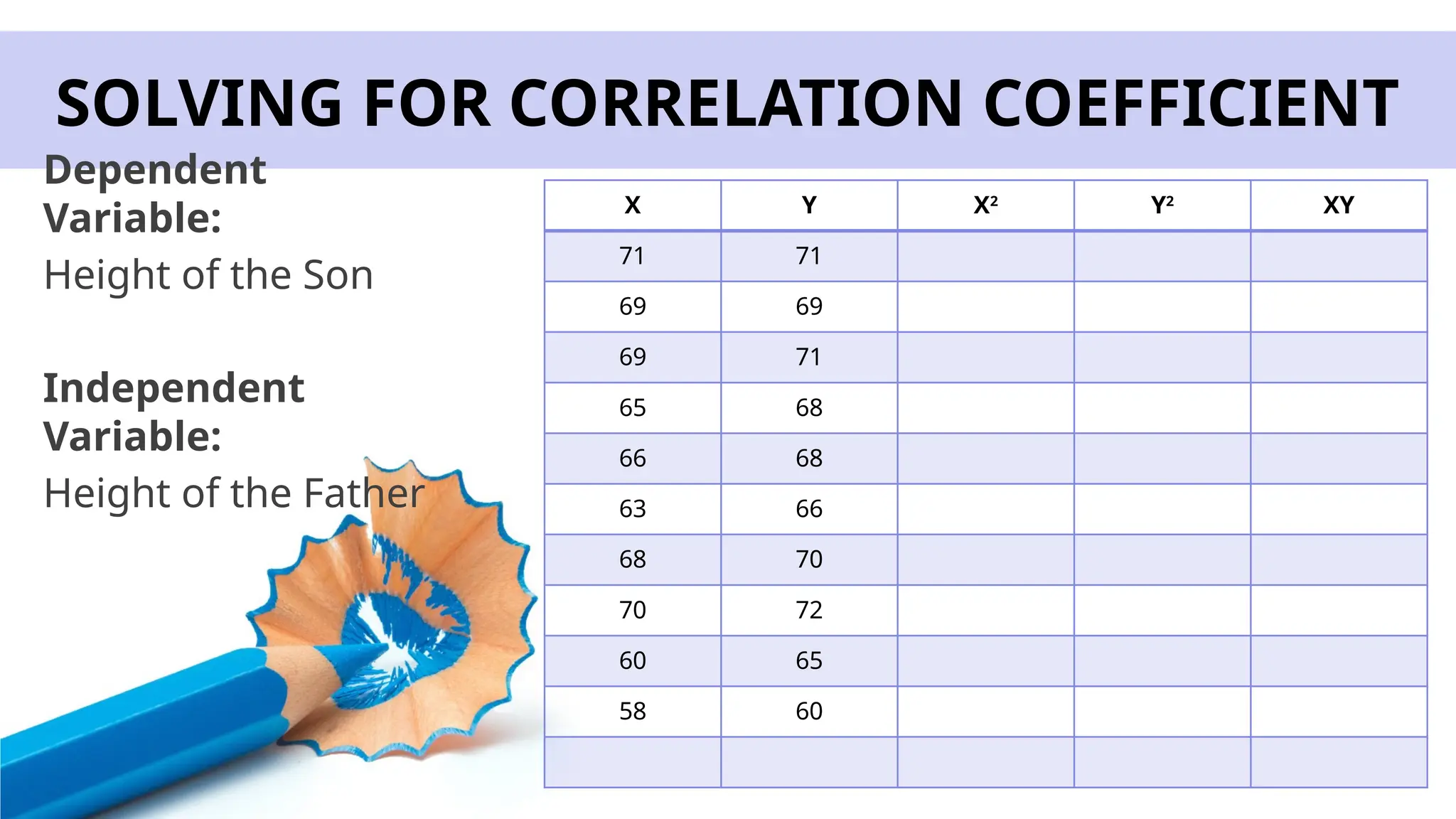
Dependent
Variable:
Height of the Son
Independent
Variable:
Height of the Father
X Y X2
Y2
XY
71 71
69 69
69 71
65 68
66 68
63 66
68 70
70 72
60 65
58 60
SOLVING FOR CORRELATION COEFFICIENT
Dependent
Variable:
Height of the Son
Independent
Variable:
Height of the Father
X Y X2
Y2
XY
71 71 5041 5041 5041
69 69 4761 4761 4761
69 71 4761 5041 4899
65 68 4225 4624 4420
66 68 4356 4624 4488
63 66 3969 4356 4158
68 70 4624 4900 4760
70 72 4900 5184 5040
60 65 3600 4225 3900
58 60 3364 3600 3480
SOLVING FOR CORRELATION COEFFICIENT
X Y X2
Y2
XY
71 71 5041 5041 5041
69 69 4761 4761 4761
69 71 4761 5041 4899
65 68 4225 4624 4420
66 68 4356 4624 4488
63 66 3969 4356 4158
68 70 4624 4900 4760
70 72 4900 5184 5040
60 65 3600 4225 3900
58 60 3364 3600 3480
𝑟=
𝑛∑𝑋𝑌−(∑𝑋)(∑𝑌)
√[𝑛∑𝑋
2
−(∑𝑋)
2
][𝑛∑𝑌
2
−(∑𝑌)
2
]
SOLVING FOR CORRELATION COEFFICIENT
X Y X2
Y2
XY
71 71 5041 5041 5041
69 69 4761 4761 4761
69 71 4761 5041 4899
65 68 4225 4624 4420
66 68 4356 4624 4488
63 66 3969 4356 4158
68 70 4624 4900 4760
70 72 4900 5184 5040
60 65 3600 4225 3900
58 60 3364 3600 3480
𝑟=
(10)(44,947)−(659)(680)
√[10(43601)−(659)
2
][10(46356)−(680)
2
]
=
1350
√(1729)(1160)
=𝟎.𝟗𝟓
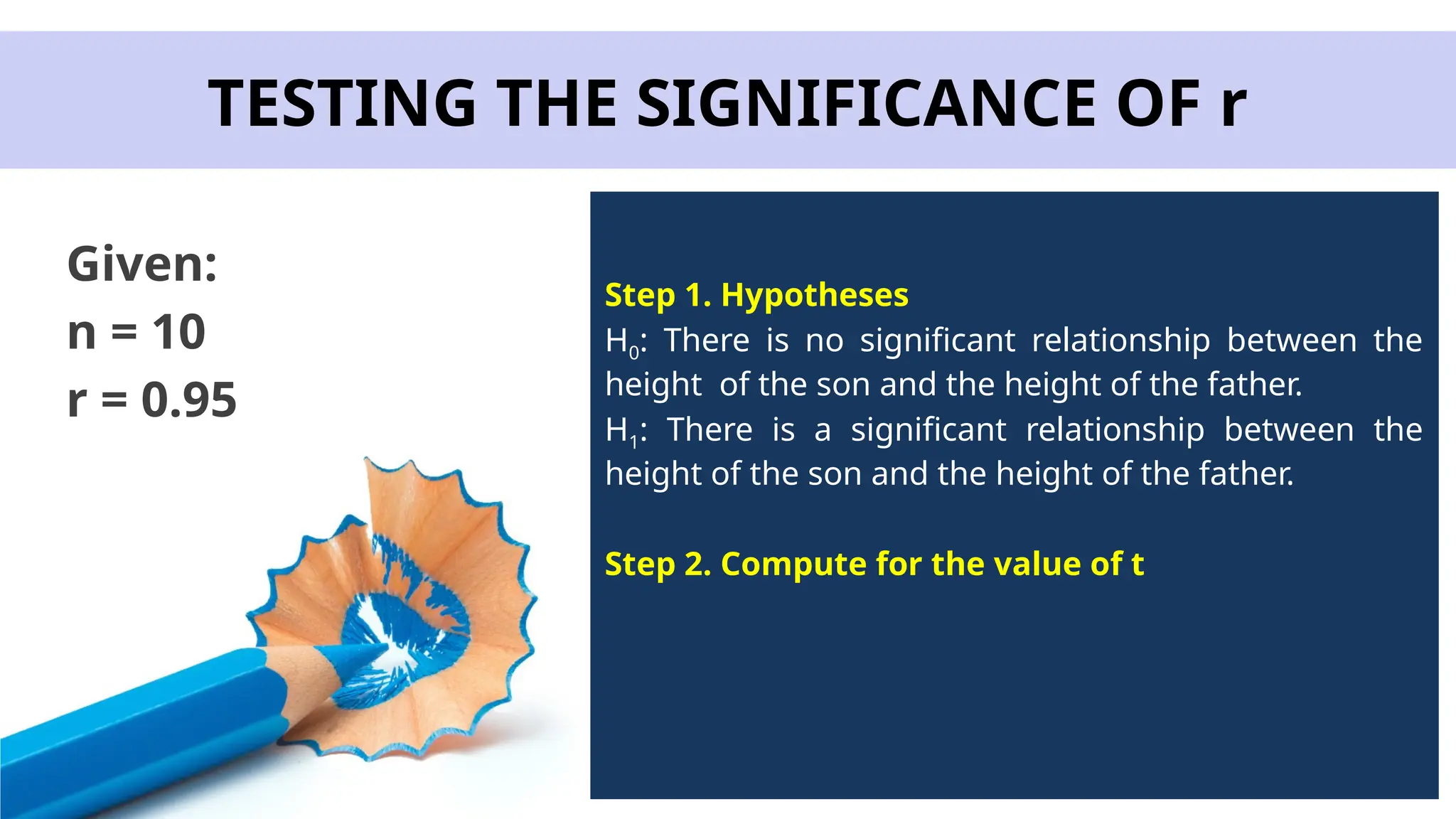
TESTING THE SIGNIFICANCE OF r
Given:
n = 10
r = 0.95
Step 1. Hypotheses
H0: There is no significant relationship between the
height of the son and the height of the father.
H1: There is a significant relationship between the
height of the son and the height of the father.
Step 2. Compute for the value of t
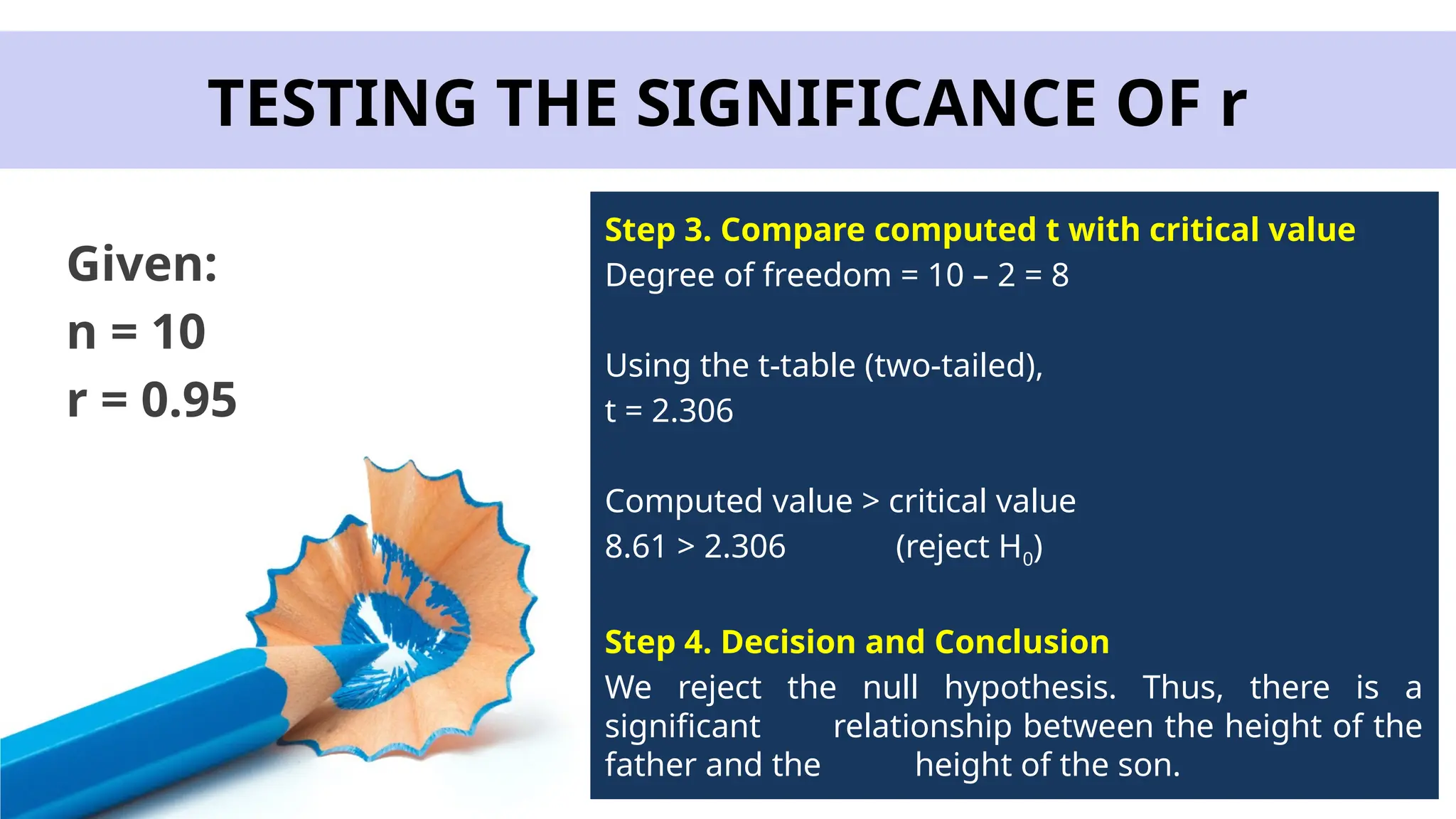
TESTING THE SIGNIFICANCE OF r
Given:
n = 10
r = 0.95
Step 3. Compare computed t with critical value
Degree of freedom = 10 – 2 = 8
Using the t-table (two-tailed),
t = 2.306
Computed value > critical value
8.61 > 2.306 (reject H0)
Step 4. Decision and Conclusion
We reject the null hypothesis. Thus, there is a
significant relationship between the height of the
father and the height of the son.
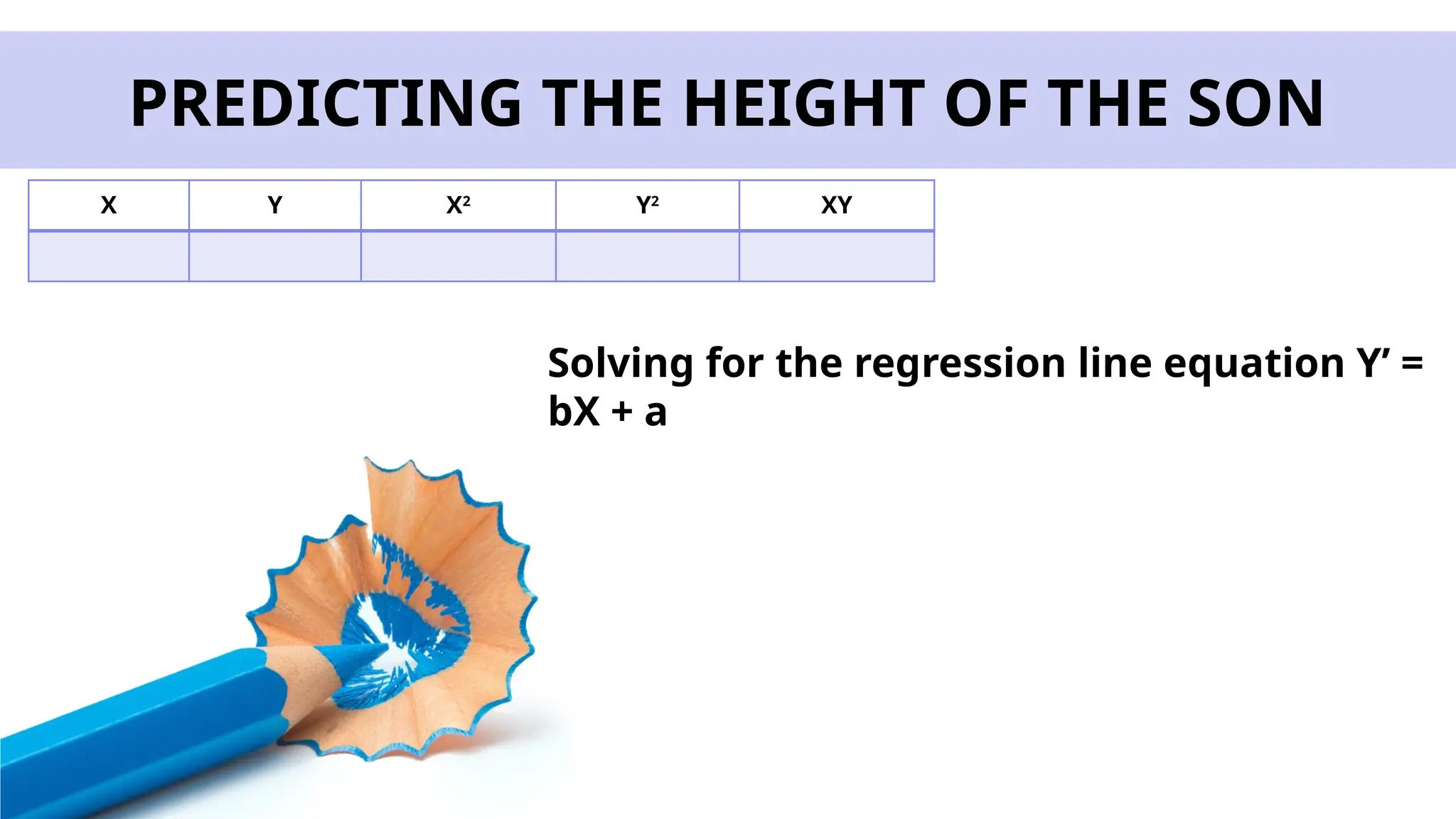
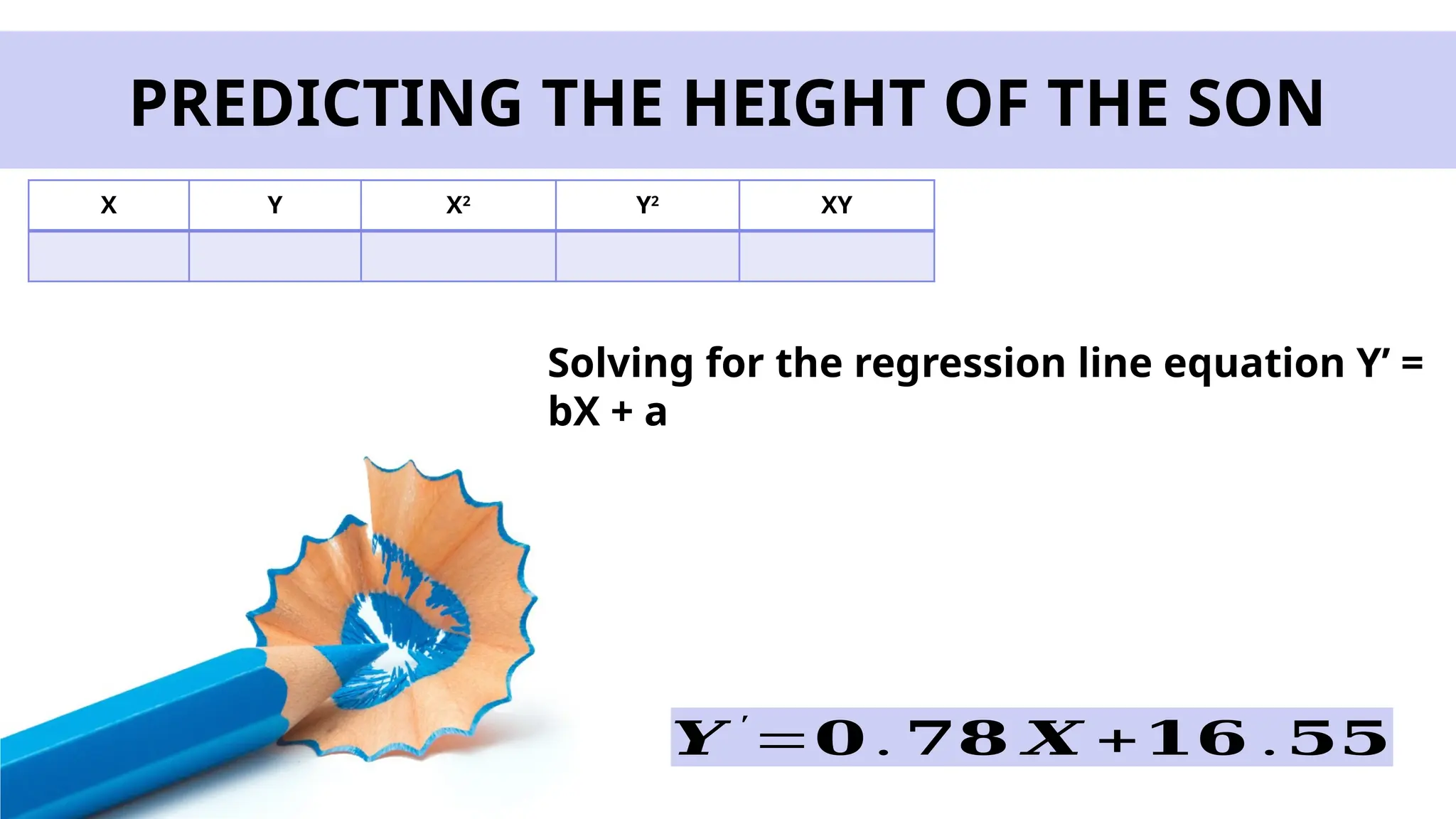
PREDICTING THE HEIGHT OF THE SON
Solving for the regression line equation Y’ =
bX + a
X Y X2
Y2
XY
PREDICTING THE HEIGHT OF THE SON
Solving for the regression line equation Y’ =
bX + a
X Y X2
Y2
XY
𝒀 ′
=𝟎 . 𝟕𝟖 𝑿 +𝟏𝟔 .𝟓𝟓
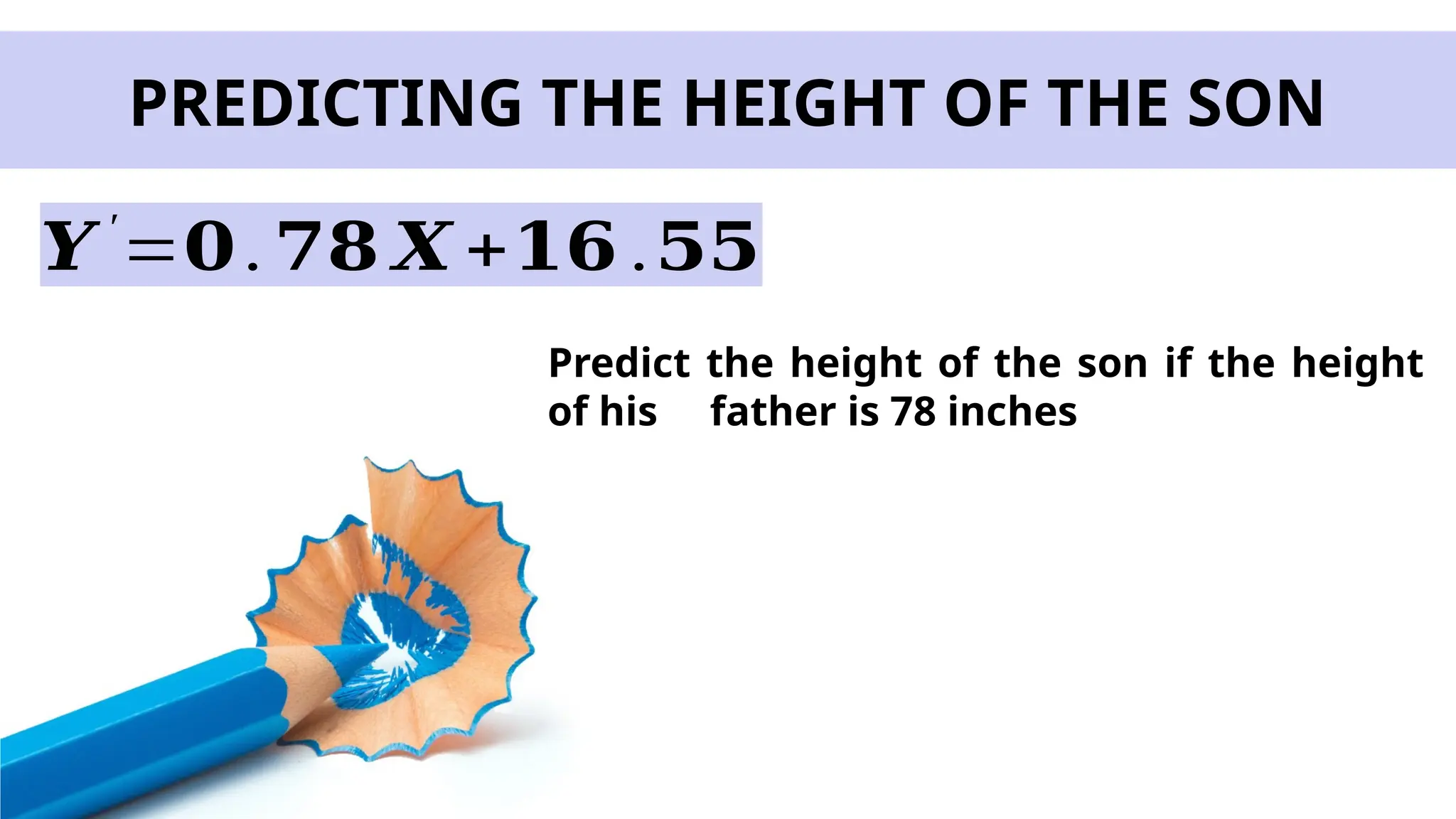
PREDICTING THE HEIGHT OF THE SON
Predict the height of the son if the height
of his father is 78 inches
𝒀 ′
=𝟎.𝟕𝟖 𝑿 +𝟏𝟔 .𝟓𝟓
EXPLORING THE
REGRESSION ANALYSIS
CHAPTER 6 l LESSON 3 l STATISTICS AND PROBABILITY

Lesson 3 Exploring the Regression Analysis.pptx

  • 1.
    EXPLORING THE REGRESSION ANALYSIS CHAPTER6 l LESSON 3 l STATISTICS AND PROBABILITY
  • 2.
    Identify the independentand dependent variable A B C D LEARNING COMPETENCI ES The learner… Calculate the slope and y- intercept of the regression line Interpret the calculated slope and y-intercept of the regression line Predict the value of the dependent variable given the value of the independent variable
  • 3.
  • 4.
    The formula forthe test statistic, where df = n – 2
  • 5.
    STEPS IN TESTINGTHE SIGNIFICANCE OF r Step 1. State the null and alternative hypotheses. Step 2. Compute for the value of t. Step 3. Compare the computed value of t with the critical value of t. The degree of freedom is n – 2. The test calls for a two-tailed test. Step 4. Decision and Conclusion
  • 6.
    PROBLEM 1. FAMILYINCOME AND SAVINGS A researcher investigated the relationship between family income and savings. Using the data from 15 families, the computed r between income and savings was found to be 0.76. Is the computed r significant at 0.05 level of significance? Can we conclude that the relationship really exists?
  • 7.
    PROBLEM 1. FAMILYINCOME AND SAVINGS A researcher investigated the relationship between family income and savings. Using the data from 15 families, the computed r between income and savings was found to be 0.76. Is the computed r significant at 0.05 level of significance? Can we conclude that the relationship really exists? Step 1. Hypotheses H0: There is no significant relationship between family income and savings (r = 0). H1: There is a significant relationship between family income and savings (r ≠ 0). Step 2. Compute for the value of t Given: n = 15 r = 0.76
  • 8.
    PROBLEM 1. FAMILYINCOME AND SAVINGS A researcher investigated the relationship between family income and savings. Using the data from 15 families, the computed r between income and savings was found to be 0.76. Is the computed r significant at 0.05 level of significance? Can we conclude that the relationship really exists? Step 3. Compare with the critical value Degree of freedom = n – 2 = 15 – 2 = 13 Using the t-table for two-tailed, t = 2.16 Computed t > critical value 4.22 > 2.16 (reject H0) Step 4. Decision and Conclusion We reject the null hypothesis. Thus, there is a significant relationship between family income and savings.
  • 9.
    PROBLEM 2. IQSCORES AND AGE A researcher would like to know if IQ scores are related to age. Using 10 high school students, he found out that computed r is 0.58. At 0.05 level of significance, can he conclude that the relationship really exists in the population?
  • 10.
    PROBLEM 2. IQSCORES AND AGE A researcher would like to know if IQ scores are related to age. Using 10 high school students, he found out that computed r is 0.58. At 0.05 level of significance, can he conclude that the relationship really exists in the population? Step 1. Hypotheses H0: There is no significant relationship between IQ scores and age (r = 0). H1: There is a significant relationship between IQ scores and age (r ≠ 0). Step 2. Compute for the value of t Given: n = 10 r = 0.58
  • 11.
    PROBLEM 2. IQSCORES AND AGE A researcher would like to know if IQ scores are related to age. Using 10 high school students, he found out that computed r is 0.58. At 0.05 level of significance, can he conclude that the relationship really exists in the population? Step 3. Compare with the critical value Degree of freedom = n – 2 = 10 – 2 = 8 Using the t-table for two-tailed, t = 2.306 Computed t > critical value 2.01 < 2.306 (do not reject H0) Step 4. Decision and Conclusion We do not have sufficient evidence to reject the null hypothesis. Thus, there is no significant relationship between IQ scores and age.
  • 12.
    Note: If thecomputed r is significant, the regression analysis can be performed.
  • 13.
  • 14.
    Dependent variables Are variablesthat are being predicted or explained
  • 15.
    Independent variables Are variablesthat are being used to predict or explain the dependent variables
  • 16.
    When two variablesare related, one is the dependent variable while the other is the independent variable.
  • 17.
  • 18.
    Identify the dependentand independent variables in each pair of the following variables. Pair 1: Monthly Salary and annual income of the worker Dependent Variable: Independent Variable:
  • 19.
    Identify the dependentand independent variables in each pair of the following variables. Pair 1: Monthly Salary and annual income of the worker Annual income depends upon the monthly salary Dependent Variable: Annual Income Independent Variable: Monthly Salary
  • 20.
    Identify the dependentand independent variables in each pair of the following variables. Pair 2: IQ and academic performance of a student Dependent Variable: Independent Variable:
  • 21.
    Identify the dependentand independent variables in each pair of the following variables. Pair 2: IQ and academic performance of a student Academic performance depends upon the IQ Dependent Variable: Academic Performance Independent Variable: IQ
  • 22.
    Identify the dependentand independent variables in each pair of the following variables. Pair 3: Temperature and volume of air in a balloon Dependent Variable: Independent Variable:
  • 23.
    Identify the dependentand independent variables in each pair of the following variables. Pair 3: Temperature and volume of air in a balloon Volume of air in a balloon depends upon the temperature Dependent Variable: Volume of air in a balloon Independent Variable: Temperature
  • 24.
    Identify the dependentand independent variables in each pair of the following variables. Pair 4: Altitude and acceleration due to gravity Dependent Variable: Independent Variable:
  • 25.
    Identify the dependentand independent variables in each pair of the following variables. Pair 4: Altitude and acceleration due to gravity Acceleration depends upon altitude Dependent Variable: Acceleration Independent Variable: Altitude
  • 26.
    Identify the dependentand independent variables in each pair of the following variables. Pair 5: Demand and price of goods Dependent Variable: Independent Variable:
  • 27.
    Identify the dependentand independent variables in each pair of the following variables. Pair 5: Height of the son and height of the father Height of the son depends upon the height of the father Dependent Variable: Height of the Son Independent Variable: Height of the Father
  • 28.
    TREND LINE The line“closest” to the points in the scatterplot
  • 31.
    The points inthe scatterplot regress with reference to
  • 32.
    The regression lineis the same as the trend line.
  • 33.
    THE REGRESSION LINE(THE LINE OF BEST FIT) The equation Y’ = bX + a is the equation of the regression line, Where a = y-intercept andb = slope of the regression line 𝑎= (∑ 𝑌 )(∑ 𝑋2 )− (∑ 𝑋 )(∑ 𝑋𝑌 ) 𝑛 (∑ 𝑋 2 )− (∑ 𝑋 ) 2 𝑏= 𝑛(∑ 𝑋𝑌 )− (∑ 𝑋 )(∑ 𝑌 ) 𝑛(∑ 𝑋 2 )−(∑ 𝑋 ) 2
  • 34.
    REVIEW ON SLOPE ANDY- INTERCEPT
  • 35.
    Determine the slopeand y- intercept in the following linear equations: a)y = 3x – 5 b)y = -4x
  • 36.
    PREDICTING THE VALUEOF Y IF X IS KNOWN The regression line Y’ = bX + a is also called the line of prediction. Since in the analysis, only the y distance was considered, the line cannot be used to predict X from Y.
  • 37.
    PREDICTING THE VALUEOF Y IF X IS KNOWN Step 1. Find the value of the correlation coefficient. Step 2. Test the significance of r. If r is significant, proceed to the regression analysis (Proceed to Step 3). If r is not significant, regression analysis cannot be done (Stop).
  • 38.
    PREDICTING THE VALUEOF Y IF X IS KNOWN Step 3. Find the values of a and b. Step 4. Substitute the values a and b in the regression line Y’ = bX + a.
  • 39.
    PROBLEM 3. NUMBEROF ABSENCES AND NUMBER OF MISSED QUIZZES The following data shows number of absences and the number of quizzes missed by five students. Solve for the correlation coefficient and test for its significance. If there is a significant relationship between two variables, predict the number of quizzes missed by a student who was absent for 6 days. Student Number of Absences Number of Missed Quizzes 1 1 1 2 1 2 3 2 4 4 3 2 5 4 4
  • 40.
    Solving for theCorrelation Coefficient Step 1. Identify the dependent and independent variables Number of missed quizzes depend on the number of absences Dependent Variable: Number of missed quizzes Independent Variable: Number of absences Student Number of Absences (X) Number of Missed Quizzes (Y) 1 1 1 2 1 2 3 2 4 4 3 2 5 4 4
  • 41.
    Solving for theCorrelation Coefficient Step 2. Compute for the correlation coefficient 𝑟 = 𝑛∑ 𝑋𝑌 −(∑ 𝑋 )(∑ 𝑌 ) √[𝑛∑ 𝑋2 −(∑ 𝑋 ) 2 ][𝑛∑ 𝑌 2 −(∑ 𝑌 ) 2 ] Student X Y X2 Y2 XY 1 1 1 2 1 2 3 2 4 4 3 2 5 4 4
  • 42.
    Solving for theCorrelation Coefficient Step 2. Compute for the correlation coefficient 𝑟 = 5(33)−(11)(13) √[5(31)−(11) 2 ][5( 41)−(13) 2 ] Student X Y X2 Y2 XY 1 1 1 1 1 1 2 1 2 1 4 2 3 2 4 4 16 8 4 3 2 9 4 6 5 4 4 16 16 16
  • 43.
    Solving for theCorrelation Coefficient Step 2. Compute for the correlation coefficient 𝑟= 5(33)−(11)(13) √[5(31)−(11) 2 ][5(41)−(13) 2 ] = 22 √(34)(36) =𝟎.𝟔𝟑 Student X Y X2 Y2 XY 1 1 1 1 1 1 2 1 2 1 4 2 3 2 4 4 16 8 4 3 2 9 4 6 5 4 4 16 16 16
  • 44.
    Testing the Significanceof r Step 1. State the hypotheses H0: There is no significant relationship between the number of absences and the number of missed quizzes. H1: There is a significant relationship between the number of absences and the number of missed quizzes.
  • 45.
    Testing the Significanceof r Step 2. Compute for the Value of t Given: n = 5 r = 0.63
  • 46.
    Testing the Significanceof r Step 3. Compare computed value with critical value Degree of Freedom = 5 – 2 = 3 Critical Value: t = 3.182 Computed Value < Critical Value 1.41 < 3.182 (do not reject H0)
  • 47.
    Testing the Significanceof r Step 4. Decision and Conclusion We do not have sufficient evidence to reject the null hypothesis. Thus, there is no significant relationship between the number of missed classes and the number of absences. Note: Since there is no significant relationship between number of absences and number of missed quizzes, then we will not proceed to regression analysis.
  • 48.
    PROBLEM 4. HEIGHTOF THE FATHER AND SON The following data pertains to the heights of fathers and their eldest sons in inches. If there is a significant relationship between the two variables, predict the height of the son if the height of his father is 78 inches. Height of the Father Height of the Son 71 71 69 69 69 71 65 68 66 68 63 66 68 70 70 72 60 65 58 60
  • 49.
    SOLVING FOR CORRELATIONCOEFFICIENT Dependent Variable: Height of the Son Independent Variable: Height of the Father X Y X2 Y2 XY 71 71 69 69 69 71 65 68 66 68 63 66 68 70 70 72 60 65 58 60
  • 50.
    SOLVING FOR CORRELATIONCOEFFICIENT Dependent Variable: Height of the Son Independent Variable: Height of the Father X Y X2 Y2 XY 71 71 5041 5041 5041 69 69 4761 4761 4761 69 71 4761 5041 4899 65 68 4225 4624 4420 66 68 4356 4624 4488 63 66 3969 4356 4158 68 70 4624 4900 4760 70 72 4900 5184 5040 60 65 3600 4225 3900 58 60 3364 3600 3480
  • 51.
    SOLVING FOR CORRELATIONCOEFFICIENT X Y X2 Y2 XY 71 71 5041 5041 5041 69 69 4761 4761 4761 69 71 4761 5041 4899 65 68 4225 4624 4420 66 68 4356 4624 4488 63 66 3969 4356 4158 68 70 4624 4900 4760 70 72 4900 5184 5040 60 65 3600 4225 3900 58 60 3364 3600 3480 𝑟= 𝑛∑𝑋𝑌−(∑𝑋)(∑𝑌) √[𝑛∑𝑋 2 −(∑𝑋) 2 ][𝑛∑𝑌 2 −(∑𝑌) 2 ]
  • 52.
    SOLVING FOR CORRELATIONCOEFFICIENT X Y X2 Y2 XY 71 71 5041 5041 5041 69 69 4761 4761 4761 69 71 4761 5041 4899 65 68 4225 4624 4420 66 68 4356 4624 4488 63 66 3969 4356 4158 68 70 4624 4900 4760 70 72 4900 5184 5040 60 65 3600 4225 3900 58 60 3364 3600 3480 𝑟= (10)(44,947)−(659)(680) √[10(43601)−(659) 2 ][10(46356)−(680) 2 ] = 1350 √(1729)(1160) =𝟎.𝟗𝟓
  • 53.
    TESTING THE SIGNIFICANCEOF r Given: n = 10 r = 0.95 Step 1. Hypotheses H0: There is no significant relationship between the height of the son and the height of the father. H1: There is a significant relationship between the height of the son and the height of the father. Step 2. Compute for the value of t
  • 54.
    TESTING THE SIGNIFICANCEOF r Given: n = 10 r = 0.95 Step 3. Compare computed t with critical value Degree of freedom = 10 – 2 = 8 Using the t-table (two-tailed), t = 2.306 Computed value > critical value 8.61 > 2.306 (reject H0) Step 4. Decision and Conclusion We reject the null hypothesis. Thus, there is a significant relationship between the height of the father and the height of the son.
  • 55.
    PREDICTING THE HEIGHTOF THE SON Solving for the regression line equation Y’ = bX + a X Y X2 Y2 XY
  • 56.
    PREDICTING THE HEIGHTOF THE SON Solving for the regression line equation Y’ = bX + a X Y X2 Y2 XY 𝒀 ′ =𝟎 . 𝟕𝟖 𝑿 +𝟏𝟔 .𝟓𝟓
  • 57.
    PREDICTING THE HEIGHTOF THE SON Predict the height of the son if the height of his father is 78 inches 𝒀 ′ =𝟎.𝟕𝟖 𝑿 +𝟏𝟔 .𝟓𝟓
  • 58.
    EXPLORING THE REGRESSION ANALYSIS CHAPTER6 l LESSON 3 l STATISTICS AND PROBABILITY