USING SCIENTIFIC NOTATIONS IN
CALCULATIONS
USING SCIENTIFIC NOTATIONS IN
CALCULATIONS
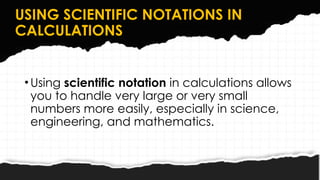
•Using scientific notation in calculations allows
you to handle very large or very small
numbers more easily, especially in science,
engineering, and mathematics.
USING SCIENTIFIC NOTATIONS IN
CALCULATIONS
EXAMPLE:
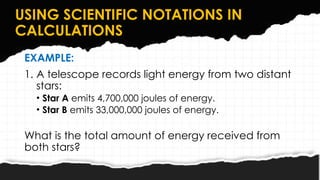
1. A telescope records light energy from two distant
stars:
• Star A emits 4,700,000 joules of energy.
• Star B emits 33,000,000 joules of energy.
What is the total amount of energy received from
both stars?
USING SCIENTIFIC NOTATIONS IN
CALCULATIONS
EXAMPLE:
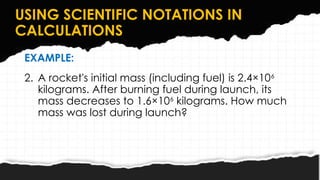
2. A rocket's initial mass (including fuel) is 2.4×10⁶
kilograms. After burning fuel during launch, its
mass decreases to 1.6×10⁶
kilograms. How much
mass was lost during launch?
USING SCIENTIFIC NOTATIONS IN
CALCULATIONS
EXAMPLE:
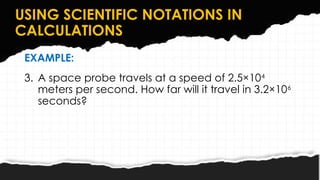
3. A space probe travels at a speed of 2.5×10⁴
meters per second. How far will it travel in 3.2×10⁶
seconds?
USING SCIENTIFIC NOTATIONS IN
CALCULATIONS
EXAMPLE:
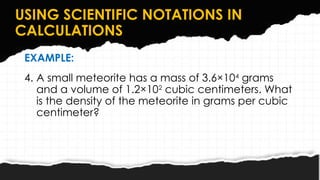
4. A small meteorite has a mass of 3.6×10⁴
grams
and a volume of 1.2×10²
cubic centimeters. What
is the density of the meteorite in grams per cubic
centimeter?
USING SCIENTIFIC NOTATIONS IN
CALCULATIONS
TRY THIS OUT!
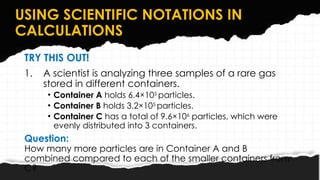
1. A scientist is analyzing three samples of a rare gas
stored in different containers.
• Container A holds 6.4×10⁵
particles.
• Container B holds 3.2×10⁵
particles.
• Container C has a total of 9.6×10⁶
particles, which were
evenly distributed into 3 containers.
Question:
How many more particles are in Container A and B
combined compared to each of the smaller containers from
C?
MULTIPLYING SCIENTIFIC NOTATION
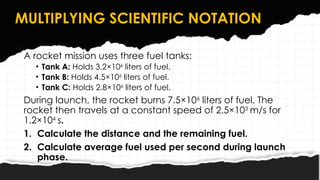
A rocket mission uses three fuel tanks:
• Tank A: Holds 3.2×10⁶
liters of fuel.
• Tank B: Holds 4.5×10⁶
liters of fuel.
• Tank C: Holds 2.8×10⁶
liters of fuel.
During launch, the rocket burns 7.5×10⁶
liters of fuel. The
rocket then travels at a constant speed of 2.5×10³
m/s for
1.2×10⁴
s.
1. Calculate the distance and the remaining fuel.
2. Calculate average fuel used per second during launch
phase.

USING SCIENTIFIC NOTATIONS IN
COMPUTATIONS
LESSON 2. USING SCIENTIFIC NOTATIONS IN CALCULATIONS.pptx

LESSON 2. USING SCIENTIFIC NOTATIONS IN CALCULATIONS.pptx

  • 2.
  • 3.
    USING SCIENTIFIC NOTATIONSIN CALCULATIONS •Using scientific notation in calculations allows you to handle very large or very small numbers more easily, especially in science, engineering, and mathematics.
  • 4.
    USING SCIENTIFIC NOTATIONSIN CALCULATIONS EXAMPLE: 1. A telescope records light energy from two distant stars: • Star A emits 4,700,000 joules of energy. • Star B emits 33,000,000 joules of energy. What is the total amount of energy received from both stars?
  • 5.
    USING SCIENTIFIC NOTATIONSIN CALCULATIONS EXAMPLE: 2. A rocket's initial mass (including fuel) is 2.4×10⁶ kilograms. After burning fuel during launch, its mass decreases to 1.6×10⁶ kilograms. How much mass was lost during launch?
  • 6.
    USING SCIENTIFIC NOTATIONSIN CALCULATIONS EXAMPLE: 3. A space probe travels at a speed of 2.5×10⁴ meters per second. How far will it travel in 3.2×10⁶ seconds?
  • 7.
    USING SCIENTIFIC NOTATIONSIN CALCULATIONS EXAMPLE: 4. A small meteorite has a mass of 3.6×10⁴ grams and a volume of 1.2×10² cubic centimeters. What is the density of the meteorite in grams per cubic centimeter?
  • 8.
    USING SCIENTIFIC NOTATIONSIN CALCULATIONS TRY THIS OUT! 1. A scientist is analyzing three samples of a rare gas stored in different containers. • Container A holds 6.4×10⁵ particles. • Container B holds 3.2×10⁵ particles. • Container C has a total of 9.6×10⁶ particles, which were evenly distributed into 3 containers. Question: How many more particles are in Container A and B combined compared to each of the smaller containers from C?
  • 9.
    MULTIPLYING SCIENTIFIC NOTATION Arocket mission uses three fuel tanks: • Tank A: Holds 3.2×10⁶ liters of fuel. • Tank B: Holds 4.5×10⁶ liters of fuel. • Tank C: Holds 2.8×10⁶ liters of fuel. During launch, the rocket burns 7.5×10⁶ liters of fuel. The rocket then travels at a constant speed of 2.5×10³ m/s for 1.2×10⁴ s. 1. Calculate the distance and the remaining fuel. 2. Calculate average fuel used per second during launch phase.
  • 10.