Presented by Sufi Mohamed The Glaring Facts Search Engine Optimization: Lesson 2:  PPC vs. Natural Results
Agenda The Market Share of Search Engines Determine the Searcher’s Reason How Search Engines Drive Commerce on the Web How Users Scan Results Pages How Users Click on Results: Natural vs. Paid
Understanding Search Engine Market Share Who should you pay attention to? Which search engine will benefit you the best? Who will you tailor your SEO efforts towards?
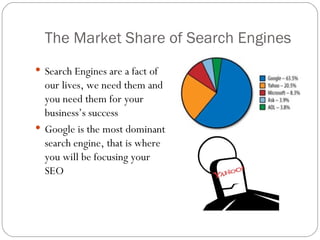
The Market Share of Search Engines Search Engines are a fact of our lives, we need them and you need them for your business’s success Google is the most dominant search engine, that is where you will be focusing your SEO
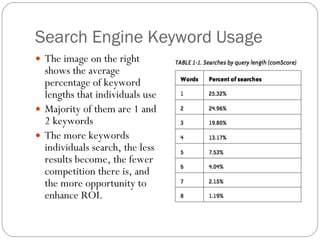
Search Engine Keyword Usage The image on the right shows the average percentage of keyword lengths that individuals use Majority of them are 1 and 2 keywords The more keywords individuals search, the less results become, the fewer competition there is, and the more opportunity to enhance ROI.
How do Users use Search Engines?  What kind of information will benefit you? What can you expect of users who use Search Engines? What types of SE users are there?
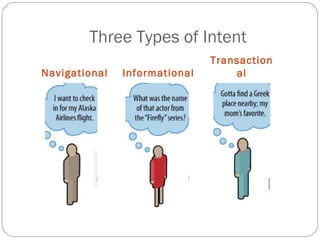
Search Engine Users Have Intent Search Engines are  tools Search  intent  remains the same, but search keywords are fluctuating There are three types of search queries and they have different functions  Navigational Queries Performed with the intent of surfing directly to a specific website (predetermined) Informational Queries Involve a huge range of searchers, random and information-seeking Transactional Queries Registering, paying bills, identifying a local business, making a purchase online, completing a task.
Three Types of Intent Navigational Informational Transactional
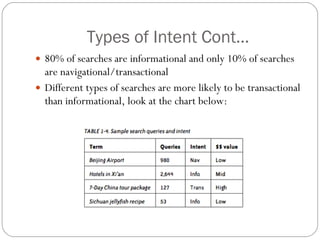
Types of Intent Cont… 80% of searches are informational and only 10% of searches are navigational/transactional Different types of searches are more likely to be transactional than informational, look at the chart below:
Types of Intent Cont… Even though informational searches are less likely to convert into sales, you cannot ignore it’s 80% share of the types of inquiries. Build relationships, encourage transactional behaviour Most users do not know how to use search engines, maening, they will most likely type 2-3 keywords and come up with very non-specific results General inquires are thus more attractive to businesses If companies buying Pay-Per-Click (PPC) search ads bought only high-converting navigational and transactional terms and left informational ones to competitors, they would lose market share to those competitors
How Search Engines Drive Commerce on the Web
Crazy Statistics E-commerce sales reported by the U.S. Census Bureau were a healthy $31.9 billion through 2008 (http: //www.census.gov/mrts/www/data/pdf/08Q4.pdf) 74% of respondents used search engines to  find local business information versus 65% who turned to print Yellow Pages , 50% who used Internet Yellow Pages, and 44% who used traditional newspapers. 86% surveyed said they have used the  Internet to find a local business , a rise from the 70% figure reported the year before 80% reported  researching a product or service online , then making that purchase offline from a local business WebVisible and Nielsen 2007 report on local search http://searchengineland.com/ survey-search-now-top-resource-for-local-information-12396
How Users Scan Results Pages How do Users see Google’s Search Results? Where will your content have to be on the results page?
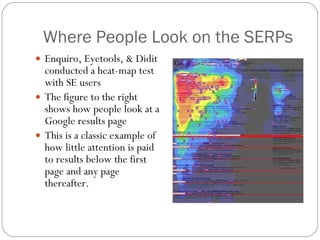
Where People Look on the SERPs Enquiro, Eyetools, & Didit conducted a heat-map test with SE users The figure to the right shows how people look at a Google results page This is a classic example of how little attention is paid to results below the first page and any page thereafter.
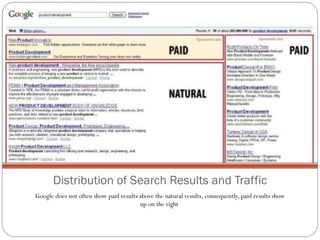
Distribution of Search Results and Traffic Google does not often show paid results above the natural results, consequently, paid results show up on the right
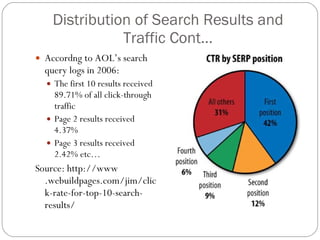
Distribution of Search Results and Traffic Cont… Accordng to AOL’s search query logs in 2006: The first 10 results received 89.71% of all click-through traffic Page 2 results received 4.37% Page 3 results received 2.42% etc… Source: http://www .webuildpages.com/jim/click-rate-for-top-10-search-results/
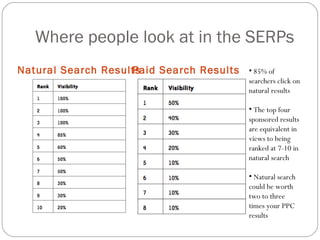
Where people look at in the SERPs Natural Search Results Paid Search Results 85% of searchers click on natural results The top four sponsored results are equivalent in views to being ranked at 7-10 in natural search Natural search could be worth two to three times your PPC results
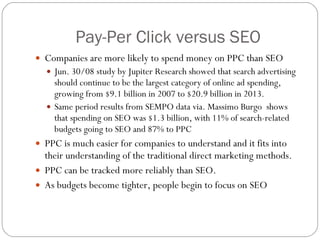
Pay-Per Click versus SEO Companies are more likely to spend money on PPC than SEO Jun. 30/08 study by Jupiter Research showed that search advertising should continue to be the largest category of online ad spending, growing from $9.1 billion in 2007 to $20.9 billion in 2013. Same period results from SEMPO data via. Massimo Burgo  shows that spending on SEO was $1.3 billion, with 11% of search-related budgets going to SEO and 87% to PPC PPC is much easier for companies to understand and it fits into their understanding of the traditional direct marketing methods.  PPC can be tracked more reliably than SEO. As budgets become tighter, people begin to focus on SEO
Conclusion
Why SEO is better than PPC Reasons why you should choose SEO rather than PPC More repetitive SERPs More reliable than in engaging users PPC (see the eye-tracking scan) Much cheaper than PPC Much more interactive, informative, and rewarding for a user Easier
Brought to you by Sufi M @  The Glaring Facts http://www.theglaringfacts.com

Lesson 2: Pay-Per-Click Vs Natural Results

  • 1.
    Presented by SufiMohamed The Glaring Facts Search Engine Optimization: Lesson 2: PPC vs. Natural Results
  • 2.
    Agenda The MarketShare of Search Engines Determine the Searcher’s Reason How Search Engines Drive Commerce on the Web How Users Scan Results Pages How Users Click on Results: Natural vs. Paid
  • 3.
    Understanding Search EngineMarket Share Who should you pay attention to? Which search engine will benefit you the best? Who will you tailor your SEO efforts towards?
  • 4.
    The Market Shareof Search Engines Search Engines are a fact of our lives, we need them and you need them for your business’s success Google is the most dominant search engine, that is where you will be focusing your SEO
  • 5.
    Search Engine KeywordUsage The image on the right shows the average percentage of keyword lengths that individuals use Majority of them are 1 and 2 keywords The more keywords individuals search, the less results become, the fewer competition there is, and the more opportunity to enhance ROI.
  • 6.
    How do Usersuse Search Engines? What kind of information will benefit you? What can you expect of users who use Search Engines? What types of SE users are there?
  • 7.
    Search Engine UsersHave Intent Search Engines are tools Search intent remains the same, but search keywords are fluctuating There are three types of search queries and they have different functions Navigational Queries Performed with the intent of surfing directly to a specific website (predetermined) Informational Queries Involve a huge range of searchers, random and information-seeking Transactional Queries Registering, paying bills, identifying a local business, making a purchase online, completing a task.
  • 8.
    Three Types ofIntent Navigational Informational Transactional
  • 9.
    Types of IntentCont… 80% of searches are informational and only 10% of searches are navigational/transactional Different types of searches are more likely to be transactional than informational, look at the chart below:
  • 10.
    Types of IntentCont… Even though informational searches are less likely to convert into sales, you cannot ignore it’s 80% share of the types of inquiries. Build relationships, encourage transactional behaviour Most users do not know how to use search engines, maening, they will most likely type 2-3 keywords and come up with very non-specific results General inquires are thus more attractive to businesses If companies buying Pay-Per-Click (PPC) search ads bought only high-converting navigational and transactional terms and left informational ones to competitors, they would lose market share to those competitors
  • 11.
    How Search EnginesDrive Commerce on the Web
  • 12.
    Crazy Statistics E-commercesales reported by the U.S. Census Bureau were a healthy $31.9 billion through 2008 (http: //www.census.gov/mrts/www/data/pdf/08Q4.pdf) 74% of respondents used search engines to find local business information versus 65% who turned to print Yellow Pages , 50% who used Internet Yellow Pages, and 44% who used traditional newspapers. 86% surveyed said they have used the Internet to find a local business , a rise from the 70% figure reported the year before 80% reported researching a product or service online , then making that purchase offline from a local business WebVisible and Nielsen 2007 report on local search http://searchengineland.com/ survey-search-now-top-resource-for-local-information-12396
  • 13.
    How Users ScanResults Pages How do Users see Google’s Search Results? Where will your content have to be on the results page?
  • 14.
    Where People Lookon the SERPs Enquiro, Eyetools, & Didit conducted a heat-map test with SE users The figure to the right shows how people look at a Google results page This is a classic example of how little attention is paid to results below the first page and any page thereafter.
  • 15.
    Distribution of SearchResults and Traffic Google does not often show paid results above the natural results, consequently, paid results show up on the right
  • 16.
    Distribution of SearchResults and Traffic Cont… Accordng to AOL’s search query logs in 2006: The first 10 results received 89.71% of all click-through traffic Page 2 results received 4.37% Page 3 results received 2.42% etc… Source: http://www .webuildpages.com/jim/click-rate-for-top-10-search-results/
  • 17.
    Where people lookat in the SERPs Natural Search Results Paid Search Results 85% of searchers click on natural results The top four sponsored results are equivalent in views to being ranked at 7-10 in natural search Natural search could be worth two to three times your PPC results
  • 18.
    Pay-Per Click versusSEO Companies are more likely to spend money on PPC than SEO Jun. 30/08 study by Jupiter Research showed that search advertising should continue to be the largest category of online ad spending, growing from $9.1 billion in 2007 to $20.9 billion in 2013. Same period results from SEMPO data via. Massimo Burgo shows that spending on SEO was $1.3 billion, with 11% of search-related budgets going to SEO and 87% to PPC PPC is much easier for companies to understand and it fits into their understanding of the traditional direct marketing methods. PPC can be tracked more reliably than SEO. As budgets become tighter, people begin to focus on SEO
  • 19.
  • 20.
    Why SEO isbetter than PPC Reasons why you should choose SEO rather than PPC More repetitive SERPs More reliable than in engaging users PPC (see the eye-tracking scan) Much cheaper than PPC Much more interactive, informative, and rewarding for a user Easier
  • 21.
    Brought to youby Sufi M @ The Glaring Facts http://www.theglaringfacts.com