Unit 6 Digital Signal Processing
Lesson 17 Digital signal processors
25/1/31 2
Lesson 17 Digital signal processors
• Backgrounds
• Text tour
• Language in use
– Vocabulary
25/1/31 3
• Terminology
– Von Neumann architecture
– Harvard architecture
– Accumulator
– Shifter
– circular buffer
Backgrounds
25/1/31 4
• Terminology
– Fixed point
– Floating point
– Mantissa
– Exponent
– parallel architecture
Backgrounds
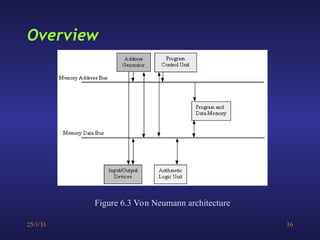
Von Neumann architecture
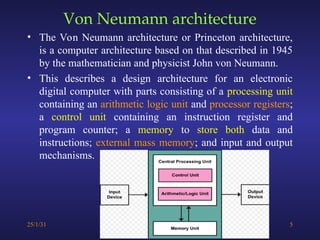
• The Von Neumann architecture or Princeton architecture,
is a computer architecture based on that described in 1945
by the mathematician and physicist John von Neumann.
• This describes a design architecture for an electronic
digital computer with parts consisting of a processing unit
containing an arithmetic logic unit and processor registers;
a control unit containing an instruction register and
program counter; a memory to store both data and
instructions; external mass memory; and input and output
mechanisms.
25/1/31 5
Harvard architecture
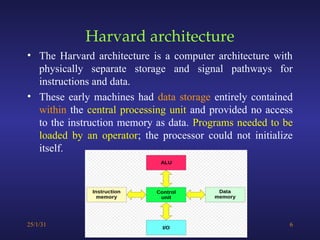
• The Harvard architecture is a computer architecture with
physically separate storage and signal pathways for
instructions and data.
• These early machines had data storage entirely contained
within the central processing unit and provided no access
to the instruction memory as data. Programs needed to be
loaded by an operator; the processor could not initialize
itself.
25/1/31 6
Accumulator
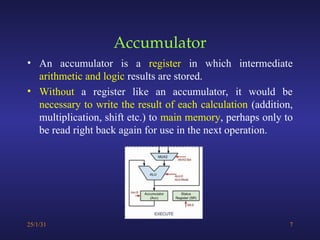
• An accumulator is a register in which intermediate
arithmetic and logic results are stored.
• Without a register like an accumulator, it would be
necessary to write the result of each calculation (addition,
multiplication, shift etc.) to main memory, perhaps only to
be read right back again for use in the next operation.
25/1/31 7
Shifter
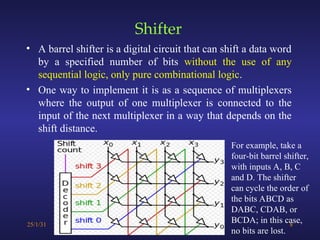
• A barrel shifter is a digital circuit that can shift a data word
by a specified number of bits without the use of any
sequential logic, only pure combinational logic.
• One way to implement it is as a sequence of multiplexers
where the output of one multiplexer is connected to the
input of the next multiplexer in a way that depends on the
shift distance.
25/1/31 8
For example, take a
four-bit barrel shifter,
with inputs A, B, C
and D. The shifter
can cycle the order of
the bits ABCD as
DABC, CDAB, or
BCDA; in this case,
no bits are lost.
25/1/31 9
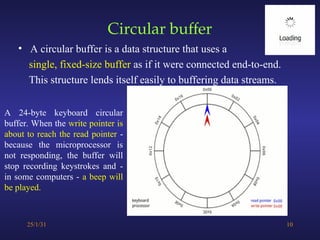
Circular buffer
• A circular buffer is a data structure that uses a
single, fixed-size buffer as if it were connected end-to-end.
This structure lends itself easily to buffering data streams.
25/1/31 10
A 24-byte keyboard circular
buffer. When the write pointer is
about to reach the read pointer -
because the microprocessor is
not responding, the buffer will
stop recording keystrokes and -
in some computers - a beep will
be played.
Fixed point
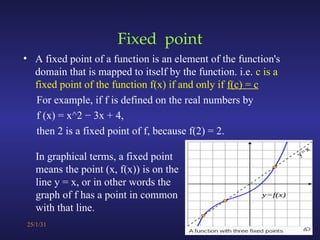
• A fixed point of a function is an element of the function's
domain that is mapped to itself by the function. i.e. c is a
fixed point of the function f(x) if and only if f(c) = c
For example, if f is defined on the real numbers by
f (x) = x^2 − 3x + 4,
then 2 is a fixed point of f, because f(2) = 2.
25/1/31 11
In graphical terms, a fixed point
means the point (x, f(x)) is on the
line y = x, or in other words the
graph of f has a point in common
with that line.
Floating point
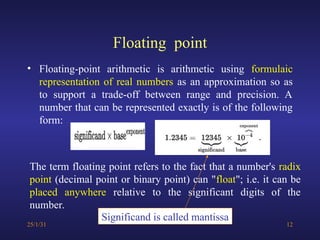
• Floating-point arithmetic is arithmetic using formulaic
representation of real numbers as an approximation so as
to support a trade-off between range and precision. A
number that can be represented exactly is of the following
form:
25/1/31 12
The term floating point refers to the fact that a number's radix
point (decimal point or binary point) can "float"; i.e. it can be
placed anywhere relative to the significant digits of the
number.
Significand is called mantissa
Parallel architecture
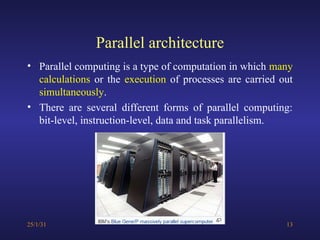
• Parallel computing is a type of computation in which many
calculations or the execution of processes are carried out
simultaneously.
• There are several different forms of parallel computing:
bit-level, instruction-level, data and task parallelism.
25/1/31 13
25/1/31 14
Text tour
• Outline
– Overview
– Data formats
– Selection of DSPs
– Purchasing DSPs
– Summary
25/1/31 15
• Digital signal processing tasks can be performed by
all processors. Specialized digital signal processors
(DSPs), however, perform these tasks most efficiently
and most quickly.
– The Harvard or modified Harvard architecture
• multiple memories and buses
– Fast multipliers, accumulators and shifters
– Hardware support for circular buffers
– Address generators
Overview
25/1/31 16
Overview
Figure 6.3 Von Neumann architecture
25/1/31 17
Overview
Figure 6.4 Harvard architecture
25/1/31 18
• DSPs are available in two major classes:
– fixed point
– floating point
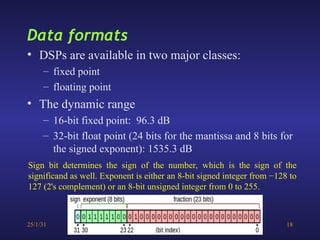
• The dynamic range
– 16-bit fixed point: 96.3 dB
– 32-bit float point (24 bits for the mantissa and 8 bits for
the signed exponent): 1535.3 dB
Data formats
Sign bit determines the sign of the number, which is the sign of the
significand as well. Exponent is either an 8-bit signed integer from −128 to
127 (2's complement) or an 8-bit unsigned integer from 0 to 255.
25/1/31 19
• Choosing a DSP for a particular application is not
always easy.
– The first decision is on whether to choose a fixed point
or a floating point device
• fixed point devices are cheaper and quicker
• floating point devices are more convenient to program and
more suited to calculation-intensive algorithms
– The data width of the DSP determines how accurately it
can represent numbers.
Selection of DSPs
25/1/31 20
– Speed is another issue, not only how many cycles occur
in each second but also how many instructions execute
in each cycle and how much work each of these
instructions accomplishes.
– The specific hardware and software features offered by
a particular DSP can make one choice better than
another, as can the amount of on-chip memory
available.
Selection of DSPs
25/1/31 21
• DSPs can be purchased in three forms
– as a core
– as a processor
– as a board level product.
Purchasing DSPs
25/1/31 22
• The distinction between DSPs and other microprocessors
is not always a clear line.
• it is very possible that the Digital Signal Processor may be
the "traditional" microprocessor.
Summary
25/1/31 23
• Vocabulary
– Intensive, loop, share
Language in use
25/1/31 24
Vocabulary
25/1/31 25
Intensive in dictionary
• Of, relating to, or characterized by intensity:
– intensive training.
• concentrated on a single area or subject or into a short time; very
thorough or vigorous
• Relating to or being a method especially of land cultivation
intended to increase the productivity of a fixed area by means of an
increase in capital and labor.
25/1/31 26
Intensive in text
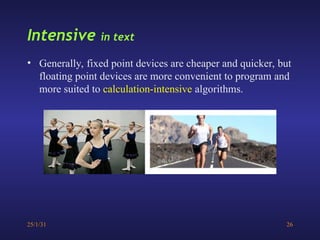
• Generally, fixed point devices are cheaper and quicker, but
floating point devices are more convenient to program and
more suited to calculation-intensive algorithms.
25/1/31 27
Loop in dictionary
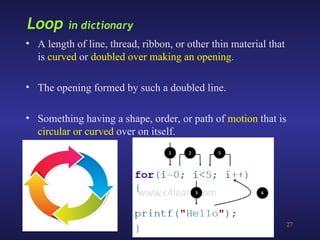
• A length of line, thread, ribbon, or other thin material that
is curved or doubled over making an opening.
• The opening formed by such a doubled line.
• Something having a shape, order, or path of motion that is
circular or curved over on itself.
25/1/31 28
Loop in text
• Other constructs that are frequently offered are efficient
looping schemes, since so many DSP operations involve a
great deal of repetition.
25/1/31 29
Loop in use
• automatic tracking loop
• feedback control loop
• ground loop
• infinite loop
• local loop
• phase-locked loop
• receiving loop
25/1/31 30
Share in dictionary
• A part or portion belonging to, distributed to, contributed
by, or owed by a person or group.
• An equitable portion:
– do one's share of the work.
25/1/31 31
Share in text
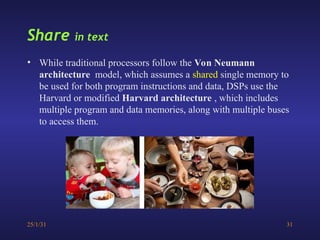
• While traditional processors follow the Von Neumann
architecture model, which assumes a shared single memory to
be used for both program instructions and data, DSPs use the
Harvard or modified Harvard architecture , which includes
multiple program and data memories, along with multiple buses
to access them.
25/1/31 32
Share in use
• Participate implies taking part in something, such as an
activity, together with another or others
• Partake often refers to having or taking a portion of
something, such as food; it can also mean to have part
of the quality, nature, or character of something
Thank You
25/1/31 33

Lesson 17 Digital signal processors (Lecture 9).ppt

  • 1.
    Unit 6 DigitalSignal Processing Lesson 17 Digital signal processors
  • 2.
    25/1/31 2 Lesson 17Digital signal processors • Backgrounds • Text tour • Language in use – Vocabulary
  • 3.
    25/1/31 3 • Terminology –Von Neumann architecture – Harvard architecture – Accumulator – Shifter – circular buffer Backgrounds
  • 4.
    25/1/31 4 • Terminology –Fixed point – Floating point – Mantissa – Exponent – parallel architecture Backgrounds
  • 5.
    Von Neumann architecture •The Von Neumann architecture or Princeton architecture, is a computer architecture based on that described in 1945 by the mathematician and physicist John von Neumann. • This describes a design architecture for an electronic digital computer with parts consisting of a processing unit containing an arithmetic logic unit and processor registers; a control unit containing an instruction register and program counter; a memory to store both data and instructions; external mass memory; and input and output mechanisms. 25/1/31 5
  • 6.
    Harvard architecture • TheHarvard architecture is a computer architecture with physically separate storage and signal pathways for instructions and data. • These early machines had data storage entirely contained within the central processing unit and provided no access to the instruction memory as data. Programs needed to be loaded by an operator; the processor could not initialize itself. 25/1/31 6
  • 7.
    Accumulator • An accumulatoris a register in which intermediate arithmetic and logic results are stored. • Without a register like an accumulator, it would be necessary to write the result of each calculation (addition, multiplication, shift etc.) to main memory, perhaps only to be read right back again for use in the next operation. 25/1/31 7
  • 8.
    Shifter • A barrelshifter is a digital circuit that can shift a data word by a specified number of bits without the use of any sequential logic, only pure combinational logic. • One way to implement it is as a sequence of multiplexers where the output of one multiplexer is connected to the input of the next multiplexer in a way that depends on the shift distance. 25/1/31 8 For example, take a four-bit barrel shifter, with inputs A, B, C and D. The shifter can cycle the order of the bits ABCD as DABC, CDAB, or BCDA; in this case, no bits are lost.
  • 9.
  • 10.
    Circular buffer • Acircular buffer is a data structure that uses a single, fixed-size buffer as if it were connected end-to-end. This structure lends itself easily to buffering data streams. 25/1/31 10 A 24-byte keyboard circular buffer. When the write pointer is about to reach the read pointer - because the microprocessor is not responding, the buffer will stop recording keystrokes and - in some computers - a beep will be played.
  • 11.
    Fixed point • Afixed point of a function is an element of the function's domain that is mapped to itself by the function. i.e. c is a fixed point of the function f(x) if and only if f(c) = c For example, if f is defined on the real numbers by f (x) = x^2 − 3x + 4, then 2 is a fixed point of f, because f(2) = 2. 25/1/31 11 In graphical terms, a fixed point means the point (x, f(x)) is on the line y = x, or in other words the graph of f has a point in common with that line.
  • 12.
    Floating point • Floating-pointarithmetic is arithmetic using formulaic representation of real numbers as an approximation so as to support a trade-off between range and precision. A number that can be represented exactly is of the following form: 25/1/31 12 The term floating point refers to the fact that a number's radix point (decimal point or binary point) can "float"; i.e. it can be placed anywhere relative to the significant digits of the number. Significand is called mantissa
  • 13.
    Parallel architecture • Parallelcomputing is a type of computation in which many calculations or the execution of processes are carried out simultaneously. • There are several different forms of parallel computing: bit-level, instruction-level, data and task parallelism. 25/1/31 13
  • 14.
    25/1/31 14 Text tour •Outline – Overview – Data formats – Selection of DSPs – Purchasing DSPs – Summary
  • 15.
    25/1/31 15 • Digitalsignal processing tasks can be performed by all processors. Specialized digital signal processors (DSPs), however, perform these tasks most efficiently and most quickly. – The Harvard or modified Harvard architecture • multiple memories and buses – Fast multipliers, accumulators and shifters – Hardware support for circular buffers – Address generators Overview
  • 16.
    25/1/31 16 Overview Figure 6.3Von Neumann architecture
  • 17.
    25/1/31 17 Overview Figure 6.4Harvard architecture
  • 18.
    25/1/31 18 • DSPsare available in two major classes: – fixed point – floating point • The dynamic range – 16-bit fixed point: 96.3 dB – 32-bit float point (24 bits for the mantissa and 8 bits for the signed exponent): 1535.3 dB Data formats Sign bit determines the sign of the number, which is the sign of the significand as well. Exponent is either an 8-bit signed integer from −128 to 127 (2's complement) or an 8-bit unsigned integer from 0 to 255.
  • 19.
    25/1/31 19 • Choosinga DSP for a particular application is not always easy. – The first decision is on whether to choose a fixed point or a floating point device • fixed point devices are cheaper and quicker • floating point devices are more convenient to program and more suited to calculation-intensive algorithms – The data width of the DSP determines how accurately it can represent numbers. Selection of DSPs
  • 20.
    25/1/31 20 – Speedis another issue, not only how many cycles occur in each second but also how many instructions execute in each cycle and how much work each of these instructions accomplishes. – The specific hardware and software features offered by a particular DSP can make one choice better than another, as can the amount of on-chip memory available. Selection of DSPs
  • 21.
    25/1/31 21 • DSPscan be purchased in three forms – as a core – as a processor – as a board level product. Purchasing DSPs
  • 22.
    25/1/31 22 • Thedistinction between DSPs and other microprocessors is not always a clear line. • it is very possible that the Digital Signal Processor may be the "traditional" microprocessor. Summary
  • 23.
    25/1/31 23 • Vocabulary –Intensive, loop, share Language in use
  • 24.
  • 25.
    25/1/31 25 Intensive indictionary • Of, relating to, or characterized by intensity: – intensive training. • concentrated on a single area or subject or into a short time; very thorough or vigorous • Relating to or being a method especially of land cultivation intended to increase the productivity of a fixed area by means of an increase in capital and labor.
  • 26.
    25/1/31 26 Intensive intext • Generally, fixed point devices are cheaper and quicker, but floating point devices are more convenient to program and more suited to calculation-intensive algorithms.
  • 27.
    25/1/31 27 Loop indictionary • A length of line, thread, ribbon, or other thin material that is curved or doubled over making an opening. • The opening formed by such a doubled line. • Something having a shape, order, or path of motion that is circular or curved over on itself.
  • 28.
    25/1/31 28 Loop intext • Other constructs that are frequently offered are efficient looping schemes, since so many DSP operations involve a great deal of repetition.
  • 29.
    25/1/31 29 Loop inuse • automatic tracking loop • feedback control loop • ground loop • infinite loop • local loop • phase-locked loop • receiving loop
  • 30.
    25/1/31 30 Share indictionary • A part or portion belonging to, distributed to, contributed by, or owed by a person or group. • An equitable portion: – do one's share of the work.
  • 31.
    25/1/31 31 Share intext • While traditional processors follow the Von Neumann architecture model, which assumes a shared single memory to be used for both program instructions and data, DSPs use the Harvard or modified Harvard architecture , which includes multiple program and data memories, along with multiple buses to access them.
  • 32.
    25/1/31 32 Share inuse • Participate implies taking part in something, such as an activity, together with another or others • Partake often refers to having or taking a portion of something, such as food; it can also mean to have part of the quality, nature, or character of something
  • 33.