LESSON-15
LEASE FINANCING, HIRE -
PURCHASE AND FACTORING
                                                                             Rekha Rani


STRUCTURE
15.0    Introduction
15.1    Objectives
15.2    Concept of Lease Financing
15.3    Meaning of Lease Financing
15.4    Importance of Lease Financing
15.5    Types of Lease Agreements
        15.5.1 Financial lease
        15.5.2 Operating lease
        15.5.3 Sale and lease back
        15.5.4 Leveraged leasing
        15.5.5 Direct leasing
15.6    Advantages of leasing
15.7    Leasing in India
15.8    Concept & Meaning of Hire purchase
15.9    Difference between Lease Financing and Hire Purchase
15.10   NSIC & Hire Purchase
15.11   Factoring
        15.11.1 Factoring procedure
        15.11.2 Merits
15.12   Summary
15.13   Glossary
15.14   Self Assessment Questions
15.15   Further Readings

15.0 INTRODUCTION
In order to start and sustain a business one needs finance. In the unit one on feasibility
study, you have already seen the process of estimating financial requirements. The
process involved (a) making a list of all the assets (b) identifying the sources of
supply (c) estimating the cost of acquisition when the assets are to be acquired on
outright basis. Then investment requirements as well as entrepreneur’s fear will
increase. To scare away the entrepreneur’s fear, the emphasis should be given to
resources and not to the ownership. In this unit we intend to familiarize you with
some important financial innovations i.e., leasing, hire purchase and factoring.


                                                                                      227
15.1 OBJECTIVES

After going through this unit you should be able to
• Describe the meaning of leasing
• Explain the role and importance of lease financing in economic development of a
   country
• Distinguish between the various types of leases
• Describe the meaning of hire purchase
• Distinguish between leasing and hire purchase
• Describe the meaning of factoring

15.2 CONCEPT 0F LEASE FINANCING

Lease financing denotes procurement of assets through lease. The subject of
leasing falls in the category of finance. Leasing has grown as a big industry in the
USA and UK and spread to other countries during the present century. In India,
the concept was pioneered in 1973 when the First Leasing Company was set up in
Madras and the eighties have seen a rapid growth of this business. Lease as a
concept involves a contract whereby the ownership, financing and risk taking of
any equipment or asset are separated and shared by two or more parties. Thus, the
lessor may finance and lessee may accept the risk through the use of it while a
third party may own it. Alternatively the lessor may finance and own it while the
lessee enjoys the use of it and bears the risk. There are various combinations in
which the above characteristics are shared by the lessor and lessee.

15.3 MEANING 0F LEASE FINANCING

A lease transaction is a commercial arrangement whereby an equipment owner or
Manufacturer conveys to the equipment user the right to use the equipment in return
for a rental. In other words, lease is a contract between the owner of an asset (the
lessor) and its user (the lessee) for the right to use the asset during a specified period
in return for a mutually agreed periodic payment (the lease rentals). The important
feature of a lease contract is separation of the ownership of the asset from its usage.
Lease financing is based on the observation made by Donald B. Grant:
“Why own a cow when the milk is so cheap? All you really need is milk and not the
cow.”

15.4 IMPORTANCE 0F LEASE FINANCING
Leasing industry plays an important role in the economic development of a country by
providing money incentives to lessee. The lessee does not have to pay the cost of asset
at the time of signing the contract of leases. Leasing contracts are more flexible so
lessees can structure the leasing contracts according to their needs for finance. The
lessee can also pass on the risk of obsolescence to the lessor by acquiring those


                                                                                       228
appliances, which have high technological obsolescence. To day, most of us are
familiar with leases of houses, apartments, offices, etc.


15.5 TYPES OF LEASE AGREEMENTS
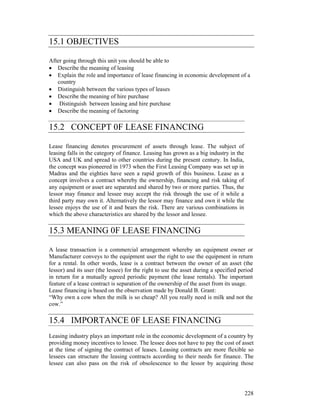
Lease agreements are basically of two types. They are (a) Financial lease and (b)
Operating lease. The other variations in lease agreements are (c) Sale and lease back
(d) Leveraged leasing and (e) Direct leasing.


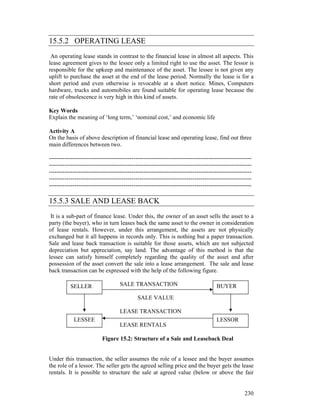
                                           LEASE
                                        AGREEMENTS


    CAPITAL           OPERATING        SALE AND LEASE        LEVERAGED        DIRECT LEASING
 LEASE/FINANCIA         LEASE               BACK              LEASING
    L LEASE


                                      Figure 15.1: Types of leases


15.5.1 FINANCIAL LEASE

 Long-term, non-cancellable lease contracts are known as financial leases. The
essential point of financial lease agreement is that it contains a condition whereby the
lessor agrees to transfer the title for the asset at the end of the lease period at a
nominal cost. At lease it must give an option to the lessee to purchase the asset he has
used at the expiry of the lease. Under this lease the lessor recovers 90% of the fair
value of the asset as lease rentals and the lease period is 75% of the economic life of
the asset. The lease agreement is irrevocable. Practically all the risks incidental to the
asset ownership and all the benefits arising there from are transferred to the lessee
who bears the cost of maintenance, insurance and repairs. Only title deeds remain
with the lessor. Financial lease is also known as ‘capital lease’. In India, financial
leases are very popular with high-cost and high technology equipment.


                                                                                      229
15.5.2 OPERATING LEASE
 An operating lease stands in contrast to the financial lease in almost all aspects. This
lease agreement gives to the lessee only a limited right to use the asset. The lessor is
responsible for the upkeep and maintenance of the asset. The lessee is not given any
uplift to purchase the asset at the end of the lease period. Normally the lease is for a
short period and even otherwise is revocable at a short notice. Mines, Computers
hardware, trucks and automobiles are found suitable for operating lease because the
rate of obsolescence is very high in this kind of assets.

Key Words
Explain the meaning of ‘long term,’ ‘nominal cost,’ and economic life

Activity A
On the basis of above description of financial lease and operating lease, find out three
main differences between two.

-------------------------------------------------------------------------------------------------------
-------------------------------------------------------------------------------------------------------
-------------------------------------------------------------------------------------------------------
-------------------------------------------------------------------------------------------------------
-------------------------------------------------------------------------------------------------------

15.5.3 SALE AND LEASE BACK
 It is a sub-part of finance lease. Under this, the owner of an asset sells the asset to a
party (the buyer), who in turn leases back the same asset to the owner in consideration
of lease rentals. However, under this arrangement, the assets are not physically
exchanged but it all happens in records only. This is nothing but a paper transaction.
Sale and lease back transaction is suitable for those assets, which are not subjected
depreciation but appreciation, say land. The advantage of this method is that the
lessee can satisfy himself completely regarding the quality of the asset and after
possession of the asset convert the sale into a lease arrangement. The sale and lease
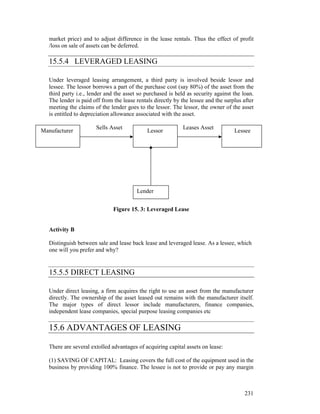
back transaction can be expressed with the help of the following figure.

          SELLER                    SALE TRANSACTION                                 BUYER
                                             SALE VALUE

                                    LEASE TRANSACTION
            LESSEE                                                                   LESSOR
                                    LEASE RENTALS

                           Figure 15.2: Structure of a Sale and Leaseback Deal


Under this transaction, the seller assumes the role of a lessee and the buyer assumes
the role of a lessor. The seller gets the agreed selling price and the buyer gets the lease
rentals. It is possible to structure the sale at agreed value (below or above the fair


                                                                                                   230
market price) and to adjust difference in the lease rentals. Thus the effect of profit
   /loss on sale of assets can be deferred.

   15.5.4 LEVERAGED LEASING

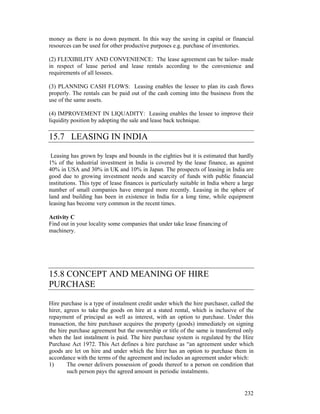
   Under leveraged leasing arrangement, a third party is involved beside lessor and
   lessee. The lessor borrows a part of the purchase cost (say 80%) of the asset from the
   third party i.e., lender and the asset so purchased is held as security against the loan.
   The lender is paid off from the lease rentals directly by the lessee and the surplus after
   meeting the claims of the lender goes to the lessor. The lessor, the owner of the asset
   is entitled to depreciation allowance associated with the asset.

                       Sells Asset                           Leases Asset
Manufacturer                                  Lessor                                Lessee
  L


                                         Lender


                               Figure 15. 3: Leveraged Lease


   Activity B

   Distinguish between sale and lease back lease and leveraged lease. As a lessee, which
   one will you prefer and why?


   15.5.5 DIRECT LEASING

   Under direct leasing, a firm acquires the right to use an asset from the manufacturer
   directly. The ownership of the asset leased out remains with the manufacturer itself.
   The major types of direct lessor include manufacturers, finance companies,
   independent lease companies, special purpose leasing companies etc

   15.6 ADVANTAGES OF LEASING

   There are several extolled advantages of acquiring capital assets on lease:

   (1) SAVING OF CAPITAL: Leasing covers the full cost of the equipment used in the
   business by providing 100% finance. The lessee is not to provide or pay any margin


                                                                                         231
money as there is no down payment. In this way the saving in capital or financial
resources can be used for other productive purposes e.g. purchase of inventories.

(2) FLEXIBILITY AND CONVENIENCE: The lease agreement can be tailor- made
in respect of lease period and lease rentals according to the convenience and
requirements of all lessees.

(3) PLANNING CASH FLOWS: Leasing enables the lessee to plan its cash flows
properly. The rentals can be paid out of the cash coming into the business from the
use of the same assets.

(4) IMPROVEMENT IN LIQUADITY: Leasing enables the lessee to improve their
liquidity position by adopting the sale and lease back technique.

15.7 LEASING IN INDIA

 Leasing has grown by leaps and bounds in the eighties but it is estimated that hardly
1% of the industrial investment in India is covered by the lease finance, as against
40% in USA and 30% in UK and 10% in Japan. The prospects of leasing in India are
good due to growing investment needs and scarcity of funds with public financial
institutions. This type of lease finances is particularly suitable in India where a large
number of small companies have emerged more recently. Leasing in the sphere of
land and building has been in existence in India for a long time, while equipment
leasing has become very common in the recent times.

Activity C
Find out in your locality some companies that under take lease financing of
machinery.


15.8 CONCEPT AND MEANING OF HIRE
PURCHASE

Hire purchase is a type of instalment credit under which the hire purchaser, called the
hirer, agrees to take the goods on hire at a stated rental, which is inclusive of the
repayment of principal as well as interest, with an option to purchase. Under this
transaction, the hire purchaser acquires the property (goods) immediately on signing
the hire purchase agreement but the ownership or title of the same is transferred only
when the last instalment is paid. The hire purchase system is regulated by the Hire
Purchase Act 1972. This Act defines a hire purchase as “an agreement under which
goods are let on hire and under which the hirer has an option to purchase them in
accordance with the terms of the agreement and includes an agreement under which:
1)      The owner delivers possession of goods thereof to a person on condition that
        such person pays the agreed amount in periodic instalments.


                                                                                     232
2)     The property in the goods is to pass to such person on the payment of the last
       of such instalments, and
3)     Such person has a right to terminate the agreement at any time before the
       property so passes”.

Hire purchase should be distinguished from instalment sale wherein property passes
to the purchaser with the payment of the first instalment. But in case of HP
(ownership remains with the seller until the last instalment is paid) buyer gets
ownership after paying the last instalment. HP also differs form leasing.

15.9 DIFFERENCE BETWEEN LEASE FINANCING
AND HIRE PURCHASE

BASIS                        LEASE FINANCING               HIRE PURCHASE
Meaning                      A lease transaction is a      Hire purchase is a type of
                             commercial arrangement,       instalment credit under
                             whereby an equipment          which the hire purchaser
                             owner or manufacturer         agrees to take the goods on
                             conveys to the equipment      hire at a stated rental,
                             user the right to use the     which is inclusive of the
                             equipment in return for a     repayment of principal as
                             rental.                       well as interest, with an
                                                           option to purchase.
Option to user               No option is provided to      Option is provided to the
                             the lessee (user) to          hirer (user).
                             purchase the goods.
Nature of expenditure        Lease rentals paid by the     Only interest element
                             lessee are entirely revenue   included in the HP
                             expenditure of the lessee.    instalments is revenue
                                                           expenditure by nature.
Components                   Lease rentals comprise of     HP instalments comprise
                             2 elements (1) finance        of 3 elements (1) normal
                             charge and (2) capital        trading profit (2) finance
                             recovery.                     charge and (3) recovery of
                                                           cost of goods/assets.


15.10 NSIC AND HIRE PURCHASE

Small scale firms can acquire industrial machinery, office equipment, vehicles, etc.,
without making full payment through hire purchase. With the help of assets acquired
through hire purchase they can produce and sell. From the earning payments can
easily be made in instalments. Ultimately the ownership of assets can be acquired.
Now several agencies like National Small Industries Corporation (NSIC) provide
machinery and equipment to small scale units on hire purchase basis and on lease
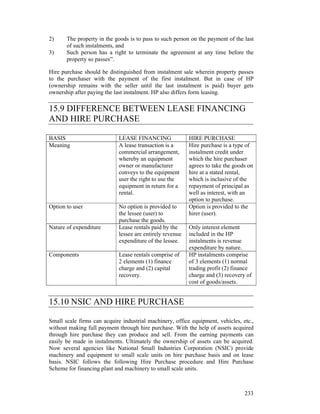
basis. NSIC follows the following Hire Purchase procedure and Hire Purchase
Scheme for financing plant and machinery to small scale units.


                                                                                  233
Hire Purchase


             "Finance of Plant & Machinery to small scale
             industrial units/ enterprises on installment
             terms."


15.11 FACTORING
Factoring is another type of financial service provided by the specialist organizations.
When small scale firms sell on credit basis, collection of receivable poses a problem.
In that case factoring organizations play an important role in collection of debtors.
Factoring involves sale of receivables to specialized firm, called factors. Factors
collect receivables and also advance cash against receivables to solve the client firm’s
liquidity problem. For providing their services, they charge interest on advance and
commission for other services. In other words, factoring is an arrangement under
which a financial institution (called factor) undertakes the task of collecting the book
debts of its client in return for a service charge in the form of discount or rebate. The
factoring institution eliminates the client’s risk of bad debts by taking over the
responsibility of book debts due to the client. The factoring institution advances a
proportion of the value of book debts of the client immediately and the balance on
maturity of book debts.

15.11.1 FACTORING PROCEDURE
The agreement between the supplier and the factor specifies the factoring procedure.
Usually the firm sends the customer’s order to the factor for evaluating the customer’s
creditworthiness and approval. Once the factor is satisfied about the customer’s credit
worthiness and agrees to buy receivables, the firm dispatches goods to the customer.


                                                                                     234
The customer will be informed that his account has been sold to the factor, and he is
instructed to make payment directly to the factor. To perform his functions of credit
evaluation and collection for a large number of clients, a factor may maintain a credit
department with specialized staff. Once the factor has purchased a firm’s receivables
and if he agrees to own them, he will have to provide protection against any bad-debt
losses to the firm.

15.11.2 MERITS
1. As a result of factoring services, the enterprise can concentrate on manufacturing
   and selling.
2. The risk of bad debts is eliminated.
3. The factoring institution also provides advice on business trends and other related
   matters.

In India, subsidiaries of four Indian banks-State Bank of India, Canara Bank, Punjab
National Bank and Allahabad Bank are providing factoring services.

Activity D

Match the following

Nature of Asset                              Type of Lease
Aircraft/ ship with crew                     Operating lease
Construction equipment                       Wet lease
Sugar mill                                   Finance lease


15.12 SUMMARY
A lease is an agreement for the use of the asset for a specified rental. The owner of the
asset is called the lessor and the user the lessee. Two important categories of leases
are: operating leases and financial leases. Operating leases are short team, cancellable
leases where the risk of obsolescence is borne by the lessor. Financial leases are long-
term, non-cancellable leases where any risk in the use of the asset is borne by the
lessee and he enjoys the returns too. The other sub-parts of finance lease are: sale and
lease back and leveraged financing. Under sale and lease back lease the owner of an
asset sells the asset to a party, who in turn leases back the same asset to the owner in
consideration of lease rentals. Under leveraged leasing a third party (i.e. financier or
lender) is involved beside lessor and lessee. Direct lease another type of leases, which
is popularly used. Under this, a firm acquires the right to use an asset from the
manufacturer directly. Leasing plays an important role in the economic development
of a country by providing money incentives to lessee. Lease financing has several
advantages. In India, the First Leasing Company Ltd. was set up in Madras in 1973.
As per the industrial investment, lease finance in India just like a newborn baby. Hire
purchase and factoring are the other forms of financial services. Hire purchase is a
type of instalment credit under which the hire purchaser agrees to take the goods on


                                                                                     235
hire at a stated rental. The system of the hire purchase is regulated by the Hire
Purchase Act 1972. Small scale firms suffer from the problem of dearth of funds. In
this case hire purchase system plays an important role by providing equipment;
vehicles etc. on hire purchase without making full payments. NSIC also provides
machinery and equipment to Small Scale units on hire purchase basis and on lease
basis. Factoring the other financial service under which a financial institution
undertakes the task of collecting the book debts of it client.

    15.13 GLOSSARY
Capital lease: It is a lease obligation that has to be capitalized on the balance sheet. It
is characterized by: it is non-cancelable; the life of lease is less than the life of the
asset(s) being leased; and, the lessor does not pay for the upkeep, maintenance, or
servicing costs of the asset(s) during the lease period.

Sub-lease: A transaction in which leased property is released by the original lessee to
a third party, and the lease agreement between the two original parties remains in
effect.

Wet lease: A wet lease is any leasing arrangement whereby a company agrees to
provide an aircraft and at least one pilot to another company. ‘Dry lease’ on the other
hand, refers to leasing only the aircraft.


15.14 SELF ASSESSMENT QUESTIONS
1) Explain the term Leasing. State the various types of lease agreements.
2) What are the advantages of Leasing?
3) What is the hire purchase financing? How does it differ from the lease?
     financing?
4) Write a short note on Factoring
.
15.15 FURTHER READINGS
1. Ghosh P.K. and Gupta G.S., Fundamentals of Leasing and Lease Financing,
   Vision Book Pvt. Ltd., New Delhi 1985.
2. Monga J.R., Financial Accounting: Concept & Applications, Mayur Paperbacks,
   19th Edition.
3. Pandey I.M., Financial Management, Vikas Publishing House Pvt. Ltd. 8th
   Edition.

    ARTICLES

Agrawal N.K. & P.L. Joshi, “Accounting for Leases”, the Chartered Accountant Aug.,
1983, page 92-97.


                                                                                       236
Ghosh T.P., “Leasing: A financing decision”, the Chartered Accountant, June 1987,
page 996-967.
Mukhopadhyay D., “Lease Financing- An Overview”, the Management Accountant,
May 1995, page 354-356.
Ramanujam K.M., R. Thennsyhi, “Accounting for Leases”, the Management
Accountant, Nov., 1995, page 850-852.


                                                                             237

Lesson 15

  • 1.
    LESSON-15 LEASE FINANCING, HIRE- PURCHASE AND FACTORING Rekha Rani STRUCTURE 15.0 Introduction 15.1 Objectives 15.2 Concept of Lease Financing 15.3 Meaning of Lease Financing 15.4 Importance of Lease Financing 15.5 Types of Lease Agreements 15.5.1 Financial lease 15.5.2 Operating lease 15.5.3 Sale and lease back 15.5.4 Leveraged leasing 15.5.5 Direct leasing 15.6 Advantages of leasing 15.7 Leasing in India 15.8 Concept & Meaning of Hire purchase 15.9 Difference between Lease Financing and Hire Purchase 15.10 NSIC & Hire Purchase 15.11 Factoring 15.11.1 Factoring procedure 15.11.2 Merits 15.12 Summary 15.13 Glossary 15.14 Self Assessment Questions 15.15 Further Readings 15.0 INTRODUCTION In order to start and sustain a business one needs finance. In the unit one on feasibility study, you have already seen the process of estimating financial requirements. The process involved (a) making a list of all the assets (b) identifying the sources of supply (c) estimating the cost of acquisition when the assets are to be acquired on outright basis. Then investment requirements as well as entrepreneur’s fear will increase. To scare away the entrepreneur’s fear, the emphasis should be given to resources and not to the ownership. In this unit we intend to familiarize you with some important financial innovations i.e., leasing, hire purchase and factoring. 227
  • 2.
    15.1 OBJECTIVES After goingthrough this unit you should be able to • Describe the meaning of leasing • Explain the role and importance of lease financing in economic development of a country • Distinguish between the various types of leases • Describe the meaning of hire purchase • Distinguish between leasing and hire purchase • Describe the meaning of factoring 15.2 CONCEPT 0F LEASE FINANCING Lease financing denotes procurement of assets through lease. The subject of leasing falls in the category of finance. Leasing has grown as a big industry in the USA and UK and spread to other countries during the present century. In India, the concept was pioneered in 1973 when the First Leasing Company was set up in Madras and the eighties have seen a rapid growth of this business. Lease as a concept involves a contract whereby the ownership, financing and risk taking of any equipment or asset are separated and shared by two or more parties. Thus, the lessor may finance and lessee may accept the risk through the use of it while a third party may own it. Alternatively the lessor may finance and own it while the lessee enjoys the use of it and bears the risk. There are various combinations in which the above characteristics are shared by the lessor and lessee. 15.3 MEANING 0F LEASE FINANCING A lease transaction is a commercial arrangement whereby an equipment owner or Manufacturer conveys to the equipment user the right to use the equipment in return for a rental. In other words, lease is a contract between the owner of an asset (the lessor) and its user (the lessee) for the right to use the asset during a specified period in return for a mutually agreed periodic payment (the lease rentals). The important feature of a lease contract is separation of the ownership of the asset from its usage. Lease financing is based on the observation made by Donald B. Grant: “Why own a cow when the milk is so cheap? All you really need is milk and not the cow.” 15.4 IMPORTANCE 0F LEASE FINANCING Leasing industry plays an important role in the economic development of a country by providing money incentives to lessee. The lessee does not have to pay the cost of asset at the time of signing the contract of leases. Leasing contracts are more flexible so lessees can structure the leasing contracts according to their needs for finance. The lessee can also pass on the risk of obsolescence to the lessor by acquiring those 228
  • 3.
    appliances, which havehigh technological obsolescence. To day, most of us are familiar with leases of houses, apartments, offices, etc. 15.5 TYPES OF LEASE AGREEMENTS Lease agreements are basically of two types. They are (a) Financial lease and (b) Operating lease. The other variations in lease agreements are (c) Sale and lease back (d) Leveraged leasing and (e) Direct leasing. LEASE AGREEMENTS CAPITAL OPERATING SALE AND LEASE LEVERAGED DIRECT LEASING LEASE/FINANCIA LEASE BACK LEASING L LEASE Figure 15.1: Types of leases 15.5.1 FINANCIAL LEASE Long-term, non-cancellable lease contracts are known as financial leases. The essential point of financial lease agreement is that it contains a condition whereby the lessor agrees to transfer the title for the asset at the end of the lease period at a nominal cost. At lease it must give an option to the lessee to purchase the asset he has used at the expiry of the lease. Under this lease the lessor recovers 90% of the fair value of the asset as lease rentals and the lease period is 75% of the economic life of the asset. The lease agreement is irrevocable. Practically all the risks incidental to the asset ownership and all the benefits arising there from are transferred to the lessee who bears the cost of maintenance, insurance and repairs. Only title deeds remain with the lessor. Financial lease is also known as ‘capital lease’. In India, financial leases are very popular with high-cost and high technology equipment. 229
  • 4.
    15.5.2 OPERATING LEASE An operating lease stands in contrast to the financial lease in almost all aspects. This lease agreement gives to the lessee only a limited right to use the asset. The lessor is responsible for the upkeep and maintenance of the asset. The lessee is not given any uplift to purchase the asset at the end of the lease period. Normally the lease is for a short period and even otherwise is revocable at a short notice. Mines, Computers hardware, trucks and automobiles are found suitable for operating lease because the rate of obsolescence is very high in this kind of assets. Key Words Explain the meaning of ‘long term,’ ‘nominal cost,’ and economic life Activity A On the basis of above description of financial lease and operating lease, find out three main differences between two. ------------------------------------------------------------------------------------------------------- ------------------------------------------------------------------------------------------------------- ------------------------------------------------------------------------------------------------------- ------------------------------------------------------------------------------------------------------- ------------------------------------------------------------------------------------------------------- 15.5.3 SALE AND LEASE BACK It is a sub-part of finance lease. Under this, the owner of an asset sells the asset to a party (the buyer), who in turn leases back the same asset to the owner in consideration of lease rentals. However, under this arrangement, the assets are not physically exchanged but it all happens in records only. This is nothing but a paper transaction. Sale and lease back transaction is suitable for those assets, which are not subjected depreciation but appreciation, say land. The advantage of this method is that the lessee can satisfy himself completely regarding the quality of the asset and after possession of the asset convert the sale into a lease arrangement. The sale and lease back transaction can be expressed with the help of the following figure. SELLER SALE TRANSACTION BUYER SALE VALUE LEASE TRANSACTION LESSEE LESSOR LEASE RENTALS Figure 15.2: Structure of a Sale and Leaseback Deal Under this transaction, the seller assumes the role of a lessee and the buyer assumes the role of a lessor. The seller gets the agreed selling price and the buyer gets the lease rentals. It is possible to structure the sale at agreed value (below or above the fair 230
  • 5.
    market price) andto adjust difference in the lease rentals. Thus the effect of profit /loss on sale of assets can be deferred. 15.5.4 LEVERAGED LEASING Under leveraged leasing arrangement, a third party is involved beside lessor and lessee. The lessor borrows a part of the purchase cost (say 80%) of the asset from the third party i.e., lender and the asset so purchased is held as security against the loan. The lender is paid off from the lease rentals directly by the lessee and the surplus after meeting the claims of the lender goes to the lessor. The lessor, the owner of the asset is entitled to depreciation allowance associated with the asset. Sells Asset Leases Asset Manufacturer Lessor Lessee L Lender Figure 15. 3: Leveraged Lease Activity B Distinguish between sale and lease back lease and leveraged lease. As a lessee, which one will you prefer and why? 15.5.5 DIRECT LEASING Under direct leasing, a firm acquires the right to use an asset from the manufacturer directly. The ownership of the asset leased out remains with the manufacturer itself. The major types of direct lessor include manufacturers, finance companies, independent lease companies, special purpose leasing companies etc 15.6 ADVANTAGES OF LEASING There are several extolled advantages of acquiring capital assets on lease: (1) SAVING OF CAPITAL: Leasing covers the full cost of the equipment used in the business by providing 100% finance. The lessee is not to provide or pay any margin 231
  • 6.
    money as thereis no down payment. In this way the saving in capital or financial resources can be used for other productive purposes e.g. purchase of inventories. (2) FLEXIBILITY AND CONVENIENCE: The lease agreement can be tailor- made in respect of lease period and lease rentals according to the convenience and requirements of all lessees. (3) PLANNING CASH FLOWS: Leasing enables the lessee to plan its cash flows properly. The rentals can be paid out of the cash coming into the business from the use of the same assets. (4) IMPROVEMENT IN LIQUADITY: Leasing enables the lessee to improve their liquidity position by adopting the sale and lease back technique. 15.7 LEASING IN INDIA Leasing has grown by leaps and bounds in the eighties but it is estimated that hardly 1% of the industrial investment in India is covered by the lease finance, as against 40% in USA and 30% in UK and 10% in Japan. The prospects of leasing in India are good due to growing investment needs and scarcity of funds with public financial institutions. This type of lease finances is particularly suitable in India where a large number of small companies have emerged more recently. Leasing in the sphere of land and building has been in existence in India for a long time, while equipment leasing has become very common in the recent times. Activity C Find out in your locality some companies that under take lease financing of machinery. 15.8 CONCEPT AND MEANING OF HIRE PURCHASE Hire purchase is a type of instalment credit under which the hire purchaser, called the hirer, agrees to take the goods on hire at a stated rental, which is inclusive of the repayment of principal as well as interest, with an option to purchase. Under this transaction, the hire purchaser acquires the property (goods) immediately on signing the hire purchase agreement but the ownership or title of the same is transferred only when the last instalment is paid. The hire purchase system is regulated by the Hire Purchase Act 1972. This Act defines a hire purchase as “an agreement under which goods are let on hire and under which the hirer has an option to purchase them in accordance with the terms of the agreement and includes an agreement under which: 1) The owner delivers possession of goods thereof to a person on condition that such person pays the agreed amount in periodic instalments. 232
  • 7.
    2) The property in the goods is to pass to such person on the payment of the last of such instalments, and 3) Such person has a right to terminate the agreement at any time before the property so passes”. Hire purchase should be distinguished from instalment sale wherein property passes to the purchaser with the payment of the first instalment. But in case of HP (ownership remains with the seller until the last instalment is paid) buyer gets ownership after paying the last instalment. HP also differs form leasing. 15.9 DIFFERENCE BETWEEN LEASE FINANCING AND HIRE PURCHASE BASIS LEASE FINANCING HIRE PURCHASE Meaning A lease transaction is a Hire purchase is a type of commercial arrangement, instalment credit under whereby an equipment which the hire purchaser owner or manufacturer agrees to take the goods on conveys to the equipment hire at a stated rental, user the right to use the which is inclusive of the equipment in return for a repayment of principal as rental. well as interest, with an option to purchase. Option to user No option is provided to Option is provided to the the lessee (user) to hirer (user). purchase the goods. Nature of expenditure Lease rentals paid by the Only interest element lessee are entirely revenue included in the HP expenditure of the lessee. instalments is revenue expenditure by nature. Components Lease rentals comprise of HP instalments comprise 2 elements (1) finance of 3 elements (1) normal charge and (2) capital trading profit (2) finance recovery. charge and (3) recovery of cost of goods/assets. 15.10 NSIC AND HIRE PURCHASE Small scale firms can acquire industrial machinery, office equipment, vehicles, etc., without making full payment through hire purchase. With the help of assets acquired through hire purchase they can produce and sell. From the earning payments can easily be made in instalments. Ultimately the ownership of assets can be acquired. Now several agencies like National Small Industries Corporation (NSIC) provide machinery and equipment to small scale units on hire purchase basis and on lease basis. NSIC follows the following Hire Purchase procedure and Hire Purchase Scheme for financing plant and machinery to small scale units. 233
  • 8.
    Hire Purchase "Finance of Plant & Machinery to small scale industrial units/ enterprises on installment terms." 15.11 FACTORING Factoring is another type of financial service provided by the specialist organizations. When small scale firms sell on credit basis, collection of receivable poses a problem. In that case factoring organizations play an important role in collection of debtors. Factoring involves sale of receivables to specialized firm, called factors. Factors collect receivables and also advance cash against receivables to solve the client firm’s liquidity problem. For providing their services, they charge interest on advance and commission for other services. In other words, factoring is an arrangement under which a financial institution (called factor) undertakes the task of collecting the book debts of its client in return for a service charge in the form of discount or rebate. The factoring institution eliminates the client’s risk of bad debts by taking over the responsibility of book debts due to the client. The factoring institution advances a proportion of the value of book debts of the client immediately and the balance on maturity of book debts. 15.11.1 FACTORING PROCEDURE The agreement between the supplier and the factor specifies the factoring procedure. Usually the firm sends the customer’s order to the factor for evaluating the customer’s creditworthiness and approval. Once the factor is satisfied about the customer’s credit worthiness and agrees to buy receivables, the firm dispatches goods to the customer. 234
  • 9.
    The customer willbe informed that his account has been sold to the factor, and he is instructed to make payment directly to the factor. To perform his functions of credit evaluation and collection for a large number of clients, a factor may maintain a credit department with specialized staff. Once the factor has purchased a firm’s receivables and if he agrees to own them, he will have to provide protection against any bad-debt losses to the firm. 15.11.2 MERITS 1. As a result of factoring services, the enterprise can concentrate on manufacturing and selling. 2. The risk of bad debts is eliminated. 3. The factoring institution also provides advice on business trends and other related matters. In India, subsidiaries of four Indian banks-State Bank of India, Canara Bank, Punjab National Bank and Allahabad Bank are providing factoring services. Activity D Match the following Nature of Asset Type of Lease Aircraft/ ship with crew Operating lease Construction equipment Wet lease Sugar mill Finance lease 15.12 SUMMARY A lease is an agreement for the use of the asset for a specified rental. The owner of the asset is called the lessor and the user the lessee. Two important categories of leases are: operating leases and financial leases. Operating leases are short team, cancellable leases where the risk of obsolescence is borne by the lessor. Financial leases are long- term, non-cancellable leases where any risk in the use of the asset is borne by the lessee and he enjoys the returns too. The other sub-parts of finance lease are: sale and lease back and leveraged financing. Under sale and lease back lease the owner of an asset sells the asset to a party, who in turn leases back the same asset to the owner in consideration of lease rentals. Under leveraged leasing a third party (i.e. financier or lender) is involved beside lessor and lessee. Direct lease another type of leases, which is popularly used. Under this, a firm acquires the right to use an asset from the manufacturer directly. Leasing plays an important role in the economic development of a country by providing money incentives to lessee. Lease financing has several advantages. In India, the First Leasing Company Ltd. was set up in Madras in 1973. As per the industrial investment, lease finance in India just like a newborn baby. Hire purchase and factoring are the other forms of financial services. Hire purchase is a type of instalment credit under which the hire purchaser agrees to take the goods on 235
  • 10.
    hire at astated rental. The system of the hire purchase is regulated by the Hire Purchase Act 1972. Small scale firms suffer from the problem of dearth of funds. In this case hire purchase system plays an important role by providing equipment; vehicles etc. on hire purchase without making full payments. NSIC also provides machinery and equipment to Small Scale units on hire purchase basis and on lease basis. Factoring the other financial service under which a financial institution undertakes the task of collecting the book debts of it client. 15.13 GLOSSARY Capital lease: It is a lease obligation that has to be capitalized on the balance sheet. It is characterized by: it is non-cancelable; the life of lease is less than the life of the asset(s) being leased; and, the lessor does not pay for the upkeep, maintenance, or servicing costs of the asset(s) during the lease period. Sub-lease: A transaction in which leased property is released by the original lessee to a third party, and the lease agreement between the two original parties remains in effect. Wet lease: A wet lease is any leasing arrangement whereby a company agrees to provide an aircraft and at least one pilot to another company. ‘Dry lease’ on the other hand, refers to leasing only the aircraft. 15.14 SELF ASSESSMENT QUESTIONS 1) Explain the term Leasing. State the various types of lease agreements. 2) What are the advantages of Leasing? 3) What is the hire purchase financing? How does it differ from the lease? financing? 4) Write a short note on Factoring . 15.15 FURTHER READINGS 1. Ghosh P.K. and Gupta G.S., Fundamentals of Leasing and Lease Financing, Vision Book Pvt. Ltd., New Delhi 1985. 2. Monga J.R., Financial Accounting: Concept & Applications, Mayur Paperbacks, 19th Edition. 3. Pandey I.M., Financial Management, Vikas Publishing House Pvt. Ltd. 8th Edition. ARTICLES Agrawal N.K. & P.L. Joshi, “Accounting for Leases”, the Chartered Accountant Aug., 1983, page 92-97. 236
  • 11.
    Ghosh T.P., “Leasing:A financing decision”, the Chartered Accountant, June 1987, page 996-967. Mukhopadhyay D., “Lease Financing- An Overview”, the Management Accountant, May 1995, page 354-356. Ramanujam K.M., R. Thennsyhi, “Accounting for Leases”, the Management Accountant, Nov., 1995, page 850-852. 237