






NUMBERS, OPERATIONS
AND RELATIONSHIPS
LESSON OUTCOMES
PROPERTIES OF
WHOLE NUMBERS
CALCULATING
USING WHOLE
NUMBERS
CALCULATION
TECHNIQUES
MULTIPLES AND
FACTORS
SOLVING
PROBLEMS
KAHOOT TIME (BASELINE TEST)
• https://create.kahoot.it/details/6c9ed82d-fada-4f58-bd9f-b5da05957a84
• Instructions:
• Please search Kahoot.it online.
• Wait for the code.
• Work in pairs and use one phone.
PROPERTIES OF WHOLE
NUMBERS
WHOLE NUMBERS
• Whole numbers are the set of positive integers or natural numbers along with the
zero.
THE PROPERTIES OF
WHOLE NUMBERS
1. Closure Property
2. Commutative Property of Addition and
Multiplication
3. Associative Property of Addition and
Multiplication
4. Distributive Property of Multiplication
over addition
5. Identity Property
1. CLOSURE PROPERTY
• According to the Closure Property “Whole numbers are closed under addition and
multiplication”.
5 + 9 = 14 5 x 9 = 45
Note
• Closure Property is not applicable for subtraction and division of whole numbers.
• Division of a whole number by zero is undefined.
COMMUTATIVE PROPERTY OF
ADDITION AND MULTIPLICATION
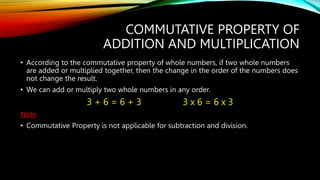
• According to the commutative property of whole numbers, if two whole numbers
are added or multiplied together, then the change in the order of the numbers does
not change the result.
• We can add or multiply two whole numbers in any order.
3 + 6 = 6 + 3 3 x 6 = 6 x 3
Note
• Commutative Property is not applicable for subtraction and division.
ASSOCIATIVE PROPERTY OF
ADDITION AND MULTIPLICATION
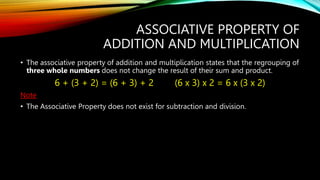
• The associative property of addition and multiplication states that the regrouping of
three whole numbers does not change the result of their sum and product.
6 + (3 + 2) = (6 + 3) + 2 (6 x 3) x 2 = 6 x (3 x 2)
Note
• The Associative Property does not exist for subtraction and division.
DISTRIBUTIVE PROPERTY OF
MULTIPLICATION OVER ADDITION
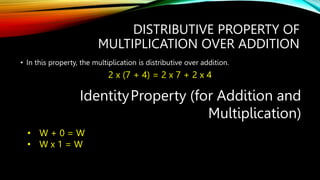
• In this property, the multiplication is distributive over addition.
2 x (7 + 4) = 2 x 7 + 2 x 4
IdentityProperty (for Addition and
Multiplication)
• W + 0 = W
• W x 1 = W
CALCULATING USING
WHOLE NUMBERS
CALCULATING USING WHOLE
NUMBERS
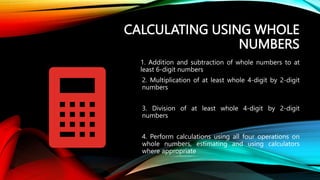
1. Addition and subtraction of whole numbers to at
least 6-digit numbers
2. Multiplication of at least whole 4-digit by 2-digit
numbers
3. Division of at least whole 4-digit by 2-digit
numbers
4. Perform calculations using all four operations on
whole numbers, estimating and using calculators
where appropriate
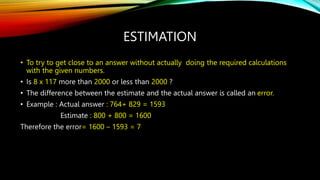
ESTIMATION
• To try to get close to an answer without actually doing the required calculations
with the given numbers.
• Is 8 x 117 more than 2000 or less than 2000 ?
• The difference between the estimate and the actual answer is called an error.
• Example : Actual answer : 764+ 829 = 1593
Estimate : 800 + 800 = 1600
Therefore the error= 1600 – 1593 = 7
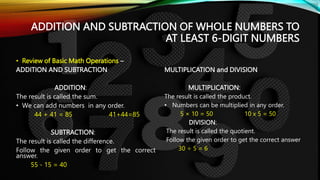
ADDITION AND SUBTRACTION OF WHOLE NUMBERS TO
AT LEAST 6-DIGIT NUMBERS
• Review of Basic Math Operations –
ADDITION AND SUBTRACTION
ADDITION:
The result is called the sum.
• We can add numbers in any order.
44 + 41 = 85 41+44=85
SUBTRACTION:
The result is called the difference.
Follow the given order to get the correct
answer.
55 - 15 = 40
MULTIPLICATION and DIVISION
MULTIPLICATION:
The result is called the product.
• Numbers can be multiplied in any order.
5 × 10 = 50 10 x 5 = 50
DIVISION:
The result is called the quotient.
Follow the given order to get the correct answer
30 ÷ 5 = 6
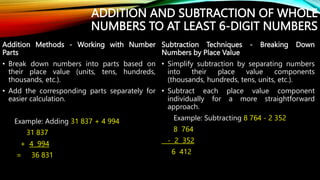
ADDITION AND SUBTRACTION OF WHOLE
NUMBERS TO AT LEAST 6-DIGIT NUMBERS
Addition Methods - Working with Number
Parts
• Break down numbers into parts based on
their place value (units, tens, hundreds,
thousands, etc.).
• Add the corresponding parts separately for
easier calculation.
Example: Adding 31 837 + 4 994
31 837
+ 4 994
= 36 831
Subtraction Techniques - Breaking Down
Numbers by Place Value
• Simplify subtraction by separating numbers
into their place value components
(thousands, hundreds, tens, units, etc.).
• Subtract each place value component
individually for a more straightforward
approach.
Example: Subtracting 8 764 - 2 352
8 764
- 2 352
6 412
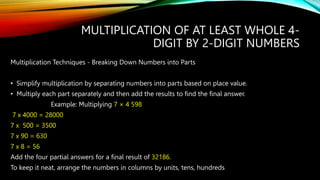
MULTIPLICATION OF AT LEAST WHOLE 4-
DIGIT BY 2-DIGIT NUMBERS
Multiplication Techniques - Breaking Down Numbers into Parts
• Simplify multiplication by separating numbers into parts based on place value.
• Multiply each part separately and then add the results to find the final answer.
Example: Multiplying 7 × 4 598
7 x 4000 = 28000
7 x 500 = 3500
7 x 90 = 630
7 x 8 = 56
Add the four partial answers for a final result of 32186.
To keep it neat, arrange the numbers in columns by units, tens, hundreds
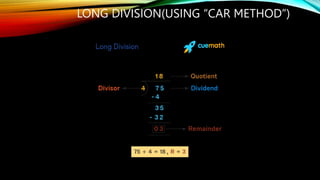
LONG DIVISION(USING “CAR METHOD”)
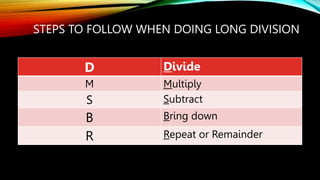
STEPS TO FOLLOW WHEN DOING LONG DIVISION
D Divide
M Multiply
S Subtract
B Bring down
R Repeat or Remainder
MULTIPLE AND FACTORS
OF WHOLE NUMBERS
MULTIPLE AND FACTORS OF WHOLE
NUMBERS
Exploring whole numbers .
Working in pairs to investigate relationships between multiple and factors of whole
numbers
Each pair should have 2 cards
The task is to find as many numbers as you can that can be divided by their chosen
numbers without leaving a remainder.
Record your answer
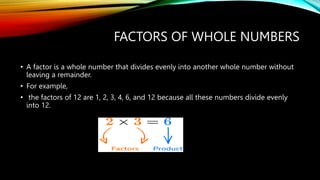
FACTORS OF WHOLE NUMBERS
• A factor is a whole number that divides evenly into another whole number without
leaving a remainder.
• For example,
• the factors of 12 are 1, 2, 3, 4, 6, and 12 because all these numbers divide evenly
into 12.
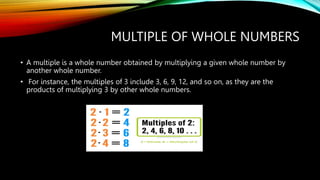
MULTIPLE OF WHOLE NUMBERS
• A multiple is a whole number obtained by multiplying a given whole number by
another whole number.
• For instance, the multiples of 3 include 3, 6, 9, 12, and so on, as they are the
products of multiplying 3 by other whole numbers.
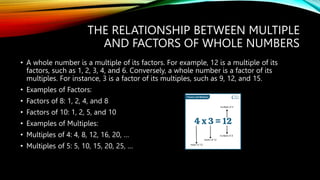
THE RELATIONSHIP BETWEEN MULTIPLE
AND FACTORS OF WHOLE NUMBERS
• A whole number is a multiple of its factors. For example, 12 is a multiple of its
factors, such as 1, 2, 3, 4, and 6. Conversely, a whole number is a factor of its
multiples. For instance, 3 is a factor of its multiples, such as 9, 12, and 15.
• Examples of Factors:
• Factors of 8: 1, 2, 4, and 8
• Factors of 10: 1, 2, 5, and 10
• Examples of Multiples:
• Multiples of 4: 4, 8, 12, 16, 20, …
• Multiples of 5: 5, 10, 15, 20, 25, …
ANY QUESTION?

Lesson 1 - Whole Numbers (Grade 9 Mathematics)

  • 1.
  • 2.
    LESSON OUTCOMES PROPERTIES OF WHOLENUMBERS CALCULATING USING WHOLE NUMBERS CALCULATION TECHNIQUES MULTIPLES AND FACTORS SOLVING PROBLEMS
  • 3.
    KAHOOT TIME (BASELINETEST) • https://create.kahoot.it/details/6c9ed82d-fada-4f58-bd9f-b5da05957a84 • Instructions: • Please search Kahoot.it online. • Wait for the code. • Work in pairs and use one phone.
  • 4.
  • 5.
    WHOLE NUMBERS • Wholenumbers are the set of positive integers or natural numbers along with the zero.
  • 6.
    THE PROPERTIES OF WHOLENUMBERS 1. Closure Property 2. Commutative Property of Addition and Multiplication 3. Associative Property of Addition and Multiplication 4. Distributive Property of Multiplication over addition 5. Identity Property
  • 7.
    1. CLOSURE PROPERTY •According to the Closure Property “Whole numbers are closed under addition and multiplication”. 5 + 9 = 14 5 x 9 = 45 Note • Closure Property is not applicable for subtraction and division of whole numbers. • Division of a whole number by zero is undefined.
  • 8.
    COMMUTATIVE PROPERTY OF ADDITIONAND MULTIPLICATION • According to the commutative property of whole numbers, if two whole numbers are added or multiplied together, then the change in the order of the numbers does not change the result. • We can add or multiply two whole numbers in any order. 3 + 6 = 6 + 3 3 x 6 = 6 x 3 Note • Commutative Property is not applicable for subtraction and division.
  • 9.
    ASSOCIATIVE PROPERTY OF ADDITIONAND MULTIPLICATION • The associative property of addition and multiplication states that the regrouping of three whole numbers does not change the result of their sum and product. 6 + (3 + 2) = (6 + 3) + 2 (6 x 3) x 2 = 6 x (3 x 2) Note • The Associative Property does not exist for subtraction and division.
  • 10.
    DISTRIBUTIVE PROPERTY OF MULTIPLICATIONOVER ADDITION • In this property, the multiplication is distributive over addition. 2 x (7 + 4) = 2 x 7 + 2 x 4 IdentityProperty (for Addition and Multiplication) • W + 0 = W • W x 1 = W
  • 11.
  • 12.
    CALCULATING USING WHOLE NUMBERS 1.Addition and subtraction of whole numbers to at least 6-digit numbers 2. Multiplication of at least whole 4-digit by 2-digit numbers 3. Division of at least whole 4-digit by 2-digit numbers 4. Perform calculations using all four operations on whole numbers, estimating and using calculators where appropriate
  • 13.
    ESTIMATION • To tryto get close to an answer without actually doing the required calculations with the given numbers. • Is 8 x 117 more than 2000 or less than 2000 ? • The difference between the estimate and the actual answer is called an error. • Example : Actual answer : 764+ 829 = 1593 Estimate : 800 + 800 = 1600 Therefore the error= 1600 – 1593 = 7
  • 14.
    ADDITION AND SUBTRACTIONOF WHOLE NUMBERS TO AT LEAST 6-DIGIT NUMBERS • Review of Basic Math Operations – ADDITION AND SUBTRACTION ADDITION: The result is called the sum. • We can add numbers in any order. 44 + 41 = 85 41+44=85 SUBTRACTION: The result is called the difference. Follow the given order to get the correct answer. 55 - 15 = 40 MULTIPLICATION and DIVISION MULTIPLICATION: The result is called the product. • Numbers can be multiplied in any order. 5 × 10 = 50 10 x 5 = 50 DIVISION: The result is called the quotient. Follow the given order to get the correct answer 30 ÷ 5 = 6
  • 15.
    ADDITION AND SUBTRACTIONOF WHOLE NUMBERS TO AT LEAST 6-DIGIT NUMBERS Addition Methods - Working with Number Parts • Break down numbers into parts based on their place value (units, tens, hundreds, thousands, etc.). • Add the corresponding parts separately for easier calculation. Example: Adding 31 837 + 4 994 31 837 + 4 994 = 36 831 Subtraction Techniques - Breaking Down Numbers by Place Value • Simplify subtraction by separating numbers into their place value components (thousands, hundreds, tens, units, etc.). • Subtract each place value component individually for a more straightforward approach. Example: Subtracting 8 764 - 2 352 8 764 - 2 352 6 412
  • 16.
    MULTIPLICATION OF ATLEAST WHOLE 4- DIGIT BY 2-DIGIT NUMBERS Multiplication Techniques - Breaking Down Numbers into Parts • Simplify multiplication by separating numbers into parts based on place value. • Multiply each part separately and then add the results to find the final answer. Example: Multiplying 7 × 4 598 7 x 4000 = 28000 7 x 500 = 3500 7 x 90 = 630 7 x 8 = 56 Add the four partial answers for a final result of 32186. To keep it neat, arrange the numbers in columns by units, tens, hundreds
  • 17.
  • 18.
    STEPS TO FOLLOWWHEN DOING LONG DIVISION D Divide M Multiply S Subtract B Bring down R Repeat or Remainder
  • 19.
  • 20.
    MULTIPLE AND FACTORSOF WHOLE NUMBERS Exploring whole numbers . Working in pairs to investigate relationships between multiple and factors of whole numbers Each pair should have 2 cards The task is to find as many numbers as you can that can be divided by their chosen numbers without leaving a remainder. Record your answer
  • 21.
    FACTORS OF WHOLENUMBERS • A factor is a whole number that divides evenly into another whole number without leaving a remainder. • For example, • the factors of 12 are 1, 2, 3, 4, 6, and 12 because all these numbers divide evenly into 12.
  • 22.
    MULTIPLE OF WHOLENUMBERS • A multiple is a whole number obtained by multiplying a given whole number by another whole number. • For instance, the multiples of 3 include 3, 6, 9, 12, and so on, as they are the products of multiplying 3 by other whole numbers.
  • 23.
    THE RELATIONSHIP BETWEENMULTIPLE AND FACTORS OF WHOLE NUMBERS • A whole number is a multiple of its factors. For example, 12 is a multiple of its factors, such as 1, 2, 3, 4, and 6. Conversely, a whole number is a factor of its multiples. For instance, 3 is a factor of its multiples, such as 9, 12, and 15. • Examples of Factors: • Factors of 8: 1, 2, 4, and 8 • Factors of 10: 1, 2, 5, and 10 • Examples of Multiples: • Multiples of 4: 4, 8, 12, 16, 20, … • Multiples of 5: 5, 10, 15, 20, 25, …
  • 24.