21st Century
Literature from
the Philippines and
the World
Prepared by: Jerome M. Codera
Hello!
My name is Jerome M. Codera and I will be your teacher in
21st Century Literature from the Philippines and the World
2
“
General Description: This course
aims to engage students in
appreciation and critical study of
21st Century Literature from the
Philippines and the World
encompassing their various
dimensions, genres, elements,
structures, contexts, and traditions.
3
Important matters:
➜ September 24 – October 16, 2021 (20
days)
➜ We have our official Facebook group
➜ Your module will be posted in our
Facebook group.
➜ Attendance is a MUST!
➜ Do your best ❤
4
Warm-up activity
(quizizz.com)
Link needed!
LESSON 1:
GEOGRAPHIC,
LINGUISTIC, AND
ETHNIC
DIMENSIONS OF
PHILIPPINE
LITERARY
HISTORY
WHAT I NEED TO KNOW
2. understand
literature from pre-
colonial to
contemporary periods.
3. make a graphical
timeline focusing on
how the literatures for
each literary
period proliferated.
At the end of this
lesson, the learners
are expected to:
1. define literature
from various writers;
and
7
“
What is literature?
The word literature is derived
from the Latin term LITERA
which means letter. It has
been defined differently by
various writers.
8
Literature according to:
Literature
expresses the
feelings of people
to society, to the
government to his
surroundings, to
his fellowmen,
and to his Divine
Creator. (Brother
Azurin)
Literature is
anything that is
printed as long as
it is related to the
ideas and feelings
of the people,
whether it is true,
or just a product
of one’s
Imagination.
(Webster)
“True literature is a
piece of written work
which is undying. It
expresses the feelings
and emotions of people
in response to his
everyday efforts to live,
to be happy in his
environment and, after
struggles, to reach his
Creator.”
(PANITIKANG
FILIPINO)
9
• Some loosely interpret
literature as any printed a
material written within a book,
a magazine or a pamphlet.
Others define literature as a
faithful reproduction of man’s
manifold experiences blended
into one harmonious
expression.
“true literature is a piece of written
work which is undying. It expresses the
feelings and emotions of people in
response to his everyday efforts to live,
to be happy in his environment and, after
struggles, to reach his Creator.”
In Panitikang Pilipino written by Atienza, Ramos,
Salazar and Naza
11
Philippine Literature
is a diverse and rich group of
works that has evolved side – by
– side with the country’s history.
It had started with fables and
legends made by the ancient
Filipinos long before the arrival
of Spanish influence. The main
themes of Philippine literature
focus on the country’s pre –
colonial cultural traditions and
socio – political histories of its
colonial and contemporary
traditions.
12
13
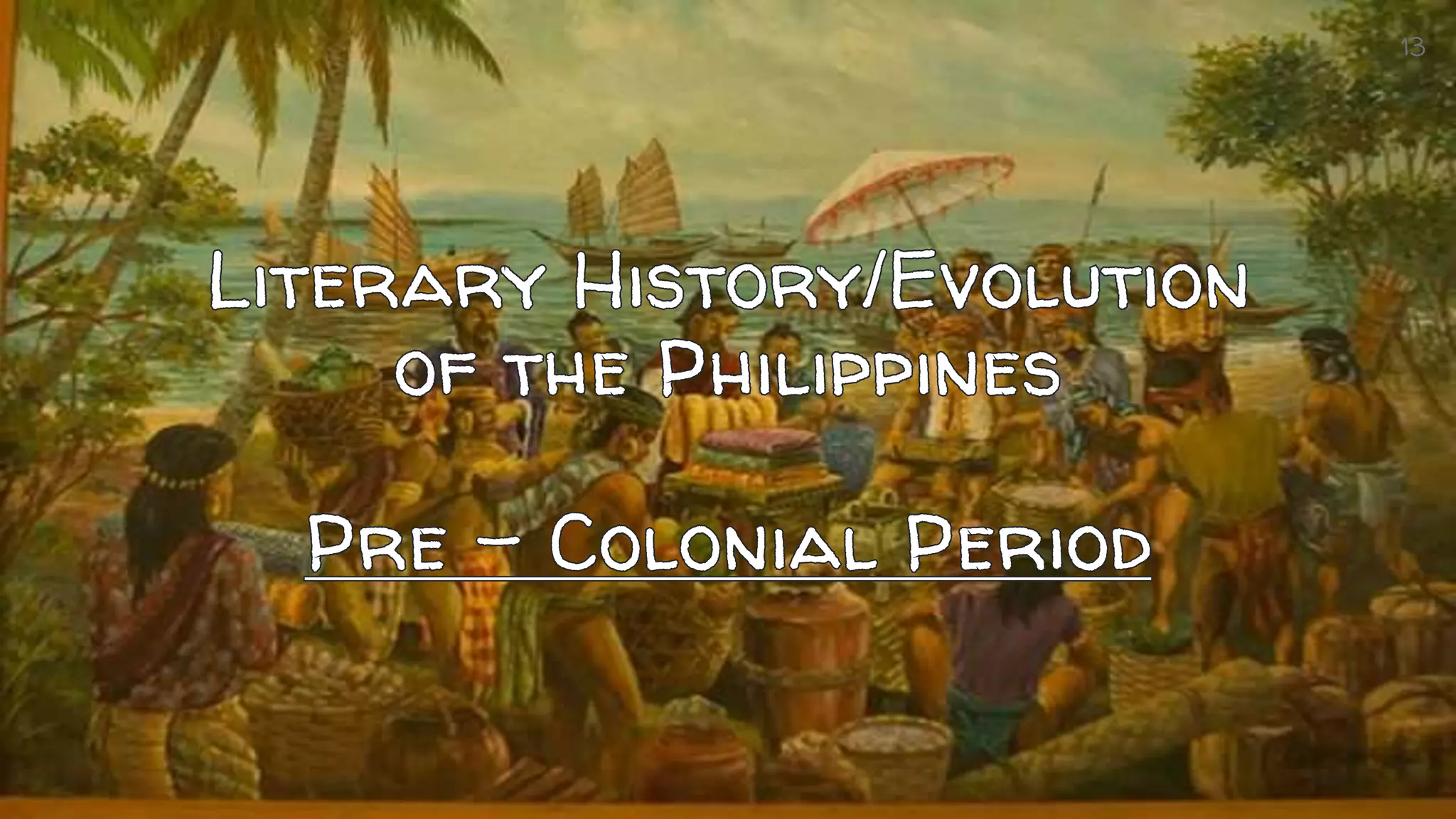
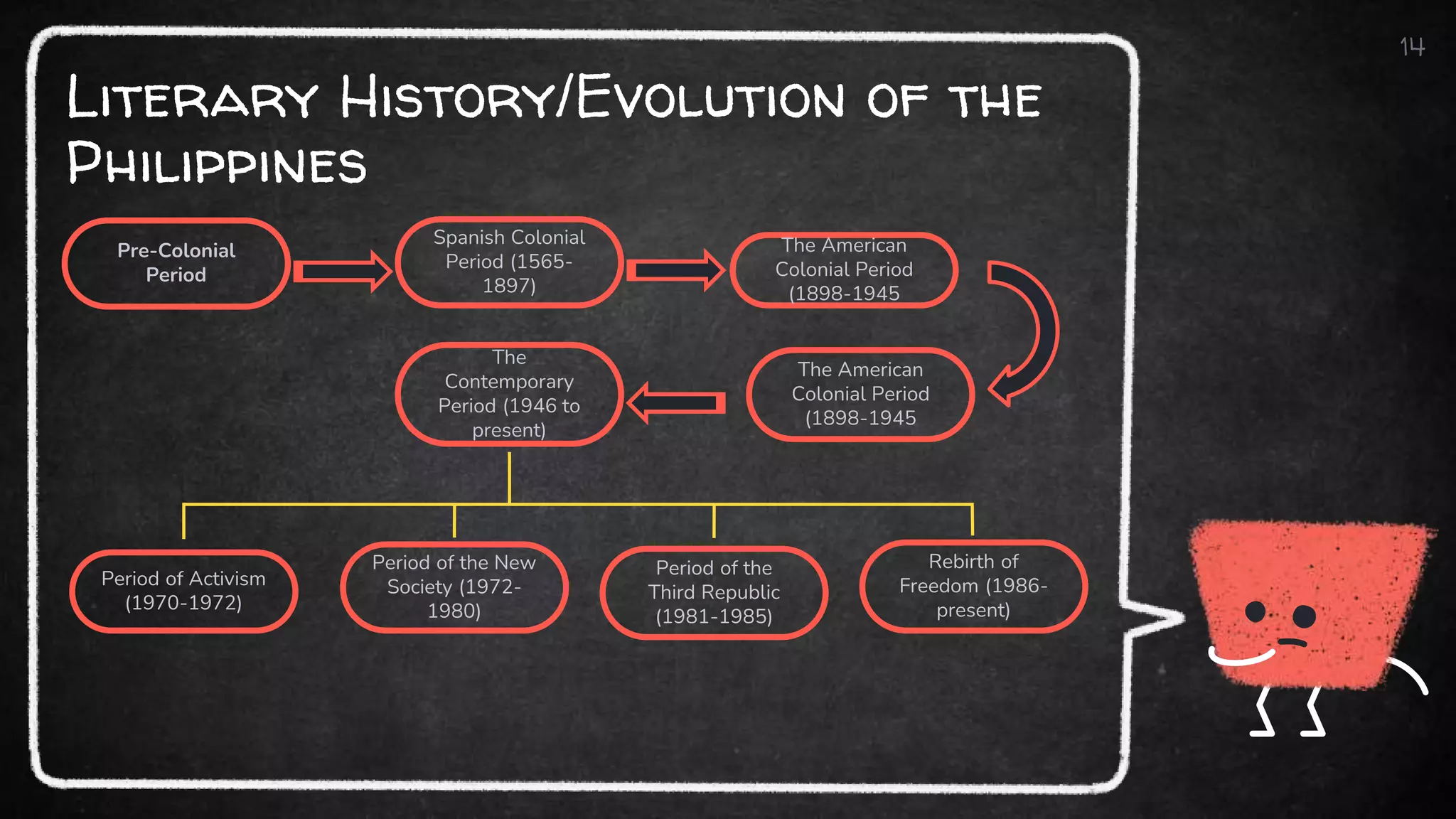
Literary History/Evolution of the
Philippines
14
Pre-Colonial
Period
The American
Colonial Period
(1898-1945
Spanish Colonial
Period (1565-
1897)
The American
Colonial Period
(1898-1945
The
Contemporary
Period (1946 to
present)
Period of Activism
(1970-1972)
Period of the New
Society (1972-
1980)
Period of the
Third Republic
(1981-1985)
Rebirth of
Freedom (1986-
present)
Pre – Colonial Period
 The evolution of Philippine literature depended on
the influences of colonization and the spirit of the
age.
 The first Filipino alphabet called ALIBATA was
replaced by the Roman alphabet.
 Indigenous Philippine literature was based on
traditions and customs of a particular area of the
country.
15
Pre – Colonial Period
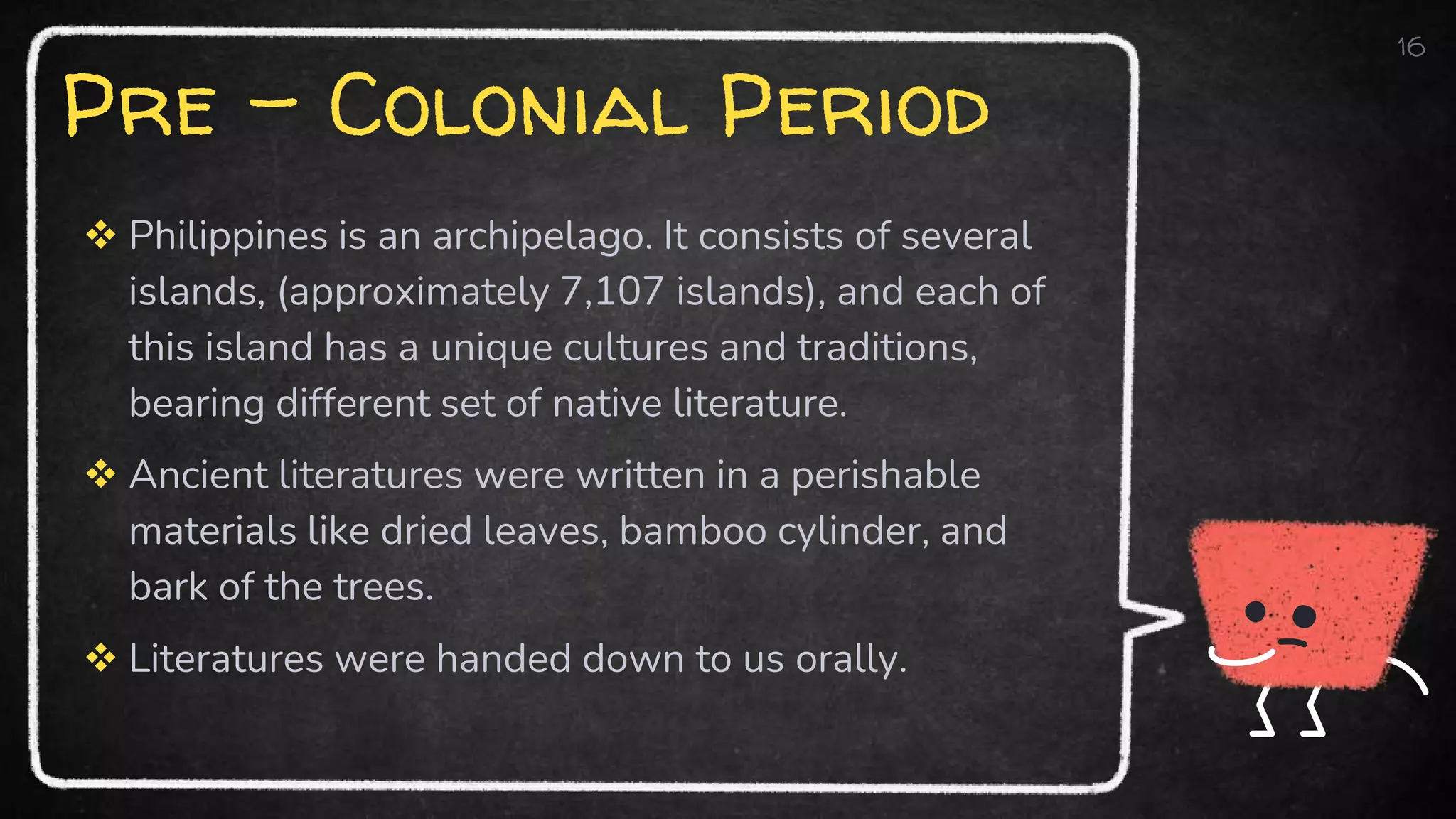
 Philippines is an archipelago. It consists of several
islands, (approximately 7,107 islands), and each of
this island has a unique cultures and traditions,
bearing different set of native literature.
 Ancient literatures were written in a perishable
materials like dried leaves, bamboo cylinder, and
bark of the trees.
 Literatures were handed down to us orally.
16
There were two
literary forms
during the pre-
colonial period:
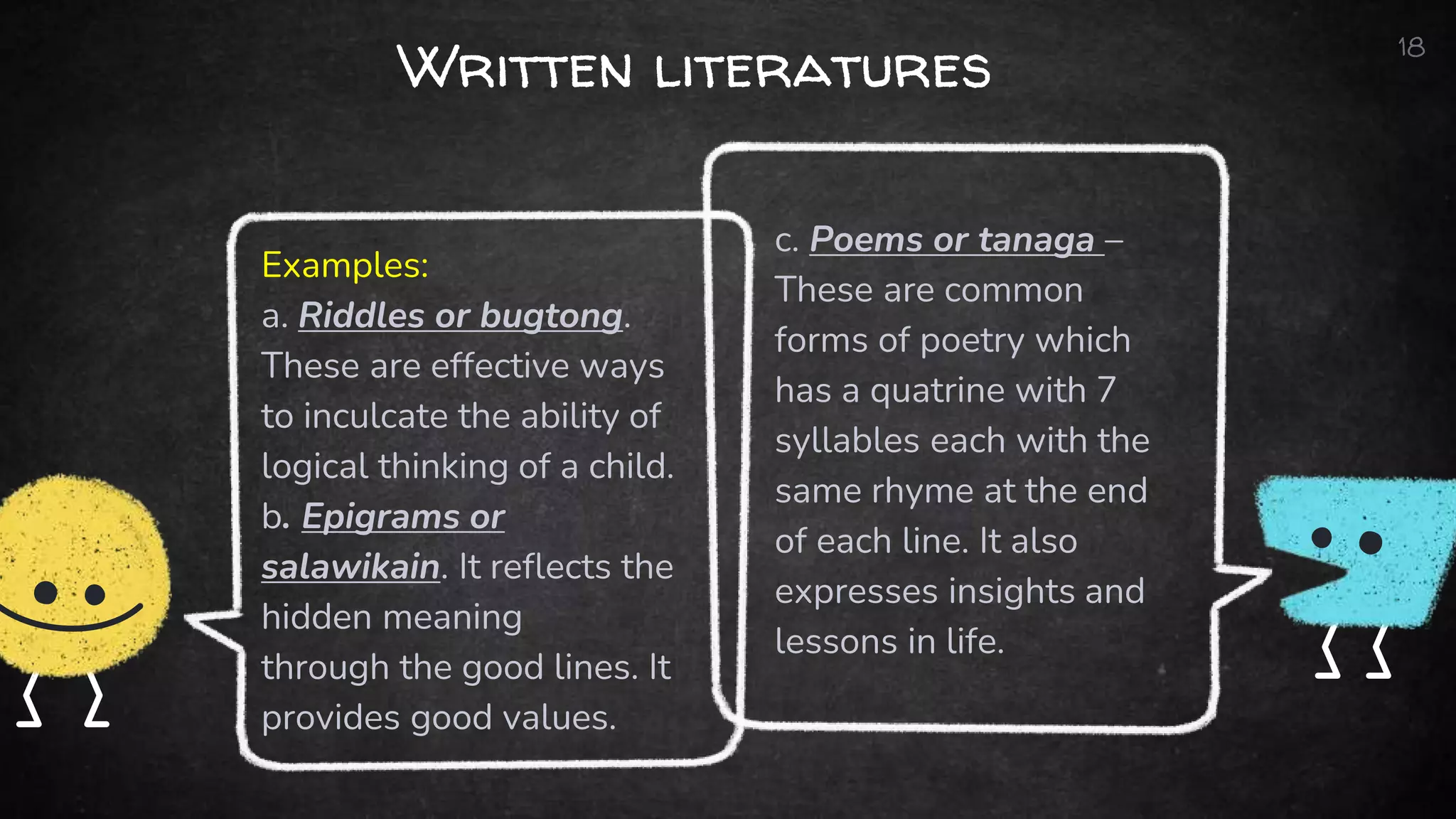
Examples:
a. Riddles or bugtong.
These are effective ways
to inculcate the ability of
logical thinking of a child.
b. Epigrams or
salawikain. It reflects the
hidden meaning
through the good lines. It
provides good values.
Written literatures
c. Poems or tanaga –
These are common
forms of poetry which
has a quatrine with 7
syllables each with the
same rhyme at the end
of each line. It also
expresses insights and
lessons in life.
18
Oral literature
19
Examples:
a. CHANT. It is used in witchcraft and enchantment.
While, ambahan is a traditional poetry of Hanunoo
Mangyans of Oriental Mindoro which teaches lesson
about life. It is recited by parents to educate their
children by the youth expressing their love, by the old to
impart experiences, or by the community in tribal
ceremony.
b. BALAGTASAN .This is a Filipino form of debate done
in verse. The term is derived from the surname of
Francisco Balagtas the author of Filipino epic Florante at
Laura.
20
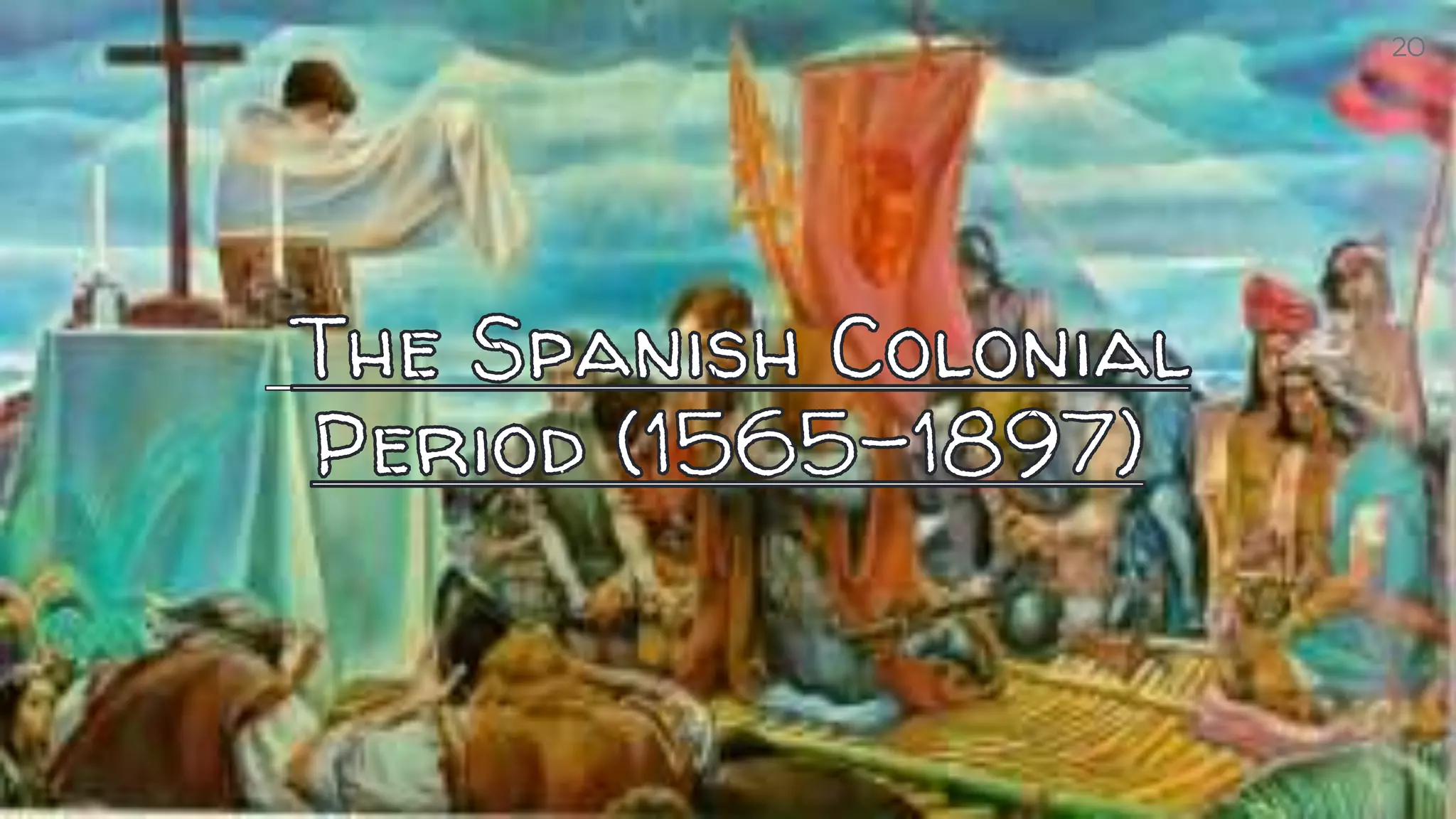
The Spanish Colonial Period
(1565-1897)
21
Sixteenth Century was the start of the
deprivation of the indigenous Philippine
literature. Spanish colonial government
finally got in the scene. They were able to
manipulate literature by monopolizing it
under the religious orders. Literature
revolved mainly on the themes of Spanish/
European culture and of course, the Roman
Catholic religion.
Literary Influences during Spanish
colonization
a. Christian Doctrine or Doctrina Christiana was the first book ever
printed in the Philippines in 1593 by the Dominican press.
b. Libro de la Lengua Tagala by Fernando Bagongbanta is a tagalog
translations to the Spanish lines, still with the superiority of the Spanish
language.
c. Pasyon is influenced by the Spanish contexts of Christianity. At least,
they embodied several Filipino sentiments and values (the feeling of
Filipino mother towards a suffering son).
22
Filipino writers in Spanish became
conscious for the search of freedom
a. Pasyon Dapat Ipag-alab ng Puso by Marcelo H. del Pilar expressed
his rebellious writing style and was identified.
b. Pascual Poblete’s Patnubay sa Binyagan associated Filipinos’
struggle for independence with Jesus’ life.
c. Jose Rizal’s Noli Me Tangere and El Filibusterismo made a very
powerful contributions to the awakening of Filipinos as it introduce the
rejection of Spanish rule. He also influenced the succeeding writers.
23
24
d. The narrative poems Awit and Corrido
talked about world of royals, warriors, and
lovers (the basic concept in Florante at
Laura).
e. Komedya. Francisco Baltazar’s Florante at
Laura embodied the concept of colonization
and oppression which gave voice to their
revolutionary action towards freedom.
25
The American Colonial Period
(1898-1945
26
 Philippine literature in Spanish time started to
lose its track on the first decade.
 The poems of Fernando Ma. Guerrero (Crisalidas),
Balmori’s Se deshojo la Flor novel, and many
others discussed revolution and sentiments for
patriotism and reform proved that Philippine
literature was used to claim freedom from the
colonizers.
 Even though Philippine literature was in English,
the preservation of the content for Filipino
experiences was achieved.
The American Colonial Period
(1898-1945
27
 Short story writers in English like Manuel Arguilla
in his “A Son is Born,” were one of the
foundations of Philippine literature. Poetry in
English was also founded.
 Sarzuela was overpowered by English drama.
28
The Contemporary Period (1946
to present)
29
This period started during the rebirth
of freedom in (1946 to present). The
Americans returned in 1945. Filipinos
rejoiced and guerrillas fled to the mountain
and joined the liberating American Army.
On July 4, 1946, the Philippines regained its
freedom and the Filipino flag waved
joyously alone. The chains were broken.
The State of Literature during
this Period
The early post – liberation period was marked by a kind of
“struggle of mind and spirit” posed by the sudden emancipation
from the enemy, and the wild desire to see print.
a. Heart of The Islands (1947) is a collection of poems by Manuel
Viray
b. Philippines Cross Section (1950) is a collection of prose and
poetry by Maximo Ramos and Florentino Valeros
c. Prose and Poems (1952) by Nick Joaquin
d. Philippine Writing (1953) by T.D. Agcaoili
e. Philippine Havest by Amador Daguio
30
The State of Literature during
this Period
f. Horizons Least (1967) is a collection of works by the professors
of UE, mostly in English (short stories, essays, research papers,
poem, and drama) by Artemio Patacsil and Silverio Baltazar. The
themes of most poems dealt with the usual love of nature, social
and political problems. Toribia Maño’s poems showed deep
emotional intensity.
g. Who Spoke of Courage in His Sleep by NVM Gonzales
h. Speak Not, Speak Also by Conrado V. Pedroche
i. Other poets were Toribia Maño and Edith L. Tiempo, Jose Garcia
Villa’s Have Come, Am Here has won acclaim both here and
abroad
31
Extra Resources
Link:
https://d.docs.live.net/716f5d044a13474a/
Desktop/Module%20%202021-
2022/SHS_Q1_Mod1_21st-Century-
Literature-Lesson-1-and-6-version-3.pdf
The New Filipino
Literature during
this Period
The New Filipino Literature
during this Period Philippine
literature in Tagalog was revived
during this period. Most themes
in writings dealt with Japanese
brutalities, of the poverty of life
under the Japanese government,
and the brave guerilla exploits.
Period of Activism
(1970-1972) Many young
people became activists to ask for
change in the government. In the
expression of this desire for
change, the writings of some
youth who were fueled with
nationalism in order to emphasize
the importance of their petitions.
The Literary
Revolution
The youth became completely
rebellious during this period.
This was proven not only in the
bloody demonstrations in the
sidewalk but also in literature.
Campus newspapers showed
rebellious emotions.
Writings During the
Period of Activism
The irreverence for the poor
reached its peak during this
period of the mass revolution. It
was also during this period that
Bomba films started to come out
to discredit our ways as Filipinos.
The period of the New Society
started on September 21, 1972. The
Carlos Palanca Awards continued to
give annual awards. Almost all themes
in most writings Dealt with the
development and progress of the
country – like Green Revolution, family
planning, proper nutrition, environment,
drug addiction, and pollution.
Themes of most poems dealt
with patience, regard for native
culture, customs and the
beauties of nature, and
surroundings.
The government led in reviving old
plays and dramas, like the Tagalog
Zarzuela, Cenaculo and the Embayoka
of the Muslims which were presentedin
the rebuilt Metropolitan Theater, the
Folk Arts Theater, and the Cultural
Center of the Philippines.
Radio continued to be patronized
during this period. The play series
like Si Matar,Dahlia, Ito Ang Palad
Ko, and Mr. Lonely were the forms of
recreation of those without
Television
In the period of the New Society,
newspapers donned new forms.News on
economic progress, discipline, culture,
tourism, and the like were favored more
than the sensationalized reporting of
killings, rape, and robberies.
After ten years of military rule
and some changes in the life of
the Filipino which started under
the New Society, Martial Law was
at last lifted on January 2, 1981
1. – Poems
during this period were romantic
and revolutionary. Writers wrote
openly of criticism against the
government. The supplications of
the people were coached in fiery,
colorful, violent, profane, and
insulting language.
2. – Many
Filipino songs dealt with themes
that were really True – to – life
like those of grief, poverty,
aspirations for freedom, love of
God, country, and fellowmen.
History took another twist. Once
more, the Filipino people regained
their independence which they lost
twenty years ago. In the span of four
days from February 21-25, 1986, the
so – called People Power (Lakas ng
Bayan) prevailed.
Newspapers and other
Publications
Newspapers, which were once branded
crony newspapers, became an instant
opposition papers overnight.
Books
The Philippine revolution of 1986 and the fire
of its spirit that carried the Filipinos through
another epoch in Philippine history is still being
documented just as they have been in the
countless millions who participated in body
and spirit in its realization.
Start answering
your module
Thank you for listening!
Any questions?
You can direct message on my messenger account: Jerome Codera
49

Lesson 1 literature

  • 1.
    21st Century Literature from thePhilippines and the World Prepared by: Jerome M. Codera
  • 2.
    Hello! My name isJerome M. Codera and I will be your teacher in 21st Century Literature from the Philippines and the World 2
  • 3.
    “ General Description: Thiscourse aims to engage students in appreciation and critical study of 21st Century Literature from the Philippines and the World encompassing their various dimensions, genres, elements, structures, contexts, and traditions. 3
  • 4.
    Important matters: ➜ September24 – October 16, 2021 (20 days) ➜ We have our official Facebook group ➜ Your module will be posted in our Facebook group. ➜ Attendance is a MUST! ➜ Do your best ❤ 4
  • 5.
  • 6.
  • 7.
    WHAT I NEEDTO KNOW 2. understand literature from pre- colonial to contemporary periods. 3. make a graphical timeline focusing on how the literatures for each literary period proliferated. At the end of this lesson, the learners are expected to: 1. define literature from various writers; and 7
  • 8.
    “ What is literature? Theword literature is derived from the Latin term LITERA which means letter. It has been defined differently by various writers. 8
  • 9.
    Literature according to: Literature expressesthe feelings of people to society, to the government to his surroundings, to his fellowmen, and to his Divine Creator. (Brother Azurin) Literature is anything that is printed as long as it is related to the ideas and feelings of the people, whether it is true, or just a product of one’s Imagination. (Webster) “True literature is a piece of written work which is undying. It expresses the feelings and emotions of people in response to his everyday efforts to live, to be happy in his environment and, after struggles, to reach his Creator.” (PANITIKANG FILIPINO) 9
  • 10.
    • Some looselyinterpret literature as any printed a material written within a book, a magazine or a pamphlet. Others define literature as a faithful reproduction of man’s manifold experiences blended into one harmonious expression.
  • 11.
    “true literature isa piece of written work which is undying. It expresses the feelings and emotions of people in response to his everyday efforts to live, to be happy in his environment and, after struggles, to reach his Creator.” In Panitikang Pilipino written by Atienza, Ramos, Salazar and Naza 11
  • 12.
    Philippine Literature is adiverse and rich group of works that has evolved side – by – side with the country’s history. It had started with fables and legends made by the ancient Filipinos long before the arrival of Spanish influence. The main themes of Philippine literature focus on the country’s pre – colonial cultural traditions and socio – political histories of its colonial and contemporary traditions. 12
  • 13.
  • 14.
    Literary History/Evolution ofthe Philippines 14 Pre-Colonial Period The American Colonial Period (1898-1945 Spanish Colonial Period (1565- 1897) The American Colonial Period (1898-1945 The Contemporary Period (1946 to present) Period of Activism (1970-1972) Period of the New Society (1972- 1980) Period of the Third Republic (1981-1985) Rebirth of Freedom (1986- present)
  • 15.
    Pre – ColonialPeriod  The evolution of Philippine literature depended on the influences of colonization and the spirit of the age.  The first Filipino alphabet called ALIBATA was replaced by the Roman alphabet.  Indigenous Philippine literature was based on traditions and customs of a particular area of the country. 15
  • 16.
    Pre – ColonialPeriod  Philippines is an archipelago. It consists of several islands, (approximately 7,107 islands), and each of this island has a unique cultures and traditions, bearing different set of native literature.  Ancient literatures were written in a perishable materials like dried leaves, bamboo cylinder, and bark of the trees.  Literatures were handed down to us orally. 16
  • 17.
    There were two literaryforms during the pre- colonial period:
  • 18.
    Examples: a. Riddles orbugtong. These are effective ways to inculcate the ability of logical thinking of a child. b. Epigrams or salawikain. It reflects the hidden meaning through the good lines. It provides good values. Written literatures c. Poems or tanaga – These are common forms of poetry which has a quatrine with 7 syllables each with the same rhyme at the end of each line. It also expresses insights and lessons in life. 18
  • 19.
    Oral literature 19 Examples: a. CHANT.It is used in witchcraft and enchantment. While, ambahan is a traditional poetry of Hanunoo Mangyans of Oriental Mindoro which teaches lesson about life. It is recited by parents to educate their children by the youth expressing their love, by the old to impart experiences, or by the community in tribal ceremony. b. BALAGTASAN .This is a Filipino form of debate done in verse. The term is derived from the surname of Francisco Balagtas the author of Filipino epic Florante at Laura.
  • 20.
  • 21.
    The Spanish ColonialPeriod (1565-1897) 21 Sixteenth Century was the start of the deprivation of the indigenous Philippine literature. Spanish colonial government finally got in the scene. They were able to manipulate literature by monopolizing it under the religious orders. Literature revolved mainly on the themes of Spanish/ European culture and of course, the Roman Catholic religion.
  • 22.
    Literary Influences duringSpanish colonization a. Christian Doctrine or Doctrina Christiana was the first book ever printed in the Philippines in 1593 by the Dominican press. b. Libro de la Lengua Tagala by Fernando Bagongbanta is a tagalog translations to the Spanish lines, still with the superiority of the Spanish language. c. Pasyon is influenced by the Spanish contexts of Christianity. At least, they embodied several Filipino sentiments and values (the feeling of Filipino mother towards a suffering son). 22
  • 23.
    Filipino writers inSpanish became conscious for the search of freedom a. Pasyon Dapat Ipag-alab ng Puso by Marcelo H. del Pilar expressed his rebellious writing style and was identified. b. Pascual Poblete’s Patnubay sa Binyagan associated Filipinos’ struggle for independence with Jesus’ life. c. Jose Rizal’s Noli Me Tangere and El Filibusterismo made a very powerful contributions to the awakening of Filipinos as it introduce the rejection of Spanish rule. He also influenced the succeeding writers. 23
  • 24.
    24 d. The narrativepoems Awit and Corrido talked about world of royals, warriors, and lovers (the basic concept in Florante at Laura). e. Komedya. Francisco Baltazar’s Florante at Laura embodied the concept of colonization and oppression which gave voice to their revolutionary action towards freedom.
  • 25.
  • 26.
    The American ColonialPeriod (1898-1945 26  Philippine literature in Spanish time started to lose its track on the first decade.  The poems of Fernando Ma. Guerrero (Crisalidas), Balmori’s Se deshojo la Flor novel, and many others discussed revolution and sentiments for patriotism and reform proved that Philippine literature was used to claim freedom from the colonizers.  Even though Philippine literature was in English, the preservation of the content for Filipino experiences was achieved.
  • 27.
    The American ColonialPeriod (1898-1945 27  Short story writers in English like Manuel Arguilla in his “A Son is Born,” were one of the foundations of Philippine literature. Poetry in English was also founded.  Sarzuela was overpowered by English drama.
  • 28.
  • 29.
    The Contemporary Period(1946 to present) 29 This period started during the rebirth of freedom in (1946 to present). The Americans returned in 1945. Filipinos rejoiced and guerrillas fled to the mountain and joined the liberating American Army. On July 4, 1946, the Philippines regained its freedom and the Filipino flag waved joyously alone. The chains were broken.
  • 30.
    The State ofLiterature during this Period The early post – liberation period was marked by a kind of “struggle of mind and spirit” posed by the sudden emancipation from the enemy, and the wild desire to see print. a. Heart of The Islands (1947) is a collection of poems by Manuel Viray b. Philippines Cross Section (1950) is a collection of prose and poetry by Maximo Ramos and Florentino Valeros c. Prose and Poems (1952) by Nick Joaquin d. Philippine Writing (1953) by T.D. Agcaoili e. Philippine Havest by Amador Daguio 30
  • 31.
    The State ofLiterature during this Period f. Horizons Least (1967) is a collection of works by the professors of UE, mostly in English (short stories, essays, research papers, poem, and drama) by Artemio Patacsil and Silverio Baltazar. The themes of most poems dealt with the usual love of nature, social and political problems. Toribia Maño’s poems showed deep emotional intensity. g. Who Spoke of Courage in His Sleep by NVM Gonzales h. Speak Not, Speak Also by Conrado V. Pedroche i. Other poets were Toribia Maño and Edith L. Tiempo, Jose Garcia Villa’s Have Come, Am Here has won acclaim both here and abroad 31
  • 32.
  • 33.
    The New Filipino Literatureduring this Period
  • 34.
    The New FilipinoLiterature during this Period Philippine literature in Tagalog was revived during this period. Most themes in writings dealt with Japanese brutalities, of the poverty of life under the Japanese government, and the brave guerilla exploits.
  • 35.
    Period of Activism (1970-1972)Many young people became activists to ask for change in the government. In the expression of this desire for change, the writings of some youth who were fueled with nationalism in order to emphasize the importance of their petitions.
  • 36.
    The Literary Revolution The youthbecame completely rebellious during this period. This was proven not only in the bloody demonstrations in the sidewalk but also in literature. Campus newspapers showed rebellious emotions.
  • 37.
    Writings During the Periodof Activism The irreverence for the poor reached its peak during this period of the mass revolution. It was also during this period that Bomba films started to come out to discredit our ways as Filipinos.
  • 38.
    The period ofthe New Society started on September 21, 1972. The Carlos Palanca Awards continued to give annual awards. Almost all themes in most writings Dealt with the development and progress of the country – like Green Revolution, family planning, proper nutrition, environment, drug addiction, and pollution.
  • 39.
    Themes of mostpoems dealt with patience, regard for native culture, customs and the beauties of nature, and surroundings.
  • 40.
    The government ledin reviving old plays and dramas, like the Tagalog Zarzuela, Cenaculo and the Embayoka of the Muslims which were presentedin the rebuilt Metropolitan Theater, the Folk Arts Theater, and the Cultural Center of the Philippines.
  • 41.
    Radio continued tobe patronized during this period. The play series like Si Matar,Dahlia, Ito Ang Palad Ko, and Mr. Lonely were the forms of recreation of those without Television
  • 42.
    In the periodof the New Society, newspapers donned new forms.News on economic progress, discipline, culture, tourism, and the like were favored more than the sensationalized reporting of killings, rape, and robberies.
  • 43.
    After ten yearsof military rule and some changes in the life of the Filipino which started under the New Society, Martial Law was at last lifted on January 2, 1981
  • 44.
    1. – Poems duringthis period were romantic and revolutionary. Writers wrote openly of criticism against the government. The supplications of the people were coached in fiery, colorful, violent, profane, and insulting language.
  • 45.
    2. – Many Filipinosongs dealt with themes that were really True – to – life like those of grief, poverty, aspirations for freedom, love of God, country, and fellowmen.
  • 46.
    History took anothertwist. Once more, the Filipino people regained their independence which they lost twenty years ago. In the span of four days from February 21-25, 1986, the so – called People Power (Lakas ng Bayan) prevailed.
  • 47.
    Newspapers and other Publications Newspapers,which were once branded crony newspapers, became an instant opposition papers overnight. Books The Philippine revolution of 1986 and the fire of its spirit that carried the Filipinos through another epoch in Philippine history is still being documented just as they have been in the countless millions who participated in body and spirit in its realization.
  • 48.
  • 49.
    Thank you forlistening! Any questions? You can direct message on my messenger account: Jerome Codera 49