PRAYER
ATTENDANCE
CHECK
LET'S BREAK
THE ICE!
HOUSE
RULES
Always
lend
your
ears.
Raise hand
if you have
concern,
wanted to
answer or
ask a
question.
Be
cooperative.
MODAL
VERBS
OBJECTI
VES
1
2
3
Define modal;
Learn appropriate
usage of modals on
certain situation; and
Write a mission
statement on health
protocols using
modals.
LISTEN! IT'S
WRITTEN.
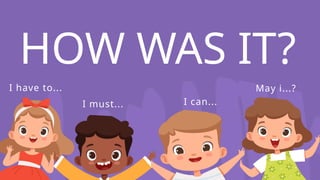
HOW WAS IT?
May i...?
I can...
I have to...
I must...
WHAT IS IT?
May i...?
I can...
I have to...
I must...
MODAL
VERBS
MODAL
VERBS
A modal verb (or modal
auxiliary verb) is a type of
verb that is used to indicate
mood or tense which refers
to the speaker's attitude
towards the prohibition,
obligation, or permission of
an action.
MODAL
VERBS
Examples of modal verbs
include "can," "could," "may,"
"might," "shall," "should,"
"will," "would," and "must”.
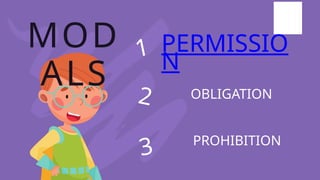
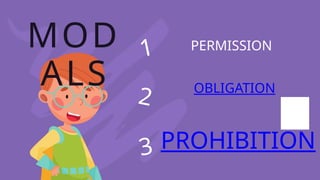
MOD
ALS
1
2
3
PERMISSIO
N
OBLIGATION
PROHIBITION
PERM
IS
SIO
N
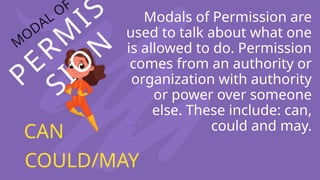
Modals of Permission are
used to talk about what one
is allowed to do. Permission
comes from an authority or
organization with authority
or power over someone
else. These include: can,
could and may.
M
ODAL OF
CAN
COULD/MAY
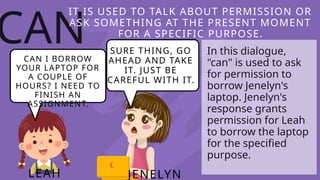
CAN
IT IS USED TO TALK ABOUT PERMISSION OR
ASK SOMETHING AT THE PRESENT MOMENT
FOR A SPECIFIC PURPOSE.
CAN I BORROW
YOUR LAPTOP FOR
A COUPLE OF
HOURS? I NEED TO
FINISH AN
ASSIGNMENT.
LEAH JENELYN
SURE THING, GO
AHEAD AND TAKE
IT. JUST BE
CAREFUL WITH IT.
In this dialogue,
"can" is used to ask
for permission to
borrow Jenelyn's
laptop. Jenelyn's
response grants
permission for Leah
to borrow the laptop
for the specified
purpose.
COULD/
MAY
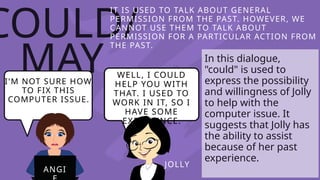
IT IS USED TO TALK ABOUT GENERAL
PERMISSION FROM THE PAST. HOWEVER, WE
CANNOT USE THEM TO TALK ABOUT
PERMISSION FOR A PARTICULAR ACTION FROM
THE PAST.
I'M NOT SURE HOW
TO FIX THIS
COMPUTER ISSUE.
WELL, I COULD
HELP YOU WITH
THAT. I USED TO
WORK IN IT, SO I
HAVE SOME
EXPERIENCE.
In this dialogue,
"could" is used to
express the possibility
and willingness of Jolly
to help with the
computer issue. It
suggests that Jolly has
the ability to assist
because of her past
experience.
ANGI
JOLLY
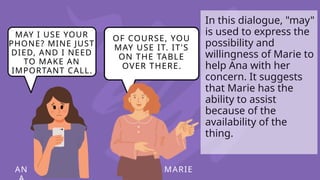
OF COURSE, YOU
MAY USE IT. IT'S
ON THE TABLE
OVER THERE.
In this dialogue, "may"
is used to express the
possibility and
willingness of Marie to
help Ana with her
concern. It suggests
that Marie has the
ability to assist
because of the
availability of the
thing.
AN MARIE
MAY I USE YOUR
PHONE? MINE JUST
DIED, AND I NEED
TO MAKE AN
IMPORTANT CALL.
MOD
ALS
1
2
3
PERMISSION
OBLIGATION
PROHIBITION
O
BLIG
A
TIO
N
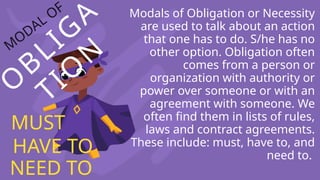
M
ODAL OF Modals of Obligation or Necessity
are used to talk about an action
that one has to do. S/he has no
other option. Obligation often
comes from a person or
organization with authority or
power over someone or with an
agreement with someone. We
often find them in lists of rules,
laws and contract agreements.
These include: must, have to, and
need to.
MUST
HAVE TO
NEED TO
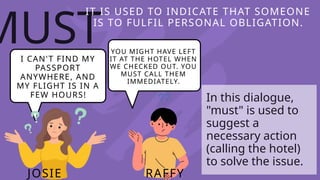
MUST
IT IS USED TO INDICATE THAT SOMEONE
IS TO FULFIL PERSONAL OBLIGATION.
I CAN'T FIND MY
PASSPORT
ANYWHERE, AND
MY FLIGHT IS IN A
FEW HOURS!
JOSIE RAFFY
YOU MIGHT HAVE LEFT
IT AT THE HOTEL WHEN
WE CHECKED OUT. YOU
MUST CALL THEM
IMMEDIATELY.
In this dialogue,
"must" is used to
suggest a
necessary action
(calling the hotel)
to solve the issue.
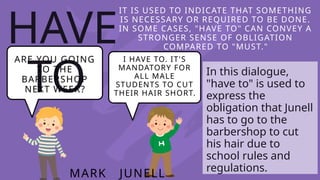
HAVE
TO
IT IS USED TO INDICATE THAT SOMETHING
IS NECESSARY OR REQUIRED TO BE DONE.
IN SOME CASES, "HAVE TO" CAN CONVEY A
STRONGER SENSE OF OBLIGATION
COMPARED TO "MUST."
ARE YOU GOING
TO THE
BARBERSHOP
NEXT WEEK?
MARK JUNELL
I HAVE TO. IT'S
MANDATORY FOR
ALL MALE
STUDENTS TO CUT
THEIR HAIR SHORT.
In this dialogue,
"have to" is used to
express the
obligation that Junell
has to go to the
barbershop to cut
his hair due to
school rules and
regulations.
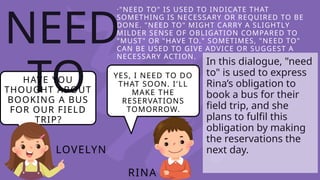
NEED
TO
·"NEED TO" IS USED TO INDICATE THAT
SOMETHING IS NECESSARY OR REQUIRED TO BE
DONE. "NEED TO" MIGHT CARRY A SLIGHTLY
MILDER SENSE OF OBLIGATION COMPARED TO
"MUST" OR "HAVE TO." SOMETIMES, "NEED TO"
CAN BE USED TO GIVE ADVICE OR SUGGEST A
NECESSARY ACTION.
HAVE YOU
THOUGHT ABOUT
BOOKING A BUS
FOR OUR FIELD
TRIP?
LOVELYN
RINA
YES, I NEED TO DO
THAT SOON. I'LL
MAKE THE
RESERVATIONS
TOMORROW.
In this dialogue, "need
to" is used to express
Rina’s obligation to
book a bus for their
field trip, and she
plans to fulfil this
obligation by making
the reservations the
next day.
MOD
ALS
1
2
3
PERMISSION
OBLIGATION
PROHIBITION
PRO
H
IB
ITIO
N
M
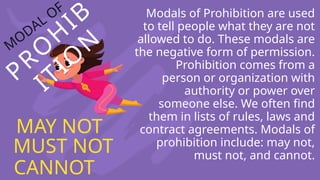
ODAL OF Modals of Prohibition are used
to tell people what they are not
allowed to do. These modals are
the negative form of permission.
Prohibition comes from a
person or organization with
authority or power over
someone else. We often find
them in lists of rules, laws and
contract agreements. Modals of
prohibition include: may not,
must not, and cannot.
MAY NOT
MUST NOT
CANNOT
MAY NOT
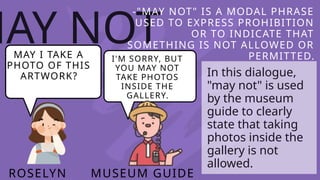
-"MAY NOT" IS A MODAL PHRASE
USED TO EXPRESS PROHIBITION
OR TO INDICATE THAT
SOMETHING IS NOT ALLOWED OR
PERMITTED.
I'M SORRY, BUT
YOU MAY NOT
TAKE PHOTOS
INSIDE THE
GALLERY.
MAY I TAKE A
PHOTO OF THIS
ARTWORK?
ROSELYN MUSEUM GUIDE
In this dialogue,
"may not" is used
by the museum
guide to clearly
state that taking
photos inside the
gallery is not
allowed.
MUST
NOT
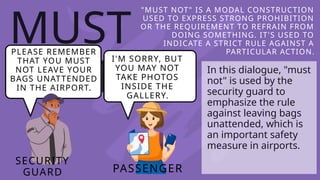
"MUST NOT" IS A MODAL CONSTRUCTION
USED TO EXPRESS STRONG PROHIBITION
OR THE REQUIREMENT TO REFRAIN FROM
DOING SOMETHING. IT'S USED TO
INDICATE A STRICT RULE AGAINST A
PARTICULAR ACTION.
I'M SORRY, BUT
YOU MAY NOT
TAKE PHOTOS
INSIDE THE
GALLERY.
PLEASE REMEMBER
THAT YOU MUST
NOT LEAVE YOUR
BAGS UNATTENDED
IN THE AIRPORT.
SECURITY
GUARD
In this dialogue, "must
not" is used by the
security guard to
emphasize the rule
against leaving bags
unattended, which is
an important safety
measure in airports.
PASSENGER
ANNOT
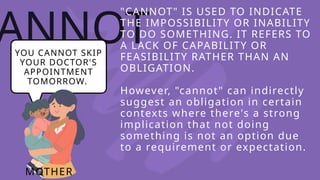
"CANNOT" IS USED TO INDICATE
THE IMPOSSIBILITY OR INABILITY
TO DO SOMETHING. IT REFERS TO
A LACK OF CAPABILITY OR
FEASIBILITY RATHER THAN AN
OBLIGATION.
However, "cannot" can indirectly
suggest an obligation in certain
contexts where there's a strong
implication that not doing
something is not an option due
to a requirement or expectation.
YOU CANNOT SKIP
YOUR DOCTOR'S
APPOINTMENT
TOMORROW.
MOTHER
WHAT HAVE I
LEARNED?May i...?
I can...
I have to...
I must...
WHAT IS
MODAL?
WHAT
ARE THE
USES OF
WHAT IS
MODAL
OF
WHAT IS
MODAL
OF
WHAT IS
MODAL
OF
WHAT CAN I
DO? May i...?
I can...
I have to...
I must...
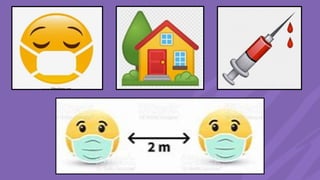
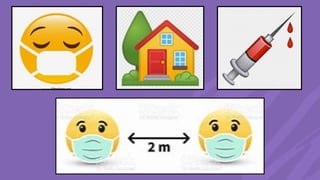
FROM YOUR ACTIVITY EARLIER,
CONSTRUCT FIVE (5) HEALTH
PROTOCOLS ABOUT THE FOLLOWING
EMOTICONS THAT SHOW COMMON
PRACTICES WE DO TO PREVENT THE
SPREAD OF THE COVID19 WITH USE
OF MODALS OF PERMISSION,
MODALS OF OBLIGATION, AND
MODALS OF PROHIBITION.
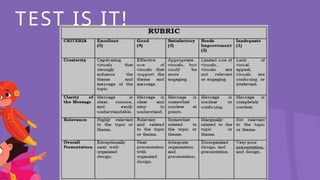
Make a poster out of the words
you have noted in the activity
and write a mission statement
on health protocols using
modals of obligation,
permission or prohibition. (20
points)
TEST IS IT!
TEST IS IT!
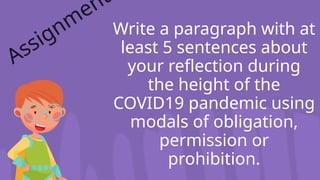
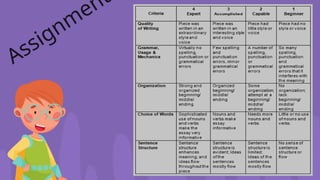
Write a paragraph with at
least 5 sentences about
your reflection during
the height of the
COVID19 pandemic using
modals of obligation,
permission or
prohibition.
Assignm
ent
Assignm
ent
THANK YOU &
SEE YOU NEXT
MEETING!
PREPARED BY: CRISAN PACIBO-ESPIDA
TEACHER I

For English 9- Quarter 1 - Module 1: Modals

  • 2.
  • 3.
  • 4.
  • 6.
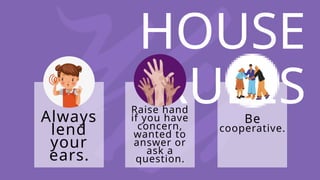
    HOUSE RULES Always lend your ears. Raise hand if youhave concern, wanted to answer or ask a question. Be cooperative.
  • 7.
  • 8.
    OBJECTI VES 1 2 3 Define modal; Learn appropriate usageof modals on certain situation; and Write a mission statement on health protocols using modals.
  • 9.
  • 10.
    HOW WAS IT? Mayi...? I can... I have to... I must...
  • 12.
    WHAT IS IT? Mayi...? I can... I have to... I must...
  • 13.
  • 14.
    MODAL VERBS A modal verb(or modal auxiliary verb) is a type of verb that is used to indicate mood or tense which refers to the speaker's attitude towards the prohibition, obligation, or permission of an action.
  • 15.
    MODAL VERBS Examples of modalverbs include "can," "could," "may," "might," "shall," "should," "will," "would," and "must”.
  • 16.
  • 17.
    PERM IS SIO N Modals of Permissionare used to talk about what one is allowed to do. Permission comes from an authority or organization with authority or power over someone else. These include: can, could and may. M ODAL OF CAN COULD/MAY
  • 18.
    CAN IT IS USEDTO TALK ABOUT PERMISSION OR ASK SOMETHING AT THE PRESENT MOMENT FOR A SPECIFIC PURPOSE. CAN I BORROW YOUR LAPTOP FOR A COUPLE OF HOURS? I NEED TO FINISH AN ASSIGNMENT. LEAH JENELYN SURE THING, GO AHEAD AND TAKE IT. JUST BE CAREFUL WITH IT. In this dialogue, "can" is used to ask for permission to borrow Jenelyn's laptop. Jenelyn's response grants permission for Leah to borrow the laptop for the specified purpose.
  • 19.
    COULD/ MAY IT IS USEDTO TALK ABOUT GENERAL PERMISSION FROM THE PAST. HOWEVER, WE CANNOT USE THEM TO TALK ABOUT PERMISSION FOR A PARTICULAR ACTION FROM THE PAST. I'M NOT SURE HOW TO FIX THIS COMPUTER ISSUE. WELL, I COULD HELP YOU WITH THAT. I USED TO WORK IN IT, SO I HAVE SOME EXPERIENCE. In this dialogue, "could" is used to express the possibility and willingness of Jolly to help with the computer issue. It suggests that Jolly has the ability to assist because of her past experience. ANGI JOLLY
  • 20.
    OF COURSE, YOU MAYUSE IT. IT'S ON THE TABLE OVER THERE. In this dialogue, "may" is used to express the possibility and willingness of Marie to help Ana with her concern. It suggests that Marie has the ability to assist because of the availability of the thing. AN MARIE MAY I USE YOUR PHONE? MINE JUST DIED, AND I NEED TO MAKE AN IMPORTANT CALL.
  • 21.
  • 22.
    O BLIG A TIO N M ODAL OF Modalsof Obligation or Necessity are used to talk about an action that one has to do. S/he has no other option. Obligation often comes from a person or organization with authority or power over someone or with an agreement with someone. We often find them in lists of rules, laws and contract agreements. These include: must, have to, and need to. MUST HAVE TO NEED TO
  • 23.
    MUST IT IS USEDTO INDICATE THAT SOMEONE IS TO FULFIL PERSONAL OBLIGATION. I CAN'T FIND MY PASSPORT ANYWHERE, AND MY FLIGHT IS IN A FEW HOURS! JOSIE RAFFY YOU MIGHT HAVE LEFT IT AT THE HOTEL WHEN WE CHECKED OUT. YOU MUST CALL THEM IMMEDIATELY. In this dialogue, "must" is used to suggest a necessary action (calling the hotel) to solve the issue.
  • 24.
    HAVE TO IT IS USEDTO INDICATE THAT SOMETHING IS NECESSARY OR REQUIRED TO BE DONE. IN SOME CASES, "HAVE TO" CAN CONVEY A STRONGER SENSE OF OBLIGATION COMPARED TO "MUST." ARE YOU GOING TO THE BARBERSHOP NEXT WEEK? MARK JUNELL I HAVE TO. IT'S MANDATORY FOR ALL MALE STUDENTS TO CUT THEIR HAIR SHORT. In this dialogue, "have to" is used to express the obligation that Junell has to go to the barbershop to cut his hair due to school rules and regulations.
  • 25.
    NEED TO ·"NEED TO" ISUSED TO INDICATE THAT SOMETHING IS NECESSARY OR REQUIRED TO BE DONE. "NEED TO" MIGHT CARRY A SLIGHTLY MILDER SENSE OF OBLIGATION COMPARED TO "MUST" OR "HAVE TO." SOMETIMES, "NEED TO" CAN BE USED TO GIVE ADVICE OR SUGGEST A NECESSARY ACTION. HAVE YOU THOUGHT ABOUT BOOKING A BUS FOR OUR FIELD TRIP? LOVELYN RINA YES, I NEED TO DO THAT SOON. I'LL MAKE THE RESERVATIONS TOMORROW. In this dialogue, "need to" is used to express Rina’s obligation to book a bus for their field trip, and she plans to fulfil this obligation by making the reservations the next day.
  • 26.
  • 27.
    PRO H IB ITIO N M ODAL OF Modalsof Prohibition are used to tell people what they are not allowed to do. These modals are the negative form of permission. Prohibition comes from a person or organization with authority or power over someone else. We often find them in lists of rules, laws and contract agreements. Modals of prohibition include: may not, must not, and cannot. MAY NOT MUST NOT CANNOT
  • 28.
    MAY NOT -"MAY NOT"IS A MODAL PHRASE USED TO EXPRESS PROHIBITION OR TO INDICATE THAT SOMETHING IS NOT ALLOWED OR PERMITTED. I'M SORRY, BUT YOU MAY NOT TAKE PHOTOS INSIDE THE GALLERY. MAY I TAKE A PHOTO OF THIS ARTWORK? ROSELYN MUSEUM GUIDE In this dialogue, "may not" is used by the museum guide to clearly state that taking photos inside the gallery is not allowed.
  • 29.
    MUST NOT "MUST NOT" ISA MODAL CONSTRUCTION USED TO EXPRESS STRONG PROHIBITION OR THE REQUIREMENT TO REFRAIN FROM DOING SOMETHING. IT'S USED TO INDICATE A STRICT RULE AGAINST A PARTICULAR ACTION. I'M SORRY, BUT YOU MAY NOT TAKE PHOTOS INSIDE THE GALLERY. PLEASE REMEMBER THAT YOU MUST NOT LEAVE YOUR BAGS UNATTENDED IN THE AIRPORT. SECURITY GUARD In this dialogue, "must not" is used by the security guard to emphasize the rule against leaving bags unattended, which is an important safety measure in airports. PASSENGER
  • 30.
    ANNOT "CANNOT" IS USEDTO INDICATE THE IMPOSSIBILITY OR INABILITY TO DO SOMETHING. IT REFERS TO A LACK OF CAPABILITY OR FEASIBILITY RATHER THAN AN OBLIGATION. However, "cannot" can indirectly suggest an obligation in certain contexts where there's a strong implication that not doing something is not an option due to a requirement or expectation. YOU CANNOT SKIP YOUR DOCTOR'S APPOINTMENT TOMORROW. MOTHER
  • 31.
    WHAT HAVE I LEARNED?Mayi...? I can... I have to... I must...
  • 32.
  • 33.
  • 34.
  • 35.
  • 36.
  • 37.
    WHAT CAN I DO?May i...? I can... I have to... I must...
  • 38.
    FROM YOUR ACTIVITYEARLIER, CONSTRUCT FIVE (5) HEALTH PROTOCOLS ABOUT THE FOLLOWING EMOTICONS THAT SHOW COMMON PRACTICES WE DO TO PREVENT THE SPREAD OF THE COVID19 WITH USE OF MODALS OF PERMISSION, MODALS OF OBLIGATION, AND MODALS OF PROHIBITION.
  • 40.
    Make a posterout of the words you have noted in the activity and write a mission statement on health protocols using modals of obligation, permission or prohibition. (20 points) TEST IS IT!
  • 41.
  • 42.
    Write a paragraphwith at least 5 sentences about your reflection during the height of the COVID19 pandemic using modals of obligation, permission or prohibition. Assignm ent
  • 43.
  • 44.
    THANK YOU & SEEYOU NEXT MEETING! PREPARED BY: CRISAN PACIBO-ESPIDA TEACHER I