








CONSUMER
COMPLIANCE IN
THE AGE OF CFPB
NICE Webinars Series

March 28, 2013
WITH YOU TODAY

Aviad Abiri
VP, Portfolio Business Development
NICE Systems

2
Consumer Compliance Event, Feb 19 2013
CONSUMER
COMPLIANCE IN
THE HOT SEAT
Intense Compliance Dynamics!
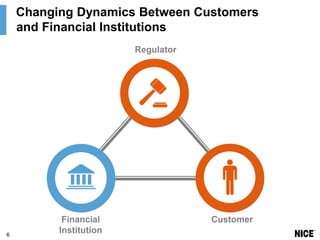
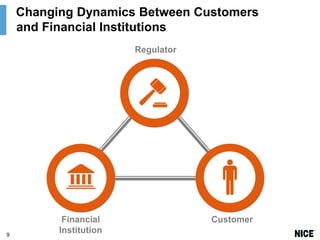
Changing Dynamics Between Customers
and Financial Institutions
Regulator

6

Financial
Institution

Customer
Changing Dynamics Between Customers
and Financial Institutions
Regulator

9

Financial
Institution

Customer
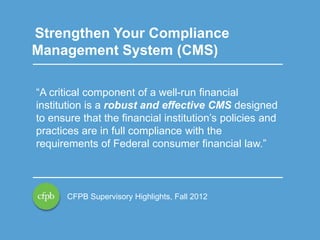
Strengthen Your Compliance
Management System (CMS)
“A critical component of a well-run financial
institution is a robust and effective CMS designed
to ensure that the financial institution’s policies and
practices are in full compliance with the
requirements of Federal consumer financial law.”

CFPB Supervisory Highlights, Fall 2012

10
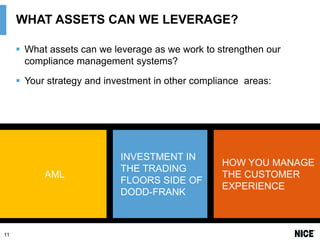
WHAT ASSETS CAN WE LEVERAGE?
 What assets can we leverage as we work to strengthen our
compliance management systems?
 Your strategy and investment in other compliance areas:

AML

11

INVESTMENT IN
THE TRADING
FLOORS SIDE OF
DODD-FRANK

HOW YOU MANAGE
THE CUSTOMER
EXPERIENCE



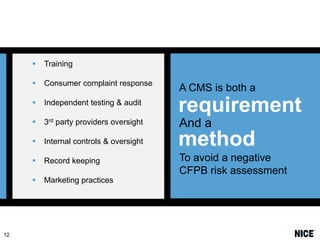
Consumer complaint response

A CMS is both a



Independent testing & audit

requirement



3rd party providers oversight

And a



Internal controls & oversight

method



Record keeping



12

Training

To avoid a negative
CFPB risk assessment

Marketing practices
CUSTOMER
INTERACTION
COMPLIANCE
Strengthening the
Contact Center
In the Age of CFPB
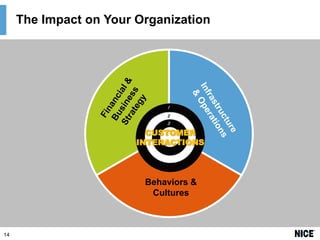
The Impact on Your Organization

CUSTOMER
INTERACTIONS

Behaviors &
Cultures

14
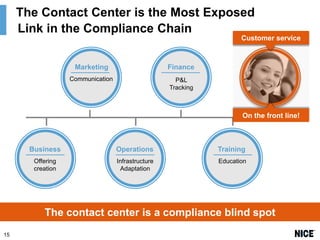
The Contact Center is the Most Exposed
Link in the Compliance Chain
Customer service

Marketing

Finance

Communication

P&L
Tracking

On the front line!

Business

Operations

Training

Offering
creation

Infrastructure
Adaptation

Education

The contact center is a compliance blind spot
15
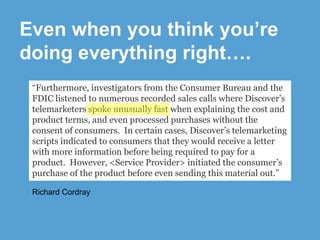
Even when you think you’re
doing everything right….
“Furthermore, investigators from the Consumer Bureau and the
FDIC listened to numerous recorded sales calls where Discover’s
telemarketers spoke unusually fast when explaining the cost and
product terms, and even processed purchases without the
consent of consumers. In certain cases, Discover’s telemarketing
scripts indicated to consumers that they would receive a letter
with more information before being required to pay for a
product. However, <Service Provider> initiated the consumer’s
purchase of the product before even sending this material out.”
Richard Cordray
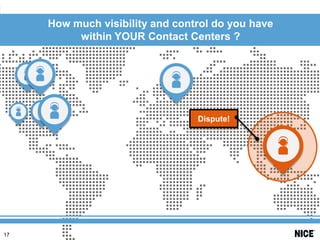
How much visibility and control do you have
within YOUR Contact Centers ?

Dispute!

17
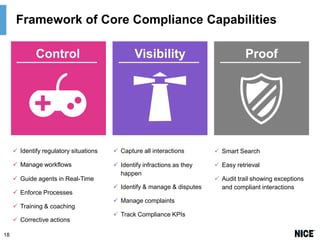
Framework of Core Compliance Capabilities
Control

Visibility

Proof

 Identify regulatory situations

 Capture all interactions

 Smart Search

 Manage workflows

 Identify infractions as they
happen

 Easy retrieval

 Guide agents in Real-Time

 Enforce Processes
 Training & coaching
 Corrective actions
18

 Identify & manage & disputes
 Manage complaints
 Track Compliance KPIs

 Audit trail showing exceptions
and compliant interactions
Control

19
077-9663851
21
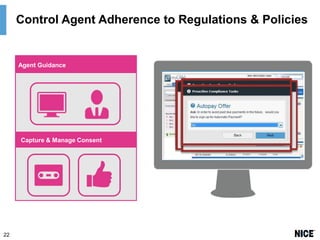
Control Agent Adherence to Regulations & Policies

Agent Guidance

Capture & Manage Consent

22
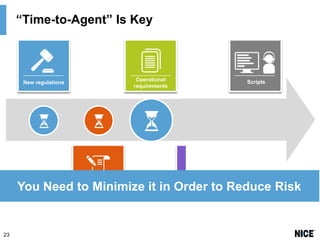
“Time-to-Agent” Is Key

New regulations

Operational
requirements

Scripts

Internal policies
Training to
You Need to Minimize it in Order plan Reduce Risk

23
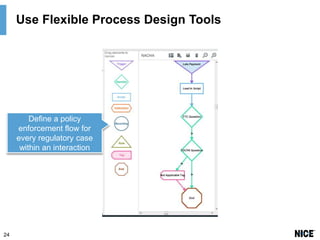
Use Flexible Process Design Tools

Define a policy
enforcement flow for
every regulatory case
within an interaction

24
Visibility

25
26
Visibility
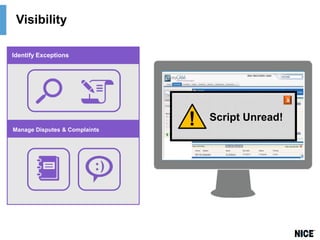
Identify Exceptions

Manage Disputes & Complaints

Callouts one after the
other (one replaces the
Script Unread!
other)

!

x
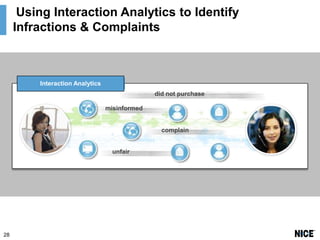
Using Interaction Analytics to Identify
Infractions & Complaints

Interaction Analysis
Emotion Analytics
Call Over Analytics
Talk FlowDetection
Desktop Analytics
Speech
did not purchase
misinformed

complain

unfair

28
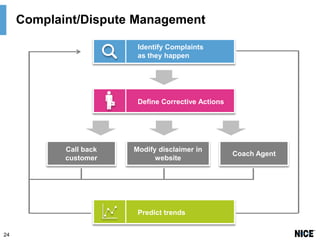
Complaint/Dispute Management
Identify Complaints
as they happen

Define Corrective Actions

Call back
customer

Modify disclaimer in
website

Predict trends
24

Coach Agent
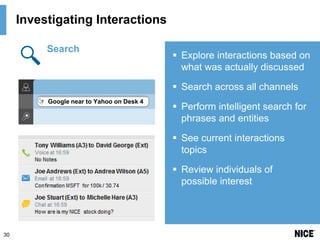
Investigating Interactions
Search

 Explore interactions based on
what was actually discussed

 Search across all channels
Google near to Yahoo on Desk 4

Search Interactions

 Perform intelligent search for
phrases and entities

 See current interactions
topics
 Review individuals of
possible interest

30
Proof

31
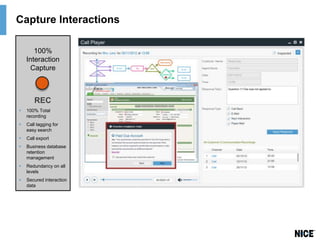
Capture Interactions
100%
Interaction
Capture

REC


100% Total
recording



Call tagging for
easy search



Call export



Business database
retention
management



Redundancy on all
levels



Secured interaction
data
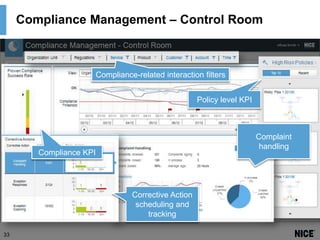
Compliance Management – Control Room

Compliance-related interaction filters
Policy level KPI

Complaint
handling

Compliance KPI

Corrective Action
scheduling and
tracking
33
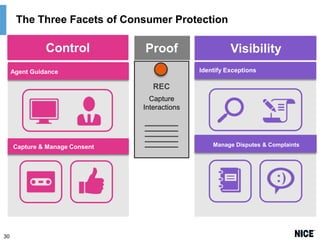
The Three Facets of Consumer Protection

Control

Proof

Visibility
Identify Exceptions

Agent Guidance

REC
Capture
Interactions

Capture & Manage Consent

30

Manage Disputes & Complaints
Proactive Compliance for Contact Center
35
The Time to Prepare is Now

?

?

?

?

?

? ?

?

36

?
?

?

?

? ?

?

?

?

?
THANK YOU
Questions?

37
38

Less Risk - That would be NICE. Consumer Compliance in the Age of CFPB

  • 1.
    CONSUMER COMPLIANCE IN THE AGEOF CFPB NICE Webinars Series March 28, 2013
  • 2.
    WITH YOU TODAY AviadAbiri VP, Portfolio Business Development NICE Systems 2
  • 3.
  • 4.
  • 5.
  • 6.
    Changing Dynamics BetweenCustomers and Financial Institutions Regulator 6 Financial Institution Customer
  • 9.
    Changing Dynamics BetweenCustomers and Financial Institutions Regulator 9 Financial Institution Customer
  • 10.
    Strengthen Your Compliance ManagementSystem (CMS) “A critical component of a well-run financial institution is a robust and effective CMS designed to ensure that the financial institution’s policies and practices are in full compliance with the requirements of Federal consumer financial law.” CFPB Supervisory Highlights, Fall 2012 10
  • 11.
    WHAT ASSETS CANWE LEVERAGE?  What assets can we leverage as we work to strengthen our compliance management systems?  Your strategy and investment in other compliance areas: AML 11 INVESTMENT IN THE TRADING FLOORS SIDE OF DODD-FRANK HOW YOU MANAGE THE CUSTOMER EXPERIENCE
  • 12.
      Consumer complaint response ACMS is both a  Independent testing & audit requirement  3rd party providers oversight And a  Internal controls & oversight method  Record keeping  12 Training To avoid a negative CFPB risk assessment Marketing practices
  • 13.
  • 14.
    The Impact onYour Organization CUSTOMER INTERACTIONS Behaviors & Cultures 14
  • 15.
    The Contact Centeris the Most Exposed Link in the Compliance Chain Customer service Marketing Finance Communication P&L Tracking On the front line! Business Operations Training Offering creation Infrastructure Adaptation Education The contact center is a compliance blind spot 15
  • 16.
    Even when youthink you’re doing everything right…. “Furthermore, investigators from the Consumer Bureau and the FDIC listened to numerous recorded sales calls where Discover’s telemarketers spoke unusually fast when explaining the cost and product terms, and even processed purchases without the consent of consumers. In certain cases, Discover’s telemarketing scripts indicated to consumers that they would receive a letter with more information before being required to pay for a product. However, <Service Provider> initiated the consumer’s purchase of the product before even sending this material out.” Richard Cordray
  • 17.
    How much visibilityand control do you have within YOUR Contact Centers ? Dispute! 17
  • 18.
    Framework of CoreCompliance Capabilities Control Visibility Proof  Identify regulatory situations  Capture all interactions  Smart Search  Manage workflows  Identify infractions as they happen  Easy retrieval  Guide agents in Real-Time  Enforce Processes  Training & coaching  Corrective actions 18  Identify & manage & disputes  Manage complaints  Track Compliance KPIs  Audit trail showing exceptions and compliant interactions
  • 19.
  • 20.
  • 21.
  • 22.
    Control Agent Adherenceto Regulations & Policies Agent Guidance Capture & Manage Consent 22
  • 23.
    “Time-to-Agent” Is Key Newregulations Operational requirements Scripts Internal policies Training to You Need to Minimize it in Order plan Reduce Risk 23
  • 24.
    Use Flexible ProcessDesign Tools Define a policy enforcement flow for every regulatory case within an interaction 24
  • 25.
  • 26.
  • 27.
    Visibility Identify Exceptions Manage Disputes& Complaints Callouts one after the other (one replaces the Script Unread! other) ! x
  • 28.
    Using Interaction Analyticsto Identify Infractions & Complaints Interaction Analysis Emotion Analytics Call Over Analytics Talk FlowDetection Desktop Analytics Speech did not purchase misinformed complain unfair 28
  • 29.
    Complaint/Dispute Management Identify Complaints asthey happen Define Corrective Actions Call back customer Modify disclaimer in website Predict trends 24 Coach Agent
  • 30.
    Investigating Interactions Search  Exploreinteractions based on what was actually discussed  Search across all channels Google near to Yahoo on Desk 4 Search Interactions  Perform intelligent search for phrases and entities  See current interactions topics  Review individuals of possible interest 30
  • 31.
  • 32.
    Capture Interactions 100% Interaction Capture REC  100% Total recording  Calltagging for easy search  Call export  Business database retention management  Redundancy on all levels  Secured interaction data
  • 33.
    Compliance Management –Control Room Compliance-related interaction filters Policy level KPI Complaint handling Compliance KPI Corrective Action scheduling and tracking 33
  • 34.
    The Three Facetsof Consumer Protection Control Proof Visibility Identify Exceptions Agent Guidance REC Capture Interactions Capture & Manage Consent 30 Manage Disputes & Complaints
  • 35.
    Proactive Compliance forContact Center 35
  • 36.
    The Time toPrepare is Now ? ? ? ? ? ? ? ? 36 ? ? ? ? ? ? ? ? ? ?
  • 37.
  • 38.

Editor's Notes

  • #5 Hi EveryoneMy name is Ori Bach I am and I manage NICE”s consumer compliance practice.I’d like to start off the day, by providing a short overview of the changes we are experiencing and there effects on our environment
  • #6 Why Are We Here?We are in the midst of a huge regulatory change that is unfolding before our eyes .We have a new regulator under Dodd-Frank that is building itself out , about 1,000 people up to date . 450 million $ in budget A legal and political battle is enfolding regarding the scope and powers of this regulatorMassive enforcement actions are being levied . $536 million in public penalties. More that has not yet been disclosedRules that require us to change the way we operate are being finalized Many institutions under active audit or other forms of regulatory pressure Lets analyze the nature of this change How deep is the changeWhere should we place it on the spectrum of regulatory changes.Is this the type of change that is fairly limited in scope, for example we technically change a business process or a system.Is the regulator trying to formalize already existing industry standards For example PCI compliance Or is this on the other side of the spectrum of regulatory change one that involves more fundamental change in culture or even our business model . Is this what the patriot act did to the world AML? Looking at the drivers beyond Dodd-Frank , at what the CFPB is saying and the action it is taking I would would day it the latter . The CFPB is looking to effect a very fundamental change in the balance of power between consumers and the financial industry . *** Get quote ***What is the pace of change How much time do we have to prepare ?There the answer is mixed:There are changes effected thru the fairly structured process of rule making.For example the rules published a few weeks ago ***Check*** regarding mortgage originator compensation .It toke about a 1 year *** Check** for the rule making process to be complete and we have X months until it comes to effect.While the process is relatively fast in regulatory terms we have visibility into it , we can provide our input’s, and it applies only going forward .And then there is the change that effected thru enforcement actions. All the recent consent orders were applied to periods that preceded the creation of the CFPB.“We continue to expect that more such actions will follow.  We are signaling as clearly as we can that other financial institutions should review their marketing practices to ensure that they are not deceiving or misleading consumers” “The CFPB was very clear that those actions were not targeted only toward the specific FI’s on their receiving end but a call to action to the industry This created s urgency not only to change what we do going forward but also to assess our liability regarding the past.Finally who does the change apply toIs it the problem of specific FI”s / outsources that stepped out of line or is a joint problem.Think about the CFPB complaint database. The pulling together of complaints . Constantly being monitored by CFPB analysts to identify areas of risk to customer.A large number of complaints in the bank of the person seating to your left might trigger an audit in the bank of the person seating on your right
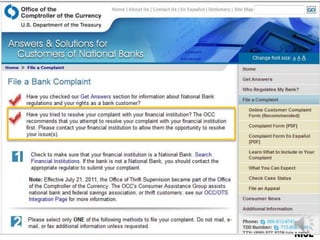
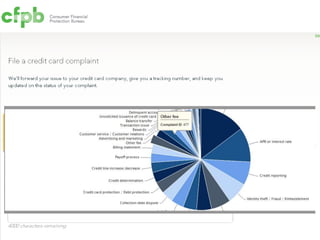
  • #7 Now let’s look at how is this change effecting the relationship between customers , banks and the regulatorLet’s start with the customer and the regulatorIt’s has never been so easier to file a complaints .I don’t know if any of you have ever filed a complaint with the OCC (office of currency comptroller) .What is the first notice you see “Please attempt to resolve the issue with your bank”What is the first question that you get asked when you go the complaint page :“Did you attempt to resolve the problem with your financial institutions”What happens if you answer “No” you can’t proceed with filing the complaint.The OCC see’s itself as a point of escalationLets compare that to how the CFPB receives complaints What is the first question you get asked in the CFPB website :“Tell us your story”What is the second question “What is the desired resolution”What happens once you file a complaint , you become part of the CFPB database. You become part of a community of other with similar grievenessesCustomers are aware of this empowerment.A few days ago I met an old friend and was telling him about the CFPB. He stopped me and told me his own storyHe applied for a credit card and got denied Called the call center and told them that he they don’t call him back in 2 hours giving him everything he wants he will go to the CFPB and file a complaint for discrmiantion AAmazingly enough within 2 hours he got a callback and got everything he wanted Clearly the customer is empowered How about the regulator ?The CFPB is building itself out , hiring and trying to define it’s authority. As it does so it’s meeting resistance. ***NLRB vs check****It’s taking a risk based approach to audits. Which is much harder to regulate and prove then technical enforcement of rules It is moving closer to customer and FI”sIs the regulator on the call?The FI”sFinally there is the financial institute The stake of being non compliant has dramatically gone upChange in the business model (E.g. new mortgage regulations regarding mortgage broker compensations)Are we moving from contractual to fiduciary relationshipPressure to change . It can do so by moving closer to the customer and the regulator and strengthen it’s complianceAll 3 are moving closer to one another
  • #10 Now let’s look at how is this change effecting the relationship between customers , banks and the regulatorLet’s start with the customer and the regulatorIt’s has never been so easier to file a complaints .I don’t know if any of you have ever filed a complaint with the OCC (office of currency comptroller) .What is the first notice you see “Please attempt to resolve the issue with your bank”What is the first question that you get asked when you go the complaint page :“Did you attempt to resolve the problem with your financial institutions”What happens if you answer “No” you can’t proceed with filing the complaint.The OCC see’s itself as a point of escalationLets compare that to how the CFPB receives complaints What is the first question you get asked in the CFPB website :“Tell us your story”What is the second question “What is the desired resolution”What happens once you file a complaint , you become part of the CFPB database. You become part of a community of other with similar grievenessesCustomers are aware of this empowerment.A few days ago I met an old friend and was telling him about the CFPB. He stopped me and told me his own storyHe applied for a credit card and got denied Called the call center and told them that he they don’t call him back in 2 hours giving him everything he wants he will go to the CFPB and file a complaint for discrmiantion AAmazingly enough within 2 hours he got a callback and got everything he wanted Clearly the customer is empowered How about the regulator ?The CFPB is building itself out , hiring and trying to define it’s authority. As it does so it’s meeting resistance. ***NLRB vs check****It’s taking a risk based approach to audits. Which is much harder to regulate and prove then technical enforcement of rules It is moving closer to customer and FI”sIs the regulator on the call?The FI”sFinally there is the financial institute The stake of being non compliant has dramatically gone upChange in the business model (E.g. new mortgage regulations regarding mortgage broker compensations)Are we moving from contractual to fiduciary relationshipPressure to change . It can do so by moving closer to the customer and the regulator and strengthen it’s complianceAll 3 are moving closer to one another
  • #11 The CFPB not only tells us what regulation we need to comply with but also has painted a way on how to achieve compliance.To emphasize its importance, here is a quote from the recent CFPB supervisory highlights saying that “A critical component of a well-run financial institution is a robust and effective CMS designed to ensure that the financial institution’s policies and practices are in full compliance with the requirements of Federal consumer financial law.” What A ComplianceManagement System, or in short CMS, is both a requirement and a method to avoid a negative CFPB risk assessment. It is comprised of: training, consumer complaint response, independent testing and audit, 3rd party providers oversight, internal controls and oversight, record keeping and marketing practices.
  • #13 In other words, a CMS is both a requirement and a method to avoid a negative CFPB risk assessment. It is comprised of: training, consumer complaint response, independent testing and audit, 3rd party providers oversight, internal controls and oversight, record keeping and marketing practices.
  • #14 Thank you Amy!Hello everyone. My name is AviadAbiri and I am ***** .In the following session we will discuss some of key challenges involving ensuring complince in your customer interactions What Amy described to us so interestingly is the VISION of what being compliant means.It implies a deep change in everything we do in the organization.
  • #15 It implies changing our culture, our infrastructures, and most of all the way we treat our customers.-&gt; Therefore Customer Interactions are at the center of this change. TRANSITION: we are now going to discuss the very concrete aspects of what it takes to be compliant in customer interactions
  • #16 What needs to be done in order to be compliant across the organization?In many areas of the organization , it’s quite straight forward:E.g. You want to make sure customers are informed that the APY on a CD changes at the end of the period. You add a disclaimer in your website and you’re done.Customer Service is different:High volumes (many agents, many interactions)Each interaction is unique and unpredictableDependent on people -&gt; inconsistentIt’s not by chance if most infractions happen “there” (in CC)TRANSITION: the truth is, CC is a blind spot. And even when you think you do everything right…
  • #17 …reality can prove you wrong. (Quote taken from Richard Cordray’s public notes following Discover’s consent order). TRANSITION: having the right policies and processes in place, providing the best training &amp; coaching packages, all that is not enough… Because at the end of the day, at the decisive moment, you’re not “there”… You don’t know what the agent says (or doesn’t say) and you’re exposed to risk.
  • #18 To what extent are your contact centers exposed? Do you really know if your agents are adhering to policies and regulations?Do you have any visibility into your outsourced contact centers?When do you become aware of customer complaints and how do you manage disputes? Not sure you have the right answers?... Well, you’re not alone! I’m sure pretty much most of the people in this room feel the same way…TRANSITION: so we lack visibility and control. Those are big words. Let’s try to break them down a little…
  • #19 What does it mean to be in control?What can help you gain visibility?How can you be sure you’ll be able to provide proofs when the audit comes?
  • #21 PAINS:1. Complexity,fast pace, lack of consistencyAgents are facing complexity. Higher pressure than ever before, new requirements every day. Agents can’t cope with the pace.E.g. Veteran calling from Virginia asking questions about mortgage.-&gt; many different regulations apply. Agents need to remember which one are relevant, what to say, what not to say, what to do next, etc. while providing excellent service…2. Measured on operational KPIs (Op. Efficiencyand customer satisfaction)Even if you do everything right (write clear policies, coach agents, etc), agents will still do everything they can to reduce handle time.E.g. Discover (speaking too fast)3. Workforce skilled for serviceNot Compliance minded4. Often outsourcedCultural gap, distance -&gt; challenges on the compliance officer to ensure compliance adherence and commitment.TRADITIONAL TOOLS ARE INSUFFICIENTHigh agent turn over -&gt; coaching is not enoughNew requirements are constantly introduced -&gt; systems not flexible enough to accommodateAt the decisive moment, you rely on human beings… So you will always only be as compliant as your lowest performing agent is. -&gt; you need to help those agents…CLICKNeed to provide a managed &amp; structured agent experience.Identify regulatory situations according to the context of the interactionGuide him in real-time with the right disclosures: what to say, when to say itMake sure they read the scriptsEnforce the agent to follow the required workflow Capture customer consentThis way, the compliance officer can ensure that all agent interactions are consistent and compliant.
  • #22 That looks better, right?
  • #23 Let’s take an example:A customer is calling the contact center. CLICKYou want to be able to notify the agent, even before he starts providing service, that this customer has a past due payment on his account, and provide him the exact script he needs to read to the customer.You also want to make sure the agent has read the script before moving on with the process/discussion.CLICKYou want to get customer consent to make the payment.CLICKYou want to inform the customer – as required by regulation – that there are several payment methods available he can chose from.CLICKYou want to make sure the customer knows he has paid.CLICKYou want to make sure you offer that customer, products/services that will avoid a similar situation to happen again in the future (in this case Automatic Payment offer)
  • #24 Every day, you have 6-8 new requirements you need to comply with. Now you need to roll them out across the organization, till you “touch” the last of your CC agent…How does this work today? How long does it take you to reach the agent today? You have so many steps, so many people involved, so many tasks to do before your agents are aware of those new requirement and indeed include them into their dialog with customers. It takes too long. And by the time agents are being coached about a new regulation, there are already 5 new of them out there…
  • #25 Easily translate new policies into actionable processes :There are new tools to help you control &amp; shorten the process of reaching the contact center agent and ensuring that he or she are 100% adherent with any given policy or regulation. Those tools enable to design policies and regulations which are then immediately rolled out throughout the contact center. The policy is shaped as a work flow with questions that lead to different texts and actions. You can enforce the flow by not allowing to move forward in the process if a certain condition is missing (E.g. capturing customer’s consent)
  • #26 Main points:Controlling the agent experience is important but not sufficient. You also needs visibility into what happened Problems areas will persist and you need to understand the root cause beyond themInfractions will happen , you need to be made aware of them and apply corrective actions Disputes will happen and you need manage them in a way that will prevent them for escalating into a regulatory complaint
  • #27 Main points:The challenge is huge.Millions of interactions across multiple channels The interaction are unstructured and complex.You need tools to help you manage the information overload
  • #28 What are some of the key capabilities we need in order to deal with this challenge:Understand where agents did not adhere to scripts Understand where abusive or deceptive practices where used Understand when disputes with your customers happen Manage the response to those problems
  • #29 The majority of live customer interactions happens over the phone.How do you analyze those phone calls.Speech analytics technology can help you identify key words and emotions that indicate disputesIf you customer is calling to complain he will use certain key words will express emotions
  • #30 Main points:Once a dispute/complaint has been detected you want to manage it a way that would:Prevent the problem from escalating to a regulatory compliant (reach out to your customer and attempt to resolve it with him)Prevent similar problems from occurring in the future – (ex: coach an agent)Remember the CFPB risk based approach means that to many regulatory complaints may trigger an audit
  • #31 Another important capability it the ability to quickly search into past interactions :This needs to be done both :When investigating a specific complaint and attempting to reconstruct the interactions – This is reminiscent of the req. under the trading side of Dodd Frank to reconstruct trades within 72 hours During an audit when investigating how your contact center addressed a specific policy, process or productFor example : If the phrase “improve your credit score” as part of collection call comes into questions you need to be able to quickly retrieve those interactions.
  • #32 Control and visibility are important but successfully passing audits also requires being able to proof compliance
  • #33 What are the key elements you need have in place in order to be able to proof compliance:Capture all interactions relating to regulatory situationsTag them with the applicable policies, products and customers for future easy accessManage your retention policies in a way that aligns with their regulatory risk Hold interactions that relate to areas where you are audit or litigation Have an audit trail of all corrective actions takenRemember record keeping is an important part of a Compliance management systemsThink how powerful it would be during an audit where infraction are found to show record proofing that those are the exception and in 99.9% of the time you have been compliant
  • #34 In order to be effective you should centralize your management of the control, visibility and proof in one place.Compliance KPI’s as they relate to your enterprise or specific areas of your business, specific policies Track both where you are in a point in time as well as your improvement over time Identify high risk policiesTrack corrective actions and make sure then are being applied consistently and in a timely manner Combine your internal risk assessment with external complaints Use this as a driver to constantly understand and address your risk areas
  • #35 To RecapDuring the call you need to guide your agents perform that right actions and read the right scriptsMake sure they stop and do not move forward with actions requiring the customer consent Constantly monitor for exceptions and disputes and apply the right corrective actions to address Make sure both infractions and complaint interactions are captured for easy proof in the future.
  • #36 As your work to strengthen your compliance management system we invite you to look at the NICE ProActive Compliance solution for CC.Part of ProActive Compliance solution suite to address trading floors Please visit the demo station
  • #37 Don’t wait till you receive the cfpb notice letter of an upcoming examination to strategize your next move. The time for preparation is now.