Roman Spectacles
Theater
• Spectators included men and
  women, slaves and free
  individuals
• Theater days also included
  religious observances and
  processions that included
  images of the gods
• Acoustics were very important,
  given the lack of microphones
  and amplifiers
• Those with the most prestige
  got the best seats
                                    Theater at Emerita Augusta
• A local noble might sponsor a     (Merida, Spain)
  feast or singing competition in
  conjunction with a theater day
Circuses and Chariot Racing
•   In Latin, a Circus is a
    racetrack
•   Rome’s Circus Maximus held
    150,000-180,000 spectators
    in the Augustan period and
    250,000 in the reign of
    Trajan
•   Races were an opportunity
    for the people to interact
    with one another (Ovid
    recommends picking up
    women there) and with the
    emperor
•   4-horse chariots raced 7 laps
    (5.25 miles) in about 15
    minutes                         Circus Maximus, Rome
•   Each team--Red, White, Blue,    (reconstruction)
    and Green (plus Purple and
    Gold under Domitian)--had
    its supporters and betting
The Popularity of the Circus
• The first-century AD satirist
  Juvenal wrote, “Long ago the
  people shed their anxieties, ever
  since we do not sell our votes to
  anyone. For the people—who
  once conferred imperium
  (“command”), symbols of office,
  legions, everything—now hold
  themselves in check and
  anxiously desire only two things,
  the grain dole and chariot races
  in the Circus” (Satires 10.77-81).
• Juvenal's famous phrase, panem
  et circenses (“bread and
  circuses”) has become proverbial
  to describe giving away              The Circus Maximus as it
  significant rights in exchange for   appears today
  material pleasures.
Chariots and Charioteers
• Most Charioteers began their careers as slaves, those who were
  successful soon accumulated enough money to buy their freedom.
• Roman racing chariots were designed to be as small and
  lightweight as possible. Unlike military chariots, which were larger
  and often reinforced with metal, racing chariots were made of
  wood and afforded little support or protection for the charioteer,
  who basically had to balance himself on the axle as he drove
• Wrecks were common and as popular with the audience as
  crashes are with NASCAR fans.
Amphitheaters and Gladiatorial Games
•   Gladiatorial combats not held as
    often as theater days and chariot
    races
•   Earliest permanent amphitheater
    70 BC; most famous was the Flavian
    Amphitheater (Colosseum)
•   The name Colosseum comes from
    the colossal statue of Nero
    (modified to resemble Titus or
    possibly the sun god) that stood
    outside (the statue had been
    recycled from Nero’s Golden House,
    the grounds of which the
    amphitheater occupied
                                         Colosseum, Rome
•   Popularity of Gladiatorial games
    attests to Roman fondness for
    blood sports
The Colosseum
•   The floor of the Colosseum was covered
    with sand (harena; origin of the term
    “arena”)
•   The floor was outfitted with trap-doors
    designed to let animals leap dramatically
    into the fray.
•   Under the arena was a basement, filled with
    narrow passages. In this confined space,
    animals and their keepers, fighters, slaves
    and stage-hands toiled in the almost total
    darkness to bring pleasure to Romans.
•   A series of winches and the capstans would
    have allowed teams of slaves to pull in
    unison and hoist heavy animals from the
    basement to the main arena, and this
    machinery has been reconstructed, in part,
    from ancient drawings - aided by the bronze
    fittings that still survive in the basement's
    floor. The rope-burns of the hoists are still   Colosseum, interior
    visible in the stone of the lift-shafts.
A Multi-Purpose Space
• The center of the
  Colosseum could be filled
  with water so that mock
  naval battles could be
  staged.
• The speed with which the
  water could be drained and
  the arena readied for the
  next performance was part
  of the spectacle.            Mock naval battle, reconstruction
Gladiators
• The term gladiator means “swordsman” (from the Latin gladius, “sword”)
• The tradition of gladiatorial combat may have been adopted from the
  Etruscans
• Gladiatorial games originated in sacrifices to the spirits of the dead and the
  need to propitiate them with offerings of blood.
• Gladiatorial combats were introduced to Rome in 264 BC, when the sons of
  Junius Brutus honored their father by matching three pairs of gladiators.
Who Were the Gladiators?
•   Most gladiators were prisoners of war, slaves bought for the purpose, or criminals
    sentenced to serve in the schools (damnati ad ludos). At a time when three of every five
    persons did not survive until their twentieth birthday, the odds of a professional gladiator
    being killed in any particular bout, at least during the first century AD, were perhaps one in
    ten. But for the criminal who was to be publicly executed (damnati ad mortem) or for
    Christian martyrs who refused to renounce their faith and worship the gods, there was no
    hope of survival in the arena.
•   Free men also volunteered to be gladiators and, by the end of the Republic, comprised half
    the number who fought. Often, they were social outcasts, freed slaves, discharged
    soldiers, or former gladiators who had been liberated on retirement but chose to return
    for a period of service.
•   Successful gladiators could become celebrities: graffiti from Pompeii proclaim: "Caladus,
    the Thracian, makes all the girls sigh," and "Crescens, the net fighter, holds the hearts of all
    the girls."
Types of Gladiators
• Gladiators fought in various combinations: man vs. man (or even
  woman vs. woman), man vs. wild beast, various beasts against
  each other
• Gladiators also fought with various weapons. Originally, captured
  soldiers had been made to fight with their own weapons and in
  their particular style of combat. This tradition gave rise to the
  designations we see in combats of the Imperial period.


 Mosaic: gladiators
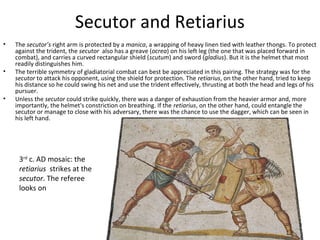
Secutor and Retiarius
•   The secutor’s right arm is protected by a manica, a wrapping of heavy linen tied with leather thongs. To protect
    against the trident, the secutor also has a greave (ocrea) on his left leg (the one that was placed forward in
    combat), and carries a curved rectangular shield (scutum) and sword (gladius). But it is the helmet that most
    readily distinguishes him.
•   The terrible symmetry of gladiatorial combat can best be appreciated in this pairing. The strategy was for the
    secutor to attack his opponent, using the shield for protection. The retiarius, on the other hand, tried to keep
    his distance so he could swing his net and use the trident effectively, thrusting at both the head and legs of his
    pursuer.
•   Unless the secutor could strike quickly, there was a danger of exhaustion from the heavier armor and, more
    importantly, the helmet's constriction on breathing. If the retiarius, on the other hand, could entangle the
    secutor or manage to close with his adversary, there was the chance to use the dagger, which can be seen in
    his left hand.


     3rd c. AD mosaic: the
     retiarius strikes at the
     secutor. The referee
     looks on
Murmillo
• Except for the helmet, the
  equipment of the murmillo and
  secutor was the same. Both wore a
  loincloth and belt, the right arm
  protected by a manica of tied linen
  and the left leg by a short greave.
  The curved rectangular shield and
  straight sword that both carried
  were similar to those used by the
  Roman soldier. It is the helmet of
  the murmillo, with its high angular
  crest and broad curved brim that is
  so distinctive.
                                        Murmillo helmet
Thraex and Murmillo
•   The Thraex or Thracian wore the usual
    loincloth and belt, and protected the right
    arm with a manica. Because the shield
    (parma or parmula), which Pliny describes
    as round and slightly concave (Natural
    History, XXXIII.129), was smaller than the
    scutum of the murmillo, his traditional
    adversary, longer greaves were required
    to protect the legs and thighs, which were
    wrapped with thick quilted fabric. The
    characteristic weapon of the Thracian was
    the traditional sica, a short sword with a
    curved or angled blade designed to maim
    the exposed areas of the back. The broad-
    brimmed helmet also is distinctive.
•   In this detail from a larger mosaic, the
    Thraex attacks with the sword in his left
    hand, which usually would hold the shield.
    Gladiators were trained to fight against
    those who were right-handed, and it was
    the right-hand side that was protected. It
    must have been disconcerting, therefore,
    to confront a left-handed opponent, who
    would have the advantage. Indeed, in one      Thraex (left) amd Murmillo (right)
    graffito, a gladiator is specifically
    described as being left handed, sc(aeva).
Female Gladiators

• A relief from
  Halicarnassus
  shows 2 female
  gladiators
• The inscription
  gives their names
  as Amazon and
  Achillia
Bestiarius
• The bestiarii were not
  gladiators, as such, but
  fought for their lives in the
  arena against wild beasts
• The bestiarii often were
  wretched creatures,
  condemned criminals or
  prisoners of war, who had
  little chance against the
  animals they fought (Seneca,    Mosaic: leopard attacking a
                                  bestiarius
  De Beneficiis, II.19).
Venator
•   the venatores were specialists of wild animal hunts.
    The popularity of these cruel spectacles was such
    that, by the time they were abolished in AD 523
    during the consulship of Flavius Anicius Maximus,
    tens of thousands of animals had died, and entire
    species were no longer to be found in their native
    habitat, all having been captured or driven away.
•   There were no more hippopotamuses in Nubia or
    elephants in northern Africa; the lions which once
    had been represented in Assyrian reliefs were gone.
•   Either five thousand or ten thousand animals were
    reported to have died in the dedication of the
    Colosseum; eleven thousand died in the celebration
    of Trajan's conquest of Dacia; and Augustus boasted
    that, in the twenty-six venationes presented in his
    reign, thirty-five hundred animals had been killed.    Mosaic: venator
•   When Pompey presented elephants (and the first
    rhinoceros) at the Circus Maximus, he did so in part
    to demonstrate his power over even the strongest
    of beasts.
Gladiators and Roman Society
• The gladiator held a morbid fascination for the ancient
  Romans. Their blood was considered a remedy against
  impotence, and the bride whose hair had been parted
  by the spear of a defeated gladiator was thought to
  enjoy a fertile married life.
• Although their lives were brutal and short, gladiators
  often were admired for their bravery, endurance, and
  willingness to die. In forfeiting their lives in the arena,
  the gladiator was thought to honor the audience, and
  glory was what it could offer in return.
A Gladiator’s Voice
•   There is not a lot of direct evidence from the
    gladiators themselves, but one found a way
    to speak out from beyond the grave.
•   The inscription that accompanies the
    funerary relief shown at right reads, “After
    breaking my opponent Demetrius I did not kill
    him immediately. Fate and the cunning
    treachery of the referee killed me.”
•   Normally, the referee intervened to stop a
    fight as soon as one gladiator requested
    missio (release) by signaling submission.
•   The decision to grant or decline missio was
    then referred to the munerarius (the person
    who paid for the show) who in turn was
    expected to defer to the wishes of the
    people. But in this case, the referee allowed
    Demetrius to get up, pick up his weapon and
    fight again.
•   The referee must have interpreted
    Demetrius' fall as accidental and allowed him    Tombstone of Roman gladiator
    to get up again.                                 Diodorus, who was buried 1,800
•   Demetrius took advantage of the second           years ago in Turkey.
    chance and gave poor Diodorus the fatal
    blow.
Combats in Context
•   The blood lust of the spectators and emperors alike, the brutality of the combat,
    and the callous deaths of men and animals still disturb modern sensibilities.
    Certainly, Rome was cruel. Defeated enemies and criminals forfeited any right to a
    place within society.
•   In publicly witnessing such violence, citizens were reassured that the proper social
    order has been restored and they, themselves, deterred from such actions.
•   In this display, the games reaffirmed the moral and political order of things, and
    the death of criminals and wild animals, the real and symbolic re-establishment of
    a society under threat.
•   In the arena, civilization triumphed over the wild and untamed, over the outlaw,
    the barbarian, the enemy.


     Jean-Léon Gérôme. Police
     Verso (“Thumbs Down”), 1872
Roman Objections
•   By the age of Nero cultured and elevated men
    were beginning to revolt at the arena butcheries
    which still delighted the mob.
•   The following quotation is from a letter the 1st
    century AD philosopher Seneca the Younger wrote
    to his friend Lucilius.
•   “I turned in to the games one mid-day hoping for a
    little wit and humor there. I was bitterly
    disappointed. It was really mere butchery. The
    morning's show was merciful compared to it. Then
    men were thrown to lions and to bears: but at
    midday to the audience. There was no escape for
    them. The slayer was kept fighting until he could
    be slain. "Kill him! flog him! burn him alive" was
    the cry: "Why is he such a coward? Why won't he
    rush on the steel? Why does he fall so meekly?
    Why won't he die willingly?" Unhappy that I am,
    how have I deserved that I must look on such a
    scene as this? Do not, my Lucilius, attend the
    games, I pray you. Either you will be corrupted by
    the multitude, or, if you show disgust, be hated by
    them. So stay away.” (Epistle 7)
                                                          Seneca
Roman Civilization
• If you have enjoyed this presentation, sign up for
  GNHU 282 Roman Civilization and learn more!
• GNHU 282 is offered as a fully online course in
  Winter Session 2012.
• There are no scheduled meetings; you are free to
  work at your own pace.
• Sign up for GNHU 282 (call # 10003) on WESS.
• Questions? Ask Dr. Jones
  (jonespr@mail.montclair.edu)

Gnhu282romanspectacles

  • 1.
  • 2.
    Theater • Spectators includedmen and women, slaves and free individuals • Theater days also included religious observances and processions that included images of the gods • Acoustics were very important, given the lack of microphones and amplifiers • Those with the most prestige got the best seats Theater at Emerita Augusta • A local noble might sponsor a (Merida, Spain) feast or singing competition in conjunction with a theater day
  • 3.
    Circuses and ChariotRacing • In Latin, a Circus is a racetrack • Rome’s Circus Maximus held 150,000-180,000 spectators in the Augustan period and 250,000 in the reign of Trajan • Races were an opportunity for the people to interact with one another (Ovid recommends picking up women there) and with the emperor • 4-horse chariots raced 7 laps (5.25 miles) in about 15 minutes Circus Maximus, Rome • Each team--Red, White, Blue, (reconstruction) and Green (plus Purple and Gold under Domitian)--had its supporters and betting
  • 4.
    The Popularity ofthe Circus • The first-century AD satirist Juvenal wrote, “Long ago the people shed their anxieties, ever since we do not sell our votes to anyone. For the people—who once conferred imperium (“command”), symbols of office, legions, everything—now hold themselves in check and anxiously desire only two things, the grain dole and chariot races in the Circus” (Satires 10.77-81). • Juvenal's famous phrase, panem et circenses (“bread and circuses”) has become proverbial to describe giving away The Circus Maximus as it significant rights in exchange for appears today material pleasures.
  • 5.
    Chariots and Charioteers •Most Charioteers began their careers as slaves, those who were successful soon accumulated enough money to buy their freedom. • Roman racing chariots were designed to be as small and lightweight as possible. Unlike military chariots, which were larger and often reinforced with metal, racing chariots were made of wood and afforded little support or protection for the charioteer, who basically had to balance himself on the axle as he drove • Wrecks were common and as popular with the audience as crashes are with NASCAR fans.
  • 6.
    Amphitheaters and GladiatorialGames • Gladiatorial combats not held as often as theater days and chariot races • Earliest permanent amphitheater 70 BC; most famous was the Flavian Amphitheater (Colosseum) • The name Colosseum comes from the colossal statue of Nero (modified to resemble Titus or possibly the sun god) that stood outside (the statue had been recycled from Nero’s Golden House, the grounds of which the amphitheater occupied Colosseum, Rome • Popularity of Gladiatorial games attests to Roman fondness for blood sports
  • 7.
    The Colosseum • The floor of the Colosseum was covered with sand (harena; origin of the term “arena”) • The floor was outfitted with trap-doors designed to let animals leap dramatically into the fray. • Under the arena was a basement, filled with narrow passages. In this confined space, animals and their keepers, fighters, slaves and stage-hands toiled in the almost total darkness to bring pleasure to Romans. • A series of winches and the capstans would have allowed teams of slaves to pull in unison and hoist heavy animals from the basement to the main arena, and this machinery has been reconstructed, in part, from ancient drawings - aided by the bronze fittings that still survive in the basement's floor. The rope-burns of the hoists are still Colosseum, interior visible in the stone of the lift-shafts.
  • 8.
    A Multi-Purpose Space •The center of the Colosseum could be filled with water so that mock naval battles could be staged. • The speed with which the water could be drained and the arena readied for the next performance was part of the spectacle. Mock naval battle, reconstruction
  • 9.
    Gladiators • The termgladiator means “swordsman” (from the Latin gladius, “sword”) • The tradition of gladiatorial combat may have been adopted from the Etruscans • Gladiatorial games originated in sacrifices to the spirits of the dead and the need to propitiate them with offerings of blood. • Gladiatorial combats were introduced to Rome in 264 BC, when the sons of Junius Brutus honored their father by matching three pairs of gladiators.
  • 10.
    Who Were theGladiators? • Most gladiators were prisoners of war, slaves bought for the purpose, or criminals sentenced to serve in the schools (damnati ad ludos). At a time when three of every five persons did not survive until their twentieth birthday, the odds of a professional gladiator being killed in any particular bout, at least during the first century AD, were perhaps one in ten. But for the criminal who was to be publicly executed (damnati ad mortem) or for Christian martyrs who refused to renounce their faith and worship the gods, there was no hope of survival in the arena. • Free men also volunteered to be gladiators and, by the end of the Republic, comprised half the number who fought. Often, they were social outcasts, freed slaves, discharged soldiers, or former gladiators who had been liberated on retirement but chose to return for a period of service. • Successful gladiators could become celebrities: graffiti from Pompeii proclaim: "Caladus, the Thracian, makes all the girls sigh," and "Crescens, the net fighter, holds the hearts of all the girls."
  • 11.
    Types of Gladiators •Gladiators fought in various combinations: man vs. man (or even woman vs. woman), man vs. wild beast, various beasts against each other • Gladiators also fought with various weapons. Originally, captured soldiers had been made to fight with their own weapons and in their particular style of combat. This tradition gave rise to the designations we see in combats of the Imperial period. Mosaic: gladiators
  • 12.
    Secutor and Retiarius • The secutor’s right arm is protected by a manica, a wrapping of heavy linen tied with leather thongs. To protect against the trident, the secutor also has a greave (ocrea) on his left leg (the one that was placed forward in combat), and carries a curved rectangular shield (scutum) and sword (gladius). But it is the helmet that most readily distinguishes him. • The terrible symmetry of gladiatorial combat can best be appreciated in this pairing. The strategy was for the secutor to attack his opponent, using the shield for protection. The retiarius, on the other hand, tried to keep his distance so he could swing his net and use the trident effectively, thrusting at both the head and legs of his pursuer. • Unless the secutor could strike quickly, there was a danger of exhaustion from the heavier armor and, more importantly, the helmet's constriction on breathing. If the retiarius, on the other hand, could entangle the secutor or manage to close with his adversary, there was the chance to use the dagger, which can be seen in his left hand. 3rd c. AD mosaic: the retiarius strikes at the secutor. The referee looks on
  • 13.
    Murmillo • Except forthe helmet, the equipment of the murmillo and secutor was the same. Both wore a loincloth and belt, the right arm protected by a manica of tied linen and the left leg by a short greave. The curved rectangular shield and straight sword that both carried were similar to those used by the Roman soldier. It is the helmet of the murmillo, with its high angular crest and broad curved brim that is so distinctive. Murmillo helmet
  • 14.
    Thraex and Murmillo • The Thraex or Thracian wore the usual loincloth and belt, and protected the right arm with a manica. Because the shield (parma or parmula), which Pliny describes as round and slightly concave (Natural History, XXXIII.129), was smaller than the scutum of the murmillo, his traditional adversary, longer greaves were required to protect the legs and thighs, which were wrapped with thick quilted fabric. The characteristic weapon of the Thracian was the traditional sica, a short sword with a curved or angled blade designed to maim the exposed areas of the back. The broad- brimmed helmet also is distinctive. • In this detail from a larger mosaic, the Thraex attacks with the sword in his left hand, which usually would hold the shield. Gladiators were trained to fight against those who were right-handed, and it was the right-hand side that was protected. It must have been disconcerting, therefore, to confront a left-handed opponent, who would have the advantage. Indeed, in one Thraex (left) amd Murmillo (right) graffito, a gladiator is specifically described as being left handed, sc(aeva).
  • 15.
    Female Gladiators • Arelief from Halicarnassus shows 2 female gladiators • The inscription gives their names as Amazon and Achillia
  • 16.
    Bestiarius • The bestiariiwere not gladiators, as such, but fought for their lives in the arena against wild beasts • The bestiarii often were wretched creatures, condemned criminals or prisoners of war, who had little chance against the animals they fought (Seneca, Mosaic: leopard attacking a bestiarius De Beneficiis, II.19).
  • 17.
    Venator • the venatores were specialists of wild animal hunts. The popularity of these cruel spectacles was such that, by the time they were abolished in AD 523 during the consulship of Flavius Anicius Maximus, tens of thousands of animals had died, and entire species were no longer to be found in their native habitat, all having been captured or driven away. • There were no more hippopotamuses in Nubia or elephants in northern Africa; the lions which once had been represented in Assyrian reliefs were gone. • Either five thousand or ten thousand animals were reported to have died in the dedication of the Colosseum; eleven thousand died in the celebration of Trajan's conquest of Dacia; and Augustus boasted that, in the twenty-six venationes presented in his reign, thirty-five hundred animals had been killed. Mosaic: venator • When Pompey presented elephants (and the first rhinoceros) at the Circus Maximus, he did so in part to demonstrate his power over even the strongest of beasts.
  • 18.
    Gladiators and RomanSociety • The gladiator held a morbid fascination for the ancient Romans. Their blood was considered a remedy against impotence, and the bride whose hair had been parted by the spear of a defeated gladiator was thought to enjoy a fertile married life. • Although their lives were brutal and short, gladiators often were admired for their bravery, endurance, and willingness to die. In forfeiting their lives in the arena, the gladiator was thought to honor the audience, and glory was what it could offer in return.
  • 19.
    A Gladiator’s Voice • There is not a lot of direct evidence from the gladiators themselves, but one found a way to speak out from beyond the grave. • The inscription that accompanies the funerary relief shown at right reads, “After breaking my opponent Demetrius I did not kill him immediately. Fate and the cunning treachery of the referee killed me.” • Normally, the referee intervened to stop a fight as soon as one gladiator requested missio (release) by signaling submission. • The decision to grant or decline missio was then referred to the munerarius (the person who paid for the show) who in turn was expected to defer to the wishes of the people. But in this case, the referee allowed Demetrius to get up, pick up his weapon and fight again. • The referee must have interpreted Demetrius' fall as accidental and allowed him Tombstone of Roman gladiator to get up again. Diodorus, who was buried 1,800 • Demetrius took advantage of the second years ago in Turkey. chance and gave poor Diodorus the fatal blow.
  • 20.
    Combats in Context • The blood lust of the spectators and emperors alike, the brutality of the combat, and the callous deaths of men and animals still disturb modern sensibilities. Certainly, Rome was cruel. Defeated enemies and criminals forfeited any right to a place within society. • In publicly witnessing such violence, citizens were reassured that the proper social order has been restored and they, themselves, deterred from such actions. • In this display, the games reaffirmed the moral and political order of things, and the death of criminals and wild animals, the real and symbolic re-establishment of a society under threat. • In the arena, civilization triumphed over the wild and untamed, over the outlaw, the barbarian, the enemy. Jean-Léon Gérôme. Police Verso (“Thumbs Down”), 1872
  • 21.
    Roman Objections • By the age of Nero cultured and elevated men were beginning to revolt at the arena butcheries which still delighted the mob. • The following quotation is from a letter the 1st century AD philosopher Seneca the Younger wrote to his friend Lucilius. • “I turned in to the games one mid-day hoping for a little wit and humor there. I was bitterly disappointed. It was really mere butchery. The morning's show was merciful compared to it. Then men were thrown to lions and to bears: but at midday to the audience. There was no escape for them. The slayer was kept fighting until he could be slain. "Kill him! flog him! burn him alive" was the cry: "Why is he such a coward? Why won't he rush on the steel? Why does he fall so meekly? Why won't he die willingly?" Unhappy that I am, how have I deserved that I must look on such a scene as this? Do not, my Lucilius, attend the games, I pray you. Either you will be corrupted by the multitude, or, if you show disgust, be hated by them. So stay away.” (Epistle 7) Seneca
  • 22.
    Roman Civilization • Ifyou have enjoyed this presentation, sign up for GNHU 282 Roman Civilization and learn more! • GNHU 282 is offered as a fully online course in Winter Session 2012. • There are no scheduled meetings; you are free to work at your own pace. • Sign up for GNHU 282 (call # 10003) on WESS. • Questions? Ask Dr. Jones (jonespr@mail.montclair.edu)