z
z
Presented by Jonathan E. Coughlan
October 13, 2017
Recent Ethics
OPINIONS
z
Reporting
MISCONDUCT
You agree to meet with former
law partner for a glass of wine
after work one day

And she tells you very

upsetting news…
z
Do you have any duty to investigate and
see whether what you learned about the
overbilling was true?
1. Yes
2. No
3. Don’t Know – That’s what my
managing partner is for
z
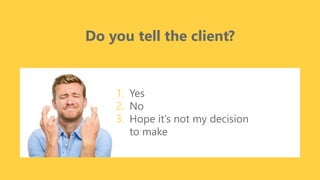
Do you tell the client?
1. Yes
2. No
3. Hope it’s not my decision
to make
z
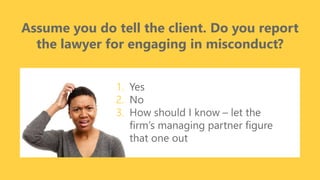
Assume you do tell the client. Do you report
the lawyer for engaging in misconduct?
1. Yes
2. No
3. How should I know – let the
firm’s managing partner figure
that one out
z
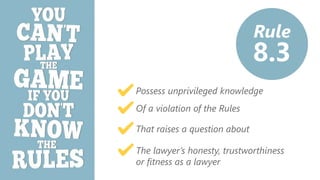
Rule
8.3
Possess unprivileged knowledge
Of a violation of the Rules
That raises a question about
The lawyer’s honesty, trustworthiness
or fitness as a lawyer
z
Is it privileged knowledge?
1. Yes
2. No
z
Do you have knowledge?
1. Yes
2. No
z
Rule
1.0(g)
“Knows”/”known” denotes actual
knowledge of the fact in question
A person’s knowledge may be
inferred from the circumstances
z
Assume you had just heard your friend tell
you at the bar about what she had done. Do
you have knowledge at this point in time?
1. Yes
2. No
3. Depends
z
Assume your former partner tells you she
overbilled a client at her new firm, but not any
clients at your firm while she was there. Do you
have any obligation to tell her new firm?
1. Yes
2. No
3. Not my problem
z
Do you have to report this to
disciplinary authorities?
1. Yes
2. No
z
Rule
8.3
Possess unprivileged knowledge
Of a violation of the Rules
That raises a question about
The lawyer’s honesty, trustworthiness
or fitness as a lawyer
z
So is it privileged?
1. Yes
2. No
z
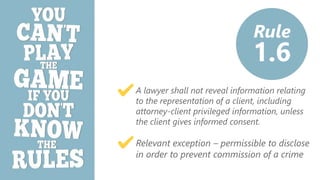
A lawyer shall not reveal information relating
to the representation of a client, including
attorney-client privileged information, unless
the client gives informed consent.
Relevant exception – permissible to disclose
in order to prevent commission of a crime
Rule
1.6
z
OPINION
2016-02
Question is whether the information
acquired from the client regarding
their prior lawyer’s conduct is
privileged, thereby eliminating any
duty to report under Rule 8.3
z
OPINION
2016-02
Prohibited from revealing
information related to representation
without client consent
But Rule 8.3 requires disclosure to
disciplinary authorities of all
information that is not privileged
z
OPINION
2016-02
Even if confidential under 1.6, if the
information is not privileged then it’s
permissible to report the misconduct
If privileged, lawyer must obtain
client consent to reveal by reporting
to disciplinary authorities
z
Does the conduct raise a question about
the lawyer’s honesty, trustworthiness
or fitness to practice?
1. Yes
2. No
z
OPINION
2017-02
Issued February 10, 2017
Withdraws Opinion 89-32
z
Jud.Cond.R.
2.15(A)
A judge who has knowledge that
another judge has committed a
violation of the Code of Judicial
Conduct that raises a question
regarding the judge’s honesty,
trustworthiness, or fitness as a
judge in other respects is
required to report it to the
appropriate disciplinary authority
z
Jud.Cond.R.
2.15(B)
A judge who has knowledge of a
lawyer’s violation of the Rules of
Professional Conduct conduct
that raises a question regarding
the lawyer’s honesty,
trustworthiness, or fitness as a
lawyer has an ethical duty to
report it
z
Do judges have a duty report a witness who
testifies to possession of marijuana?
1. Yes
2. No
z
What about a witness that
testifies to a felony?
1. Yes
2. No
z
Does a judge have to recuse from a case if
the judge has reported one of the lawyers to
disciplinary authorities?
1. Of course
2. Nope
3. Good question
z
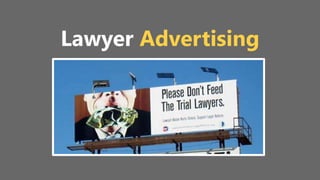
Lawyer Advertising
z
What about lawyer advertising saying
“There is no charge unless we win your
case” or “No fee without recovery”?
1. That’s fine – I see it all
the time
2. Depends
z
OPINION
2017-01
Prohibited if the lawyer will be
seeking payment of fees/costs at any
time unless the lawyer uses a
disclaimer that clearly indicates the
client will be responsible for the
expenses and costs
z
Is it proper for a lawyer to advertise legal
services by sending unsolicited emails?
1. Absolutely
2. Maybe but…
3. No
4. Why would anyone want to?
z
OPINION
2017-03
Issued April 7, 2017
Update + Withdrawal of 2004-1
Solicitation of Professional
Employment via Email
z
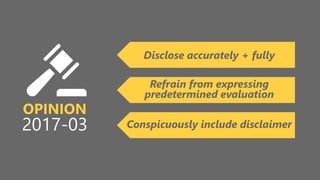
OPINION
2017-03
Disclose accurately + fully
Refrain from expressing
predetermined evaluation
Conspicuously include disclaimer
z
OPINION
2017-05
Issued June 9, 2017
Virtual Law Office
z
What is a
Virtual Law
Office?
z
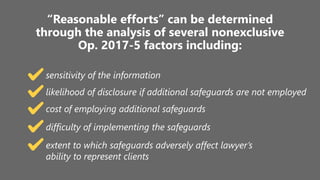
“Reasonable efforts” can be determined
through the analysis of several nonexclusive
Op. 2017-5 factors including:
sensitivity of the information
likelihood of disclosure if additional safeguards are not employed
cost of employing additional safeguards
difficulty of implementing the safeguards
extent to which safeguards adversely affect lawyer’s
ability to represent clients
z
1
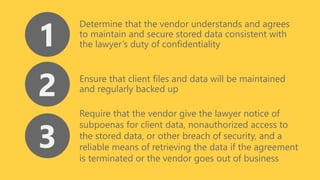
Determine that the vendor understands and agrees
to maintain and secure stored data consistent with
the lawyer’s duty of confidentiality
2 Ensure that client files and data will be maintained
and regularly backed up
3
Require that the vendor give the lawyer notice of
subpoenas for client data, nonauthorized access to
the stored data, or other breach of security, and a
reliable means of retrieving the data if the agreement
is terminated or the vendor goes out of business
z
Jonathan E. Coughlan
Kegler Brown Hill + Ritter
jcoughlan@keglerbrown.com
keglerbrown.com/coughlan
614-462-5455
z
Presented by Chris Weber
October 13, 2017
z
Engagement Letter
TIPS
z
Identify Client1
z
Exclude affiliates?
z
Define Scope2
z
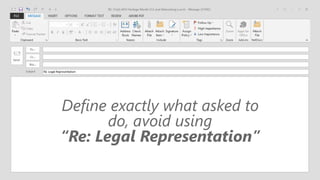
Define exactly what asked to
do, avoid using
“Re: Legal Representation”
z
Benefits to
Avoid blame for
unrelated matters
Defines when
representation ends
Easier to be adverse
to a former client
z
Gentle Termination Letter
z
Dual Representation3
z
Someone Other Than Client Pays4
z
RPC 1.8(f)(4)
Statement of Insured’s Rights
z
Evergreen Retainer5
z
Flat Fees6
z
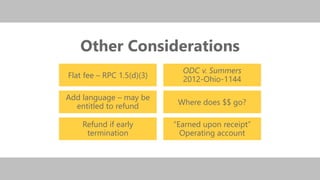
Other Considerations
Flat fee – RPC 1.5(d)(3)
Add language – may be
entitled to refund
Refund if early
termination
ODC v. Summers
2012-Ohio-1144
Where does $$ go?
“Earned upon receipt”
Operating account
z
Advance Waivers7
z
Sharing Fees
Not in Same Firm
z
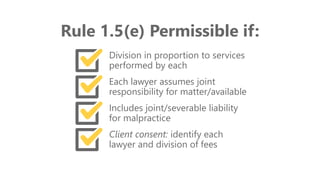
Rule 1.5(e) Permissible if:
Division in proportion to services
performed by each
Each lawyer assumes joint
responsibility for matter/available
Includes joint/severable liability
for malpractice
Client consent: identify each
lawyer and division of fees
z
Doing Business
with Clients
Rule 1.8(a) – explain in writing
Terms, risks/disadvantages
to client
Reasonable alternatives
Lawyer’s role
Advisable to consult with
another lawyer
z
Properly
DECLINING
Representation
z
Prospective clients
RPC 1.18: Communications
are confidential
Confirmation in writing
unable to take
Consider whether to inform
of applicable S/L
z
Additional Tips
z
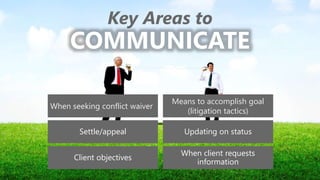
Key Areas to
COMMUNICATE
When seeking conflict waiver
Settle/appeal
Client objectives
Means to accomplish goal
(litigation tactics)
Updating on status
When client requests
information
z
How to
COMMUNICATE
z
z
How to
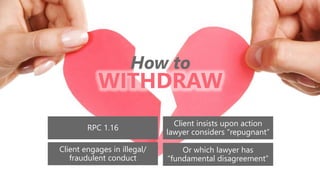
RPC 1.16
Client engages in illegal/
fraudulent conduct
Client insists upon action
lawyer considers “repugnant”
Or which lawyer has
“fundamental disagreement”
WITHDRAW
z
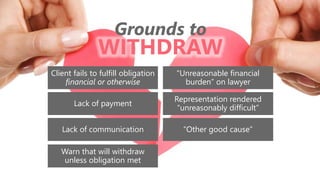
Client fails to fulfill obligation
financial or otherwise
Lack of payment
Lack of communication
Warn that will withdraw
unless obligation met
“Unreasonable financial
burden” on lawyer
Representation rendered
“unreasonably difficult”
“Other good cause”
Grounds to
WITHDRAW
z
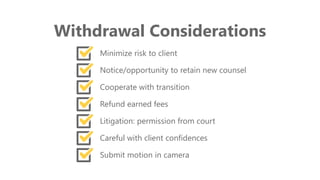
Withdrawal Considerations
Minimize risk to client
Notice/opportunity to retain new counsel
Cooperate with transition
Refund earned fees
Litigation: permission from court
Careful with client confidences
Submit motion in camera
z
Chris Weber
Kegler Brown Hill + Ritter
cweber@keglerbrown.com
keglerbrown.com/weber
614-462-5415

20th Annual Professional Responsibility Seminar

  • 1.
  • 2.
    z Presented by JonathanE. Coughlan October 13, 2017 Recent Ethics OPINIONS
  • 3.
    z Reporting MISCONDUCT You agree tomeet with former law partner for a glass of wine after work one day And she tells you very upsetting news…
  • 4.
    z Do you haveany duty to investigate and see whether what you learned about the overbilling was true? 1. Yes 2. No 3. Don’t Know – That’s what my managing partner is for
  • 5.
    z Do you tellthe client? 1. Yes 2. No 3. Hope it’s not my decision to make
  • 6.
    z Assume you dotell the client. Do you report the lawyer for engaging in misconduct? 1. Yes 2. No 3. How should I know – let the firm’s managing partner figure that one out
  • 7.
    z Rule 8.3 Possess unprivileged knowledge Ofa violation of the Rules That raises a question about The lawyer’s honesty, trustworthiness or fitness as a lawyer
  • 8.
    z Is it privilegedknowledge? 1. Yes 2. No
  • 9.
    z Do you haveknowledge? 1. Yes 2. No
  • 10.
    z Rule 1.0(g) “Knows”/”known” denotes actual knowledgeof the fact in question A person’s knowledge may be inferred from the circumstances
  • 11.
    z Assume you hadjust heard your friend tell you at the bar about what she had done. Do you have knowledge at this point in time? 1. Yes 2. No 3. Depends
  • 12.
    z Assume your formerpartner tells you she overbilled a client at her new firm, but not any clients at your firm while she was there. Do you have any obligation to tell her new firm? 1. Yes 2. No 3. Not my problem
  • 13.
    z Do you haveto report this to disciplinary authorities? 1. Yes 2. No
  • 14.
    z Rule 8.3 Possess unprivileged knowledge Ofa violation of the Rules That raises a question about The lawyer’s honesty, trustworthiness or fitness as a lawyer
  • 15.
    z So is itprivileged? 1. Yes 2. No
  • 16.
    z A lawyer shallnot reveal information relating to the representation of a client, including attorney-client privileged information, unless the client gives informed consent. Relevant exception – permissible to disclose in order to prevent commission of a crime Rule 1.6
  • 17.
    z OPINION 2016-02 Question is whetherthe information acquired from the client regarding their prior lawyer’s conduct is privileged, thereby eliminating any duty to report under Rule 8.3
  • 18.
    z OPINION 2016-02 Prohibited from revealing informationrelated to representation without client consent But Rule 8.3 requires disclosure to disciplinary authorities of all information that is not privileged
  • 19.
    z OPINION 2016-02 Even if confidentialunder 1.6, if the information is not privileged then it’s permissible to report the misconduct If privileged, lawyer must obtain client consent to reveal by reporting to disciplinary authorities
  • 20.
    z Does the conductraise a question about the lawyer’s honesty, trustworthiness or fitness to practice? 1. Yes 2. No
  • 21.
    z OPINION 2017-02 Issued February 10,2017 Withdraws Opinion 89-32
  • 22.
    z Jud.Cond.R. 2.15(A) A judge whohas knowledge that another judge has committed a violation of the Code of Judicial Conduct that raises a question regarding the judge’s honesty, trustworthiness, or fitness as a judge in other respects is required to report it to the appropriate disciplinary authority
  • 23.
    z Jud.Cond.R. 2.15(B) A judge whohas knowledge of a lawyer’s violation of the Rules of Professional Conduct conduct that raises a question regarding the lawyer’s honesty, trustworthiness, or fitness as a lawyer has an ethical duty to report it
  • 24.
    z Do judges havea duty report a witness who testifies to possession of marijuana? 1. Yes 2. No
  • 25.
    z What about awitness that testifies to a felony? 1. Yes 2. No
  • 26.
    z Does a judgehave to recuse from a case if the judge has reported one of the lawyers to disciplinary authorities? 1. Of course 2. Nope 3. Good question
  • 27.
  • 28.
    z What about lawyeradvertising saying “There is no charge unless we win your case” or “No fee without recovery”? 1. That’s fine – I see it all the time 2. Depends
  • 29.
    z OPINION 2017-01 Prohibited if thelawyer will be seeking payment of fees/costs at any time unless the lawyer uses a disclaimer that clearly indicates the client will be responsible for the expenses and costs
  • 30.
    z Is it properfor a lawyer to advertise legal services by sending unsolicited emails? 1. Absolutely 2. Maybe but… 3. No 4. Why would anyone want to?
  • 31.
    z OPINION 2017-03 Issued April 7,2017 Update + Withdrawal of 2004-1 Solicitation of Professional Employment via Email
  • 32.
    z OPINION 2017-03 Disclose accurately +fully Refrain from expressing predetermined evaluation Conspicuously include disclaimer
  • 33.
    z OPINION 2017-05 Issued June 9,2017 Virtual Law Office
  • 34.
  • 35.
    z “Reasonable efforts” canbe determined through the analysis of several nonexclusive Op. 2017-5 factors including: sensitivity of the information likelihood of disclosure if additional safeguards are not employed cost of employing additional safeguards difficulty of implementing the safeguards extent to which safeguards adversely affect lawyer’s ability to represent clients
  • 36.
    z 1 Determine that thevendor understands and agrees to maintain and secure stored data consistent with the lawyer’s duty of confidentiality 2 Ensure that client files and data will be maintained and regularly backed up 3 Require that the vendor give the lawyer notice of subpoenas for client data, nonauthorized access to the stored data, or other breach of security, and a reliable means of retrieving the data if the agreement is terminated or the vendor goes out of business
  • 37.
    z Jonathan E. Coughlan KeglerBrown Hill + Ritter jcoughlan@keglerbrown.com keglerbrown.com/coughlan 614-462-5455
  • 38.
    z Presented by ChrisWeber October 13, 2017
  • 39.
  • 40.
  • 41.
  • 42.
  • 43.
    z Define exactly whatasked to do, avoid using “Re: Legal Representation”
  • 44.
    z Benefits to Avoid blamefor unrelated matters Defines when representation ends Easier to be adverse to a former client
  • 45.
  • 46.
  • 47.
  • 48.
    z RPC 1.8(f)(4) Statement ofInsured’s Rights
  • 49.
  • 50.
  • 51.
    z Other Considerations Flat fee– RPC 1.5(d)(3) Add language – may be entitled to refund Refund if early termination ODC v. Summers 2012-Ohio-1144 Where does $$ go? “Earned upon receipt” Operating account
  • 52.
  • 53.
  • 54.
    z Rule 1.5(e) Permissibleif: Division in proportion to services performed by each Each lawyer assumes joint responsibility for matter/available Includes joint/severable liability for malpractice Client consent: identify each lawyer and division of fees
  • 55.
    z Doing Business with Clients Rule1.8(a) – explain in writing Terms, risks/disadvantages to client Reasonable alternatives Lawyer’s role Advisable to consult with another lawyer
  • 56.
  • 57.
    z Prospective clients RPC 1.18:Communications are confidential Confirmation in writing unable to take Consider whether to inform of applicable S/L
  • 58.
  • 59.
    z Key Areas to COMMUNICATE Whenseeking conflict waiver Settle/appeal Client objectives Means to accomplish goal (litigation tactics) Updating on status When client requests information
  • 60.
  • 61.
  • 62.
    z How to RPC 1.16 Clientengages in illegal/ fraudulent conduct Client insists upon action lawyer considers “repugnant” Or which lawyer has “fundamental disagreement” WITHDRAW
  • 63.
    z Client fails tofulfill obligation financial or otherwise Lack of payment Lack of communication Warn that will withdraw unless obligation met “Unreasonable financial burden” on lawyer Representation rendered “unreasonably difficult” “Other good cause” Grounds to WITHDRAW
  • 64.
    z Withdrawal Considerations Minimize riskto client Notice/opportunity to retain new counsel Cooperate with transition Refund earned fees Litigation: permission from court Careful with client confidences Submit motion in camera
  • 65.
    z Chris Weber Kegler BrownHill + Ritter cweber@keglerbrown.com keglerbrown.com/weber 614-462-5415

Editor's Notes

  • #8 Rule 8.3 Reporting Requirements
  • #11 Rule 8.3 Reporting Requirements
  • #15 Rule 8.3 Reporting Requirements
  • #17 Rule 8.3 Reporting Requirements
  • #19 Board opinion cites to Rule 1.6 and indicates a lawyer is prohibited from revealing any information relating to the representation, without client consent. But Rule 8.3 requires disclosure to disciplinary authorities of all information that is not privileged. So, even if confidential under 1.6, if the information is not privileged then it permissible to report the misconduct. If it is privileged, the lawyer must obtain client consent to reveal the information by reporting it to disciplinary authorities.
  • #20 Board opinion cites to Rule 1.6 and indicates a lawyer is prohibited from revealing any information relating to the representation, without client consent. But Rule 8.3 requires disclosure to disciplinary authorities of all information that is not privileged. So, even if confidential under 1.6, if the information is not privileged then it permissible to report the misconduct. If it is privileged, the lawyer must obtain client consent to reveal the information by reporting it to disciplinary authorities.
  • #30 A lawyer is not required to recover the costs and expenses from the client. A lawyer is permitted to “advance the court costs and expenses of litigation, the repayment of which may be contingent upon the outcome of the matter.” However, in some instances, a lawyer may require the client to directly repay the costs advanced by the lawyer if the case is unsuccessful or the recovery is too small to recoup the costs of litigation advanced by the lawyer. Prof.Cond.R. 1.5(c)(1).
  • #31 Whether it is proper for a lawyer to advertise legal services by sending unsolicited emails to persons? Whether a lawyer can participate in a lawyer referral service or lawyer advertising service that sends unsolicited emails? APPLICABLE RULES: Prof. Cond. R. 5.3, 7.1, 7.2, and 7.3
  • #33  1) disclose accurately and fully the manner in which the lawyer became aware of the identity and specific legal need of the addressee; 2) refrain from expressing any predetermined evaluation of the merits of the addressee’s case; and 3) conspicuously include the recital “ADVERTISING MATERIAL” or “ADVERTISEMENT ONLY” at the beginning and ending of any electronic communication.
  • #35 A virtual law office “VLO” typically involves a lawyer communicating with clients almost exclusively through secure Internet portals, emails, or other electronic messaging.1 See also Adv. Op. 1999-9. A VLO permits lawyers to work remotely, offers clients and lawyers the ability to discuss matters electronically without meeting in person, affords clients the opportunity to review their client file online, and reduces or eliminates the overhead typically associated with traditional offices. A VLO is uniquely situated to provide limited scope representation or “unbundled legal services” through electronic means, including “document drafting assistance, document review, representation in dispute resolution, legal advice, case evaluation, negotiation counseling, and litigation coaching.”
  • #36 1) the sensitivity of the information, 2) the likelihood of disclosure if additional safeguards are not employed, 3) the cost of employing additional safeguards, 4) the difficulty of implementing the safeguards, and 5) the extent to which the safeguards adversely affect the lawyer’s ability to represent clients. Prof.Cond.R. 1.6(c), cmt. [18].
  • #37 Specifically, the lawyer should:  Determine that the vendor understands and agrees to maintain and secure stored data consistent with the lawyer’s duty of confidentiality;   Ensure that client files and data will be maintained and regularly backed up;   Require that the vendor give the lawyer notice of subpoenas for client data, nonauthorized access to the stored data, or other breach of security, and a reliable means of retrieving the data if the agreement is terminated or the vendor goes out of business.
  • #47 Confirm no conflict No secrets between joint clients Give option to secure separate counsel
  • #48 Confirm in writing Represent insured
  • #52 Flat fee - RPC 1.5(d)(3) Add language - may be entitled to refund Refund if early termination ODC v. Summers, 2012-Ohio-1144 Where does $$ go? “Earned upon receipt” - Operating account
  • #54 Contingent fee cases
  • #58 Prospective clients Communications are confidential – RPC 1.18 Confirm in writing unable to take Consider whether to inform of applicable S/L
  • #59 Communicate with Clients; Failure to communicate is bad business; Can lead to malpractice and ethical problems; RPC 1.4 requires us to communicate with clients
  • #60 Communicate with Clients; Failure to communicate is bad business; Can lead to malpractice and ethical problems; RPC 1.4 requires us to communicate with clients
  • #61 Talk to clients – do not rely exclusively on e-mails; Show client value and hard work; Gets you paid; Informs client of status
  • #62 Send key letters, pleadings and bills;
  • #63 RPC 1.16 Client engages in illegal/fraudulent conduct Client insists upon action lawyer considers “repugnant” Or which lawyer has “fundamental disagreement”
  • #64 Client fails to fulfill obligation - Financial or otherwise Lack of payment Lack of communication Warn that will withdraw unless obligation met “Unreasonable financial burden” on lawyer Representation rendered “unreasonably difficult” “Other good cause”
  • #65 Minimize risk to client Notice/opportunity to retain new counsel Cooperate with transition Refund unearned fees Litigation – permission from court Careful with client confidences Submit motion in camera