Harper Lee wrote  To Kill a Mocking Bird  about an event that happened near her community when she was about 10 years of age.  The objective of this project is to understand the context and experience that Harper Lee was writing about.  She witnessed this event in 1936 and the novel was not published until 1960.  “ Truth is stranger than fiction”
What can be inspiration for writing? How do writer’s develop setting (Where/ When/ Context)? How do writer’s develop the experience of a different time period? What would it be like to live in the 30s? Daily life? Beliefs?  What would it be like to live in the Southern states in the 30s? What factors make up the experience of time period?
I will suggest a variety of topics, but students may propose their own ideas based on their essential questions reflections Once students choose their topics they need to decide on different facets of that topic to inquire about.  NARROW DOWN THE TOPIC!
Harper Lee Biography Scottsboro boys Jim Crow Laws Growing up in the South Southern Songs/ Gospel/ Religious Songs KKK Brown vs. Board of Education Great Depression Racism then and now 1930s films 1930s songs 1930s advertisements 1930s technology 1930s politics Southern Experience (politics) Gender expectations
To get a contextual understanding for our novel study To be able to connect personally to the literature being read To connect world events to what we are reading Create a digital presentation with your discovery of the “Southern 30s” and connect it to the novel Reflect upon what events you would be inspired to write about Reflect upon contextual aspects of our time period that would need to be addressed and understood in your writing
Social-historical context, Southern American politics, historical events Art-popular culture, advertisements, social commentary Music-popular music, secular and religious music, Gospel, regional music Multimedia-presentation skills, captivating the audience, visually enhancing content,  Drama-engaging the audience speaking skills English-connecting to text and context, appreciation and comprehension, all 6 strands, creation of text, consideration of purpose and audience, revision
Choose/ propose topic Narrow topic: create facets for inquiry Check in with teacher (input/ revision for direction) Research/ Sources (validity, variety, resources) Check in conversation with peers or teacher to see completeness/ any holes? Presentation Creation Peer Revision (multimedia/ art expert) Rehearsal and feedback (drama expert) Exhibition (possibilities: present to peers/ post to class website/ post to TKAM blog page/ present at a local theatre production of TKAM/ present to other grade 10 classes)
Content Presentation
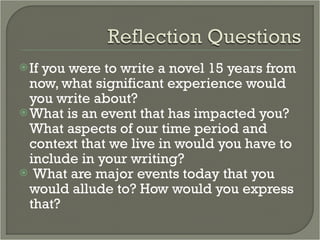
If you were to write a novel 15 years from now, what significant experience would you write about?  What is an event that has impacted you? What aspects of our time period and context that we live in would you have to include in your writing? What are major events today that you would allude to? How would you express that?

Lee experience-Proctor

  • 1.
    Harper Lee wrote To Kill a Mocking Bird about an event that happened near her community when she was about 10 years of age. The objective of this project is to understand the context and experience that Harper Lee was writing about. She witnessed this event in 1936 and the novel was not published until 1960. “ Truth is stranger than fiction”
  • 2.
    What can beinspiration for writing? How do writer’s develop setting (Where/ When/ Context)? How do writer’s develop the experience of a different time period? What would it be like to live in the 30s? Daily life? Beliefs? What would it be like to live in the Southern states in the 30s? What factors make up the experience of time period?
  • 3.
    I will suggesta variety of topics, but students may propose their own ideas based on their essential questions reflections Once students choose their topics they need to decide on different facets of that topic to inquire about. NARROW DOWN THE TOPIC!
  • 4.
    Harper Lee BiographyScottsboro boys Jim Crow Laws Growing up in the South Southern Songs/ Gospel/ Religious Songs KKK Brown vs. Board of Education Great Depression Racism then and now 1930s films 1930s songs 1930s advertisements 1930s technology 1930s politics Southern Experience (politics) Gender expectations
  • 5.
    To get acontextual understanding for our novel study To be able to connect personally to the literature being read To connect world events to what we are reading Create a digital presentation with your discovery of the “Southern 30s” and connect it to the novel Reflect upon what events you would be inspired to write about Reflect upon contextual aspects of our time period that would need to be addressed and understood in your writing
  • 6.
    Social-historical context, SouthernAmerican politics, historical events Art-popular culture, advertisements, social commentary Music-popular music, secular and religious music, Gospel, regional music Multimedia-presentation skills, captivating the audience, visually enhancing content, Drama-engaging the audience speaking skills English-connecting to text and context, appreciation and comprehension, all 6 strands, creation of text, consideration of purpose and audience, revision
  • 7.
    Choose/ propose topicNarrow topic: create facets for inquiry Check in with teacher (input/ revision for direction) Research/ Sources (validity, variety, resources) Check in conversation with peers or teacher to see completeness/ any holes? Presentation Creation Peer Revision (multimedia/ art expert) Rehearsal and feedback (drama expert) Exhibition (possibilities: present to peers/ post to class website/ post to TKAM blog page/ present at a local theatre production of TKAM/ present to other grade 10 classes)
  • 8.
  • 9.
    If you wereto write a novel 15 years from now, what significant experience would you write about? What is an event that has impacted you? What aspects of our time period and context that we live in would you have to include in your writing? What are major events today that you would allude to? How would you express that?