Department of
Department of Environmental Science
State University of Bangladesh
Masters in Environmental Science Program
ES 522: Environmental Analysis and Its
Interpretation
Lecture 5:
Environmental Knowledge
Management
Lecture Outline:
 What is Knowledge Management? What are the process of
Knowledge transformation?
 What are the knowledge components?
 What is Environmental Knowledge Management?
 Difference between EKM and EMIS
 What is Environmental Knowledge Circulation Process
(EKCP) and its Functions
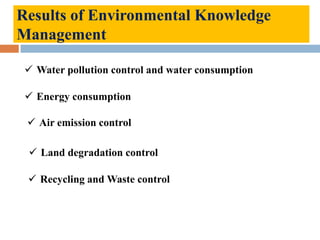
 Results of Environmental Knowledge Management
What is Knowledge Management?
A systematic collection of activities, processes and policies to enable
individuals, teams and organisations to generate, capture, organise, store,
access, disseminate and apply knowledge to learn, reflect and be in a
position to achieve their objectives.
"Knowledge management is the process of capturing, distributing,
and effectively using knowledge."
 Knowledge management is a collaborative and integrated approach to the
creation, capture, organization, access, and use of an enterprise’ s intellectual
assets. ( Grey 1996)
 Knowledge management consists of “leveraging intellectual assets to enhance
organizational performance. ” ( Stankosky 2008)
 Knowledge management is the concept under which information is turned into
actionable knowledge and made available effortlessly in a usable form to the
people who can apply it. (Patel and Harty, 1998)
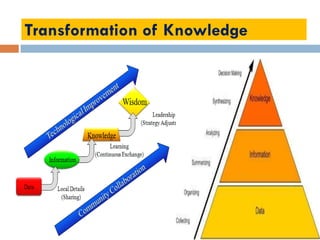
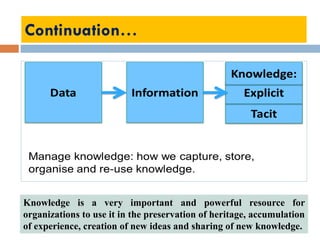
Transformation of Knowledge
Continuation…
Knowledge is a very important and powerful resource for
organizations to use it in the preservation of heritage, accumulation
of experience, creation of new ideas and sharing of new knowledge.
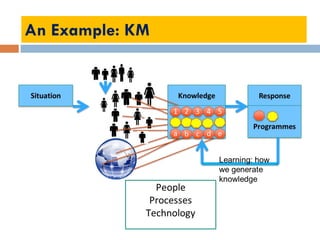
An Example: KM
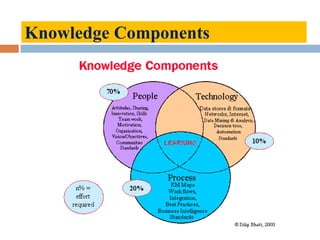
Knowledge Components
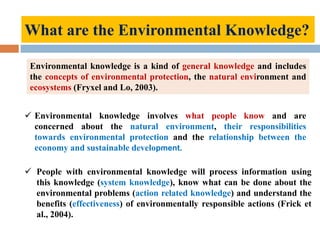
Environmental knowledge is a kind of general knowledge and includes
the concepts of environmental protection, the natural environment and
ecosystems (Fryxel and Lo, 2003).
 Environmental knowledge involves what people know and are
concerned about the natural environment, their responsibilities
towards environmental protection and the relationship between the
economy and sustainable development.
 People with environmental knowledge will process information using
this knowledge (system knowledge), know what can be done about the
environmental problems (action related knowledge) and understand the
benefits (effectiveness) of environmentally responsible actions (Frick et
al., 2004).
What are the Environmental Knowledge?
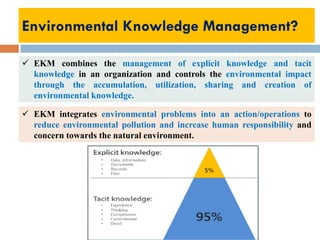
 EKM combines the management of explicit knowledge and tacit
knowledge in an organization and controls the environmental impact
through the accumulation, utilization, sharing and creation of
environmental knowledge.
 EKM integrates environmental problems into an action/operations to
reduce environmental pollution and increase human responsibility and
concern towards the natural environment.
Environmental Knowledge Management?
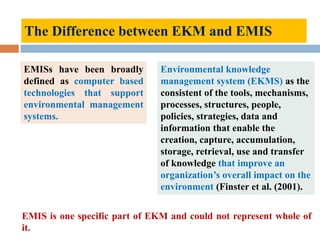
The Difference between EKM and EMIS
EMISs have been broadly
defined as computer based
technologies that support
environmental management
systems.
Environmental knowledge
management system (EKMS) as the
consistent of the tools, mechanisms,
processes, structures, people,
policies, strategies, data and
information that enable the
creation, capture, accumulation,
storage, retrieval, use and transfer
of knowledge that improve an
organization’s overall impact on the
environment (Finster et al. (2001).
EMIS is one specific part of EKM and could not represent whole of
it.
Environmental Knowledge Circulation
Process (EKCP)
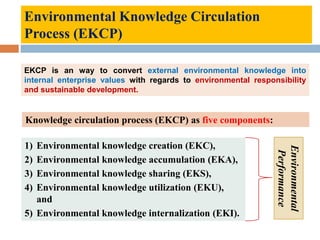
Knowledge circulation process (EKCP) as five components:
1) Environmental knowledge creation (EKC),
2) Environmental knowledge accumulation (EKA),
3) Environmental knowledge sharing (EKS),
4) Environmental knowledge utilization (EKU),
and
5) Environmental knowledge internalization (EKI).
EKCP is an way to convert external environmental knowledge into
internal enterprise values with regards to environmental responsibility
and sustainable development.
Environmental
Performance
Continuation…
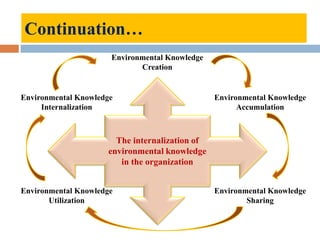
The internalization of
environmental knowledge
in the organization
Environmental Knowledge
Creation
Environmental Knowledge
Internalization
Environmental Knowledge
Accumulation
Environmental Knowledge
Utilization
Environmental Knowledge
Sharing
Results of Environmental Knowledge
Management
 Water pollution control and water consumption
 Energy consumption
 Air emission control
 Land degradation control
 Recycling and Waste control
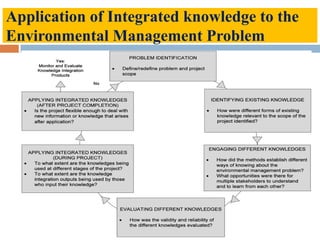
Application of Integrated knowledge to the
Environmental Management Problem
Environmental Knowledge Management?
Contract:
Shankor Paul
E-mail: shankor.paul@gmail.com
Cell: 01712009028;
FB ID & LinkedIn: Shankor Paul; Skype: Shankor_Paul

Lecture-5 Environmental KM

  • 1.
    Department of Department ofEnvironmental Science State University of Bangladesh Masters in Environmental Science Program ES 522: Environmental Analysis and Its Interpretation Lecture 5: Environmental Knowledge Management
  • 2.
    Lecture Outline:  Whatis Knowledge Management? What are the process of Knowledge transformation?  What are the knowledge components?  What is Environmental Knowledge Management?  Difference between EKM and EMIS  What is Environmental Knowledge Circulation Process (EKCP) and its Functions  Results of Environmental Knowledge Management
  • 3.
    What is KnowledgeManagement? A systematic collection of activities, processes and policies to enable individuals, teams and organisations to generate, capture, organise, store, access, disseminate and apply knowledge to learn, reflect and be in a position to achieve their objectives. "Knowledge management is the process of capturing, distributing, and effectively using knowledge."  Knowledge management is a collaborative and integrated approach to the creation, capture, organization, access, and use of an enterprise’ s intellectual assets. ( Grey 1996)  Knowledge management consists of “leveraging intellectual assets to enhance organizational performance. ” ( Stankosky 2008)  Knowledge management is the concept under which information is turned into actionable knowledge and made available effortlessly in a usable form to the people who can apply it. (Patel and Harty, 1998)
  • 4.
  • 5.
    Continuation… Knowledge is avery important and powerful resource for organizations to use it in the preservation of heritage, accumulation of experience, creation of new ideas and sharing of new knowledge.
  • 6.
  • 7.
  • 8.
    Environmental knowledge isa kind of general knowledge and includes the concepts of environmental protection, the natural environment and ecosystems (Fryxel and Lo, 2003).  Environmental knowledge involves what people know and are concerned about the natural environment, their responsibilities towards environmental protection and the relationship between the economy and sustainable development.  People with environmental knowledge will process information using this knowledge (system knowledge), know what can be done about the environmental problems (action related knowledge) and understand the benefits (effectiveness) of environmentally responsible actions (Frick et al., 2004). What are the Environmental Knowledge?
  • 9.
     EKM combinesthe management of explicit knowledge and tacit knowledge in an organization and controls the environmental impact through the accumulation, utilization, sharing and creation of environmental knowledge.  EKM integrates environmental problems into an action/operations to reduce environmental pollution and increase human responsibility and concern towards the natural environment. Environmental Knowledge Management?
  • 10.
    The Difference betweenEKM and EMIS EMISs have been broadly defined as computer based technologies that support environmental management systems. Environmental knowledge management system (EKMS) as the consistent of the tools, mechanisms, processes, structures, people, policies, strategies, data and information that enable the creation, capture, accumulation, storage, retrieval, use and transfer of knowledge that improve an organization’s overall impact on the environment (Finster et al. (2001). EMIS is one specific part of EKM and could not represent whole of it.
  • 11.
    Environmental Knowledge Circulation Process(EKCP) Knowledge circulation process (EKCP) as five components: 1) Environmental knowledge creation (EKC), 2) Environmental knowledge accumulation (EKA), 3) Environmental knowledge sharing (EKS), 4) Environmental knowledge utilization (EKU), and 5) Environmental knowledge internalization (EKI). EKCP is an way to convert external environmental knowledge into internal enterprise values with regards to environmental responsibility and sustainable development. Environmental Performance
  • 12.
    Continuation… The internalization of environmentalknowledge in the organization Environmental Knowledge Creation Environmental Knowledge Internalization Environmental Knowledge Accumulation Environmental Knowledge Utilization Environmental Knowledge Sharing
  • 13.
    Results of EnvironmentalKnowledge Management  Water pollution control and water consumption  Energy consumption  Air emission control  Land degradation control  Recycling and Waste control
  • 14.
    Application of Integratedknowledge to the Environmental Management Problem
  • 15.
  • 16.
    Contract: Shankor Paul E-mail: shankor.paul@gmail.com Cell:01712009028; FB ID & LinkedIn: Shankor Paul; Skype: Shankor_Paul