Communication Skills
2
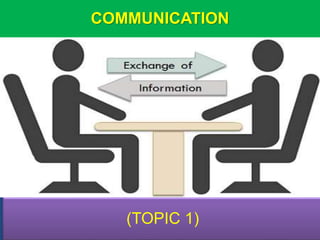
(TOPIC 1)
COMMUNICATION
To introduce the topic and explain various
aspects of communication
AIM OF PRESENTATION
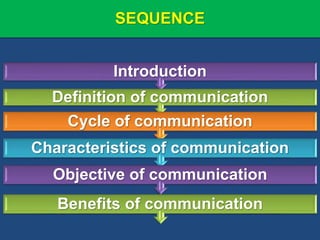
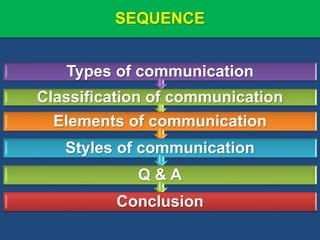
SEQUENCE
Introduction
Definition of communication
Cycle of communication
Characteristics of communication
Objective of communication
Benefits of communication
SEQUENCE
Types of communication
Classification of communication
Elements of communication
Styles of communication
Q & A
Conclusion
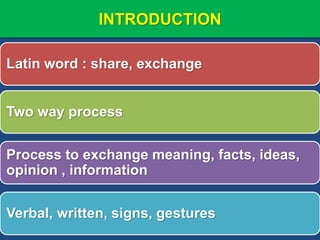
INTRODUCTION
Latin word : share, exchange
Two way process
Process to exchange meaning, facts, ideas,
opinion , information
Verbal, written, signs, gestures
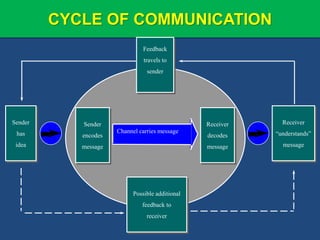
CYCLE OF COMMUNICATION
Receiver
“understands”
message
Sender
has
idea
Possible additional
feedback to
receiver
Sender
encodes
message
Receiver
decodes
message
Channel carries message
Feedback
travels to
sender
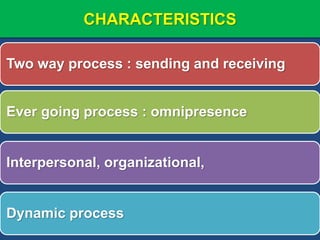
CHARACTERISTICS
Two way process : sending and receiving
Ever going process : omnipresence
Interpersonal, organizational,
Dynamic process
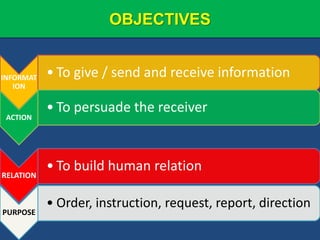
OBJECTIVES
INFORMAT
ION
• To give / send and receive information
ACTION
• To persuade the receiver
RELATION
• To build human relation
PURPOSE
• Order, instruction, request, report, direction
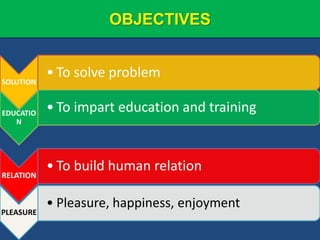
OBJECTIVES
SOLUTION
• To solve problem
EDUCATIO
N
• To impart education and training
RELATION
• To build human relation
PLEASURE
• Pleasure, happiness, enjoyment
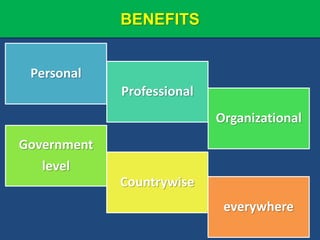
BENEFITS
Personal
Professional
Organizational
Government
level
Countrywise
everywhere
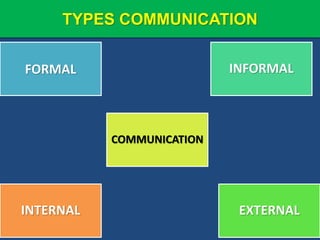
TYPES COMMUNICATION
FORMAL INFORMAL
EXTERNAL
COMMUNICATION
INTERNAL
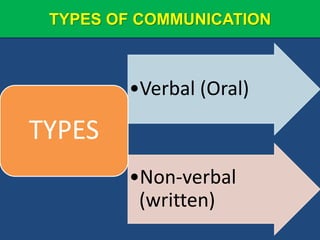
TYPES OF COMMUNICATION
•Verbal (Oral)
•Non-verbal
(written)
TYPES
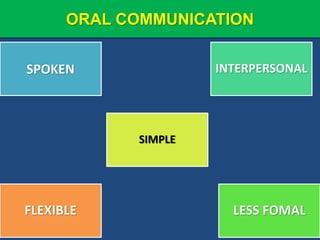
ORAL COMMUNICATION
SPOKEN INTERPERSONAL
LESS FOMAL
SIMPLE
FLEXIBLE
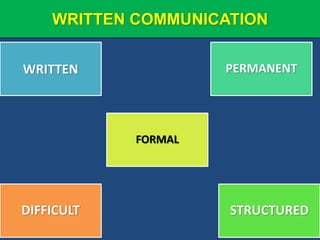
WRITTEN COMMUNICATION
WRITTEN PERMANENT
STRUCTURED
FORMAL
DIFFICULT
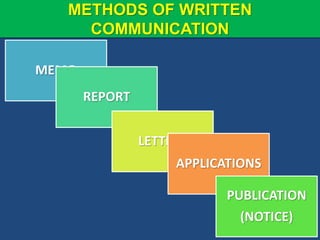
METHODS OF WRITTEN
COMMUNICATION
MEMO
REPORT
LETTERS
APPLICATIONS
PUBLICATION
(NOTICE)
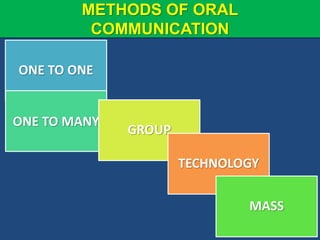
METHODS OF ORAL
COMMUNICATION
ONE TO ONE
ONE TO MANY
GROUP
TECHNOLOGY
MASS
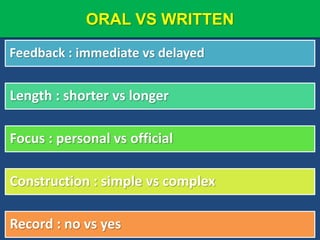
ORAL VS WRITTEN
Feedback : immediate vs delayed
Length : shorter vs longer
Focus : personal vs official
Construction : simple vs complex
Record : no vs yes
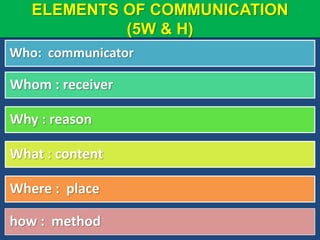
ELEMENTS OF COMMUNICATION
(5W & H)
Who: communicator
Whom : receiver
Why : reason
What : content
Where : place
how : method
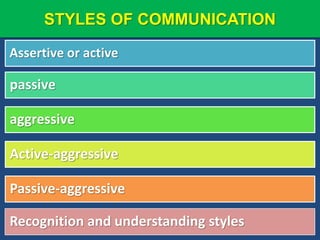
STYLES OF COMMUNICATION
Assertive or active
passive
aggressive
Active-aggressive
Passive-aggressive
Recognition and understanding styles
FINAL THOUGHT
(CONCLUSION)
COMMUNICATION
EVERYWHERE
LIFE LINE
EVERYTHING
Q & A

Lecture-1.ppt