EC-2262: Computer Organization and Architecture
Credits: 3-0-0
CSE B.Tech. IV Sem.
Dr. Anand A. Bhaskar
Head & Asst. Prof.
Department of E&CE
Sir Padampat Singhania University
Udaipur, Rajasthan
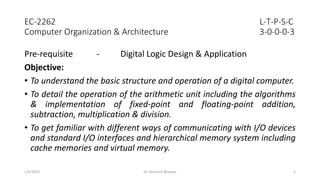
EC-2262 L-T-P-S-C
Computer Organization & Architecture 3-0-0-0-3
Pre-requisite - Digital Logic Design & Application
Objective:
• To understand the basic structure and operation of a digital computer.
• To detail the operation of the arithmetic unit including the algorithms
& implementation of fixed-point and floating-point addition,
subtraction, multiplication & division.
• To get familiar with different ways of communicating with I/O devices
and standard I/O interfaces and hierarchical memory system including
cache memories and virtual memory.
1/4/2022 Dr. Anand A Bhaskar 2
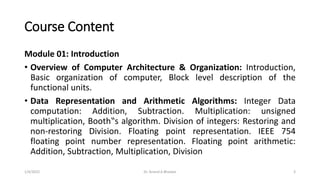
Course Content
Module 01: Introduction
• Overview of Computer Architecture & Organization: Introduction,
Basic organization of computer, Block level description of the
functional units.
• Data Representation and Arithmetic Algorithms: Integer Data
computation: Addition, Subtraction. Multiplication: unsigned
multiplication, Booth‟s algorithm. Division of integers: Restoring and
non-restoring Division. Floating point representation. IEEE 754
floating point number representation. Floating point arithmetic:
Addition, Subtraction, Multiplication, Division
1/4/2022 Dr. Anand A Bhaskar 3
Course Content
Module 02; Processor Organization and Architecture
• Von Neumann model, Harvard Architecture, Register Organization,
Instruction formats, addressing modes, instruction cycle. Instruction,
interpretation and sequencing. ALU and Shifters, Basic pipelined
datapath and control, Data dependences, data hazards, Branch
hazards, delayed branches, branch prediction, Performance measures
– CPI, speedup, efficiency, throughput and Amdahl‟s law.
1/4/2022 Dr. Anand A Bhaskar 4
Course Content
Module 03: Control Unit Design
• Hardwired control unit design methods: State table, delay element,
sequence counter with examples like control unit for multiplication
and division Microprogrammed control Unit: Microinstruction
sequencing and execution. Micro operations, Wilkie‟s
microprogrammed Control Unit, Examples on microprograms.
1/4/2022 Dr. Anand A Bhaskar 5
Course Content
Module 04: Memory Organization
• Classifications of primary and secondary memories. Types of RAM
(SRAM, DRAM, SDRAM, DDR, SSD) and ROM, Characteristics of
memory, Memory hierarchy: cost and performance measurement.
Virtual Memory: Concept, Segmentation and Paging, Address
translation mechanism. Interleaved and Associative memory. Cache
memory Concepts, Locality of reference, design problems based on
mapping techniques. Cache Coherency, Write Policies
1/4/2022 Dr. Anand A Bhaskar 6
Course Content
Module 05: I/O Organization and Peripherals
• Common I/O device types and characteristics Types of data transfer
techniques: Programmed I/O, Interrupt driven I/O and DMA.
Introduction to buses, Bus arbitration and multiple bus hierarchy
Interrupt types, Interrupts handling.
1/4/2022 Dr. Anand A Bhaskar 7
Course Content
Module 06: Advanced Processor Principles
• Introduction to parallel processing, Flynn‟s Classification Concepts of
superscalar architecture, out-of-order execution, speculative
execution, multithreaded processor, VLIW, data flow computing.
Introduction to Multi-core processor architecture.
1/4/2022 Dr. Anand A Bhaskar 8
Text/Reference Books
1. Computer Organization and Architecture: Designing for Performance. Stallings
W. 10th Ed. Pearson Publication. 2013.
2. Computer Architecture and Organization. Hayes J. P. McGraw-Hill. 1988.
3. Computer Architecture and Organization: Design Principles and Applications.
Govindarajulu B. 2nd Ed. McGraw-Hill (India).
4. Structured Computer Organization. Tanenbaum A. S. 6th Ed. Pearson.
5. Computer System Architecture. Mano M. 3rd Ed., Pearson Publication, 2007.
6. Computer Architecture and Parallel Processing. Hwang K. & Briggs F. A.
McGraw-Hill
7. Computer Organization and Design. Chaudhuri P. P. Prentice Hall India, 2004.
8. Computer System Architecture and Organization. Usha M. & Shrikant T. S.
Wiley India. 2014.
1/4/2022 Dr. Anand A Bhaskar 9
Introduction to COA
• The computer organization and architecture (COA) is one of the
important and comprehensive subject the includes many
foundational concepts and knowledge used in the design of a
computer system.
• The COA also continues to be the most important part of syllabus for
computer science courses across all universities and also various
competitive examinations.
1/4/2022 Dr. Anand A Bhaskar 10
Introduction to COA
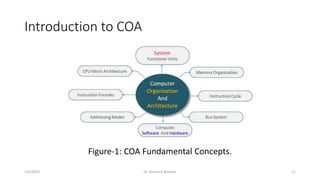
Figure-1: COA Fundamental Concepts.
1/4/2022 Dr. Anand A Bhaskar 11
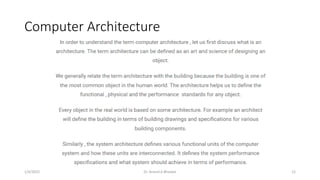
Computer Architecture
1/4/2022 Dr. Anand A Bhaskar 12
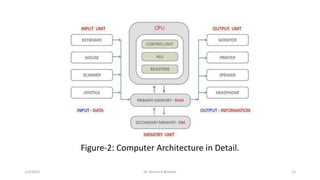
Figure-2: Computer Architecture in Detail.
1/4/2022 Dr. Anand A Bhaskar 13
1/4/2022 Dr. Anand A Bhaskar 14
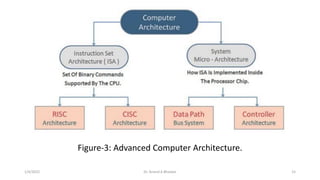
Figure-3: Advanced Computer Architecture.
1/4/2022 Dr. Anand A Bhaskar 15
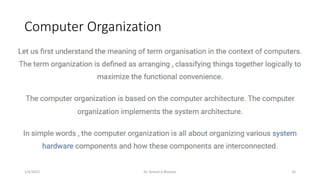
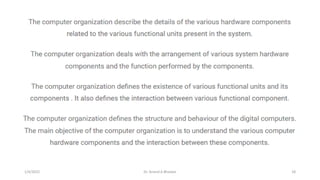
Computer Organization
1/4/2022 Dr. Anand A Bhaskar 16
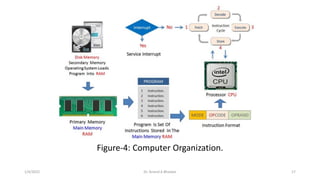
Figure-4: Computer Organization.
1/4/2022 Dr. Anand A Bhaskar 17
1/4/2022 Dr. Anand A Bhaskar 18
Thank You!
1/4/2022 Dr. Anand A Bhaskar 19

Lecture-01.pdf

  • 1.
    EC-2262: Computer Organizationand Architecture Credits: 3-0-0 CSE B.Tech. IV Sem. Dr. Anand A. Bhaskar Head & Asst. Prof. Department of E&CE Sir Padampat Singhania University Udaipur, Rajasthan
  • 2.
    EC-2262 L-T-P-S-C Computer Organization& Architecture 3-0-0-0-3 Pre-requisite - Digital Logic Design & Application Objective: • To understand the basic structure and operation of a digital computer. • To detail the operation of the arithmetic unit including the algorithms & implementation of fixed-point and floating-point addition, subtraction, multiplication & division. • To get familiar with different ways of communicating with I/O devices and standard I/O interfaces and hierarchical memory system including cache memories and virtual memory. 1/4/2022 Dr. Anand A Bhaskar 2
  • 3.
    Course Content Module 01:Introduction • Overview of Computer Architecture & Organization: Introduction, Basic organization of computer, Block level description of the functional units. • Data Representation and Arithmetic Algorithms: Integer Data computation: Addition, Subtraction. Multiplication: unsigned multiplication, Booth‟s algorithm. Division of integers: Restoring and non-restoring Division. Floating point representation. IEEE 754 floating point number representation. Floating point arithmetic: Addition, Subtraction, Multiplication, Division 1/4/2022 Dr. Anand A Bhaskar 3
  • 4.
    Course Content Module 02;Processor Organization and Architecture • Von Neumann model, Harvard Architecture, Register Organization, Instruction formats, addressing modes, instruction cycle. Instruction, interpretation and sequencing. ALU and Shifters, Basic pipelined datapath and control, Data dependences, data hazards, Branch hazards, delayed branches, branch prediction, Performance measures – CPI, speedup, efficiency, throughput and Amdahl‟s law. 1/4/2022 Dr. Anand A Bhaskar 4
  • 5.
    Course Content Module 03:Control Unit Design • Hardwired control unit design methods: State table, delay element, sequence counter with examples like control unit for multiplication and division Microprogrammed control Unit: Microinstruction sequencing and execution. Micro operations, Wilkie‟s microprogrammed Control Unit, Examples on microprograms. 1/4/2022 Dr. Anand A Bhaskar 5
  • 6.
    Course Content Module 04:Memory Organization • Classifications of primary and secondary memories. Types of RAM (SRAM, DRAM, SDRAM, DDR, SSD) and ROM, Characteristics of memory, Memory hierarchy: cost and performance measurement. Virtual Memory: Concept, Segmentation and Paging, Address translation mechanism. Interleaved and Associative memory. Cache memory Concepts, Locality of reference, design problems based on mapping techniques. Cache Coherency, Write Policies 1/4/2022 Dr. Anand A Bhaskar 6
  • 7.
    Course Content Module 05:I/O Organization and Peripherals • Common I/O device types and characteristics Types of data transfer techniques: Programmed I/O, Interrupt driven I/O and DMA. Introduction to buses, Bus arbitration and multiple bus hierarchy Interrupt types, Interrupts handling. 1/4/2022 Dr. Anand A Bhaskar 7
  • 8.
    Course Content Module 06:Advanced Processor Principles • Introduction to parallel processing, Flynn‟s Classification Concepts of superscalar architecture, out-of-order execution, speculative execution, multithreaded processor, VLIW, data flow computing. Introduction to Multi-core processor architecture. 1/4/2022 Dr. Anand A Bhaskar 8
  • 9.
    Text/Reference Books 1. ComputerOrganization and Architecture: Designing for Performance. Stallings W. 10th Ed. Pearson Publication. 2013. 2. Computer Architecture and Organization. Hayes J. P. McGraw-Hill. 1988. 3. Computer Architecture and Organization: Design Principles and Applications. Govindarajulu B. 2nd Ed. McGraw-Hill (India). 4. Structured Computer Organization. Tanenbaum A. S. 6th Ed. Pearson. 5. Computer System Architecture. Mano M. 3rd Ed., Pearson Publication, 2007. 6. Computer Architecture and Parallel Processing. Hwang K. & Briggs F. A. McGraw-Hill 7. Computer Organization and Design. Chaudhuri P. P. Prentice Hall India, 2004. 8. Computer System Architecture and Organization. Usha M. & Shrikant T. S. Wiley India. 2014. 1/4/2022 Dr. Anand A Bhaskar 9
  • 10.
    Introduction to COA •The computer organization and architecture (COA) is one of the important and comprehensive subject the includes many foundational concepts and knowledge used in the design of a computer system. • The COA also continues to be the most important part of syllabus for computer science courses across all universities and also various competitive examinations. 1/4/2022 Dr. Anand A Bhaskar 10
  • 11.
    Introduction to COA Figure-1:COA Fundamental Concepts. 1/4/2022 Dr. Anand A Bhaskar 11
  • 12.
  • 13.
    Figure-2: Computer Architecturein Detail. 1/4/2022 Dr. Anand A Bhaskar 13
  • 14.
    1/4/2022 Dr. AnandA Bhaskar 14
  • 15.
    Figure-3: Advanced ComputerArchitecture. 1/4/2022 Dr. Anand A Bhaskar 15
  • 16.
  • 17.
  • 18.
    1/4/2022 Dr. AnandA Bhaskar 18
  • 19.
    Thank You! 1/4/2022 Dr.Anand A Bhaskar 19