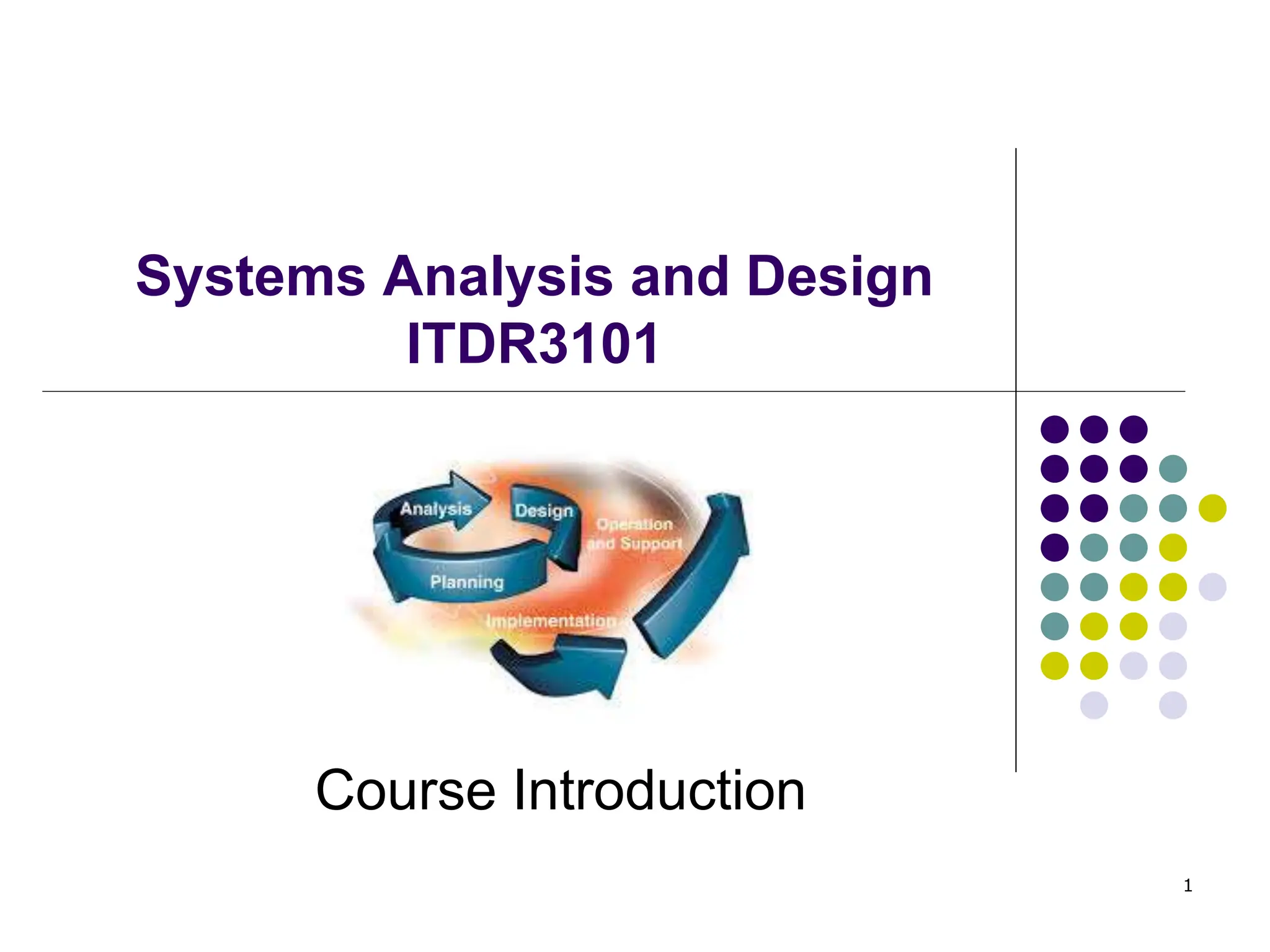
Systems Analysis and Design
ITDR3101
Course Introduction
1
Contact Information
Instructor
Dr. Amr Kamal (SYSCO of Systems Analysis and Design)
Email
amrmkamal.ibr@cas.edu.om
Office: D208
Blackboard web site
http://www.coas.edu.om
2
3
What is Systems Analysis and Design
(SAD)?
Systems Analysis: is the process of understanding and
specifying in detail what the information system should
accomplish
System Design: is the process to define and describe in
detail how the components of the information system
should be physically implemented
Why is it important?
 Success of information systems depends on good SAD
 Widely used in industry - proven techniques
 Part of career growth in IT - lots of interesting and well
paying jobs!
 Increasing demand for systems analysis skills
4
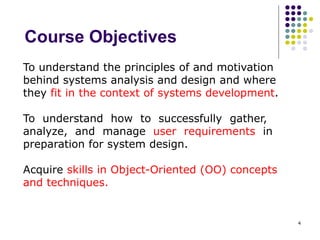
Course Objectives
To understand the principles of and motivation
behind systems analysis and design and where
they fit in the context of systems development.
To understand how to successfully gather,
analyze, and manage user requirements in
preparation for system design.
Acquire skills in Object-Oriented (OO) concepts
and techniques.
5
Course Objectives Cont.
To be conversant with the use of Computer
Assisted Software Engineering (CASE) tools such
as Sybase Power Designer (15.5) that supports a
particular design paradigm or any open source
Case –Tool that supports UML such as (draw.io,
ClickChart, or Star UML, etc.).
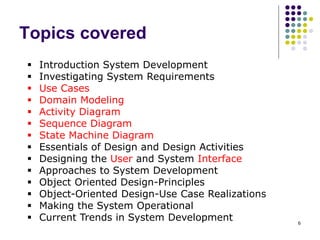
Topics covered
6
 Introduction System Development
 Investigating System Requirements
 Use Cases
 Domain Modeling
 Activity Diagram
 Sequence Diagram
 State Machine Diagram
 Essentials of Design and Design Activities
 Designing the User and System Interface
 Approaches to System Development
 Object Oriented Design-Principles
 Object-Oriented Design-Use Case Realizations
 Making the System Operational
 Current Trends in System Development
7
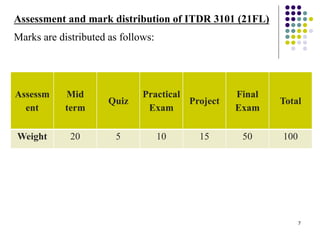
Assessm
ent
Mid
term
Quiz
Practical
Exam
Project
Final
Exam
Total
Weight 20 5 10 15 50 100
Assessment and mark distribution of ITDR 3101 (21FL)
Marks are distributed as follows:
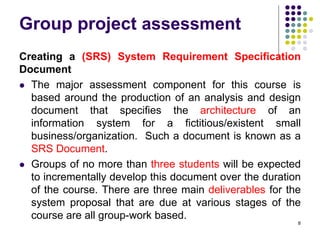
Group project assessment
Creating a (SRS) System Requirement Specification
Document
 The major assessment component for this course is
based around the production of an analysis and design
document that specifies the architecture of an
information system for a fictitious/existent small
business/organization. Such a document is known as a
SRS Document.
 Groups of no more than three students will be expected
to incrementally develop this document over the duration
of the course. There are three main deliverables for the
system proposal that are due at various stages of the
course are all group-work based.
8
9
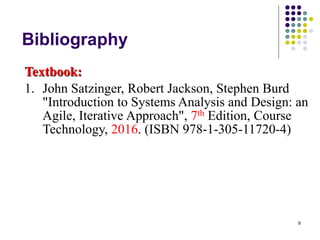
Bibliography
Textbook:
1. John Satzinger, Robert Jackson, Stephen Burd
"Introduction to Systems Analysis and Design: an
Agile, Iterative Approach", 7th Edition, Course
Technology, 2016. (ISBN 978-1-305-11720-4)
10
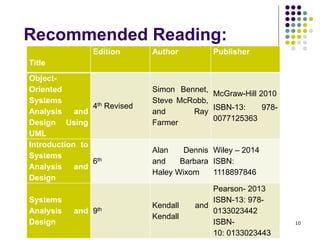
Recommended Reading:
Title
Edition Author Publisher
Object-
Oriented
Systems
Analysis and
Design Using
UML
4th Revised
Simon Bennet,
Steve McRobb,
and Ray
Farmer
McGraw-Hill 2010
ISBN-13: 978-
0077125363
Introduction to
Systems
Analysis and
Design
6th
Alan Dennis
and Barbara
Haley Wixom
Wiley – 2014
ISBN:
1118897846
Systems
Analysis and
Design
9th
Kendall and
Kendall
Pearson- 2013
ISBN-13: 978-
0133023442
ISBN-
10: 0133023443

Course Outline System Analysis and Design

  • 1.
    Systems Analysis andDesign ITDR3101 Course Introduction 1
  • 2.
    Contact Information Instructor Dr. AmrKamal (SYSCO of Systems Analysis and Design) Email amrmkamal.ibr@cas.edu.om Office: D208 Blackboard web site http://www.coas.edu.om 2
  • 3.
    3 What is SystemsAnalysis and Design (SAD)? Systems Analysis: is the process of understanding and specifying in detail what the information system should accomplish System Design: is the process to define and describe in detail how the components of the information system should be physically implemented Why is it important?  Success of information systems depends on good SAD  Widely used in industry - proven techniques  Part of career growth in IT - lots of interesting and well paying jobs!  Increasing demand for systems analysis skills
  • 4.
    4 Course Objectives To understandthe principles of and motivation behind systems analysis and design and where they fit in the context of systems development. To understand how to successfully gather, analyze, and manage user requirements in preparation for system design. Acquire skills in Object-Oriented (OO) concepts and techniques.
  • 5.
    5 Course Objectives Cont. Tobe conversant with the use of Computer Assisted Software Engineering (CASE) tools such as Sybase Power Designer (15.5) that supports a particular design paradigm or any open source Case –Tool that supports UML such as (draw.io, ClickChart, or Star UML, etc.).
  • 6.
    Topics covered 6  IntroductionSystem Development  Investigating System Requirements  Use Cases  Domain Modeling  Activity Diagram  Sequence Diagram  State Machine Diagram  Essentials of Design and Design Activities  Designing the User and System Interface  Approaches to System Development  Object Oriented Design-Principles  Object-Oriented Design-Use Case Realizations  Making the System Operational  Current Trends in System Development
  • 7.
    7 Assessm ent Mid term Quiz Practical Exam Project Final Exam Total Weight 20 510 15 50 100 Assessment and mark distribution of ITDR 3101 (21FL) Marks are distributed as follows:
  • 8.
    Group project assessment Creatinga (SRS) System Requirement Specification Document  The major assessment component for this course is based around the production of an analysis and design document that specifies the architecture of an information system for a fictitious/existent small business/organization. Such a document is known as a SRS Document.  Groups of no more than three students will be expected to incrementally develop this document over the duration of the course. There are three main deliverables for the system proposal that are due at various stages of the course are all group-work based. 8
  • 9.
    9 Bibliography Textbook: 1. John Satzinger,Robert Jackson, Stephen Burd "Introduction to Systems Analysis and Design: an Agile, Iterative Approach", 7th Edition, Course Technology, 2016. (ISBN 978-1-305-11720-4)
  • 10.
    10 Recommended Reading: Title Edition AuthorPublisher Object- Oriented Systems Analysis and Design Using UML 4th Revised Simon Bennet, Steve McRobb, and Ray Farmer McGraw-Hill 2010 ISBN-13: 978- 0077125363 Introduction to Systems Analysis and Design 6th Alan Dennis and Barbara Haley Wixom Wiley – 2014 ISBN: 1118897846 Systems Analysis and Design 9th Kendall and Kendall Pearson- 2013 ISBN-13: 978- 0133023442 ISBN- 10: 0133023443

Editor's Notes

  • #6 Current version in CAS, Ibri: Power Designer version 12.1 Latest version: Power Designer version 16.6
  • #7 Provide a brief introduction into each top.
  • #9 SRS: Software Requirement Specification SRS is a document that describes an organization's understanding (in writing) of a customer or potential client's system requirements and dependencies at a particular point in time (usually) prior to any actual design or development work. An SRS is a two-way insurance policy that assures that both the client and the S/W house (firm) understand the requirements at a given point in time. SRS document concentrates on: what needs to be done avoids the solution (“how to do”) aspects (avoids all implementation details). The requirements should be written using end-user terminology.