PLANNING_ACTIVITIES
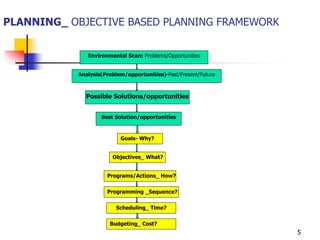
Forecasting/Goal Setting
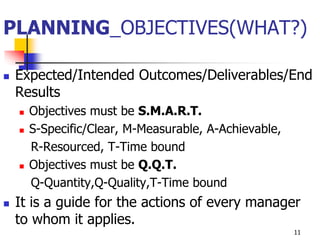
Establish Objectives
Establish Programs/Actions
Scheduling /Timing of programs/actions for achieving the
programs/actions
Budgeting of programs/actions; Establish cost commitments for the
programs/actions
Developing policies/procedures to guide the program/actions
2
3.
PLANNING_PRINCIPLES
Progressive Elaboration
The further we project a plan into the future, the more unstable and undependable it
becomes;
Make detailed immediate/short-term plans
Make rough medium and long-term plans and update as you progress.
Participation & Communication
People has a tendency to resist change;
Provide for participation and communication in the planning process.
COLLECTIVE EFFORT
Planning Horizon
Provide for both short term and long term plans.
3
4.
PLANNING_COMMON MISTAKES
Vagueand unclear objectives
Ignoring environmental context
Neglecting stakeholder interest
One-shot planning
Plan misalignment
Insufficient time and effort
4
GOAL_EXAMPLES
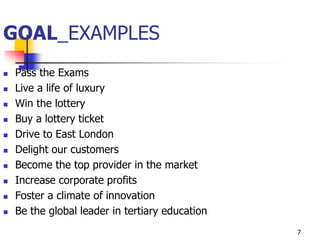
Pass theExams
Live a life of luxury
Win the lottery
Buy a lottery ticket
Drive to East London
Delight our customers
Become the top provider in the market
Increase corporate profits
Foster a climate of innovation
Be the global leader in tertiary education
7
8.
PLANNING_ FORECASTING/GOAL SETTING
(WHY?VISION?)
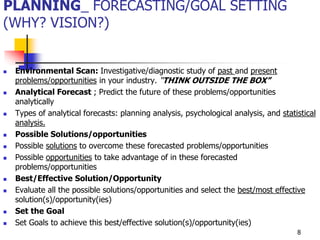
Environmental Scan: Investigative/diagnostic study of past and present
problems/opportunities in your industry. “THINK OUTSIDE THE BOX”
Analytical Forecast ; Predict the future of these problems/opportunities
analytically
Types of analytical forecasts: planning analysis, psychological analysis, and statistical
analysis.
Possible Solutions/opportunities
Possible solutions to overcome these forecasted problems/opportunities
Possible opportunities to take advantage of in these forecasted
problems/opportunities
Best/Effective Solution/Opportunity
Evaluate all the possible solutions/opportunities and select the best/most effective
solution(s)/opportunity(ies)
Set the Goal
Set Goals to achieve this best/effective solution(s)/opportunity(ies)
8
9.
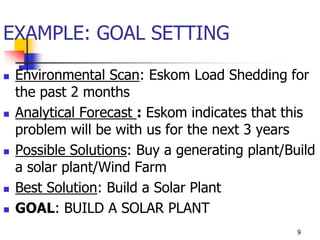
EXAMPLE: GOAL SETTING
Environmental Scan: Eskom Load Shedding for
the past 2 months
Analytical Forecast : Eskom indicates that this
problem will be with us for the next 3 years
Possible Solutions: Buy a generating plant/Build
a solar plant/Wind Farm
Best Solution: Build a Solar Plant
GOAL: BUILD A SOLAR PLANT
9
10.
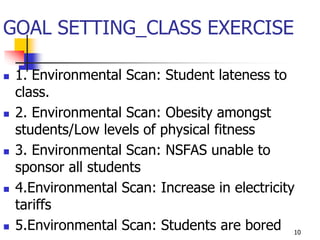
GOAL SETTING_CLASS EXERCISE
1. Environmental Scan: Student lateness to
class.
2. Environmental Scan: Obesity amongst
students/Low levels of physical fitness
3. Environmental Scan: NSFAS unable to
sponsor all students
4.Environmental Scan: Increase in electricity
tariffs
5.Environmental Scan: Students are bored 10
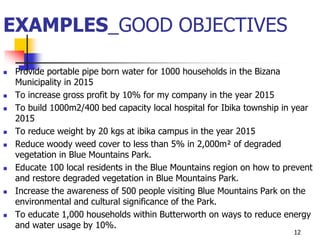
EXAMPLES_GOOD OBJECTIVES
Provideportable pipe born water for 1000 households in the Bizana
Municipality in 2015
To increase gross profit by 10% for my company in the year 2015
To build 1000m2/400 bed capacity local hospital for Ibika township in year
2015
To reduce weight by 20 kgs at ibika campus in the year 2015
Reduce woody weed cover to less than 5% in 2,000m² of degraded
vegetation in Blue Mountains Park.
Educate 100 local residents in the Blue Mountains region on how to prevent
and restore degraded vegetation in Blue Mountains Park.
Increase the awareness of 500 people visiting Blue Mountains Park on the
environmental and cultural significance of the Park.
To educate 1,000 households within Butterworth on ways to reduce energy
and water usage by 10%.
12
13.
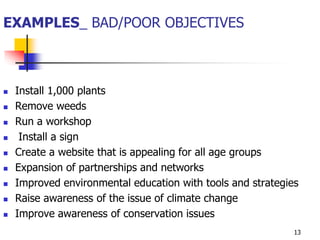
EXAMPLES_ BAD/POOR OBJECTIVES
Install 1,000 plants
Remove weeds
Run a workshop
Install a sign
Create a website that is appealing for all age groups
Expansion of partnerships and networks
Improved environmental education with tools and strategies
Raise awareness of the issue of climate change
Improve awareness of conservation issues
13
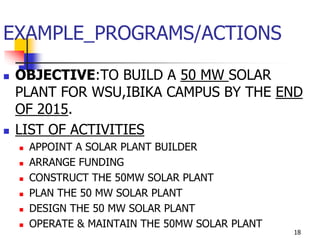
EXAMPLE_PROGRAMS/ACTIONS
OBJECTIVE:TO BUILDA 50 MW SOLAR
PLANT FOR WSU,IBIKA CAMPUS BY THE END
OF 2015.
LIST OF ACTIVITIES
APPOINT A SOLAR PLANT BUILDER
ARRANGE FUNDING
CONSTRUCT THE 50MW SOLAR PLANT
PLAN THE 50 MW SOLAR PLANT
DESIGN THE 50 MW SOLAR PLANT
OPERATE & MAINTAIN THE 50MW SOLAR PLANT
18
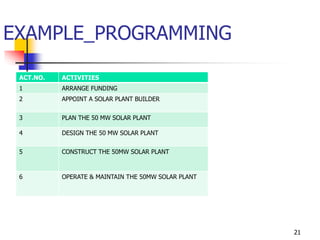
EXAMPLE_PROGRAMMING
ACT.NO. ACTIVITIES
1 ARRANGEFUNDING
2 APPOINT A SOLAR PLANT BUILDER
3 PLAN THE 50 MW SOLAR PLANT
4 DESIGN THE 50 MW SOLAR PLANT
5 CONSTRUCT THE 50MW SOLAR PLANT
6 OPERATE & MAINTAIN THE 50MW SOLAR PLANT
21
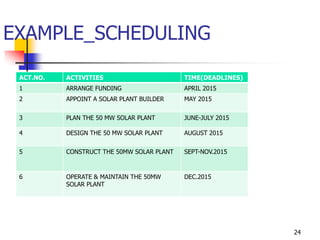
EXAMPLE_SCHEDULING
ACT.NO. ACTIVITIES TIME(DEADLINES)
1ARRANGE FUNDING APRIL 2015
2 APPOINT A SOLAR PLANT BUILDER MAY 2015
3 PLAN THE 50 MW SOLAR PLANT JUNE-JULY 2015
4 DESIGN THE 50 MW SOLAR PLANT AUGUST 2015
5 CONSTRUCT THE 50MW SOLAR PLANT SEPT-NOV.2015
6 OPERATE & MAINTAIN THE 50MW
SOLAR PLANT
DEC.2015
24
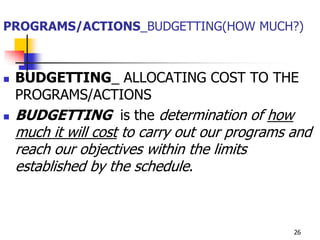
PROGRAMS/ACTIONS_BUDGETTING(HOW MUCH?)
BUDGETTING_ALLOCATING COST TO THE
PROGRAMS/ACTIONS
BUDGETTING is the determination of how
much it will cost to carry out our programs and
reach our objectives within the limits
established by the schedule.
26
26.
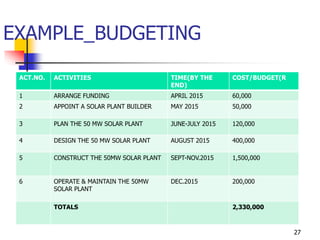
EXAMPLE_BUDGETING
ACT.NO. ACTIVITIES TIME(BYTHE
END)
COST/BUDGET(R
1 ARRANGE FUNDING APRIL 2015 60,000
2 APPOINT A SOLAR PLANT BUILDER MAY 2015 50,000
3 PLAN THE 50 MW SOLAR PLANT JUNE-JULY 2015 120,000
4 DESIGN THE 50 MW SOLAR PLANT AUGUST 2015 400,000
5 CONSTRUCT THE 50MW SOLAR PLANT SEPT-NOV.2015 1,500,000
6 OPERATE & MAINTAIN THE 50MW
SOLAR PLANT
DEC.2015 200,000
TOTALS 2,330,000
27
27.
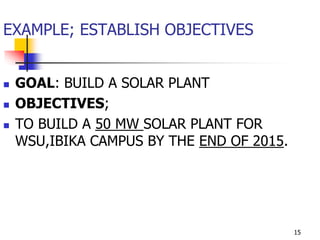
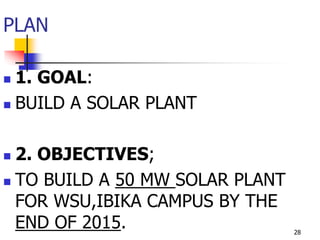
PLAN
1. GOAL:
BUILD A SOLAR PLANT
2. OBJECTIVES;
TO BUILD A 50 MW SOLAR PLANT
FOR WSU,IBIKA CAMPUS BY THE
END OF 2015. 28
28.
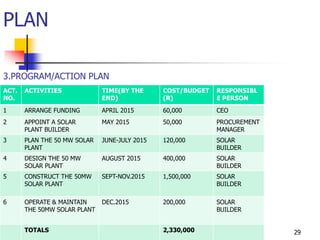
3.PROGRAM/ACTION PLAN
ACT.
NO.
ACTIVITIES TIME(BYTHE
END)
COST/BUDGET
(R)
RESPONSIBL
E PERSON
1 ARRANGE FUNDING APRIL 2015 60,000 CEO
2 APPOINT A SOLAR
PLANT BUILDER
MAY 2015 50,000 PROCUREMENT
MANAGER
3 PLAN THE 50 MW SOLAR
PLANT
JUNE-JULY 2015 120,000 SOLAR
BUILDER
4 DESIGN THE 50 MW
SOLAR PLANT
AUGUST 2015 400,000 SOLAR
BUILDER
5 CONSTRUCT THE 50MW
SOLAR PLANT
SEPT-NOV.2015 1,500,000 SOLAR
BUILDER
6 OPERATE & MAINTAIN
THE 50MW SOLAR PLANT
DEC.2015 200,000 SOLAR
BUILDER
TOTALS 2,330,000 29
PLAN
PROGRAM/ACTIONS_ REVIEW/RECONCILE
Asa final step, all programs/actions,
schedules, budgets should be reviewed
and reconciled to ensure that they are
integrated and unified.
31
31.
POLICIES(GUIDELINES)
It isa command from top management to
perform in a specified manner.
It establishes definite limits of authority.
Develop and apply uniform and flexible
guidelines to control peoples behaviour during
the execution of the programs/actions.
32
32.
EXAMPLE_POLICY
Eg. ACTIVITY:CONSTRUCT A SOLAR PLANT
MANAGEMENT POLICY/GUIDELINE?
“THE SOLAR PLANT BUILDER SHALL USE
STUDENTS TO BUILD THE PLANT”
33
33.
PROGRAMS/ACTIONS_
PROCEDURES(STANDARD METHODS/METHODOLOGY)
Todevelop and apply standardised(STEP BY STEP) methods of
performing each of the listed activities
EXAMPLE;
ACTIVITY NO; 2
ACTIVITY: APPOINT A SOLAR PLANT BUILDER
STANDARD PROCEDURE/METHODOLOGY;
1.INVITE PROPOSALS FROM SOLAR PLANT BUILDERS
2.EVALUATE PROPOSALS
3.SELECT THE BEST PROPOSAL
4.APPOINT SOLAR PLANT BUILDER
34
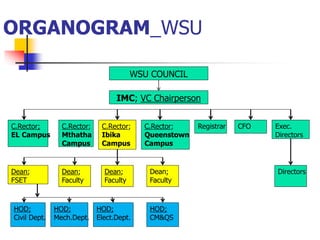
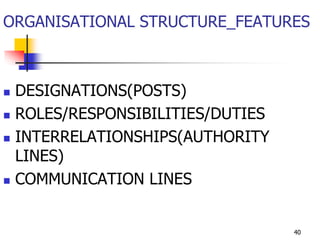
ORGANISATION_STRUCTURE/ORGANOGRAM
The structurewithin which the activities/tasks and resources
are organised.
The structure is dependent on the organisational goal.
Different organisational goals will require different structures.
Eg. The structure in a bakery producing bread will be different
to that of a hairdressing salon.
Producing bread is a standard procedure and is repeated over
and over.
Hair stylists never cut and perm hair of each customer in the
same style over and over. A certain style may, however, be in
fashion for a period of time.
37
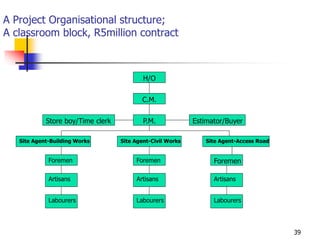
A Project Organisationalstructure;
A classroom block, R5million contract
39
H/O
C.M.
P.M.Store boy/Time clerk Estimator/Buyer
Site Agent-Building Works Site Agent-Civil Works Site Agent-Access Road
Foremen Foremen Foremen
Artisans
Labourers
Artisans
Labourers
Artisans
Labourers
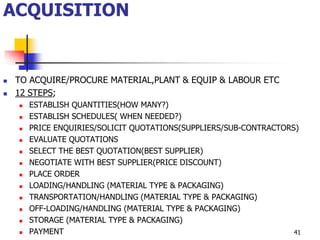
ACQUISITION
TO ACQUIRE/PROCUREMATERIAL,PLANT & EQUIP & LABOUR ETC
12 STEPS;
ESTABLISH QUANTITIES(HOW MANY?)
ESTABLISH SCHEDULES( WHEN NEEDED?)
PRICE ENQUIRIES/SOLICIT QUOTATIONS(SUPPLIERS/SUB-CONTRACTORS)
EVALUATE QUOTATIONS
SELECT THE BEST QUOTATION(BEST SUPPLIER)
NEGOTIATE WITH BEST SUPPLIER(PRICE DISCOUNT)
PLACE ORDER
LOADING/HANDLING (MATERIAL TYPE & PACKAGING)
TRANSPORTATION/HANDLING (MATERIAL TYPE & PACKAGING)
OFF-LOADING/HANDLING (MATERIAL TYPE & PACKAGING)
STORAGE (MATERIAL TYPE & PACKAGING)
PAYMENT 41
41.
DELEGATING
The managercan do everything
himself and make most of the
decisions or
He can assign as much as possible to
his people/team members.
42
42.
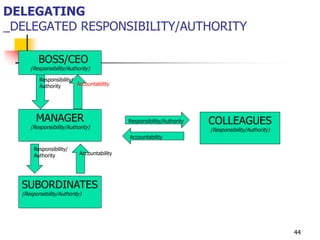
DELEGATING
Delegating isthe work a manager performs to entrust/assign to
others;
Responsibility; The work/decisions assigned to a position.
Authority; is the sum of the powers or rights necessary to do the work.
Centralised; Authority reserved at top levels of the
organisation.
Decentralised; Delegation of authority to the levels
where the work is performed.
Accountability; The obligation to perform responsibly and
exercise authority in terms of established performance
standards. (Results)
43
DELEGATING
Responsibility andauthority must be delegated
clearly and simultaneously
A manager's accountability can never safely be
delegated.
The Manager should reserve for himself only
those responsibilities which others cannot do
effectively for him.
45
45.
DELEGATING_EFFECTIVE CONTROLS
Establishperformance standards
Divisionalisation
The process of breaking large functional organisation units into divisions grouped in terms of
product, geography, or some other basis.
Dispersion: The physical separation of people, equipment and facilities.
Consolidation: The bringing together at one physical location of people, equipment and
facilities.
Single reporting relationships/Single line of Command
The more people who reports to a manager or to whom a manager reports, the less
accountable the person or the manager tends to become.
Individual accountability
46
46.
DELEGATING
_CHALLENGES/BARRIERS
Organisational barriers:Organisational policies
and methodologies
Psychological barriers;
Failure of the manager to understand what
type and volume of work he should delegate.
Management Style; Micro-managing
47
47.
TUTORIAL2;
RESEARCH
DISCUSS THEPHRASE “RESPONSIBILITY
WITHOUT AUTHORITY”
LIST THE DIFFERENCES BETWEEN
DELEGATING AND MICRO-MANAGING
WHICH ASPECT OF A MANAGER’S
RESPONSIBILITIES/DUTIES CAN BE
DELEGATED SAFELY TO OTHERS.
48
RELATIONSHIPS/TEAMWORK
_TEAM COMPOSITION
TEAM(KEY)
Manager, (Team leader)
subordinates,
Boss
Peers/Colleagues.
SUPPORT TEAM
Customers/Client
Suppliers/Service providers
Professional Advisors
Community
Regulators: DOL etc 51
51.
RELATIONSHIPS/TEAMWORK
_INTERNAL TEAM_ RELATIONSHIPS
Staff relationship(Cordial Relationships)
Relation amongst individuals who provide advice
and service in the accomplishment of objectives.
Line relationship(Command relationship).
Relationship amongst those persons who are
accountable for final results and therefore have
authority to make decisions with respect to those
results.
52
52.
RELATIONSHIPS/TEAMWORK
_BUILDING
ESTABLISH &COMMUNICATE CLEAR TEAMWORK
GOALS/OBJECTIVES
ESTABLISH RULES TO PROMOTE TEAMWORK
ESTABLISH TRUST AMONGST TEAM
MEMBERS.(TAKES TIME)
REGULAR TEAM MEETINGS/SOCIAL
GATHERINGS/TEAM EXERCISES/ACTIVITIES
REGULAR COMMUNICATION/INFORMATION SHARING
AMONGST TEAM MEMBERS
ENCOURAGE TEAM PROBLEM SOLVING
53
MANAGEMENT LEADERSHIP
Leadingis the energising function that
makes planning, control and organising
possible.
Leading is the work the manager
performs to get people to take required
action.
Leading is quite synonymous to driving
55
TUTORIAL2
_RESEARCH
NAME ANDDESCRIBE THE DIFFERENT
TYPES OF MANAGEMENT LEADERSHIP
WHAT IS THE DIFFERENCE BETWEEN A
MANAGER AND A LEADER?
58
58.
DECISION MAKING
_WHAT DOWE DO?
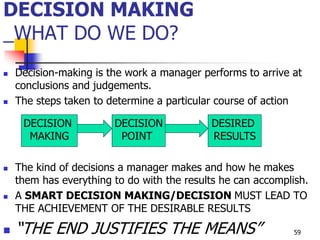
Decision-making is the work a manager performs to arrive at
conclusions and judgements.
The steps taken to determine a particular course of action
The kind of decisions a manager makes and how he makes
them has everything to do with the results he can accomplish.
A SMART DECISION MAKING/DECISION MUST LEAD TO
THE ACHIEVEMENT OF THE DESIRABLE RESULTS
“THE END JUSTIFIES THE MEANS” 59
DECISION
MAKING
DESIRED
RESULTS
DECISION
POINT
DECISION MAKING
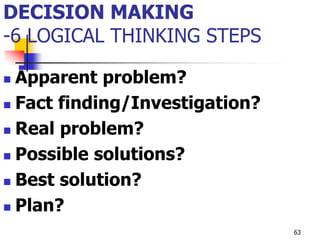
-6 LOGICALTHINKING STEPS
Apparent problem?
Fact finding/Investigation?
Real problem?
Possible solutions?
Best solution?
Plan?
63
63.
DECISION MAKING
_APPARENT PROBLEM?
OBSERVABLE SYMPTOMS/FRINGES OF THE
PROBLEM
SUPERFICIAL VIEW
TENTATIVE
EXAMPLES
HEADACHE
STOMACHE
STUDENTS ON STRIKE
FIRE OUTBREAK
ACCIDENT 64
64.
DECISION MAKING
_FACT FINDING/INVESTIGATIONS
FACTS?- WHAT?,HOW?,WHO?,WHERE?,WHEN?,WHY?
INTERPRETATION?
INFERENCES/CONCLUSIONS?
TAKES TIME AND EFFORT
TO SAVE TIME; Determine in advance what
information we really need, and in what priority we
require it.
THIS IS WHAT ESTABLISHES THE
BASIS/PRECEDENT OF THE DECISION MAKING
65
65.
DECISION MAKING
_FACTS?_ Situationfactors
What happened?
how did it happen?
Describe the situation
Obtain first hand evidence(not here
says/gossips) via;
visual observations of the situation,
interviews of several witnesses
with different/varied viewpoints66
66.
DECISION MAKING
_FACTS?_ CausativeFactors
Why did the problem occur?
Causative factors? Causes/Root Causes?
Causes/Root Causes;
Significance/importance to the situation?
(Does it matter?)
Constant or change in the future?
Obtain first hand evidence(not here says/gossips) via;
visual observations of the situation,
interviews of several witnesses with
different/varied viewpoints
67
67.
DECISION MAKING
_FACTS?_ PeopleFactors
Who is involved?
Behaviour of the people involved?;
Significance/importance to the situation?
Constant or change in the future?
Obtain first hand evidence(not here
says/gossips) via;
visual observations of the situation,
interviews of several witnesses with
different/varied viewpoints
68
68.
DECISION MAKING
_FACTS?_ PlaceFactors
Where did the problem occur?
Location /environment of the problem?( The
Culture)
Significance /Importance to the situation?
Constant or change in the future?
Obtain first hand evidence(not here says/gossips) via;
visual observations of the situation,
interviews of several witnesses with
different/varied viewpoints
69
69.
DECISION MAKING
_FACTS?_ TimeFactors
When did the situation occur?
Time factor and accompanied values etc;
Significance/Importance to the situation?
Obtain first hand evidence(not here
says/gossips) via;
visual observations of the situation,
interviews of several witnesses with
different/varied viewpoints
70
70.
DECISION MAKING
_What isthe real problem? Problem Statement?
Nature of the problem?
DEFINE THE KEY PROBLEM/UNDERLYING PROBLEM( CLEAR,CONCISE,STRAIGHT FORWARD
AND EASY TO UNDERSTAND)
BASIC FACTS( WHAT,HOW,WHO,WHERE,WHEN,WHY?)
EXTENT & SERIOUSNESS( WHY IT MATTERS?) WHY IS IT SUCH A BIG DEAL? SUPPORT WITH HARD EVIDENCE
HOW DOES IT RELATE/AFFECT THE FF?
Team (Key/Support)
Customers/Clients
Environment; Regulators/Competitors/Physical Environment
Public Image
Cost/Profit
ROOT CAUSES OF THE PROBLEM
TIMING : TEMPORAL/SHORT-TERM/LONG-TERM
RELATED/ASSOCIATED PROBLEMS
PROPOSE A POSSIBLE SOLUTION
BENEFITS OF THE SOLUTION
“A PROBLEM WELL-STATED IS A PROBLEM HALF-SOLVED” CHARLES
KETTERING
71
71.
EXAMPLE; PROBLEM STATEMENT
There is serious congestion of students in the
University’s hostels in recent years. The
university decided to house only first year
students in the schools hostel so as to reduce
congestion in the hostels. We know, however,
that only a year later, some first year students
do choose to share their rooms with continuing
students leading to congestion in the hostels.
The University must therefore rethink its
student housing policy. 72
72.
CLASS EXERCISE
PROBLEM STATEMENT:NSFAS?
WRITE A COMPLETE PROBLEM
STATEMENT ABOUT NSFAS INABILITY TO
SUPPORT THE EDUCATION OF ALL
QUALIFIED STUDENTS
73
73.
EXAMPLE: CASE STUDY_PROBLEM NOT
INVESTIGATED AND DEFINED
APPARENT PROBLEM
A Metalworking Company found its accident rate creeping up. costs for lost time,
machine stoppage and hospital care increasing.
QUICK DECISION
Company instituted a company-wide safety campaign; SAFETY POSTERS & SAFETY
TRAINING
RESULTS
Accidents still continued.
INVESTIGATION
Causes of the accidents;
29% of the accidents were occurring in one department using high speed machine
tools,
45% of the machine operators were "moonlighting". Taking temporary job offers
from competing metal working firms nearby offering a higher pay.
74
74.
DECISION MAKING
_POSSIBLE SOLUTIONS
HOW?
BRAINSTORMING_TEAM/PEOPLE INVOLVED
SUB-CONSCIOUS MIND_THINKING
OUTPUT
LIST OF POSSIBLE SOLUTIONS
ALWAYS ADD “DO-NOTHING” ALTERNATIVE TO
THE LIST
75
75.
DECISION MAKING
_BEST SOLUTION/DECISIONPOINT?
DECISION POINT; DECISION ON THE BEST SOLUTION.
DECIDER: MANAGER OR THE TEAM
HOW TO DECIDE: SOLE OR COLLECTIVE
TOOL: JUDGEMENT/OBJECTIVITY
HOW:
PROS & CONS OF EACH CHOICE
CHOOSE THE SOLUTION THAT WILL YIELD THE BEST RESULTS WITH
MIN.NEGATIVE IMPACTS/EFFECTS
BEST SOLUTION; PILOT TEST & CHECK THE RESULTS
IF RESULTS ARE POSITIVE; FULL SCALE IMPLEMENTATION
IF RESULTS ARE NEGATIVE; RECONSIDER/FURTHER SEARCH FOR
ANOTHER SOLUTION
76
76.
DECISION MAKING
_PLAN
DEVELOPA PLAN TO IMPLEMENT THE BEST
SOLUTION
Goal
Objectives
Programs/Actions
Scheduling /Timing of programs/actions
Budgeting of programs/actions
Policies/procedures
77
77.
GROUP TUTORIAL2
_DECISION MAKING
As the contracts manager/Site Agent you arrive on site after receiving a
message on the two-way radio in your car that the foreman has an
extremely urgent problem. You find the following situation after your
arrival:
The four conveyor belts to transport the concrete to the first floor slab to be
poured are all non-operational due to a labourer pouring diesel instead of
petrol into their tanks.
Two "Ready Mix Concrete" trucks waiting to offload their 6m3 load of 30MPa
concrete.
You have to make a quick decision. Keeping the steps of decision-making in
mind, summarise all the factors that you will have to consider in order to
make a decision and select then the decision you will most probably make.
78
78.
MOTIVATING
Motivation
Thework a manager performs to inspire,
encourage and impel people to take required
action
Motivation is the energiser for all the
management functions and activities
Motivating Skills
The ability to get people to perform or take a
required action 79
79.
MOTIVATION
_INSPIRE
Inspire -to infuse a spirit of willingness consciously
or unconsciously into people to perform most
effectively.
Achieved thru the ff:
Leader personality,
Leadership style,
80
MOTIVATION_IMPEL
Impel
Toforce or incite action by any means
necessary.
Achieved thru:
Compulsion,
Coercion
Fear.
82
82.
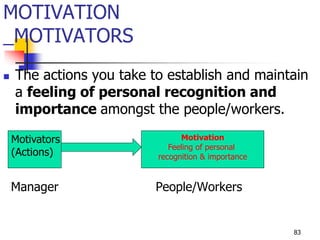
MOTIVATION
_MOTIVATORS
The actionsyou take to establish and maintain
a feeling of personal recognition and
importance amongst the people/workers.
Manager People/Workers
83
Motivators
(Actions)
Motivation
Feeling of personal
recognition & importance
83.
Motivators
the opportunityfor personal development
achievement
recognition
promotion
levels of responsibility. etc
84
84.
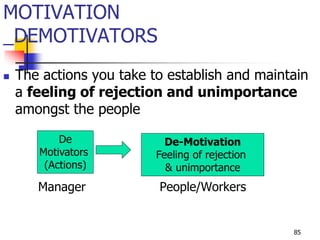
MOTIVATION
_DEMOTIVATORS
The actionsyou take to establish and maintain
a feeling of rejection and unimportance
amongst the people
Manager People/Workers
85
De
Motivators
(Actions)
De-Motivation
Feeling of rejection
& unimportance
85.
De-motivators
company policymay frustrate some employees and be
viewed to some as a hindrance
bureaucracy or needless paperwork may be
considered to be a barrier to getting a job completed
Poor working conditions may be poor salary
staff feeling they are not valued nor consulted.
86
86.
MOTIVATION
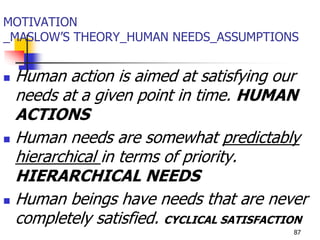
_MASLOW’S THEORY_HUMAN NEEDS_ASSUMPTIONS
Human action is aimed at satisfying our
needs at a given point in time. HUMAN
ACTIONS
Human needs are somewhat predictably
hierarchical in terms of priority.
HIERARCHICAL NEEDS
Human beings have needs that are never
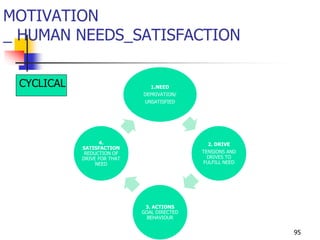
completely satisfied. CYCLICAL SATISFACTION
87
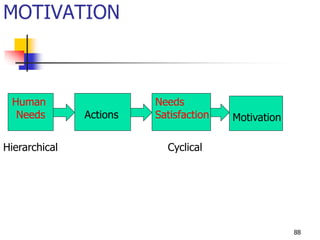
MOTIVATION
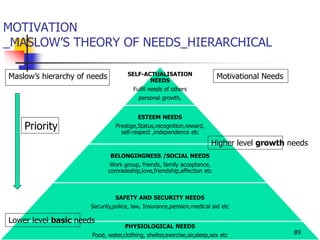
_MASLOW’S THEORY OFNEEDS_HIERARCHICAL
SELF-ACTUALISATION
NEEDS
Fulfil needs of others
personal growth,
ESTEEM NEEDS
Prestige,Status,recognition,reward,
self-respect ,independence etc
BELONGINGNESS /SOCIAL NEEDS
Work group, friends, family acceptance,
comradeship,love,friendship,affection etc
SAFETY AND SECURITY NEEDS
Security,police, law, Insurance,pension,medical aid etc
PHYSIOLOGICAL NEEDS
Food, water,clothing, shelter,exercise,air,sleep,sex etc 89
Maslow’s hierarchy of needs Motivational Needs
Higher level growth needs
Lower level basic needs
Priority
89.
CLASS EXERCISE
STUDENTSTO IDENTIFY THEIR
LEVEL OF NEEDS IN THE HIERARCHY
IS A CELL PHONE A NEED OR A
WANT?
IF IT IS A NEED WHERE WILL YOU
PLACE IT IN THE MASLOW’S
HIERARCHY.
90
90.
MOTIVATION
_ MANAGEMENT LESSONS
Workers actions is aimed at satisfying
their needs at a given point in time.
Workers needs can never be completely
satisfied. When one need is fulfilled a
person seeks to fulfil the next one and so
on.
Workers needs are hierarchical in terms of
priority.(Needs profile)
91
91.
MOTIVATION
_ MANAGEMENT LESSONS
OUR NEEDS CHANGE OR EVOLVE WITH
TIME IN TERMS OF IMPORTANCE.
SO OUR NEEDS ARE STATED FOR A
PARTICULAR TIME
92
92.
MOTIVATION
_ MANAGEMENT RESPONSE
Workers can be motivated to take the required
action once their needs are satisfied.
Assess and categorise the needs profile of
your workers
Satisfy the needs according to the needs profile
category
Satisfy first the bottom needs of your workers
before you move to the top needs
93
93.
MOTIVATION
_ MANAGEMENT RESPONSE
One must satisfy the lower level basic needs
before progressing to meet higher level growth
needs
Once these two levels are reasonably satisfied
one may be able to reach the highest level of
self-actualisation.
94
MOTIVATION
_ HUMAN NEEDS_SATISFACTION
The deficiency/unmet basic needs are said to drive people to
fulfil that need. Also the drive to fulfil such needs will become
stronger the longer the duration they are denied eg. The longer
a person goes without food the more hungry they will become.
In the drive to fulfil this unmet basic need he takes actions that
are focused on fulfilling this basic need and in so doing the
need is satisfied and the drive to fulfil that need is lowered.
Once that need is fulfilled a person seeks to fulfil the next one
in the hierarchy and so on.
96
96.
MOTIVATION
_ MANAGEMENT RESPONSE
The drive to fulfil basic needs are stronger with
people who have been denied these basic
needs for a long time eg.poverty-stricken
people,prisoners,slaves,
unemployed,youth,women,disabled etc.
Assess and categorise the drive of your
workers
Channel those with the stronger drive into goal-
oriented actions that will fulfil these needs.
97
97.
MOTIVATION_FACTORS
Participation(Problem Solving,decision making)
Communication(Work progress/achievements)
Recognition( Outstanding/exceptional work)
Promotion
Appreciation/Reward( Incentive schemes, Bonus schemes etc)
Welfare( Life Insurance,pension,medical aid,PF)
Personal growth (standard of living)
Work Achievements(Assessment/feedback)
Flexibility(Work-Life balance)
Empowerment (Own decision-making/Innovativeness/Creativity)
Financial perks and benefits( free lunch, subsidise school fees etc)
98
1. Knowing yourpeople
Identify special needs,motivational needs
Method: observation,
study,interviews,personal relationships etc
Caution: Information obtained is confidential
and must be treated as such. No Gossip!
Downside: False information
100
100.
2. Developing afeeling of proprietorship/Ownership,
Create opportunities/environment
for the ff:
Participation.
Communication(work
progress/achievements)
Empowerment(Own decision-
making/Innovativeness)
Develop needed knowledge and skills.101
101.
3. Encouraging Teamwork/Teamfeeling,
Work groups,task forces,committees etc
Frequent discussions on the job,
meetings, counselling and coaching to
improve skills and other job-related
activities
Group Assignments & Tutorials
102
102.
4.Developing a friendlycompetition_Subordinates
Create a competitive situation
Competition to be fair and equitable.
Competitors create their own ground rules.
Reward & appreciate more winners(prize
money, promotion, recognition, praise, etc.)
Organise another competition for the losers
103
103.
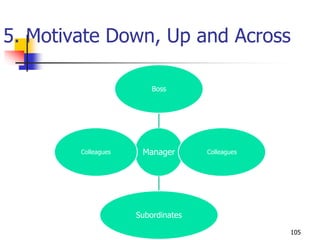
5. Motivate Down,Up and Across
Boss
Method: participation and communication,recognition &
appreciation
Line Managers
Method: participation and communication,recognition &
appreciation
Subordinates
Method: participation and communication,recognition &
appreciation
104
104.
5. Motivate Down,Up and Across
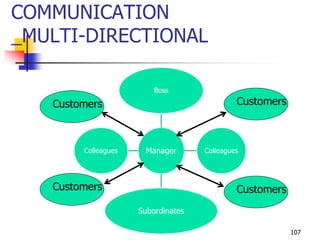
105
Manager
Boss
Colleagues
Subordinates
Colleagues
COMMUNICATION
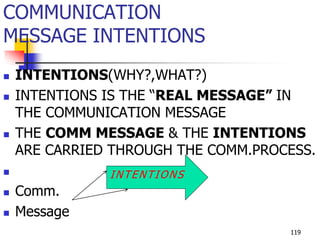
_COMM. MESSAGE
COMMUNICATIONMESSAGE
(CARRY OUR IDEAS,THOUGHTS)
EXAMPLE;
A : GIVE ME YOUR SHOES
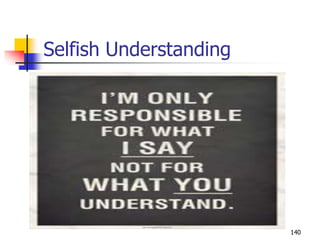
B: WHY SHOULD I GIVE U MY SHOES?
WHAT DO YOU NEED IT FOR?
118
COMMUNICATION
_GOAL/PURPOSE
TO SEEKTO ACHIEVE A SHARED/COMMON UNDERSTANDING
OF THE INTENTIONS
“GET THE REAL MESSAGE ACROSS”
“BEING ON THE SAME PAGE”
GET THE EMOTIONAL/LOGICAL MEANING BEHIND THE
WORDS,SIGNS AND SYMBOLS
HEAD/HEART MUST UNDERSTAND THE MESSAGE
THE MEETING OF THE MINDS
EFFECTIVE COMMUNICATION
120
120.
COMMUNICATION
_DEFINED
The workthe Sender/Receiver
performs to create
shared/Common understanding of
the message INTENTIONS.
WHAT I SAID & WHAT I MEANT
WHAT I MEANT IS THE MESSAGE
INTENTIONS
121
121.
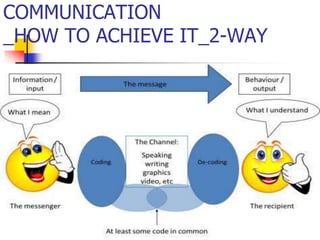
COMMUNICATION
_HOW TO ACHIEVEIT_2-WAY
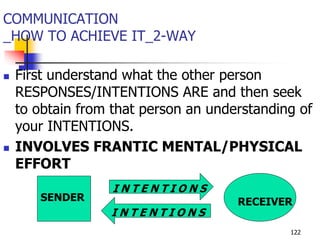
First understand what the other person
RESPONSES/INTENTIONS ARE and then seek
to obtain from that person an understanding of
your INTENTIONS.
INVOLVES FRANTIC MENTAL/PHYSICAL
EFFORT
122
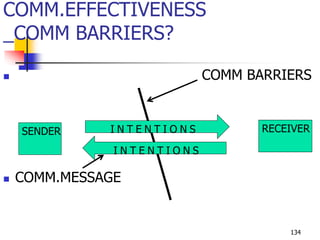
SENDER
I N T E N T I O N S
I N T E N T I O N S
RECEIVER
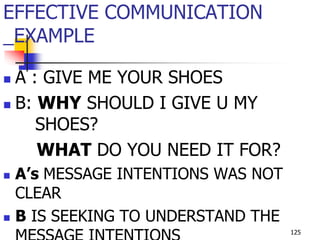
EFFECTIVE COMMUNICATION
_EXAMPLE
A: GIVE ME YOUR SHOES
B: WHY SHOULD I GIVE U MY
SHOES?
WHAT DO YOU NEED IT FOR?
A’s MESSAGE INTENTIONS WAS NOT
CLEAR
B IS SEEKING TO UNDERSTAND THE
125
INEFFECTIVE COMMUNICATION
_SPOKEN WORD_EXAMPLES
LECTURER;CHECK THE TIME EVERY 30 MINS.
CLASS PRESIDENT; YES SIR
DOES THE CLASS PRESIDENT UNDERSTAND
THE INTENTIONS OF THE MESSAGE?
WAS THIS INTENTION CLEAR IN THE
MESSAGE TRANSMITTED?
CLASS PRESIDENT MUST SEEK TO
UNDERSTAND THE MESSAGE INTENTIONS
130
130.
INEFFECTIVE COMMUNICATION
_SIGNS/ACTIONS_EXAMPLES
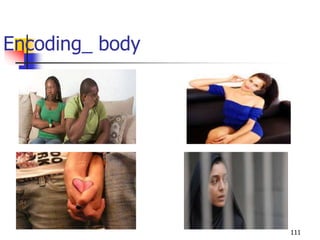
ASTUDENT BOY BUYS A MOBILE PHONE AND
SENDS IT TO A LADY FRIEND IN CLASS
STUDENT BOY’S INTENTIONS:
FRIENDSHIP,LOVING RELATIONSHIP,HELPFUL
?
DOES THIS LADY KNOW WHAT HIS
INTENTIONS ARE?
WAS HIS INTENTIONS CLEAR? 131
131.
INEFFECTIVE COMMUNICATION
_WRITTEN_EXAMPLE
YOU:“GET ME SOME WATER”
FRIEND; OK
ARE YOUR INTENTIONS CLEAR IN THIS
COMM. MESSAGE?
DID THE FRIEND SEEK TO UNDERSTAND THE
MESSAGE INTENTIONS?
132
132.
INEFFECTIVE COMMUNICATION
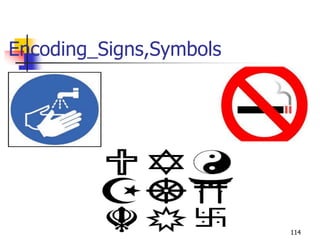
_SIGNS_EXAMPLE
ANENGLISH CUSTOMER IN A GERMAN
RESTAURANT
CUSTOMER INTENTIONS: WANTS A
MUSHROOM AND CANNOT SPEAK GERMAN
CUSTOMER; DREW A MUSHROOM ON A
PIECE OF PAPER AND GAVE IT TO THE
WAITRESS
WAITRESS; RETURNED WITH AN UMBRELLA
133
COMM.SKILLS
_COMMUNICATION IMPROVEMENT
Geta feedback/Response
Finding out what people understand
Get a full response
Conduct follow-up questions/tests
what, where, when, who, why, or how?
144
144.
COMM.SKILLS
_COMMUNICATION IMPROVEMENT
Helpingpeople to remember what they
understand
Repetition of the comm.message in different
ways
Get people associated with the ideas in the
comm.message
145
145.
SELECTING PEOPLE
Theselection of people for;
Vacant positions
Promotion
in the organisation.
146
146.
SELECTING PEOPLE
_THE PROCESS
Planning personnel/staff needs over the long term.
Job organisation; place of work,accomodation,car,office,tools,protective clothing etc
A qualification specification; characteristics of the person desired.
Qualifications/Experience
Job Candidate Search; Advert,Direct contacts, Recruiting Agencies, Professional
Associations,Social Network etc.
Solicite applications from job candidates; cvs and cover letters,certificates etc
Review job applications; candidate suitability
investigate previous job history, qualifications, physical examination, check
references etc
Interviews; administer psychological tests, conduct preliminary interviews, final
interviews
Job Candidate Selection & Appointment
Job follow-up so that the person selected will fit properly and will be assured of a
satisfying place on his new team.
147
147.
DEVELOPING PEOPLE
Developingpeople is the work a manager
performs to help people improve their;
Knowledge: cognisance of facts, truths and
other information.
Attitude: reaction to things, people, situation
and information.
Skill: the ability to put knowledge into
practice.
148
DEVELOPING PEOPLE
_PROCESS
Staffperformance appraisal,
Evaluation of current performance and potential for advancement.
Purpose; Identify Strengths and Weaknesses
Method; A group basis/an appraisal form
Counselling;
Recognise their strengths and weaknesses
Plan & Implement personal improvement.
Coaching/Mentorship on the job,
Job rotation,
Attendance of courses and seminars,
Committee/team participation.
151
151.
CONTROLLING
Consists ofseeing to it that performance is
happening according to;
the PLAN that has been adopted,
the ORDERS/PROCEDURES which have
been given,
The PRINCIPLES/POLICIES/
GUIDELINES which have been given/ laid
down.
152
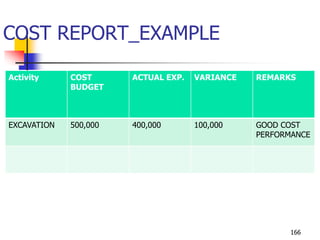
EXAMPLES
COST BUDGET;R1 MILLION
ACTUAL EXPENDITURE; R1.2 MILLION
BUDGET DEVIATION/VARIANCE;(R200,000)
QUALITY CRITERIA; 100 +/- 10mm slump
QUALITY TEST(SLUMP TEST RESULTS): 70mm
QUALITY DEVIATION/VARIANCE; (30mm)
THIS HAS TO BE CORRECTED AND PREVENTED155
155.
CONTROLLING_ACTIVITIES
Performance Standards/Targets:Establishing
standards of performance
Performance Measurement; Measuring current
performance
Performance Evaluation; Comparing/Evaluate
current performance with the established standard of
performance
Performance Correction; Taking corrective action if
a deviation in performance is detected.
156
SETTING PERFORMANCE STANDARD
_GOAL
SET PERFORMANCE STANDARDS
TO IDENTIFY GOOD/POOR/FAILED PERFORMANCE
TO CORRECT/IMPROVE POOR
PERFORMANCE
TO REWARD GOOD PERFORMANCE
NOT FOR PUNISHMENT/SCAPE GOATS
158
158.
PERFORMANCE STANDARDS
Theperformance standard tells
a manager where he should be.
Performance Targets
159
159.
PERFORMANCE STANDARDS
_EXAMPLES
EGS.OFPERFORMANCE STANDARD.
40% PASS MARK FOR DP
40% PASS MARK FOR EXAMS
SANS 241- QUALITY PERFORMANCE
STANDARD FOR DRINKING WATER
160
160.
SETTING PERFORMANCE STANDARDS
_2 CHALLENGES
Psychological challenge;
Understood and accepted by those to be affected.
Opportunity to contribute their ideas
Technical challenge;
Realistic/Achievable as far as the time,cost, quantity and quality
is concerned
Test the adequacy of the method/process being used in the
work
161
PERFORMANCE STANDARDS
_3 KEYPRINCIPLES
Psychology.
The acceptance of standards
Correct performance failures/reward good
performance( Individual/Group)
Total Standards
Standards are necessary for both methods/process and
products/results
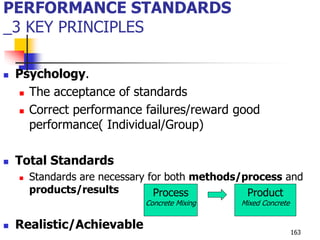
Realistic/Achievable 163
Process
Concrete Mixing
Product
Mixed Concrete
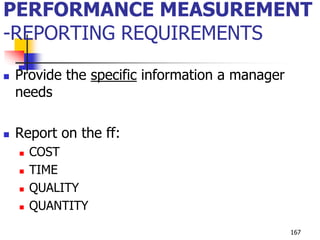
PERFORMANCE MEASUREMENT
-REPORTING_PURPOSE
Measureand report actual
performance against established
performance standards
The reports tell us where we are in
performance.
PM Methods: Tests and Inspections
165
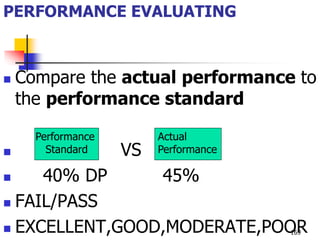
PERFORMANCE EVALUATING
Comparethe actual performance to
the performance standard
VS
40% DP 45%
FAIL/PASS
EXCELLENT,GOOD,MODERATE,POOR169
Performance
Standard
Actual
Performance
PERFORMANCE EVALUATING
_REQUIREMENTS
Checksand Balances/Fairness;
seek independent viewpoint of the person on higher
level or outside the organisation.
EXAM MODERATOR
YOU CAN EVALUATE YOUR OWN WORK AND
CORRECT YOURSELF. BUT SELF-CONTROL IS A
CHALLENGE IN PERFORMANCE EVALUATION;
LIES, ERRORS,CHEATING ETC.
171
171.
PERFORMANCE EVALUATING
_PRINCIPLES
MajorExceptions/Variations Not Routine
Variations.
Determine allowable limits of tolerance/
deviation. Eg. +/-10mm
Measure against standards and not by
tolerances.
172
172.
PERFORMANCE CORRECTING
Thefinal step in control is to take
corrective action.
Performance correcting is the work a
manager performs to improve and
regulate methods and results.
173
PERFORMANCE CORRECTING_PROBLEMS
Avoidself-criticism.
Provide for self-correction.
Correct first thing first. focus on
critical activities first in the corrective
action.
Overcome emotional resistance.
participation and communication.
175