Welcome to Adobe Connect: Using trace data
or subjective data, that is the question during
Covid19"
While we are waiting for everyone to join, could you indicate in the
chat:
1) Who are you?
2) Why are you here?
3) What are your expectations for today?
Using trace data or
subjective data, that is the
question during Covid19
Prof Bart Rienties
14 July 2020
Welcome to Adobe Connect: Using trace data
or subjective data, that is the question during
Covid19"
While we are waiting for everyone to join, could you indicate in the
chat:
1) Who are you?
2) Why are you here?
3) What are your expectations for today?
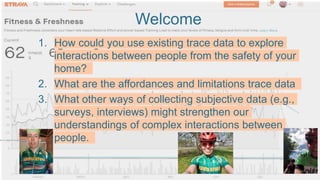
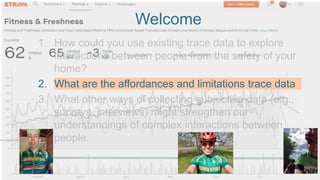
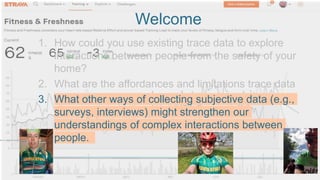
Welcome
1. How could you use existing trace data to explore
interactions between people from the safety of your
home?
2. What are the affordances and limitations trace data
3. What other ways of collecting subjective data (e.g.,
surveys, interviews) might strengthen our
understandings of complex interactions between
people.
Luke Harding (2020) Spy vs Spy. 3 July 2020. Guardian Weekly.
So what types of trace & existing
data might you use?
Types of trace and existing data
Readily available data
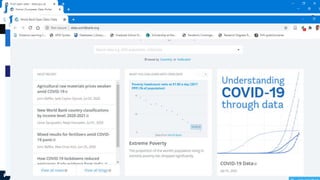
• Open data sets
• Policy documents
• Analytics data
 Discussion forums
 Chat
 Log data
 Etc.
Extracted/generated data (from
data made available from existing
research studies)
• Assessment data
• Eye-tracking
• Interviews
• Observations
• Psychometric instruments
• Purposefully collected log data
• Surveys
• Wearables
• Etc
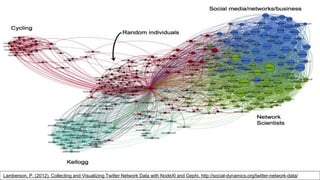
Lamberson, P. (2012). Collecting and Visualizing Twitter Network Data with NodeXl and Gephi. http://social-dynamics.org/twitter-network-data/
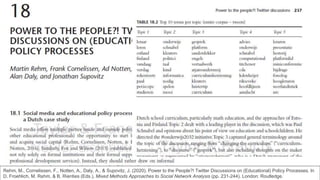
Rehm, M., Cornelissen, F., Notten, A., Daly, A., & Supovitz, J. (2020). Power to the People?! Twitter Discussions on (Educational) Policy Processes. In
D. Froehlich, M. Rehm, & B. Rienties (Eds.), Mixed Methods Approaches to Social Network Analysis (pp. 231-244). London: Routledge.
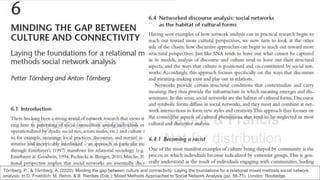
Törnberg, P., & Törnberg, A. (2020). Minding the gap between culture and connectivity: Laying the foundations for a relational mixed methods social network
analysis. In D. Froehlich, M. Rehm, & B. Rienties (Eds.), Mixed Methods Approaches to Social Network Analysis (pp. 58-71). London: Routledge.
Welcome
1. How could you use existing trace data to explore
interactions between people from the safety of your
home?
2. What are the affordances and limitations trace data
3. What other ways of collecting subjective data (e.g.,
surveys, interviews) might strengthen our
understandings of complex interactions between
people.
So what might be the affordances and
limitations of such approaches?
Main affordances
1. You don’t need to leave the house 
2. Access to large and rich data, possibly from multiple contexts and settings
3. Most data sets will be nicely “cleaned up”
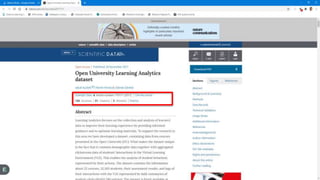
4. You can follow the steps from the first authors and learn to “replicate”, and develop
new skills (e.g., new statistical methods, software packages)
5. You can validate or contradict their results with different research questions,
approaches, ideas (see for example OU Analyse data set)
6. You can build on scientific community and contribute to the robustness of research
findings
Quantitative research done well is quicker
to analyse and write-up
1. Quantitative data analysis is “relatively”
straightforward
1. Follows clear established protocols
2. If you don’t have specific quant skills, you
can learn (YouTube) or ask others (hire a
statistical expert )
3. Analyses can be tested and verified by
others ( validity, reliability, generalisability)
You will have an easier time at the viva
1. Assuming that you have done the analyses
well, it is difficult for examiners to critique your
approach and findings
2. Most questions during viva will focus on the
design of your tasks/study, rather than how
you might have (mis)interpreted
qualitative/sloppy/tentative data
Main limitations
1. What is your new contribution to knowledge?
2. What is the significance of your contribution?
3. Perhaps the best elements of the research
study have already been published? (i.e.,
there is only one winner)
4. Difficulty to link anonymous data with new
data sources
Welcome
1. How could you use existing trace data to explore
interactions between people from the safety of your
home?
2. What are the affordances and limitations trace data
3. What other ways of collecting subjective data (e.g.,
surveys, interviews) might strengthen our
understandings of complex interactions between
people.
What other ways of collecting subjective data might
strengthen our understandings of complex
interactions between people
Options for subjective data gathering
during COVID
• (Follow-up) surveys
• Follow-up interviews and/or focus groups (e.g.,
via Skype, MS teams, Zoom)
• Critical reflection events
• Diaries
• Blogs/Vlogs
• Podcasts
Using trace data or
subjective data, that is the
question during Covid19
Prof Bart Rienties
14 July 2020
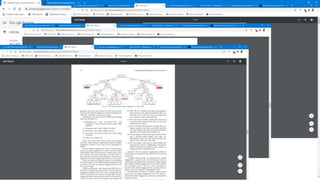
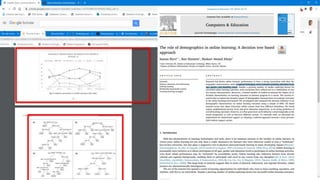
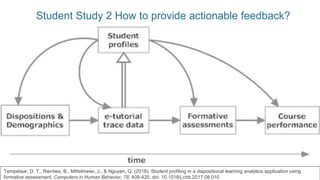
Student Study 2 How to provide actionable feedback?
Tempelaar, D. T., Rienties, B., Mittelmeier, J., & Nguyen, Q. (2018). Student profiling in a dispositional learning analytics application using
formative assessment. Computers in Human Behavior, 78, 408-420. doi: 10.1016/j.chb.2017.08.010
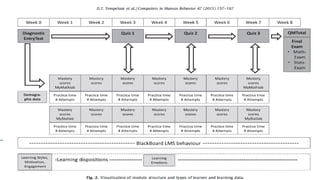
Tempelaar, D. T., Rienties, B., & Giesbers, B. (2015). In search for the most informative data for feedback generation: Learning Analytics in a data-rich context.
Computers in Human Behavior, 47, 157-167
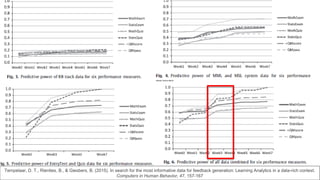
Tempelaar, D. T., Rienties, B., & Giesbers, B. (2015). In search for the most informative data for feedback generation: Learning Analytics in a data-rich context.
Computers in Human Behavior, 47, 157-167
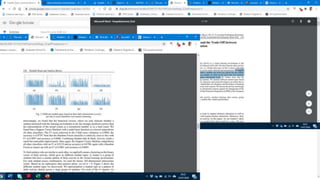
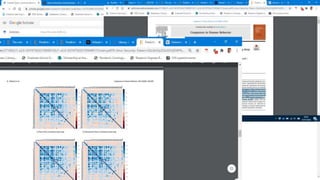
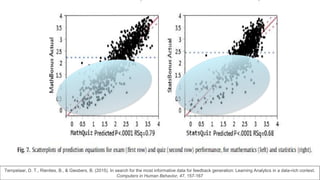
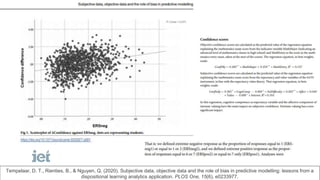
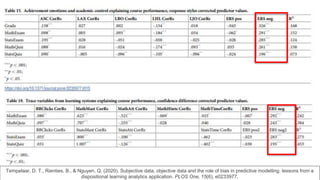
Tempelaar, D. T., Rienties, B., & Nguyen, Q. (2020). Subjective data, objective data and the role of bias in predictive modelling: lessons from a
dispositional learning analytics application. PLOS One, 15(6), e0233977.
Tempelaar, D. T., Rienties, B., & Nguyen, Q. (2020). Subjective data, objective data and the role of bias in predictive modelling: lessons from a
dispositional learning analytics application. PLOS One, 15(6), e0233977.

Lecture series: Using trace data or subjective data, that is the question during Covid19

  • 1.
    Welcome to AdobeConnect: Using trace data or subjective data, that is the question during Covid19" While we are waiting for everyone to join, could you indicate in the chat: 1) Who are you? 2) Why are you here? 3) What are your expectations for today?
  • 2.
    Using trace dataor subjective data, that is the question during Covid19 Prof Bart Rienties 14 July 2020
  • 3.
    Welcome to AdobeConnect: Using trace data or subjective data, that is the question during Covid19" While we are waiting for everyone to join, could you indicate in the chat: 1) Who are you? 2) Why are you here? 3) What are your expectations for today?
  • 4.
    Welcome 1. How couldyou use existing trace data to explore interactions between people from the safety of your home? 2. What are the affordances and limitations trace data 3. What other ways of collecting subjective data (e.g., surveys, interviews) might strengthen our understandings of complex interactions between people.
  • 5.
    Luke Harding (2020)Spy vs Spy. 3 July 2020. Guardian Weekly.
  • 6.
    So what typesof trace & existing data might you use?
  • 7.
    Types of traceand existing data Readily available data • Open data sets • Policy documents • Analytics data  Discussion forums  Chat  Log data  Etc. Extracted/generated data (from data made available from existing research studies) • Assessment data • Eye-tracking • Interviews • Observations • Psychometric instruments • Purposefully collected log data • Surveys • Wearables • Etc
  • 14.
    Lamberson, P. (2012).Collecting and Visualizing Twitter Network Data with NodeXl and Gephi. http://social-dynamics.org/twitter-network-data/
  • 15.
    Rehm, M., Cornelissen,F., Notten, A., Daly, A., & Supovitz, J. (2020). Power to the People?! Twitter Discussions on (Educational) Policy Processes. In D. Froehlich, M. Rehm, & B. Rienties (Eds.), Mixed Methods Approaches to Social Network Analysis (pp. 231-244). London: Routledge.
  • 16.
    Törnberg, P., &Törnberg, A. (2020). Minding the gap between culture and connectivity: Laying the foundations for a relational mixed methods social network analysis. In D. Froehlich, M. Rehm, & B. Rienties (Eds.), Mixed Methods Approaches to Social Network Analysis (pp. 58-71). London: Routledge.
  • 17.
    Welcome 1. How couldyou use existing trace data to explore interactions between people from the safety of your home? 2. What are the affordances and limitations trace data 3. What other ways of collecting subjective data (e.g., surveys, interviews) might strengthen our understandings of complex interactions between people.
  • 18.
    So what mightbe the affordances and limitations of such approaches?
  • 19.
    Main affordances 1. Youdon’t need to leave the house  2. Access to large and rich data, possibly from multiple contexts and settings 3. Most data sets will be nicely “cleaned up” 4. You can follow the steps from the first authors and learn to “replicate”, and develop new skills (e.g., new statistical methods, software packages) 5. You can validate or contradict their results with different research questions, approaches, ideas (see for example OU Analyse data set) 6. You can build on scientific community and contribute to the robustness of research findings
  • 20.
    Quantitative research donewell is quicker to analyse and write-up 1. Quantitative data analysis is “relatively” straightforward 1. Follows clear established protocols 2. If you don’t have specific quant skills, you can learn (YouTube) or ask others (hire a statistical expert ) 3. Analyses can be tested and verified by others ( validity, reliability, generalisability)
  • 21.
    You will havean easier time at the viva 1. Assuming that you have done the analyses well, it is difficult for examiners to critique your approach and findings 2. Most questions during viva will focus on the design of your tasks/study, rather than how you might have (mis)interpreted qualitative/sloppy/tentative data
  • 22.
    Main limitations 1. Whatis your new contribution to knowledge? 2. What is the significance of your contribution? 3. Perhaps the best elements of the research study have already been published? (i.e., there is only one winner) 4. Difficulty to link anonymous data with new data sources
  • 23.
    Welcome 1. How couldyou use existing trace data to explore interactions between people from the safety of your home? 2. What are the affordances and limitations trace data 3. What other ways of collecting subjective data (e.g., surveys, interviews) might strengthen our understandings of complex interactions between people.
  • 24.
    What other waysof collecting subjective data might strengthen our understandings of complex interactions between people
  • 25.
    Options for subjectivedata gathering during COVID • (Follow-up) surveys • Follow-up interviews and/or focus groups (e.g., via Skype, MS teams, Zoom) • Critical reflection events • Diaries • Blogs/Vlogs • Podcasts
  • 26.
    Using trace dataor subjective data, that is the question during Covid19 Prof Bart Rienties 14 July 2020
  • 27.
    Student Study 2How to provide actionable feedback? Tempelaar, D. T., Rienties, B., Mittelmeier, J., & Nguyen, Q. (2018). Student profiling in a dispositional learning analytics application using formative assessment. Computers in Human Behavior, 78, 408-420. doi: 10.1016/j.chb.2017.08.010
  • 29.
    Tempelaar, D. T.,Rienties, B., & Giesbers, B. (2015). In search for the most informative data for feedback generation: Learning Analytics in a data-rich context. Computers in Human Behavior, 47, 157-167
  • 30.
    Tempelaar, D. T.,Rienties, B., & Giesbers, B. (2015). In search for the most informative data for feedback generation: Learning Analytics in a data-rich context. Computers in Human Behavior, 47, 157-167
  • 31.
    Tempelaar, D. T.,Rienties, B., & Nguyen, Q. (2020). Subjective data, objective data and the role of bias in predictive modelling: lessons from a dispositional learning analytics application. PLOS One, 15(6), e0233977.
  • 32.
    Tempelaar, D. T.,Rienties, B., & Nguyen, Q. (2020). Subjective data, objective data and the role of bias in predictive modelling: lessons from a dispositional learning analytics application. PLOS One, 15(6), e0233977.

Editor's Notes

  • #2 Bart to welcome till slide 5
  • #4 Bart to welcome till slide 5